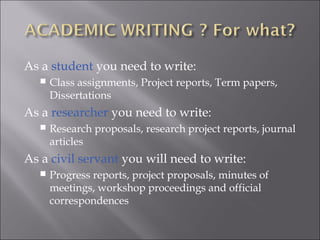
As a student you need to write:
 Class assignments, Project reports, Term papers,
Dissertations
As a researcher you need to write:
 Research proposals, research project reports, journal
articles
As a civil servant you will need to write:
 Progress reports, project proposals, minutes of
meetings, workshop proceedings and official
correspondences
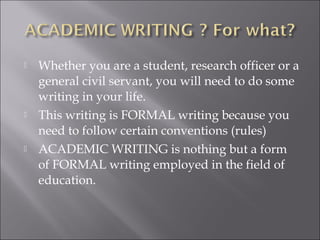
 Whether you are a student, research officer or a
general civil servant, you will need to do some
writing in your life.
 This writing is FORMAL writing because you
need to follow certain conventions (rules)
 ACADEMIC WRITING is nothing but a form
of FORMAL writing employed in the field of
education.
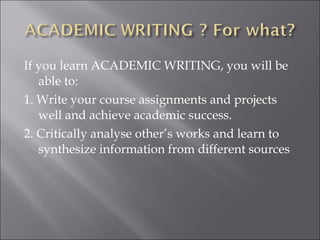
If you learn ACADEMIC WRITING, you will be
able to:
1. Write your course assignments and projects
well and achieve academic success.
2. Critically analyse other’s works and learn to
synthesize information from different sources
 Principles of good writing
 How to do a literature review?
 Extract and synthesize relevant information
 Citing and referencing
 Note taking and summarizing skills
 Reading skills and strategies
 Writing skills
 Conventions of Academic Writing
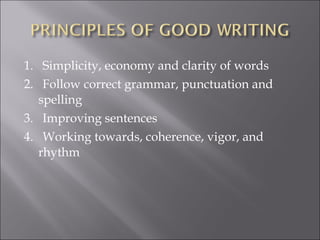
1.   Simplicity, economy and clarity of words
2.   Follow correct grammar, punctuation and
spelling
3.   Improving sentences
4.   Working towards, coherence, vigor, and
rhythm
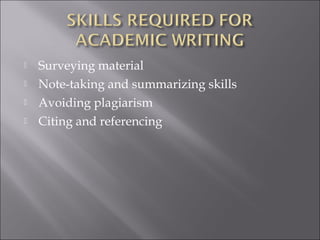
 Surveying material
 Note-taking and summarizing skills
 Avoiding plagiarism
 Citing and referencing
 Predicting
 Skimming
 Scanning
 Detailed reading
 Guessing unknown words
 Understanding main ideas
 Inferring
 Understanding text organization
 Assessing a writer’s purpose
 Evaluating a writer’s purpose
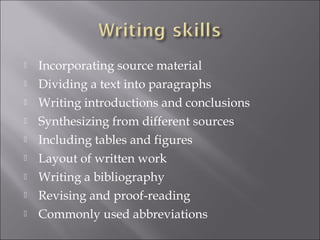
 Incorporating source material
 Dividing a text into paragraphs
 Writing introductions and conclusions
 Synthesizing from different sources
 Including tables and figures
 Layout of written work
 Writing a bibliography
 Revising and proof-reading
 Commonly used abbreviations
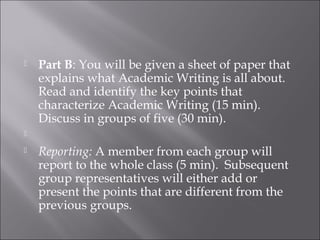
 Part B: You will be given a sheet of paper that
explains what Academic Writing is all about.
Read and identify the key points that
characterize Academic Writing (15 min).
Discuss in groups of five (30 min).
  
 Reporting: A member from each group will
report to the whole class (5 min). Subsequent
group representatives will either add or
present the points that are different from the
previous groups.
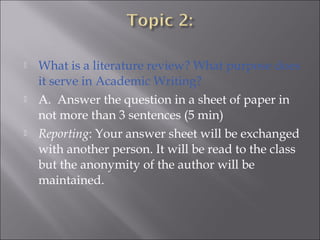
 What is a literature review? What purpose does
it serve in Academic Writing?
 A.  Answer the question in a sheet of paper in
not more than 3 sentences (5 min)
 Reporting: Your answer sheet will be exchanged
with another person. It will be read to the class
but the anonymity of the author will be
maintained.
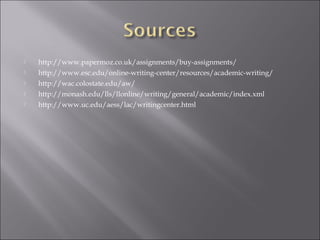
 http://www.papermoz.co.uk/assignments/buy-assignments/
 http://www.esc.edu/online-writing-center/resources/academic-writing/
 http://wac.colostate.edu/aw/
 http://monash.edu/lls/llonline/writing/general/academic/index.xml
 http://www.uc.edu/aess/lac/writingcenter.html

Essentials of Academic Writing

  • 2.
    As a studentyou need to write:  Class assignments, Project reports, Term papers, Dissertations As a researcher you need to write:  Research proposals, research project reports, journal articles As a civil servant you will need to write:  Progress reports, project proposals, minutes of meetings, workshop proceedings and official correspondences
  • 3.
     Whether youare a student, research officer or a general civil servant, you will need to do some writing in your life.  This writing is FORMAL writing because you need to follow certain conventions (rules)  ACADEMIC WRITING is nothing but a form of FORMAL writing employed in the field of education.
  • 4.
    If you learnACADEMIC WRITING, you will be able to: 1. Write your course assignments and projects well and achieve academic success. 2. Critically analyse other’s works and learn to synthesize information from different sources
  • 5.
     Principles ofgood writing  How to do a literature review?  Extract and synthesize relevant information  Citing and referencing  Note taking and summarizing skills  Reading skills and strategies  Writing skills  Conventions of Academic Writing
  • 6.
    1.   Simplicity, economyand clarity of words 2.   Follow correct grammar, punctuation and spelling 3.   Improving sentences 4.   Working towards, coherence, vigor, and rhythm
  • 7.
     Surveying material Note-taking and summarizing skills  Avoiding plagiarism  Citing and referencing
  • 8.
     Predicting  Skimming Scanning  Detailed reading  Guessing unknown words  Understanding main ideas  Inferring  Understanding text organization  Assessing a writer’s purpose  Evaluating a writer’s purpose
  • 9.
     Incorporating sourcematerial  Dividing a text into paragraphs  Writing introductions and conclusions  Synthesizing from different sources  Including tables and figures  Layout of written work  Writing a bibliography  Revising and proof-reading  Commonly used abbreviations
  • 10.
     Part B:You will be given a sheet of paper that explains what Academic Writing is all about. Read and identify the key points that characterize Academic Writing (15 min). Discuss in groups of five (30 min).     Reporting: A member from each group will report to the whole class (5 min). Subsequent group representatives will either add or present the points that are different from the previous groups.
  • 11.
     What isa literature review? What purpose does it serve in Academic Writing?  A.  Answer the question in a sheet of paper in not more than 3 sentences (5 min)  Reporting: Your answer sheet will be exchanged with another person. It will be read to the class but the anonymity of the author will be maintained.
  • 12.
     http://www.papermoz.co.uk/assignments/buy-assignments/  http://www.esc.edu/online-writing-center/resources/academic-writing/ http://wac.colostate.edu/aw/  http://monash.edu/lls/llonline/writing/general/academic/index.xml  http://www.uc.edu/aess/lac/writingcenter.html