Writing for Academic Purposes
In this short presentation we look at
writing reports and essays
Writing
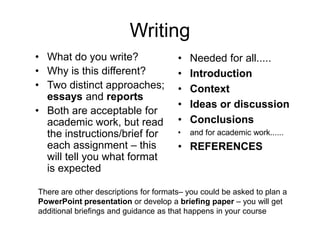
• What do you write?
• Why is this different?
• Two distinct approaches;
essays and reports
• Both are acceptable for
academic work, but read
the instructions/brief for
each assignment – this
will tell you what format
is expected
• Needed for all.....
• Introduction
• Context
• Ideas or discussion
• Conclusions
• and for academic work......
• REFERENCES
There are other descriptions for formats– you could be asked to plan a
PowerPoint presentation or develop a briefing paper – you will get
additional briefings and guidance as that happens in your course
Writing - expectations
• You do what is asked in the task briefing
– Style and content
• Good grammar and spelling
• Accurate punctuation
• Jargon explained and clarified
• Unless specified use an impersonal and
objective style
• So not ‘I’ or ‘we’ or ‘my’
Writing - expectations
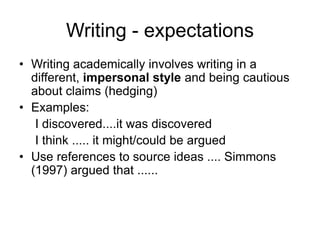
• Writing academically involves writing in a
different, impersonal style and being cautious
about claims (hedging)
• Examples:
I discovered....it was discovered
I think ..... it might/could be argued
• Use references to source ideas .... Simmons
(1997) argued that ......
Writing - expectations
• The agency or organisation’s name (rather than
‘my organisation’ does…..)
• Avoid abbreviations in text (local authority rather
than LA; housing association rather than HA)
• Where acronyms are in common use – use full
name first with initials in brackets, then can use
acronym – saves words and time
• Example: The Department of Communities and
Local Government (CLG) said ……… According to
the CLG, rent collection is a …….
Planning for writing
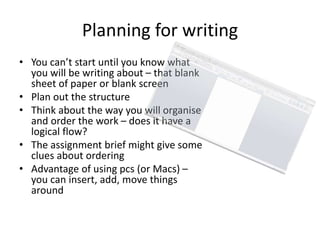
• You can’t start until you know what
you will be writing about – that blank
sheet of paper or blank screen
• Plan out the structure
• Think about the way you will organise
and order the work – does it have a
logical flow?
• The assignment brief might give some
clues about ordering
• Advantage of using pcs (or Macs) –
you can insert, add, move things
around
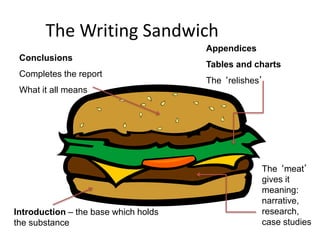
The Writing Sandwich
Introduction – the base which holds
the substance
The ‘meat’
gives it
meaning:
narrative,
research,
case studies
Conclusions
Completes the report
What it all means
Appendices
Tables and charts
The ‘relishes’
Purpose
• To inform a given audience
• Tutor, tenants, colleagues, board members – the
assignment brief will tell you
• Tailor your style and language to suit their needs
• Consider and picture your audience
– Who are they?
– What do they need to know and why?
– How will they need this information?
– What benefits will this information provide for them?
For all audiences
• Avoid or explain jargon
• Avoid slang and abbreviations (unless
acronyms)
• Be clear about what goes into your work –
content but leave writing the introduction
fully until you have written the body of the
work
A word about conclusions
• Nothing NEW goes here
• If you think of something new to add, insert in
the appropriate place in the report (or essay)
• You cover:
• What was covered or discussed (briefly) and what
was most significant or what the overall impact
has been
• Recommendations are only required if asked for –
don’t be tempted to suggest new ways forward if
you haven’t been asked for them
Reports
• Most useful for work, so
try the format
• Signposting
• White space
• Headings and
subheadings
• Numbering of sections
and paragraphs - being
consistent
• Referencing is required
in all ‘academic’ reports
FORMAT OF REPORT
• Header Page
• Contents page or list
• Introduction
• Chapters
• Conclusions
• Summary and
recommendations (if asked
for)
• Appendices
Tips
• Be consistent in style and approach
• Use a logical numbering system
• It is useful to use numbered paragraphs – think
about someone wanting to refer to your work
and pinpoint exactly where something is
• BUT….perhaps write first and then number –
both to help the work flow and so things are
logically ordered
• You reference all your work in the course, even
though a work based report wouldn’t usually be
referenced
Essays
Less formal structure
than reports but still
needing argument and
objective commentary
è Introduction
è Main arguments -
leading to
è Conclusions
Even here, you might
use headings, but check
this with whoever set
the essay
• no numbering of
headings/sections
• no appendices
• lots of referencing
• TELL THEM WHAT YOU ARE
GOING TO TELL THEM
• TELL THEM
• TELL THEM WHAT YOU TOLD
THEM (and what was most
important)

Writing for academic purposes

  • 1.
    Writing for AcademicPurposes In this short presentation we look at writing reports and essays
  • 2.
    Writing • What doyou write? • Why is this different? • Two distinct approaches; essays and reports • Both are acceptable for academic work, but read the instructions/brief for each assignment – this will tell you what format is expected • Needed for all..... • Introduction • Context • Ideas or discussion • Conclusions • and for academic work...... • REFERENCES There are other descriptions for formats– you could be asked to plan a PowerPoint presentation or develop a briefing paper – you will get additional briefings and guidance as that happens in your course
  • 3.
    Writing - expectations •You do what is asked in the task briefing – Style and content • Good grammar and spelling • Accurate punctuation • Jargon explained and clarified • Unless specified use an impersonal and objective style • So not ‘I’ or ‘we’ or ‘my’
  • 4.
    Writing - expectations •Writing academically involves writing in a different, impersonal style and being cautious about claims (hedging) • Examples: I discovered....it was discovered I think ..... it might/could be argued • Use references to source ideas .... Simmons (1997) argued that ......
  • 5.
    Writing - expectations •The agency or organisation’s name (rather than ‘my organisation’ does…..) • Avoid abbreviations in text (local authority rather than LA; housing association rather than HA) • Where acronyms are in common use – use full name first with initials in brackets, then can use acronym – saves words and time • Example: The Department of Communities and Local Government (CLG) said ……… According to the CLG, rent collection is a …….
  • 6.
    Planning for writing •You can’t start until you know what you will be writing about – that blank sheet of paper or blank screen • Plan out the structure • Think about the way you will organise and order the work – does it have a logical flow? • The assignment brief might give some clues about ordering • Advantage of using pcs (or Macs) – you can insert, add, move things around
  • 7.
    The Writing Sandwich Introduction– the base which holds the substance The ‘meat’ gives it meaning: narrative, research, case studies Conclusions Completes the report What it all means Appendices Tables and charts The ‘relishes’
  • 8.
    Purpose • To informa given audience • Tutor, tenants, colleagues, board members – the assignment brief will tell you • Tailor your style and language to suit their needs • Consider and picture your audience – Who are they? – What do they need to know and why? – How will they need this information? – What benefits will this information provide for them?
  • 9.
    For all audiences •Avoid or explain jargon • Avoid slang and abbreviations (unless acronyms) • Be clear about what goes into your work – content but leave writing the introduction fully until you have written the body of the work
  • 10.
    A word aboutconclusions • Nothing NEW goes here • If you think of something new to add, insert in the appropriate place in the report (or essay) • You cover: • What was covered or discussed (briefly) and what was most significant or what the overall impact has been • Recommendations are only required if asked for – don’t be tempted to suggest new ways forward if you haven’t been asked for them
  • 11.
    Reports • Most usefulfor work, so try the format • Signposting • White space • Headings and subheadings • Numbering of sections and paragraphs - being consistent • Referencing is required in all ‘academic’ reports FORMAT OF REPORT • Header Page • Contents page or list • Introduction • Chapters • Conclusions • Summary and recommendations (if asked for) • Appendices
  • 12.
    Tips • Be consistentin style and approach • Use a logical numbering system • It is useful to use numbered paragraphs – think about someone wanting to refer to your work and pinpoint exactly where something is • BUT….perhaps write first and then number – both to help the work flow and so things are logically ordered • You reference all your work in the course, even though a work based report wouldn’t usually be referenced
  • 13.
    Essays Less formal structure thanreports but still needing argument and objective commentary è Introduction è Main arguments - leading to è Conclusions Even here, you might use headings, but check this with whoever set the essay • no numbering of headings/sections • no appendices • lots of referencing • TELL THEM WHAT YOU ARE GOING TO TELL THEM • TELL THEM • TELL THEM WHAT YOU TOLD THEM (and what was most important)