Your Assignment
Choosing a topic What is the issue that you are going to investigate? Translate this into a research question Is it strategic in nature as opposed to tactical? Is the research question legitimate? Is it of value to your organisation and to you? Is the topic practical; what are the constraints? Cost: money, time Scope: too wide, too narrow? Is it politically acceptable or will exploring this topic be politically sensitive? Is it interesting? Do you want a topic that stretches you, or one with which you are familiar?
Study Skills Reading Reading for a higher qualification is going to involve reading widely, beyond the set texts ‘ Snowballing’: when reading something leads to other lreferenced iterature Journal articles may give a neat summary of theory: use them! Abstracts allow you to browse: if it looks interesting read it; if not, don’t Taking notes and Photocopies Reference them as you go: who wrote it? when? where? page numbers etc This could save you hours of searching when you come to write up your work Use quotes to indicate that you have ‘lifted’ directly from the text along with the citation If you summarise in your own words you still need to include a citation for the source(s) Plagiarism is a serious offence in Universities. Quotes and ideas must be fully acknowledged and accredited
Sources Literature Review Books; refereed journal articles Peer reviewed literature Review the literature critically Primary Research conducted by you specific to your topic Interviews, questionnaires Field research, generating new insight Building on secondary sources Secondary Web searches and newsgroups Company reports and internal documents Magazine and newspaper articles Consultant’s reports TV and Radio programmes Keeping up to date Look for gaps
Being ‘Critical’ In an academic environment, being critical means: Being open-minded Being intellectually sceptical about ideas, claims and arguments Not accepting things at face value Questioning assumptions and ‘taken for granteds’ Questioning existing structures and practices Focus can be: Underlying assumptions Meaning of words Methodology Data collected Interpretations made on data Reasoning/argument Your findings
Being critical when writing Present evidence to support your reasoning Read your own writing critically View the issue from multiple perspectives Acknowledge the contribution, merits and strengths but in a qualified way Reject, rebut, refute, reformulate, test and extend Identify gaps, absences, limits Evaluate the importance of omissions and flaws Take new points of view
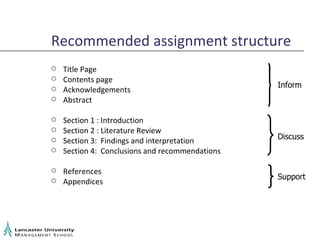
Recommended assignment structure Title Page Contents page Acknowledgements Abstract Section 1 : Introduction Section 2 : Literature Review Section 3:  Findings and interpretation Section 4:  Conclusions and recommendations References Appendices Inform Discuss Support
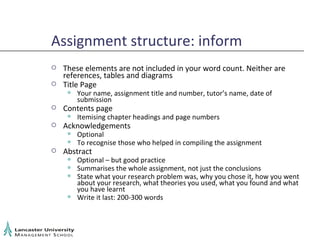
Assignment structure: inform These elements are not included in your word count. Neither are references, tables and diagrams Title Page Your name, assignment title and number, tutor’s name, date of submission Contents page Itemising chapter headings and page numbers Acknowledgements Optional To recognise those who helped in compiling the assignment Abstract Optional – but good practice Summarises the whole assignment, not just the conclusions State what your research problem was, why you chose it, how you went about your research, what theories you used, what you found and what you have learnt Write it last: 200-300 words
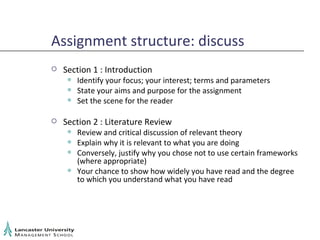
Assignment structure: discuss Section 1 : Introduction Identify your focus; your interest; terms and parameters State your aims and purpose for the assignment Set the scene for the reader Section 2 : Literature Review Review and critical discussion of relevant theory Explain why it is relevant to what you are doing Conversely, justify why you chose not to use certain frameworks (where appropriate) Your chance to show how widely you have read and the degree to which you understand what you have read
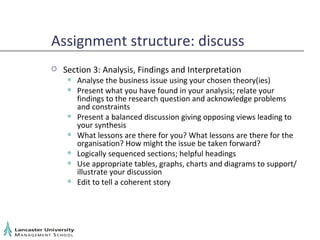
Assignment structure: discuss Section 3: Analysis, Findings and Interpretation Analyse the business issue using your chosen theory(ies) Present what you have found in your analysis; relate your findings to the research question and acknowledge problems and constraints Present a balanced discussion giving opposing views leading to your synthesis What lessons are there for you? What lessons are there for the organisation? How might the issue be taken forward? Logically sequenced sections; helpful headings Use appropriate tables, graphs, charts and diagrams to support/ illustrate your discussion Edit to tell a coherent story
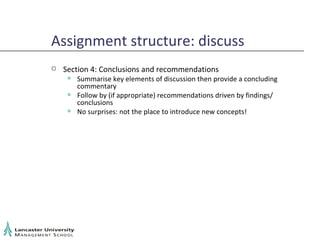
Assignment structure: discuss Section 4: Conclusions and recommendations Summarise key elements of discussion then provide a concluding commentary Follow by (if appropriate) recommendations driven by findings/ conclusions No surprises: not the place to introduce new concepts!
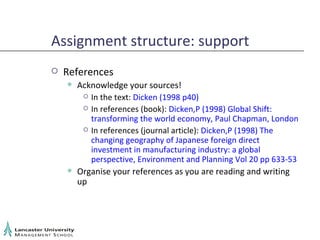
Assignment structure: support References Acknowledge your sources! In the text:  Dicken (1998 p40) In references (book):  Dicken,P (1998) Global Shift: transforming the world economy, Paul Chapman, London In references (journal article):  Dicken,P (1998) The changing geography of Japanese foreign direct investment in manufacturing industry: a global perspective, Environment and Planning Vol 20 pp 633-53 Organise your references as you are reading and writing up
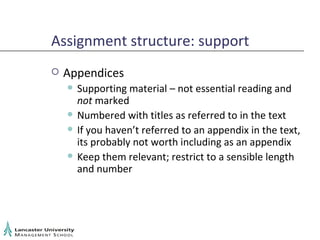
Assignment structure: support Appendices Supporting material – not essential reading and  not  marked Numbered with titles as referred to in the text If you haven’t referred to an appendix in the text, its probably not worth including as an appendix Keep them relevant; restrict to a sensible length and number
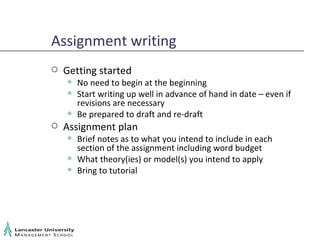
Assignment writing Getting started No need to begin at the beginning Start writing up well in advance of hand in date – even if revisions are necessary Be prepared to draft and re-draft Assignment plan Brief notes as to what you intend to include in each section of the assignment including word budget What theory(ies) or model(s) you intend to apply Bring to tutorial
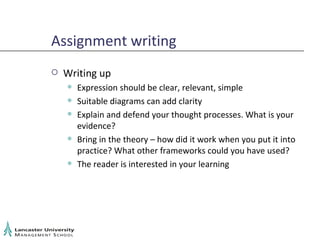
Assignment writing Writing up Expression should be clear, relevant, simple Suitable diagrams can add clarity Explain and defend your thought processes. What is your evidence? Bring in the theory – how did it work when you put it into practice? What other frameworks could you have used? The reader is interested in your learning
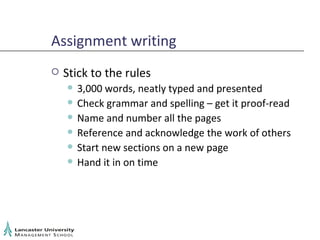
Assignment writing Stick to the rules 3,000 words, neatly typed and presented Check grammar and spelling – get it proof-read Name and number all the pages Reference and acknowledge the work of others Start new sections on a new page Hand it in on time
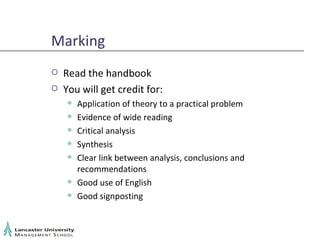
Marking Read the handbook You will get credit for: Application of theory to a practical problem Evidence of wide reading Critical analysis Synthesis Clear link between analysis, conclusions and recommendations Good use of English Good signposting

Individual assignment study skills

  • 1.
  • 2.
    Choosing a topicWhat is the issue that you are going to investigate? Translate this into a research question Is it strategic in nature as opposed to tactical? Is the research question legitimate? Is it of value to your organisation and to you? Is the topic practical; what are the constraints? Cost: money, time Scope: too wide, too narrow? Is it politically acceptable or will exploring this topic be politically sensitive? Is it interesting? Do you want a topic that stretches you, or one with which you are familiar?
  • 3.
    Study Skills ReadingReading for a higher qualification is going to involve reading widely, beyond the set texts ‘ Snowballing’: when reading something leads to other lreferenced iterature Journal articles may give a neat summary of theory: use them! Abstracts allow you to browse: if it looks interesting read it; if not, don’t Taking notes and Photocopies Reference them as you go: who wrote it? when? where? page numbers etc This could save you hours of searching when you come to write up your work Use quotes to indicate that you have ‘lifted’ directly from the text along with the citation If you summarise in your own words you still need to include a citation for the source(s) Plagiarism is a serious offence in Universities. Quotes and ideas must be fully acknowledged and accredited
  • 4.
    Sources Literature ReviewBooks; refereed journal articles Peer reviewed literature Review the literature critically Primary Research conducted by you specific to your topic Interviews, questionnaires Field research, generating new insight Building on secondary sources Secondary Web searches and newsgroups Company reports and internal documents Magazine and newspaper articles Consultant’s reports TV and Radio programmes Keeping up to date Look for gaps
  • 5.
    Being ‘Critical’ Inan academic environment, being critical means: Being open-minded Being intellectually sceptical about ideas, claims and arguments Not accepting things at face value Questioning assumptions and ‘taken for granteds’ Questioning existing structures and practices Focus can be: Underlying assumptions Meaning of words Methodology Data collected Interpretations made on data Reasoning/argument Your findings
  • 6.
    Being critical whenwriting Present evidence to support your reasoning Read your own writing critically View the issue from multiple perspectives Acknowledge the contribution, merits and strengths but in a qualified way Reject, rebut, refute, reformulate, test and extend Identify gaps, absences, limits Evaluate the importance of omissions and flaws Take new points of view
  • 7.
    Recommended assignment structureTitle Page Contents page Acknowledgements Abstract Section 1 : Introduction Section 2 : Literature Review Section 3: Findings and interpretation Section 4: Conclusions and recommendations References Appendices Inform Discuss Support
  • 8.
    Assignment structure: informThese elements are not included in your word count. Neither are references, tables and diagrams Title Page Your name, assignment title and number, tutor’s name, date of submission Contents page Itemising chapter headings and page numbers Acknowledgements Optional To recognise those who helped in compiling the assignment Abstract Optional – but good practice Summarises the whole assignment, not just the conclusions State what your research problem was, why you chose it, how you went about your research, what theories you used, what you found and what you have learnt Write it last: 200-300 words
  • 9.
    Assignment structure: discussSection 1 : Introduction Identify your focus; your interest; terms and parameters State your aims and purpose for the assignment Set the scene for the reader Section 2 : Literature Review Review and critical discussion of relevant theory Explain why it is relevant to what you are doing Conversely, justify why you chose not to use certain frameworks (where appropriate) Your chance to show how widely you have read and the degree to which you understand what you have read
  • 10.
    Assignment structure: discussSection 3: Analysis, Findings and Interpretation Analyse the business issue using your chosen theory(ies) Present what you have found in your analysis; relate your findings to the research question and acknowledge problems and constraints Present a balanced discussion giving opposing views leading to your synthesis What lessons are there for you? What lessons are there for the organisation? How might the issue be taken forward? Logically sequenced sections; helpful headings Use appropriate tables, graphs, charts and diagrams to support/ illustrate your discussion Edit to tell a coherent story
  • 11.
    Assignment structure: discussSection 4: Conclusions and recommendations Summarise key elements of discussion then provide a concluding commentary Follow by (if appropriate) recommendations driven by findings/ conclusions No surprises: not the place to introduce new concepts!
  • 12.
    Assignment structure: supportReferences Acknowledge your sources! In the text: Dicken (1998 p40) In references (book): Dicken,P (1998) Global Shift: transforming the world economy, Paul Chapman, London In references (journal article): Dicken,P (1998) The changing geography of Japanese foreign direct investment in manufacturing industry: a global perspective, Environment and Planning Vol 20 pp 633-53 Organise your references as you are reading and writing up
  • 13.
    Assignment structure: supportAppendices Supporting material – not essential reading and not marked Numbered with titles as referred to in the text If you haven’t referred to an appendix in the text, its probably not worth including as an appendix Keep them relevant; restrict to a sensible length and number
  • 14.
    Assignment writing Gettingstarted No need to begin at the beginning Start writing up well in advance of hand in date – even if revisions are necessary Be prepared to draft and re-draft Assignment plan Brief notes as to what you intend to include in each section of the assignment including word budget What theory(ies) or model(s) you intend to apply Bring to tutorial
  • 15.
    Assignment writing Writingup Expression should be clear, relevant, simple Suitable diagrams can add clarity Explain and defend your thought processes. What is your evidence? Bring in the theory – how did it work when you put it into practice? What other frameworks could you have used? The reader is interested in your learning
  • 16.
    Assignment writing Stickto the rules 3,000 words, neatly typed and presented Check grammar and spelling – get it proof-read Name and number all the pages Reference and acknowledge the work of others Start new sections on a new page Hand it in on time
  • 17.
    Marking Read thehandbook You will get credit for: Application of theory to a practical problem Evidence of wide reading Critical analysis Synthesis Clear link between analysis, conclusions and recommendations Good use of English Good signposting