HOW TO WRITE TECHNICAL
PAPERS
(JOURNALS)
M.VENKATESH
WHAT IS
RESEARCH
 It is the process of finding out something we
don’t know already.
 Process of research is to use the existing
knowledge to acquire additional knowledge.
 Research is a process not an end of state.
Research
vs Development
Research: Accomplishment of New knowledge.
Development: Enhancement of the existing knowledge.
INDICATIONS OF A
SUCCESSFUL
RESEARCH
Guide
Research
Publication in Journal(Well Established)
1. Technical writing
2. Plagiarism
3. Journal selection
4. Review paper
5. Highlights
6. Reviewers
GUIDE
 Beacon of wisdom(Information).
 Inculcates moral values and ethical practices.
 Prepares a scholar for carrying out independent research in future.
Beware of Research baba’s
research
 Habit of searching for alternatives
 Structural thinking and systematic execution
 Change in personality
Publication
in
well
established
journal
 New results or breakthrough in research.
 Experts review/comments enhances the technical weightage of the
research.
 Respect among the other researchers in the field.
(avoid online paid journals)
Technical
writing
Creativity
Inherited or Acquired?
Sharp observation capacity is required
Plagiarism
 Verbal copying of extensive materials of others.
 Misappropriating the results/data.
 Minor change in the original writing.
 Same information more than one time.
Plagiarism
(actions proposed)
Debarring from publishing in the concerned
journal.
Intimation to the head of department and
institution for necessary action
Publicizing such incidents of plagiarism with
photo.
Journal
selection
Comparing the objective and scope of our research
with the journal’s objective.
Sample papers of journal.
Paper types.
1. Original work.
2. Critic review.
3. Technical note(scientific relevance must be
there)
4. Application /discussion
Review paper
The expected standard of the paper is very high.
Assimilation and digestion of the work and conversion
into a proper paper.
Rich research experiences is needed for the review
paper. Experiences will integrate the existing work and
interwoven in the form of a review paper.
Use of copyright information in a careful way.
Highlights
common mistakes
Each sentence in abstract as a highlight.
Routine method is given as a highlight.
Claim not supported but listed as a highlight.
Suggestions
Highlight should be short.
Four to five highlights of the research work
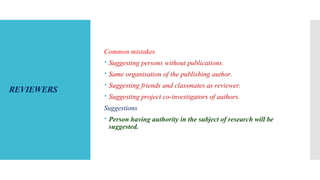
REVIEWERS
Common mistakes
 Suggesting persons without publications.
 Same organisation of the publishing author.
 Suggesting friends and classmates as reviewer.
 Suggesting project co-investigators of authors.
Suggestions
 Person having authority in the subject of research will be
suggested.
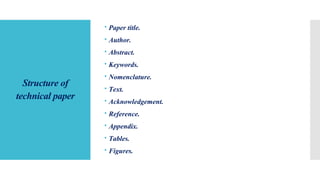
Structure of
technical paper
 Paper title.
 Author.
 Abstract.
 Keywords.
 Nomenclature.
 Text.
 Acknowledgement.
 Reference.
 Appendix.
 Tables.
 Figures.
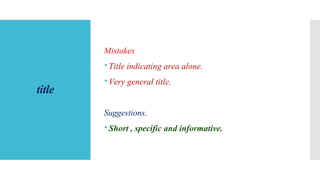
title
Mistakes
Title indicating area alone.
Very general title.
Suggestions.
Short , specific and informative.
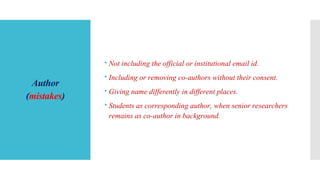
Author
(mistakes)
 Not including the official or institutional email id.
 Including or removing co-authors without their consent.
 Giving name differently in different places.
 Students as corresponding author, when senior researchers
remains as co-author in background.
Author
(suggestions)
Name the author in order of work.
Proper affiliation with address.
Full address.
Author for correspond should be clear.
abstract
Mistakes
 Title alone expanded to paragraph.
 Introduction given as abstract,
 Giving reference in abstract.
Suggestions
 It should be a self contained paragraph outlining the
context, aim, scope and major conclusion.
 It Is not a trailer.
 Applications also can be given.
keywords
Mistakes
Only words used in title.
Group of words.
Unconnected to the content.
Suggestions
To be provided for indexing purpose.
nomenclature
(mistakes)
 Not providing the nomenclature at all.
 Giving symbols in the order of occurrences.
 Not giving the meaning of symbols in the first
occurrences.
 No different definition in different places.
nomenclature
(suggestions)
 Symbols must be given in alphabetical order.
 List of nomenclature is not for the publisher, it for the person who is
reviewing the paper.
Sample order
English characters.
 Upper case.
 Lower case.
Greek alphabets.
INTRODUCTION
mistakes
 Reproduction of abstract to introduction.
 Only summary of the work done is given.
 General information from the text book.
 Writing data irrelevant of the work done.
Suggestions
 Context of the paper to be explained first.
 Categorise the work properly.
 Aim of the work to be reported.
 Outline of the work to be given at the end.
Text
(mistakes)
 No proper structure.
 No original contribution identified.
 No element of innovation ever identified.
 Concept not brought out explicitly.
 Concept explanation only through equations.
 Too poor English.
 Abbreviation and acronym for common words and not identified.
 Use symbols instead of words.
 Usage of don’t and can’t.
Text
(mistakes)
 Improper sentences (example: can’t be possible).
 Improper use of active and passive voices.
 Words wrongly capitalised.
 Lengthy mathematical text.
 Lengthy computer codes.
 Not getting approval of co-authors for the draft.
Text
(suggestions)
 Text should be divided under different headings.
 Sentence should be brief.
 Each section must be self contained, and section must be logically
connected.
 Do not use words like “clearly”, “easily”, “obviously”, and
“trivially”
 Usage of proper active and passive voice.
Active voice : Scientists and maths.
Passive voice: Engineers and Technologists.
Figures
 Different people learn in different ways, so you should complement
a textual or mathematical presentation with a graphical one.
 It is extremely helpful to give an example to clarify your ideas.
 A figure should stand on its own, containing all the information that
is necessary to understand it.
Theoretical approach
 Equations not numbered.
 Numbering done in different ways.
 No mathematical symbols used.
Experimental approach
Mistakes
 Experimental setup is not given.
 Description of the setup not given.
 Relevant data of the machinery is not given.
Suggestions
 Don’t use photograph and block diagram of the experimental setup.
Results and
discussions
 S.I units not followed.
 Improper use of S.I units.
 No comparison with other papers.
Conclusion
 Only summary of the work is given.
 Observations only given.
 Objectives only given.
EVERY ENDING
IS REALLY JUST
A NEW
BEGINNING
How to write a technical paper

How to write a technical paper

  • 1.
    HOW TO WRITETECHNICAL PAPERS (JOURNALS) M.VENKATESH
  • 2.
    WHAT IS RESEARCH  Itis the process of finding out something we don’t know already.  Process of research is to use the existing knowledge to acquire additional knowledge.  Research is a process not an end of state.
  • 3.
    Research vs Development Research: Accomplishmentof New knowledge. Development: Enhancement of the existing knowledge.
  • 4.
    INDICATIONS OF A SUCCESSFUL RESEARCH Guide Research Publicationin Journal(Well Established) 1. Technical writing 2. Plagiarism 3. Journal selection 4. Review paper 5. Highlights 6. Reviewers
  • 5.
    GUIDE  Beacon ofwisdom(Information).  Inculcates moral values and ethical practices.  Prepares a scholar for carrying out independent research in future. Beware of Research baba’s
  • 6.
    research  Habit ofsearching for alternatives  Structural thinking and systematic execution  Change in personality
  • 7.
    Publication in well established journal  New resultsor breakthrough in research.  Experts review/comments enhances the technical weightage of the research.  Respect among the other researchers in the field. (avoid online paid journals)
  • 8.
  • 9.
    Plagiarism  Verbal copyingof extensive materials of others.  Misappropriating the results/data.  Minor change in the original writing.  Same information more than one time.
  • 10.
    Plagiarism (actions proposed) Debarring frompublishing in the concerned journal. Intimation to the head of department and institution for necessary action Publicizing such incidents of plagiarism with photo.
  • 11.
    Journal selection Comparing the objectiveand scope of our research with the journal’s objective. Sample papers of journal. Paper types. 1. Original work. 2. Critic review. 3. Technical note(scientific relevance must be there) 4. Application /discussion
  • 12.
    Review paper The expectedstandard of the paper is very high. Assimilation and digestion of the work and conversion into a proper paper. Rich research experiences is needed for the review paper. Experiences will integrate the existing work and interwoven in the form of a review paper. Use of copyright information in a careful way.
  • 13.
    Highlights common mistakes Each sentencein abstract as a highlight. Routine method is given as a highlight. Claim not supported but listed as a highlight. Suggestions Highlight should be short. Four to five highlights of the research work
  • 14.
    REVIEWERS Common mistakes  Suggestingpersons without publications.  Same organisation of the publishing author.  Suggesting friends and classmates as reviewer.  Suggesting project co-investigators of authors. Suggestions  Person having authority in the subject of research will be suggested.
  • 15.
    Structure of technical paper Paper title.  Author.  Abstract.  Keywords.  Nomenclature.  Text.  Acknowledgement.  Reference.  Appendix.  Tables.  Figures.
  • 16.
    title Mistakes Title indicating areaalone. Very general title. Suggestions. Short , specific and informative.
  • 17.
    Author (mistakes)  Not includingthe official or institutional email id.  Including or removing co-authors without their consent.  Giving name differently in different places.  Students as corresponding author, when senior researchers remains as co-author in background.
  • 18.
    Author (suggestions) Name the authorin order of work. Proper affiliation with address. Full address. Author for correspond should be clear.
  • 19.
    abstract Mistakes  Title aloneexpanded to paragraph.  Introduction given as abstract,  Giving reference in abstract. Suggestions  It should be a self contained paragraph outlining the context, aim, scope and major conclusion.  It Is not a trailer.  Applications also can be given.
  • 20.
    keywords Mistakes Only words usedin title. Group of words. Unconnected to the content. Suggestions To be provided for indexing purpose.
  • 21.
    nomenclature (mistakes)  Not providingthe nomenclature at all.  Giving symbols in the order of occurrences.  Not giving the meaning of symbols in the first occurrences.  No different definition in different places.
  • 22.
    nomenclature (suggestions)  Symbols mustbe given in alphabetical order.  List of nomenclature is not for the publisher, it for the person who is reviewing the paper. Sample order English characters.  Upper case.  Lower case. Greek alphabets.
  • 23.
    INTRODUCTION mistakes  Reproduction ofabstract to introduction.  Only summary of the work done is given.  General information from the text book.  Writing data irrelevant of the work done. Suggestions  Context of the paper to be explained first.  Categorise the work properly.  Aim of the work to be reported.  Outline of the work to be given at the end.
  • 24.
    Text (mistakes)  No properstructure.  No original contribution identified.  No element of innovation ever identified.  Concept not brought out explicitly.  Concept explanation only through equations.  Too poor English.  Abbreviation and acronym for common words and not identified.  Use symbols instead of words.  Usage of don’t and can’t.
  • 25.
    Text (mistakes)  Improper sentences(example: can’t be possible).  Improper use of active and passive voices.  Words wrongly capitalised.  Lengthy mathematical text.  Lengthy computer codes.  Not getting approval of co-authors for the draft.
  • 26.
    Text (suggestions)  Text shouldbe divided under different headings.  Sentence should be brief.  Each section must be self contained, and section must be logically connected.  Do not use words like “clearly”, “easily”, “obviously”, and “trivially”  Usage of proper active and passive voice. Active voice : Scientists and maths. Passive voice: Engineers and Technologists.
  • 27.
    Figures  Different peoplelearn in different ways, so you should complement a textual or mathematical presentation with a graphical one.  It is extremely helpful to give an example to clarify your ideas.  A figure should stand on its own, containing all the information that is necessary to understand it.
  • 28.
    Theoretical approach  Equationsnot numbered.  Numbering done in different ways.  No mathematical symbols used.
  • 29.
    Experimental approach Mistakes  Experimentalsetup is not given.  Description of the setup not given.  Relevant data of the machinery is not given. Suggestions  Don’t use photograph and block diagram of the experimental setup.
  • 30.
    Results and discussions  S.Iunits not followed.  Improper use of S.I units.  No comparison with other papers.

  • 31.
    Conclusion  Only summaryof the work is given.  Observations only given.  Objectives only given.
  • 32.
    EVERY ENDING IS REALLYJUST A NEW BEGINNING