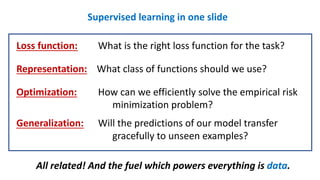
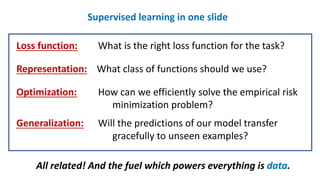
Supervised learning inone slide
Loss function: What is the right loss function for the task?
Representation: What class of functions should we use?
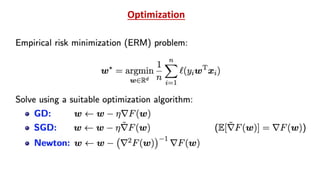
Optimization: How can we efficiently solve the empirical risk
minimization problem?
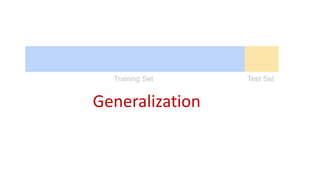
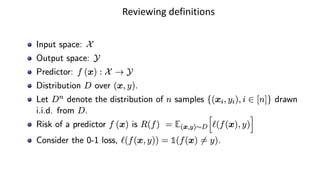
Generalization: Will the predictions of our model transfer
gracefully to unseen examples?
All related! And the fuel which powers everything is data.
5.
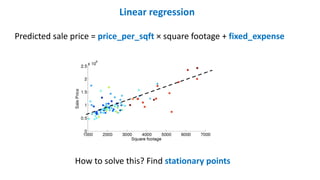
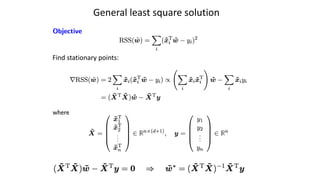
Linear regression
Predicted saleprice = price_per_sqft × square footage + fixed_expense
How to solve this? Find stationary points
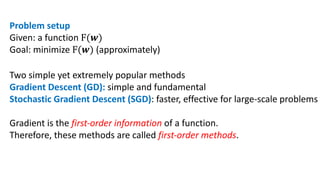
Problem setup
Given: afunction F(#)
Goal: minimize F(#) (approximately)
Two simple yet extremely popular methods
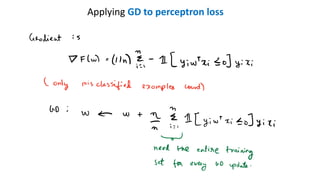
Gradient Descent (GD): simple and fundamental
Stochastic Gradient Descent (SGD): faster, effective for large-scale problems
Gradient is the first-order information of a function.
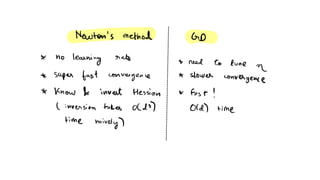
Therefore, these methods are called first-order methods.
10.
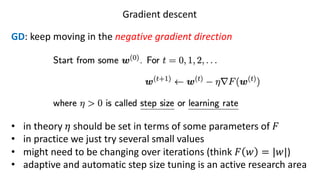
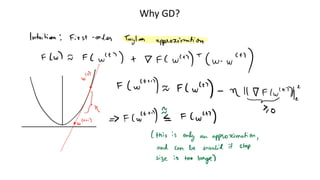
Gradient descent
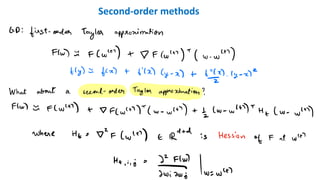
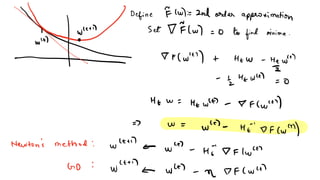
GD: keepmoving in the negative gradient direction
• in theory ! should be set in terms of some parameters of "
• in practice we just try several small values
• might need to be changing over iterations (think " # = |#|)
• adaptive and automatic step size tuning is an active research area
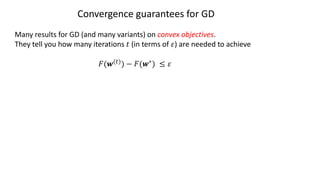
Convergence guarantees forGD
Many results for GD (and many variants) on convex objectives.
They tell you how many iterations ! (in terms of ") are needed to achieve
#(%(")) − #(%∗) ≤ "
13.
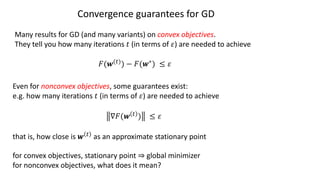
Convergence guarantees forGD
Many results for GD (and many variants) on convex objectives.
They tell you how many iterations ! (in terms of ") are needed to achieve
#(%(")) − #(%∗) ≤ "
Even for nonconvex objectives, some guarantees exist:
e.g. how many iterations ! (in terms of ") are needed to achieve
∇#(% " ) ≤ "
that is, how close is % " as an approximate stationary point
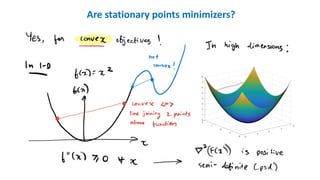
for convex objectives, stationary point ⇒ global minimizer
for nonconvex objectives, what does it mean?
14.
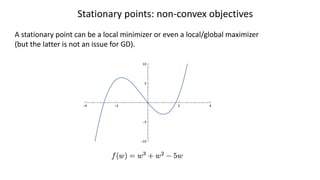
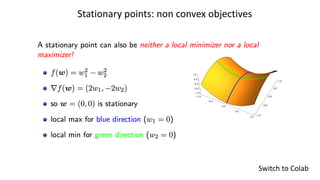
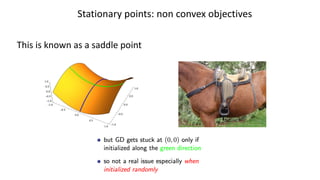
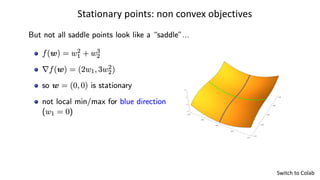
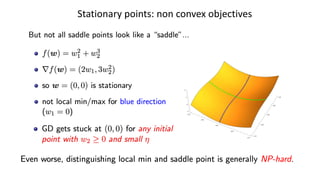
Stationary points: non-convexobjectives
A stationary point can be a local minimizer or even a local/global maximizer
(but the latter is not an issue for GD).
+(%(")) − +(%∗) ≤ "
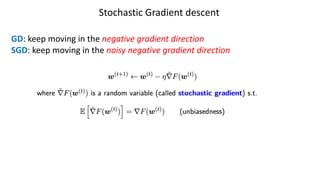
Stochastic Gradient descent
GD:keep moving in the negative gradient direction
SGD: keep moving in the noisy negative gradient direction
20.
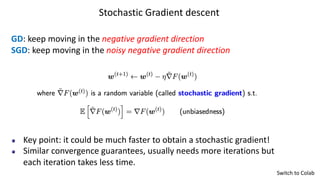
Stochastic Gradient descent
GD:keep moving in the negative gradient direction
SGD: keep moving in the noisy negative gradient direction
Key point: it could be much faster to obtain a stochastic gradient!
Similar convergence guarantees, usually needs more iterations but
each iteration takes less time.
Switch to Colab
21.
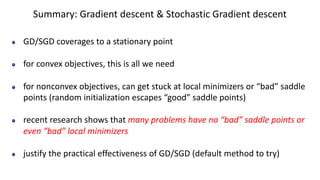
Summary: Gradient descent& Stochastic Gradient descent
GD/SGD coverages to a stationary point
for convex objectives, this is all we need
22.
Summary: Gradient descent& Stochastic Gradient descent
GD/SGD coverages to a stationary point
for convex objectives, this is all we need
for nonconvex objectives, can get stuck at local minimizers or “bad” saddle
points (random initialization escapes “good” saddle points)
recent research shows that many problems have no “bad” saddle points or
even “bad” local minimizers
justify the practical effectiveness of GD/SGD (default method to try)
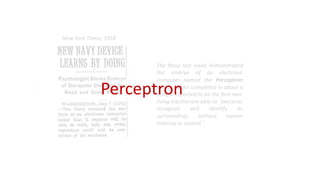
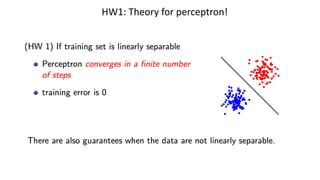
The Navy lastweek demonstrated
the embryo of an electronic
computer named the Perceptron
which, when completed in about a
year, is expected to be the first non-
living mechanism able to "perceive,
recognize and identify its
surroundings without human
training or control."
New York Times, 1958
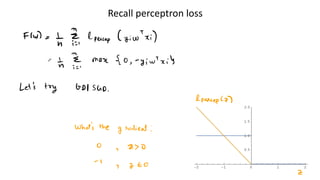
Perceptron
39.
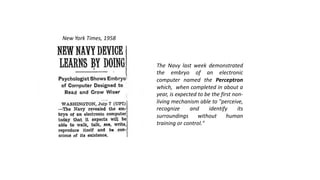
The Navy lastweek demonstrated
the embryo of an electronic
computer named the Perceptron
which, when completed in about a
year, is expected to be the first non-
living mechanism able to "perceive,
recognize and identify its
surroundings without human
training or control."
New York Times, 1958
Supervised learning inone slide
Loss function: What is the right loss function for the task?
Representation: What class of functions should we use?
Optimization: How can we efficiently solve the empirical risk
minimization problem?
Generalization: Will the predictions of our model transfer
gracefully to unseen examples?
All related! And the fuel which powers everything is data.


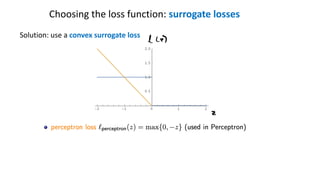
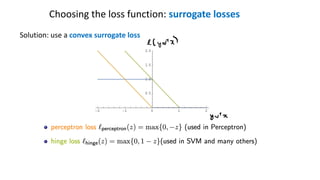
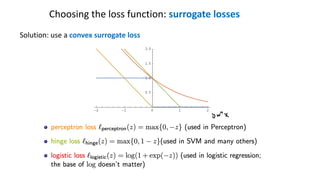
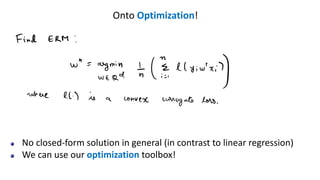


![Hacking-Uncovered-How-People-Get-Hacked-and-How-to-Stay-Safe[1].pptx](https://cdn.slidesharecdn.com/ss_thumbnails/hacking-uncovered-how-people-get-hacked-and-how-to-stay-safe1-260130170011-4883a9c7-thumbnail.jpg?width=640&height=640&fit=bounds)


![제 23회 보아즈(BOAZ) 빅데이터 컨퍼런스 - [MBOAX] : ABSA를 활용한 소비자 반응 분석 기반 운영 효율화 대시보드 설계](https://cdn.slidesharecdn.com/ss_thumbnails/3-1boaz23rdconferencemboax-260203102709-9d519923-thumbnail.jpg?width=640&height=640&fit=bounds)
