CSCI 567: Machine Learning
Vatsal Sharan
Fall 2022
Lecture 2, Sep 1
Administrivia
HW1 is out
Due in about 2 weeks (9/14 at 2pm). Start early!!!
Post on Ed Discussion if you’re looking for teammates.
Recap
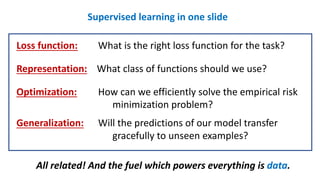
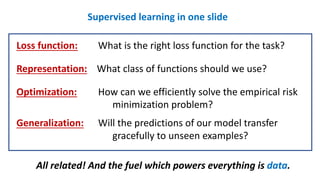
Supervised learning in one slide
Loss function: What is the right loss function for the task?
Representation: What class of functions should we use?
Optimization: How can we efficiently solve the empirical risk
minimization problem?
Generalization: Will the predictions of our model transfer
gracefully to unseen examples?
All related! And the fuel which powers everything is data.
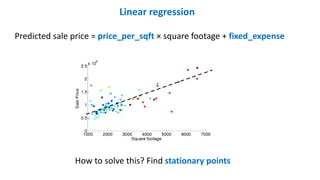
Linear regression
Predicted sale price = price_per_sqft × square footage + fixed_expense
How to solve this? Find stationary points
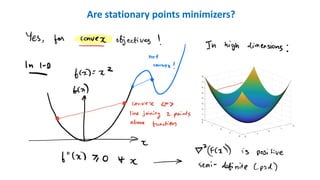
Are stationary points minimizers?
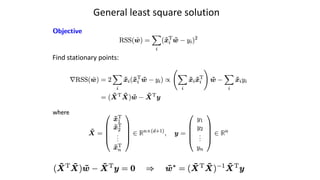
General least square solution
Find stationary points:
Optimization methods
(continued)
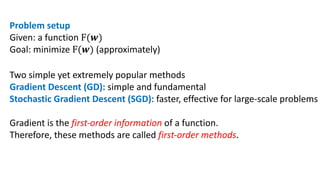
Problem setup
Given: a function F(𝒘)
Goal: minimize F(𝒘) (approximately)
Two simple yet extremely popular methods
Gradient Descent (GD): simple and fundamental
Stochastic Gradient Descent (SGD): faster, effective for large-scale problems
Gradient is the first-order information of a function.
Therefore, these methods are called first-order methods.
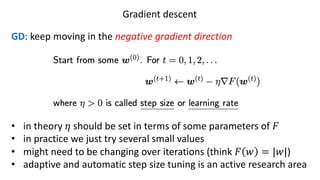
Gradient descent
GD: keep moving in the negative gradient direction
• in theory 𝜂 should be set in terms of some parameters of 𝐹
• in practice we just try several small values
• might need to be changing over iterations (think 𝐹 𝑤 = |𝑤|)
• adaptive and automatic step size tuning is an active research area
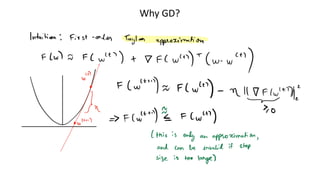
Why GD?
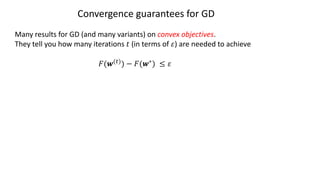
Convergence guarantees for GD
Many results for GD (and many variants) on convex objectives.
They tell you how many iterations 𝑡 (in terms of 𝜀) are needed to achieve
𝐹(𝒘(")) − 𝐹(𝒘∗) ≤ 𝜀
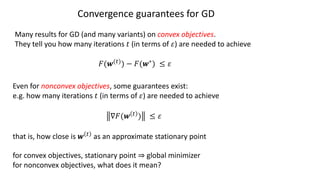
Convergence guarantees for GD
Many results for GD (and many variants) on convex objectives.
They tell you how many iterations 𝑡 (in terms of 𝜀) are needed to achieve
𝐹(𝒘(")) − 𝐹(𝒘∗) ≤ 𝜀
Even for nonconvex objectives, some guarantees exist:
e.g. how many iterations 𝑡 (in terms of 𝜀) are needed to achieve
∇𝐹(𝒘 " ) ≤ 𝜀
that is, how close is 𝒘 " as an approximate stationary point
for convex objectives, stationary point ⇒ global minimizer
for nonconvex objectives, what does it mean?
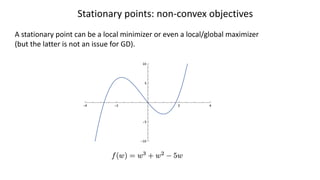
Stationary points: non-convex objectives
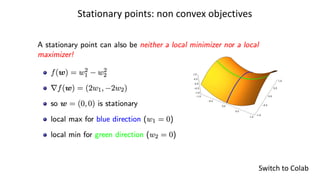
A stationary point can be a local minimizer or even a local/global maximizer
(but the latter is not an issue for GD).
𝑓(𝒘(")) − 𝑓(𝒘∗) ≤ 𝜀
Stationary points: non convex objectives
Switch to Colab
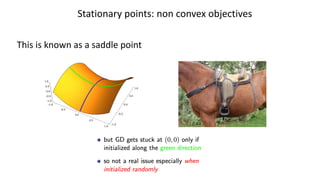
Stationary points: non convex objectives
This is known as a saddle point
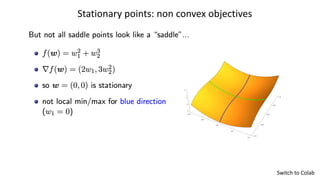
Stationary points: non convex objectives
Switch to Colab
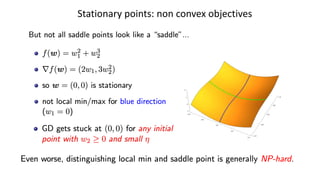
Stationary points: non convex objectives
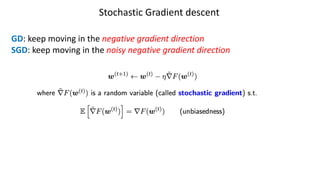
Stochastic Gradient descent
GD: keep moving in the negative gradient direction
SGD: keep moving in the noisy negative gradient direction
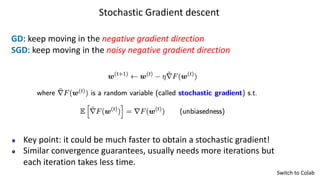
Stochastic Gradient descent
GD: keep moving in the negative gradient direction
SGD: keep moving in the noisy negative gradient direction
Key point: it could be much faster to obtain a stochastic gradient!
Similar convergence guarantees, usually needs more iterations but
each iteration takes less time.
Switch to Colab
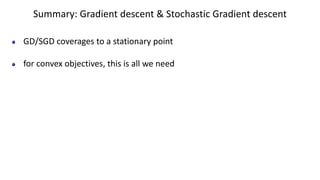
Summary: Gradient descent & Stochastic Gradient descent
GD/SGD coverages to a stationary point
for convex objectives, this is all we need
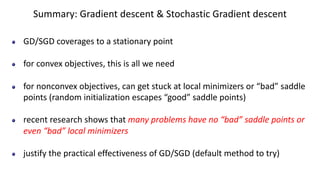
Summary: Gradient descent & Stochastic Gradient descent
GD/SGD coverages to a stationary point
for convex objectives, this is all we need
for nonconvex objectives, can get stuck at local minimizers or “bad” saddle
points (random initialization escapes “good” saddle points)
recent research shows that many problems have no “bad” saddle points or
even “bad” local minimizers
justify the practical effectiveness of GD/SGD (default method to try)
Second-order methods
Linear classifiers
The Setup
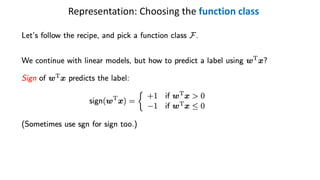
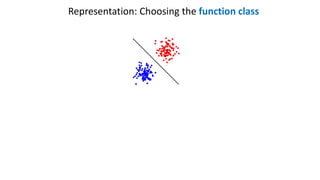
Representation: Choosing the function class
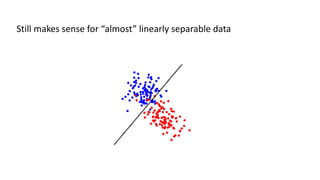
Still makes sense for “almost” linearly separable data
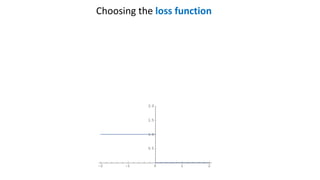
Choosing the loss function
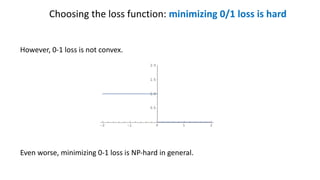
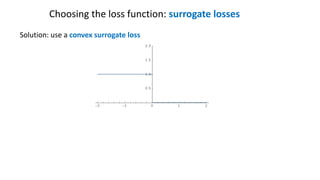
Choosing the loss function: minimizing 0/1 loss is hard
However, 0-1 loss is not convex.
Even worse, minimizing 0-1 loss is NP-hard in general.
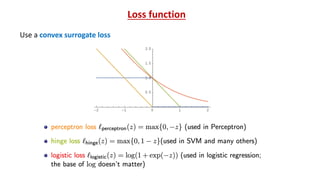
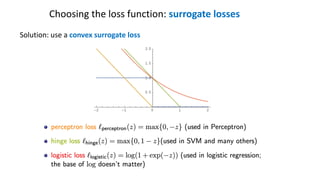
Choosing the loss function: surrogate losses
Solution: use a convex surrogate loss
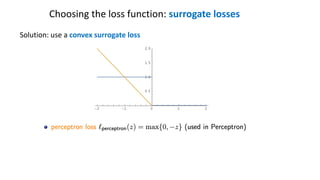
Choosing the loss function: surrogate losses
Solution: use a convex surrogate loss
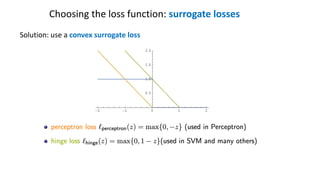
Choosing the loss function: surrogate losses
Solution: use a convex surrogate loss
Choosing the loss function: surrogate losses
Onto Optimization!
No closed-form solution in general (in contrast to linear regression)
We can use our optimization toolbox!
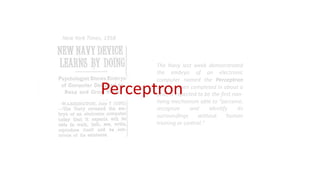
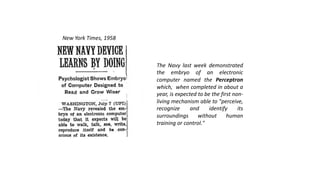
The Navy last week demonstrated
the embryo of an electronic
computer named the Perceptron
which, when completed in about a
year, is expected to be the first non-
living mechanism able to "perceive,
recognize and identify its
surroundings without human
training or control."
New York Times, 1958
Perceptron
The Navy last week demonstrated
the embryo of an electronic
computer named the Perceptron
which, when completed in about a
year, is expected to be the first non-
living mechanism able to "perceive,
recognize and identify its
surroundings without human
training or control."
New York Times, 1958
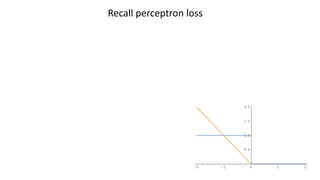
Recall perceptron loss
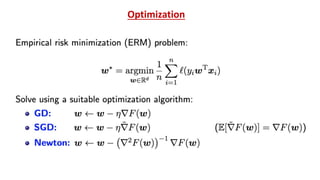
Applying GD to perceptron loss
Applying SGD to perceptron loss
Perceptron algorithm
Perceptron algorithm: Intuition
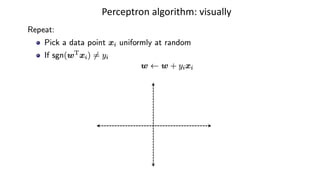
Perceptron algorithm: visually
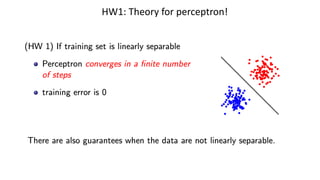
HW1: Theory for perceptron!
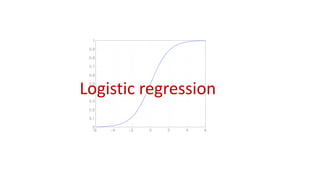
Logistic regression
Logistic loss
50
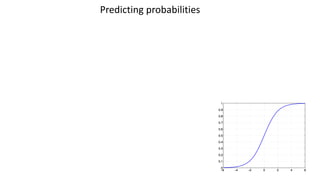
Predicting probabilities
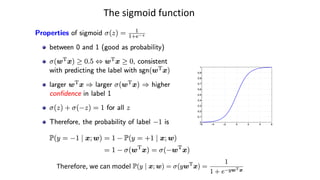
The sigmoid function
Therefore, we can model
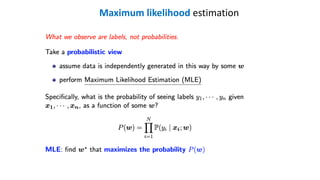
Maximum likelihood estimation
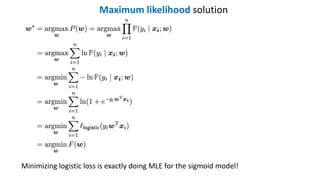
Maximum likelihood solution
Minimizing logistic loss is exactly doing MLE for the sigmoid model!
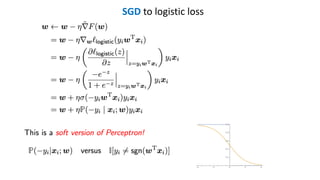
SGD to logistic loss
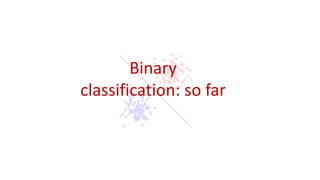
Binary
classification: so far
Supervised learning in one slide
Loss function: What is the right loss function for the task?
Representation: What class of functions should we use?
Optimization: How can we efficiently solve the empirical risk
minimization problem?
Generalization: Will the predictions of our model transfer
gracefully to unseen examples?
All related! And the fuel which powers everything is data.
Use a convex surrogate loss
Loss function
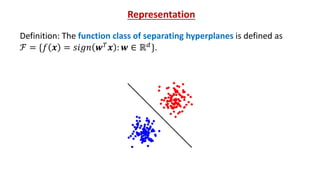
Definition: The function class of separating hyperplanes is defined as
ℱ = {𝑓 𝒙 = 𝑠𝑖𝑔𝑛 𝒘!
𝒙 : 𝒘 ∈ ℝ"
}.
Representation
Optimization
Generalization
Rich theory! Let’s see a glimpse J
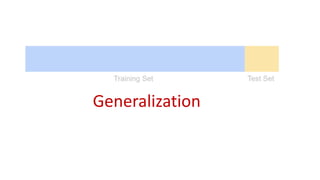
Generalization
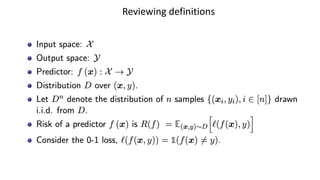
Reviewing definitions
Intuition: When does ERM generalize?
Relaxing our assumptions
We assumed that the function class is finite-sized. Results can be
extended to infinite function classes (such as separating hyperplanes).
We considered 0-1 loss. Can extend to real-valued loss (such as for
regression).
We assumed realizability. Can prove similar theorem which guarantees
small generalization gap without realizability (but with an 𝜖#
instead of
𝜖 in the denominator). This is called agnostic learning.
Rule of thumb for generalization
Suppose the functions 𝑓 in our function class ℱ have 𝑑 parameters which can be set.
Assume we discretize these parameters so they can take 𝑊 possible values each.
How much data do we need to have small generalization gap?
A useful rule of thumb: to guarantee generalization, make sure that your
training data set size 𝑛 is at least linear in the number 𝑑 of free parameters
in the function that you’re trying to learn.

lec2_unannotated.pdf ml csci 567 vatsal sharan

  • 1.
    CSCI 567: MachineLearning Vatsal Sharan Fall 2022 Lecture 2, Sep 1
  • 2.
    Administrivia HW1 is out Duein about 2 weeks (9/14 at 2pm). Start early!!! Post on Ed Discussion if you’re looking for teammates.
  • 3.
  • 4.
    Supervised learning inone slide Loss function: What is the right loss function for the task? Representation: What class of functions should we use? Optimization: How can we efficiently solve the empirical risk minimization problem? Generalization: Will the predictions of our model transfer gracefully to unseen examples? All related! And the fuel which powers everything is data.
  • 5.
    Linear regression Predicted saleprice = price_per_sqft × square footage + fixed_expense How to solve this? Find stationary points
  • 6.
  • 7.
    General least squaresolution Find stationary points:
  • 8.
  • 9.
    Problem setup Given: afunction F(𝒘) Goal: minimize F(𝒘) (approximately) Two simple yet extremely popular methods Gradient Descent (GD): simple and fundamental Stochastic Gradient Descent (SGD): faster, effective for large-scale problems Gradient is the first-order information of a function. Therefore, these methods are called first-order methods.
  • 10.
    Gradient descent GD: keepmoving in the negative gradient direction • in theory 𝜂 should be set in terms of some parameters of 𝐹 • in practice we just try several small values • might need to be changing over iterations (think 𝐹 𝑤 = |𝑤|) • adaptive and automatic step size tuning is an active research area
  • 11.
  • 12.
    Convergence guarantees forGD Many results for GD (and many variants) on convex objectives. They tell you how many iterations 𝑡 (in terms of 𝜀) are needed to achieve 𝐹(𝒘(")) − 𝐹(𝒘∗) ≤ 𝜀
  • 13.
    Convergence guarantees forGD Many results for GD (and many variants) on convex objectives. They tell you how many iterations 𝑡 (in terms of 𝜀) are needed to achieve 𝐹(𝒘(")) − 𝐹(𝒘∗) ≤ 𝜀 Even for nonconvex objectives, some guarantees exist: e.g. how many iterations 𝑡 (in terms of 𝜀) are needed to achieve ∇𝐹(𝒘 " ) ≤ 𝜀 that is, how close is 𝒘 " as an approximate stationary point for convex objectives, stationary point ⇒ global minimizer for nonconvex objectives, what does it mean?
  • 14.
    Stationary points: non-convexobjectives A stationary point can be a local minimizer or even a local/global maximizer (but the latter is not an issue for GD). 𝑓(𝒘(")) − 𝑓(𝒘∗) ≤ 𝜀
  • 15.
    Stationary points: nonconvex objectives Switch to Colab
  • 16.
    Stationary points: nonconvex objectives This is known as a saddle point
  • 17.
    Stationary points: nonconvex objectives Switch to Colab
  • 18.
    Stationary points: nonconvex objectives
  • 19.
    Stochastic Gradient descent GD:keep moving in the negative gradient direction SGD: keep moving in the noisy negative gradient direction
  • 20.
    Stochastic Gradient descent GD:keep moving in the negative gradient direction SGD: keep moving in the noisy negative gradient direction Key point: it could be much faster to obtain a stochastic gradient! Similar convergence guarantees, usually needs more iterations but each iteration takes less time. Switch to Colab
  • 21.
    Summary: Gradient descent& Stochastic Gradient descent GD/SGD coverages to a stationary point for convex objectives, this is all we need
  • 22.
    Summary: Gradient descent& Stochastic Gradient descent GD/SGD coverages to a stationary point for convex objectives, this is all we need for nonconvex objectives, can get stuck at local minimizers or “bad” saddle points (random initialization escapes “good” saddle points) recent research shows that many problems have no “bad” saddle points or even “bad” local minimizers justify the practical effectiveness of GD/SGD (default method to try)
  • 23.
  • 27.
  • 28.
  • 29.
  • 30.
  • 31.
    Still makes sensefor “almost” linearly separable data
  • 32.
  • 33.
    Choosing the lossfunction: minimizing 0/1 loss is hard However, 0-1 loss is not convex. Even worse, minimizing 0-1 loss is NP-hard in general.
  • 34.
    Choosing the lossfunction: surrogate losses Solution: use a convex surrogate loss
  • 35.
    Solution: use aconvex surrogate loss Choosing the loss function: surrogate losses
  • 36.
    Solution: use aconvex surrogate loss Choosing the loss function: surrogate losses
  • 37.
    Solution: use aconvex surrogate loss Choosing the loss function: surrogate losses
  • 38.
    Onto Optimization! No closed-formsolution in general (in contrast to linear regression) We can use our optimization toolbox!
  • 39.
    The Navy lastweek demonstrated the embryo of an electronic computer named the Perceptron which, when completed in about a year, is expected to be the first non- living mechanism able to "perceive, recognize and identify its surroundings without human training or control." New York Times, 1958 Perceptron
  • 40.
    The Navy lastweek demonstrated the embryo of an electronic computer named the Perceptron which, when completed in about a year, is expected to be the first non- living mechanism able to "perceive, recognize and identify its surroundings without human training or control." New York Times, 1958
  • 41.
  • 42.
    Applying GD toperceptron loss
  • 43.
    Applying SGD toperceptron loss
  • 44.
  • 45.
  • 46.
  • 47.
    HW1: Theory forperceptron!
  • 48.
  • 49.
  • 50.
  • 51.
  • 52.
  • 53.
    Maximum likelihood solution Minimizinglogistic loss is exactly doing MLE for the sigmoid model!
  • 54.
  • 55.
  • 56.
    Supervised learning inone slide Loss function: What is the right loss function for the task? Representation: What class of functions should we use? Optimization: How can we efficiently solve the empirical risk minimization problem? Generalization: Will the predictions of our model transfer gracefully to unseen examples? All related! And the fuel which powers everything is data.
  • 57.
    Use a convexsurrogate loss Loss function
  • 58.
    Definition: The functionclass of separating hyperplanes is defined as ℱ = {𝑓 𝒙 = 𝑠𝑖𝑔𝑛 𝒘! 𝒙 : 𝒘 ∈ ℝ" }. Representation
  • 59.
  • 60.
  • 61.
  • 62.
  • 64.
    Intuition: When doesERM generalize?
  • 70.
    Relaxing our assumptions Weassumed that the function class is finite-sized. Results can be extended to infinite function classes (such as separating hyperplanes). We considered 0-1 loss. Can extend to real-valued loss (such as for regression). We assumed realizability. Can prove similar theorem which guarantees small generalization gap without realizability (but with an 𝜖# instead of 𝜖 in the denominator). This is called agnostic learning.
  • 71.
    Rule of thumbfor generalization Suppose the functions 𝑓 in our function class ℱ have 𝑑 parameters which can be set. Assume we discretize these parameters so they can take 𝑊 possible values each. How much data do we need to have small generalization gap? A useful rule of thumb: to guarantee generalization, make sure that your training data set size 𝑛 is at least linear in the number 𝑑 of free parameters in the function that you’re trying to learn.