Prof. Nabil Sultan
Professor of Innovation Management and Leadership
University Campus Suffolk
nabil.sultan@yahoo.co.uk
1
The Disruptive and
Democratizing Credentials of
Cloud Computing
Contents
• Cloud Computing and its Applications
• Disruptive Innovations and the Disruptive
(and Servitized) Attributes of the Cloud
• Potential Impact of the Cloud on SMEs and
Developing Countries
2
What is cloud computing?
• An IT service model that relies on the Web
and technologies such as grid computing and
virtualization to deliver a range of IT services –
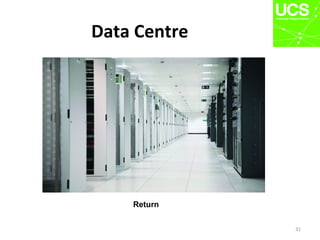
through a data centre - on a pay-per-use (or
pay-as-you-go) cost structure.
3
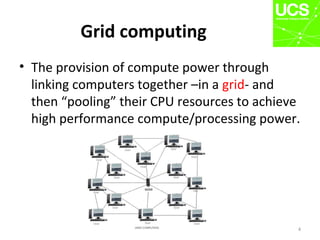
Grid computing
• The provision of compute power through
linking computers together –in a grid- and
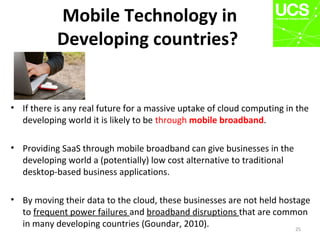
then “pooling” their CPU resources to achieve
high performance compute/processing power.
4
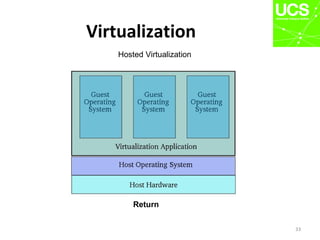
Virtualization
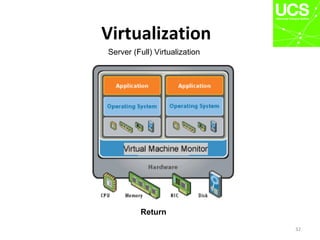
• The technology that enables single physical resources (e.g.,
a server, an operating system, an application, or storage
device) appear as multiple logical resources.
• The technology that masks the physical characteristics of
computing resources (e.g., a PC, a Server) in order to
simplify the way in which other systems, applications, or
end users interact with them. For example, a PC that is
running Windows (the host operating system) and using
virtualization software can also run Linux (
as a guest operating system).
5
Where did the word
“cloud” come from?
6
• In 2006 Eric Schmidt (Executive Chairman of
Google) described Google’s Software as
“cloud computing” at a search engine
conference.
• The term cloud is a metaphor for the Internet,
possibly inspired by cloud images in
computing text books.
Cloud computing’s
service structure
• There are broadly three types of IT services
delivered by cloud computing (Sultan, 2011):
• Software as a Service (SaaS): it involves the remote access of
software applications (e.g., productivity (Office) suites, business
applications, e.g., CRM, KMS);
• Infrastructure as a Service (IaaS): it involves the remote access of IT
infrastructure (e.g., virtual computers, processing capabilities,
storage);
• Platform as a Service (PaaS): it involves the remote access of
development software, testing and hosting of the developed
software. Example: Access to development software to create Web applications
and then to test them and host them on a desired platform (e.g., Apache web
server running on a UNIX or Linux operating system, Internet Information Server
(IIS) running on Window NT/2000 operating system). 7
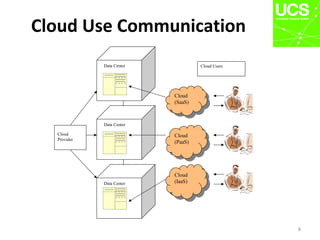
Cloud Use Communication
8
Data Center
Cloud
(SaaS)
Cloud
(SaaS)
Cloud
(PaaS)
Cloud
(PaaS)
Cloud
(IaaS)
Cloud
(IaaS)
Cloud
Provider
Cloud Users
Data Center
Data Center
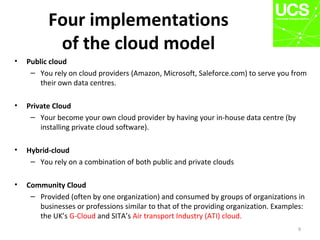
Four implementations
of the cloud model
• Public cloud
– You rely on cloud providers (Amazon, Microsoft, Saleforce.com) to serve you from
their own data centres.
• Private Cloud
– Your become your own cloud provider by having your in-house data centre (by
installing private cloud software).
• Hybrid-cloud
– You rely on a combination of both public and private clouds
• Community Cloud
– Provided (often by one organization) and consumed by groups of organizations in
businesses or professions similar to that of the providing organization. Examples:
the UK’s G-Cloud and SITA’s Air transport Industry (ATI) cloud.
9
But there are cloud
concerns !
• There are still many concerns about cloud computing:
– Security
– Data Protection
– Outages (disruption of services)
– Going “bust”!
– Interoperability (lack of open standards). You
cannot change cloud suppliers like changing your
electricity suppliers!
10
Is providing IT as a
service a new concept?
• Not really!
– In the 1930s (before computers) companies (such as IBM)
specialized in producing electric accounting machines based on
punch-cards and were able to offer data processing services (e.g.,
payrolls) to organizations in return for a fee.
– This practice continued in the 1960s and 1970s (this time using
mainframe computers and teletypes). This process was called
“Timesharing” then.
– This is why some people call cloud computing “Timesharing 2.0”
(Campbell, 2009). 11
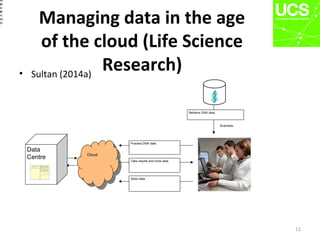
Managing data in the age
of the cloud (Life Science
Research)• Sultan (2014a)
12
ex
nt
lo
d
rc
est
ato
r
at
en
e
Cloud
Cloud
Process DNA data.
Take results and more data.
Retrieve DNA data.
Scientists
Store data.
Data
Centre
Managing data in the age of
the cloud (Healthcare
Provision)• Sultan (2014b)
13
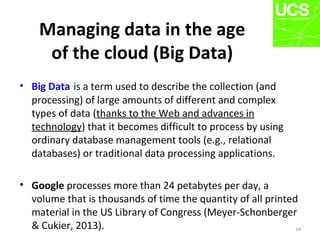
Your medical record and medical
advice
Cloud
Cloud
Retrieve my medical record and medical
advice
Data Centre
Chelsea and Westminster Hospital
Store patient’s data and medical
advice
Show record of patient’s activity
Storing, accessing and editing
patients’ data
Doctor
Relative
(allowed access to set alert
parameters)
Hospital patient
Flexiant Cloud
Orchestrator
DAKAR
Managing data in the age
of the cloud (Big Data)
• Big Data is a term used to describe the collection (and
processing) of large amounts of different and complex
types of data (thanks to the Web and advances in
technology) that it becomes difficult to process by using
ordinary database management tools (e.g., relational
databases) or traditional data processing applications.
• Google processes more than 24 petabytes per day, a
volume that is thousands of time the quantity of all printed
material in the US Library of Congress (Meyer-Schonberger
& Cukier, 2013). 14
Galactic
Information!
• University of California (UC) report : “How Much Information? 2010
Report on Enterprise Server Information” estimated :
• the annual global processing of data in 2008 by the world’s enterprise
servers at 9.57 zettabytes (1 zettabyte = 1021
) . If one is to imagine this
information as a stack of books (assuming each book is 4.8 centimetres
thick and contains 2.5 megabytes of information) it would extend for 5.6
billion miles, enough to stretch from Earth to Neptune 20 times over.
• The study estimated that enterprise server workloads are doubling about
every two years. This means that by 2024 the world’s enterprise servers
will annually process the digital equivalent of a stack of books extending
more than 4.37 light-years to Alpha Centauri, our closest neighbouring
star system in the Milky Way Galaxy 15
Break with the past
• The cloud computing model represents a significant
break with the past:
– You no longer need to buy too much of your
hardware and software needs (you can rent them!).
– No need to maintain (or update) them.
– No need to hire staff to look after them.
– You pay for what you need as you go (pay-as-you-
go). There is scalability.
– You could save power (and money).
– You might even save the environment!
– It has all attributes of a disruptive innovation! 16
Disruptive innovations
• According to Clayton Christenson and his colleagues
(Christensen, 1997; Christensen and Raynor, 2003;
Christensen , Anthony and Roth, 2004) there are two types of
disruptive innovations:
• New market disruption (affects established businesses and
creates new market opportunities). Think of the PC!
• Low-end disruption (affects the low end of the original
business by attracting customers who are served by this level
of the business). Example: Korean automakers’ entry into the
US market. The Korean automakers did not create a new
market; they simply attracted the “least attractive” customers
of the targeted businesses.
17
New market disruptive
innovations
• Such disruptions are described as “new market” disruptions
because they destabilize existing markets and create new
ones.
• They occur when characteristics (e.g., high cost,
inconvenience, complexity) of existing products prevent
many people (i.e., non-consumers) from obtaining them.
• Think of mainframe computers and minicomputers (difficult
and expensive products) and the PC (a disruptive innovation).
• Disruptive innovations have performance issues (initially)!
18
The disruptive qualities
of cloud computing
• Cost
• Complexity
• Convenience
• Serves non-consumers
• Performance issues
• New market (remote as opposed to on-
premise )consumption of IT services
19
The cloud as a
new IT servitization model
• Early literature on servitization introduces the concept as a “value-
added” activity (Vandermerwe and Rada, 1988).
• A strategy of creating value by adding services to products (Baines et
al., 2009).
• More contemporary research on serzitization sees “service(s)” as the
intangible value-creating product of exchange that is more superior
(but not an alternative) to the tangible product (Vargo and Lusch,
2008).
• However, what we see in cloud computing is that the main product
(i.e., software and hardware) turning (or morphing) into a service
(Sultan, 2014c)! 20
Democratizing IT !
• Good IT resources are no longer the privilege
of well-resourced organisations.
• Small to medium enterprise (SMEs) are likely
to be among the main beneficiaries of this
computing service model.
• If democracy means empowering the weak by
providing equal access to resources then
cloud computing is a democratizing force.
21
Democratising IT !
• Ben Kepes (2011) thinks that cloud computing has
unleashed a democratization process similar to that
brought about by the word processor.
• Businesses in developing countries now have the option
(thanks to cloud computing) to use business software (e.g.,
CRM applications) that is prohibitively expensive in the
traditional software world.
• According to Kepes, the economics and speed of
provisioning cloud computing resources is enabling an
entire generation of businesses to be founded. 22
Internet penetration in
Developing Countries
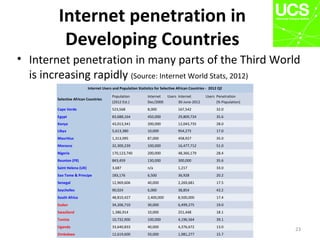
• Internet penetration in many parts of the Third World
is increasing rapidly (Source: Internet World Stats, 2012)
23
Internet Users and Population Statistics for Selective African Countries - 2012 Q2
Selective African Countries
Population
(2012 Est.)
Internet Users
Dec/2000
Internet Users
30-June-2012
Penetration
(% Population)
Cape Verde 523,568 8,000 167,542 32.0
Egypt 83,688,164 450,000 29,809,724 35.6
Kenya 43,013,341 200,000 12,043,735 28.0
Libya 5,613,380 10,000 954,275 17.0
Mauritius 1,313,095 87,000 458,927 35.0
Morocco 32,309,239 100,000 16,477,712 51.0
Nigeria 170,123,740 200,000 48,366,179 28.4
Reunion (FR) 843,459 130,000 300,000 35.6
Saint Helena (UK) 3,687 n/a 1,217 33.0
Sao Tome & Principe 183,176 6,500 36,928 20.2
Senegal 12,969,606 40,000 2,269,681 17.5
Seychelles 90,024 6,000 38,854 43.2
South Africa 48,810,427 2,400,000 8,500,000 17.4
Sudan 34,206,710 30,000 6,499,275 19.0
Swaziland 1,386,914 10,000 251,448 18.1
Tunisia 10,732,900 100,000 4,196,564 39.1
Uganda 33,640,833 40,000 4,376,672 13.0
Zimbabwe 12,619,600 50,000 1,981,277 15.7
Mobile Technology in
Developing Countries
• Inadequate communication infrastructures in many
developing countries have resulted in a huge rise in
mobile and smart phone ownerships.
• The difficulties of rolling out fixed-line networks across
Africa’s vast land mass explains why in mid-2010 mobile
users constituted around 90 percent of all African
telephone subscribers (Internet World Stats, 2012).
24
Mobile Technology in
Developing countries?
• If there is any real future for a massive uptake of cloud computing in the
developing world it is likely to be through mobile broadband.
• Providing SaaS through mobile broadband can give businesses in the
developing world a (potentially) low cost alternative to traditional
desktop-based business applications.
• By moving their data to the cloud, these businesses are not held hostage
to frequent power failures and broadband disruptions that are common
in many developing countries (Goundar, 2010). 25
Mobile Technology in
Developing Countries
• Such scenario will no doubt have an impact on the world’s
ability to access IT resources.
• The disruptive and democratising force of cloud computing
provides an opportunity for individuals and businesses in
developing countries to compete with those in advanced
nations on an equal footing.
• And could (consequently) bridge the digital divide that
currently exists between the developed and the developing
countries or north and south, thus making cloud computing
a force for good in a world marred by historic inequality and
financial greed.
26
Thank you..
27
28
Questions?
References
• Baines, T. S,, Lightfoot, H. W., Benedettini, O. and Kay, J. M. (2009). The Servitization
of Manufacturing: A Review of Literature and Reflection on Future Challenges. Journal
of Manufacturing Technology Management 20 (5): 547–567.
• Campbell, S. (2009). Timesharing 2.0. HPC Wire.
http://www.hpcwire.com/specialfeatures/cloud_computing/features/Timesharing-20-
66169142.html (accessed on: 14 March 2010).
• Gounder, S. (2010). Cloud computing: Opportunities and issues for developing
• countries. http://www.diplomacy.edu/resources/general/cloud-computing-
opportunities-and-issues-developing-countries/
• Internet World Stats (2012). “Internet Users in Africa: 2012 – Q2”;
http://www.internetworldstats.com/stats1.htm.
• Kepes, B. (2011). Revolution Not Evolution How Cloud Computing Differs from Traditional IT
and Why it Matters: Diversity Ltd.
• Meyer-Schonberger, V and Cukier, K. (2013). Big Data: A Revolution That Will Transform
How We Live, Work and Think. John Murray.
• Sultan, N. (2011). Reaching for the ‘cloud’: How SMEs can manage. International Journal of
Information Management, 31(3), 272–278.
29
References
• Sultan, N. (2014a), “Discovering the potential of cloud computing in accelerating the
search for curing serious illnesses”. International Journal of Information Management.
Vol. 34, No. 2.
• Sultan, N (2014b), “Making Use of Cloud Computing for Healthcare Provision:
Opportunities and Challenges”. International Journal of Information Management.
Vol. 34, No. 1.
• Sultan, N. (2014), “Servitization of the IT Industry: The Cloud Phenomenon”, Strategic
Change. Peer-reviewed. Vol. 23, No. 5-6, pp. 375–388. Published by John Wiley &
Sons.
• Vandermerwe, S. and Rada, J. (1988). Servitization of business: adding value by
adding Services. European Management Journal 6 (4): 314–324.
• Vargo, S. L. and Lusch, R. F. (2008). From Goods to Service(s): Divergences and
Convergences of Logics. Industrial Marketing Management 37 (3): 254–259.
30
Data Centre
31
Return
Virtualization
32
Return
Server (Full) Virtualization
Virtualization
33
Return
Hosted Virtualization

Nabil Sultan. The disruptive and democratizing credentials of cloud computing

  • 1.
    Prof. Nabil Sultan Professorof Innovation Management and Leadership University Campus Suffolk nabil.sultan@yahoo.co.uk 1 The Disruptive and Democratizing Credentials of Cloud Computing
  • 2.
    Contents • Cloud Computingand its Applications • Disruptive Innovations and the Disruptive (and Servitized) Attributes of the Cloud • Potential Impact of the Cloud on SMEs and Developing Countries 2
  • 3.
    What is cloudcomputing? • An IT service model that relies on the Web and technologies such as grid computing and virtualization to deliver a range of IT services – through a data centre - on a pay-per-use (or pay-as-you-go) cost structure. 3
  • 4.
    Grid computing • Theprovision of compute power through linking computers together –in a grid- and then “pooling” their CPU resources to achieve high performance compute/processing power. 4
  • 5.
    Virtualization • The technologythat enables single physical resources (e.g., a server, an operating system, an application, or storage device) appear as multiple logical resources. • The technology that masks the physical characteristics of computing resources (e.g., a PC, a Server) in order to simplify the way in which other systems, applications, or end users interact with them. For example, a PC that is running Windows (the host operating system) and using virtualization software can also run Linux ( as a guest operating system). 5
  • 6.
    Where did theword “cloud” come from? 6 • In 2006 Eric Schmidt (Executive Chairman of Google) described Google’s Software as “cloud computing” at a search engine conference. • The term cloud is a metaphor for the Internet, possibly inspired by cloud images in computing text books.
  • 7.
    Cloud computing’s service structure •There are broadly three types of IT services delivered by cloud computing (Sultan, 2011): • Software as a Service (SaaS): it involves the remote access of software applications (e.g., productivity (Office) suites, business applications, e.g., CRM, KMS); • Infrastructure as a Service (IaaS): it involves the remote access of IT infrastructure (e.g., virtual computers, processing capabilities, storage); • Platform as a Service (PaaS): it involves the remote access of development software, testing and hosting of the developed software. Example: Access to development software to create Web applications and then to test them and host them on a desired platform (e.g., Apache web server running on a UNIX or Linux operating system, Internet Information Server (IIS) running on Window NT/2000 operating system). 7
  • 8.
    Cloud Use Communication 8 DataCenter Cloud (SaaS) Cloud (SaaS) Cloud (PaaS) Cloud (PaaS) Cloud (IaaS) Cloud (IaaS) Cloud Provider Cloud Users Data Center Data Center
  • 9.
    Four implementations of thecloud model • Public cloud – You rely on cloud providers (Amazon, Microsoft, Saleforce.com) to serve you from their own data centres. • Private Cloud – Your become your own cloud provider by having your in-house data centre (by installing private cloud software). • Hybrid-cloud – You rely on a combination of both public and private clouds • Community Cloud – Provided (often by one organization) and consumed by groups of organizations in businesses or professions similar to that of the providing organization. Examples: the UK’s G-Cloud and SITA’s Air transport Industry (ATI) cloud. 9
  • 10.
    But there arecloud concerns ! • There are still many concerns about cloud computing: – Security – Data Protection – Outages (disruption of services) – Going “bust”! – Interoperability (lack of open standards). You cannot change cloud suppliers like changing your electricity suppliers! 10
  • 11.
    Is providing ITas a service a new concept? • Not really! – In the 1930s (before computers) companies (such as IBM) specialized in producing electric accounting machines based on punch-cards and were able to offer data processing services (e.g., payrolls) to organizations in return for a fee. – This practice continued in the 1960s and 1970s (this time using mainframe computers and teletypes). This process was called “Timesharing” then. – This is why some people call cloud computing “Timesharing 2.0” (Campbell, 2009). 11
  • 12.
    Managing data inthe age of the cloud (Life Science Research)• Sultan (2014a) 12 ex nt lo d rc est ato r at en e Cloud Cloud Process DNA data. Take results and more data. Retrieve DNA data. Scientists Store data. Data Centre
  • 13.
    Managing data inthe age of the cloud (Healthcare Provision)• Sultan (2014b) 13 Your medical record and medical advice Cloud Cloud Retrieve my medical record and medical advice Data Centre Chelsea and Westminster Hospital Store patient’s data and medical advice Show record of patient’s activity Storing, accessing and editing patients’ data Doctor Relative (allowed access to set alert parameters) Hospital patient Flexiant Cloud Orchestrator DAKAR
  • 14.
    Managing data inthe age of the cloud (Big Data) • Big Data is a term used to describe the collection (and processing) of large amounts of different and complex types of data (thanks to the Web and advances in technology) that it becomes difficult to process by using ordinary database management tools (e.g., relational databases) or traditional data processing applications. • Google processes more than 24 petabytes per day, a volume that is thousands of time the quantity of all printed material in the US Library of Congress (Meyer-Schonberger & Cukier, 2013). 14
  • 15.
    Galactic Information! • University ofCalifornia (UC) report : “How Much Information? 2010 Report on Enterprise Server Information” estimated : • the annual global processing of data in 2008 by the world’s enterprise servers at 9.57 zettabytes (1 zettabyte = 1021 ) . If one is to imagine this information as a stack of books (assuming each book is 4.8 centimetres thick and contains 2.5 megabytes of information) it would extend for 5.6 billion miles, enough to stretch from Earth to Neptune 20 times over. • The study estimated that enterprise server workloads are doubling about every two years. This means that by 2024 the world’s enterprise servers will annually process the digital equivalent of a stack of books extending more than 4.37 light-years to Alpha Centauri, our closest neighbouring star system in the Milky Way Galaxy 15
  • 16.
    Break with thepast • The cloud computing model represents a significant break with the past: – You no longer need to buy too much of your hardware and software needs (you can rent them!). – No need to maintain (or update) them. – No need to hire staff to look after them. – You pay for what you need as you go (pay-as-you- go). There is scalability. – You could save power (and money). – You might even save the environment! – It has all attributes of a disruptive innovation! 16
  • 17.
    Disruptive innovations • Accordingto Clayton Christenson and his colleagues (Christensen, 1997; Christensen and Raynor, 2003; Christensen , Anthony and Roth, 2004) there are two types of disruptive innovations: • New market disruption (affects established businesses and creates new market opportunities). Think of the PC! • Low-end disruption (affects the low end of the original business by attracting customers who are served by this level of the business). Example: Korean automakers’ entry into the US market. The Korean automakers did not create a new market; they simply attracted the “least attractive” customers of the targeted businesses. 17
  • 18.
    New market disruptive innovations •Such disruptions are described as “new market” disruptions because they destabilize existing markets and create new ones. • They occur when characteristics (e.g., high cost, inconvenience, complexity) of existing products prevent many people (i.e., non-consumers) from obtaining them. • Think of mainframe computers and minicomputers (difficult and expensive products) and the PC (a disruptive innovation). • Disruptive innovations have performance issues (initially)! 18
  • 19.
    The disruptive qualities ofcloud computing • Cost • Complexity • Convenience • Serves non-consumers • Performance issues • New market (remote as opposed to on- premise )consumption of IT services 19
  • 20.
    The cloud asa new IT servitization model • Early literature on servitization introduces the concept as a “value- added” activity (Vandermerwe and Rada, 1988). • A strategy of creating value by adding services to products (Baines et al., 2009). • More contemporary research on serzitization sees “service(s)” as the intangible value-creating product of exchange that is more superior (but not an alternative) to the tangible product (Vargo and Lusch, 2008). • However, what we see in cloud computing is that the main product (i.e., software and hardware) turning (or morphing) into a service (Sultan, 2014c)! 20
  • 21.
    Democratizing IT ! •Good IT resources are no longer the privilege of well-resourced organisations. • Small to medium enterprise (SMEs) are likely to be among the main beneficiaries of this computing service model. • If democracy means empowering the weak by providing equal access to resources then cloud computing is a democratizing force. 21
  • 22.
    Democratising IT ! •Ben Kepes (2011) thinks that cloud computing has unleashed a democratization process similar to that brought about by the word processor. • Businesses in developing countries now have the option (thanks to cloud computing) to use business software (e.g., CRM applications) that is prohibitively expensive in the traditional software world. • According to Kepes, the economics and speed of provisioning cloud computing resources is enabling an entire generation of businesses to be founded. 22
  • 23.
    Internet penetration in DevelopingCountries • Internet penetration in many parts of the Third World is increasing rapidly (Source: Internet World Stats, 2012) 23 Internet Users and Population Statistics for Selective African Countries - 2012 Q2 Selective African Countries Population (2012 Est.) Internet Users Dec/2000 Internet Users 30-June-2012 Penetration (% Population) Cape Verde 523,568 8,000 167,542 32.0 Egypt 83,688,164 450,000 29,809,724 35.6 Kenya 43,013,341 200,000 12,043,735 28.0 Libya 5,613,380 10,000 954,275 17.0 Mauritius 1,313,095 87,000 458,927 35.0 Morocco 32,309,239 100,000 16,477,712 51.0 Nigeria 170,123,740 200,000 48,366,179 28.4 Reunion (FR) 843,459 130,000 300,000 35.6 Saint Helena (UK) 3,687 n/a 1,217 33.0 Sao Tome & Principe 183,176 6,500 36,928 20.2 Senegal 12,969,606 40,000 2,269,681 17.5 Seychelles 90,024 6,000 38,854 43.2 South Africa 48,810,427 2,400,000 8,500,000 17.4 Sudan 34,206,710 30,000 6,499,275 19.0 Swaziland 1,386,914 10,000 251,448 18.1 Tunisia 10,732,900 100,000 4,196,564 39.1 Uganda 33,640,833 40,000 4,376,672 13.0 Zimbabwe 12,619,600 50,000 1,981,277 15.7
  • 24.
    Mobile Technology in DevelopingCountries • Inadequate communication infrastructures in many developing countries have resulted in a huge rise in mobile and smart phone ownerships. • The difficulties of rolling out fixed-line networks across Africa’s vast land mass explains why in mid-2010 mobile users constituted around 90 percent of all African telephone subscribers (Internet World Stats, 2012). 24
  • 25.
    Mobile Technology in Developingcountries? • If there is any real future for a massive uptake of cloud computing in the developing world it is likely to be through mobile broadband. • Providing SaaS through mobile broadband can give businesses in the developing world a (potentially) low cost alternative to traditional desktop-based business applications. • By moving their data to the cloud, these businesses are not held hostage to frequent power failures and broadband disruptions that are common in many developing countries (Goundar, 2010). 25
  • 26.
    Mobile Technology in DevelopingCountries • Such scenario will no doubt have an impact on the world’s ability to access IT resources. • The disruptive and democratising force of cloud computing provides an opportunity for individuals and businesses in developing countries to compete with those in advanced nations on an equal footing. • And could (consequently) bridge the digital divide that currently exists between the developed and the developing countries or north and south, thus making cloud computing a force for good in a world marred by historic inequality and financial greed. 26
  • 27.
  • 28.
  • 29.
    References • Baines, T.S,, Lightfoot, H. W., Benedettini, O. and Kay, J. M. (2009). The Servitization of Manufacturing: A Review of Literature and Reflection on Future Challenges. Journal of Manufacturing Technology Management 20 (5): 547–567. • Campbell, S. (2009). Timesharing 2.0. HPC Wire. http://www.hpcwire.com/specialfeatures/cloud_computing/features/Timesharing-20- 66169142.html (accessed on: 14 March 2010). • Gounder, S. (2010). Cloud computing: Opportunities and issues for developing • countries. http://www.diplomacy.edu/resources/general/cloud-computing- opportunities-and-issues-developing-countries/ • Internet World Stats (2012). “Internet Users in Africa: 2012 – Q2”; http://www.internetworldstats.com/stats1.htm. • Kepes, B. (2011). Revolution Not Evolution How Cloud Computing Differs from Traditional IT and Why it Matters: Diversity Ltd. • Meyer-Schonberger, V and Cukier, K. (2013). Big Data: A Revolution That Will Transform How We Live, Work and Think. John Murray. • Sultan, N. (2011). Reaching for the ‘cloud’: How SMEs can manage. International Journal of Information Management, 31(3), 272–278. 29
  • 30.
    References • Sultan, N.(2014a), “Discovering the potential of cloud computing in accelerating the search for curing serious illnesses”. International Journal of Information Management. Vol. 34, No. 2. • Sultan, N (2014b), “Making Use of Cloud Computing for Healthcare Provision: Opportunities and Challenges”. International Journal of Information Management. Vol. 34, No. 1. • Sultan, N. (2014), “Servitization of the IT Industry: The Cloud Phenomenon”, Strategic Change. Peer-reviewed. Vol. 23, No. 5-6, pp. 375–388. Published by John Wiley & Sons. • Vandermerwe, S. and Rada, J. (1988). Servitization of business: adding value by adding Services. European Management Journal 6 (4): 314–324. • Vargo, S. L. and Lusch, R. F. (2008). From Goods to Service(s): Divergences and Convergences of Logics. Industrial Marketing Management 37 (3): 254–259. 30
  • 31.
  • 32.
  • 33.

Editor's Notes

  • #5 CPU = Central Processing Unit (the computer’s brain)
  • #8 https://mail.google.com/mail/u/0/?shva=1#inbox
  • #10 SITA (Société Internationale de Télécommunications Aéronautique) – HQ in Geneva – is the world's leading specialist in air transport communications and information technology (IT). The company has the remit of working with the air transport community for the benefit of all members. http://www.sita.aero/content/sita-launches-dedicated-air-transport-industry-ati-cloud
  • #11 In 2009 Amazon launched a service known as Virtual Private Cloud (VPC) that was designed to address the issue of security and control which seems to be one of the concerns of large organizations. Amazon’s VPC allows organizations to connect their existing legacy infrastructures to Amazon’s clouds via a Virtual Private Network (VPN) connection. This means that Amazon’s cloud customers can create their own virtual private clouds (VPCs) within Amazon’s cloud infrastructure and then connect those VPCs directly to their network servers using industry-standard encrypted Ipsec VPN connections. What is VPN tunnel? See this for info: https://www.ivpn.net/what-is-a-tunnel Investigate SOAP (Simple Object Access Protocol) and REST (Representational State Transfer).
  • #13 Next-generation DNA sequencing machines create massive amounts of data and require massive amounts of processing power. Most of the IT infrastructures of pharmaceutical and biotechnology companies are unable to provide this capability. Cloud computing can provide the necessary storage and processing power as and when requested.
  • #14 The two-year project, which started in 2009, was funded by the UK’s Technology Strategy Board (TSB). Napier University along with a number of other partners (e.g., Chelsea and Westminster NHS Foundation Trust, CipherLab, GS1 UK, Imperial College, and Kodit) formed the consortium that bid successfully for this e-Health project (also known as the Data Capture and Auto Identification Reference –DACAR). A simulator (not real patients) was used.
  • #15 1 PB = 1000000000000000
  • #17 It is estimated that the world’s 1.5 billion computers consume about 90,000 MW of electric power, which is about 10 percent of global consumption (Lefèvre and Pierson). According to Gartner, an American research firm, IT use around the world now causes about two per cent of global CO2 emissions. The carbon footprint from computer use now exceeds that of the aviation industry (Mail online, 2009)
  • #22 The disruptive force of cloud computing is turning into a democratising force.
  • #26 Netbooks with data plans.