Cloud Computing – AnCloud Computing – An
Emerging ParadigmEmerging Paradigm
Seminar IISeminar II
Nazneen SheikhNazneen Sheikh
2010A7PS163U2010A7PS163U
AtAt GranteqGranteq LLCLLC
Jumeirah Beach RoadJumeirah Beach Road
Dubai - UAEDubai - UAE
IntroductionIntroduction
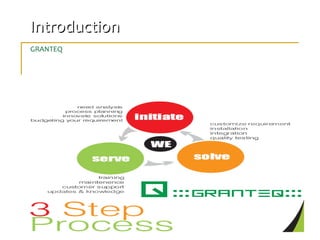
GRANTEQ is a specialist IT-AV Convergence solutions provider having a mission to
help clients design, build, support, and manage facility and infrastructures to
support every day business goals. With offices present in Middle East and India, it
strives to help the customers to implement & effectively use most feasible & cost-
effective AV & control solutions.
Team OverviewTeam Overview
 Sales /Channel Team
 Dedicated Sales team
 Channel selection on vertical coverage
 Demo facility
 Technical Excellence
 Pre-Sales / Design & Build
 Programming & Software
development
 RFP / Bid Support
 Post Sales support and level 2 remote support
TechnologyTechnology
These are the different technologies provided by Granteq:
 Audio Conferencing
 Video Conferencing
 Interactive Response Systems
 Classroom Audio Technology
 Interactive Whiteboards
 Projectors
 Display Systems
 Visualizers
and many more…
Interactive Response SystemsInteractive Response Systems
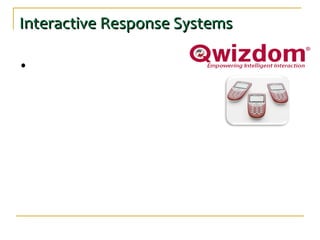
Interactive response
systems and Voting
tools
•These interactive response
systems help teachers bring more
collaboration and interactivity into
the classroom. Because they are so
easy to use, teachers can quickly
incorporate them into their
teaching to transform student
learning and increase engagement.
Video Conferencing/ TelepresenceVideo Conferencing/ Telepresence
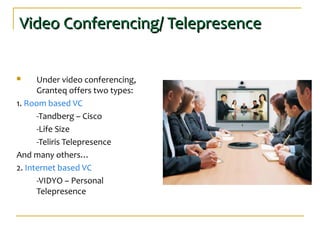
 Under video conferencing,
Granteq offers two types:
1. Room based VC
-Tandberg – Cisco
-Life Size
-Teliris Telepresence
And many others…
2. Internet based VC
-VIDYO – Personal
Telepresence
VIDYO – Personal TelepresenceVIDYO – Personal Telepresence
 VidyoConferencing delivers higher
quality expectations and greater
deployment flexibility over converged
IP networks.
 It is the first VC solution designed to
work like the Internet itself.
 Its unique intellectual property and
the advent of the VidyoRouter makes
it the first solution designed
specifically for the world of
distributed computing.
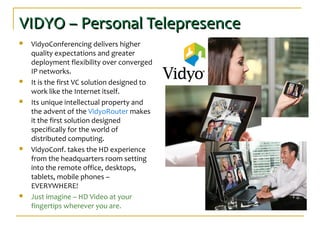
 VidyoConf. takes the HD experience
from the headquarters room setting
into the remote office, desktops,
tablets, mobile phones –
EVERYWHERE!
 Just imagine – HD Video at your
fingertips wherever you are.
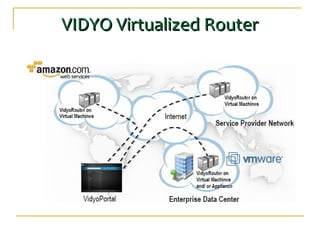
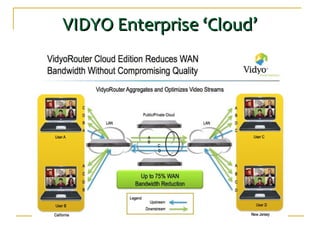
VIDYO Enterprise ‘Cloud’VIDYO Enterprise ‘Cloud’
 Vidyo is relentlessly focused on HD video conferencing
technology that is dynamic and scalable without sacrificing
quality.
 Clearly a new model is needed for the expected growth of
video conferencing in today’s web-powered, mobile and on-
demand world.
 There’s a growing need to manage bandwidth in a highly
diverse and distributed environment, and Vidyo has the
answer –
VidyoRouter™ Cloud Edition
Cloud ComputingCloud Computing
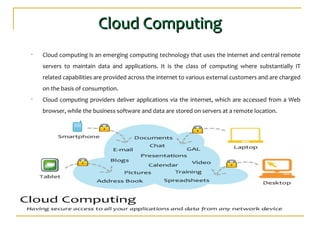
• Cloud computing is an emerging computing technology that uses the internet and central remote
servers to maintain data and applications. It is the class of computing where substantially IT
related capabilities are provided across the internet to various external customers and are charged
on the basis of consumption.
• Cloud computing providers deliver applications via the internet, which are accessed from a Web
browser, while the business software and data are stored on servers at a remote location.
Cloud ServicesCloud Services
The cloud client is both hardware and software which is relying on cloud
computing to deliver the application to your computer, smart-phone, and web
browser.
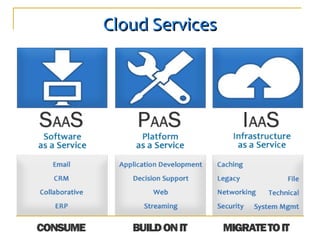
 Applications-As-A-Service (AaaS) /Software-As-A-Service (SaaS)
 Leverages the Cloud in software architecture.
 Eliminates the need to install and run the application on the customer's own
computer.
 Platform-As-A-Service (PaaS)
 Delivers a computing platform and/or solution stack as a service.
 Facilitates deployment of applications without the cost and complexity of
buying and managing the underlying hardware and software layers.
 Infrastructure-As-A-Service (IaaS)
 The delivery of computer Infrastructure-As-Service, typically platform
virtualization.
 The servers in the data center are the computer hardware and/or computer
software products that are specifically designed for the delivery of cloud
services.
Cloud ServicesCloud Services
Characteristics of ‘Cloud’ ComputingCharacteristics of ‘Cloud’ Computing
ServicesServices
 Self-Healing (In case of failure, there’s ALWAYS a backup – multiple copies are
updated regularly)
 Multi-tenancy (Multiple tenants at the same instant of time – sharing
without each other’s knowledge – FACEBOOK! – No compromise of privacy and security of data)
 Linearly Scalable (Break down workloads in pieces and then service it)
 Service-oriented (created out of other discrete services)
 Virtualized (The applications are fully decoupled from the underlying hardware –
fully virtualized environment)
 Flexible (Can be used to serve a variety of workload types – be it a small consumer app
or a very heavy loads of commercial application)
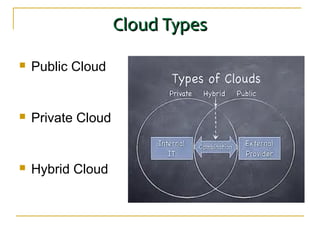
Cloud TypesCloud Types
 Public Cloud
 Private Cloud
 Hybrid Cloud
Types….ContdTypes….Contd
 Cloud computing is the delivery of computing as a service rather than
a product, whereby shared resources, software and information are
provided to computers and other devices as a utility over a network.
 Public cloud is one based on the standard cloud computing model, in
which a service provider makes resources, such as applications and
storage, available to the general public over the Internet.
 Hybrid cloud is a composition of two or more clouds (private or public)
that remain unique entities but are bound together, offering the benefits
of multiple deployment models.
 Private cloud is infrastructure operated solely for a single organization,
whether managed internally or by a third-party and hosted internally or
externally.
UsesUses
 Access to information and services
anywhere.
 Free and pay-as-user needs.
 Companies with ease of scalability.
 Processing and storage capacity without
installing machines locally.
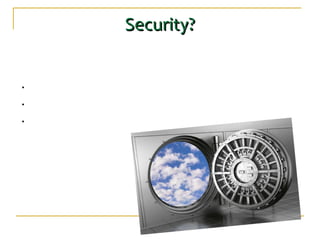
Security?Security?
The relative security of cloud computing services is a contentious issue which may be delaying its
adoption. Some argue that customer data is more secure when managed internally, while others
argue that cloud providers have a strong incentive to maintain trust and as such employ a higher
level of security.
•Data in the hands of third-party: Companies and users relegate control of their data in
the hands of others.
•Lack of access to the source: The cloud will be littered with closed source applications
and the user will be defenseless against them.
•Dependence on internet computing in the cloud.
WINDOWS AZUREWINDOWS AZURE
 Cloud computing concept introduced in .NET
4.0."Azure" is project name from Microsoft for Cloud
Computing. Through Cloud computing Microsoft
targets for platform independence in their
applications. That is each web can communicate to any
other servers directly.
AMAZONAMAZON
 Amazon played a key role in the development of cloud
computing by modernizing their data centers. Amazon Web
Services is a pioneer in this field. Currently, it is also the
largest public cloud provider.
VMWARE CLOUDVMWARE CLOUD
 Virtualization is the essential catalyst for cloud
computing. As the virtualization leader, VMware builds
on this solid foundation with platforms and solutions
to power your cloud infrastructure, build and run
robust cloud applications, and supply end-user
computing as a cloud-based service.
HYPER-V CLOUDHYPER-V CLOUD
 Microsoft solutions for private cloud are built on
Windows Server2008 R2 Hyper-V and System
Center. The Microsoft private cloud solution is a
key part of approach to cloud computing.
IBM CLOUDIBM CLOUD
 IBM helps clients excel in Cloud Computing,
offering reliable and secure SaaS, IaaS, and
PaaS solutions.
VIDYO Virtualized RouterVIDYO Virtualized Router
VIDYO Enterprise ‘Cloud’VIDYO Enterprise ‘Cloud’
ConclusionConclusion
 Cloud computing is a better way to
run a business. Instead of running your apps
yourself, they run on a shared data center.
When you use an application that runs in the
cloud, you just log in, customize it, and start
using it. That's the power of cloud computing.
 Finally, cloud apps don't eat up your valuable IT
resources. This lets you focus on deploying
more apps, new projects, and innovation.
Cloud computing – an emerging paradigm

Cloud computing – an emerging paradigm

  • 1.
    Cloud Computing –AnCloud Computing – An Emerging ParadigmEmerging Paradigm Seminar IISeminar II Nazneen SheikhNazneen Sheikh 2010A7PS163U2010A7PS163U AtAt GranteqGranteq LLCLLC Jumeirah Beach RoadJumeirah Beach Road Dubai - UAEDubai - UAE
  • 2.
    IntroductionIntroduction GRANTEQ is aspecialist IT-AV Convergence solutions provider having a mission to help clients design, build, support, and manage facility and infrastructures to support every day business goals. With offices present in Middle East and India, it strives to help the customers to implement & effectively use most feasible & cost- effective AV & control solutions.
  • 3.
    Team OverviewTeam Overview Sales /Channel Team  Dedicated Sales team  Channel selection on vertical coverage  Demo facility  Technical Excellence  Pre-Sales / Design & Build  Programming & Software development  RFP / Bid Support  Post Sales support and level 2 remote support
  • 4.
    TechnologyTechnology These are thedifferent technologies provided by Granteq:  Audio Conferencing  Video Conferencing  Interactive Response Systems  Classroom Audio Technology  Interactive Whiteboards  Projectors  Display Systems  Visualizers and many more…
  • 5.
    Interactive Response SystemsInteractiveResponse Systems Interactive response systems and Voting tools •These interactive response systems help teachers bring more collaboration and interactivity into the classroom. Because they are so easy to use, teachers can quickly incorporate them into their teaching to transform student learning and increase engagement.
  • 6.
    Video Conferencing/ TelepresenceVideoConferencing/ Telepresence  Under video conferencing, Granteq offers two types: 1. Room based VC -Tandberg – Cisco -Life Size -Teliris Telepresence And many others… 2. Internet based VC -VIDYO – Personal Telepresence
  • 7.
    VIDYO – PersonalTelepresenceVIDYO – Personal Telepresence  VidyoConferencing delivers higher quality expectations and greater deployment flexibility over converged IP networks.  It is the first VC solution designed to work like the Internet itself.  Its unique intellectual property and the advent of the VidyoRouter makes it the first solution designed specifically for the world of distributed computing.  VidyoConf. takes the HD experience from the headquarters room setting into the remote office, desktops, tablets, mobile phones – EVERYWHERE!  Just imagine – HD Video at your fingertips wherever you are.
  • 8.
    VIDYO Enterprise ‘Cloud’VIDYOEnterprise ‘Cloud’  Vidyo is relentlessly focused on HD video conferencing technology that is dynamic and scalable without sacrificing quality.  Clearly a new model is needed for the expected growth of video conferencing in today’s web-powered, mobile and on- demand world.  There’s a growing need to manage bandwidth in a highly diverse and distributed environment, and Vidyo has the answer – VidyoRouter™ Cloud Edition
  • 9.
    Cloud ComputingCloud Computing •Cloud computing is an emerging computing technology that uses the internet and central remote servers to maintain data and applications. It is the class of computing where substantially IT related capabilities are provided across the internet to various external customers and are charged on the basis of consumption. • Cloud computing providers deliver applications via the internet, which are accessed from a Web browser, while the business software and data are stored on servers at a remote location.
  • 10.
    Cloud ServicesCloud Services Thecloud client is both hardware and software which is relying on cloud computing to deliver the application to your computer, smart-phone, and web browser.  Applications-As-A-Service (AaaS) /Software-As-A-Service (SaaS)  Leverages the Cloud in software architecture.  Eliminates the need to install and run the application on the customer's own computer.  Platform-As-A-Service (PaaS)  Delivers a computing platform and/or solution stack as a service.  Facilitates deployment of applications without the cost and complexity of buying and managing the underlying hardware and software layers.  Infrastructure-As-A-Service (IaaS)  The delivery of computer Infrastructure-As-Service, typically platform virtualization.  The servers in the data center are the computer hardware and/or computer software products that are specifically designed for the delivery of cloud services.
  • 11.
  • 12.
    Characteristics of ‘Cloud’ComputingCharacteristics of ‘Cloud’ Computing ServicesServices  Self-Healing (In case of failure, there’s ALWAYS a backup – multiple copies are updated regularly)  Multi-tenancy (Multiple tenants at the same instant of time – sharing without each other’s knowledge – FACEBOOK! – No compromise of privacy and security of data)  Linearly Scalable (Break down workloads in pieces and then service it)  Service-oriented (created out of other discrete services)  Virtualized (The applications are fully decoupled from the underlying hardware – fully virtualized environment)  Flexible (Can be used to serve a variety of workload types – be it a small consumer app or a very heavy loads of commercial application)
  • 13.
    Cloud TypesCloud Types Public Cloud  Private Cloud  Hybrid Cloud
  • 14.
    Types….ContdTypes….Contd  Cloud computingis the delivery of computing as a service rather than a product, whereby shared resources, software and information are provided to computers and other devices as a utility over a network.  Public cloud is one based on the standard cloud computing model, in which a service provider makes resources, such as applications and storage, available to the general public over the Internet.  Hybrid cloud is a composition of two or more clouds (private or public) that remain unique entities but are bound together, offering the benefits of multiple deployment models.  Private cloud is infrastructure operated solely for a single organization, whether managed internally or by a third-party and hosted internally or externally.
  • 15.
    UsesUses  Access toinformation and services anywhere.  Free and pay-as-user needs.  Companies with ease of scalability.  Processing and storage capacity without installing machines locally.
  • 16.
    Security?Security? The relative securityof cloud computing services is a contentious issue which may be delaying its adoption. Some argue that customer data is more secure when managed internally, while others argue that cloud providers have a strong incentive to maintain trust and as such employ a higher level of security. •Data in the hands of third-party: Companies and users relegate control of their data in the hands of others. •Lack of access to the source: The cloud will be littered with closed source applications and the user will be defenseless against them. •Dependence on internet computing in the cloud.
  • 17.
    WINDOWS AZUREWINDOWS AZURE Cloud computing concept introduced in .NET 4.0."Azure" is project name from Microsoft for Cloud Computing. Through Cloud computing Microsoft targets for platform independence in their applications. That is each web can communicate to any other servers directly.
  • 18.
    AMAZONAMAZON  Amazon playeda key role in the development of cloud computing by modernizing their data centers. Amazon Web Services is a pioneer in this field. Currently, it is also the largest public cloud provider.
  • 19.
    VMWARE CLOUDVMWARE CLOUD Virtualization is the essential catalyst for cloud computing. As the virtualization leader, VMware builds on this solid foundation with platforms and solutions to power your cloud infrastructure, build and run robust cloud applications, and supply end-user computing as a cloud-based service.
  • 20.
    HYPER-V CLOUDHYPER-V CLOUD Microsoft solutions for private cloud are built on Windows Server2008 R2 Hyper-V and System Center. The Microsoft private cloud solution is a key part of approach to cloud computing.
  • 21.
    IBM CLOUDIBM CLOUD IBM helps clients excel in Cloud Computing, offering reliable and secure SaaS, IaaS, and PaaS solutions.
  • 22.
  • 23.
    VIDYO Enterprise ‘Cloud’VIDYOEnterprise ‘Cloud’
  • 24.
    ConclusionConclusion  Cloud computingis a better way to run a business. Instead of running your apps yourself, they run on a shared data center. When you use an application that runs in the cloud, you just log in, customize it, and start using it. That's the power of cloud computing.  Finally, cloud apps don't eat up your valuable IT resources. This lets you focus on deploying more apps, new projects, and innovation.

Editor's Notes

  • #2 Good morning everyone!