Bob Plumridge Chairman SNIA E Hitachi Data Systems  Enabling Easier Cloud Solutions Deployment
Topics for this presentation Looking at the Clouds Cloud Industry Challenges SNIA Cloud Storage Initiative
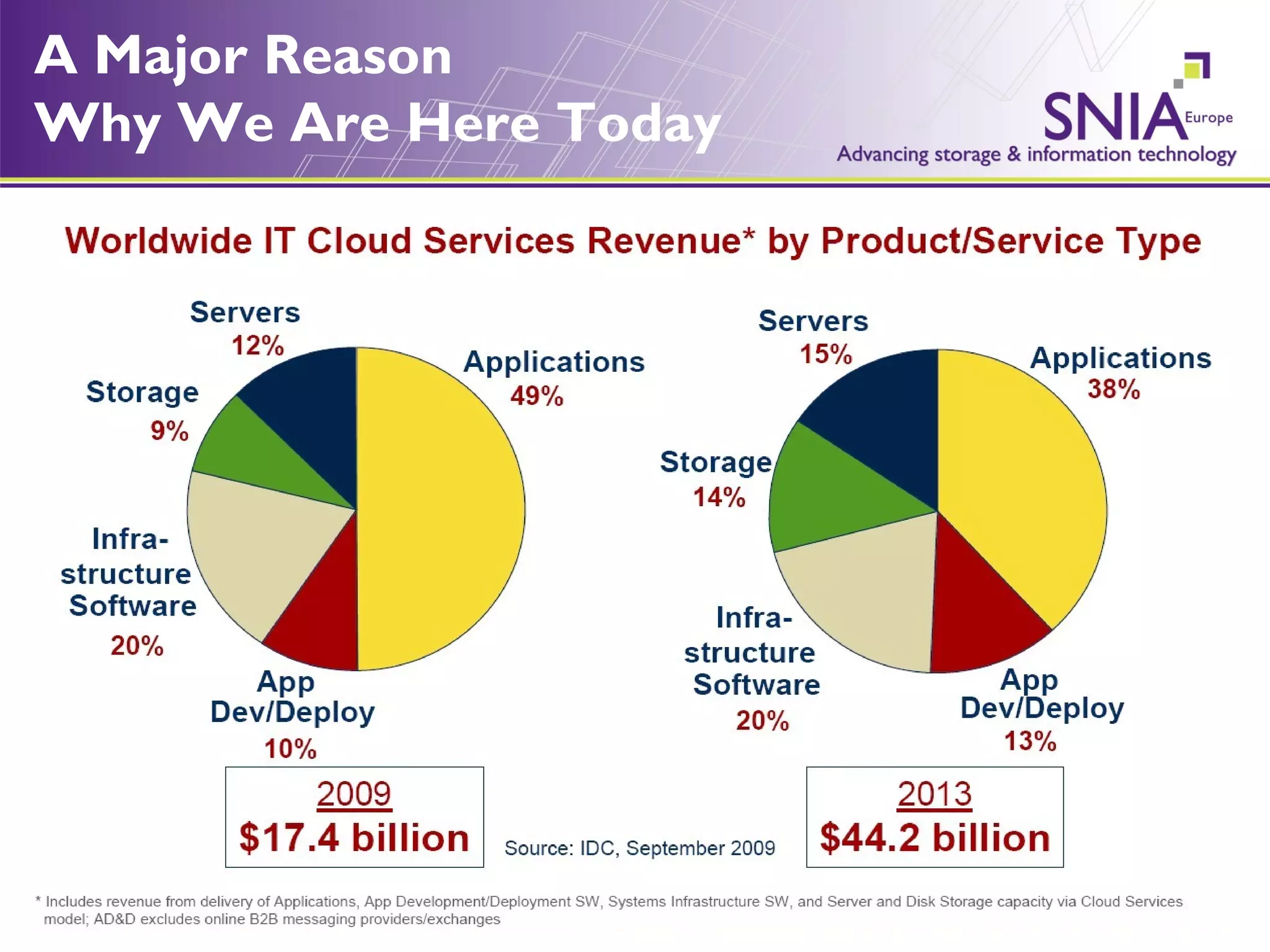
A Major Reason  Why We Are Here Today
What is Cloud Storage? The use of the term  cloud   in describing these new models arose from architecture drawings that typically used a cloud as the dominant networking icon.  The cloud conceptually represented any to any connectivity in a network, but also an abstraction of concerns such the actual connectivity and the services running in the network that accomplish that connectivity with little manual intervention.
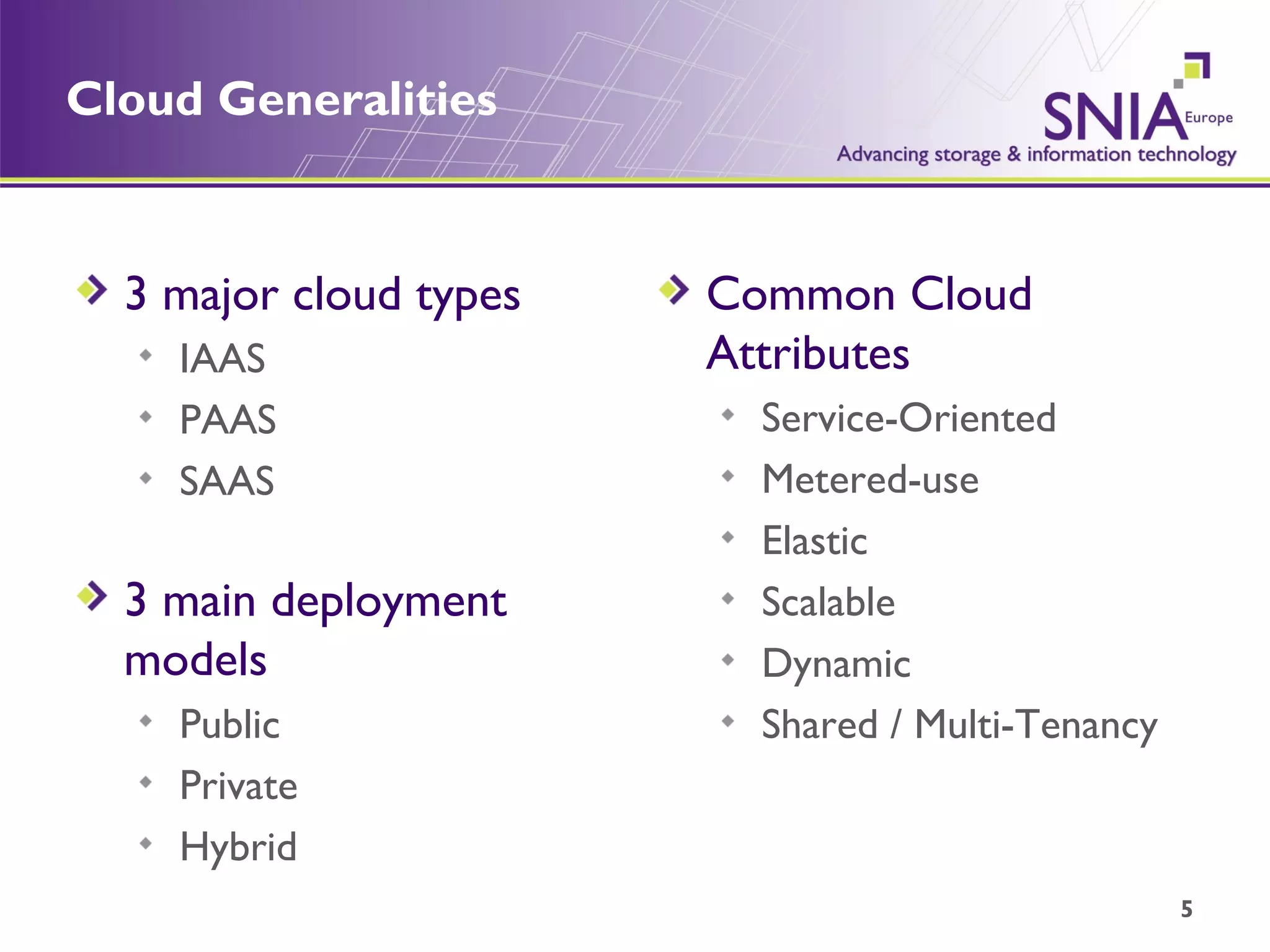
Cloud Generalities 3 major cloud types IAAS PAAS SAAS 3 main deployment models Public Private Hybrid Common Cloud Attributes Service-Oriented Metered-use Elastic Scalable Dynamic Shared / Multi-Tenancy
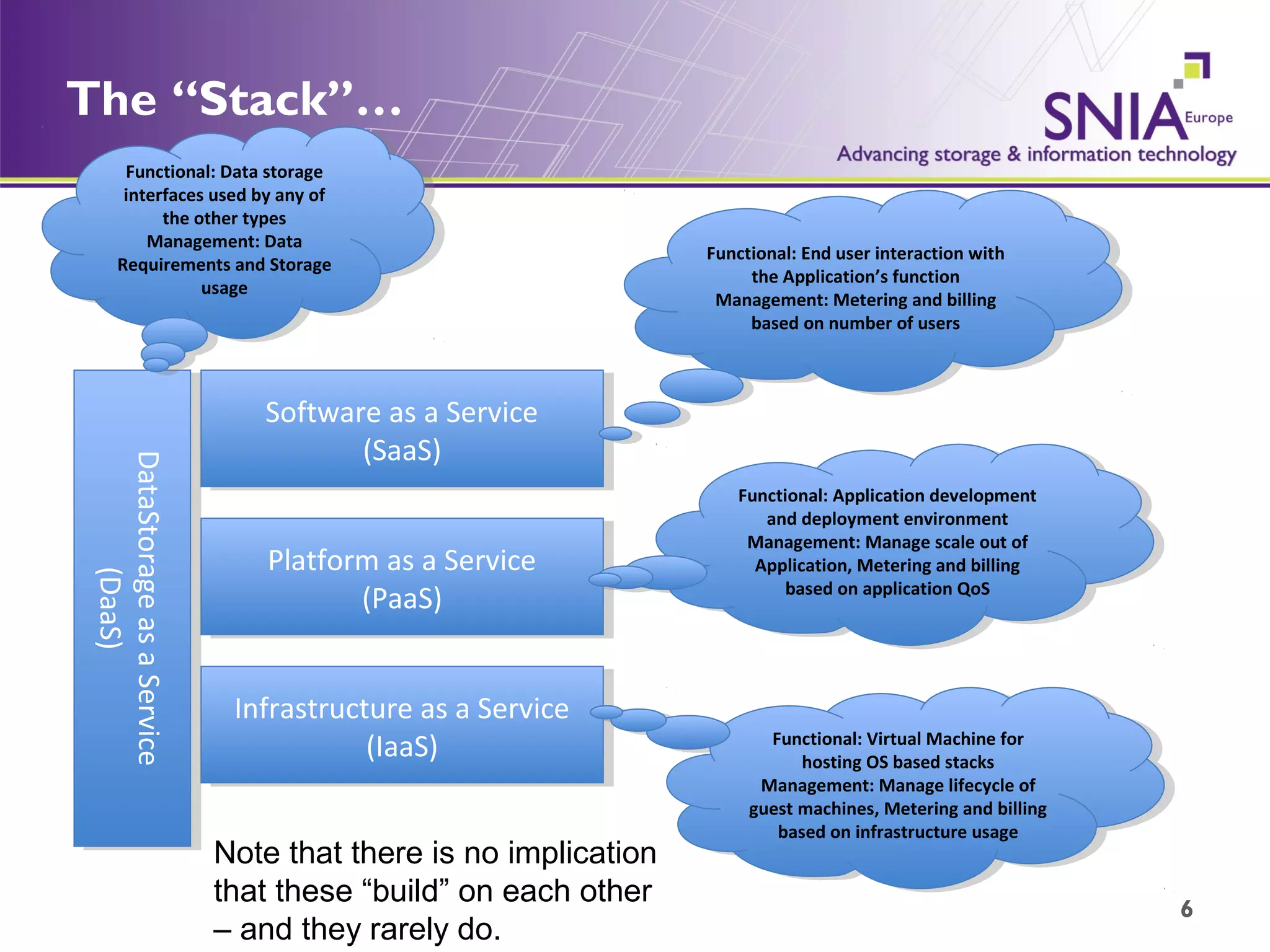
The “Stack”… DataStorage as a Service (DaaS) Software as a Service (SaaS) Platform as a Service (PaaS) Infrastructure as a Service (IaaS) Functional: Data storage interfaces used by any of the other types Management: Data Requirements and Storage usage Functional: End user interaction with the Application’s function Management: Metering and billing based on number of users Functional: Application development and deployment environment Management: Manage scale out of Application, Metering and billing based on application QoS Functional: Virtual Machine for hosting OS based stacks Management: Manage lifecycle of guest machines, Metering and billing based on infrastructure usage Note that there is no implication that these “build” on each other – and they rarely do.
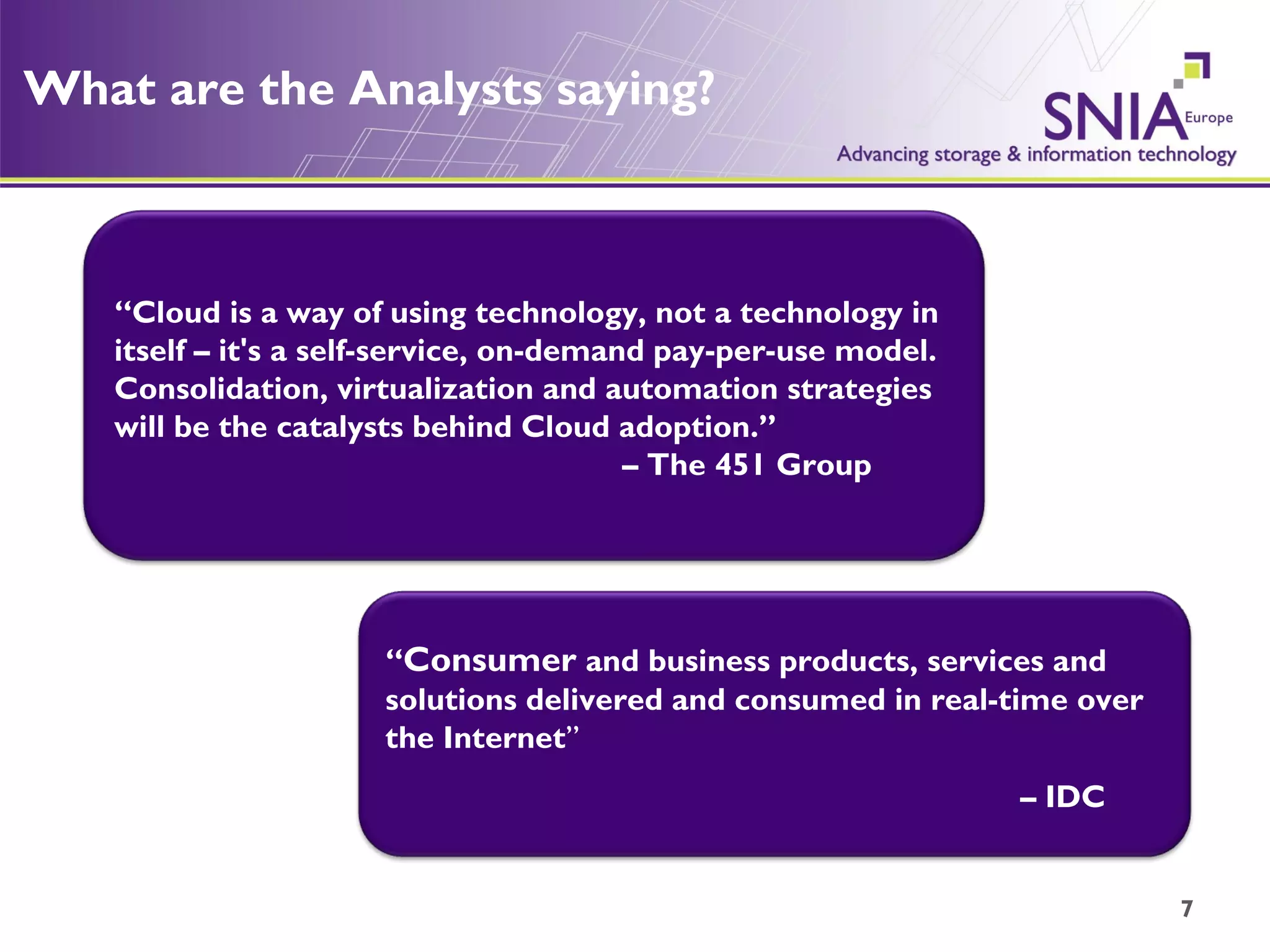
What are the Analysts saying? “ Cloud is a way of using technology, not a technology in itself – it's a self-service, on-demand pay-per-use model.  Consolidation, virtualization and automation strategies will be the catalysts behind Cloud adoption.”  – The 451 Group “ Consumer  and business products, services and solutions delivered and consumed in real-time over the Internet ”  –  IDC
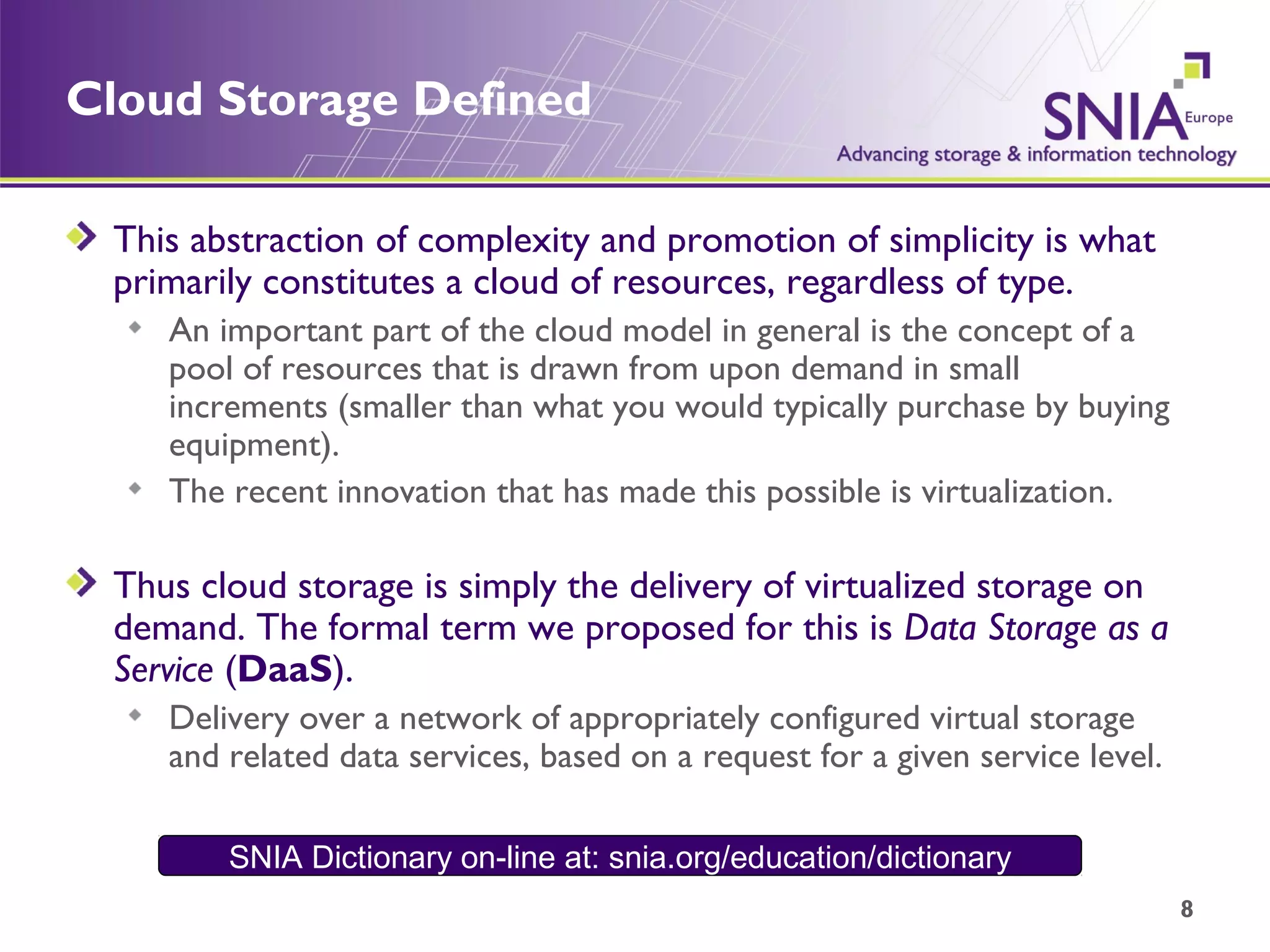
Cloud Storage Defined This abstraction of complexity and promotion of simplicity is what primarily constitutes a cloud of resources, regardless of type.  An important part of the cloud model in general is the concept of a pool of resources that is drawn from upon demand in small increments (smaller than what you would typically purchase by buying equipment).  The recent innovation that has made this possible is virtualization.  Thus cloud storage is simply the delivery of virtualized storage on demand. The formal term we proposed for this is  Data Storage as a Service  ( DaaS ). Delivery over a network of appropriately configured virtual storage and related data services, based on a request for a given service level. SNIA Dictionary on-line at: snia.org/education/dictionary
Some Basic Cloud Storage Attributes Pay as you go Self service provisioning Scalable, Elastic Rich application interfaces No need for consumers to directly manage their own storage resource By offloading the Storage Management, data owners can focus more on the management of data requirements ...
Typical Cloud User Scenarios Escalating Amount of Data, becoming more expensive to manage Is that old data worth keeping in my aging infrastructure? Meet governance needs Who is in charge of deleting old data, finding it again? New projects with a desire not to have isolated local storage Do they already go around existing storage IT practices? Storage of important data How do you make sure its requirements are being met? Storage for new Cloud Computing projects Where does the data live long term?
Cloud use case examples Offerings in the Data Storage as a Service (DaaS) space are increasing in capabilities Additional service levels beyond “Best Effort” storage Local appliances that “wrap” cloud storage for legacy applications Cloud Storage offerings that layer onto best effort services These offerings go beyond merely storing the data, and start to account for data with differing requirements There is a danger that the resulting complexity may cause the simplicity of cloud storage to be lost There is an increasing “exit cost” to move from one provider to another
Other open questions about Clouds Security & Privacy – What can the IT industry expect? Trusting Service Providers – Are SLAs the only measurements? Managing and/or using Cloud services across different geographies – what are the risks and constraints? What are the legal and regulatory challenges with Clouds Can Cloud be specific to Industry Verticals? How do I combine Services together? Is Internet the Cloud bottleneck? What about Cloud network services?  How do I transform my IT to leverage or perform in a Cloud-like fashion? …
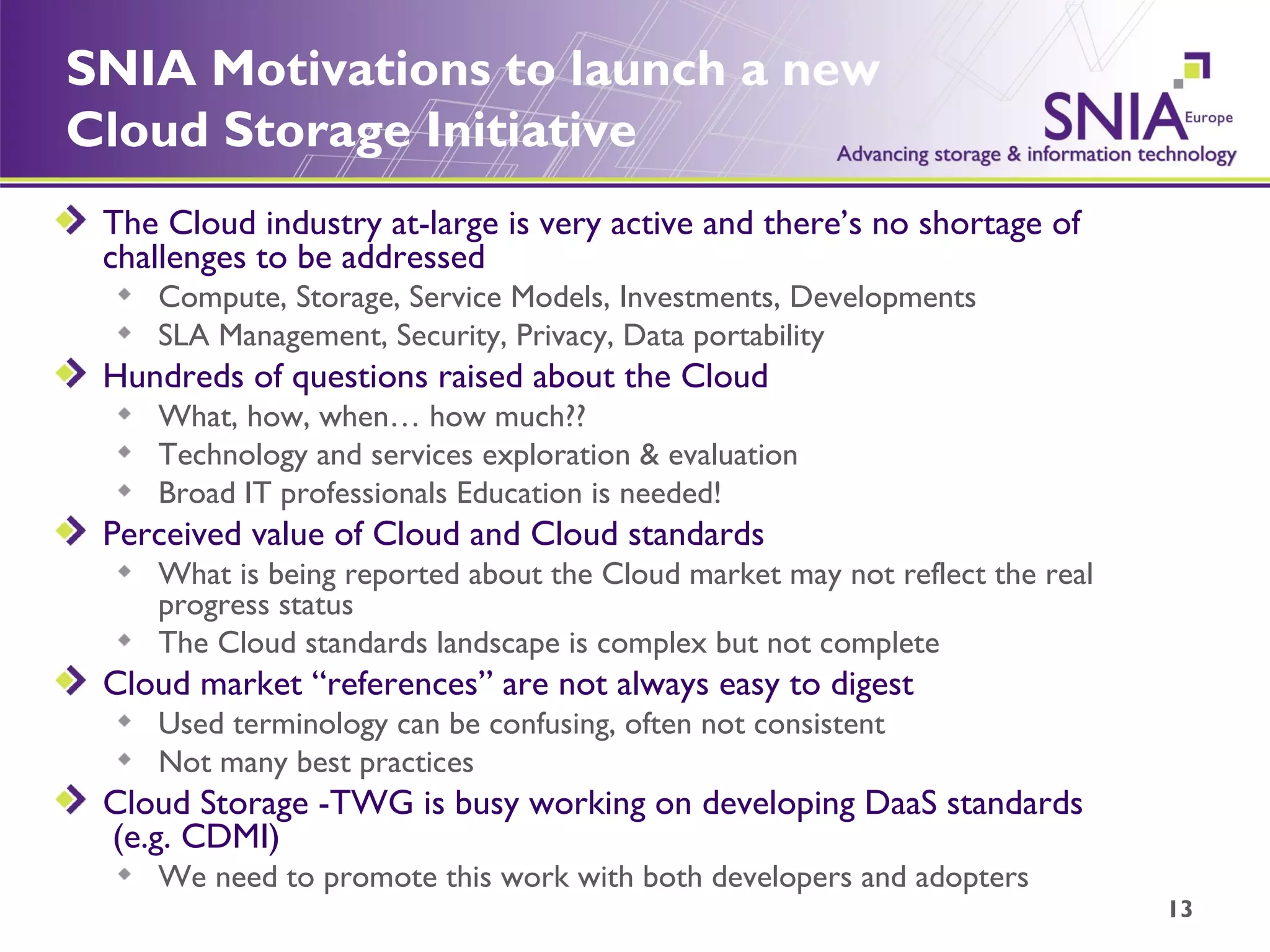
SNIA Motivations to launch a new Cloud Storage Initiative The Cloud industry at-large is very active and there’s no shortage of challenges to be addressed Compute, Storage, Service Models, Investments, Developments SLA Management, Security, Privacy, Data portability Hundreds of questions raised about the Cloud What, how, when… how much?? Technology and services exploration & evaluation Broad IT professionals Education is needed! Perceived value of Cloud and Cloud standards What is being reported about the Cloud market may not reflect the real progress status  The Cloud standards landscape is complex but not complete Cloud market “references” are not always easy to digest Used terminology can be confusing, often not consistent Not many best practices Cloud Storage -TWG is busy working on developing DaaS standards  (e.g. CDMI) We need to promote this work with both developers and adopters
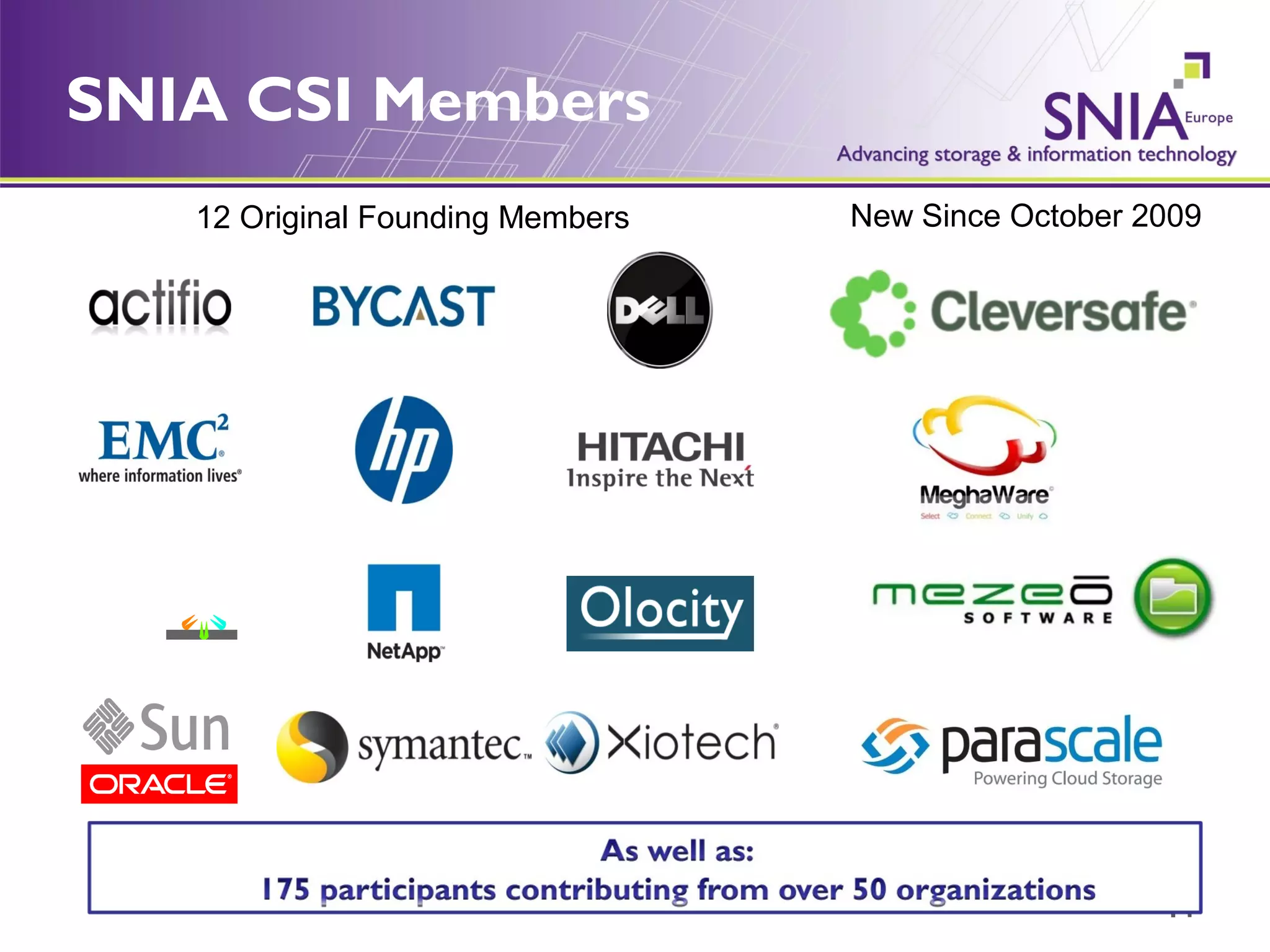
SNIA CSI Members 12 Original Founding Members New Since October 2009
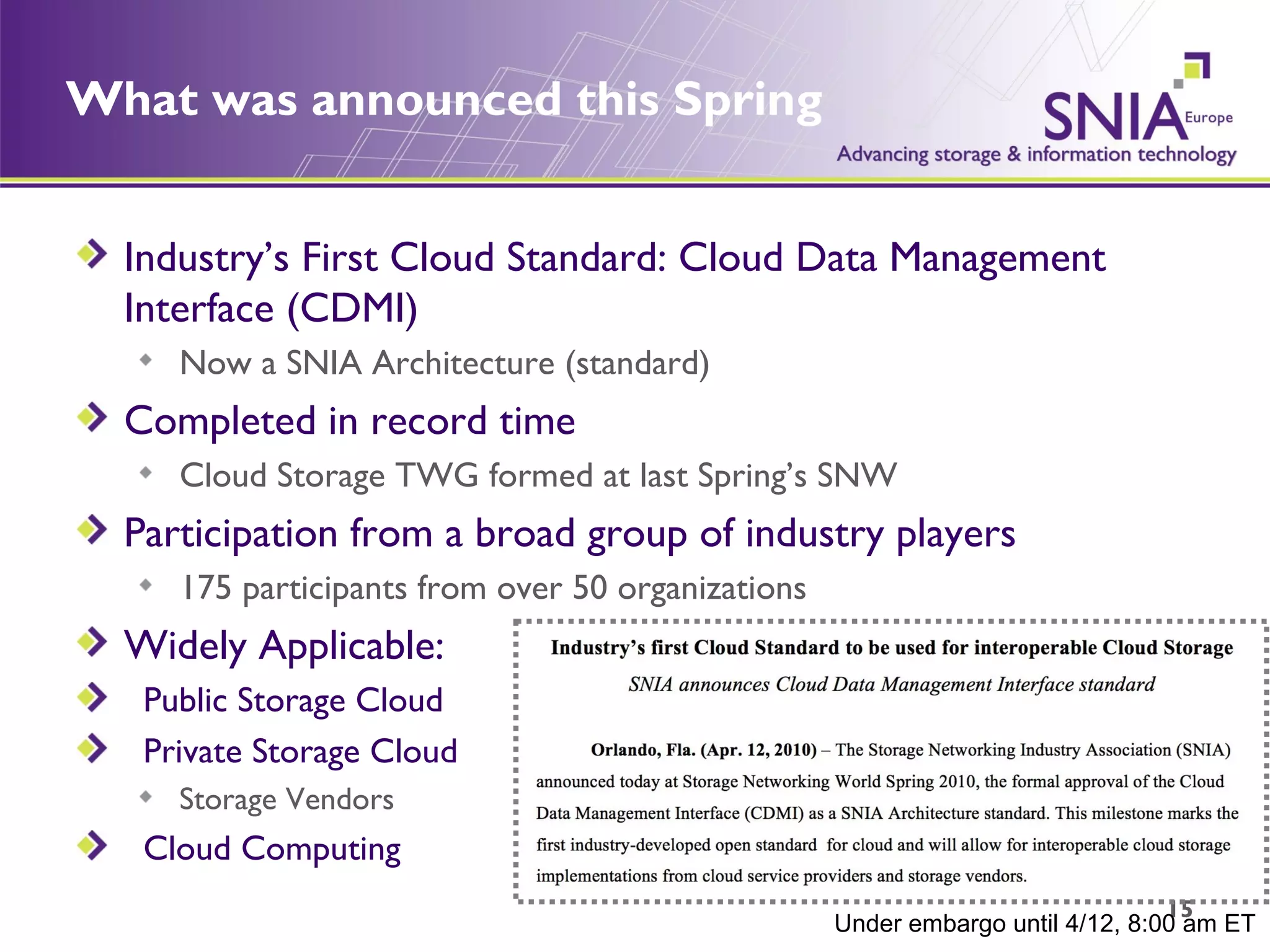
What was announced this Spring  Industry’s First Cloud Standard: Cloud Data Management Interface (CDMI) Now a SNIA Architecture (standard) Completed in record time Cloud Storage TWG formed at last Spring’s SNW Participation from a broad group of industry players 175 participants from over 50 organizations Widely Applicable: Public Storage Cloud Private Storage Cloud Storage Vendors Cloud Computing Under embargo until 4/12, 8:00 am ET
What is new(s)? SNIA Cloud Data Management Interface (CDMI) Version 1.0 is a SNIA Architecture Ready to be implemented by public and private providers Cloud Whitepapers Multi-Tenancy Paper Increased presence at SNW, other shows Cloud Pavilion - from 3 (fall) to 6 (spring) participants Cloud Hands on Lab Cloud Track and SNIA Tutorials Increased membership of CSI
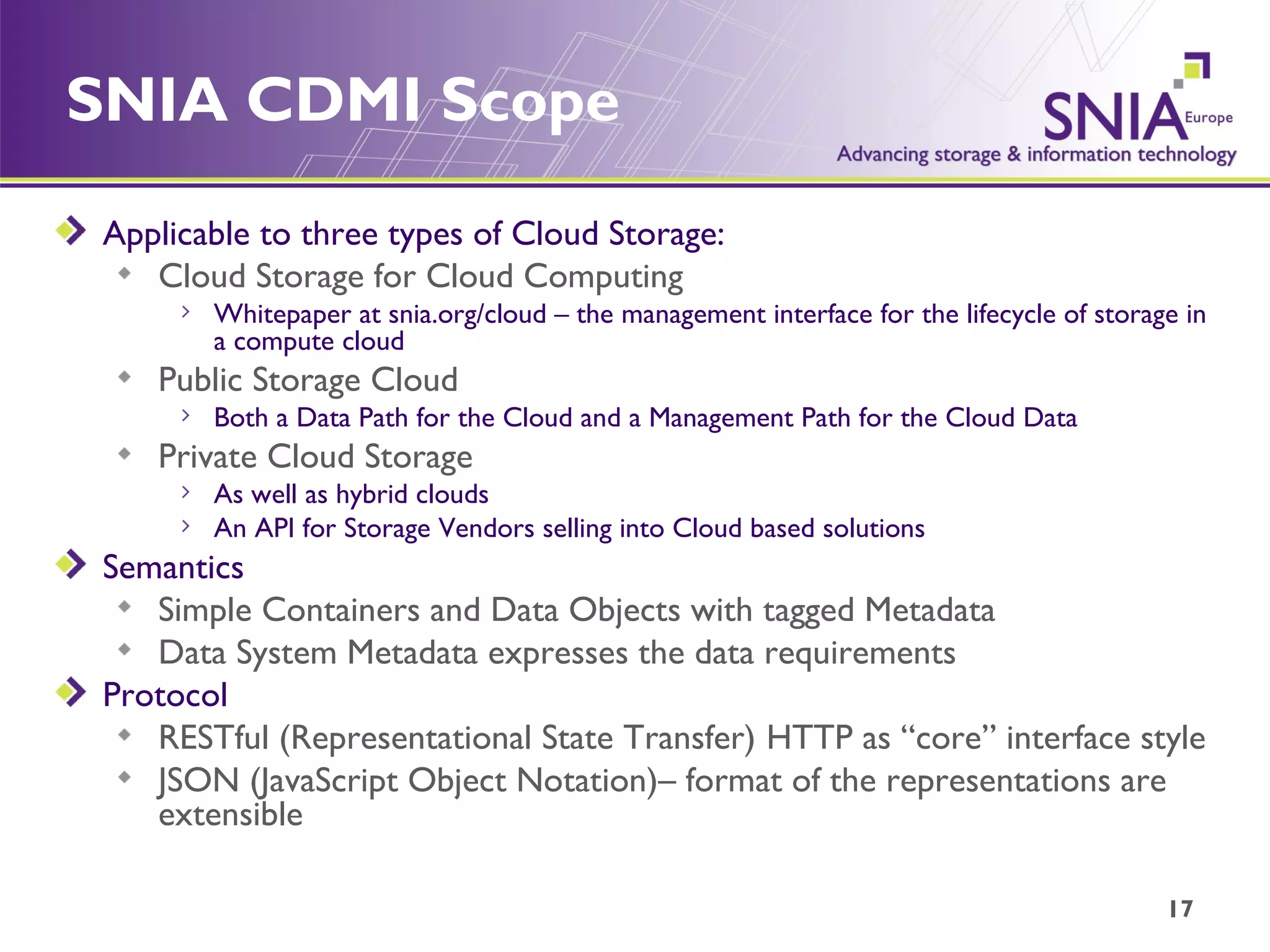
SNIA CDMI Scope Applicable to three types of Cloud Storage: Cloud Storage for Cloud Computing Whitepaper at snia.org/cloud – the management interface for the lifecycle of storage in a compute cloud Public Storage Cloud Both a Data Path for the Cloud and a Management Path for the Cloud Data Private Cloud Storage As well as hybrid clouds An API for Storage Vendors selling into Cloud based solutions Semantics Simple Containers and Data Objects with tagged Metadata Data System Metadata expresses the data requirements Protocol RESTful ( Representational State Transfer)  HTTP as “core” interface style  JSON (JavaScript Object Notation)– format of the representations are extensible
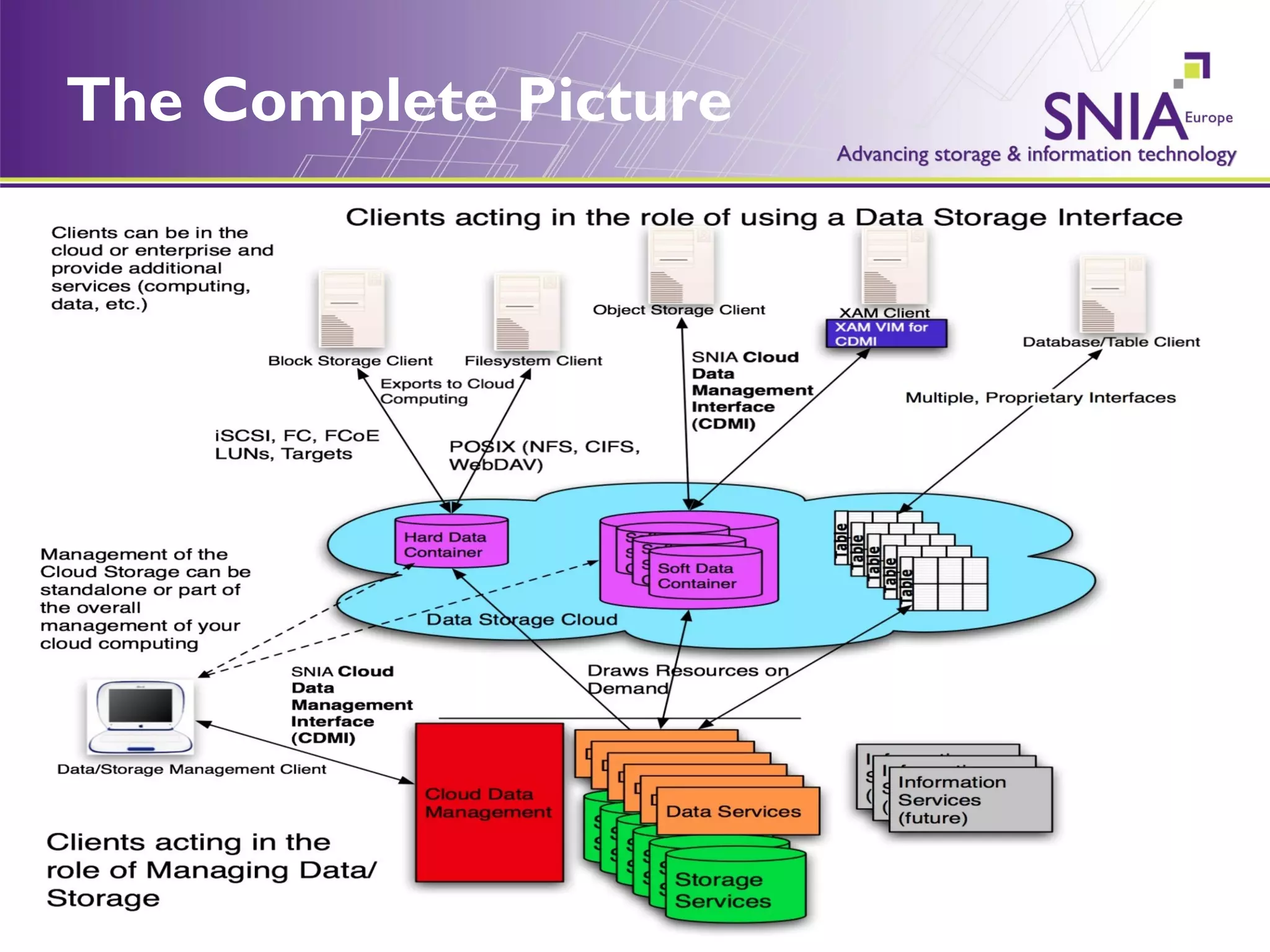
The Complete Picture
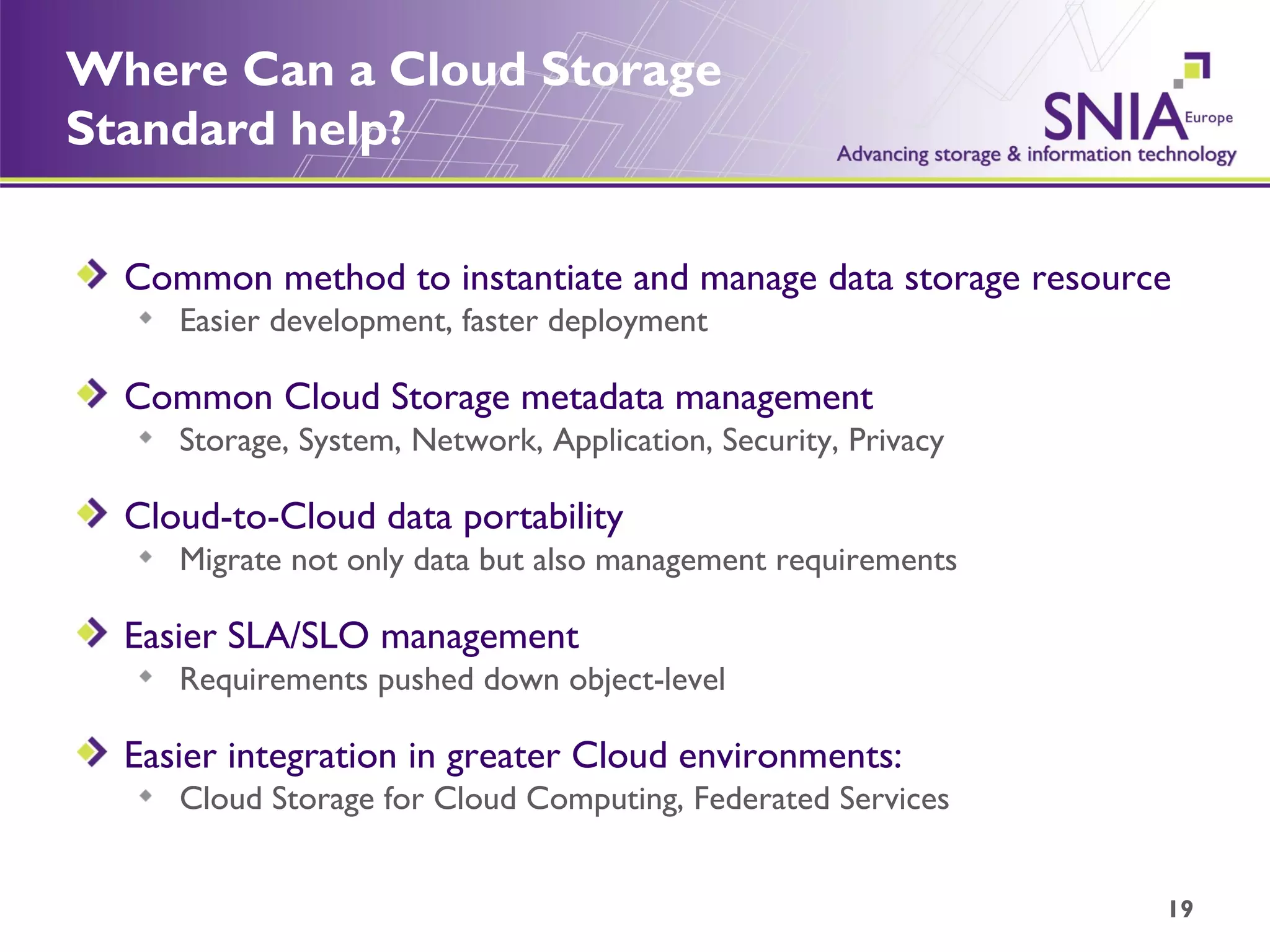
Where Can a Cloud Storage Standard help? Common method to instantiate and manage data storage resource Easier development, faster deployment Common Cloud Storage metadata management Storage, System, Network, Application, Security, Privacy Cloud-to-Cloud data portability Migrate not only data but also management requirements Easier SLA/SLO management Requirements pushed down object-level Easier integration in greater Cloud environments: Cloud Storage for Cloud Computing, Federated Services
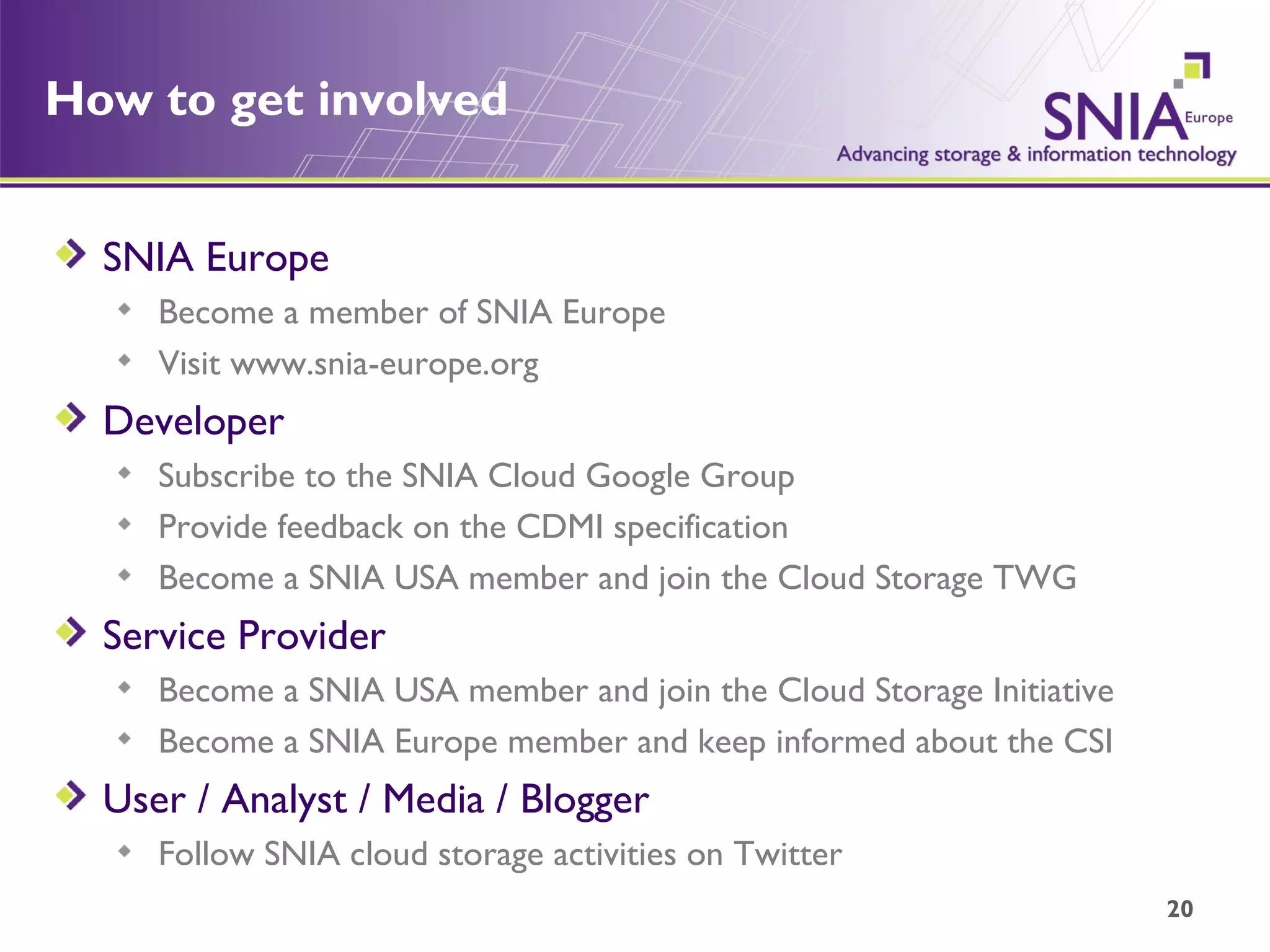
How to get involved SNIA Europe Become a member of SNIA Europe Visit www.snia-europe.org Developer Subscribe to the SNIA Cloud Google Group Provide feedback on the CDMI specification Become a SNIA USA member and join the Cloud Storage TWG Service Provider Become a SNIA USA member and join the Cloud Storage Initiative Become a SNIA Europe member and keep informed about the CSI User / Analyst / Media / Blogger Follow SNIA cloud storage activities on Twitter
Summary SNIA CSI and SNIA Europe: The industry voice for Cloud Storage Cloud Storage Education  Outreach program for Cloud users, developers, service providers Cross-Industry Collaboration for Cloud Standards Promotion of SNIA CDMI specification and future reference implementation
THANK YOU www.snia.org/cloud www.snia-europe/cloud_storage

Bob Plumridge - Enabling easier Cloud Solution Deployment (Storage Expo 2010)

  • 1.
    Bob Plumridge ChairmanSNIA E Hitachi Data Systems Enabling Easier Cloud Solutions Deployment
  • 2.
    Topics for thispresentation Looking at the Clouds Cloud Industry Challenges SNIA Cloud Storage Initiative
  • 3.
    A Major Reason Why We Are Here Today
  • 4.
    What is CloudStorage? The use of the term cloud in describing these new models arose from architecture drawings that typically used a cloud as the dominant networking icon. The cloud conceptually represented any to any connectivity in a network, but also an abstraction of concerns such the actual connectivity and the services running in the network that accomplish that connectivity with little manual intervention.
  • 5.
    Cloud Generalities 3major cloud types IAAS PAAS SAAS 3 main deployment models Public Private Hybrid Common Cloud Attributes Service-Oriented Metered-use Elastic Scalable Dynamic Shared / Multi-Tenancy
  • 6.
    The “Stack”… DataStorageas a Service (DaaS) Software as a Service (SaaS) Platform as a Service (PaaS) Infrastructure as a Service (IaaS) Functional: Data storage interfaces used by any of the other types Management: Data Requirements and Storage usage Functional: End user interaction with the Application’s function Management: Metering and billing based on number of users Functional: Application development and deployment environment Management: Manage scale out of Application, Metering and billing based on application QoS Functional: Virtual Machine for hosting OS based stacks Management: Manage lifecycle of guest machines, Metering and billing based on infrastructure usage Note that there is no implication that these “build” on each other – and they rarely do.
  • 7.
    What are theAnalysts saying? “ Cloud is a way of using technology, not a technology in itself – it's a self-service, on-demand pay-per-use model. Consolidation, virtualization and automation strategies will be the catalysts behind Cloud adoption.” – The 451 Group “ Consumer and business products, services and solutions delivered and consumed in real-time over the Internet ” – IDC
  • 8.
    Cloud Storage DefinedThis abstraction of complexity and promotion of simplicity is what primarily constitutes a cloud of resources, regardless of type. An important part of the cloud model in general is the concept of a pool of resources that is drawn from upon demand in small increments (smaller than what you would typically purchase by buying equipment). The recent innovation that has made this possible is virtualization. Thus cloud storage is simply the delivery of virtualized storage on demand. The formal term we proposed for this is Data Storage as a Service ( DaaS ). Delivery over a network of appropriately configured virtual storage and related data services, based on a request for a given service level. SNIA Dictionary on-line at: snia.org/education/dictionary
  • 9.
    Some Basic CloudStorage Attributes Pay as you go Self service provisioning Scalable, Elastic Rich application interfaces No need for consumers to directly manage their own storage resource By offloading the Storage Management, data owners can focus more on the management of data requirements ...
  • 10.
    Typical Cloud UserScenarios Escalating Amount of Data, becoming more expensive to manage Is that old data worth keeping in my aging infrastructure? Meet governance needs Who is in charge of deleting old data, finding it again? New projects with a desire not to have isolated local storage Do they already go around existing storage IT practices? Storage of important data How do you make sure its requirements are being met? Storage for new Cloud Computing projects Where does the data live long term?
  • 11.
    Cloud use caseexamples Offerings in the Data Storage as a Service (DaaS) space are increasing in capabilities Additional service levels beyond “Best Effort” storage Local appliances that “wrap” cloud storage for legacy applications Cloud Storage offerings that layer onto best effort services These offerings go beyond merely storing the data, and start to account for data with differing requirements There is a danger that the resulting complexity may cause the simplicity of cloud storage to be lost There is an increasing “exit cost” to move from one provider to another
  • 12.
    Other open questionsabout Clouds Security & Privacy – What can the IT industry expect? Trusting Service Providers – Are SLAs the only measurements? Managing and/or using Cloud services across different geographies – what are the risks and constraints? What are the legal and regulatory challenges with Clouds Can Cloud be specific to Industry Verticals? How do I combine Services together? Is Internet the Cloud bottleneck? What about Cloud network services? How do I transform my IT to leverage or perform in a Cloud-like fashion? …
  • 13.
    SNIA Motivations tolaunch a new Cloud Storage Initiative The Cloud industry at-large is very active and there’s no shortage of challenges to be addressed Compute, Storage, Service Models, Investments, Developments SLA Management, Security, Privacy, Data portability Hundreds of questions raised about the Cloud What, how, when… how much?? Technology and services exploration & evaluation Broad IT professionals Education is needed! Perceived value of Cloud and Cloud standards What is being reported about the Cloud market may not reflect the real progress status The Cloud standards landscape is complex but not complete Cloud market “references” are not always easy to digest Used terminology can be confusing, often not consistent Not many best practices Cloud Storage -TWG is busy working on developing DaaS standards (e.g. CDMI) We need to promote this work with both developers and adopters
  • 14.
    SNIA CSI Members12 Original Founding Members New Since October 2009
  • 15.
    What was announcedthis Spring Industry’s First Cloud Standard: Cloud Data Management Interface (CDMI) Now a SNIA Architecture (standard) Completed in record time Cloud Storage TWG formed at last Spring’s SNW Participation from a broad group of industry players 175 participants from over 50 organizations Widely Applicable: Public Storage Cloud Private Storage Cloud Storage Vendors Cloud Computing Under embargo until 4/12, 8:00 am ET
  • 16.
    What is new(s)?SNIA Cloud Data Management Interface (CDMI) Version 1.0 is a SNIA Architecture Ready to be implemented by public and private providers Cloud Whitepapers Multi-Tenancy Paper Increased presence at SNW, other shows Cloud Pavilion - from 3 (fall) to 6 (spring) participants Cloud Hands on Lab Cloud Track and SNIA Tutorials Increased membership of CSI
  • 17.
    SNIA CDMI ScopeApplicable to three types of Cloud Storage: Cloud Storage for Cloud Computing Whitepaper at snia.org/cloud – the management interface for the lifecycle of storage in a compute cloud Public Storage Cloud Both a Data Path for the Cloud and a Management Path for the Cloud Data Private Cloud Storage As well as hybrid clouds An API for Storage Vendors selling into Cloud based solutions Semantics Simple Containers and Data Objects with tagged Metadata Data System Metadata expresses the data requirements Protocol RESTful ( Representational State Transfer) HTTP as “core” interface style JSON (JavaScript Object Notation)– format of the representations are extensible
  • 18.
  • 19.
    Where Can aCloud Storage Standard help? Common method to instantiate and manage data storage resource Easier development, faster deployment Common Cloud Storage metadata management Storage, System, Network, Application, Security, Privacy Cloud-to-Cloud data portability Migrate not only data but also management requirements Easier SLA/SLO management Requirements pushed down object-level Easier integration in greater Cloud environments: Cloud Storage for Cloud Computing, Federated Services
  • 20.
    How to getinvolved SNIA Europe Become a member of SNIA Europe Visit www.snia-europe.org Developer Subscribe to the SNIA Cloud Google Group Provide feedback on the CDMI specification Become a SNIA USA member and join the Cloud Storage TWG Service Provider Become a SNIA USA member and join the Cloud Storage Initiative Become a SNIA Europe member and keep informed about the CSI User / Analyst / Media / Blogger Follow SNIA cloud storage activities on Twitter
  • 21.
    Summary SNIA CSIand SNIA Europe: The industry voice for Cloud Storage Cloud Storage Education Outreach program for Cloud users, developers, service providers Cross-Industry Collaboration for Cloud Standards Promotion of SNIA CDMI specification and future reference implementation
  • 22.
    THANK YOU www.snia.org/cloudwww.snia-europe/cloud_storage

Editor's Notes

  • #23 PPT Updated 27/4/2010