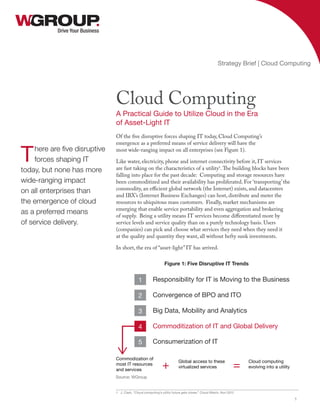
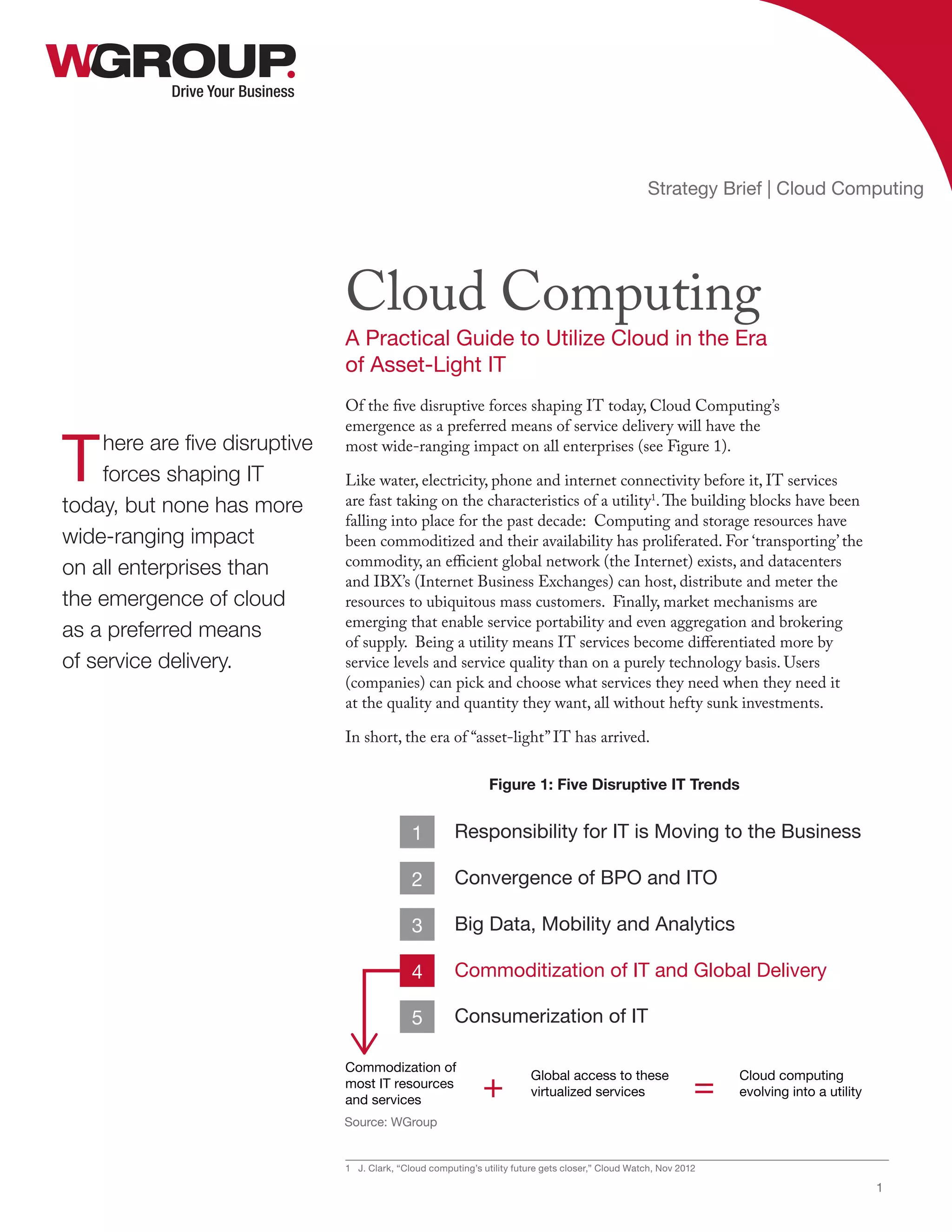
Of the five disruptive forces shaping IT today, Cloud Computing’s
emergence as a preferred means of service delivery will have the
most wide-ranging impact on all enterprises (see Figure 1).
Like water, electricity, phone and internet connectivity before it, IT services
are fast taking on the characteristics of a utility1
.The building blocks have been
falling into place for the past decade: Computing and storage resources have
been commoditized and their availability has proliferated. For ‘transporting’ the
commodity, an efficient global network (the Internet) exists, and datacenters
and IBX’s (Internet Business Exchanges) can host, distribute and meter the
resources to ubiquitous mass customers. Finally, market mechanisms are
emerging that enable service portability and even aggregation and brokering
of supply. Being a utility means IT services become differentiated more by
service levels and service quality than on a purely technology basis. Users
(companies) can pick and choose what services they need when they need it
at the quality and quantity they want, all without hefty sunk investments.
In short, the era of “asset-light” IT has arrived.
1 J. Clark, “Cloud computing’s utility future gets closer,” Cloud Watch, Nov 2012
Drive Your Business
Cloud Computing
A Practical Guide to Utilize Cloud in the Era
of Asset-Light IT
Strategy Brief | Cloud Computing
1
There are five disruptive
forces shaping IT
today, but none has more
wide-ranging impact
on all enterprises than
the emergence of cloud
as a preferred means
of service delivery.
Responsibility for IT is Moving to the Business
Convergence of BPO and ITO
Big Data, Mobility and Analytics
Commoditization of IT and Global Delivery
Consumerization of IT
1
2
3
4
5
Commodization of
most IT resources
and services
Global access to these
virtualized services
Cloud computing
evolving into a utility+ =
Figure 1: Five Disruptive IT Trends
Source: WGroup
The fluctuations in
demand for IT services
from any business are
more severe than in other
utilities, and IT services can
indeed be “transmitted”
globally with minimal
“loss.” Thus aggregating
demand globally makes
perfect sense.
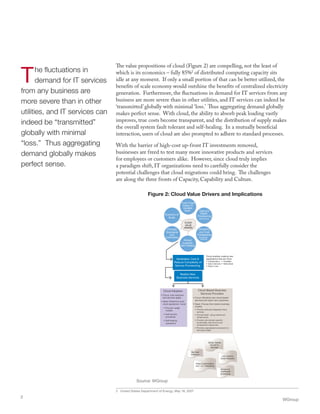
The value propositions of cloud (Figure 2) are compelling, not the least of
which is its economics – fully 85%2
of distributed computing capacity sits
idle at any moment. If only a small portion of that can be better utilized, the
benefits of scale economy would outshine the benefits of centralized electricity
generation. Furthermore, the fluctuations in demand for IT services from any
business are more severe than in other utilities, and IT services can indeed be
‘transmitted’ globally with minimal ‘loss.’ Thus aggregating demand globally
makes perfect sense. With cloud, the ability to absorb peak loading vastly
improves, true costs become transparent, and the distribution of supply makes
the overall system fault tolerant and self-healing. In a mutually beneficial
interaction, users of cloud are also prompted to adhere to standard processes.
With the barrier of high-cost up-front IT investments removed,
businesses are freed to test many more innovative products and services
for employees or customers alike. However, since cloud truly implies
a paradigm shift, IT organizations need to carefully consider the
potential challenges that cloud migrations could bring. The challenges
are along the three fronts of Capacity, Capability and Culture.
2 United States Department of Energy, May 18, 2007
WGroup
2
Realize New
Business Services
Variabalize Cost &
Reduce Complexity of
Service Provisioning
Cloud enables creating new
applications that are more
• Collaborative
• Data-intensive
• Available
• Networked
• Easy to use
Cloud Adopters
• Focus: cost reduction
and services agility
• Need: Determine post-
cloud operational model
• Pay-per-usage
models
• Self-service
processes
• Self-healing
operations
Mass Customization
and 1-to-1 Marketing
Big Data
Analytics
Low Latency
Expert Systems
Global, Mobile
Access to
Services
Always on,
distributed
processing
Cloud-Based Business
Services Providers
• Focus: Monetize new cloud-based
services and reach new customers
• Need: Choose from below business
models
• Provide vertically Integrated cloud
services
• Provide SaaS using outsourced
infrastructure
• Provide core domain-specific
functionality with all non-core
components outsourced
• Provide a specialized component on
third party SaaS
to
From Fixed
Capex
Variable
Opex Fast and
Elastic
Provisioning
(Self-Service)
Simplicity
and Cost
Transparency
(Complexity
Masking)
Always
Available,
Self-Healing
Process
Standards
and
Automation
Economy of
Scale
to
From Fixed
Capex
Variable
Opex Fast and
Elastic
Provisioning
(Self-Service)
Simplicity
and Cost
Transparency
(Complexity
Masking)
Always
Available,
Self-Healing
Process
Standards
and
Automation
Economy of
Scale
CLOUD
VALUE
DRIVERS
Figure 2: Cloud Value Drivers and Implications
Source: WGroup
Challenges of Cloud
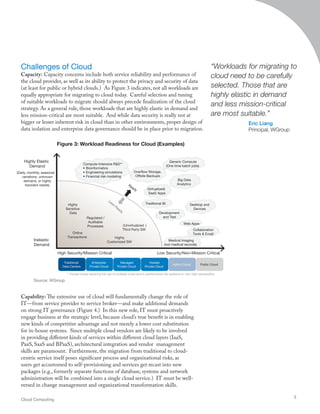
Capacity: Capacity concerns include both service reliability and performance of
the cloud provider, as well as its ability to protect the privacy and security of data
(at least for public or hybrid clouds.) As Figure 3 indicates, not all workloads are
equally appropriate for migrating to cloud today. Careful selection and tuning
of suitable workloads to migrate should always precede finalization of the cloud
strategy. As a general rule, those workloads that are highly elastic in demand and
less mission-critical are most suitable. And while data security is really not at
bigger or lesser inherent risk in cloud than in other environments, proper design of
data isolation and enterprise data governance should be in place prior to migration.
Capability: The extensive use of cloud will fundamentally change the role of
IT—from service provider to service broker—and make additional demands
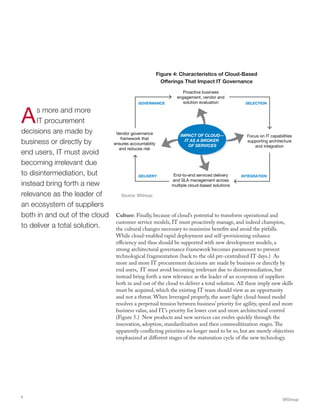
on strong IT governance (Figure 4.) In this new role, IT must proactively
engage business at the strategic level, because cloud’s true benefit is in enabling
new kinds of competitive advantage and not merely a lower cost substitution
for in-house systems. Since multiple cloud vendors are likely to be involved
in providing different kinds of services within different cloud layers (IaaS,
PaaS, SaaS and BPaaS), architectural integration and vendor management
skills are paramount. Furthermore, the migration from traditional to cloud-
centric service itself poses significant process and organizational risks, as
users get accustomed to self-provisioning and services get recast into new
packages (e.g., formerly separate functions of database, systems and network
administration will be combined into a single cloud service.) IT must be well-
versed in change management and organizational transformation skills.
“Workloads for migrating to
cloud need to be carefully
selected. Those that are
highly elastic in demand
and less mission-critical
are most suitable.”
Eric Liang
Principal, WGroup
Cloud Computing
3
** Except those requiring full use of multiple cores and hi performance file systems or very high bandwidths
Web Apps
Compute-Intensive R&D**
• Bioinformatics
• Engineering simulations
• Financial risk modeling
Big Data
Analytics
Development
and Test
Desktop and
Devices
Collaboration
Tools & Email
Traditional BI
Medical Imaging
(not medical records)
Overflow Storage,
Offsite Backups
Generic Compute
(One time batch jobs)
(Virtualized)
SaaS Apps
Inelastic
Demand
Online
Transactions
(Unvirtualized )
Third Party SW
Highly
Customized SW
Regulated /
Auditable
Processes
Highly
Sensitive
Data
Highly Elastic
Demand
(Daily, monthly, seasonal
variations, unknown
demand, or highly
transient needs)
High Security/Mission Critical Low Security/Non-Mission Critical
Traditional
Data Centers
Enterprise
Private Cloud
Managed
Private Cloud
Hosted
Private Cloud
Hybrid Cloud Public Cloud
Less
Ready
Ready
Figure 3: Workload Readiness for Cloud (Examples)
Source: WGroup
As more and more
IT procurement
decisions are made by
business or directly by
end users, IT must avoid
becoming irrelevant due
to disintermediation, but
instead bring forth a new
relevance as the leader of
an ecosystem of suppliers
both in and out of the cloud
to deliver a total solution.
Culture: Finally, because of cloud’s potential to transform operational and
customer service models, IT must proactively manage, and indeed champion,
the cultural changes necessary to maximize benefits and avoid the pitfalls.
While cloud-enabled rapid deployment and self-provisioning enhance
efficiency and thus should be supported with new development models, a
strong architectural governance framework becomes paramount to prevent
technological fragmentation (back to the old pre-centralized IT days.) As
more and more IT procurement decisions are made by business or directly by
end users, IT must avoid becoming irrelevant due to disintermediation, but
instead bring forth a new relevance as the leader of an ecosystem of suppliers
both in and out of the cloud to deliver a total solution. All these imply new skills
must be acquired, which the existing IT team should view as an opportunity
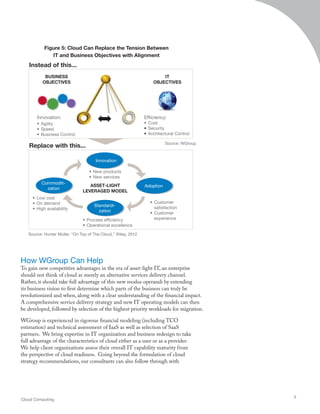
and not a threat. When leveraged properly, the asset-light cloud-based model
resolves a perpetual tension between business’ priority for agility, speed and more
business value, and IT’s priority for lower cost and more architectural control
(Figure 5.) New products and new services can evolve quickly through the
innovation, adoption, standardization and then commoditization stages.The
apparently conflicting priorities no longer need to be so, but are merely objectives
emphasized at different stages of the maturation cycle of the new technology.
WGroup
4
SELECTION
INTEGRATIONDELIVERY
GOVERNANCE
IMPACT OF CLOUD—
IT AS A BROKER
OF SERVICES
Vendor governance
framework that
ensures accountablity
and reduces risk
Proactive business
engagement, vendor and
solution evaluation
Focus on IT capabilities
supporting architecture
and integration
End-to-end serviced delivery
and SLA management across
multiple cloud-based solutions
Figure 4: Characteristics of Cloud-Based
Offerings That Impact IT Governance
Source: WGroup
How WGroup Can Help
To gain new competitive advantages in the era of asset-light IT, an enterprise
should not think of cloud as merely an alternative services delivery channel.
Rather, it should take full advantage of this new modus operandi by extending
its business vision to first determine which parts of the business can truly be
revolutionized and when, along with a clear understanding of the financial impact.
A comprehensive service delivery strategy and new IT operating models can then
be developed, followed by selection of the highest priority workloads for migration.
WGroup is experienced in rigorous financial modeling (including TCO
estimation) and technical assessment of IaaS as well as selection of SaaS
partners. We bring expertise in IT organization and business redesign to take
full advantage of the characteristics of cloud either as a user or as a provider.
We help client organizations assess their overall IT capability maturity from
the perspective of cloud readiness. Going beyond the formulation of cloud
strategy recommendations, our consultants can also follow through with
Cloud Computing
5
Source: WGroup
Instead of this...
Replace with this...
Innovation:
• Agility
• Speed
• Business Control
Efficiency:
• Cost
• Security
• Architectural Control
Innovation
Commoditi-
zation
Adoption
Standardi-
zation
• New products
• New services
• Low cost
• On demand
• High availability
• Process efficiency
• Operational excellence
• Customer
satisfaction
• Customer
experience
ASSET-LIGHT
LEVERAGED MODEL
BUSINESS
OBJECTIVES
IT
OBJECTIVES
Figure 5: Cloud Can Replace the Tension Between
IT and Business Objectives with Alignment
Source: Hunter Muller, “On Top of The Cloud,” Wiley, 2012
Contact Us
WGroup
301 Lindenwood Drive, Suite 301
Malvern, PA 19355
610-854-2700
Copyright © 2013 WGroup. All Rights Reserved.7
006_CLDCPTSB_040913
About WGroup
Founded in 1995, WGroup is a boutique management consulting firm
that provides Strategy, Management and Execution Services to
optimize business performance, minimize cost and create value. Our
consultants have years of experience, both as industry executives and
trusted advisors, to help clients think through complicated and pressing
challenges to drive their business forward.
For more information on WGroup, visit http://thinkwgroup.com
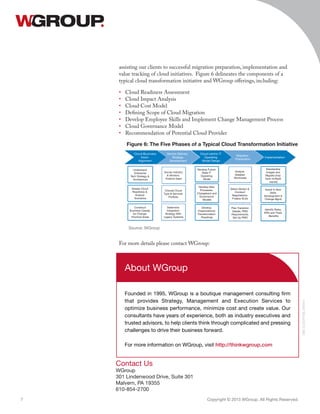
assisting our clients to successful migration preparation, implementation and
value tracking of cloud initiatives. Figure 6 delineates the components of a
typical cloud transformation initiative and WGroup offerings, including:
•	 Cloud Readiness Assessment
•	 Cloud Impact Analysis
•	 Cloud Cost Model
•	 Defining Scope of Cloud Migration
•	 Develop Employee Skills and Implement Change Management Process
•	 Cloud Governance Model
•	 Recommendation of Potential Cloud Provider
For more details please contact WGroup:
Develop New
Processes,
Chargeback and
Governance
Models
Develop Future
State IT
Operating
ledoM
Develop
Organizational
Transformation
Roadmap
Plan Transition
Details, PMO
Requirements.
Set Up PMO
Analyze
Detailed
Workloads
Select Vendor &
Conduct
Negotiations;
Finalize SLAs
Assess Cloud
Readiness &
Analyze
Scenarios
Construct
Business Case(s)
for Change;
Prioritize Areas
Understand
Enterprise
Tech Strategy &
Architecture
ssenisuB-duolC
Vision
Alignment
Service Delivery
Strategy
Development
Cloud-centric IT
Operating
Model Design
Migration
Preparation
Implementation
Determine
Integration
Strategy With
Legacy Systems
Survey Industry
& Vendors;
Analyze Gaps
Choose Cloud
Type & Services
oiloftroP
Standardize
Images and
Migrate (may
have multiple
waves)
Assist In New
Skills
Development &
.tmgMegnahC
Identify Risks,
KPIs and Track
Benefits
Figure 6: The Five Phases of a Typical Cloud Transformation Initiative
Source: WGroup

Clound computing

  • 1.
    Of the fivedisruptive forces shaping IT today, Cloud Computing’s emergence as a preferred means of service delivery will have the most wide-ranging impact on all enterprises (see Figure 1). Like water, electricity, phone and internet connectivity before it, IT services are fast taking on the characteristics of a utility1 .The building blocks have been falling into place for the past decade: Computing and storage resources have been commoditized and their availability has proliferated. For ‘transporting’ the commodity, an efficient global network (the Internet) exists, and datacenters and IBX’s (Internet Business Exchanges) can host, distribute and meter the resources to ubiquitous mass customers. Finally, market mechanisms are emerging that enable service portability and even aggregation and brokering of supply. Being a utility means IT services become differentiated more by service levels and service quality than on a purely technology basis. Users (companies) can pick and choose what services they need when they need it at the quality and quantity they want, all without hefty sunk investments. In short, the era of “asset-light” IT has arrived. 1 J. Clark, “Cloud computing’s utility future gets closer,” Cloud Watch, Nov 2012 Drive Your Business Cloud Computing A Practical Guide to Utilize Cloud in the Era of Asset-Light IT Strategy Brief | Cloud Computing 1 There are five disruptive forces shaping IT today, but none has more wide-ranging impact on all enterprises than the emergence of cloud as a preferred means of service delivery. Responsibility for IT is Moving to the Business Convergence of BPO and ITO Big Data, Mobility and Analytics Commoditization of IT and Global Delivery Consumerization of IT 1 2 3 4 5 Commodization of most IT resources and services Global access to these virtualized services Cloud computing evolving into a utility+ = Figure 1: Five Disruptive IT Trends Source: WGroup
  • 2.
    The fluctuations in demandfor IT services from any business are more severe than in other utilities, and IT services can indeed be “transmitted” globally with minimal “loss.” Thus aggregating demand globally makes perfect sense. The value propositions of cloud (Figure 2) are compelling, not the least of which is its economics – fully 85%2 of distributed computing capacity sits idle at any moment. If only a small portion of that can be better utilized, the benefits of scale economy would outshine the benefits of centralized electricity generation. Furthermore, the fluctuations in demand for IT services from any business are more severe than in other utilities, and IT services can indeed be ‘transmitted’ globally with minimal ‘loss.’ Thus aggregating demand globally makes perfect sense. With cloud, the ability to absorb peak loading vastly improves, true costs become transparent, and the distribution of supply makes the overall system fault tolerant and self-healing. In a mutually beneficial interaction, users of cloud are also prompted to adhere to standard processes. With the barrier of high-cost up-front IT investments removed, businesses are freed to test many more innovative products and services for employees or customers alike. However, since cloud truly implies a paradigm shift, IT organizations need to carefully consider the potential challenges that cloud migrations could bring. The challenges are along the three fronts of Capacity, Capability and Culture. 2 United States Department of Energy, May 18, 2007 WGroup 2 Realize New Business Services Variabalize Cost & Reduce Complexity of Service Provisioning Cloud enables creating new applications that are more • Collaborative • Data-intensive • Available • Networked • Easy to use Cloud Adopters • Focus: cost reduction and services agility • Need: Determine post- cloud operational model • Pay-per-usage models • Self-service processes • Self-healing operations Mass Customization and 1-to-1 Marketing Big Data Analytics Low Latency Expert Systems Global, Mobile Access to Services Always on, distributed processing Cloud-Based Business Services Providers • Focus: Monetize new cloud-based services and reach new customers • Need: Choose from below business models • Provide vertically Integrated cloud services • Provide SaaS using outsourced infrastructure • Provide core domain-specific functionality with all non-core components outsourced • Provide a specialized component on third party SaaS to From Fixed Capex Variable Opex Fast and Elastic Provisioning (Self-Service) Simplicity and Cost Transparency (Complexity Masking) Always Available, Self-Healing Process Standards and Automation Economy of Scale to From Fixed Capex Variable Opex Fast and Elastic Provisioning (Self-Service) Simplicity and Cost Transparency (Complexity Masking) Always Available, Self-Healing Process Standards and Automation Economy of Scale CLOUD VALUE DRIVERS Figure 2: Cloud Value Drivers and Implications Source: WGroup
  • 3.
    Challenges of Cloud Capacity:Capacity concerns include both service reliability and performance of the cloud provider, as well as its ability to protect the privacy and security of data (at least for public or hybrid clouds.) As Figure 3 indicates, not all workloads are equally appropriate for migrating to cloud today. Careful selection and tuning of suitable workloads to migrate should always precede finalization of the cloud strategy. As a general rule, those workloads that are highly elastic in demand and less mission-critical are most suitable. And while data security is really not at bigger or lesser inherent risk in cloud than in other environments, proper design of data isolation and enterprise data governance should be in place prior to migration. Capability: The extensive use of cloud will fundamentally change the role of IT—from service provider to service broker—and make additional demands on strong IT governance (Figure 4.) In this new role, IT must proactively engage business at the strategic level, because cloud’s true benefit is in enabling new kinds of competitive advantage and not merely a lower cost substitution for in-house systems. Since multiple cloud vendors are likely to be involved in providing different kinds of services within different cloud layers (IaaS, PaaS, SaaS and BPaaS), architectural integration and vendor management skills are paramount. Furthermore, the migration from traditional to cloud- centric service itself poses significant process and organizational risks, as users get accustomed to self-provisioning and services get recast into new packages (e.g., formerly separate functions of database, systems and network administration will be combined into a single cloud service.) IT must be well- versed in change management and organizational transformation skills. “Workloads for migrating to cloud need to be carefully selected. Those that are highly elastic in demand and less mission-critical are most suitable.” Eric Liang Principal, WGroup Cloud Computing 3 ** Except those requiring full use of multiple cores and hi performance file systems or very high bandwidths Web Apps Compute-Intensive R&D** • Bioinformatics • Engineering simulations • Financial risk modeling Big Data Analytics Development and Test Desktop and Devices Collaboration Tools & Email Traditional BI Medical Imaging (not medical records) Overflow Storage, Offsite Backups Generic Compute (One time batch jobs) (Virtualized) SaaS Apps Inelastic Demand Online Transactions (Unvirtualized ) Third Party SW Highly Customized SW Regulated / Auditable Processes Highly Sensitive Data Highly Elastic Demand (Daily, monthly, seasonal variations, unknown demand, or highly transient needs) High Security/Mission Critical Low Security/Non-Mission Critical Traditional Data Centers Enterprise Private Cloud Managed Private Cloud Hosted Private Cloud Hybrid Cloud Public Cloud Less Ready Ready Figure 3: Workload Readiness for Cloud (Examples) Source: WGroup
  • 4.
    As more andmore IT procurement decisions are made by business or directly by end users, IT must avoid becoming irrelevant due to disintermediation, but instead bring forth a new relevance as the leader of an ecosystem of suppliers both in and out of the cloud to deliver a total solution. Culture: Finally, because of cloud’s potential to transform operational and customer service models, IT must proactively manage, and indeed champion, the cultural changes necessary to maximize benefits and avoid the pitfalls. While cloud-enabled rapid deployment and self-provisioning enhance efficiency and thus should be supported with new development models, a strong architectural governance framework becomes paramount to prevent technological fragmentation (back to the old pre-centralized IT days.) As more and more IT procurement decisions are made by business or directly by end users, IT must avoid becoming irrelevant due to disintermediation, but instead bring forth a new relevance as the leader of an ecosystem of suppliers both in and out of the cloud to deliver a total solution. All these imply new skills must be acquired, which the existing IT team should view as an opportunity and not a threat. When leveraged properly, the asset-light cloud-based model resolves a perpetual tension between business’ priority for agility, speed and more business value, and IT’s priority for lower cost and more architectural control (Figure 5.) New products and new services can evolve quickly through the innovation, adoption, standardization and then commoditization stages.The apparently conflicting priorities no longer need to be so, but are merely objectives emphasized at different stages of the maturation cycle of the new technology. WGroup 4 SELECTION INTEGRATIONDELIVERY GOVERNANCE IMPACT OF CLOUD— IT AS A BROKER OF SERVICES Vendor governance framework that ensures accountablity and reduces risk Proactive business engagement, vendor and solution evaluation Focus on IT capabilities supporting architecture and integration End-to-end serviced delivery and SLA management across multiple cloud-based solutions Figure 4: Characteristics of Cloud-Based Offerings That Impact IT Governance Source: WGroup
  • 5.
    How WGroup CanHelp To gain new competitive advantages in the era of asset-light IT, an enterprise should not think of cloud as merely an alternative services delivery channel. Rather, it should take full advantage of this new modus operandi by extending its business vision to first determine which parts of the business can truly be revolutionized and when, along with a clear understanding of the financial impact. A comprehensive service delivery strategy and new IT operating models can then be developed, followed by selection of the highest priority workloads for migration. WGroup is experienced in rigorous financial modeling (including TCO estimation) and technical assessment of IaaS as well as selection of SaaS partners. We bring expertise in IT organization and business redesign to take full advantage of the characteristics of cloud either as a user or as a provider. We help client organizations assess their overall IT capability maturity from the perspective of cloud readiness. Going beyond the formulation of cloud strategy recommendations, our consultants can also follow through with Cloud Computing 5 Source: WGroup Instead of this... Replace with this... Innovation: • Agility • Speed • Business Control Efficiency: • Cost • Security • Architectural Control Innovation Commoditi- zation Adoption Standardi- zation • New products • New services • Low cost • On demand • High availability • Process efficiency • Operational excellence • Customer satisfaction • Customer experience ASSET-LIGHT LEVERAGED MODEL BUSINESS OBJECTIVES IT OBJECTIVES Figure 5: Cloud Can Replace the Tension Between IT and Business Objectives with Alignment Source: Hunter Muller, “On Top of The Cloud,” Wiley, 2012
  • 6.
    Contact Us WGroup 301 LindenwoodDrive, Suite 301 Malvern, PA 19355 610-854-2700 Copyright © 2013 WGroup. All Rights Reserved.7 006_CLDCPTSB_040913 About WGroup Founded in 1995, WGroup is a boutique management consulting firm that provides Strategy, Management and Execution Services to optimize business performance, minimize cost and create value. Our consultants have years of experience, both as industry executives and trusted advisors, to help clients think through complicated and pressing challenges to drive their business forward. For more information on WGroup, visit http://thinkwgroup.com assisting our clients to successful migration preparation, implementation and value tracking of cloud initiatives. Figure 6 delineates the components of a typical cloud transformation initiative and WGroup offerings, including: • Cloud Readiness Assessment • Cloud Impact Analysis • Cloud Cost Model • Defining Scope of Cloud Migration • Develop Employee Skills and Implement Change Management Process • Cloud Governance Model • Recommendation of Potential Cloud Provider For more details please contact WGroup: Develop New Processes, Chargeback and Governance Models Develop Future State IT Operating ledoM Develop Organizational Transformation Roadmap Plan Transition Details, PMO Requirements. Set Up PMO Analyze Detailed Workloads Select Vendor & Conduct Negotiations; Finalize SLAs Assess Cloud Readiness & Analyze Scenarios Construct Business Case(s) for Change; Prioritize Areas Understand Enterprise Tech Strategy & Architecture ssenisuB-duolC Vision Alignment Service Delivery Strategy Development Cloud-centric IT Operating Model Design Migration Preparation Implementation Determine Integration Strategy With Legacy Systems Survey Industry & Vendors; Analyze Gaps Choose Cloud Type & Services oiloftroP Standardize Images and Migrate (may have multiple waves) Assist In New Skills Development & .tmgMegnahC Identify Risks, KPIs and Track Benefits Figure 6: The Five Phases of a Typical Cloud Transformation Initiative Source: WGroup