A Cloud Glossary
Understanding the Cloud
Cloud is the general term for cloud computing, which refers to the
use of the Internet to access hosted services or your own appli-
cations, storage, servers, and data that are hosted in a remote
location.
Cloud
Business continuity is not something implemented at the time of
a disaster. It refers to those activities performed daily to maintain
service, consistency, and recoverability, and ensures that critical
business functions will be available to customers, suppliers,
regulators, and other entities.
Business Continuity
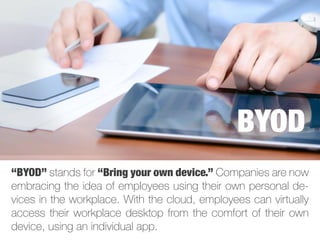
“BYOD” stands for “Bring your own device.” Companies are now
embracing the idea of employees using their own personal de-
vices in the workplace. With the cloud, employees can virtually
access their workplace desktop from the comfort of their own
device, using an individual app.
BYOD
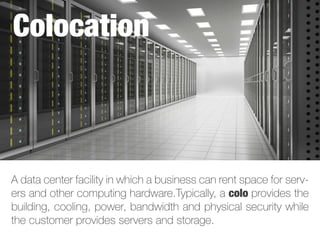
A data center facility in which a business can rent space for serv-
ers and other computing hardware.Typically, a colo provides the
building, cooling, power, bandwidth and physical security while
the customer provides servers and storage.
Colocation
A data center is a centralized repository, either physical or virtu-
al, for the storage, management, and dissemination of data and
information organized around a particular body of knowledge or
pertaining to a particular business.
Data Center
A form of virtual desktop infrastructure (VDI) in which the VDI is
outsourced and handled by a third party. Also called hosted desk-
top services, desktop-as-a-service is frequently delivered as a
cloud service along with the apps needed for use on the virtual
desktop.
Desktop-as-a-Service
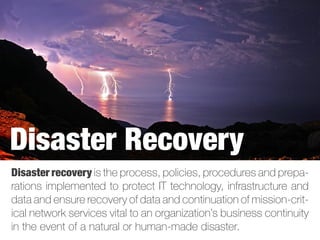
Disaster recovery is the process, policies, procedures and prepa-
rations implemented to protect IT technology, infrastructure and
data and ensure recovery of data and continuation of mission-crit-
ical network services vital to an organization’s business continuity
in the event of a natural or human-made disaster.
Disaster Recovery
Some resources of the cloud are provided and managed private-
ly and in-house, while other resources are provided through a
public cloud. For example, sensitive data can be securely stored
in a private cloud while general informational data can be stored
in a public cloud.
Hybrid Cloud
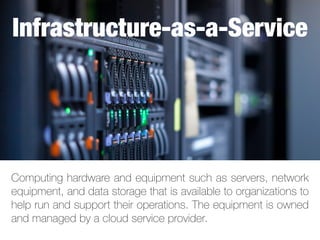
Computing hardware and equipment such as servers, network
equipment, and data storage that is available to organizations to
help run and support their operations. The equipment is owned
and managed by a cloud service provider.
Infrastructure-as-a-Service
OpEx, or operational expense, is the money a company spends
on an ongoing, day-to-day basis in order to run a business or
system.
OpEx
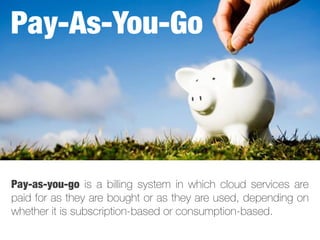
Pay-as-you-go is a billing system in which cloud services are
paid for as they are bought or as they are used, depending on
whether it is subscription-based or consumption-based.
Pay-As-You-Go
The application development environment that is available to or-
ganizations over the Internet. Examples include operating sys-
tems such as Windows and cloud-based environments.
Platform-as-a-Service
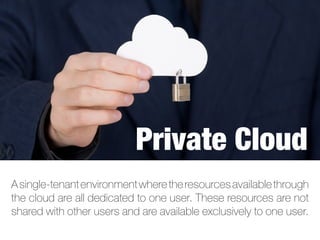
Asingle-tenantenvironmentwheretheresourcesavailablethrough
the cloud are all dedicated to one user. These resources are not
shared with other users and are available exclusively to one user.
Private Cloud
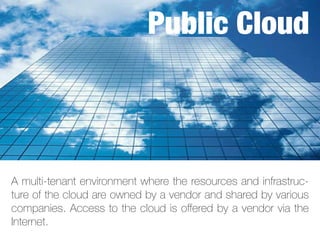
A multi-tenant environment where the resources and infrastruc-
ture of the cloud are owned by a vendor and shared by various
companies. Access to the cloud is offered by a vendor via the
Internet.
Public Cloud
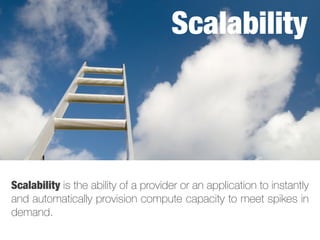
Scalability is the ability of a provider or an application to instantly
and automatically provision compute capacity to meet spikes in
demand.
Scalability
The applications and software made available to customers over
a network, usually the Internet. Examples include Gmail and oth-
er cloud-based email services.
Software-as-a-Service
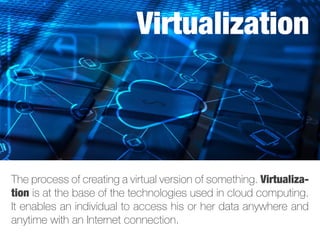
The process of creating a virtual version of something. Virtualiza-
tion is at the base of the technologies used in cloud computing.
It enables an individual to access his or her data anywhere and
anytime with an Internet connection.
Virtualization
RapidScale, Inc.
100 Pacifica Ste 100
Irvine, CA 92611
(949) 236-7007
Sales: (866) 371.1355
Support: (866) 686.0328
www.rapidscale.net
For More Information
Contact Us Today

A Cloud Glossary

  • 1.
  • 2.
    Cloud is thegeneral term for cloud computing, which refers to the use of the Internet to access hosted services or your own appli- cations, storage, servers, and data that are hosted in a remote location. Cloud
  • 3.
    Business continuity isnot something implemented at the time of a disaster. It refers to those activities performed daily to maintain service, consistency, and recoverability, and ensures that critical business functions will be available to customers, suppliers, regulators, and other entities. Business Continuity
  • 4.
    “BYOD” stands for“Bring your own device.” Companies are now embracing the idea of employees using their own personal de- vices in the workplace. With the cloud, employees can virtually access their workplace desktop from the comfort of their own device, using an individual app. BYOD
  • 5.
    A data centerfacility in which a business can rent space for serv- ers and other computing hardware.Typically, a colo provides the building, cooling, power, bandwidth and physical security while the customer provides servers and storage. Colocation
  • 6.
    A data centeris a centralized repository, either physical or virtu- al, for the storage, management, and dissemination of data and information organized around a particular body of knowledge or pertaining to a particular business. Data Center
  • 7.
    A form ofvirtual desktop infrastructure (VDI) in which the VDI is outsourced and handled by a third party. Also called hosted desk- top services, desktop-as-a-service is frequently delivered as a cloud service along with the apps needed for use on the virtual desktop. Desktop-as-a-Service
  • 8.
    Disaster recovery isthe process, policies, procedures and prepa- rations implemented to protect IT technology, infrastructure and data and ensure recovery of data and continuation of mission-crit- ical network services vital to an organization’s business continuity in the event of a natural or human-made disaster. Disaster Recovery
  • 9.
    Some resources ofthe cloud are provided and managed private- ly and in-house, while other resources are provided through a public cloud. For example, sensitive data can be securely stored in a private cloud while general informational data can be stored in a public cloud. Hybrid Cloud
  • 10.
    Computing hardware andequipment such as servers, network equipment, and data storage that is available to organizations to help run and support their operations. The equipment is owned and managed by a cloud service provider. Infrastructure-as-a-Service
  • 11.
    OpEx, or operationalexpense, is the money a company spends on an ongoing, day-to-day basis in order to run a business or system. OpEx
  • 12.
    Pay-as-you-go is abilling system in which cloud services are paid for as they are bought or as they are used, depending on whether it is subscription-based or consumption-based. Pay-As-You-Go
  • 13.
    The application developmentenvironment that is available to or- ganizations over the Internet. Examples include operating sys- tems such as Windows and cloud-based environments. Platform-as-a-Service
  • 14.
    Asingle-tenantenvironmentwheretheresourcesavailablethrough the cloud areall dedicated to one user. These resources are not shared with other users and are available exclusively to one user. Private Cloud
  • 15.
    A multi-tenant environmentwhere the resources and infrastruc- ture of the cloud are owned by a vendor and shared by various companies. Access to the cloud is offered by a vendor via the Internet. Public Cloud
  • 16.
    Scalability is theability of a provider or an application to instantly and automatically provision compute capacity to meet spikes in demand. Scalability
  • 17.
    The applications andsoftware made available to customers over a network, usually the Internet. Examples include Gmail and oth- er cloud-based email services. Software-as-a-Service
  • 18.
    The process ofcreating a virtual version of something. Virtualiza- tion is at the base of the technologies used in cloud computing. It enables an individual to access his or her data anywhere and anytime with an Internet connection. Virtualization
  • 19.
    RapidScale, Inc. 100 PacificaSte 100 Irvine, CA 92611 (949) 236-7007 Sales: (866) 371.1355 Support: (866) 686.0328 www.rapidscale.net For More Information Contact Us Today