INTRODUCTION TO GRID COMPUTING-BY ABHIJEET NAWALB.E.(Honors), CSEMBM ENGG. COLLEGE(www.mbm.ac.in)
WHY GRID - PROBLEMDOMAINS:There are some large scale problems which require analysis of high volumes of data (of the order of petabytes) to derive an inference.
Such problems thus need computing resources (say processing power of the order of teraflops, secure dependable networks and storage) often for which even a supercomputer  does not suffice.
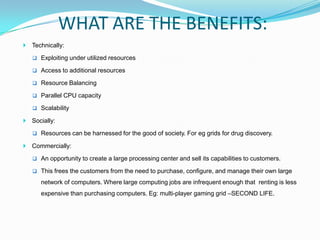
Some Such Problems: 	1) High Energy Physics Experiments (E.g. LHC)	2) Earthquake Simulation Experiments	3) Drug Discovery 	4) Weather Modeling Grid aims to provide a cost effective, scalable and reliable computing platform to such grand challenge data intensive problems.WHAT IS A GRID:
GRIDS AND THEIR TYPES:Grid is an infrastructure that involves the integrated and collaborative use of computers, networks, databases and scientific instruments.
Grid resources may be owned and managed by multiple organizations often heterogeneous (platforms, operating systems) and geographically dispersed in nature.
Computational Grid: Main computing resource shared – Processing Power.
Data Grid: Main computing resource shared – Storage. Provides fast and secure access to distributed, heterogeneous pools of data.
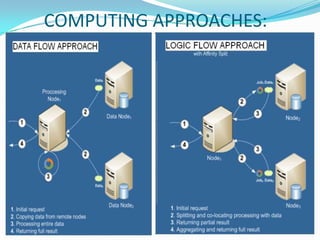
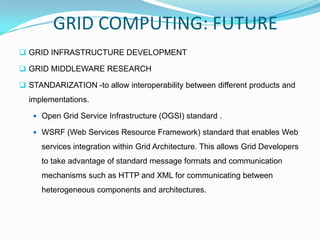
Network Grid: Main purpose to provide fault-tolerant and high performance communication. COMPUTING APPROACHES:
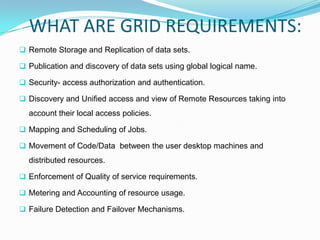
WHAT ARE GRID REQUIREMENTS:Remote Storage and Replication of data sets.
Publication and discovery of data sets using global logical name.
Security- access authorization and authentication.
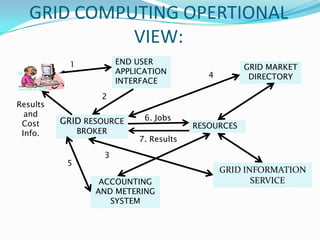
Discovery and Unified access and view of Remote Resources taking into account their local access policies.
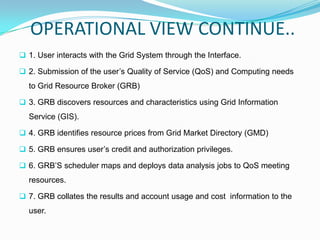
Mapping and Scheduling of Jobs.
Movement of Code/Data  between the user desktop machines and distributed resources.

Introduction to Grid Computing

  • 1.
    INTRODUCTION TO GRIDCOMPUTING-BY ABHIJEET NAWALB.E.(Honors), CSEMBM ENGG. COLLEGE(www.mbm.ac.in)
  • 2.
    WHY GRID -PROBLEMDOMAINS:There are some large scale problems which require analysis of high volumes of data (of the order of petabytes) to derive an inference.
  • 3.
    Such problems thusneed computing resources (say processing power of the order of teraflops, secure dependable networks and storage) often for which even a supercomputer does not suffice.
  • 4.
    Some Such Problems: 1) High Energy Physics Experiments (E.g. LHC) 2) Earthquake Simulation Experiments 3) Drug Discovery 4) Weather Modeling Grid aims to provide a cost effective, scalable and reliable computing platform to such grand challenge data intensive problems.WHAT IS A GRID:
  • 5.
    GRIDS AND THEIRTYPES:Grid is an infrastructure that involves the integrated and collaborative use of computers, networks, databases and scientific instruments.
  • 6.
    Grid resources maybe owned and managed by multiple organizations often heterogeneous (platforms, operating systems) and geographically dispersed in nature.
  • 7.
    Computational Grid: Maincomputing resource shared – Processing Power.
  • 8.
    Data Grid: Maincomputing resource shared – Storage. Provides fast and secure access to distributed, heterogeneous pools of data.
  • 9.
    Network Grid: Mainpurpose to provide fault-tolerant and high performance communication. COMPUTING APPROACHES:
  • 10.
    WHAT ARE GRIDREQUIREMENTS:Remote Storage and Replication of data sets.
  • 11.
    Publication and discoveryof data sets using global logical name.
  • 12.
  • 13.
    Discovery and Unifiedaccess and view of Remote Resources taking into account their local access policies.
  • 14.
  • 15.
    Movement of Code/Data between the user desktop machines and distributed resources.