Connected Dominating Set and
        Short Cycles
Connected Dominating Set and
        Short Cycles
   Joint work with Geevarghese Philip, Venkatesh Raman
                    and Saket Saurabh


          The Institute of Mathematical Sciences, Chennai
Polynomial Kernels
   No Polynomial Kernels, but FPT
              W-hard


e impact of excluding short cycles.


     Talk Outline
Polynomial Kernels
   No Polynomial Kernels, but FPT
              W-hard


e impact of excluding short cycles.


     Talk Outline
Polynomial Kernels
No Polynomial Kernels, but FPT
           W-hard


      Girth: at least seven


  Talk Outline
Polynomial Kernels ( 7)
No Polynomial Kernels, but FPT
          W-hard


        Girth: five or six


  Talk Outline
Polynomial Kernels ( 7)
No Polynomial Kernels, but FPT (5, 6)
              W-hard


          Girth: at most four


     Talk Outline
Polynomial Kernels ( 7)
No Polynomial Kernels, but FPT (5, 6)
          W-hard ( 4)


           Girth: at least seven


     Talk Outline
Polynomial Kernels ( 7)
                No Polynomial Kernels, but FPT (5, 6)
                          W-hard ( 4)


e longer the cycles we exclude, the easier the problem becomes to solve.


                      Talk Outline
Polynomial Kernels ( 7)
                No Polynomial Kernels, but FPT (5, 6)
                          W-hard ( 4)


e longer the cycles we exclude, the easier the problem becomes to solve.


                      Talk Outline
Part 1

    Why Its Useful
to not have short cycles
Consider the problem of domination:


Find a subset of at most k vertices S such that every v ∈ V is either in S or
has a neighbor in S.
Consider the problem of domination:


Find a subset of at most k vertices S such that every v ∈ V is either in S or
has a neighbor in S.


Let us consider graphs of girth at least five.
Consider the problem of domination:


Find a subset of at most k vertices S such that every v ∈ V is either in S or
has a neighbor in S.


Let us consider graphs of girth at least five.
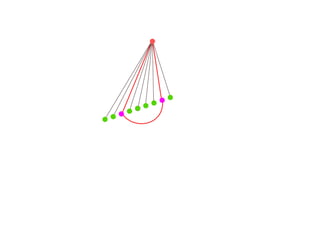
We begin by examining vertices of degree more than k.
Does there exist a dominating set of size at most k that does not include
                            the red vertex?
Who dominates the neighbors of the red vertex?
Does there exist a dominating set of size at most k that does not include
                            the red vertex?
Who dominates the neighbors of the red vertex?
Clearly, it is not the case that each one dominates itself.
Who dominates the neighbors of the red vertex?
Clearly, it is not the case that each one dominates itself.
Either a vertex from within the neighborhood dominates at least two of
                               vertices...
or a vertex from “outside” the neighborhood dominates at least two of the
                                 vertices...
High Degree Vertices


                 On graphs that have girth at least five:

Any vertex of degree more than k belongs to any dominating set of size at
                                most k.
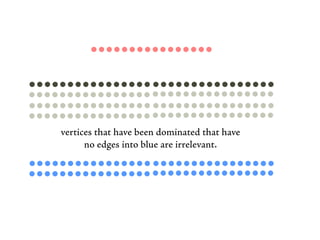
Notice that the number of reds is at most k and the number of blues is at
                                most k2 .
Greens in the neighborhood of a blue vertex cannot have a common red
                             neighbor.
us, for every blue vertex, there are at most k green vertices.
vertices that have been dominated that have
      no edges into blue are irrelevant.
So now all is bounded, and we have a happy ending: a kernel on at most

                           O(k + k2 + k3 )

vertices.
Part 2

   FPT Algorithms
and Polynomial Kernels
In the connected dominating set situation, we have to backtrack a small
way in the story so far to see what fails, and how badly.
High Degree Vertices


                 On graphs that have girth at least five:


Any vertex of degree more than k belongs to any dominating set of size at
                                most k.
High Degree Vertices


                 On graphs that have girth at least five:

                                        connected
Any vertex of degree more than k belongs to any dominating set of size at
                                most k.
Notice that the number of reds is at most k and the number of blues is
                         again at most k2 .
Greens in the neighborhood of a blue vertex cannot have a common red
                             neighbor.
us, for every blue vertex, there are at most k green vertices.
vertices that have been dominated that have
      no edges into blue are irrelevant.
vertices that have been dominated that have
      no edges into blue are irrelevant.


            Not any more...
any connected dom set contains a minimal dom set
  that resides in the bounded part of the graph.
Now we know what to do:


Guess the minimal dominating set.
Now we know what to do:


Guess the minimal dominating set.


Extend it to a connected dominating set by an application of a Steiner
Tree algorithm.
Now we know what to do:


Guess the minimal dominating set.


Extend it to a connected dominating set by an application of a Steiner
Tree algorithm.


is is evidently FPT.
Now we know what to do:


Guess the minimal dominating set.


Extend it to a connected dominating set by an application of a Steiner
Tree algorithm.


is is evidently FPT. What about kernels?
It turns out that if G did not admit cycles of length six and less, then the
number of green vertices can be bounded.
It turns out that if G did not admit cycles of length six and less, then the
number of green vertices can be bounded.


And we will show (later) that on graphs of girth five, connected
dominating set is unlikely to admit polynomial kernels.
Low Degree Vertices


If there is blue pendant vertex, make its neighbor red.

  If there is a green vertex that is pendant, delete it.

   If there is a blue vertex that is isolated, say no.
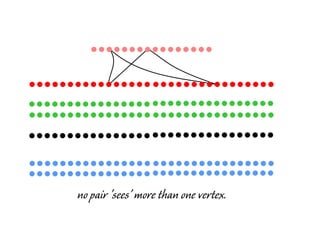
no pair 'sees' more than one vertex.
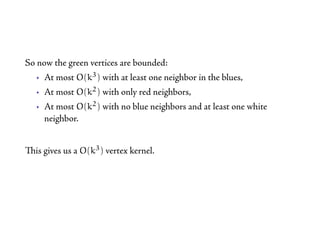
So now the green vertices are bounded:
  • At most O(k3 ) with at least one neighbor in the blues,
  • At most O(k2 ) with only red neighbors,
  • At most O(k2 ) with no blue neighbors and at least one white
     neighbor.
So now the green vertices are bounded:
   • At most O(k3 ) with at least one neighbor in the blues,
   • At most O(k2 ) with only red neighbors,
   • At most O(k2 ) with no blue neighbors and at least one white
     neighbor.


is gives us a O(k3 ) vertex kernel.
The Hard Part

Infeasibility of Polynomial Kernelization
             and W-hardness
Introducing...
Introducing...


F C C
Introducing...


F C C


NP-complete      FPT   Compositional
Introducing...


F C C


NP-complete      FPT   Compositional


Ready for reduction!
Promise: Every vertex has degree at most one into
any color class, and every color class is independent.

     Question: Does there exist a colorful tree?
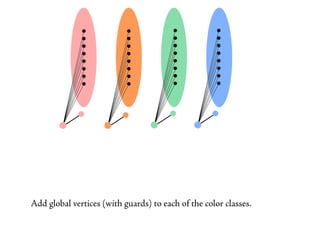
Add global vertices (with guards) to each of the color classes. subdivide
                              the edges,
   add a global vertex for the newly added vertices (with guards).
Between a pair of color classes:
• subdivide the edges,
Between a pair of color classes:
• subdivide the edges,
• add a global vertex for the newly added vertices
Between a pair of color classes:
• subdivide the edges,
• add a global vertex for the newly added vertices (with guards).
For vertices that don’t look inside the neighboring color class, add a path of
 length two to the global vertex. add a global vertex for the newly added
                            vertices (with guards).
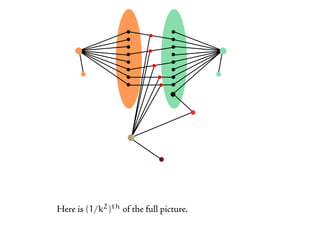
Here is (1/k2 )th of the full picture. subdivide the edges,
add a global vertex for the newly added vertices (with guards).
Notice that we have ended up with a bipartite graph... subdivide the edges,
     add a global vertex for the newly added vertices (with guards).
....with a cycle of length six. subdivide the edges,
add a global vertex for the newly added vertices (with guards).
Suppose we have a colorful tree in the source instance.
Consider the same subset.
(along with the subdivided vertices along the edges of the tree)
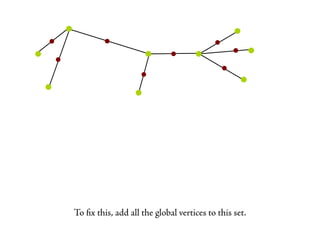
is is a connected subset, but not dominating.
To fix this, add all the global vertices to this set.
(k)
ere are k +    2    such vertices.
Now we have a dominating set, but it’s not connected any more!
Let’s look more closely.
e vertices global to color classes are connected to the tree.
Some of the other vertices are connected too!
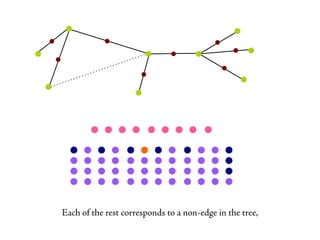
Each of the rest corresponds to a non-edge in the tree,
for which we add the path of length two to the picture.
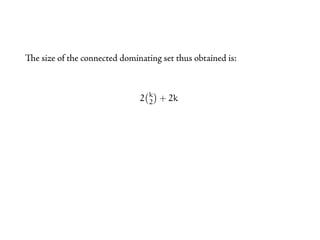
e size of the connected dominating set thus obtained is:


                                  (k)
                              2    2    + 2k
e size of the connected dominating set thus obtained is:


                                    (k)
                                2    2    + 2k

        Two vertices for every pair of original vertices in the tree.
                   (A global vertex, and a neighbor.)
e size of the connected dominating set thus obtained is:


                                   (k)
                               2    2    + 2k

            Two vertices for every original vertex in the tree:
              itself, and the corresponding global vertex.
And that works out to...


                               (k)
                           2    2    + 2k

                           = k2 + k
Let S be a connected dominating set of size at most:
                        ( ) ( )
                          k        k
                              +        +k+k
                          2        2
Let S be a connected dominating set of size at most:
                        ( ) ( )
                          k        k
                              +        +k+k
                          2        2
Of course, global vertices are forced in S, because of the guard vertices.
Let S be a connected dominating set of size at most:
                        ( ) ( )
                          k        k
                              +        +k+k
                          2        2
   Since S is a connected subset, each of these vertices have at least one
                              neighbor in S.
Let S be a connected dominating set of size at most:
                        ( ) ( )
                          k        k
                              +        +k+k
                          2        2
   Since S is a connected subset, each of these vertices have at least one
                              neighbor in S.


                Because of the budget, each of them have...
Let S be a connected dominating set of size at most:
                        ( ) ( )
                          k        k
                              +        +k+k
                          2        2
   Since S is a connected subset, each of these vertices have exactly one
                              neighbor in S.


                Because of the budget, each of them have...
us, the dominating set picks exactly one vertex from each color class.

 • Neglect the global vertices and “subdivision vertices” of degree one, to
   be left with a connected subtree with subdivided edges.
us, the dominating set picks exactly one vertex from each color class.

 • Neglect the global vertices and “subdivision vertices” of degree one, to
   be left with a connected subtree with subdivided edges.
 • is can be easily pulled back to a colorful tree of the original graph.
e W-hardness result.
A dominating set
        instance


G
We begin by
    making a copy of the graph.


G
G   G
en, for every edge in G,
we stretch it across the copies.
en, for every edge in G,
we stretch it across the copies.
Finally, add a new vertex to each copy,
with one of them global to the other copy.
Any old dominating set + new global vertex
    = new connected dominating set.
Any new dominating set contains the newly added
           global vertex WLOG.
Consider now the vertices of the
new connected dominating set.
Observe that they form a
 dominating set of G.
Takk

Connected Dominating Set and Short Cycles

  • 1.
    Connected Dominating Setand Short Cycles
  • 2.
    Connected Dominating Setand Short Cycles Joint work with Geevarghese Philip, Venkatesh Raman and Saket Saurabh The Institute of Mathematical Sciences, Chennai
  • 3.
    Polynomial Kernels No Polynomial Kernels, but FPT W-hard e impact of excluding short cycles. Talk Outline
  • 4.
    Polynomial Kernels No Polynomial Kernels, but FPT W-hard e impact of excluding short cycles. Talk Outline
  • 5.
    Polynomial Kernels No PolynomialKernels, but FPT W-hard Girth: at least seven Talk Outline
  • 6.
    Polynomial Kernels (7) No Polynomial Kernels, but FPT W-hard Girth: five or six Talk Outline
  • 7.
    Polynomial Kernels (7) No Polynomial Kernels, but FPT (5, 6) W-hard Girth: at most four Talk Outline
  • 8.
    Polynomial Kernels (7) No Polynomial Kernels, but FPT (5, 6) W-hard ( 4) Girth: at least seven Talk Outline
  • 9.
    Polynomial Kernels (7) No Polynomial Kernels, but FPT (5, 6) W-hard ( 4) e longer the cycles we exclude, the easier the problem becomes to solve. Talk Outline
  • 10.
    Polynomial Kernels (7) No Polynomial Kernels, but FPT (5, 6) W-hard ( 4) e longer the cycles we exclude, the easier the problem becomes to solve. Talk Outline
  • 11.
    Part 1 Why Its Useful to not have short cycles
  • 12.
    Consider the problemof domination:
  • 13.
    Consider the problemof domination: Find a subset of at most k vertices S such that every v ∈ V is either in S or has a neighbor in S.
  • 14.
    Consider the problemof domination: Find a subset of at most k vertices S such that every v ∈ V is either in S or has a neighbor in S. Let us consider graphs of girth at least five.
  • 15.
    Consider the problemof domination: Find a subset of at most k vertices S such that every v ∈ V is either in S or has a neighbor in S. Let us consider graphs of girth at least five. We begin by examining vertices of degree more than k.
  • 16.
    Does there exista dominating set of size at most k that does not include the red vertex?
  • 17.
    Who dominates theneighbors of the red vertex? Does there exist a dominating set of size at most k that does not include the red vertex?
  • 18.
    Who dominates theneighbors of the red vertex? Clearly, it is not the case that each one dominates itself.
  • 19.
    Who dominates theneighbors of the red vertex? Clearly, it is not the case that each one dominates itself.
  • 20.
    Either a vertexfrom within the neighborhood dominates at least two of vertices...
  • 23.
    or a vertexfrom “outside” the neighborhood dominates at least two of the vertices...
  • 26.
    High Degree Vertices On graphs that have girth at least five: Any vertex of degree more than k belongs to any dominating set of size at most k.
  • 27.
    Notice that thenumber of reds is at most k and the number of blues is at most k2 .
  • 28.
    Greens in theneighborhood of a blue vertex cannot have a common red neighbor.
  • 29.
    us, for everyblue vertex, there are at most k green vertices.
  • 30.
    vertices that havebeen dominated that have no edges into blue are irrelevant.
  • 31.
    So now allis bounded, and we have a happy ending: a kernel on at most O(k + k2 + k3 ) vertices.
  • 32.
    Part 2 FPT Algorithms and Polynomial Kernels
  • 33.
    In the connecteddominating set situation, we have to backtrack a small way in the story so far to see what fails, and how badly.
  • 34.
    High Degree Vertices On graphs that have girth at least five: Any vertex of degree more than k belongs to any dominating set of size at most k.
  • 35.
    High Degree Vertices On graphs that have girth at least five: connected Any vertex of degree more than k belongs to any dominating set of size at most k.
  • 36.
    Notice that thenumber of reds is at most k and the number of blues is again at most k2 .
  • 37.
    Greens in theneighborhood of a blue vertex cannot have a common red neighbor.
  • 38.
    us, for everyblue vertex, there are at most k green vertices.
  • 39.
    vertices that havebeen dominated that have no edges into blue are irrelevant.
  • 40.
    vertices that havebeen dominated that have no edges into blue are irrelevant. Not any more...
  • 41.
    any connected domset contains a minimal dom set that resides in the bounded part of the graph.
  • 42.
    Now we knowwhat to do:
  • 43.
    Now we knowwhat to do: Guess the minimal dominating set.
  • 44.
    Now we knowwhat to do: Guess the minimal dominating set. Extend it to a connected dominating set by an application of a Steiner Tree algorithm.
  • 45.
    Now we knowwhat to do: Guess the minimal dominating set. Extend it to a connected dominating set by an application of a Steiner Tree algorithm. is is evidently FPT.
  • 46.
    Now we knowwhat to do: Guess the minimal dominating set. Extend it to a connected dominating set by an application of a Steiner Tree algorithm. is is evidently FPT. What about kernels?
  • 47.
    It turns outthat if G did not admit cycles of length six and less, then the number of green vertices can be bounded.
  • 48.
    It turns outthat if G did not admit cycles of length six and less, then the number of green vertices can be bounded. And we will show (later) that on graphs of girth five, connected dominating set is unlikely to admit polynomial kernels.
  • 49.
    Low Degree Vertices Ifthere is blue pendant vertex, make its neighbor red. If there is a green vertex that is pendant, delete it. If there is a blue vertex that is isolated, say no.
  • 53.
    no pair 'sees'more than one vertex.
  • 56.
    So now thegreen vertices are bounded: • At most O(k3 ) with at least one neighbor in the blues, • At most O(k2 ) with only red neighbors, • At most O(k2 ) with no blue neighbors and at least one white neighbor.
  • 57.
    So now thegreen vertices are bounded: • At most O(k3 ) with at least one neighbor in the blues, • At most O(k2 ) with only red neighbors, • At most O(k2 ) with no blue neighbors and at least one white neighbor. is gives us a O(k3 ) vertex kernel.
  • 58.
    The Hard Part Infeasibilityof Polynomial Kernelization and W-hardness
  • 59.
  • 60.
  • 61.
  • 62.
  • 63.
    Promise: Every vertexhas degree at most one into any color class, and every color class is independent. Question: Does there exist a colorful tree?
  • 64.
    Add global vertices(with guards) to each of the color classes. subdivide the edges, add a global vertex for the newly added vertices (with guards).
  • 65.
    Between a pairof color classes:
  • 66.
    Between a pairof color classes: • subdivide the edges,
  • 67.
    Between a pairof color classes: • subdivide the edges, • add a global vertex for the newly added vertices
  • 68.
    Between a pairof color classes: • subdivide the edges, • add a global vertex for the newly added vertices (with guards).
  • 69.
    For vertices thatdon’t look inside the neighboring color class, add a path of length two to the global vertex. add a global vertex for the newly added vertices (with guards).
  • 70.
    Here is (1/k2)th of the full picture. subdivide the edges, add a global vertex for the newly added vertices (with guards).
  • 71.
    Notice that wehave ended up with a bipartite graph... subdivide the edges, add a global vertex for the newly added vertices (with guards).
  • 72.
    ....with a cycleof length six. subdivide the edges, add a global vertex for the newly added vertices (with guards).
  • 73.
    Suppose we havea colorful tree in the source instance.
  • 74.
  • 75.
    (along with thesubdivided vertices along the edges of the tree)
  • 76.
    is is aconnected subset, but not dominating.
  • 77.
    To fix this,add all the global vertices to this set.
  • 78.
    (k) ere are k+ 2 such vertices.
  • 79.
    Now we havea dominating set, but it’s not connected any more!
  • 80.
  • 81.
    e vertices globalto color classes are connected to the tree.
  • 82.
    Some of theother vertices are connected too!
  • 83.
    Each of therest corresponds to a non-edge in the tree,
  • 84.
    for which weadd the path of length two to the picture.
  • 85.
    e size ofthe connected dominating set thus obtained is:
  • 86.
    e size ofthe connected dominating set thus obtained is: (k) 2 2 + 2k
  • 87.
    e size ofthe connected dominating set thus obtained is: (k) 2 2 + 2k Two vertices for every pair of original vertices in the tree. (A global vertex, and a neighbor.)
  • 88.
    e size ofthe connected dominating set thus obtained is: (k) 2 2 + 2k Two vertices for every original vertex in the tree: itself, and the corresponding global vertex.
  • 89.
    And that worksout to... (k) 2 2 + 2k = k2 + k
  • 90.
    Let S bea connected dominating set of size at most: ( ) ( ) k k + +k+k 2 2
  • 91.
    Let S bea connected dominating set of size at most: ( ) ( ) k k + +k+k 2 2 Of course, global vertices are forced in S, because of the guard vertices.
  • 92.
    Let S bea connected dominating set of size at most: ( ) ( ) k k + +k+k 2 2 Since S is a connected subset, each of these vertices have at least one neighbor in S.
  • 93.
    Let S bea connected dominating set of size at most: ( ) ( ) k k + +k+k 2 2 Since S is a connected subset, each of these vertices have at least one neighbor in S. Because of the budget, each of them have...
  • 94.
    Let S bea connected dominating set of size at most: ( ) ( ) k k + +k+k 2 2 Since S is a connected subset, each of these vertices have exactly one neighbor in S. Because of the budget, each of them have...
  • 95.
    us, the dominatingset picks exactly one vertex from each color class.
  • 96.
    us, the dominatingset picks exactly one vertex from each color class. • Neglect the global vertices and “subdivision vertices” of degree one, to be left with a connected subtree with subdivided edges.
  • 97.
    us, the dominatingset picks exactly one vertex from each color class. • Neglect the global vertices and “subdivision vertices” of degree one, to be left with a connected subtree with subdivided edges. • is can be easily pulled back to a colorful tree of the original graph.
  • 98.
  • 99.
  • 100.
    We begin by making a copy of the graph. G
  • 101.
    G G
  • 102.
    en, for everyedge in G, we stretch it across the copies.
  • 103.
    en, for everyedge in G, we stretch it across the copies.
  • 104.
    Finally, add anew vertex to each copy, with one of them global to the other copy.
  • 105.
    Any old dominatingset + new global vertex = new connected dominating set.
  • 106.
    Any new dominatingset contains the newly added global vertex WLOG.
  • 107.
    Consider now thevertices of the new connected dominating set.
  • 108.
    Observe that theyform a dominating set of G.
  • 109.