Spanning Trees
Spanning trees
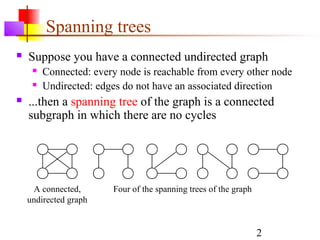
   Suppose you have a connected undirected graph
        Connected: every node is reachable from every other node
        Undirected: edges do not have an associated direction
   ...then a spanning tree of the graph is a connected
    subgraph in which there are no cycles


     A connected,       Four of the spanning trees of the graph
    undirected graph


                                                                  2
Finding a spanning tree
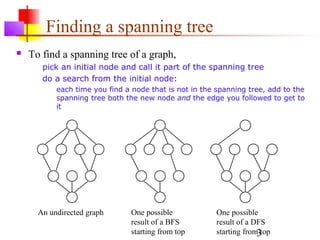
   To find a spanning tree of a graph,
       pick an initial node and call it part of the spanning tree
       do a search from the initial node:
           each time you find a node that is not in the spanning tree, add to the
           spanning tree both the new node and the edge you followed to get to
           it


      An undirected graph       One possible            One possible
                                result of a BFS         result of a DFS
                                starting from top       starting from3top
Minimizing costs
   Suppose you want to supply a set of houses (say, in a
    new subdivision) with:
       electric power
       water
       sewage lines
       telephone lines
   To keep costs down, you could connect these houses
    with a spanning tree (of, for example, power lines)
       However, the houses are not all equal distances apart
   To reduce costs even further, you could connect the
    houses with a minimum-cost spanning tree

                                                          4
Minimum-cost spanning trees
    Suppose you have a connected undirected graph with a weight
     (or cost) associated with each edge
    The cost of a spanning tree would be the sum of the costs of its
     edges
    A minimum-cost spanning tree is a spanning tree that has the
     lowest cost
                   16                                16
            A                  B               A            B
                 21 11             6                   11       6

       19                      5                            5
                     F                 C              F             C
                33        14
                                       10
            E        18        D               E     18     D
    A connected, undirected graph           A minimum-cost spanning tree
                                                                        5
Finding spanning trees
   There are two basic algorithms for finding minimum-cost
    spanning trees, and both are greedy algorithms

   Kruskal’s algorithm: Start with no nodes or edges in the
    spanning tree, and repeatedly add the cheapest edge that does
    not create a cycle
       Here, we consider the spanning tree to consist of edges only

   Prim’s algorithm: Start with any one node in the spanning
    tree, and repeatedly add the cheapest edge, and the node it leads
    to, for which the node is not already in the spanning tree.
       Here, we consider the spanning tree to consist of both nodes and edges


                                                                   6
Kruskal’s algorithm
    T = empty spanning tree;
    E = set of edges;
    N = number of nodes in graph;
    while T has fewer than N - 1 edges {
       remove an edge (v, w) of lowest cost from E
       if adding (v, w) to T would create a cycle
           then discard (v, w)
           else add (v, w) to T
    }
   Finding an edge of lowest cost can be done just by sorting
    the edges
   Efficient testing for a cycle requires a fairly complex
    algorithm (UNION-FIND) which we don’t cover in this
    course

                                                      7
Prim’s algorithm
    T = a spanning tree containing a single node s;
    E = set of edges adjacent to s;
    while T does not contain all the nodes {
       remove an edge (v, w) of lowest cost from E
       if w is already in T then discard edge (v, w)
       else {
           add edge (v, w) and node w to T
           add to E the edges adjacent to w
       }
    }
   An edge of lowest cost can be found with a priority queue
   Testing for a cycle is automatic
       Hence, Prim’s algorithm is far simpler to implement than Kruskal’s
        algorithm
                                                                  8
Mazes
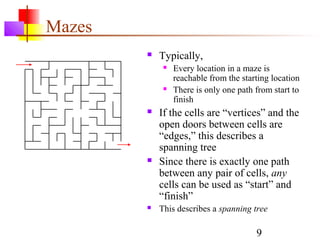
           Typically,
                Every location in a maze is
                 reachable from the starting location
                There is only one path from start to
                 finish
           If the cells are “vertices” and the
            open doors between cells are
            “edges,” this describes a
            spanning tree
           Since there is exactly one path
            between any pair of cells, any
            cells can be used as “start” and
            “finish”
           This describes a spanning tree

                                        9
Mazes as spanning trees
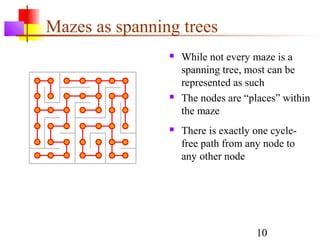
                   While not every maze is a
                    spanning tree, most can be
                    represented as such
                   The nodes are “places” within
                    the maze
                   There is exactly one cycle-
                    free path from any node to
                    any other node


                                     10
Building a maze I

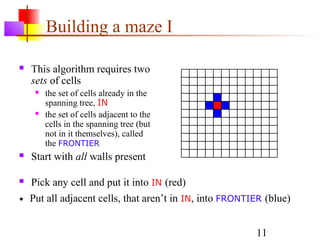
   This algorithm requires two
    sets of cells
        the set of cells already in the
         spanning tree, IN
        the set of cells adjacent to the
         cells in the spanning tree (but
         not in it themselves), called
         the FRONTIER
   Start with all walls present

   Pick any cell and put it into IN (red)
•   Put all adjacent cells, that aren’t in IN, into FRONTIER (blue)


                                                          11
Building a maze II
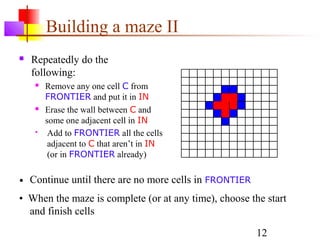
   Repeatedly do the
    following:
        Remove any one cell C from
         FRONTIER and put it in IN
        Erase the wall between C and
         some one adjacent cell in IN
         Add to FRONTIER all the cells
          adjacent to C that aren’t in IN
          (or in FRONTIER already)

•   Continue until there are no more cells in FRONTIER
• When the maze is complete (or at any time), choose the start
  and finish cells

                                                         12
The End


          13

33 spanning-trees

  • 1.
  • 2.
    Spanning trees  Suppose you have a connected undirected graph  Connected: every node is reachable from every other node  Undirected: edges do not have an associated direction  ...then a spanning tree of the graph is a connected subgraph in which there are no cycles A connected, Four of the spanning trees of the graph undirected graph 2
  • 3.
    Finding a spanningtree  To find a spanning tree of a graph, pick an initial node and call it part of the spanning tree do a search from the initial node: each time you find a node that is not in the spanning tree, add to the spanning tree both the new node and the edge you followed to get to it An undirected graph One possible One possible result of a BFS result of a DFS starting from top starting from3top
  • 4.
    Minimizing costs  Suppose you want to supply a set of houses (say, in a new subdivision) with:  electric power  water  sewage lines  telephone lines  To keep costs down, you could connect these houses with a spanning tree (of, for example, power lines)  However, the houses are not all equal distances apart  To reduce costs even further, you could connect the houses with a minimum-cost spanning tree 4
  • 5.
    Minimum-cost spanning trees  Suppose you have a connected undirected graph with a weight (or cost) associated with each edge  The cost of a spanning tree would be the sum of the costs of its edges  A minimum-cost spanning tree is a spanning tree that has the lowest cost 16 16 A B A B 21 11 6 11 6 19 5 5 F C F C 33 14 10 E 18 D E 18 D A connected, undirected graph A minimum-cost spanning tree 5
  • 6.
    Finding spanning trees  There are two basic algorithms for finding minimum-cost spanning trees, and both are greedy algorithms  Kruskal’s algorithm: Start with no nodes or edges in the spanning tree, and repeatedly add the cheapest edge that does not create a cycle  Here, we consider the spanning tree to consist of edges only  Prim’s algorithm: Start with any one node in the spanning tree, and repeatedly add the cheapest edge, and the node it leads to, for which the node is not already in the spanning tree.  Here, we consider the spanning tree to consist of both nodes and edges 6
  • 7.
    Kruskal’s algorithm T = empty spanning tree; E = set of edges; N = number of nodes in graph; while T has fewer than N - 1 edges { remove an edge (v, w) of lowest cost from E if adding (v, w) to T would create a cycle then discard (v, w) else add (v, w) to T }  Finding an edge of lowest cost can be done just by sorting the edges  Efficient testing for a cycle requires a fairly complex algorithm (UNION-FIND) which we don’t cover in this course 7
  • 8.
    Prim’s algorithm T = a spanning tree containing a single node s; E = set of edges adjacent to s; while T does not contain all the nodes { remove an edge (v, w) of lowest cost from E if w is already in T then discard edge (v, w) else { add edge (v, w) and node w to T add to E the edges adjacent to w } }  An edge of lowest cost can be found with a priority queue  Testing for a cycle is automatic  Hence, Prim’s algorithm is far simpler to implement than Kruskal’s algorithm 8
  • 9.
    Mazes  Typically,  Every location in a maze is reachable from the starting location  There is only one path from start to finish  If the cells are “vertices” and the open doors between cells are “edges,” this describes a spanning tree  Since there is exactly one path between any pair of cells, any cells can be used as “start” and “finish”  This describes a spanning tree 9
  • 10.
    Mazes as spanningtrees  While not every maze is a spanning tree, most can be represented as such  The nodes are “places” within the maze  There is exactly one cycle- free path from any node to any other node 10
  • 11.
    Building a mazeI  This algorithm requires two sets of cells  the set of cells already in the spanning tree, IN  the set of cells adjacent to the cells in the spanning tree (but not in it themselves), called the FRONTIER  Start with all walls present  Pick any cell and put it into IN (red) • Put all adjacent cells, that aren’t in IN, into FRONTIER (blue) 11
  • 12.
    Building a mazeII  Repeatedly do the following:  Remove any one cell C from FRONTIER and put it in IN  Erase the wall between C and some one adjacent cell in IN  Add to FRONTIER all the cells adjacent to C that aren’t in IN (or in FRONTIER already) • Continue until there are no more cells in FRONTIER • When the maze is complete (or at any time), choose the start and finish cells 12
  • 13.