A General Framework for
Enhancing Prediction
Performance on Time Series
Data
Chin-Hui Chen
陳晉暉
Prof. Pu-Jen Cheng
鄭卜壬教授
增進時序資料預測效能之一般化模型
1. Motivation
2. Related Works
3. Framework
4. Experiment
5. Conclusion
Agenda
Motivation
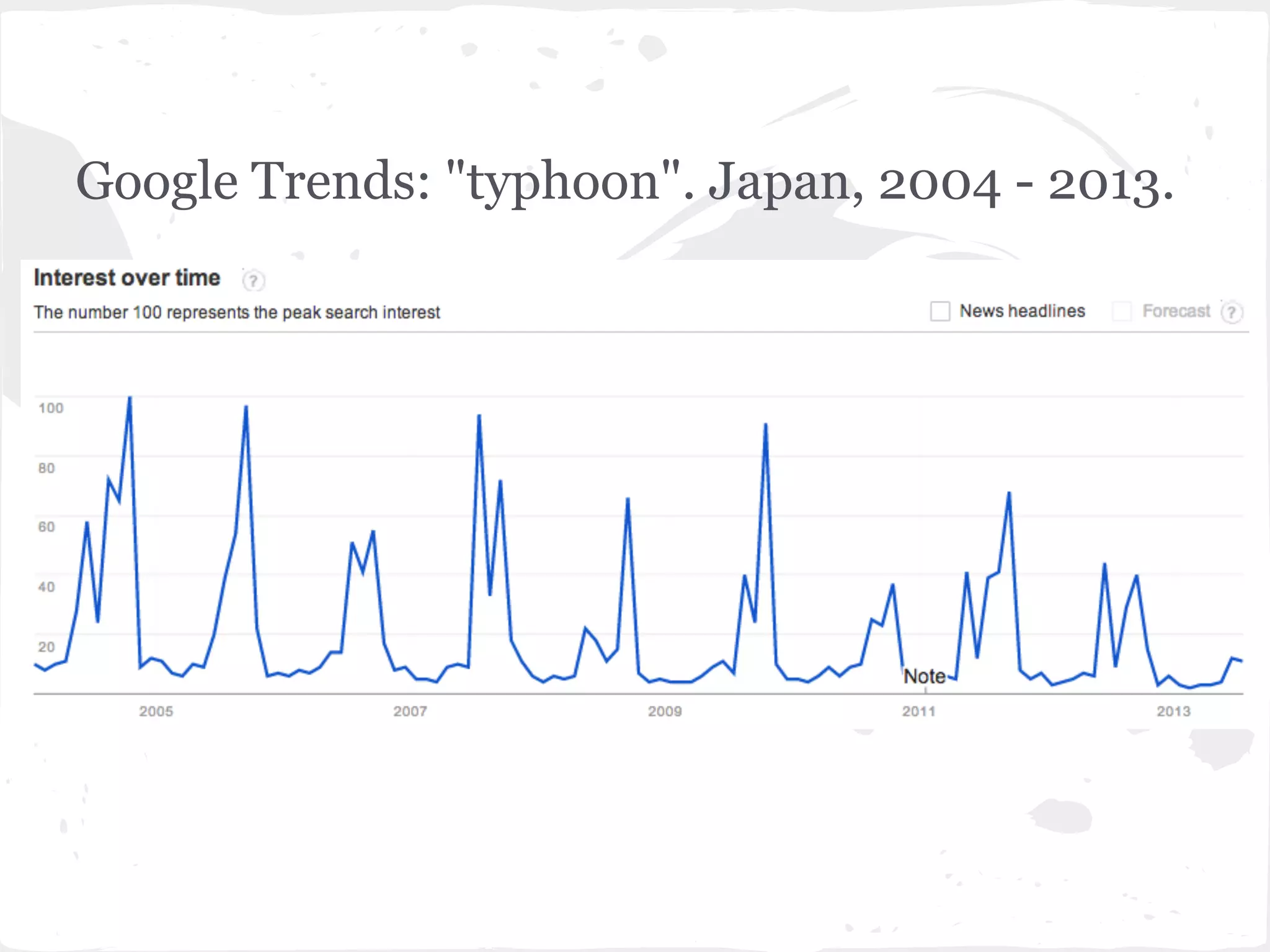
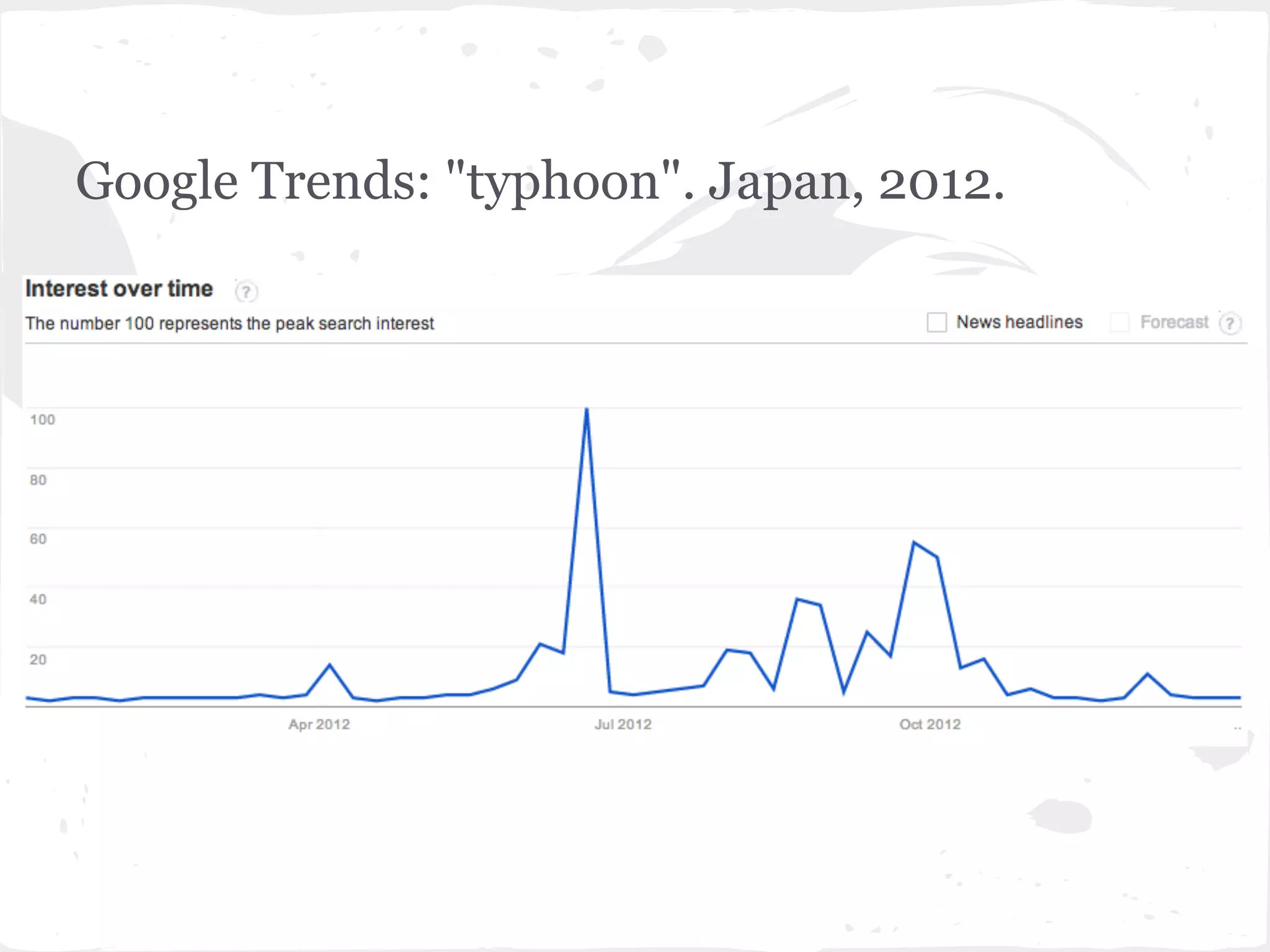
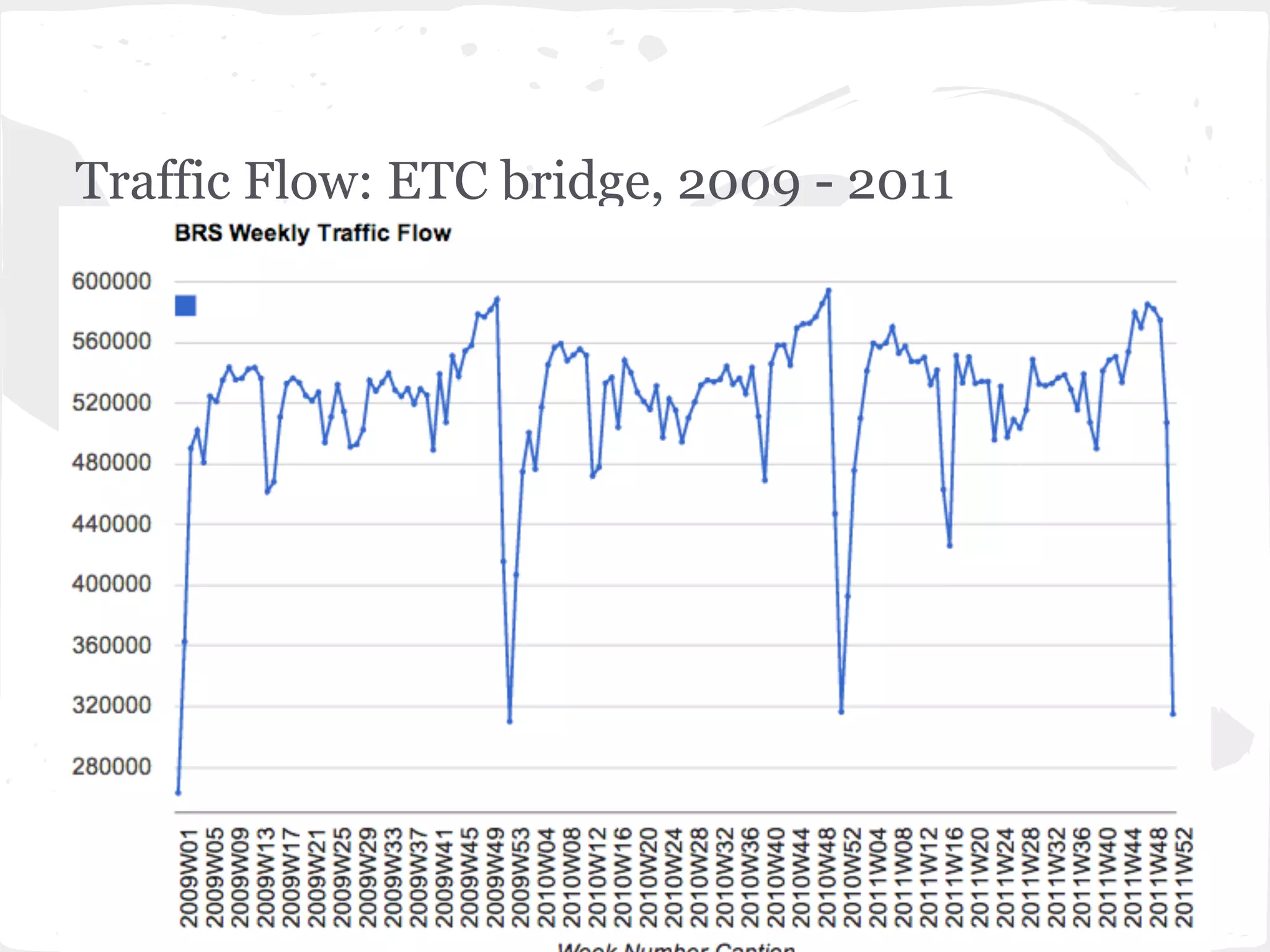
● Time series data is everywhere.
● For example:
○ Query Trend Data
○ Traffic Flow Data
Motivation
Google Trends: "typhoon". Japan, 2004 - 2013.
Google Trends: "typhoon". Japan, 2012.
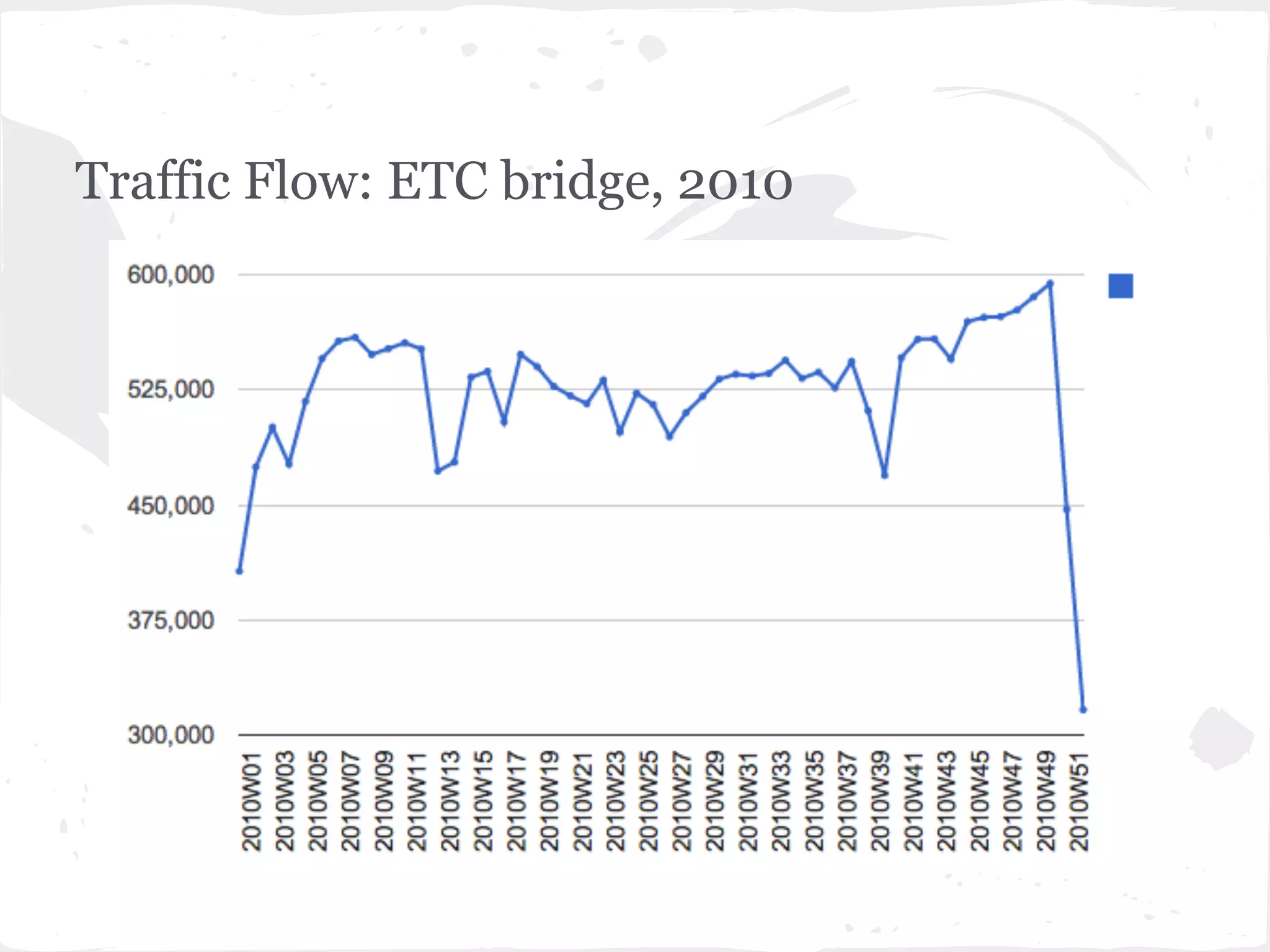
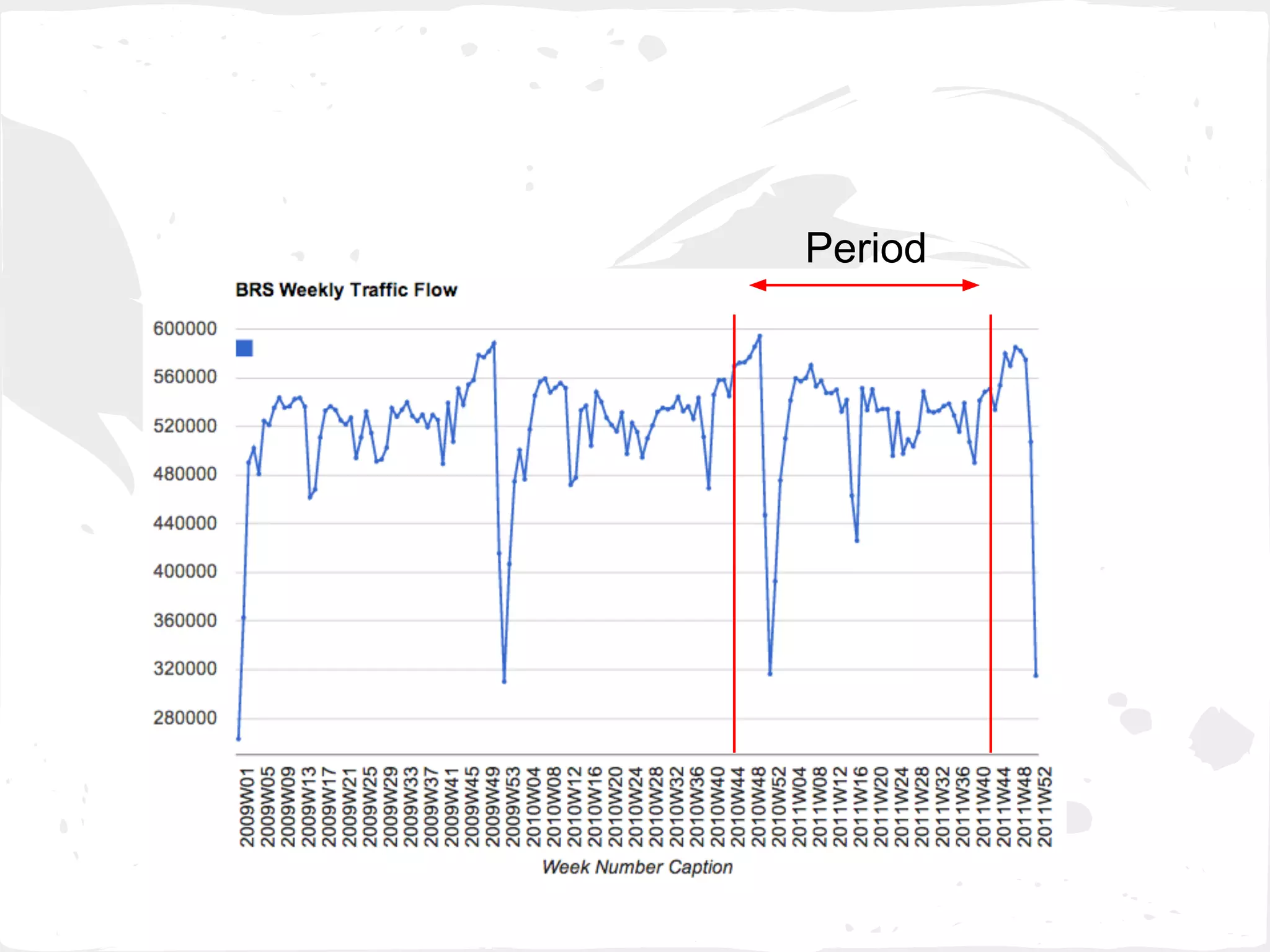
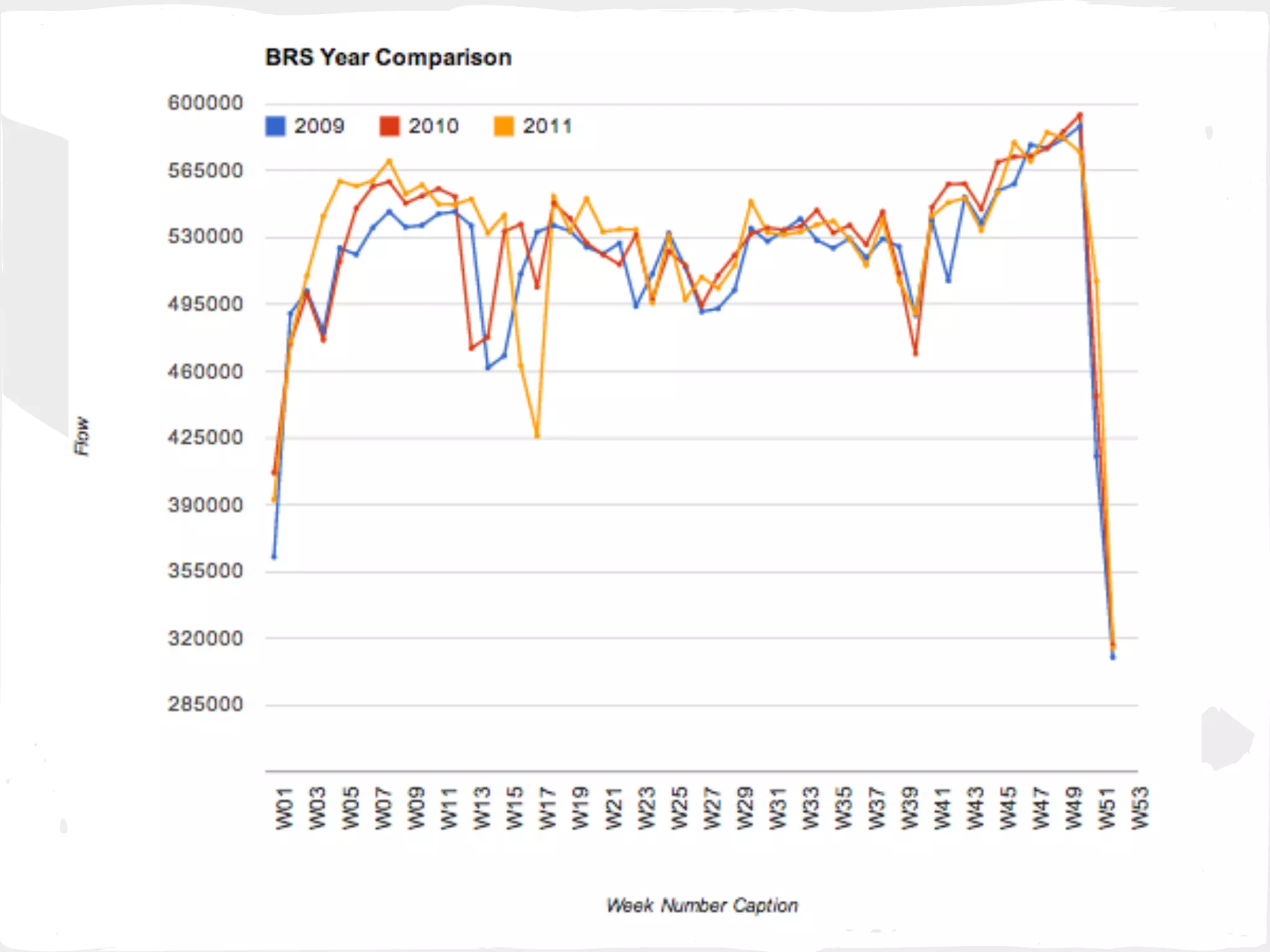
Traffic Flow: ETC bridge, 2009 - 2011
Traffic Flow: ETC bridge, 2010
Predict Time Series Data
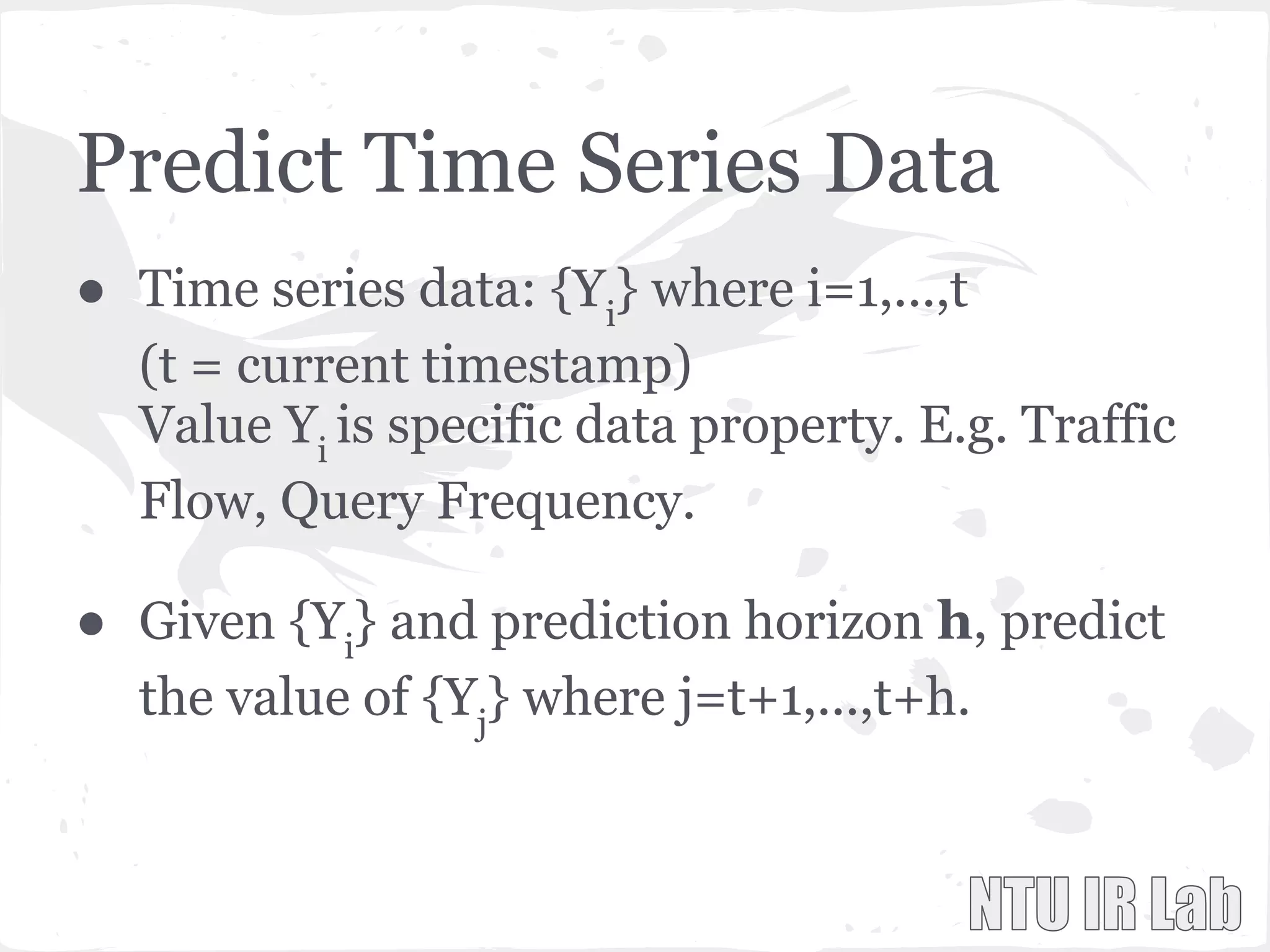
● Time series data: {Yi
} where i=1,...,t
(t = current timestamp)
Value Yi
is specific data property. E.g. Traffic
Flow, Query Frequency.
● Given {Yi
} and prediction horizon h, predict
the value of {Yj
} where j=t+1,...,t+h.
Predict Time Series Data
(cont'd)
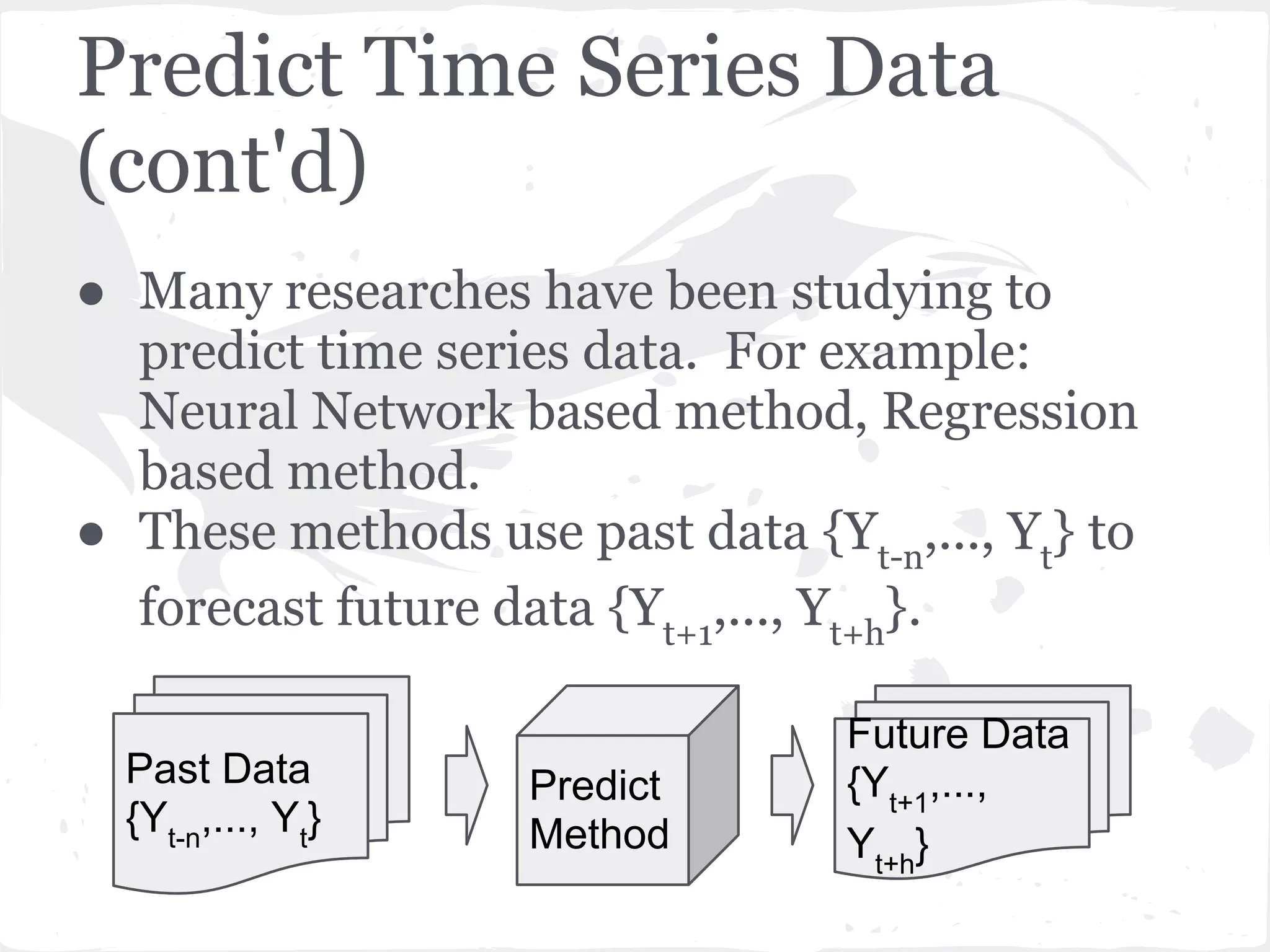
● Many researches have been studying to
predict time series data. For example:
Neural Network based method, Regression
based method.
● These methods use past data {Yt-n
,..., Yt
} to
forecast future data {Yt+1
,..., Yt+h
}.
Predict
Method
Past Data
{Yt-n
,..., Yt
}
Future Data
{Yt+1
,...,
Yt+h
}
Predict Time Series Data
(cont'd)
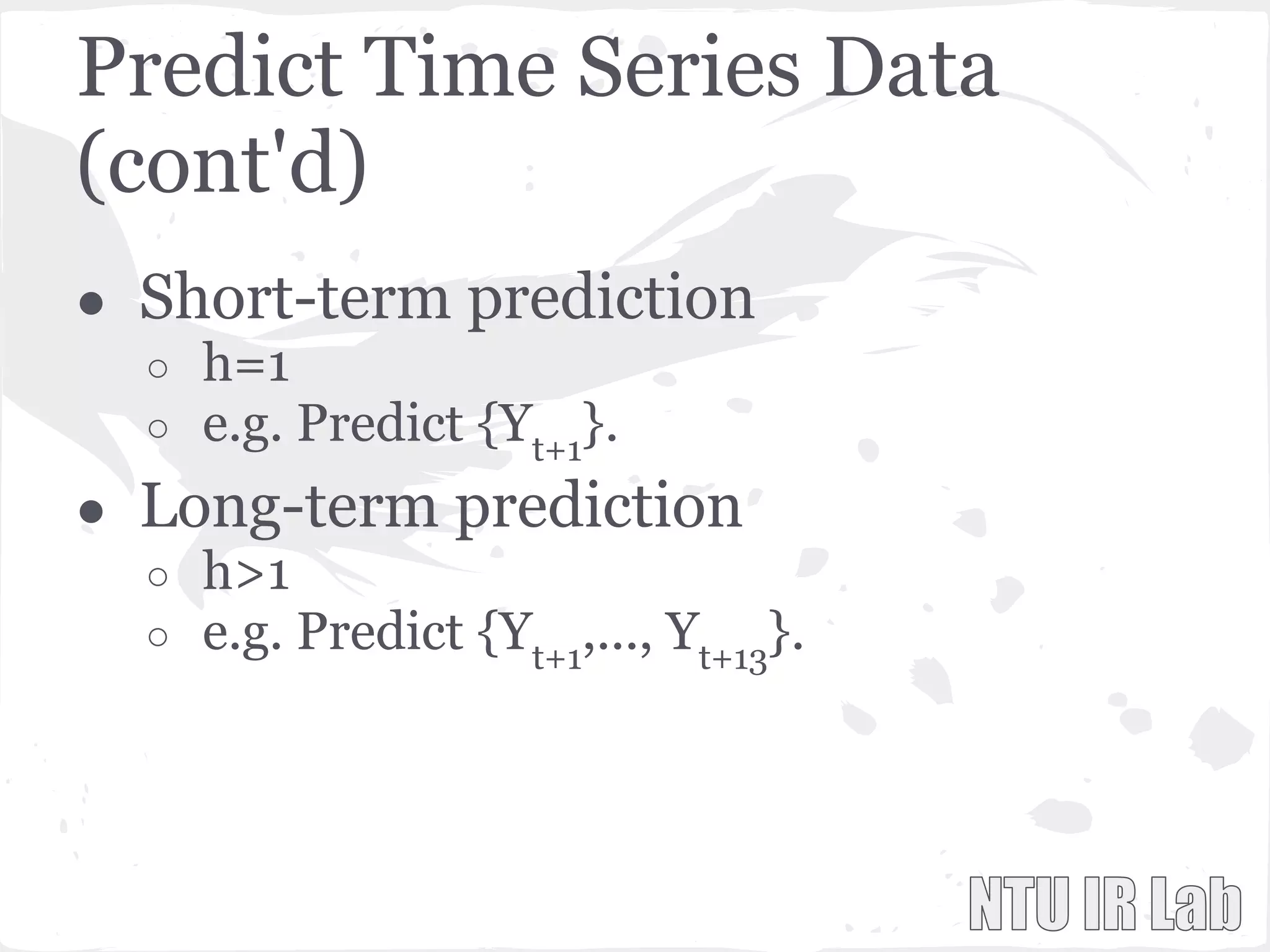
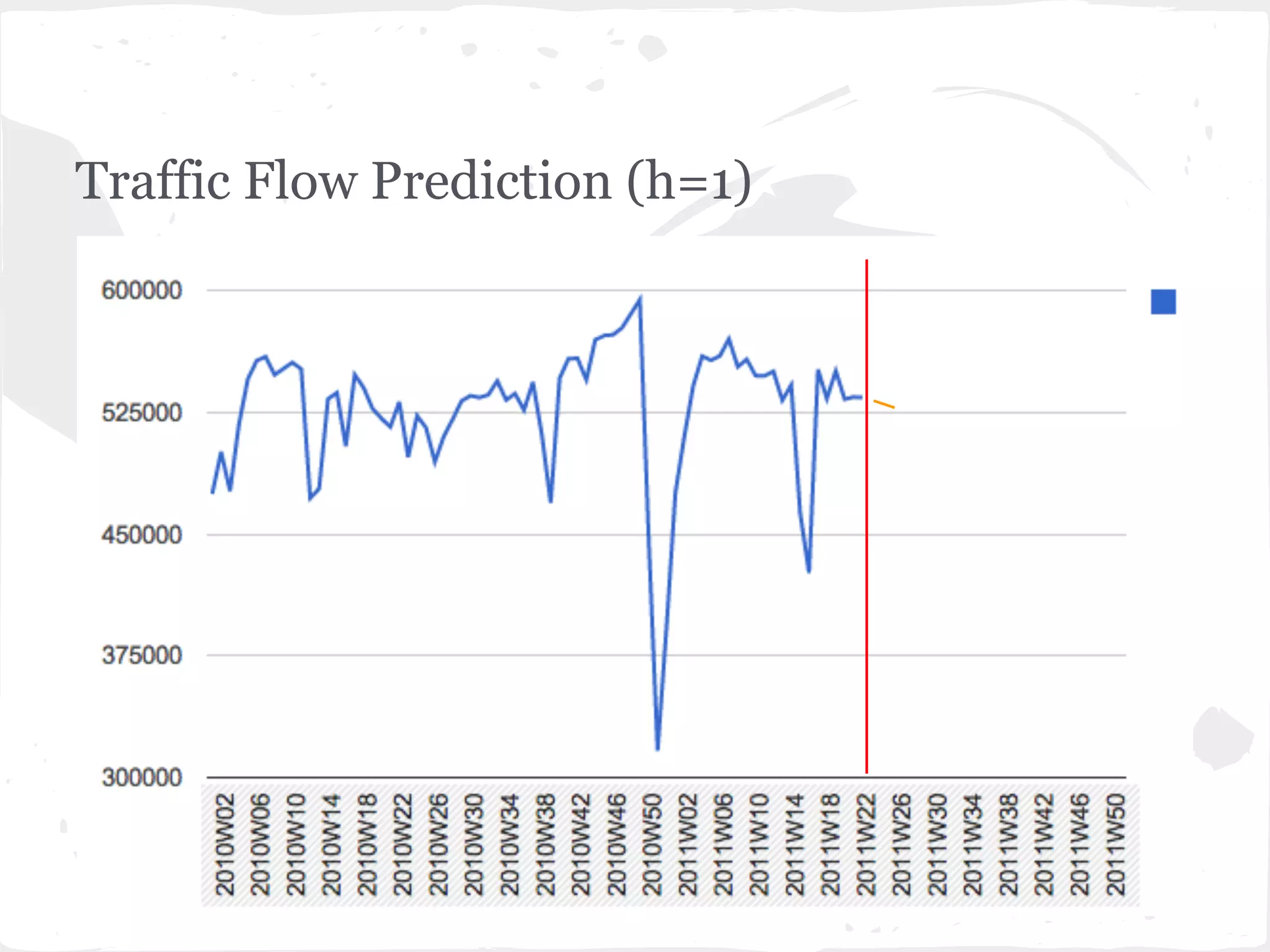
● Short-term prediction
○ h=1
○ e.g. Predict {Yt+1
}.
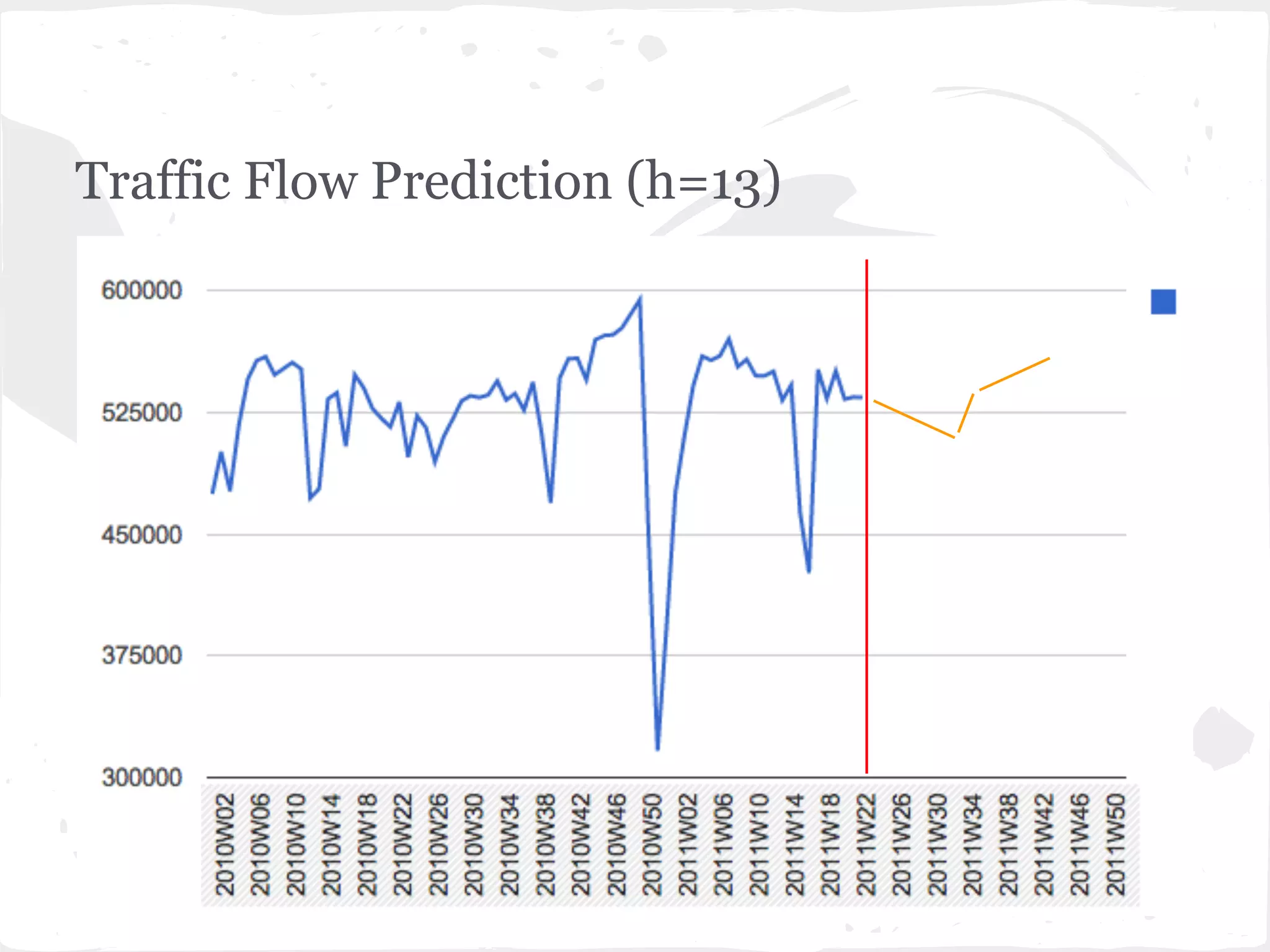
● Long-term prediction
○ h>1
○ e.g. Predict {Yt+1
,..., Yt+13
}.
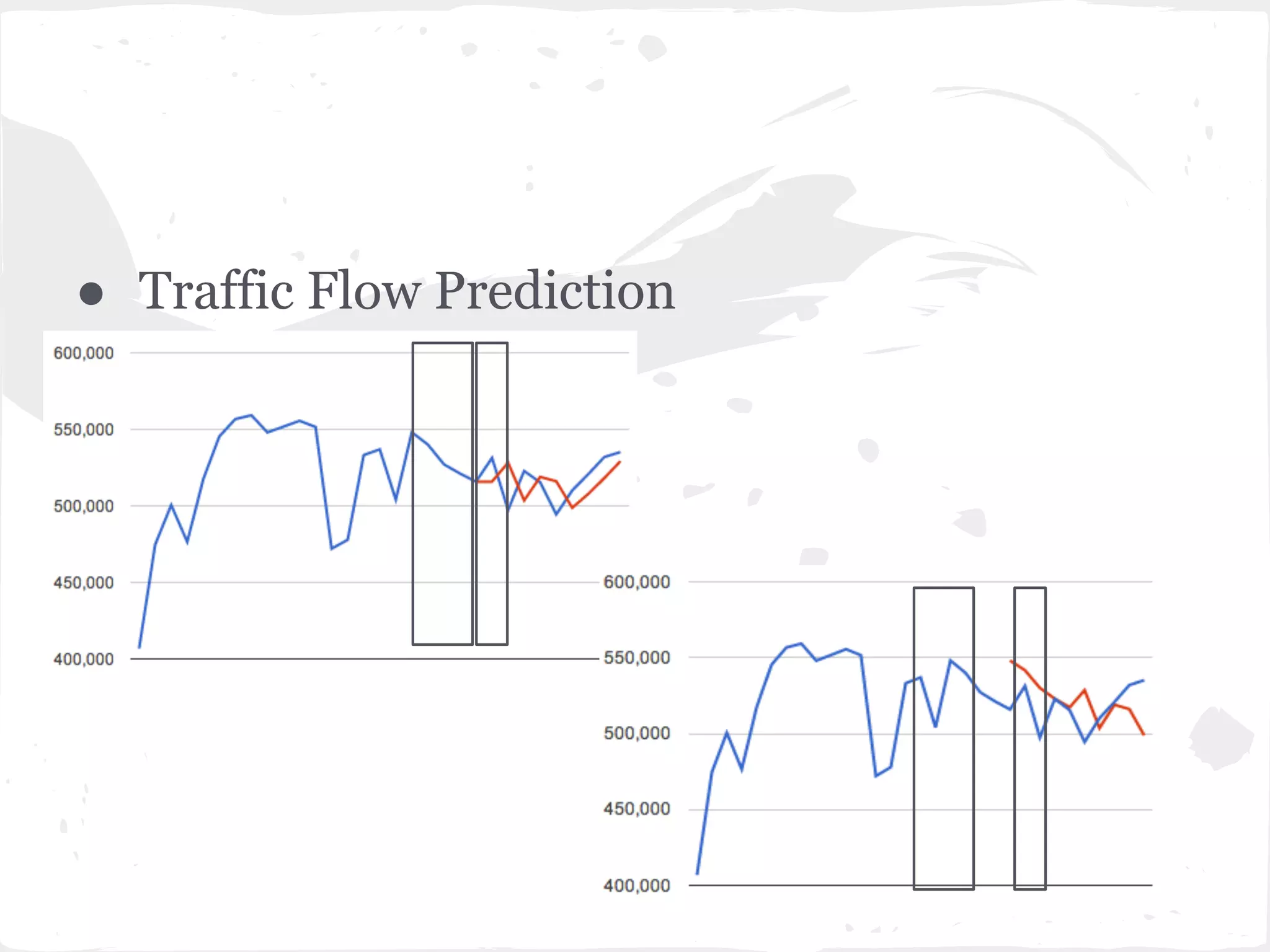
Traffic Flow Prediction (h=1)
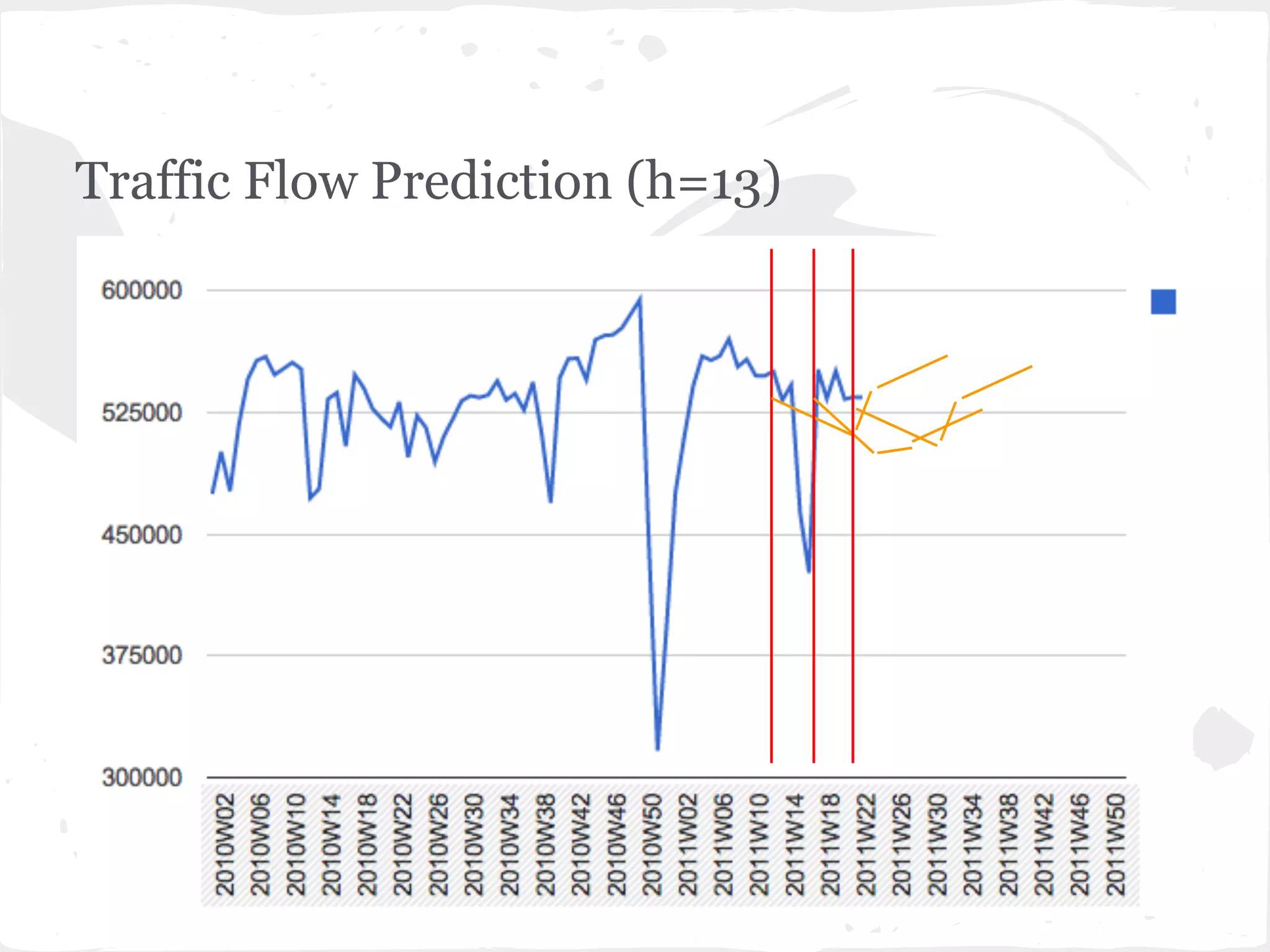
Traffic Flow Prediction (h=13)
Intuitively...
● The nearer the dataset is, the more accurate
we predicts.
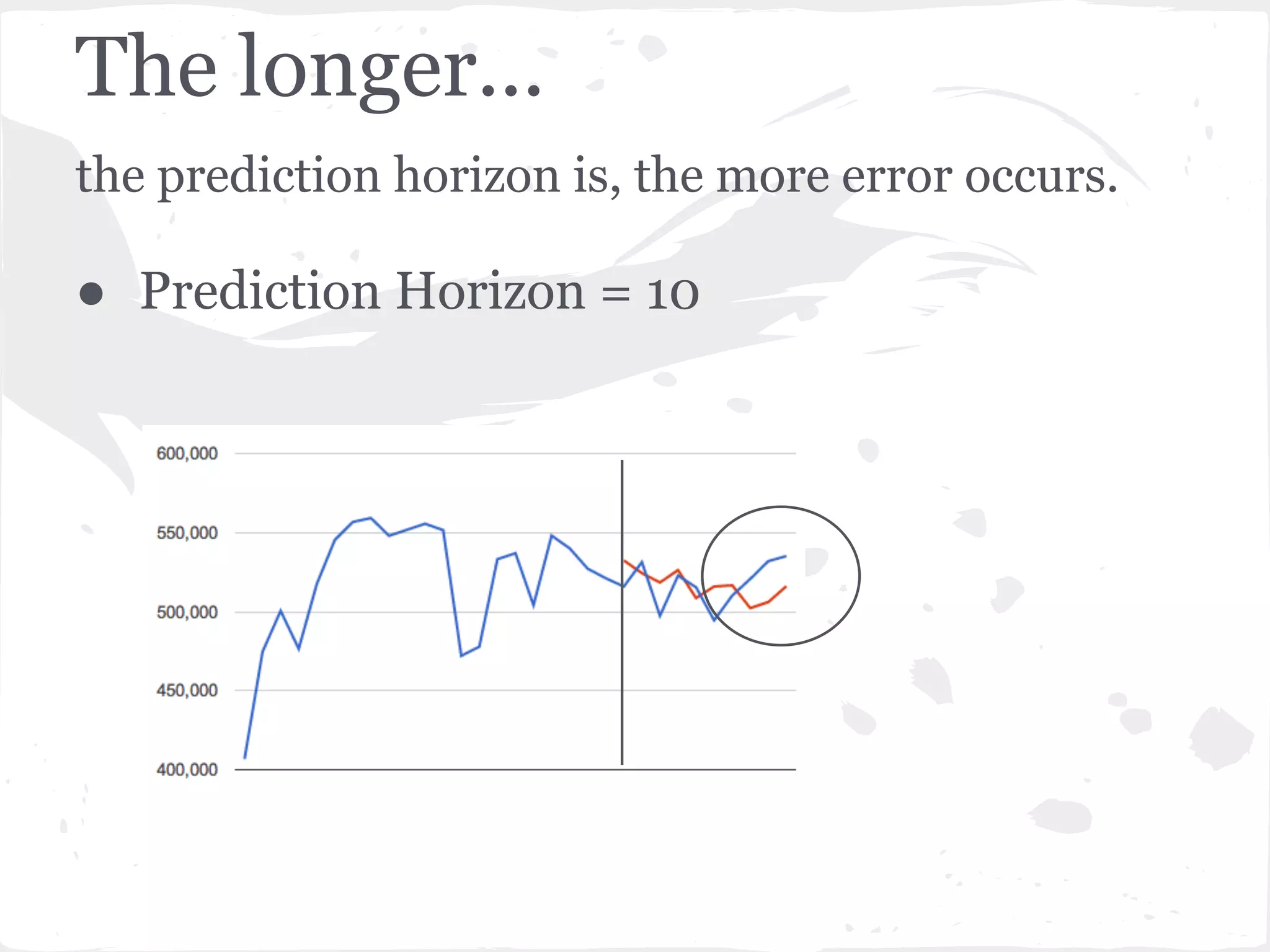
● The longer the prediction horizon is, the
more error occurs.
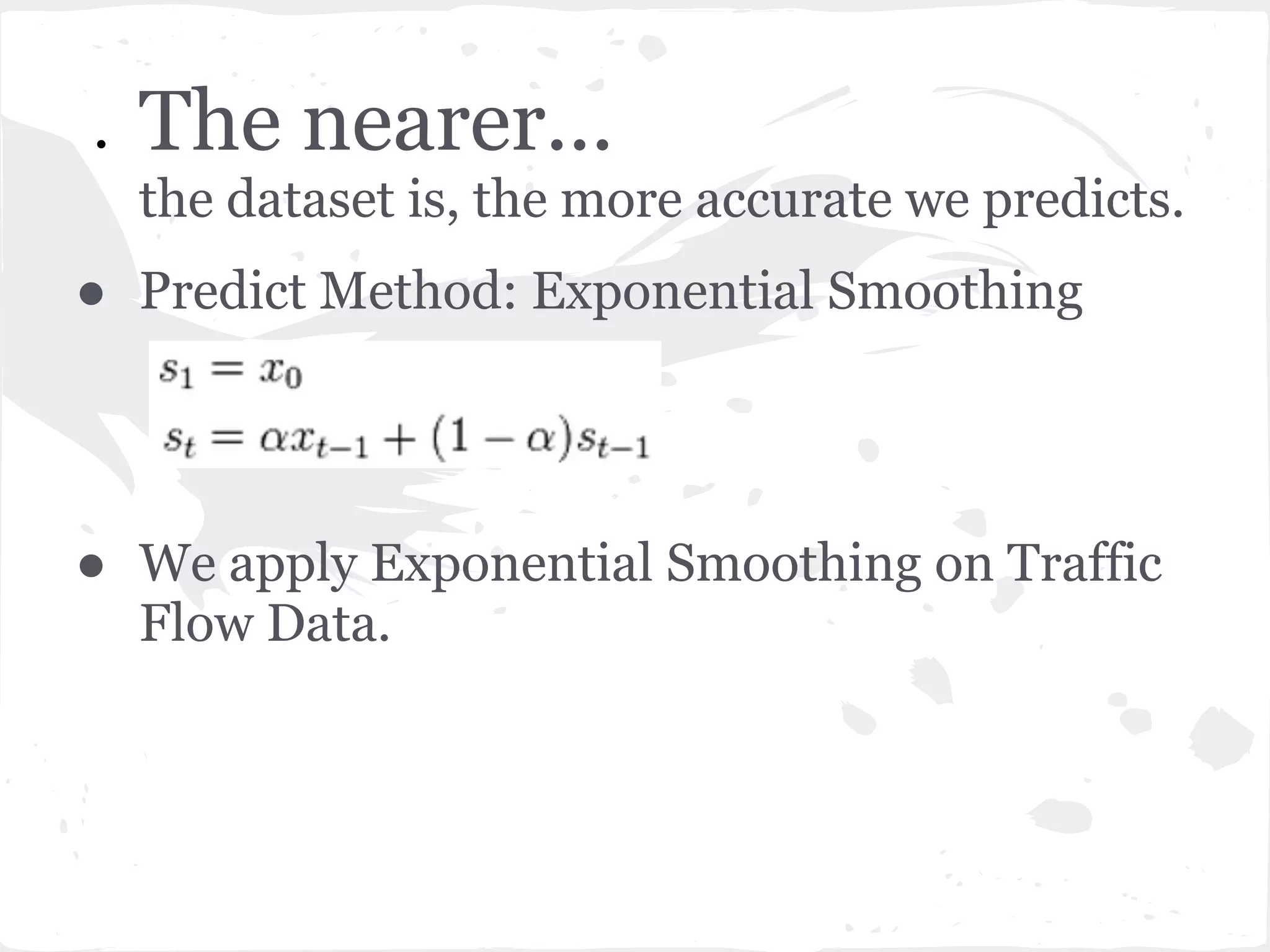
● The nearer...
the dataset is, the more accurate we predicts.
● Predict Method: Exponential Smoothing
● We apply Exponential Smoothing on Traffic
Flow Data.
● Traffic Flow Prediction
The longer...
the prediction horizon is, the more error occurs.
● Prediction Horizon = 10
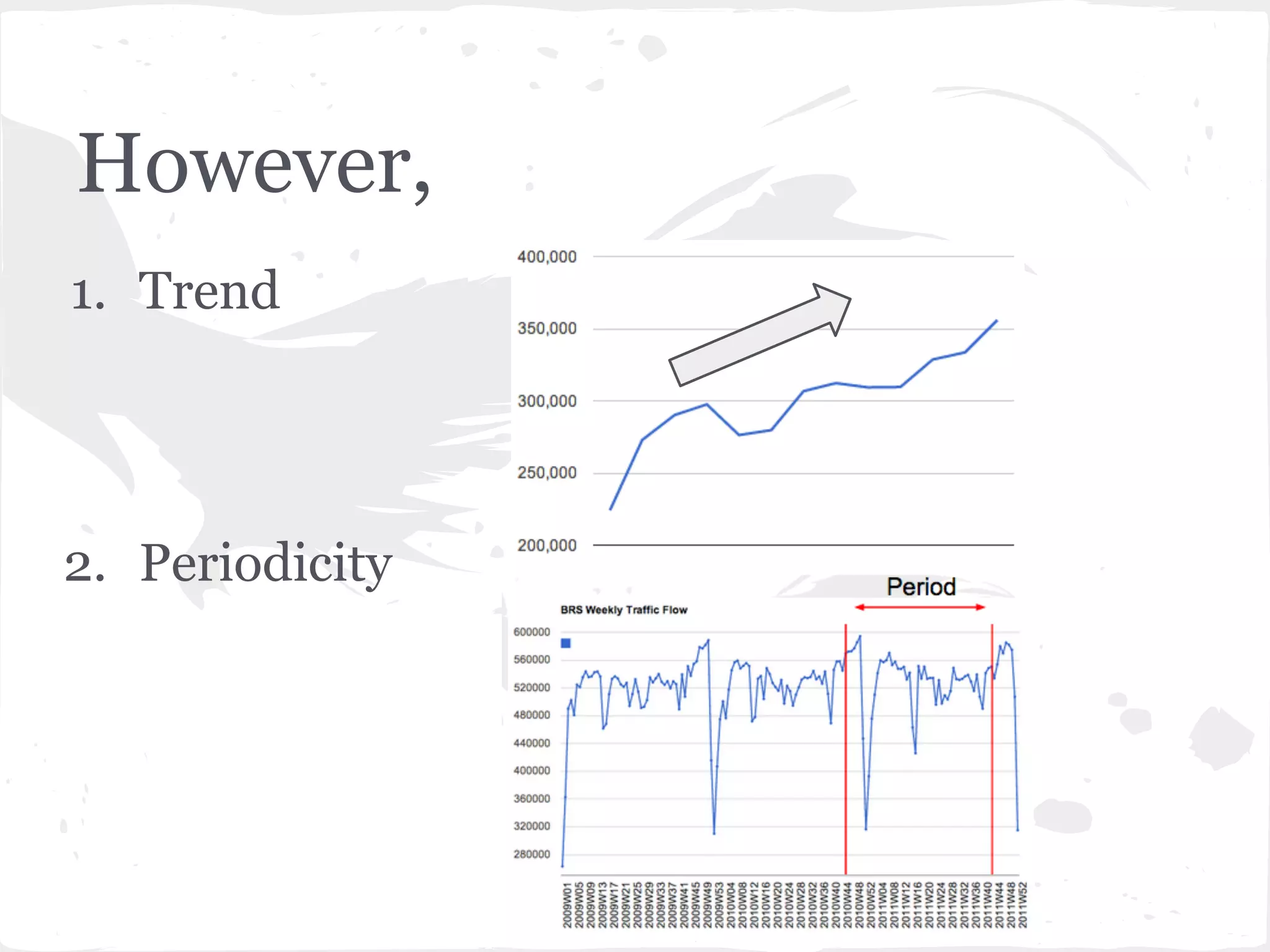
However,
1. Trend
2. Periodicity
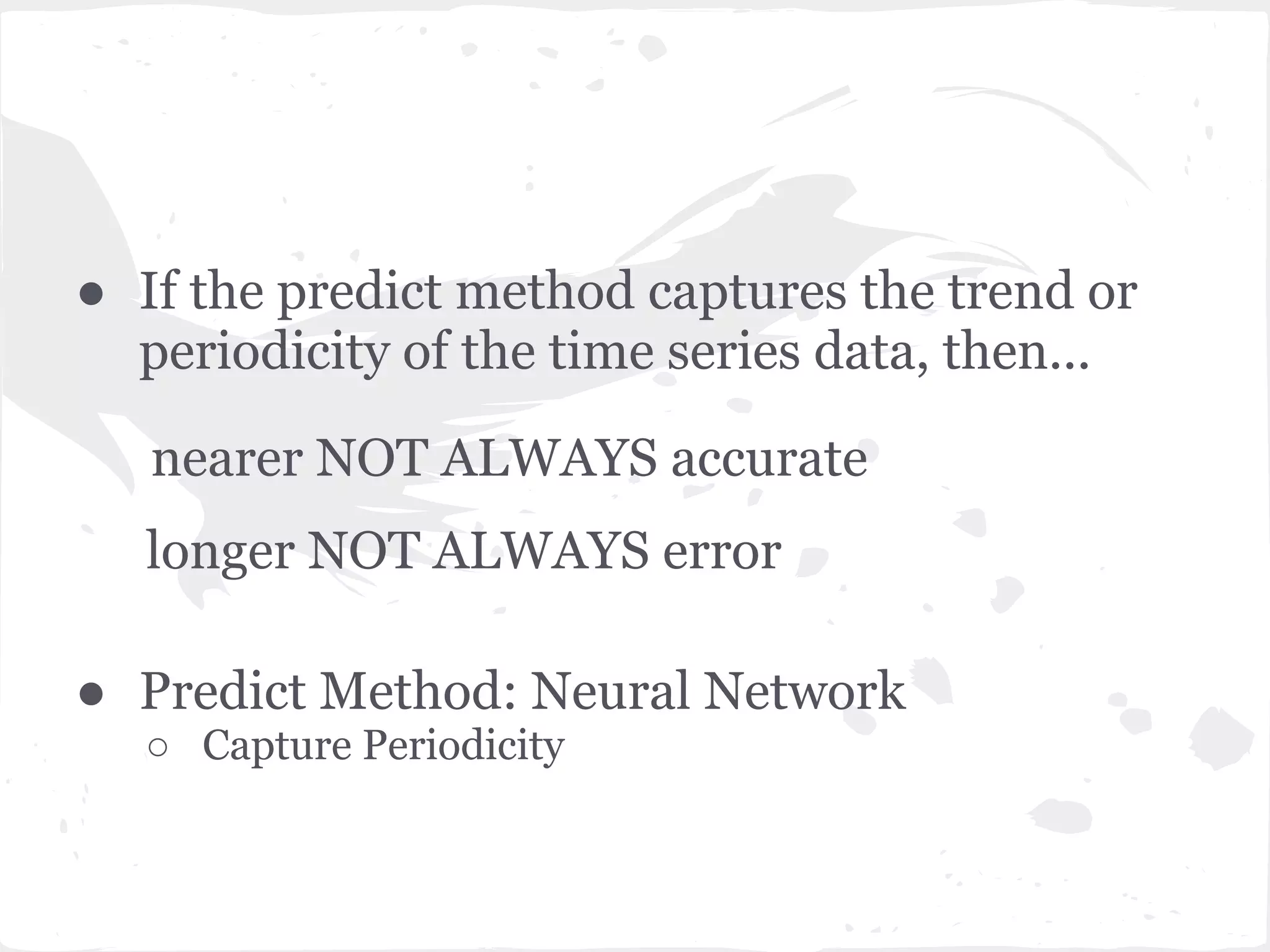
● If the predict method captures the trend or
periodicity of the time series data, then...
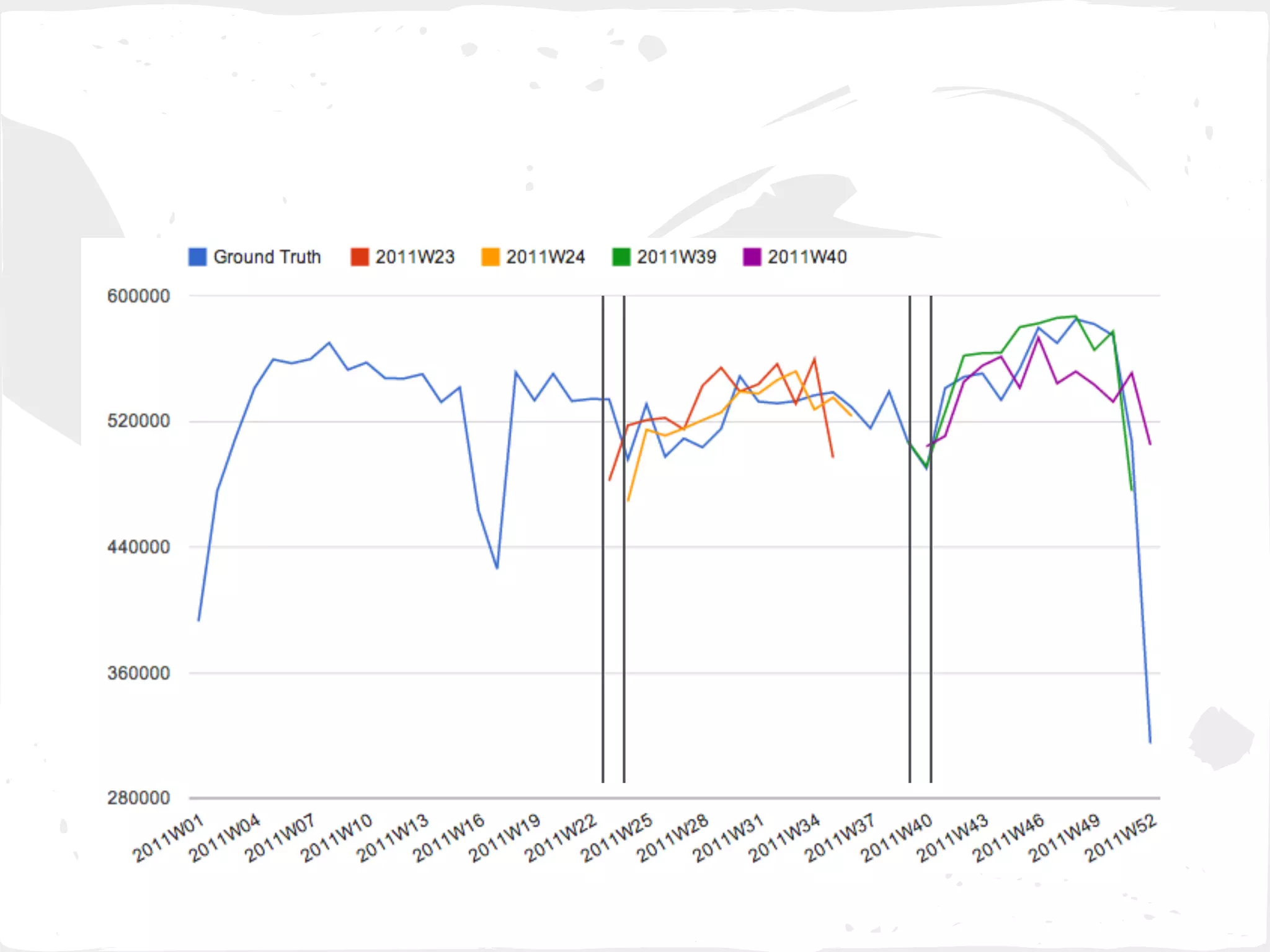
● Predict Method: Neural Network
○ Capture Periodicity
nearer NOT ALWAYS accurate
longer NOT ALWAYS error
Also
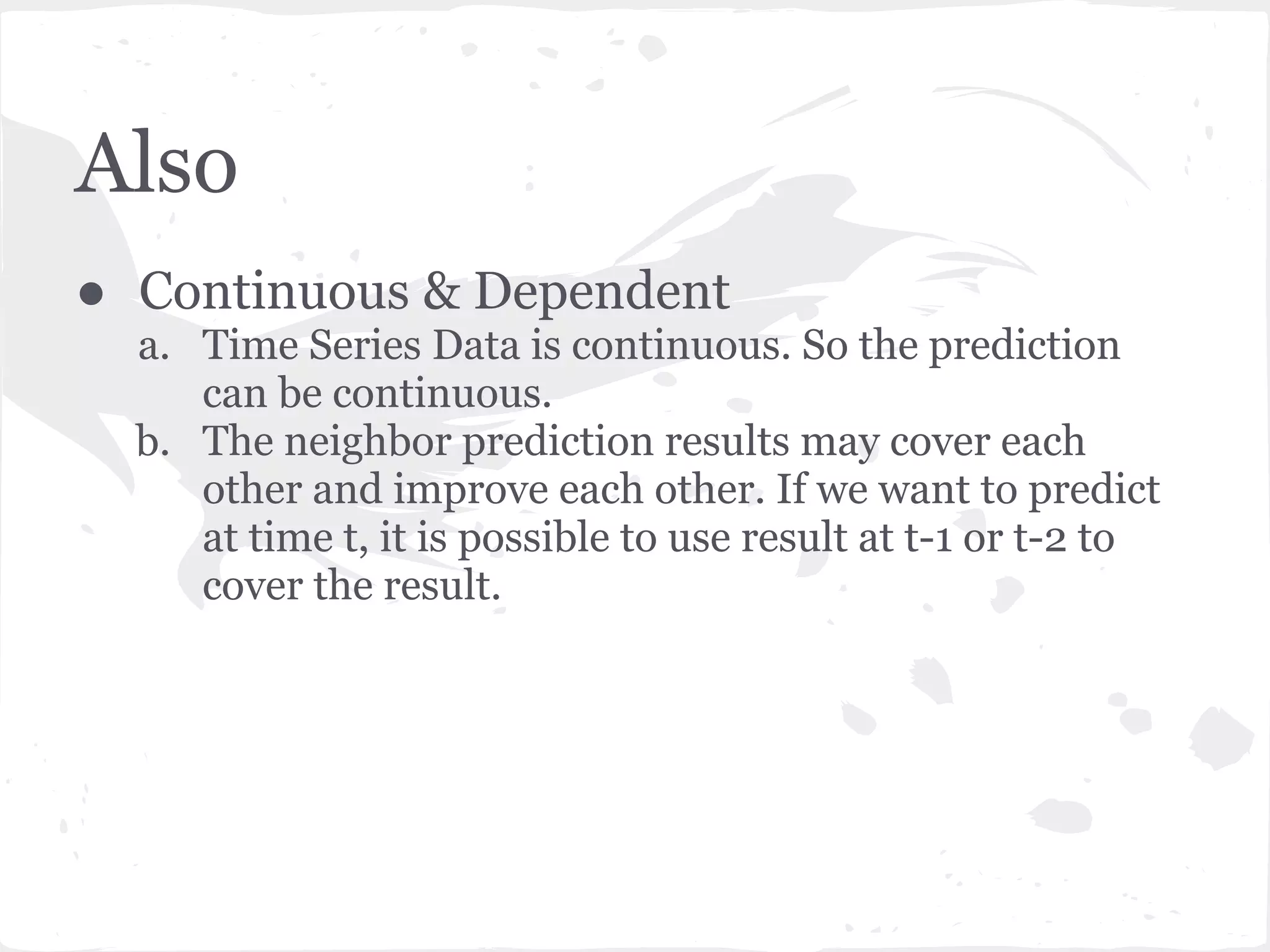
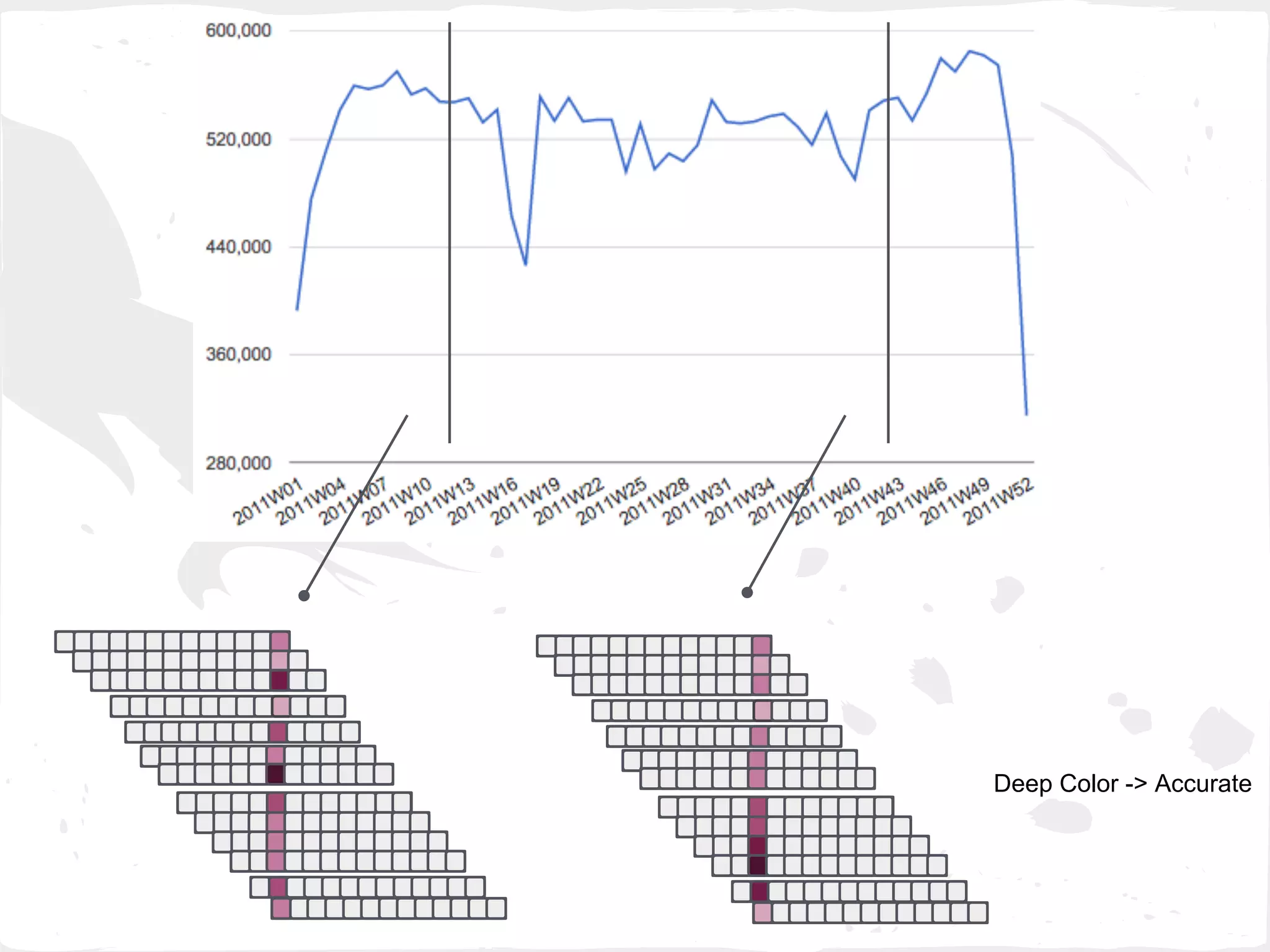
● Continuous & Dependent
a. Time Series Data is continuous. So the prediction
can be continuous.
b. The neighbor prediction results may cover each
other and improve each other. If we want to predict
at time t, it is possible to use result at t-1 or t-2 to
cover the result.
Traffic Flow Prediction (h=13)
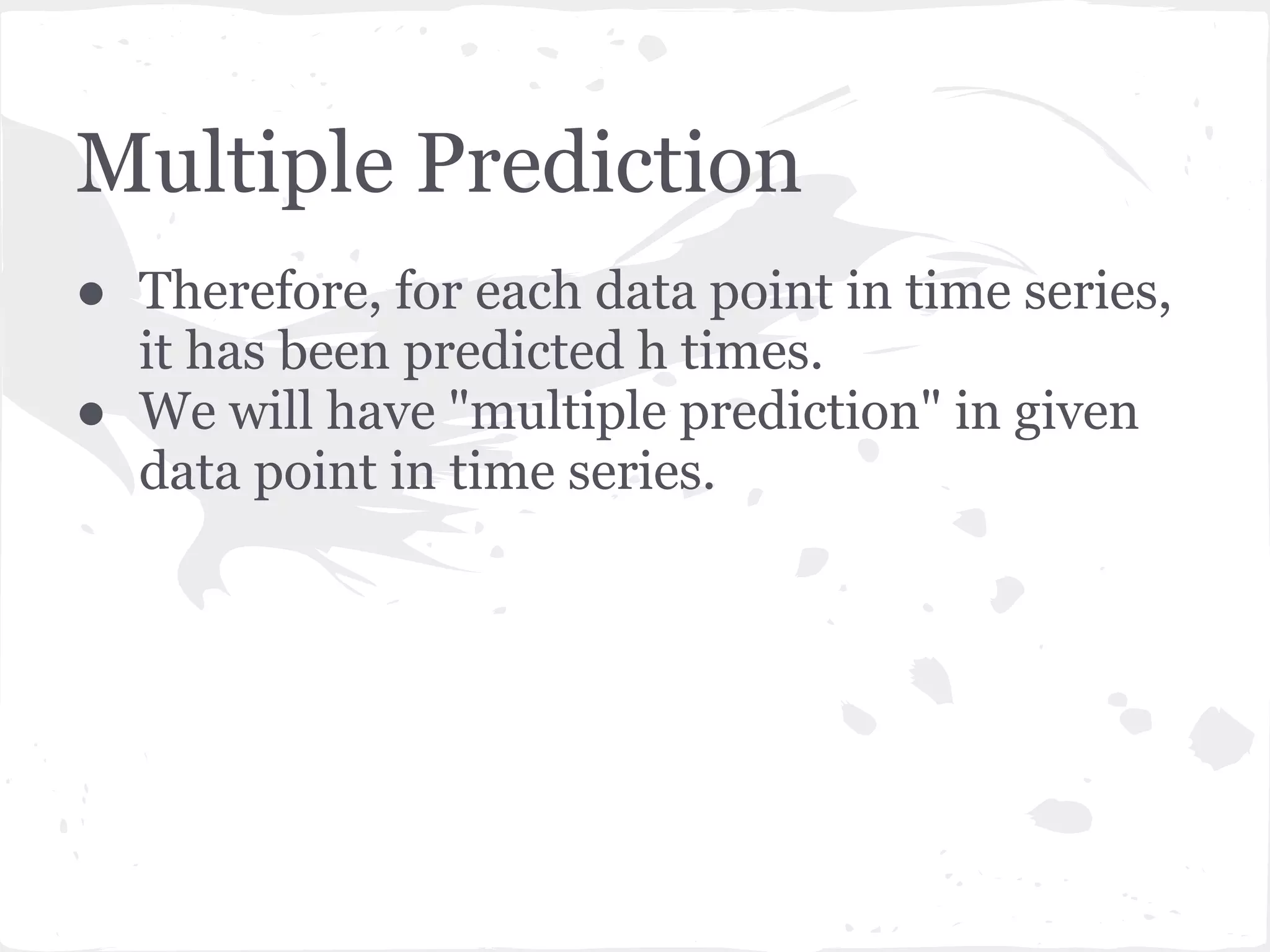
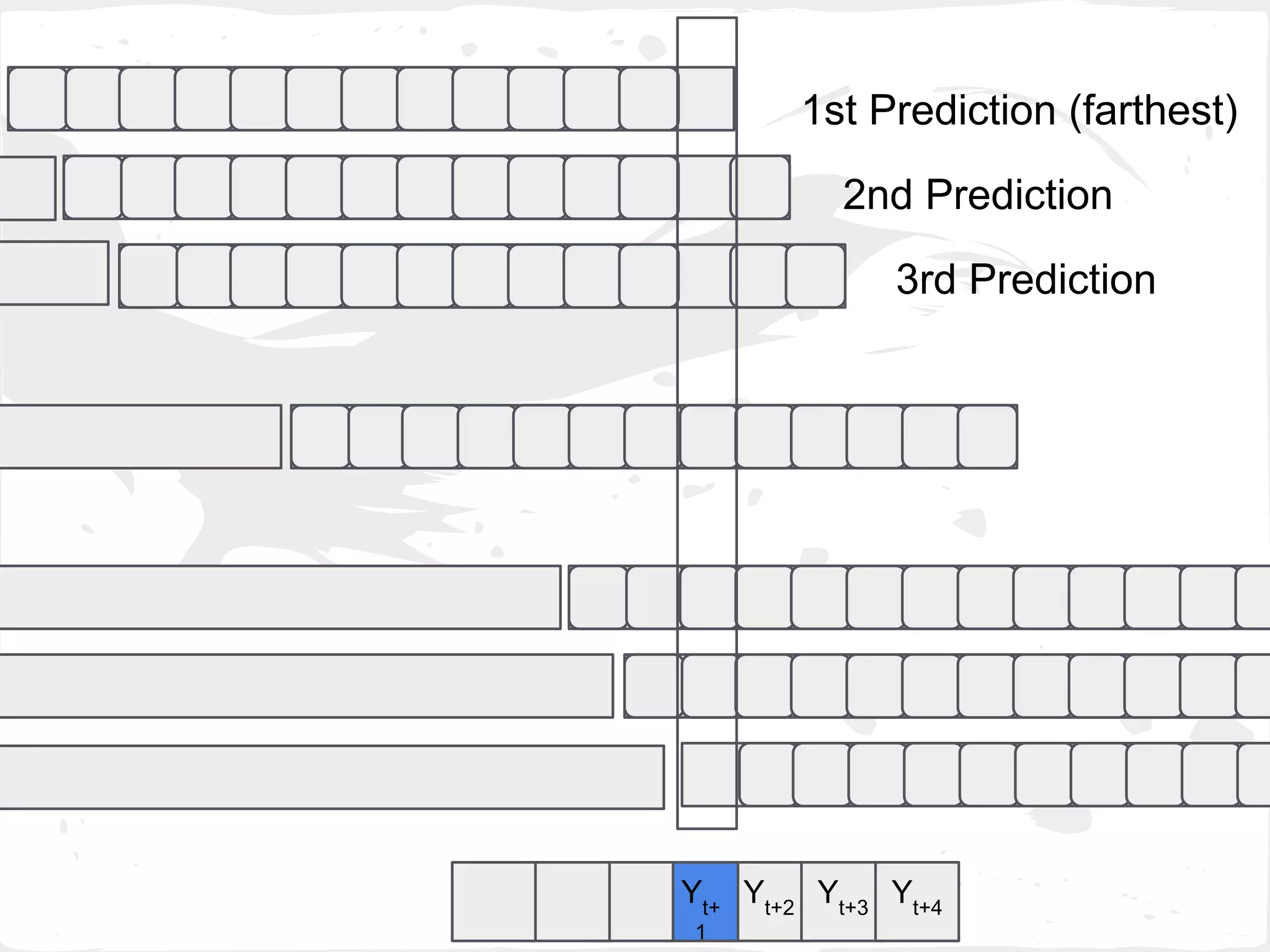
Multiple Prediction
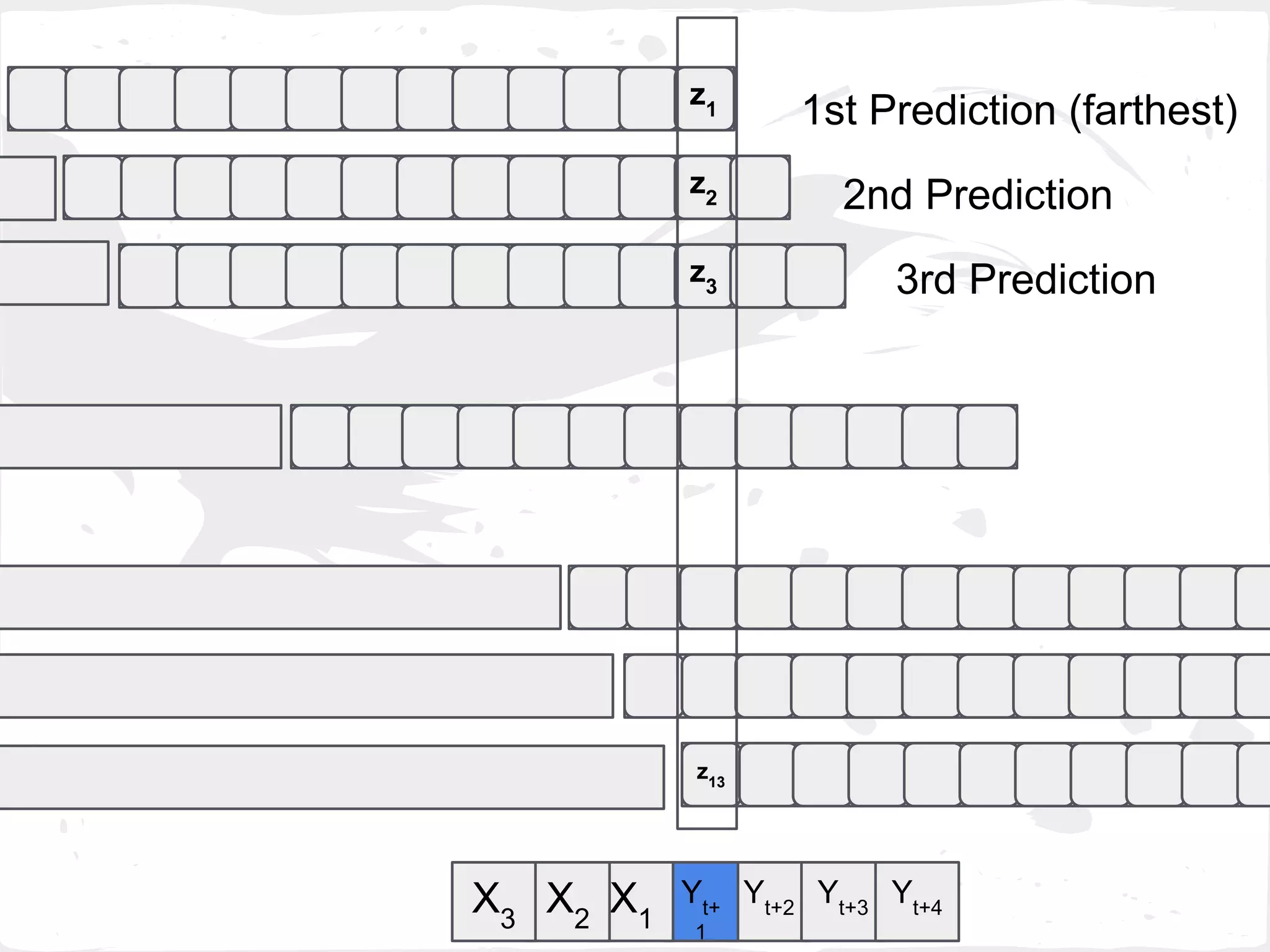
● Therefore, for each data point in time series,
it has been predicted h times.
● We will have "multiple prediction" in given
data point in time series.
Yt+2
Yt+3
Yt+
1
Yt+4
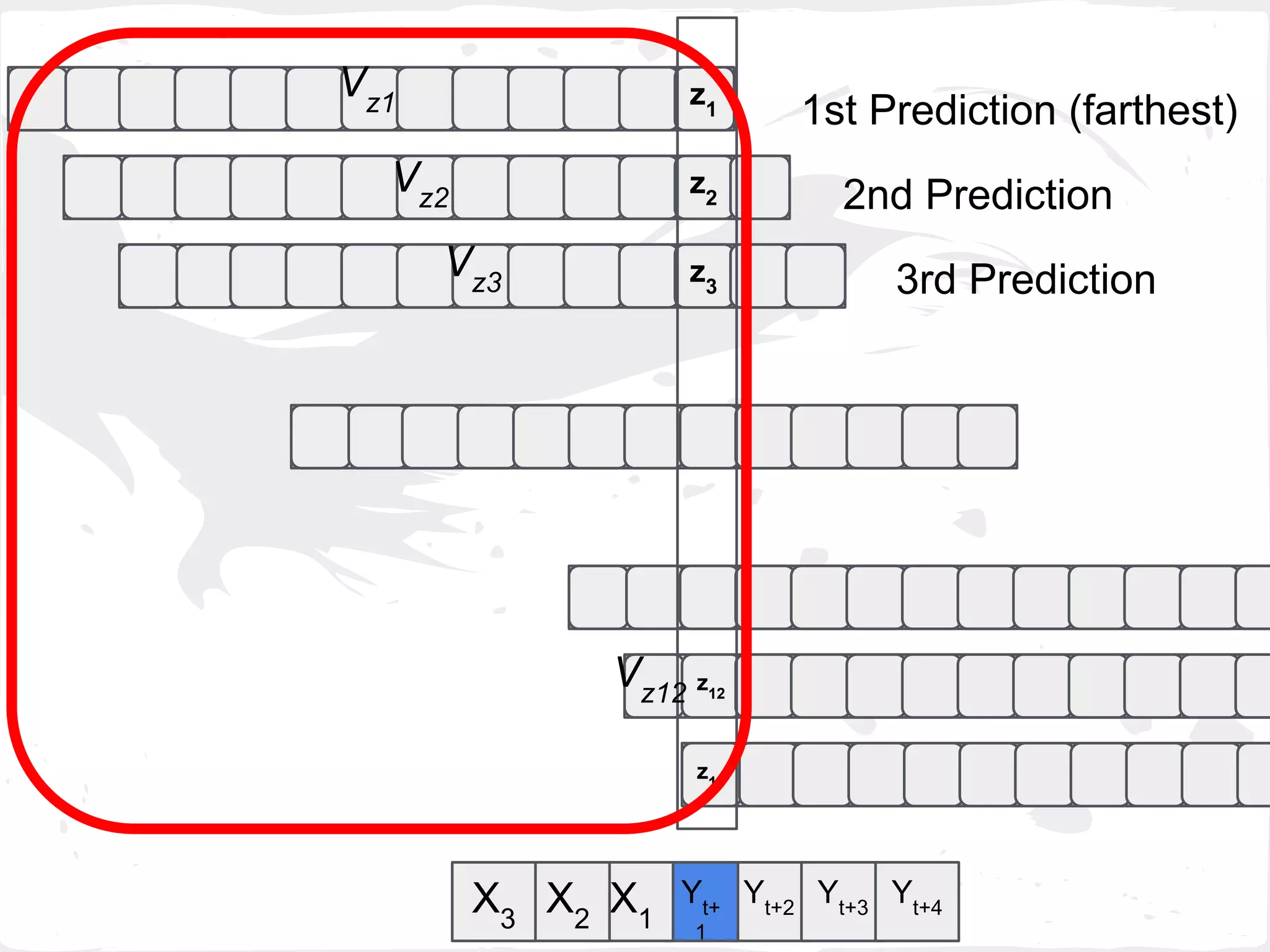
1st Prediction (farthest)
2nd Prediction
3rd Prediction
Deep Color -> Accurate
Yt+2
Yt+3
Yt+
1
Yt+4
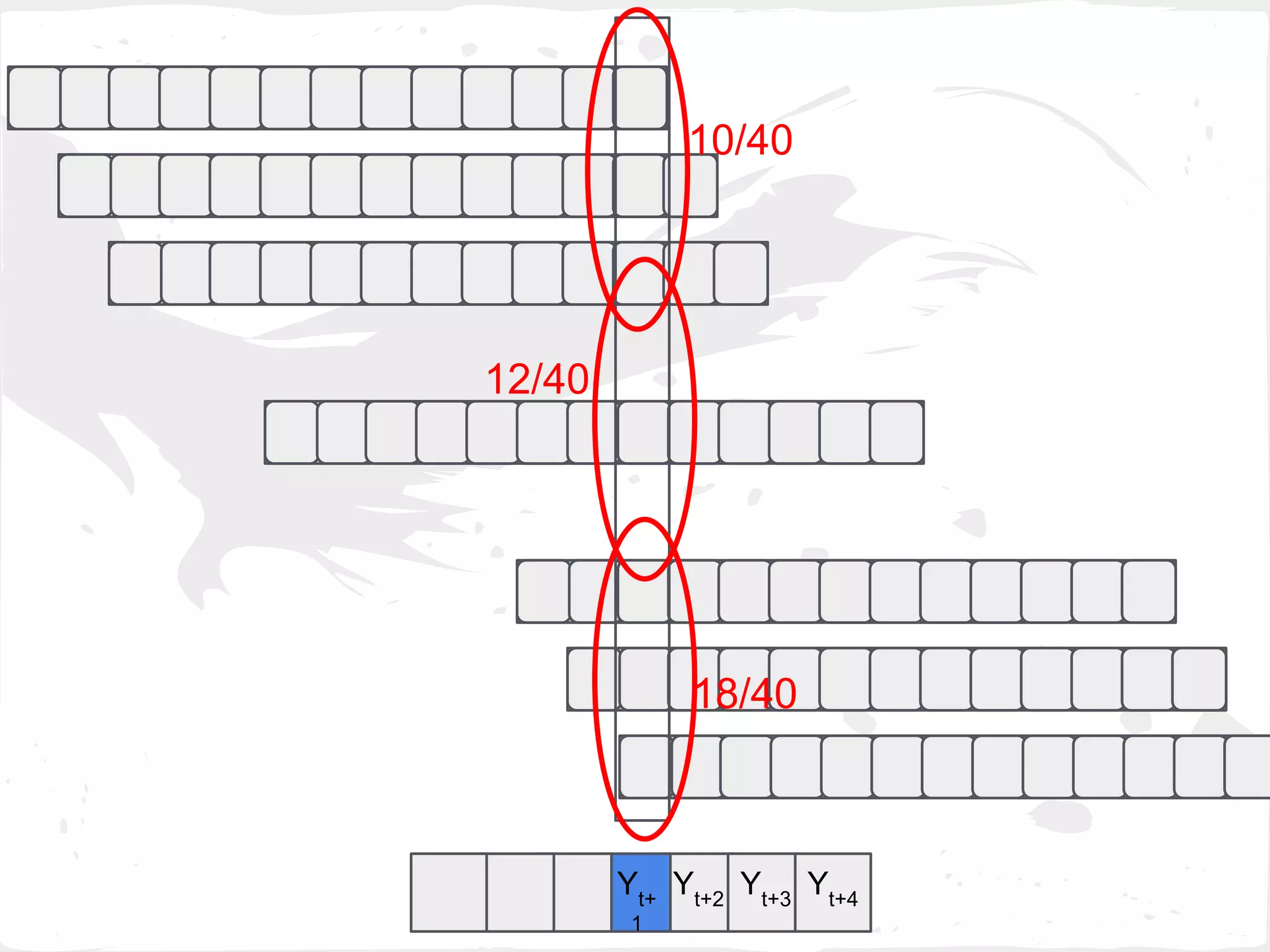
10/40
12/40
18/40
● The most accurate result may not always
happen in the latest one.
● We propose a general enhancement
framework to utilize prediction results of
multiple prediction to improve the accuracy.
Related Works
Related Works
Time Series Predict Methods:
1. Machine Learning Based
a. Neural Network
2. Regression Based
a. ARIMA approach
b. Holt-Winters ES approach
Neural Network
NNet
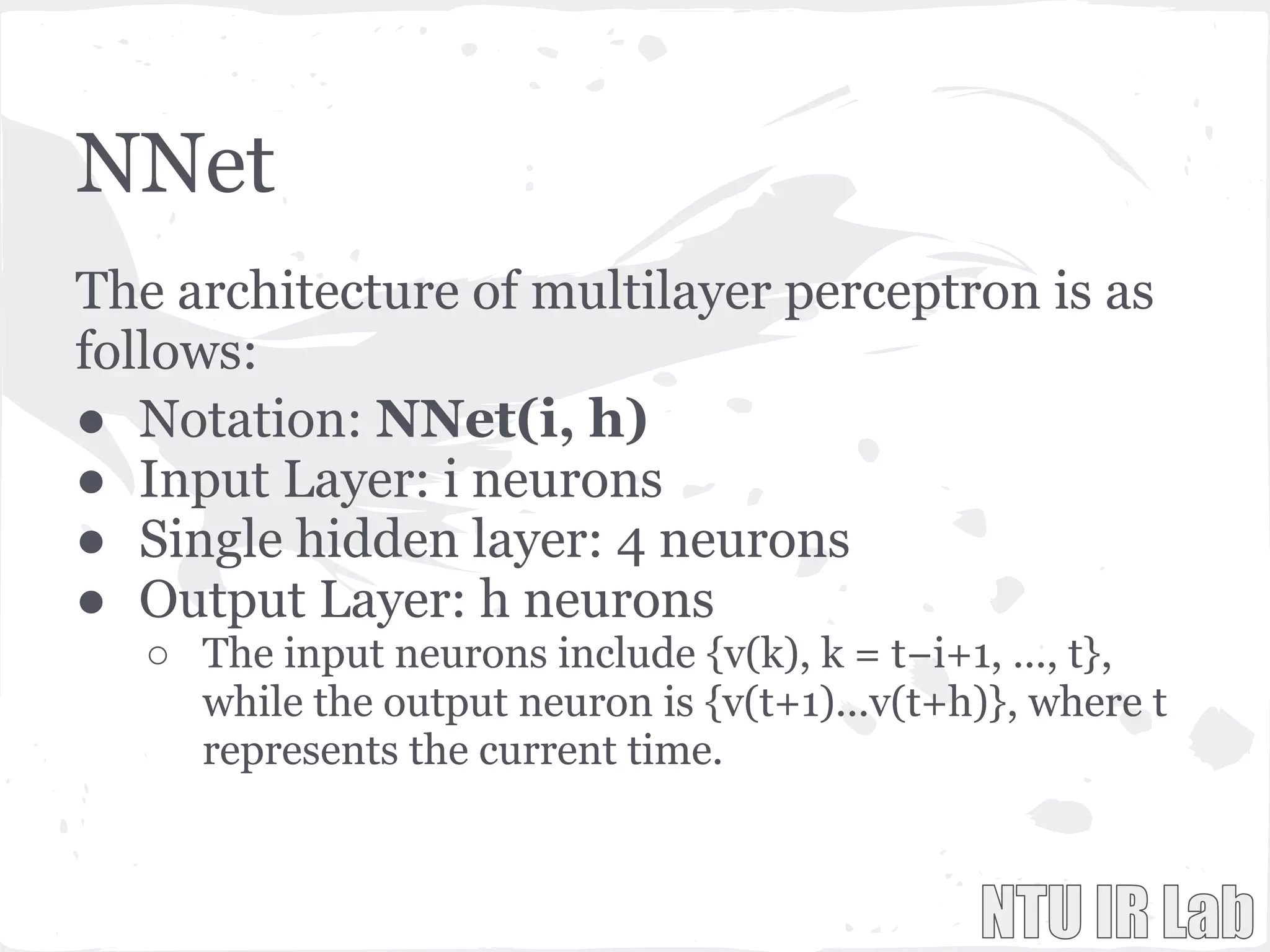
The architecture of multilayer perceptron is as
follows:
● Notation: NNet(i, h)
● Input Layer: i neurons
● Single hidden layer: 4 neurons
● Output Layer: h neurons
○ The input neurons include {v(k), k = t−i+1, ..., t},
while the output neuron is {v(t+1)...v(t+h)}, where t
represents the current time.
● Tangent sigmoid function and linear
transfer function are used for activation
function.
● This model is trained using back-
propagation algorithm over the training
dataset.
ARIMA
ARIMA
● Stands for "Autoregressive integrated
moving average"
● The model comprises 3 parts.
○ differencing
○ autoregressive (AR)
○ moving average (MA)
● Seasonal
○ NS-ARIMA: Nonseasonal ARIMA
○ S-ARIMA: Seasonal ARIMA
Differencing: non-stationary -> stationary
● stationary:
○ A stationary time series is one whose statistical
properties such as mean, variance, autocorrelation,
etc. are all constant over time.
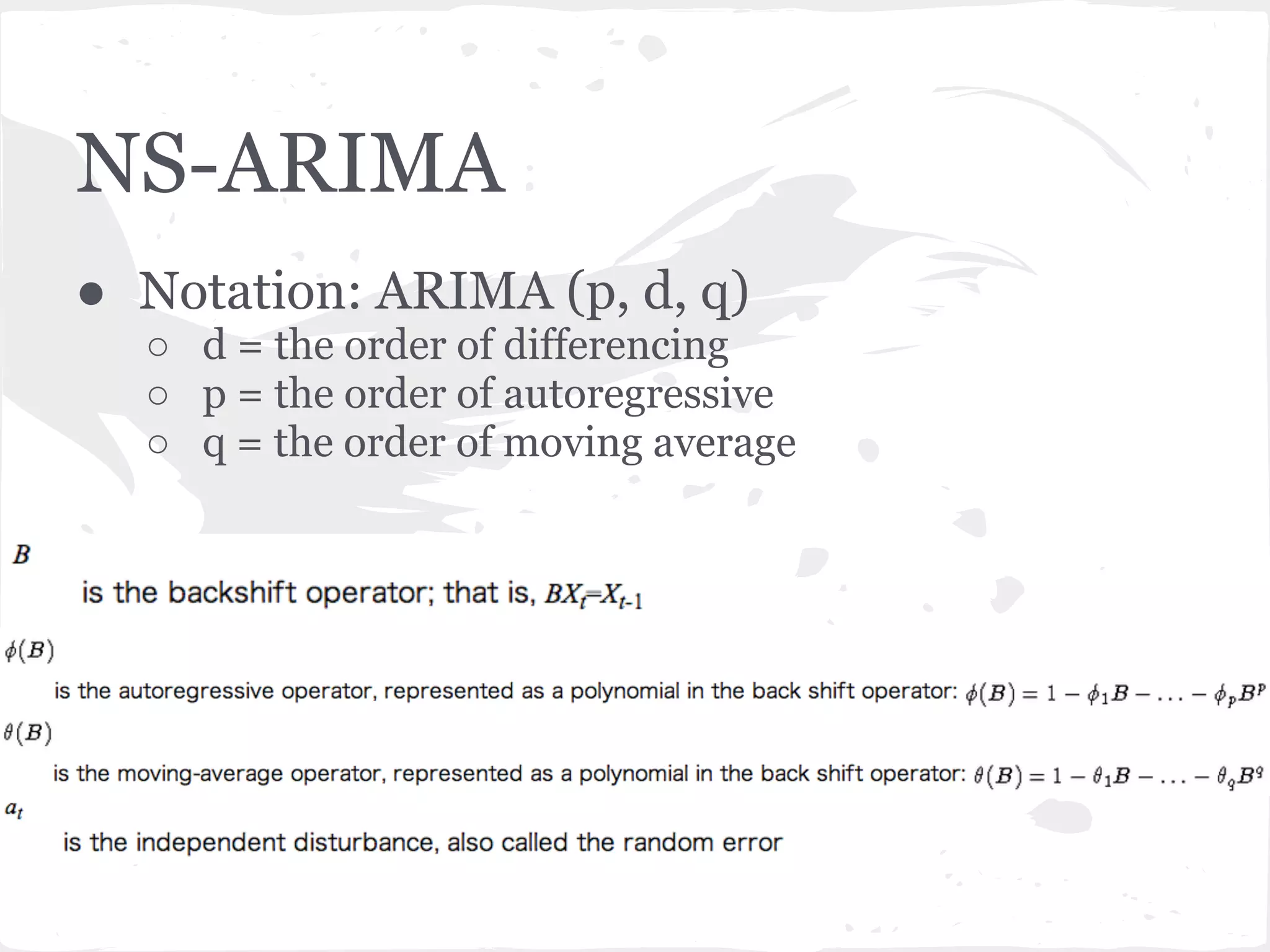
NS-ARIMA
● Notation: ARIMA (p, d, q)
○ d = the order of differencing
○ p = the order of autoregressive
○ q = the order of moving average
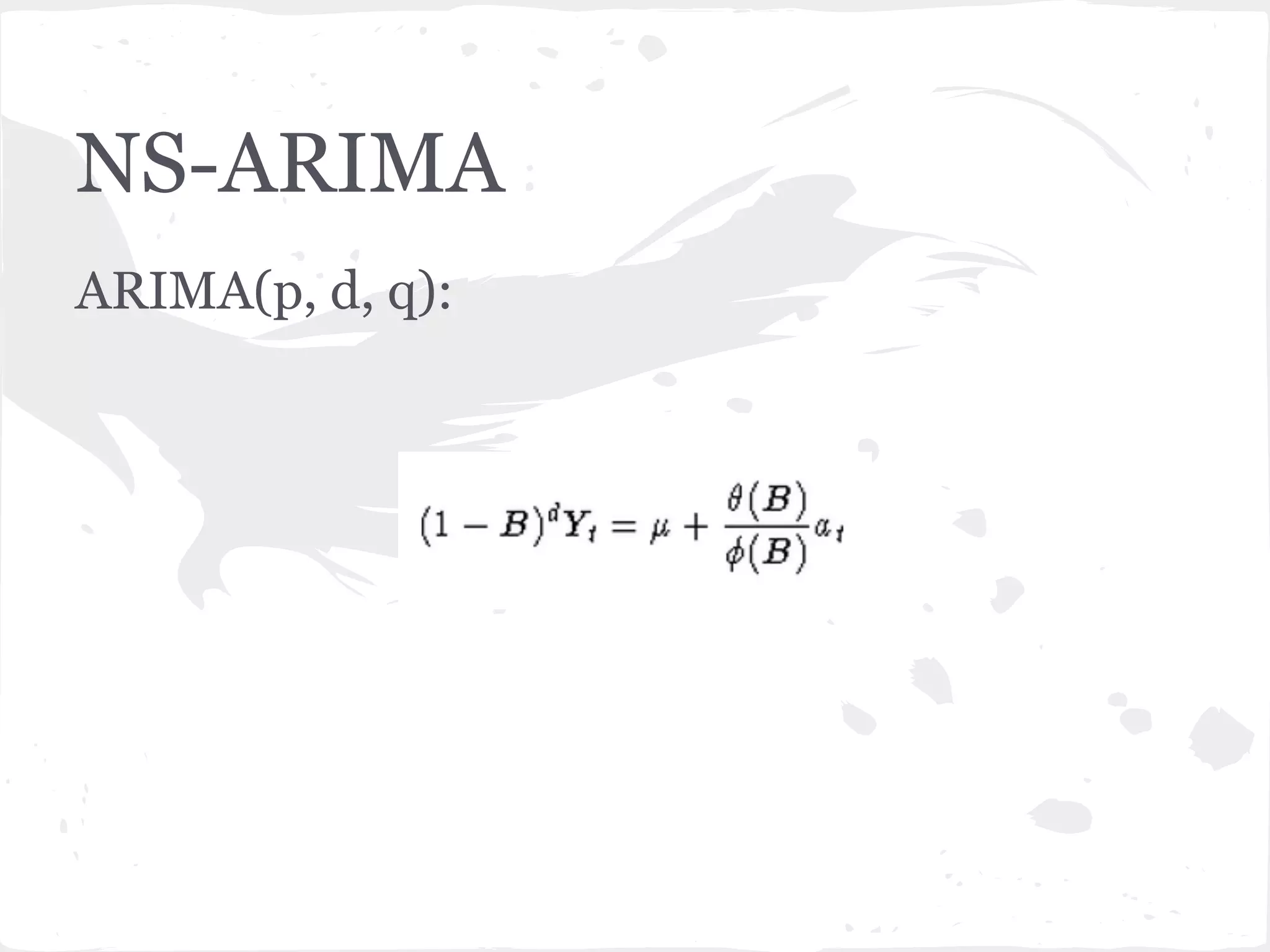
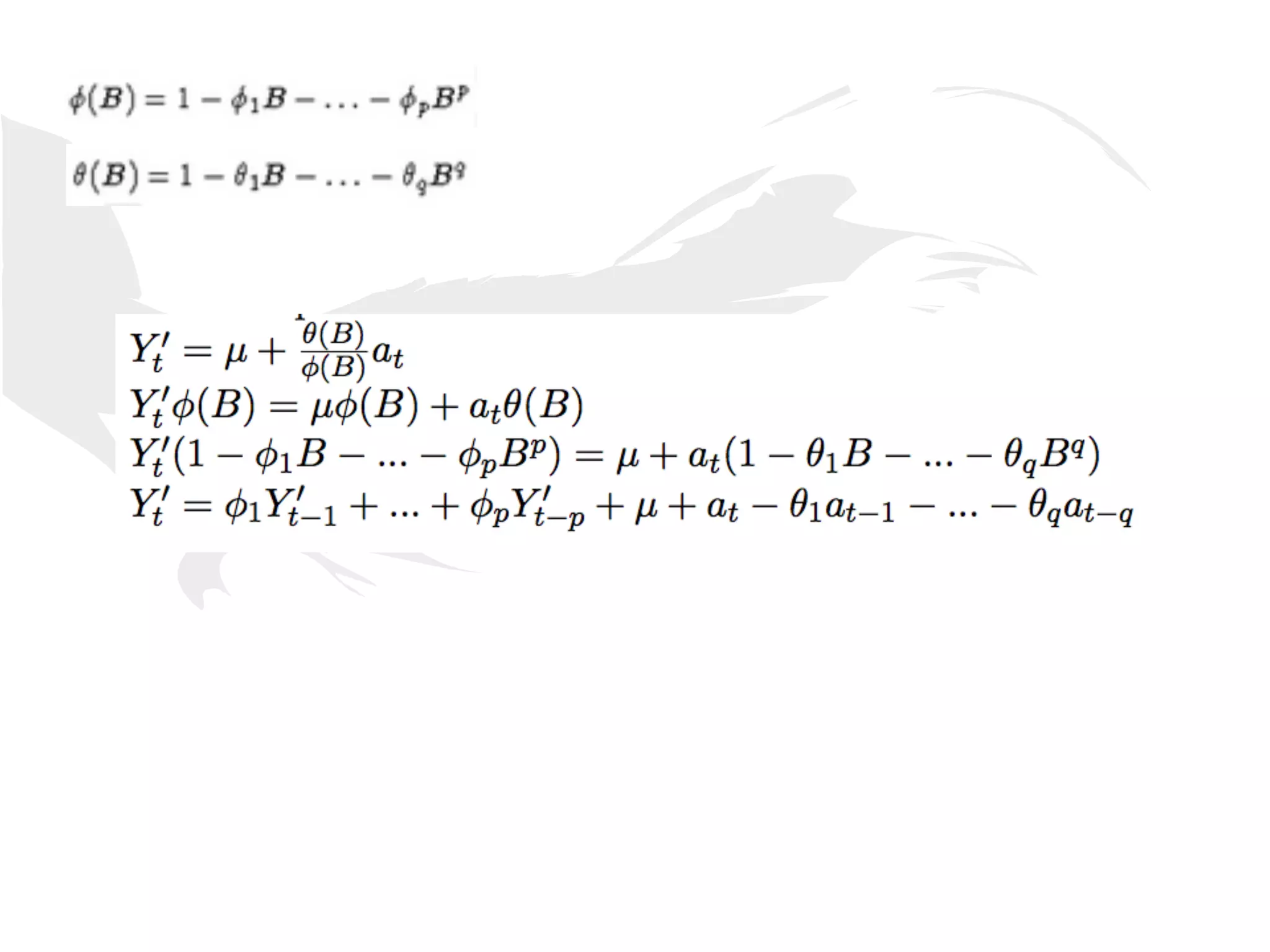
NS-ARIMA
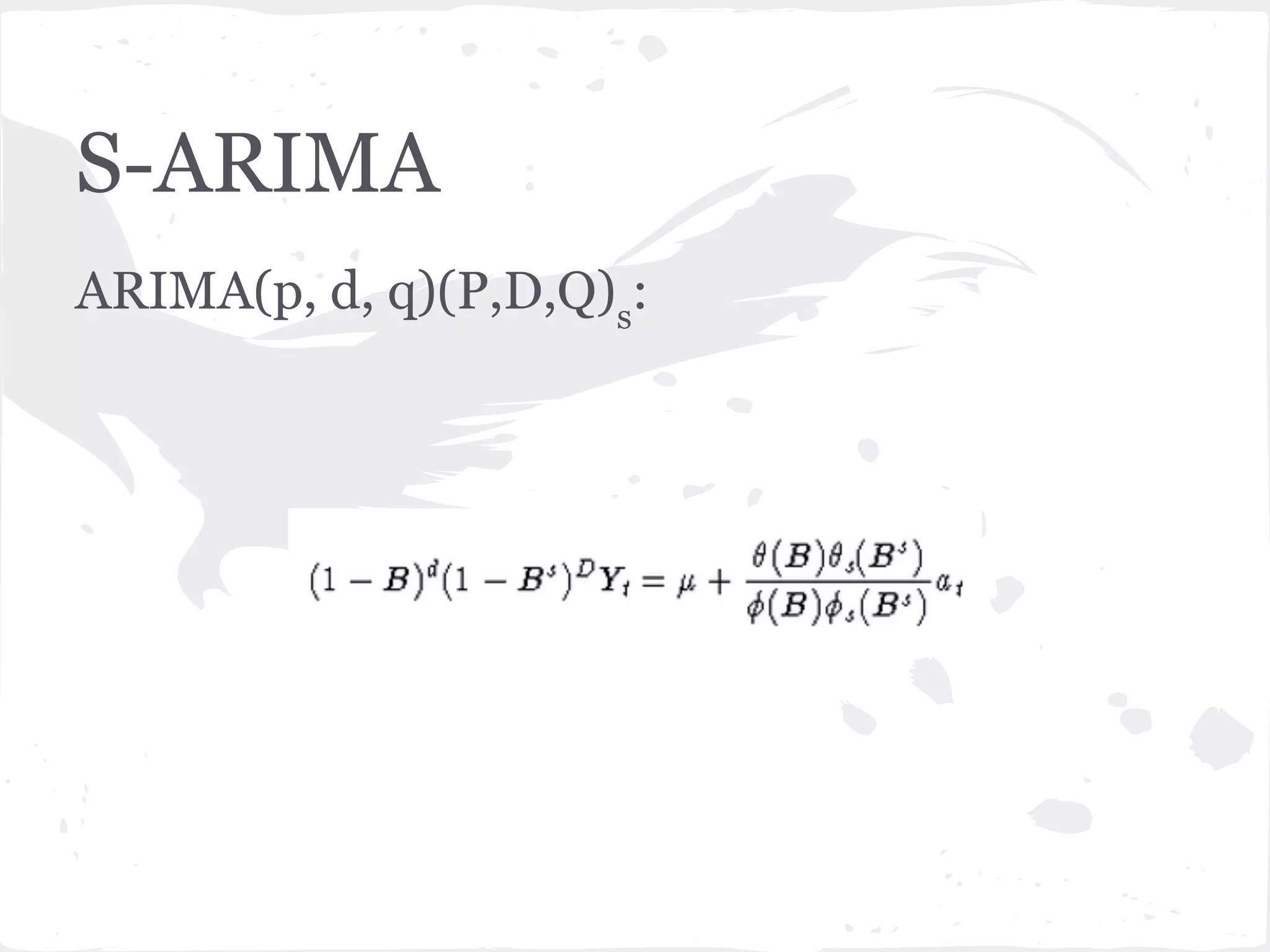
ARIMA(p, d, q):
S-ARIMA
ARIMA(p, d, q)(P,D,Q)s
:
S-ARIMA
ARIMA(p, d, q)(P,D,Q)s
:
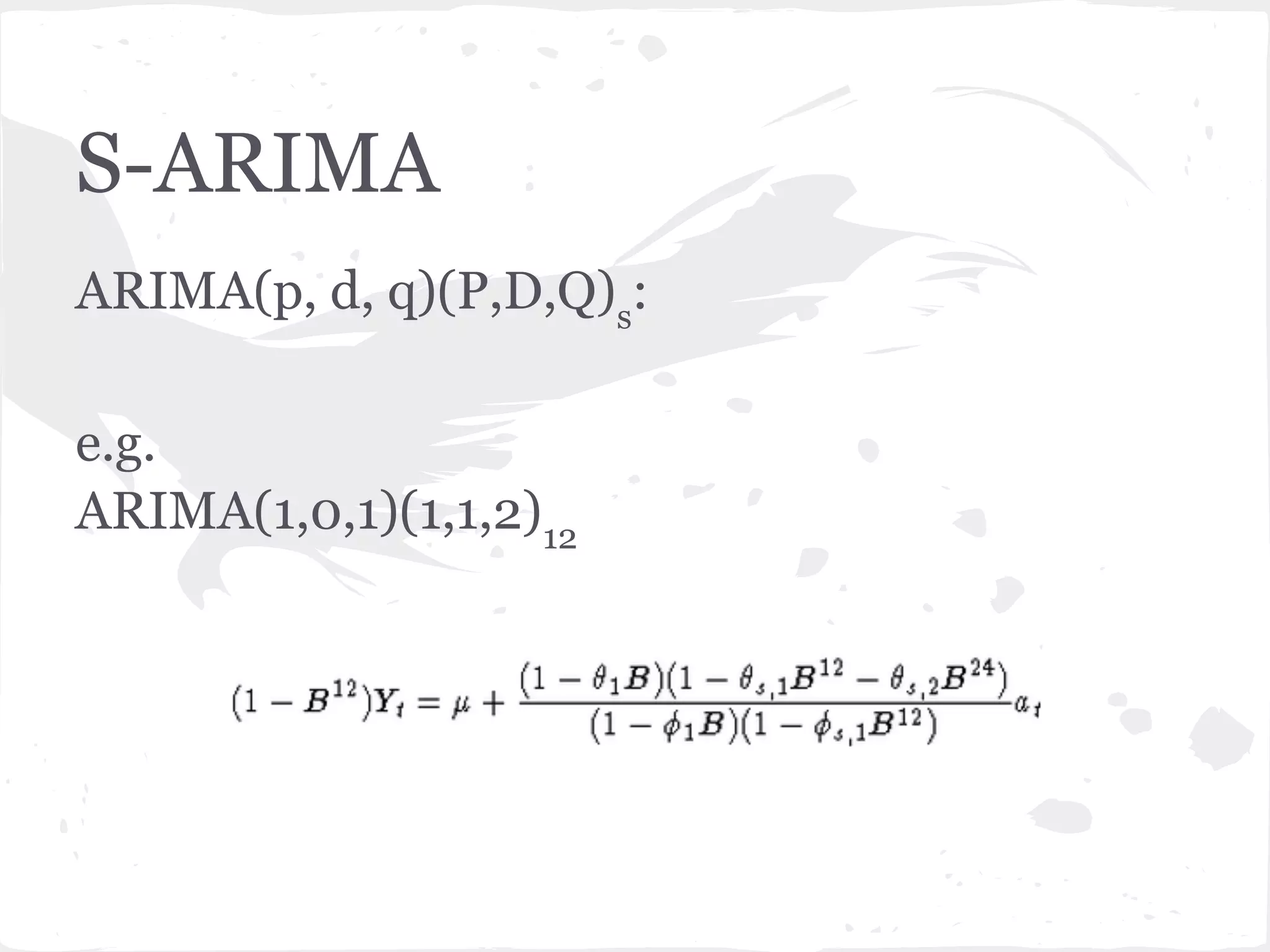
e.g.
ARIMA(1,0,1)(1,1,2)12
● In this work, S-ARIMA is adopted.
Holt-Winters ES
Holt-Winters ES
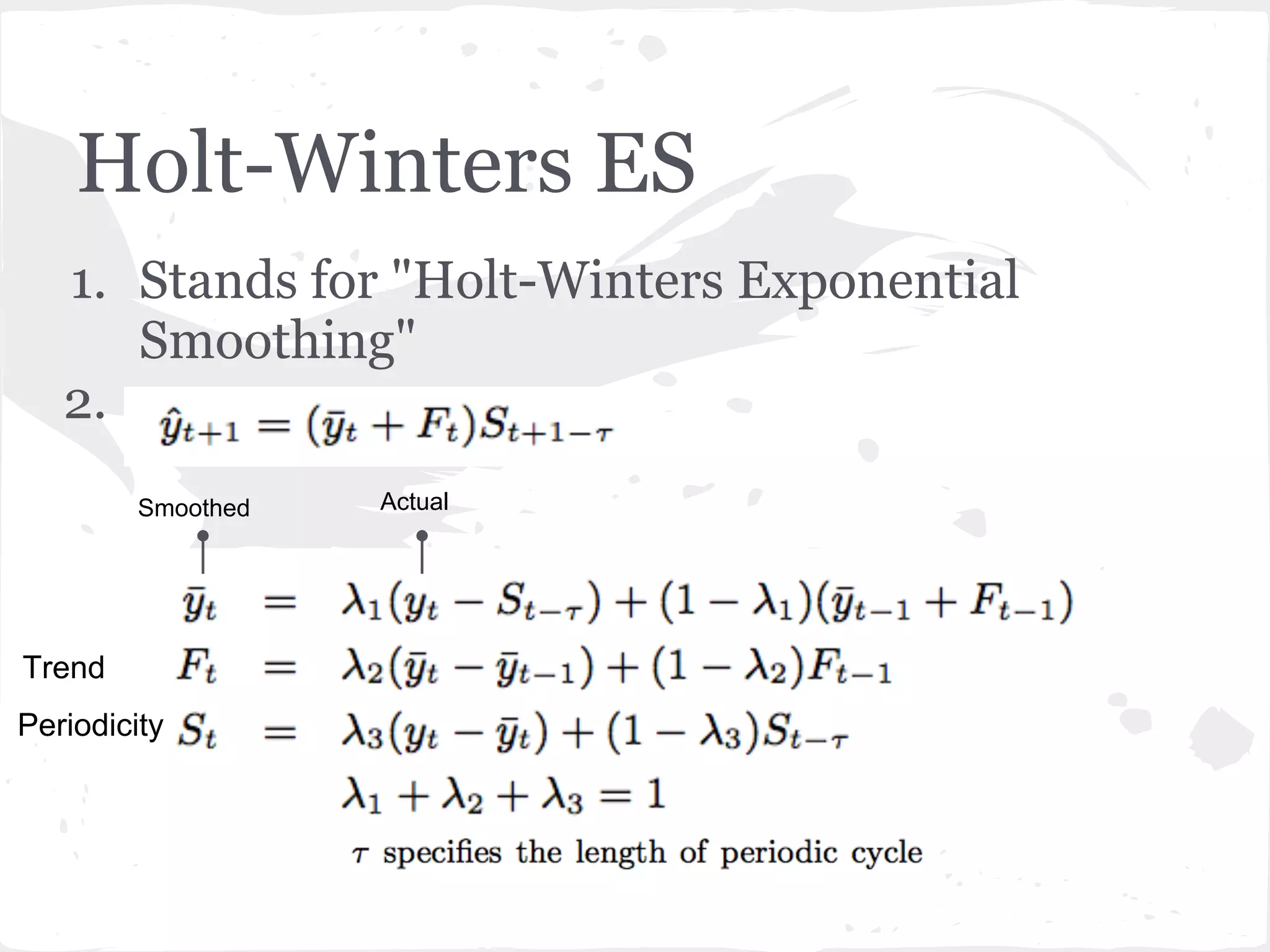
1. Stands for "Holt-Winters Exponential
Smoothing"
2.
Trend
ActualSmoothed
Periodicity
Framework
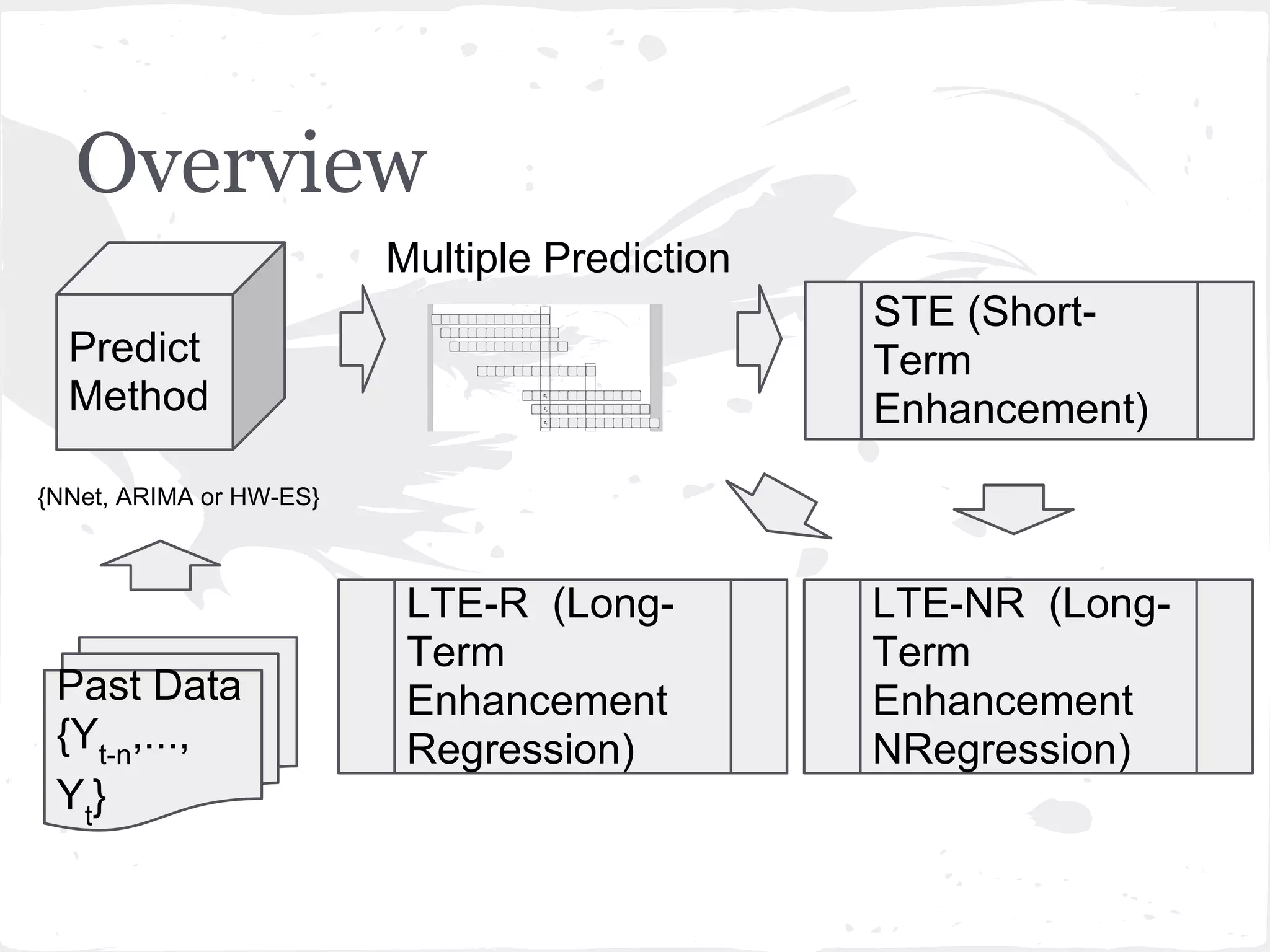
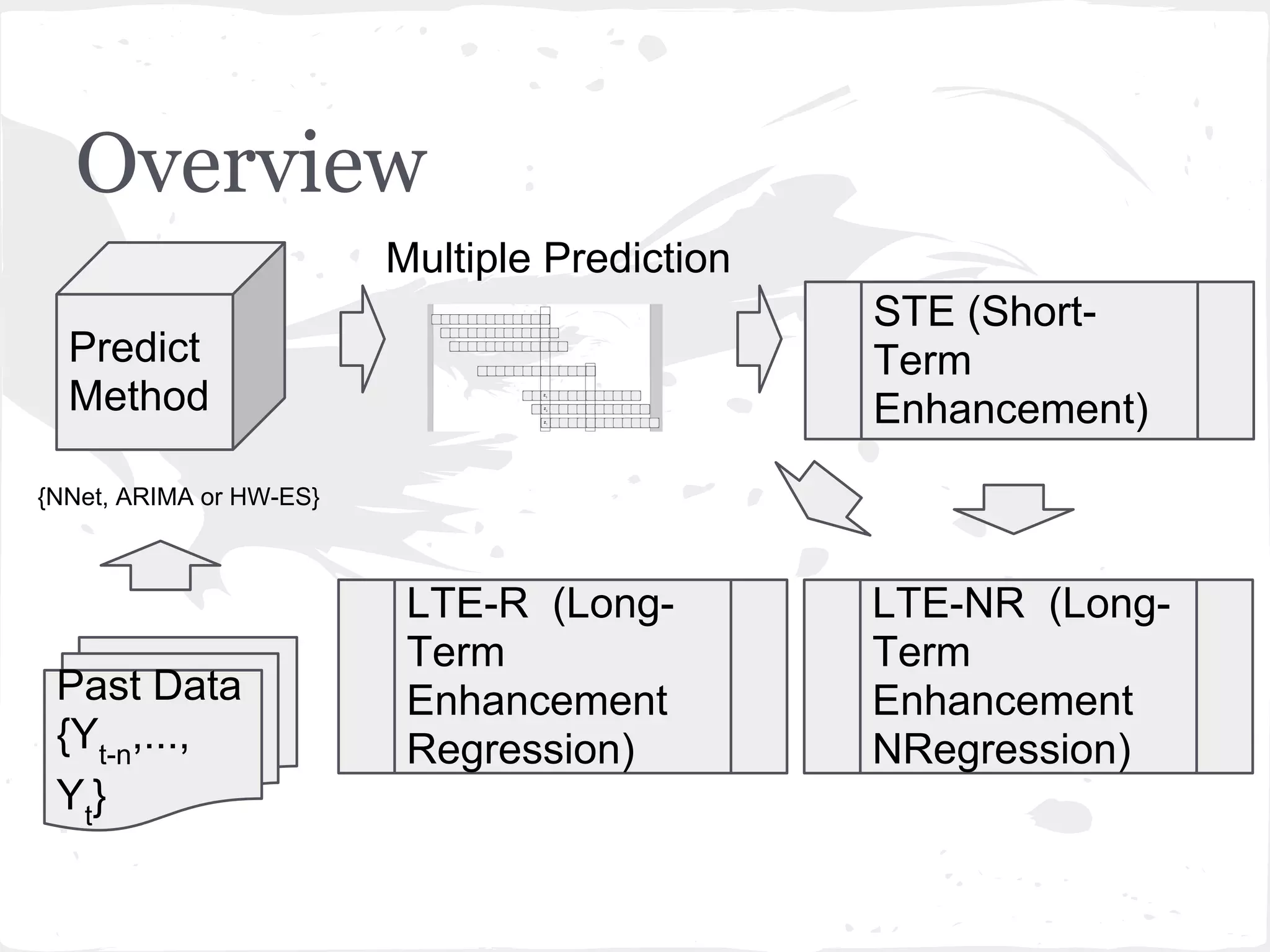
● To improve time series prediction, a general
enhancement framework is proposed.
● The framework utilizes multiple prediction
results and tries to learn the data
dependency to improve the accuracy.
Predict
Method
Multiple Prediction
Overview
Past Data
{Yt-n
,...,
Yt
}
STE (Short-
Term
Enhancement)
LTE-NR (Long-
Term
Enhancement
NRegression)
{NNet, ARIMA or HW-ES}
LTE-R (Long-
Term
Enhancement
Regression)
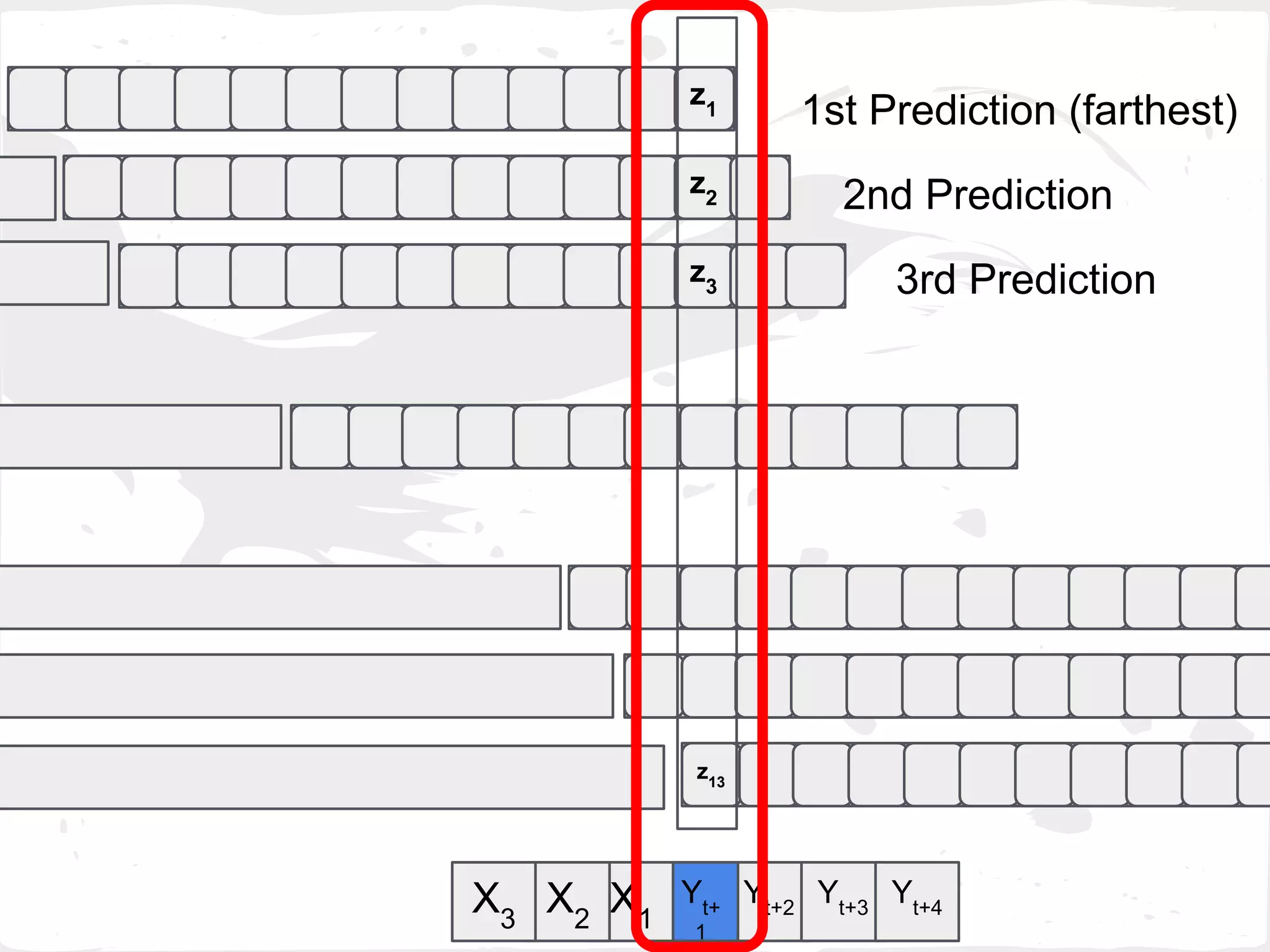
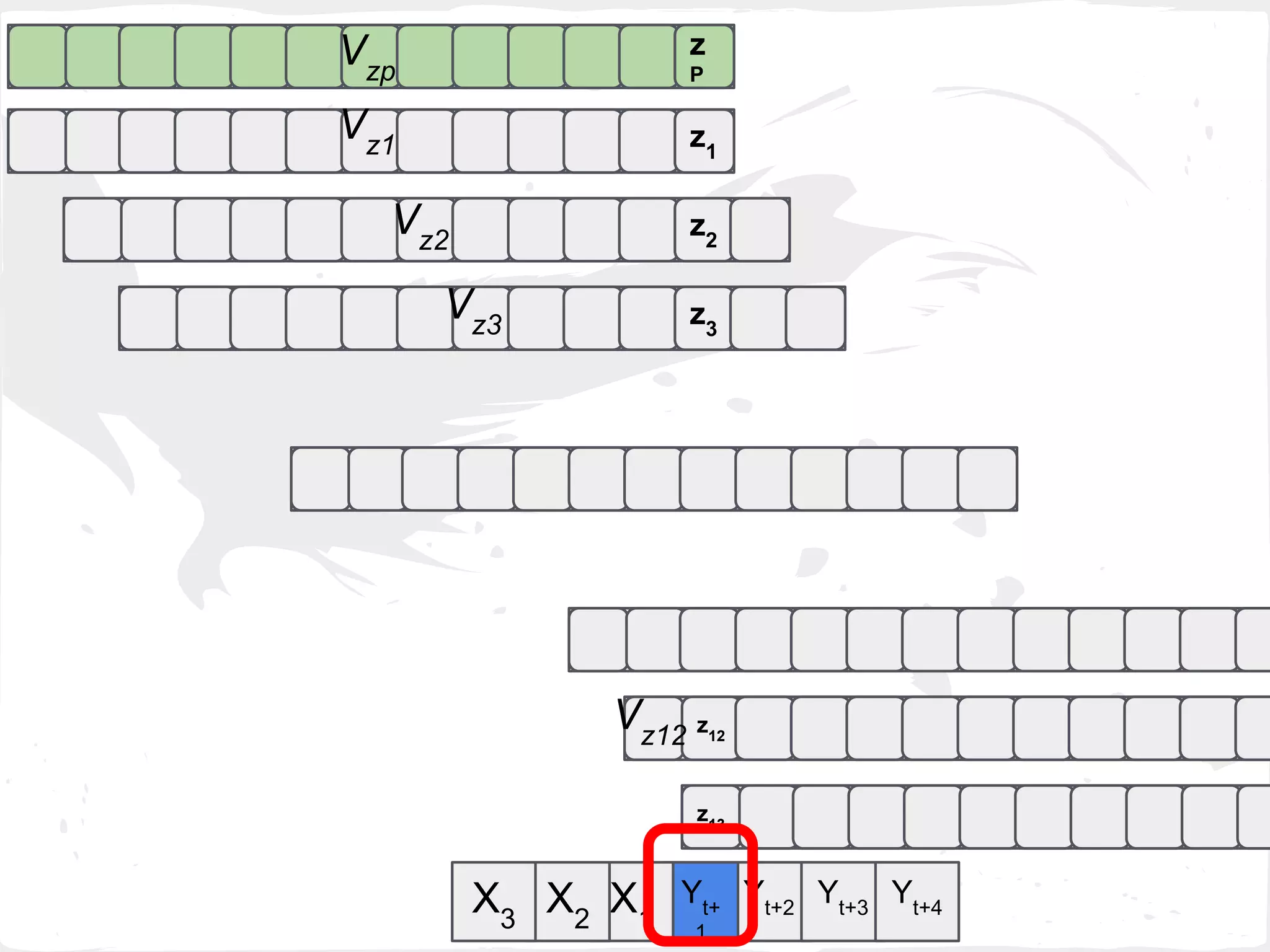
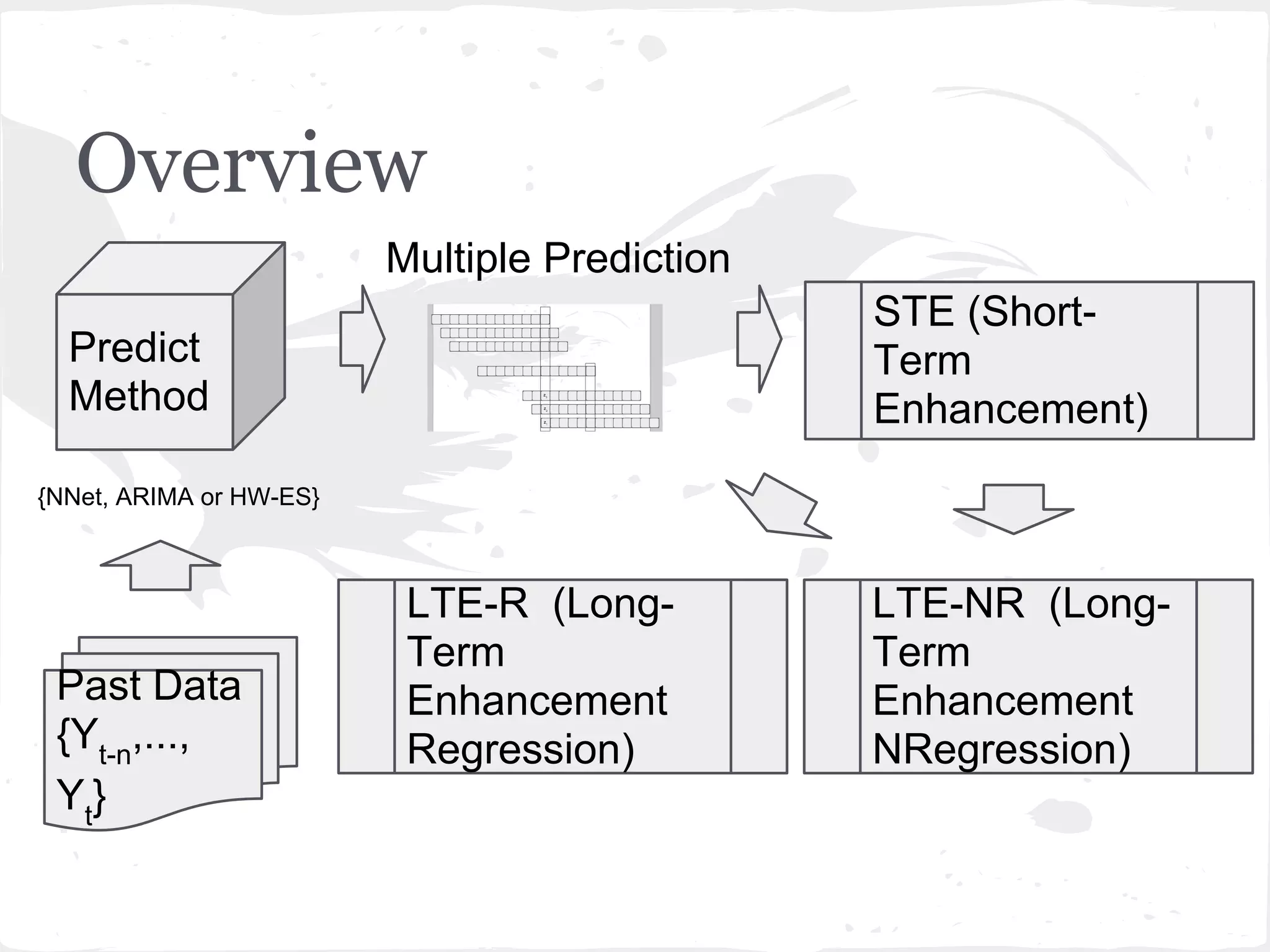
● Given a predict method, the multiple
prediction result can be generated. The
enhancement algorithms input these
information and learn from it.
● The multiple prediction result and the
corresponding labels are listed in the
following slide.
z13
z1
z2
z3
Yt+2
Yt+3
Yt+
1
X1
X2
Yt+4X3
1st Prediction (farthest)
2nd Prediction
3rd Prediction
STE (Short-Term
Enhancement)
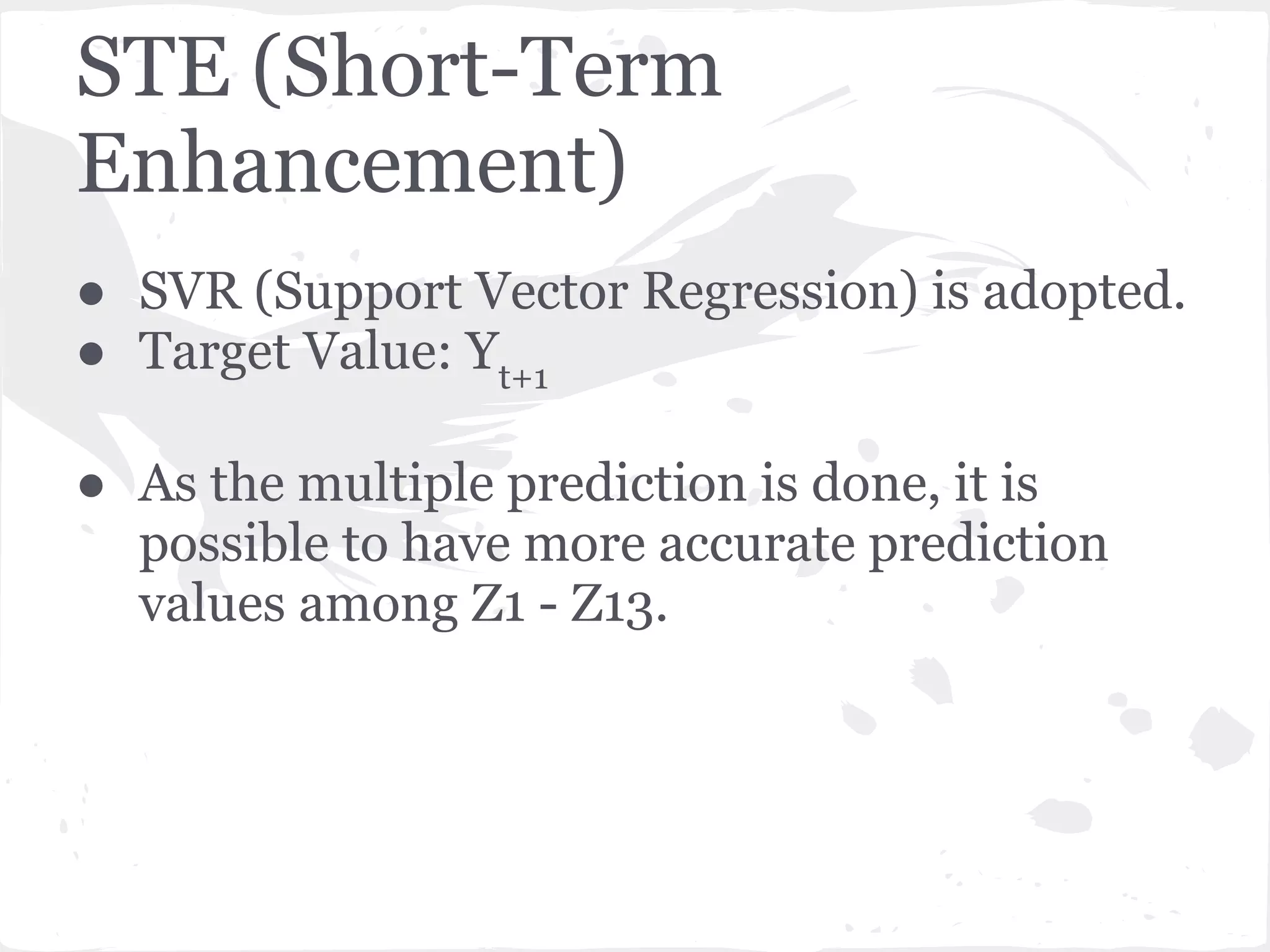
● SVR (Support Vector Regression) is adopted.
● Target Value: Yt+1
● As the multiple prediction is done, it is
possible to have more accurate prediction
values among Z1 - Z13.
Feature Set
1. S1: Statistic
a. Trimmed Mean (t_mean)
b. Last N Prediction (last_n)
c. Gaussian Distribution Modeling (gaussian_dist)
2. S2: Reliability
a. Avg Min Error (avg_min_e)
b. Last Min Error (last_min_e)
c. Trend (trend)
3. Periodicity Feature
z13
z1
z2
z3
Yt+2
Yt+3
Yt+
1
X1
X2
Yt+4X3
1st Prediction (farthest)
2nd Prediction
3rd Prediction
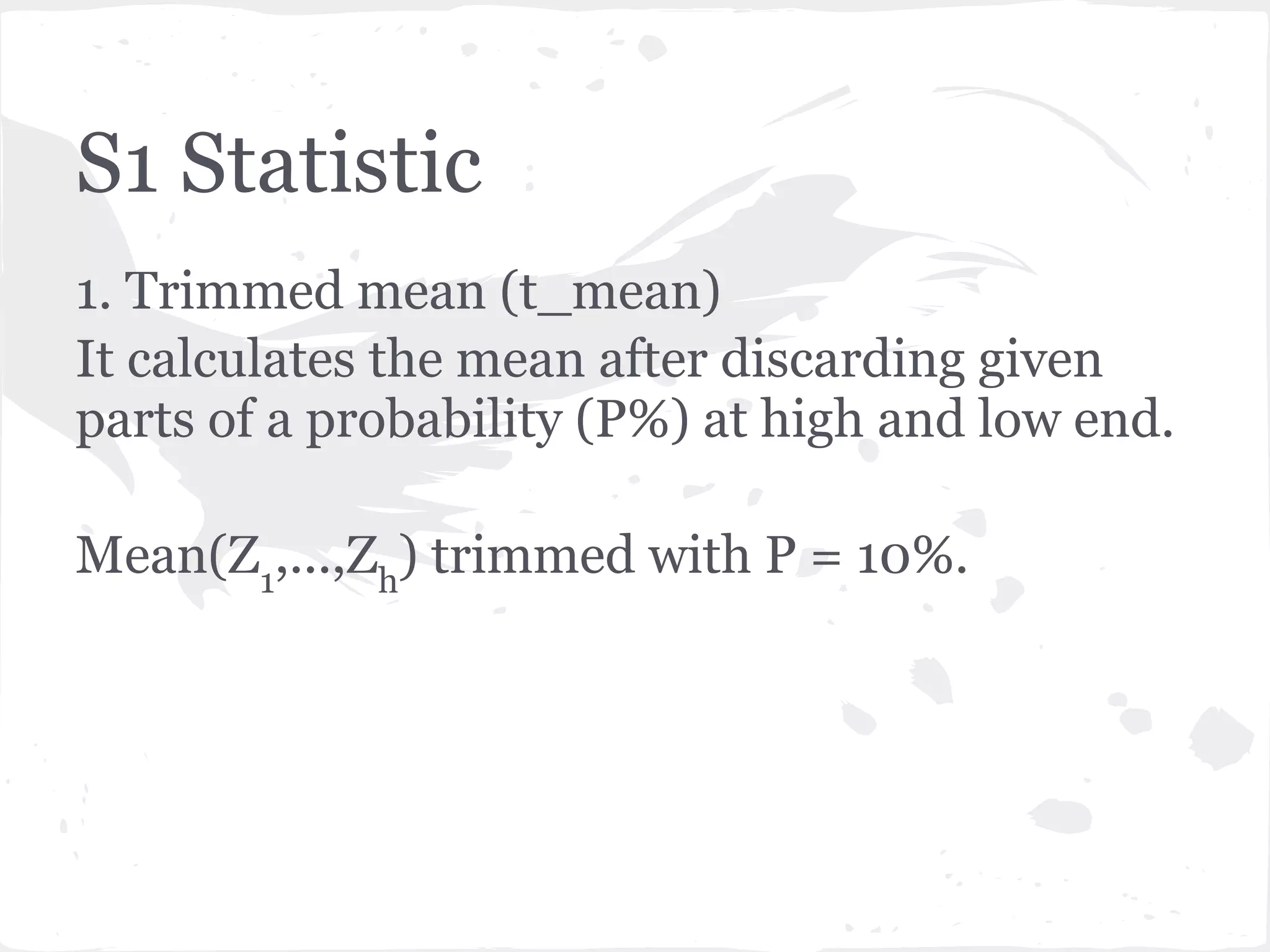
S1 Statistic
1. Trimmed mean (t_mean)
It calculates the mean after discarding given
parts of a probability (P%) at high and low end.
Mean(Z1
,...,Zh
) trimmed with P = 10%.
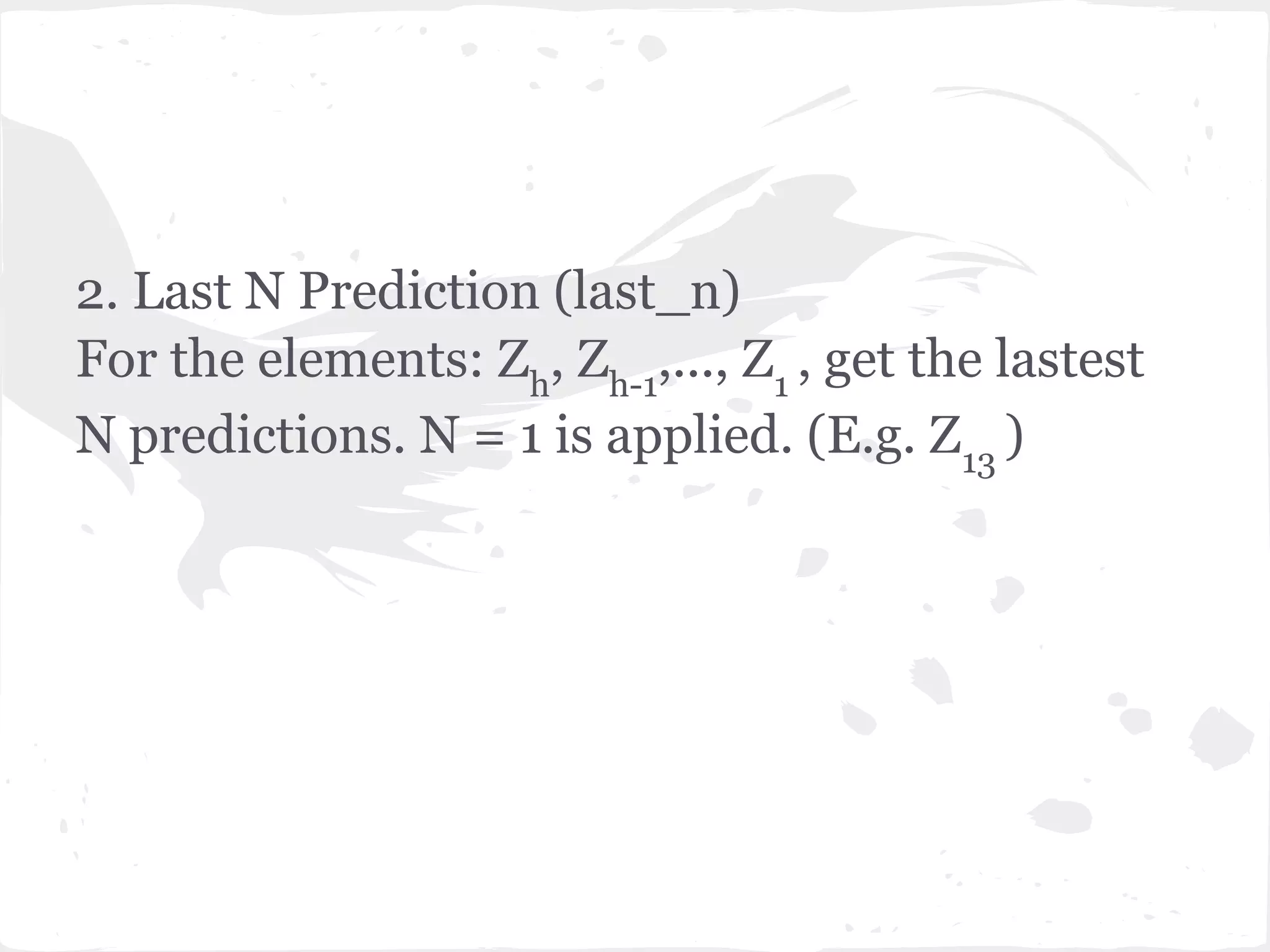
2. Last N Prediction (last_n)
For the elements: Zh
, Zh-1
,..., Z1
, get the lastest
N predictions. N = 1 is applied. (E.g. Z13
)
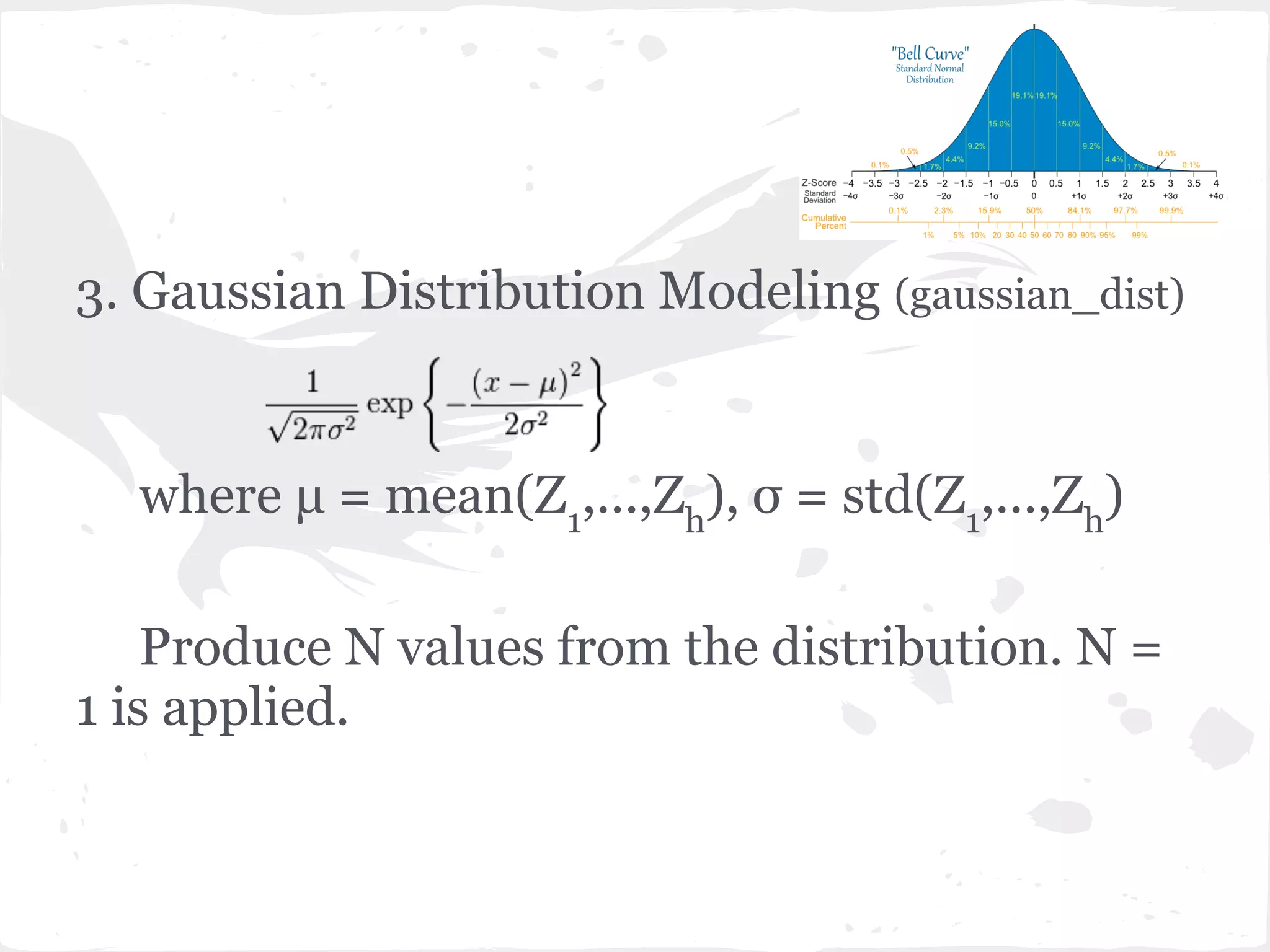
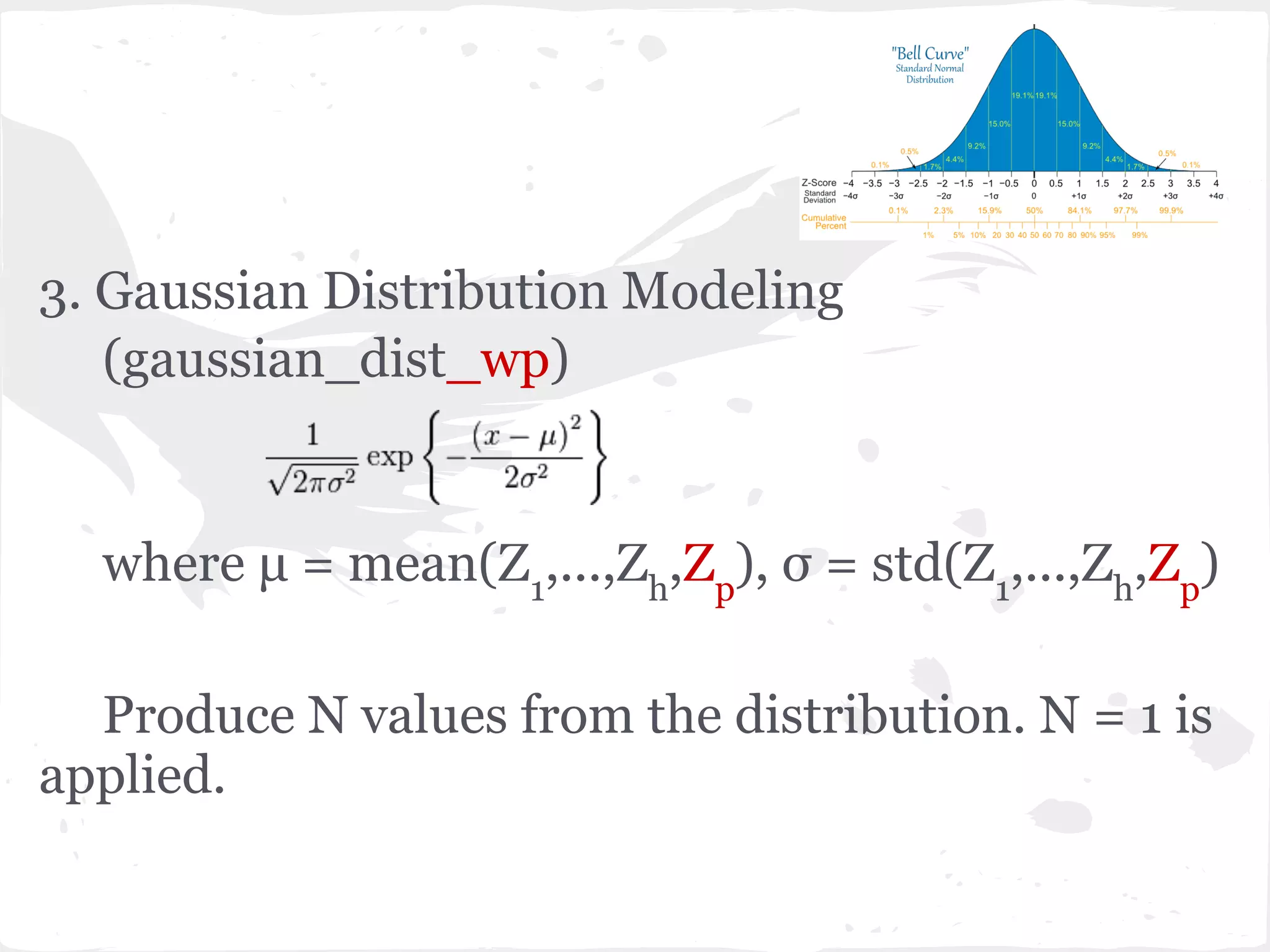
3. Gaussian Distribution Modeling (gaussian_dist)
where μ = mean(Z1
,...,Zh
), σ = std(Z1
,...,Zh
)
Produce N values from the distribution. N =
1 is applied.
z12
z13
z1
z2
z3
Yt+2
Yt+3
Yt+
1
X1
X2
Yt+4X3
1st Prediction (farthest)
2nd Prediction
3rd Prediction
Vz1
Vz2
Vz3
Vz12
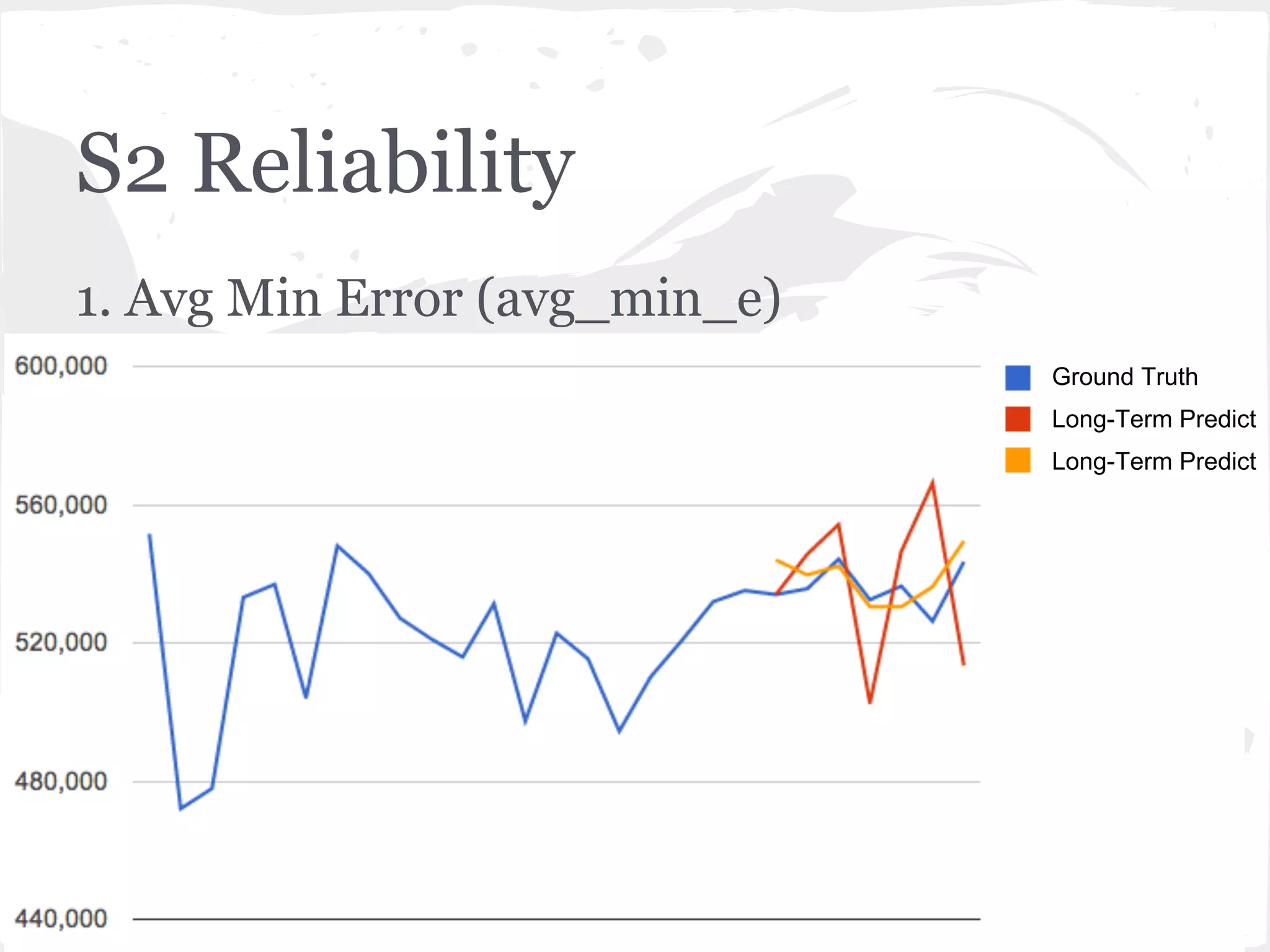
S2 Reliability
1. Avg Min Error (avg_min_e)
Ground Truth
Long-Term Predict
Long-Term Predict
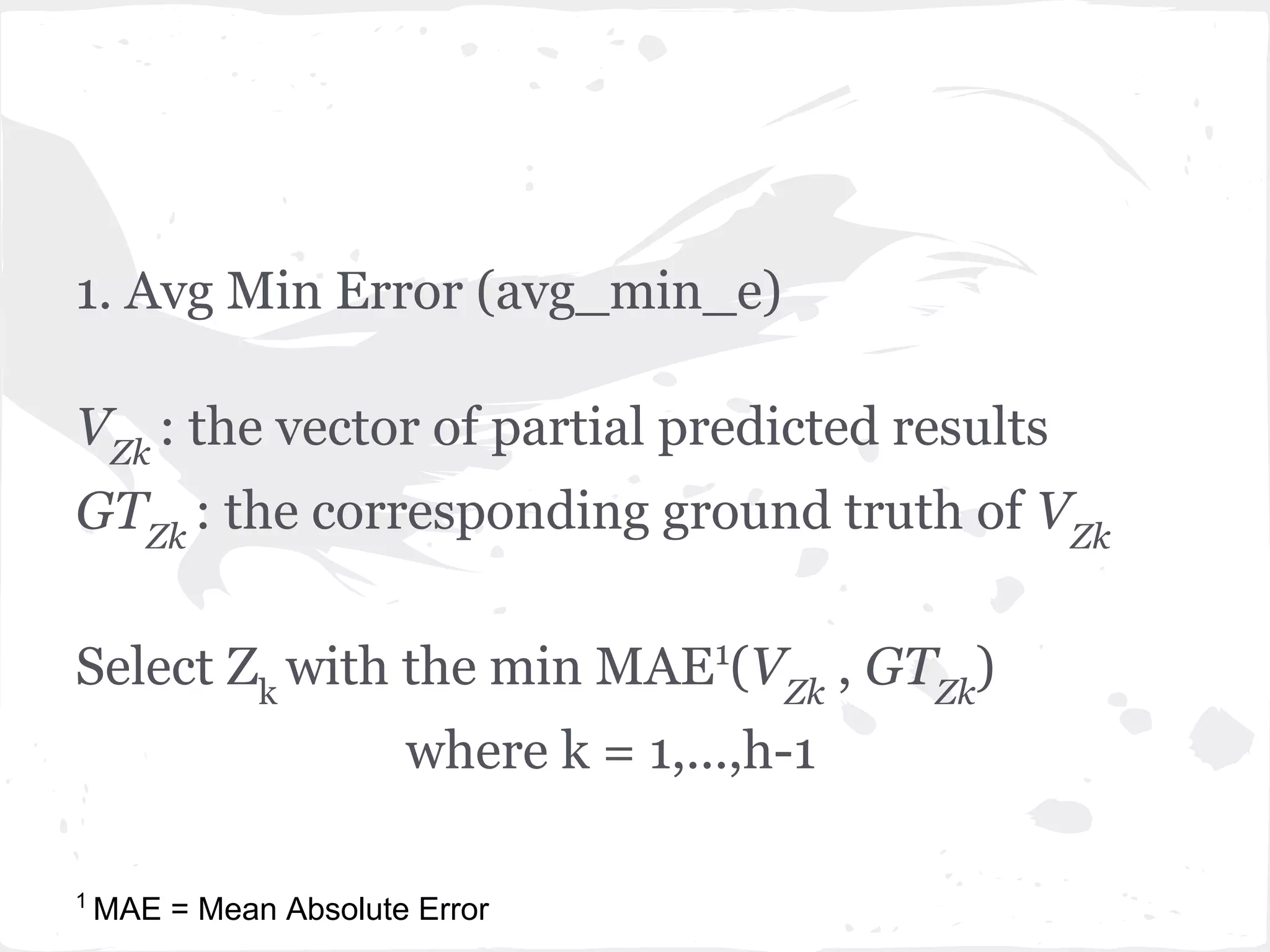
1. Avg Min Error (avg_min_e)
VZk
: the vector of partial predicted results
GTZk
: the corresponding ground truth of VZk
Select Zk
with the min MAE1
(VZk
, GTZk
)
where k = 1,...,h-1
1
MAE = Mean Absolute Error
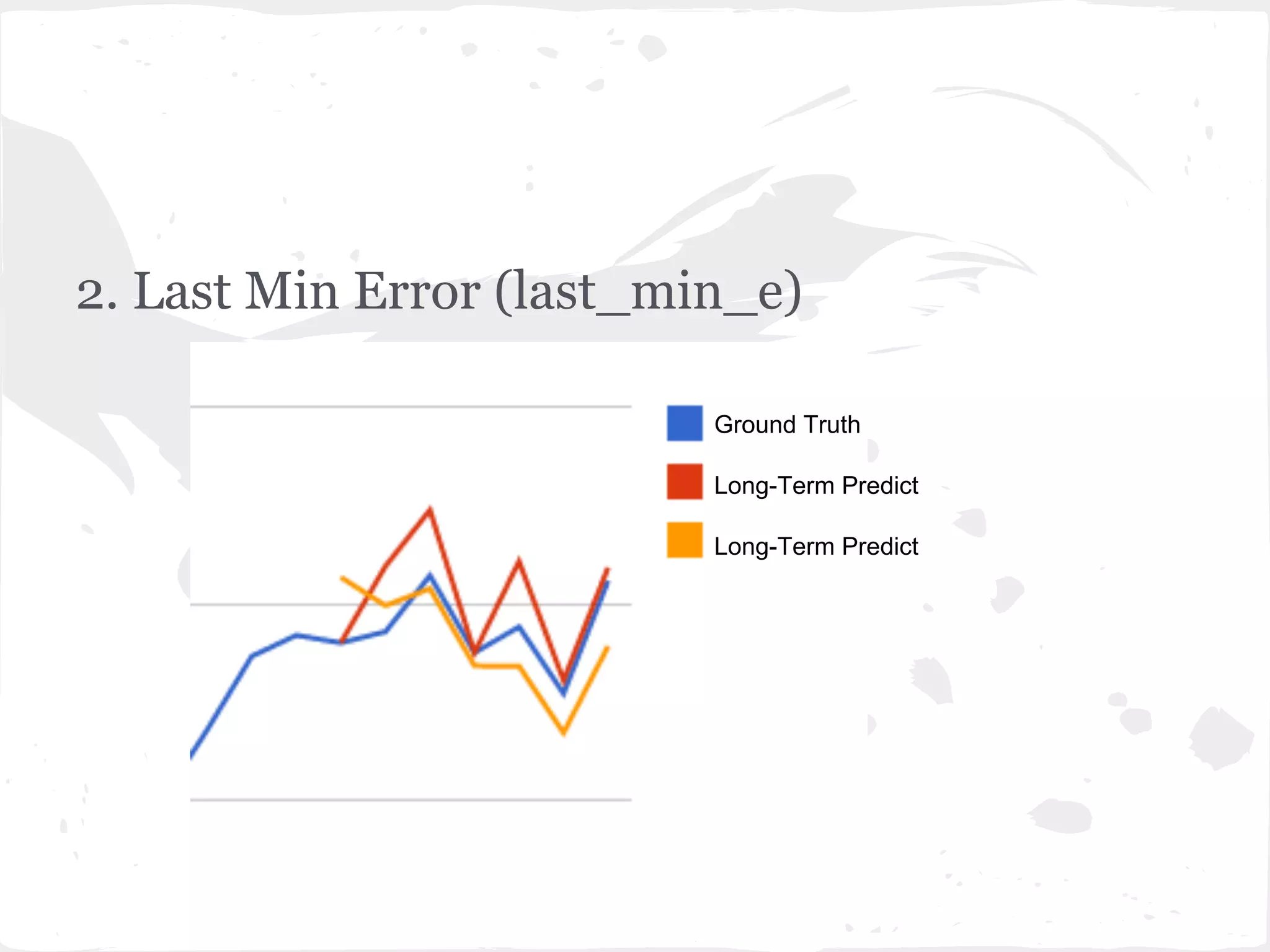
2. Last Min Error (last_min_e)
Ground Truth
Long-Term Predict
Long-Term Predict
2. Last Min Error (last_min_e)
Select Zk
with the min MAE( VZk
[1] , GTZk
[1] )
where k = 1,...,h-1
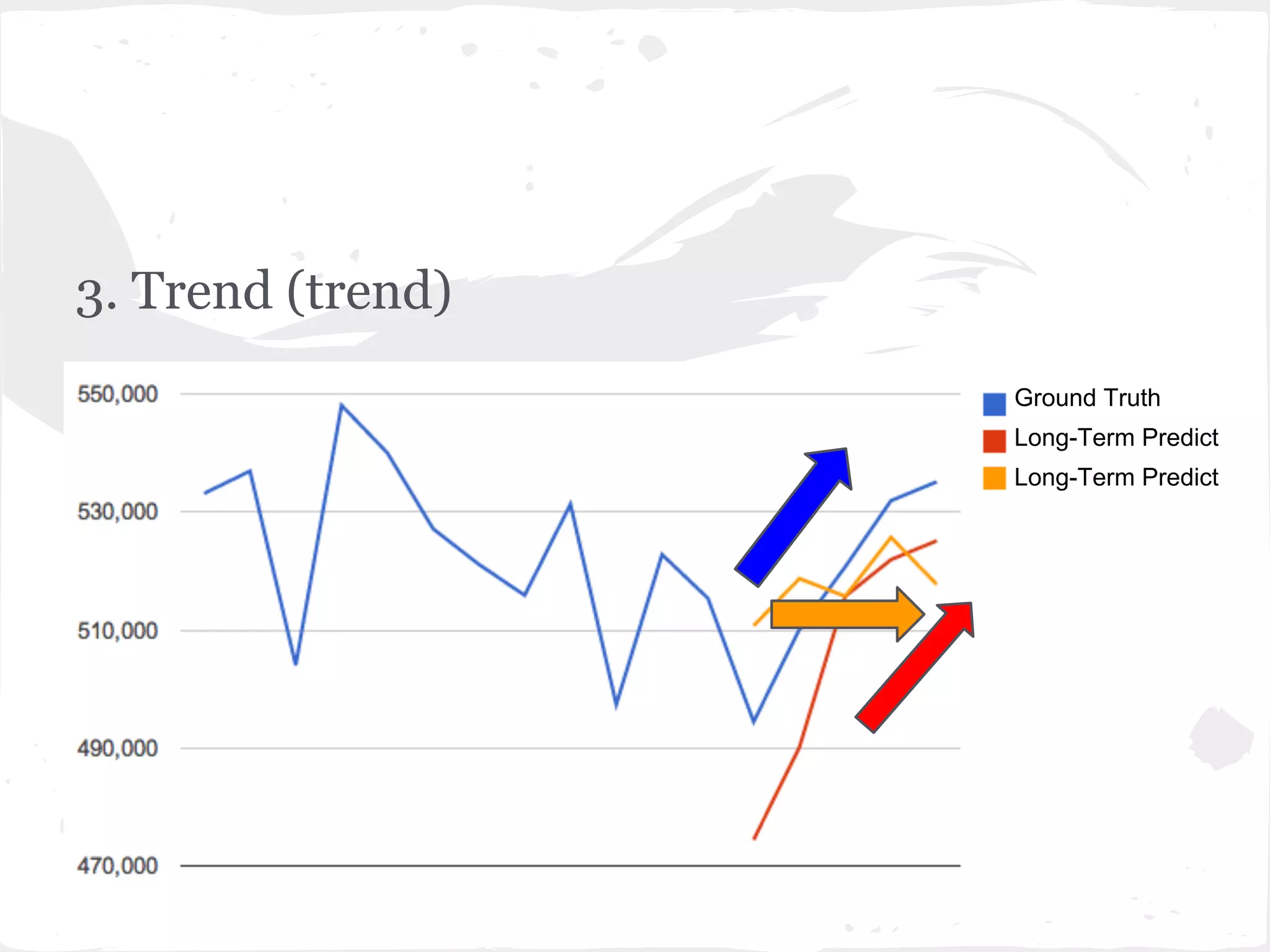
3. Trend (trend)
Ground Truth
Long-Term Predict
Long-Term Predict
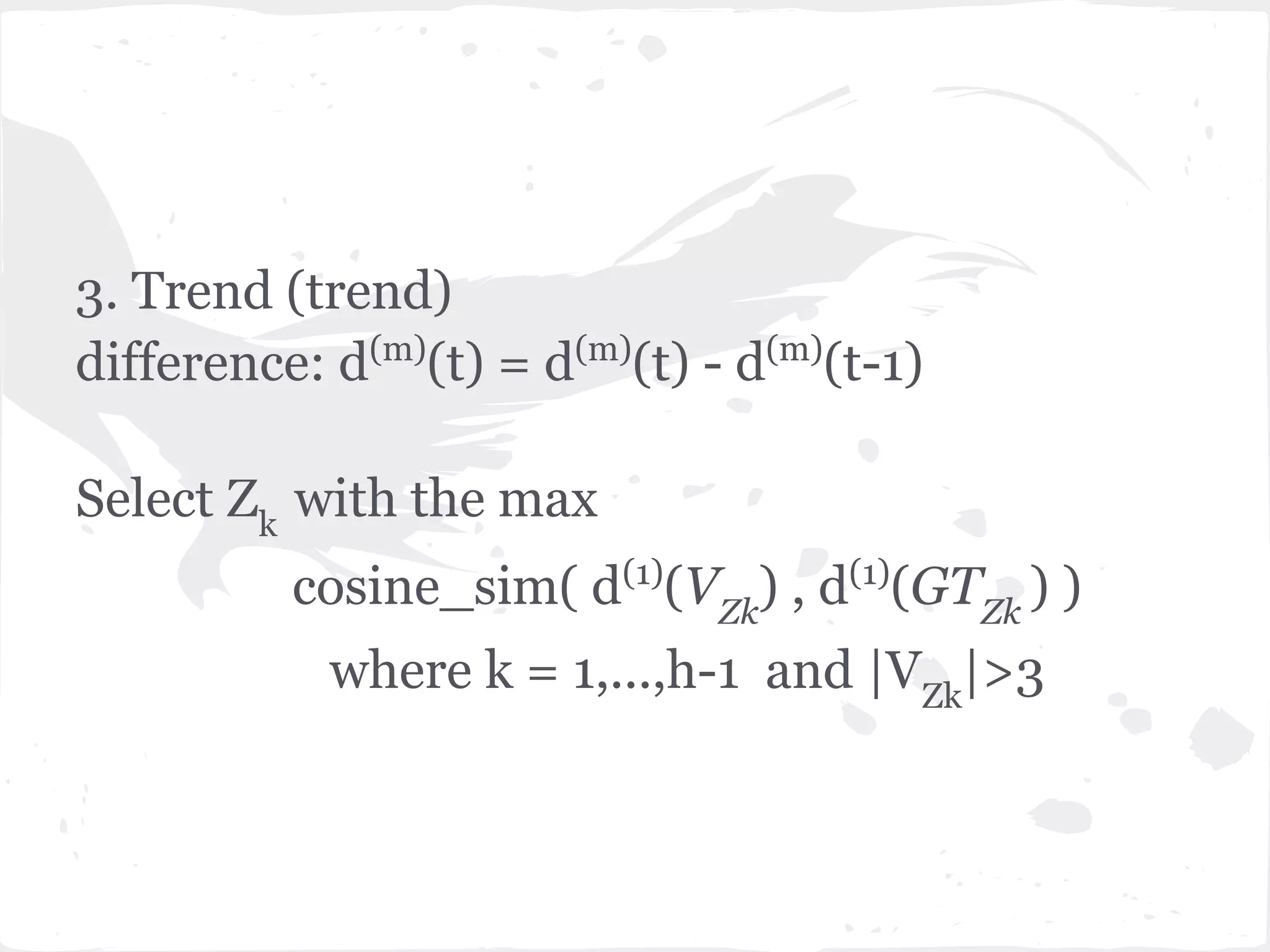
3. Trend (trend)
difference: d(m)
(t) = d(m)
(t) - d(m)
(t-1)
Select Zk
with the max
cosine_sim( d(1)
(VZk
) , d(1)
(GTZk
) )
where k = 1,...,h-1 and |VZk
|>3
Periodicity Feature
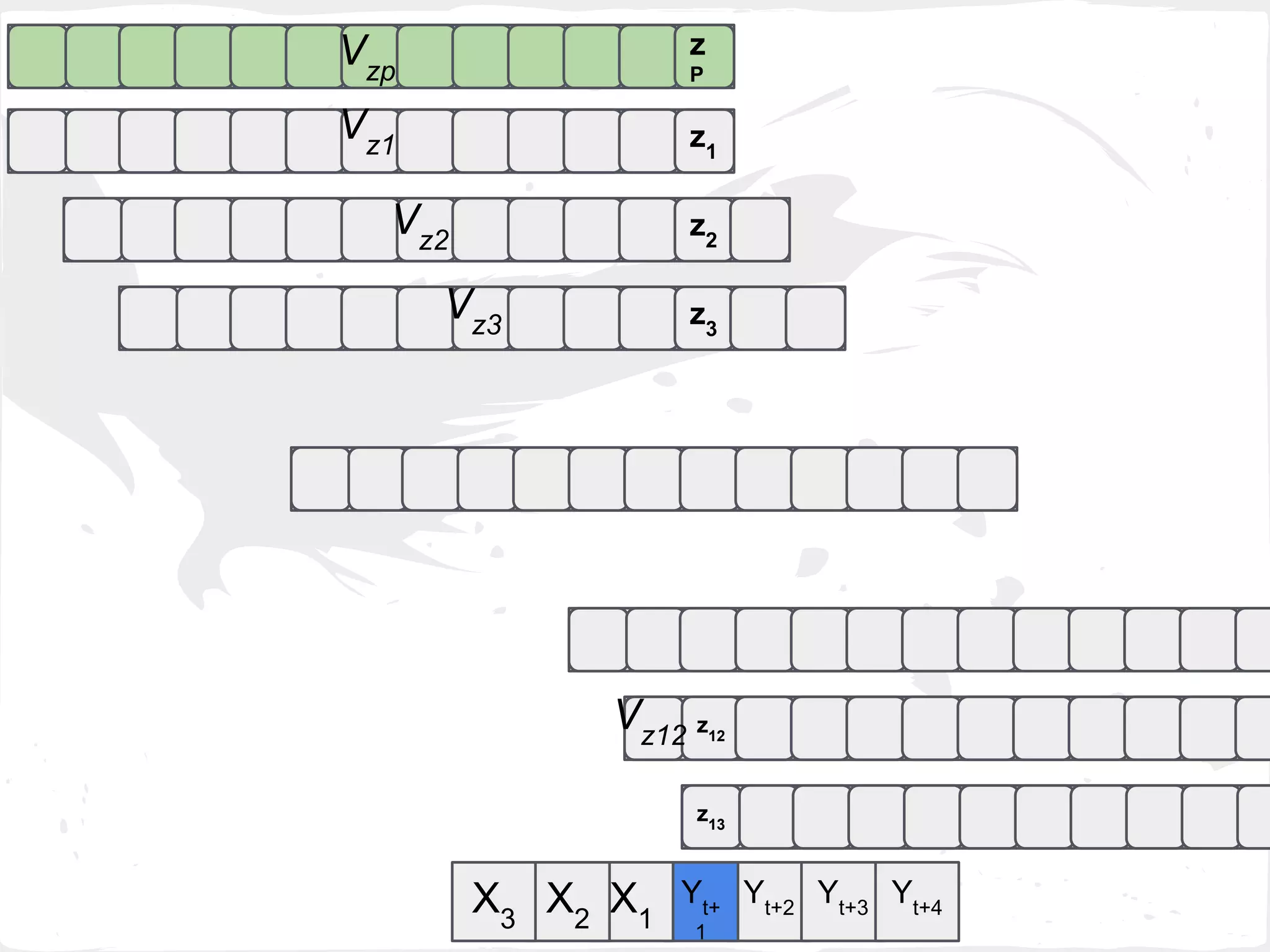
● The previous period data represents certain
accurate confidence. Therefore, we consider
periodicity into feature set property.
● Periodicity detection: FFT(Fast Fourier
transform)
● Add periodicity enhancement to S1 and S2.
Period
z12
z13
z1
z2
z3
Yt+2
Yt+3
Yt+
1
X1
X2
Yt+4X3
Vz1
Vz2
Vz3
Vz12
z
P
Vzp
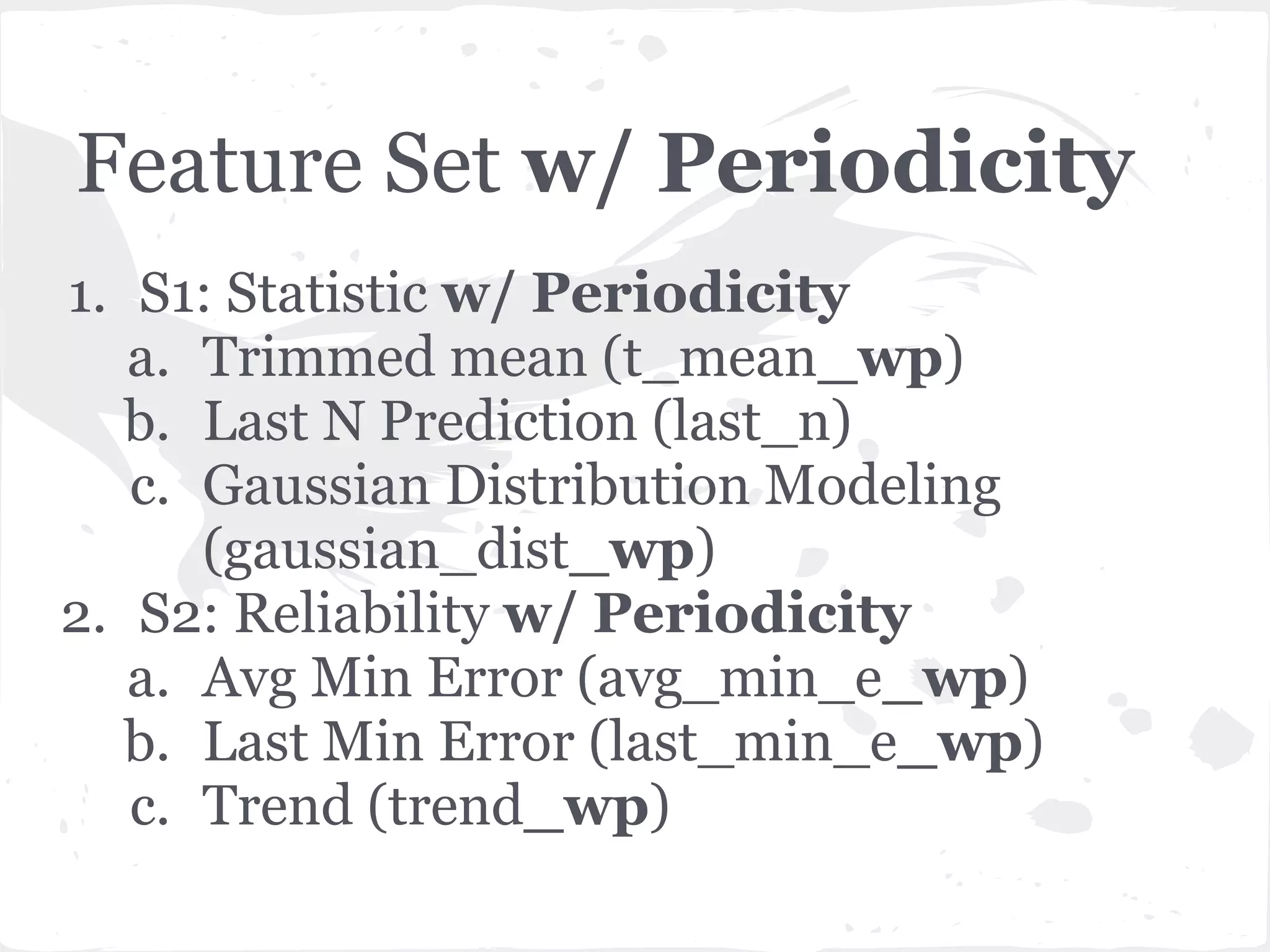
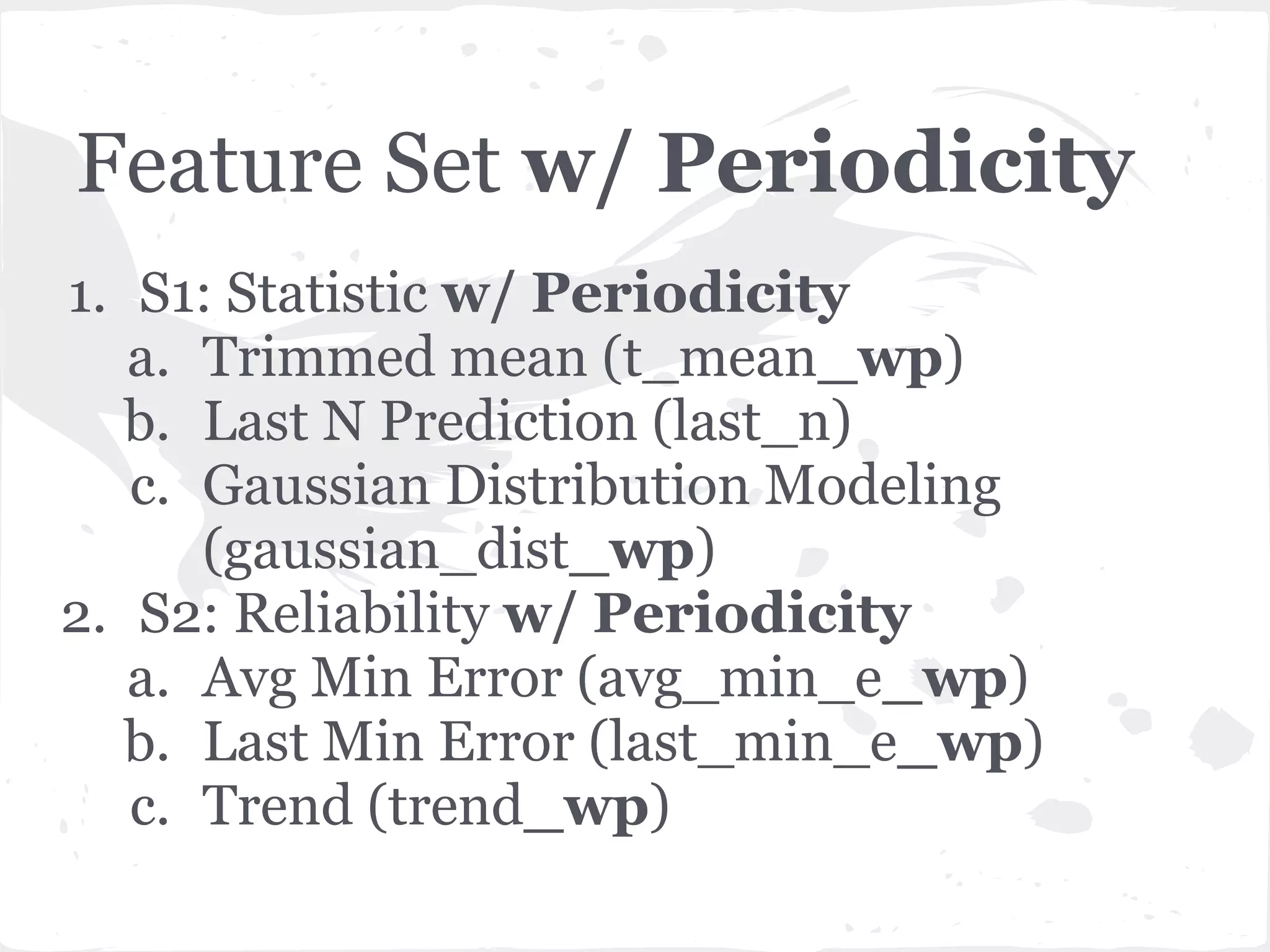
Feature Set w/ Periodicity
1. S1: Statistic w/ Periodicity
a. Trimmed mean (t_mean_wp)
b. Last N Prediction (last_n)
c. Gaussian Distribution Modeling
(gaussian_dist_wp)
2. S2: Reliability w/ Periodicity
a. Avg Min Error (avg_min_e_wp)
b. Last Min Error (last_min_e_wp)
c. Trend (trend_wp)
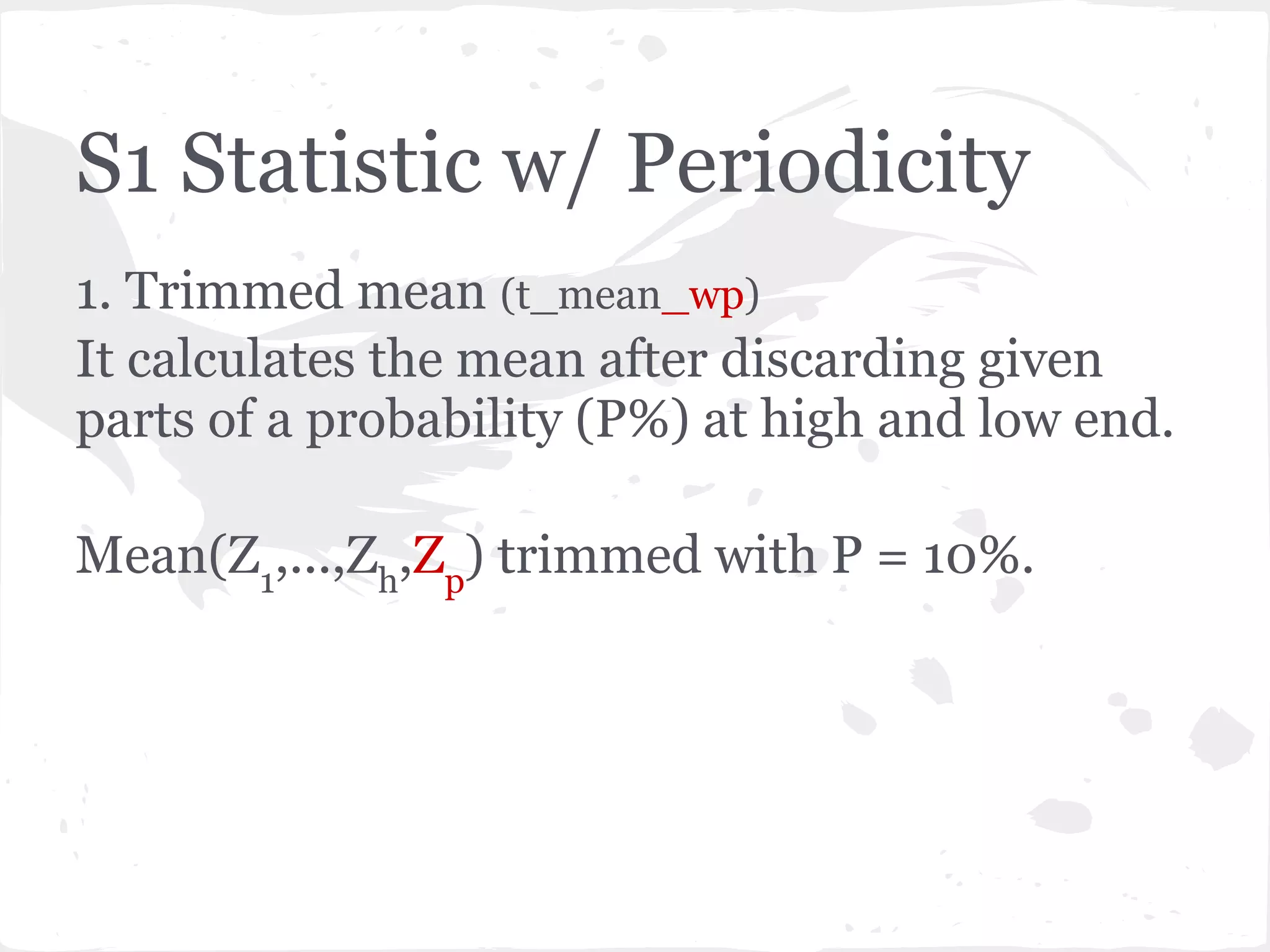
S1 Statistic w/ Periodicity
1. Trimmed mean (t_mean_wp)
It calculates the mean after discarding given
parts of a probability (P%) at high and low end.
Mean(Z1
,...,Zh
,Zp
) trimmed with P = 10%.
3. Gaussian Distribution Modeling
(gaussian_dist_wp)
where μ = mean(Z1
,...,Zh
,Zp
), σ = std(Z1
,...,Zh
,Zp
)
Produce N values from the distribution. N = 1 is
applied.
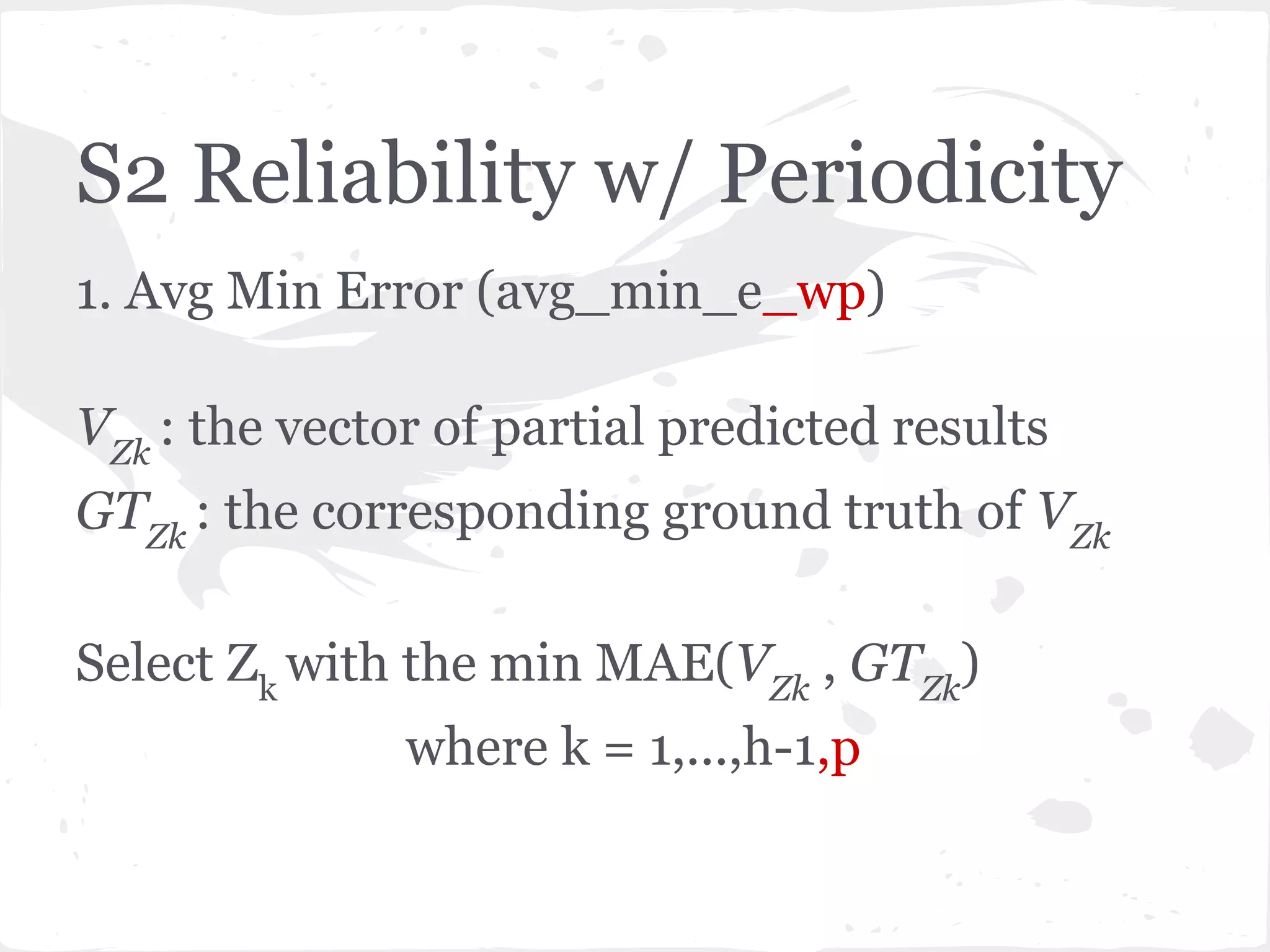
S2 Reliability w/ Periodicity
1. Avg Min Error (avg_min_e_wp)
VZk
: the vector of partial predicted results
GTZk
: the corresponding ground truth of VZk
Select Zk
with the min MAE(VZk
, GTZk
)
where k = 1,...,h-1,p
2. Last Min Error (last_min_e_wp)
Select Zk
with the min MAE( VZk
[1] , GTZk
[1] )
where k = 1,...,h-1,p
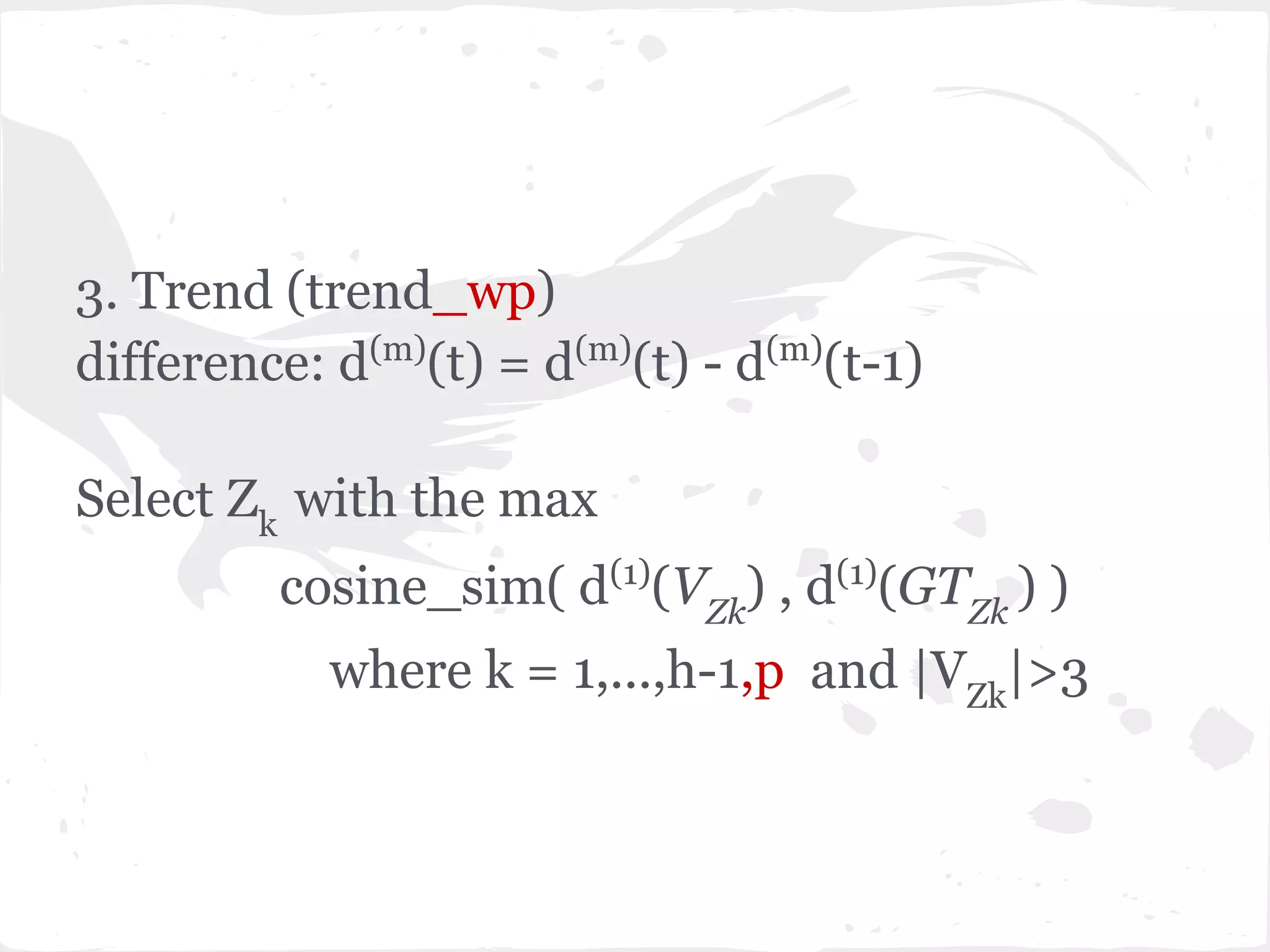
3. Trend (trend_wp)
difference: d(m)
(t) = d(m)
(t) - d(m)
(t-1)
Select Zk
with the max
cosine_sim( d(1)
(VZk
) , d(1)
(GTZk
) )
where k = 1,...,h-1,p and |VZk
|>3
Feature Set w/ Periodicity
1. S1: Statistic w/ Periodicity
a. Trimmed mean (t_mean_wp)
b. Last N Prediction (last_n)
c. Gaussian Distribution Modeling
(gaussian_dist_wp)
2. S2: Reliability w/ Periodicity
a. Avg Min Error (avg_min_e_wp)
b. Last Min Error (last_min_e_wp)
c. Trend (trend_wp)
z12
z13
z1
z2
z3
Yt+2
Yt+3
Yt+
1
X1
X2
Yt+4X3
Vz1
Vz2
Vz3
Vz12
z
P
Vzp
Predict
Method
Multiple Prediction
Overview
Past Data
{Yt-n
,...,
Yt
}
STE (Short-
Term
Enhancement)
LTE-NR (Long-
Term
Enhancement
NRegression)
{NNet, ARIMA or HW-ES}
LTE-R (Long-
Term
Enhancement
Regression)
LTE (Long-Term
Enhancement)
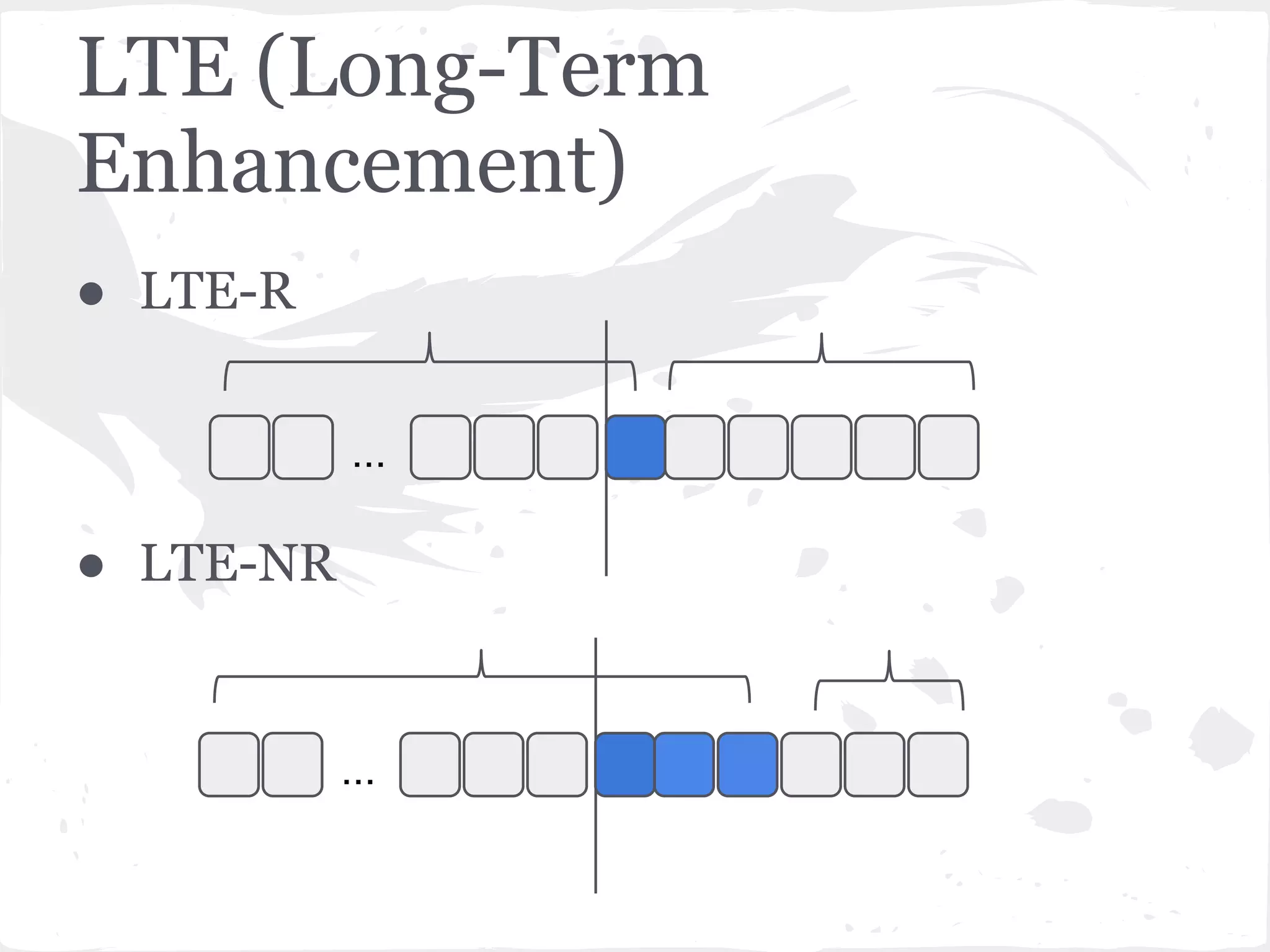
● LTE-R (Long-Term Enhancement
Regression)
● LTE-NR (Long-Term Enhancement
NRegression)
LTE-R (Long-Term
Enhancement Regression)
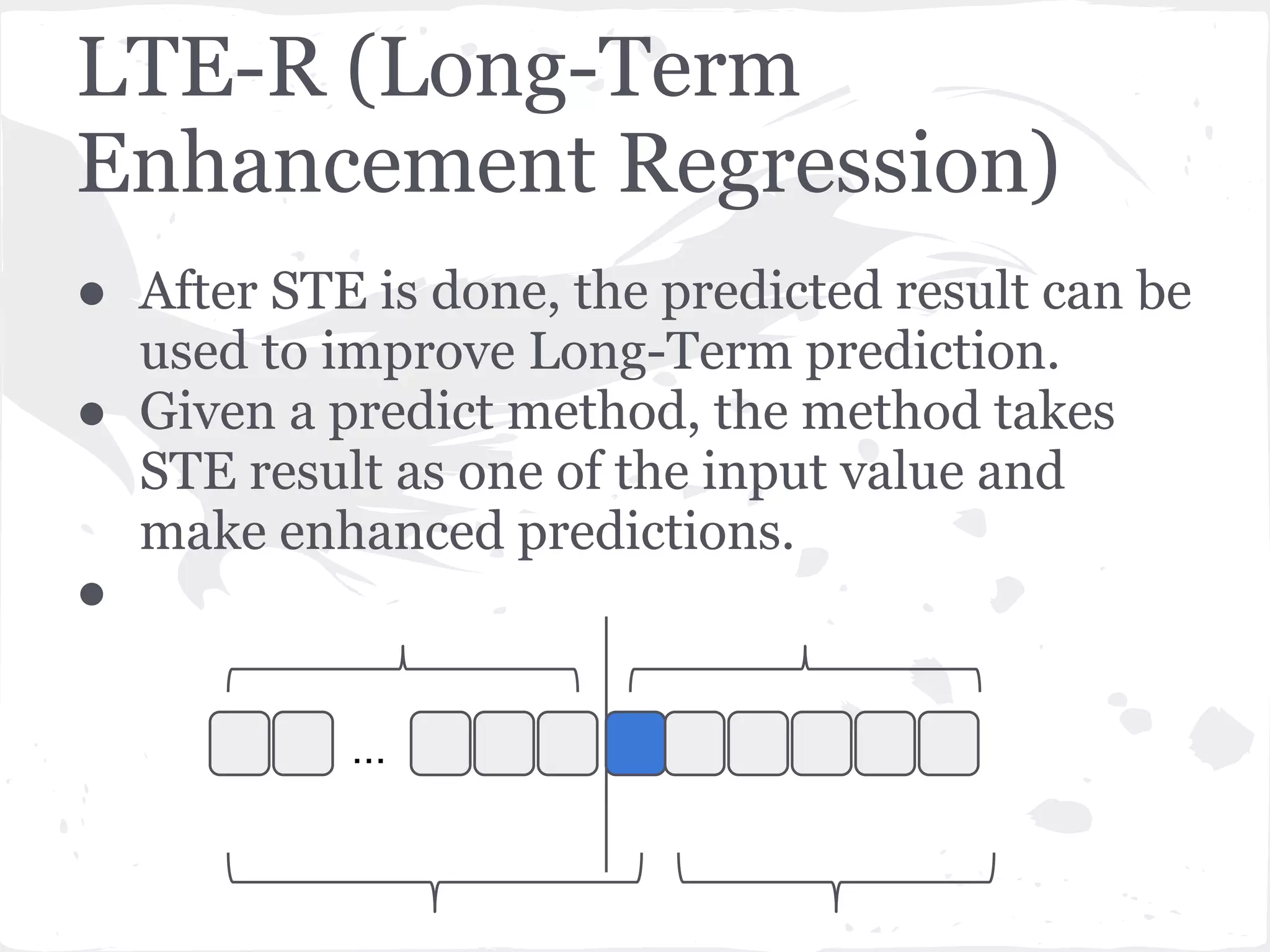
● After STE is done, the predicted result can be
used to improve Long-Term prediction.
● Given a predict method, the method takes
STE result as one of the input value and
make enhanced predictions.
●
...
LTE-NR (Long-Term
Enhancement NRegression)
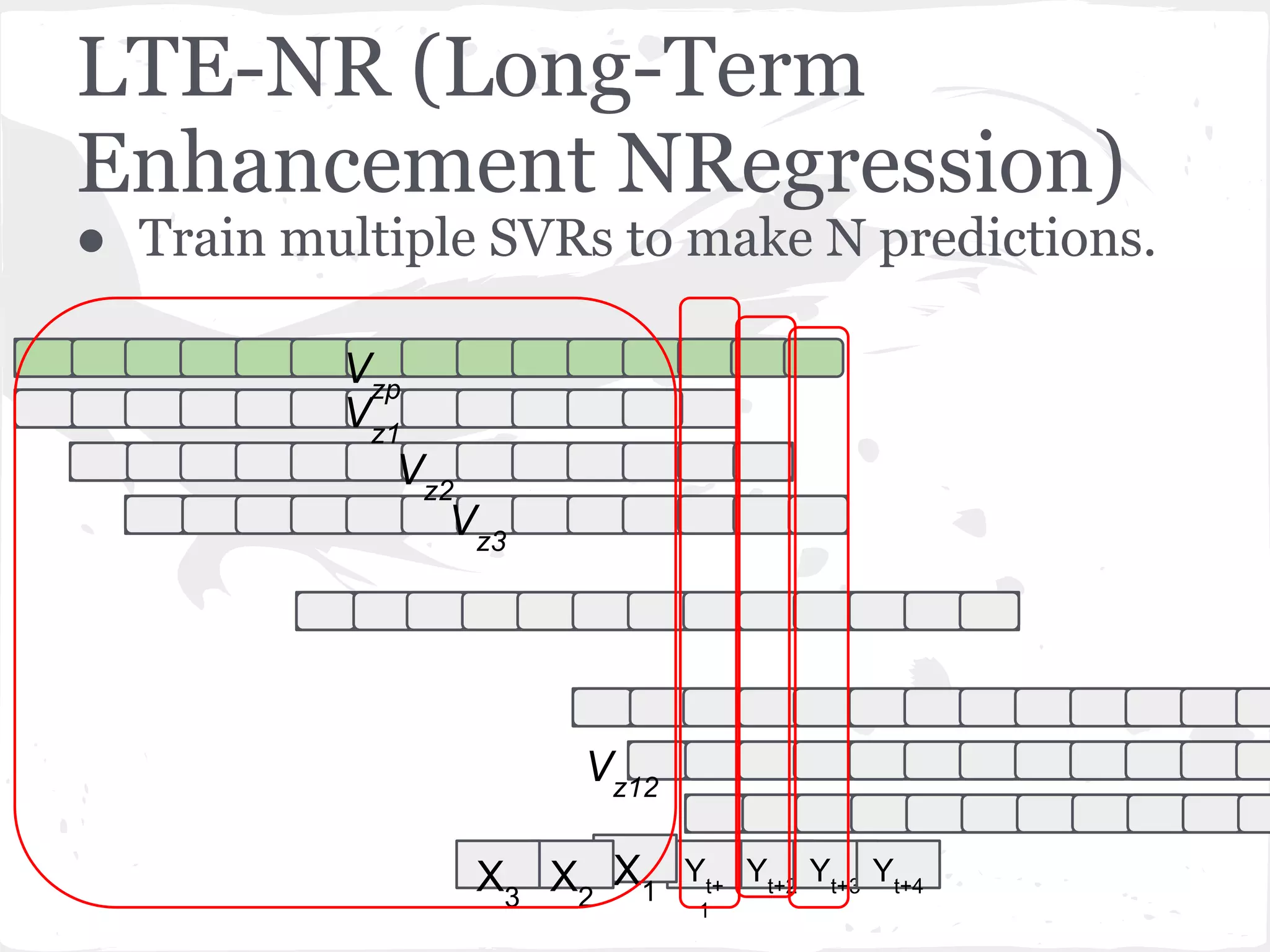
● Train multiple SVRs to make N predictions.
Yt+2
Yt+3
Yt+
1
X1X2
Yt+4X3
Vz1
Vz2
Vz3
Vz12
Vzp
LTE-NR (Long-Term
Enhancement NRegression)
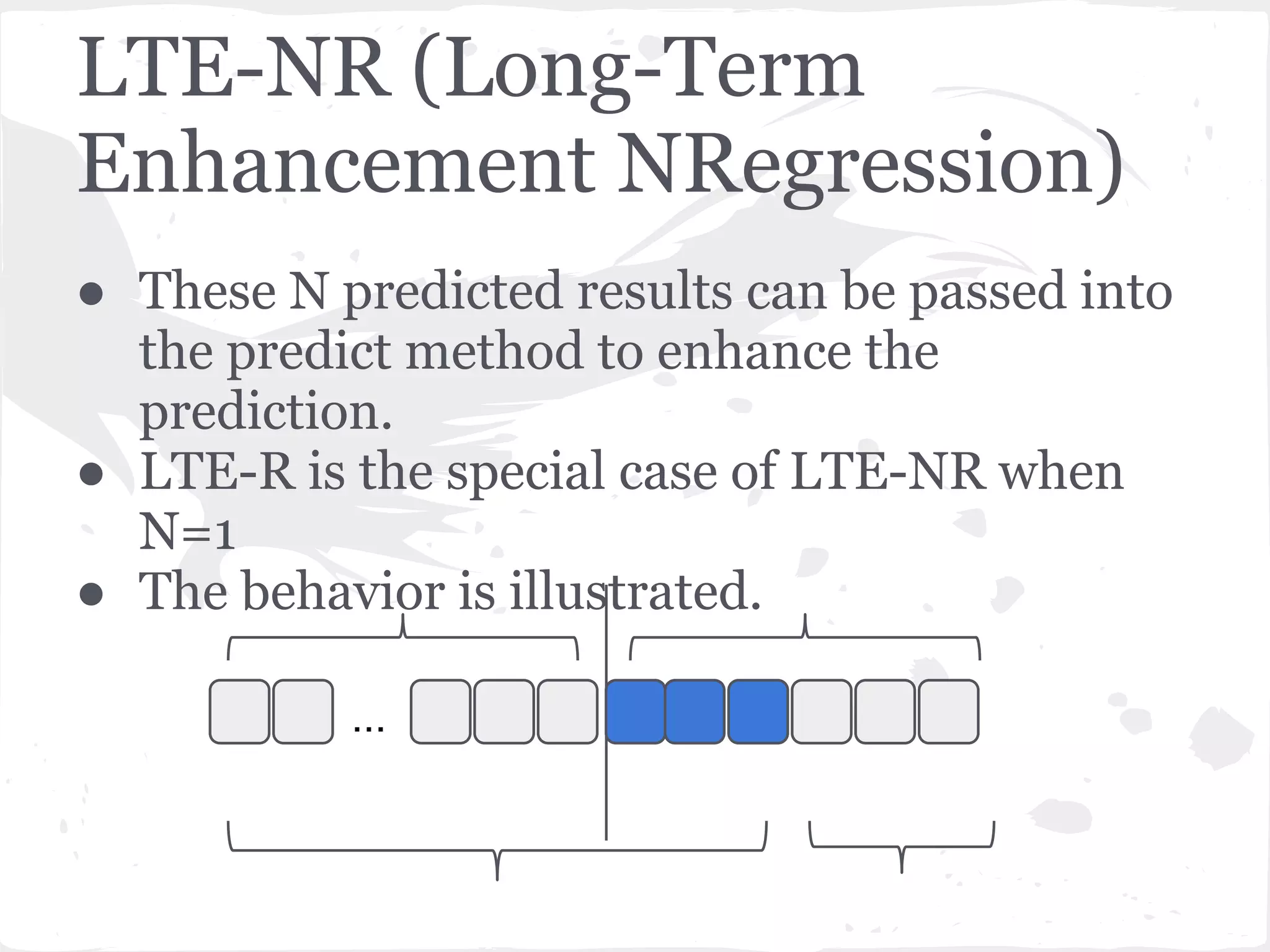
● These N predicted results can be passed into
the predict method to enhance the
prediction.
● LTE-R is the special case of LTE-NR when
N=1
● The behavior is illustrated.
...
LTE (Long-Term
Enhancement)
● LTE-R
● LTE-NR
...
...
Predict
Method
Multiple Prediction
Overview
Past Data
{Yt-n
,...,
Yt
}
STE (Short-
Term
Enhancement)
LTE-NR (Long-
Term
Enhancement
NRegression)
{NNet, ARIMA or HW-ES}
LTE-R (Long-
Term
Enhancement
Regression)
Experiment
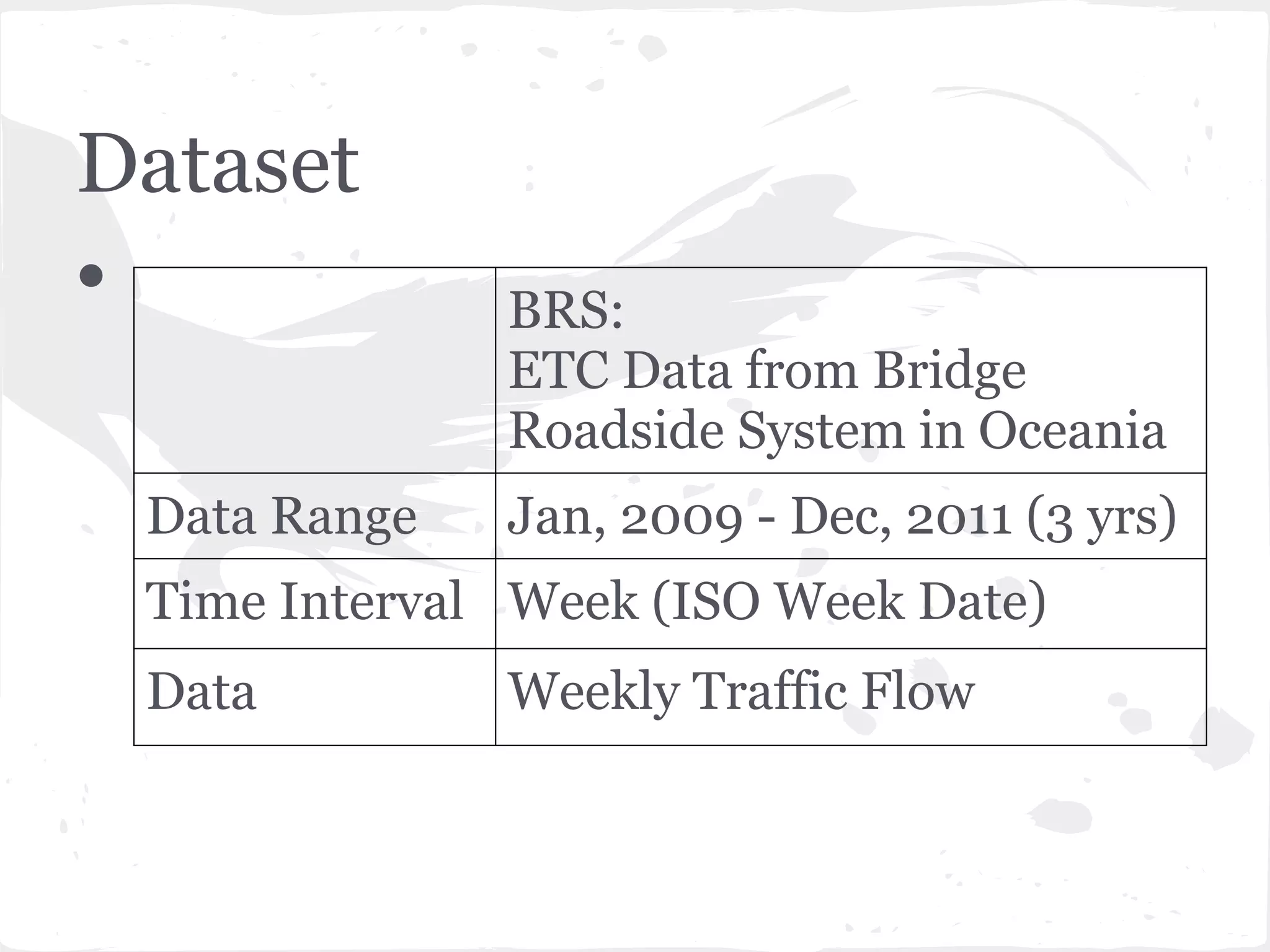
Dataset
●
BRS:
ETC Data from Bridge
Roadside System in Oceania
Data Range Jan, 2009 - Dec, 2011 (3 yrs)
Time Interval Week (ISO Week Date)
Data Weekly Traffic Flow
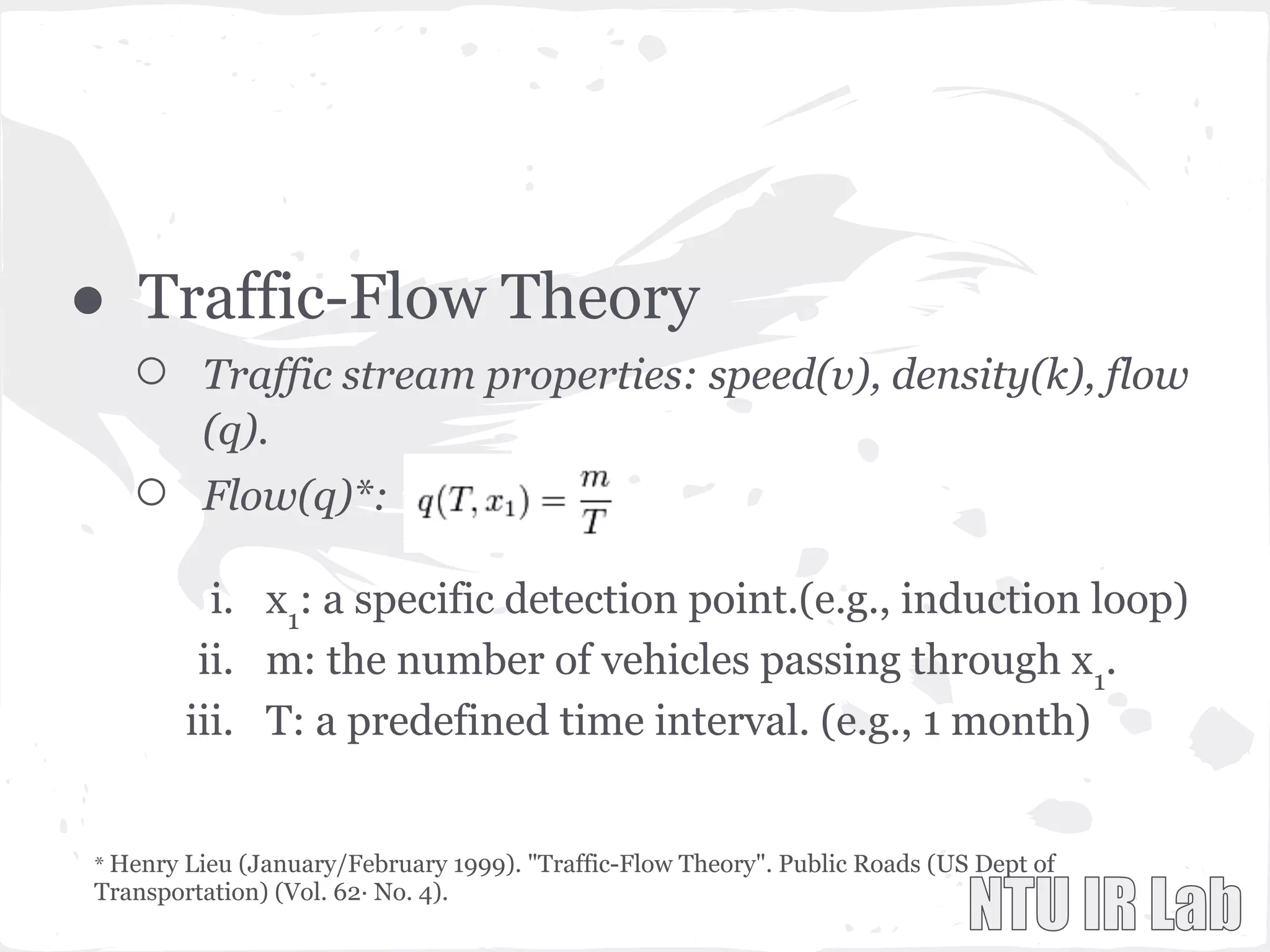
● Traffic-Flow Theory
○ Traffic stream properties: speed(v), density(k), flow
(q).
○ Flow(q)*:
i. x1
: a specific detection point.(e.g., induction loop)
ii. m: the number of vehicles passing through x1
.
iii. T: a predefined time interval. (e.g., 1 month)
* Henry Lieu (January/February 1999). "Traffic-Flow Theory". Public Roads (US Dept of
Transportation) (Vol. 62· No. 4).
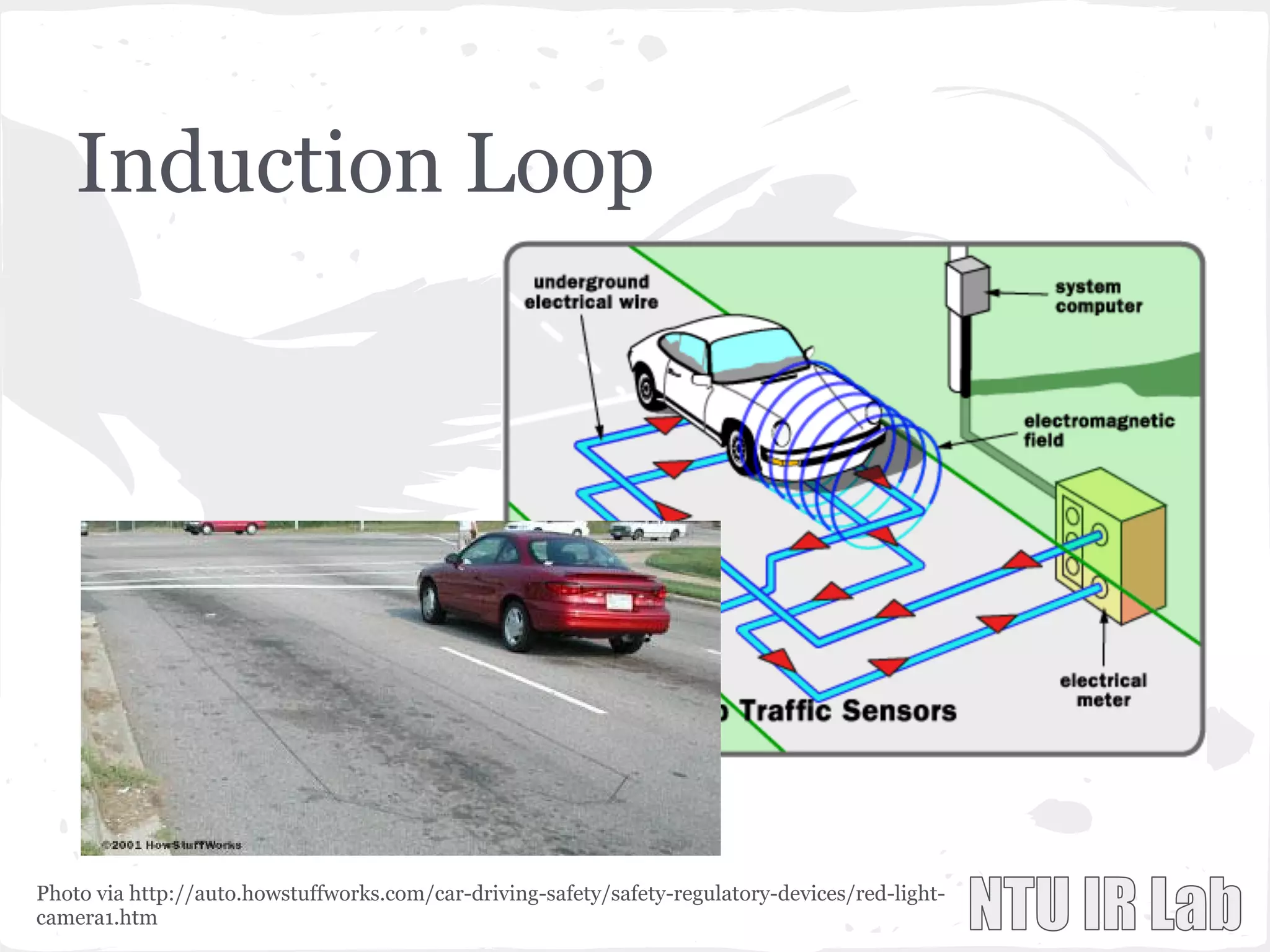
Induction Loop
Photo via http://auto.howstuffworks.com/car-driving-safety/safety-regulatory-devices/red-light-
camera1.htm
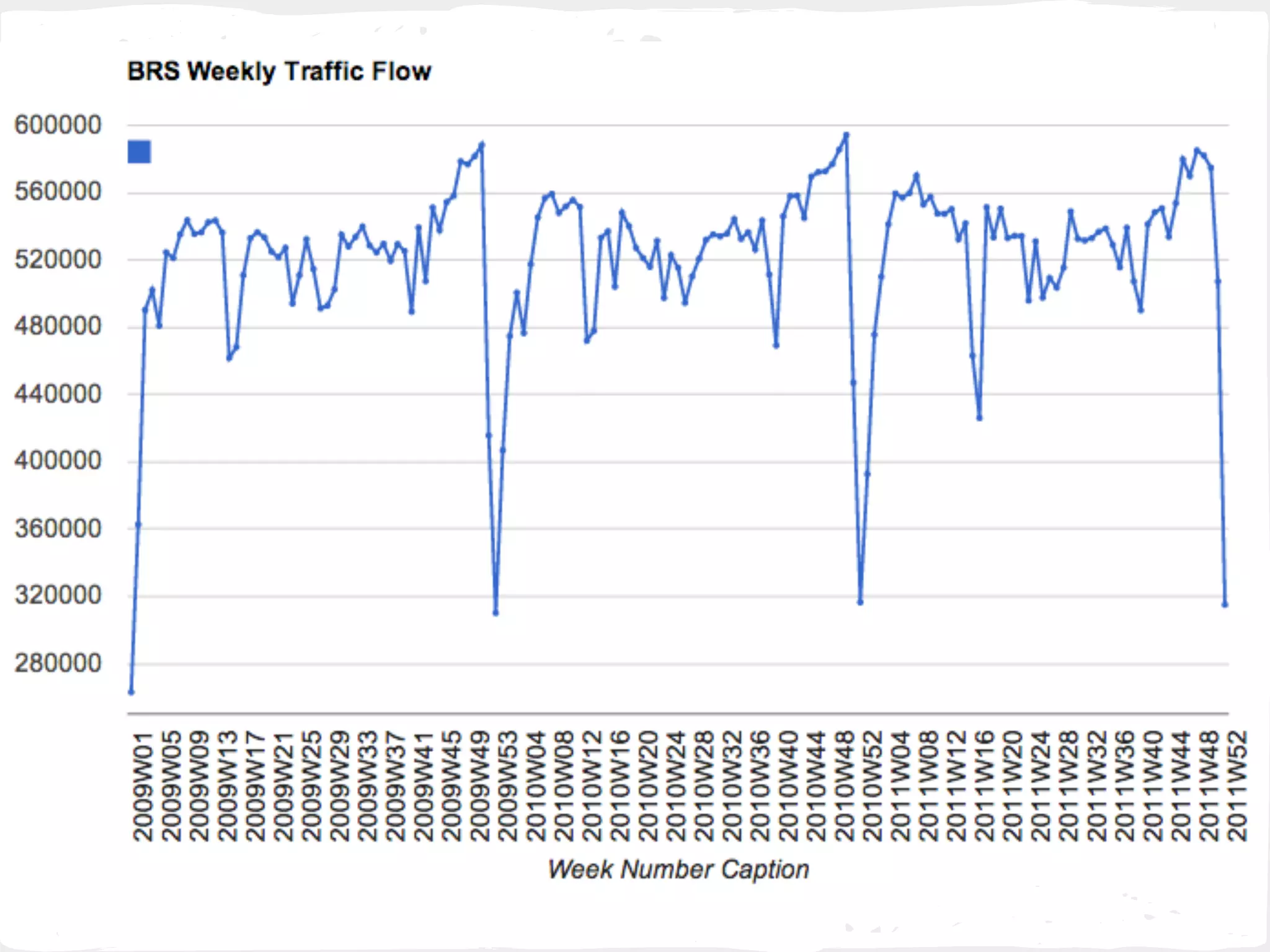
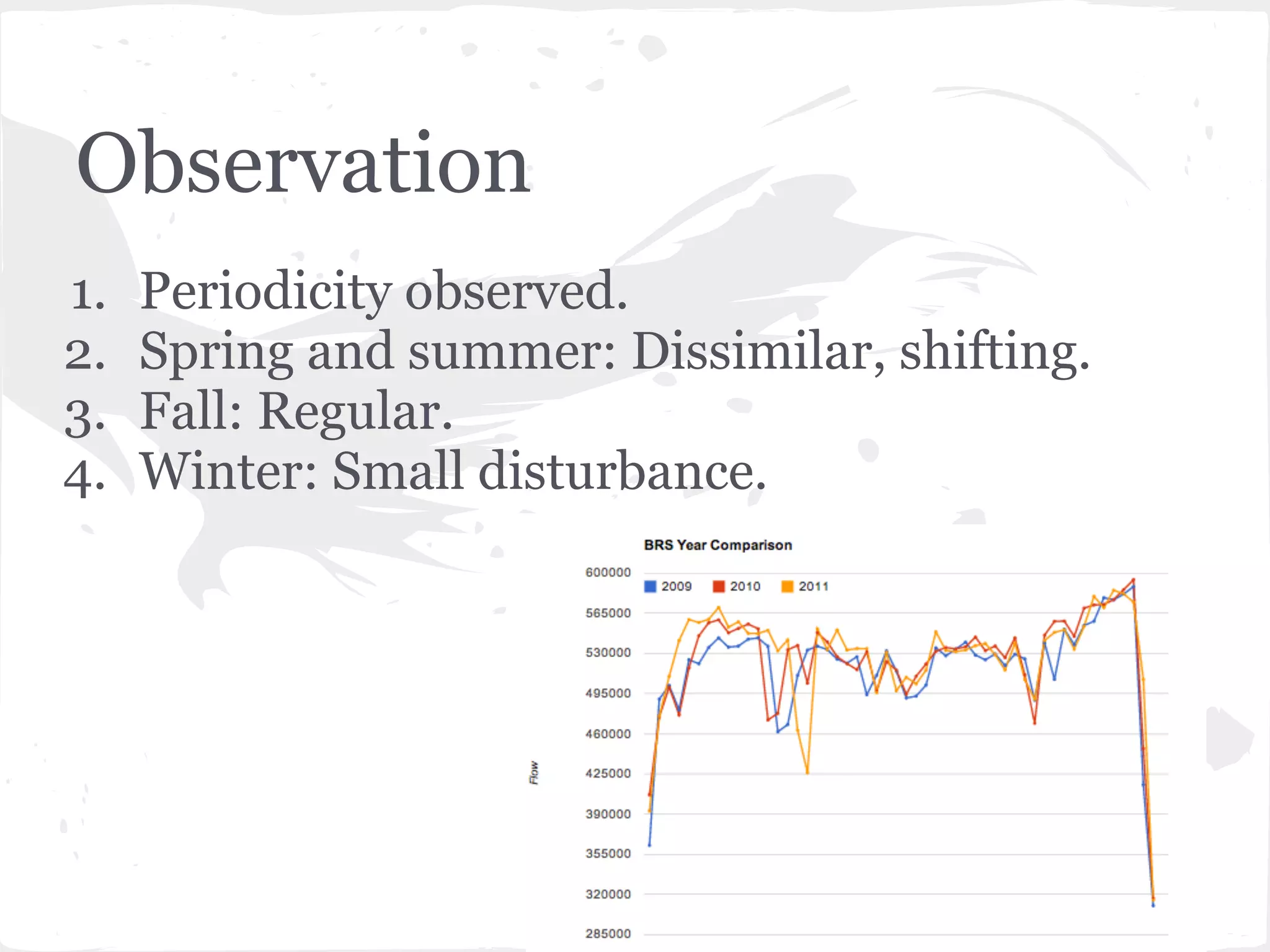
Observation
1. Periodicity observed.
2. Spring and summer: Dissimilar, shifting.
3. Fall: Regular.
4. Winter: Small disturbance.
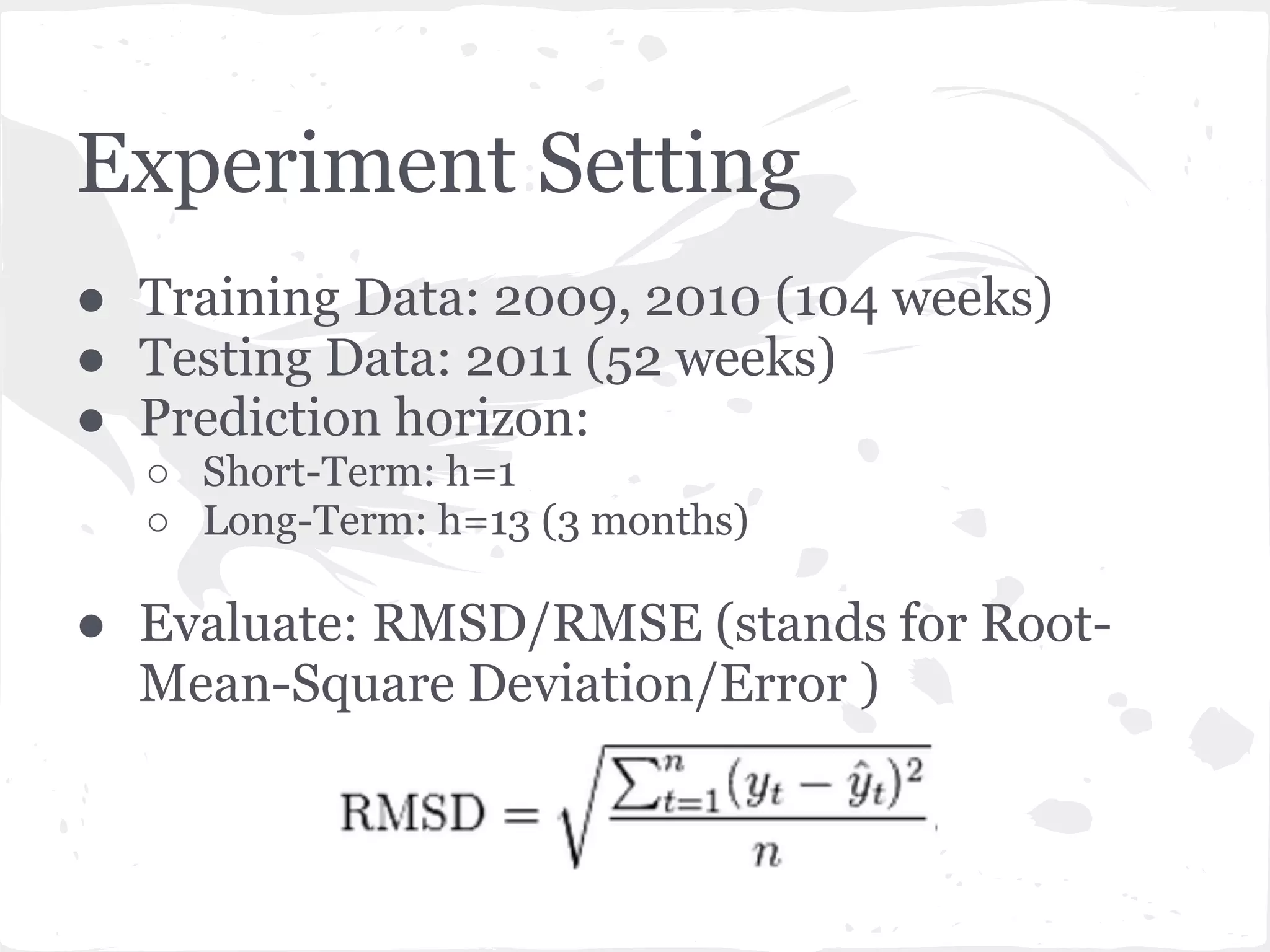
Experiment Setting
● Training Data: 2009, 2010 (104 weeks)
● Testing Data: 2011 (52 weeks)
● Prediction horizon:
○ Short-Term: h=1
○ Long-Term: h=13 (3 months)
● Evaluate: RMSD/RMSE (stands for Root-
Mean-Square Deviation/Error )
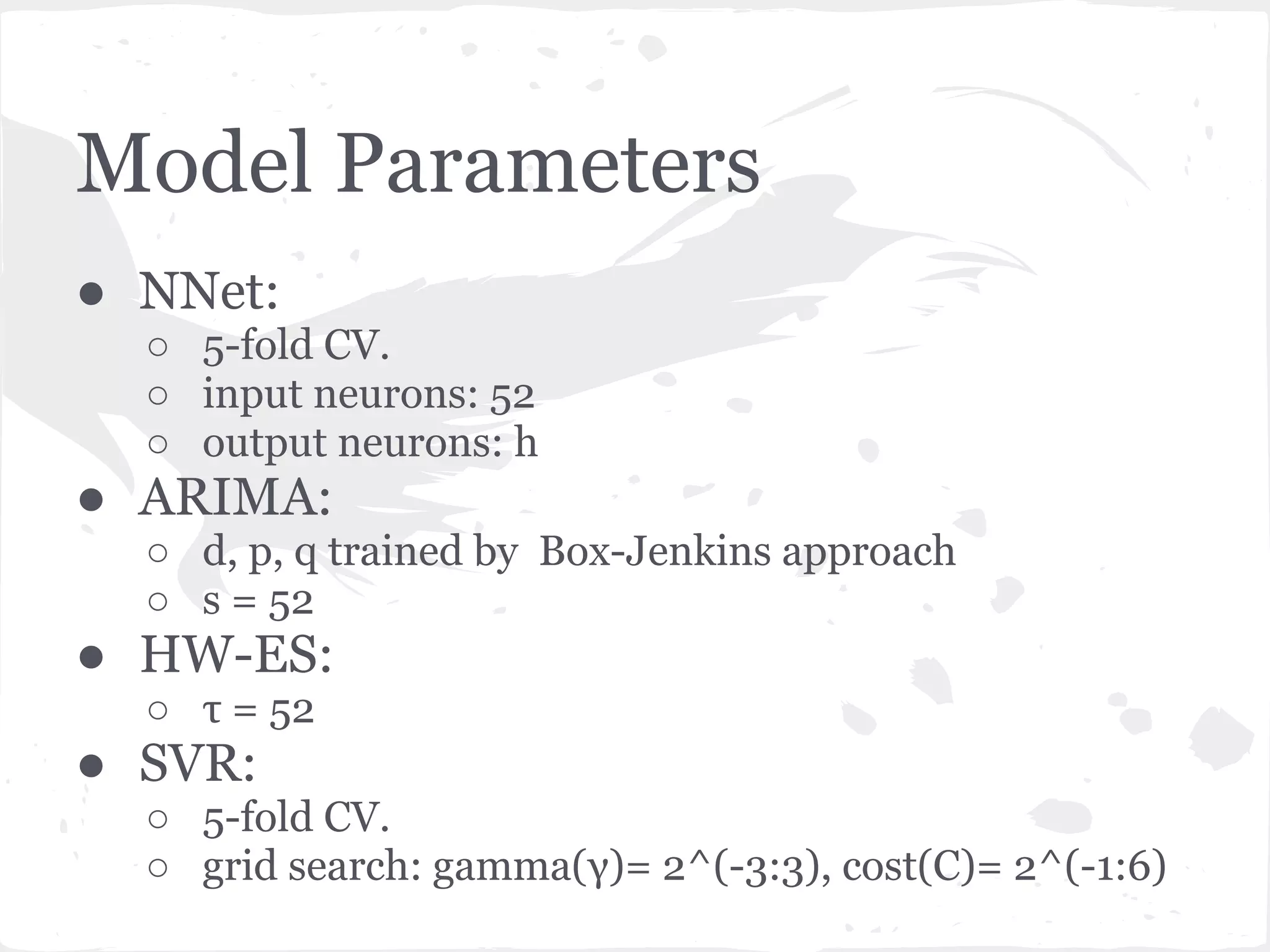
Model Parameters
● NNet:
○ 5-fold CV.
○ input neurons: 52
○ output neurons: h
● ARIMA:
○ d, p, q trained by Box-Jenkins approach
○ s = 52
● HW-ES:
○ τ = 52
● SVR:
○ 5-fold CV.
○ grid search: gamma(γ)= 2^(-3:3), cost(C)= 2^(-1:6)
STE
● Baseline: NNet, ARIMA, HW-ES
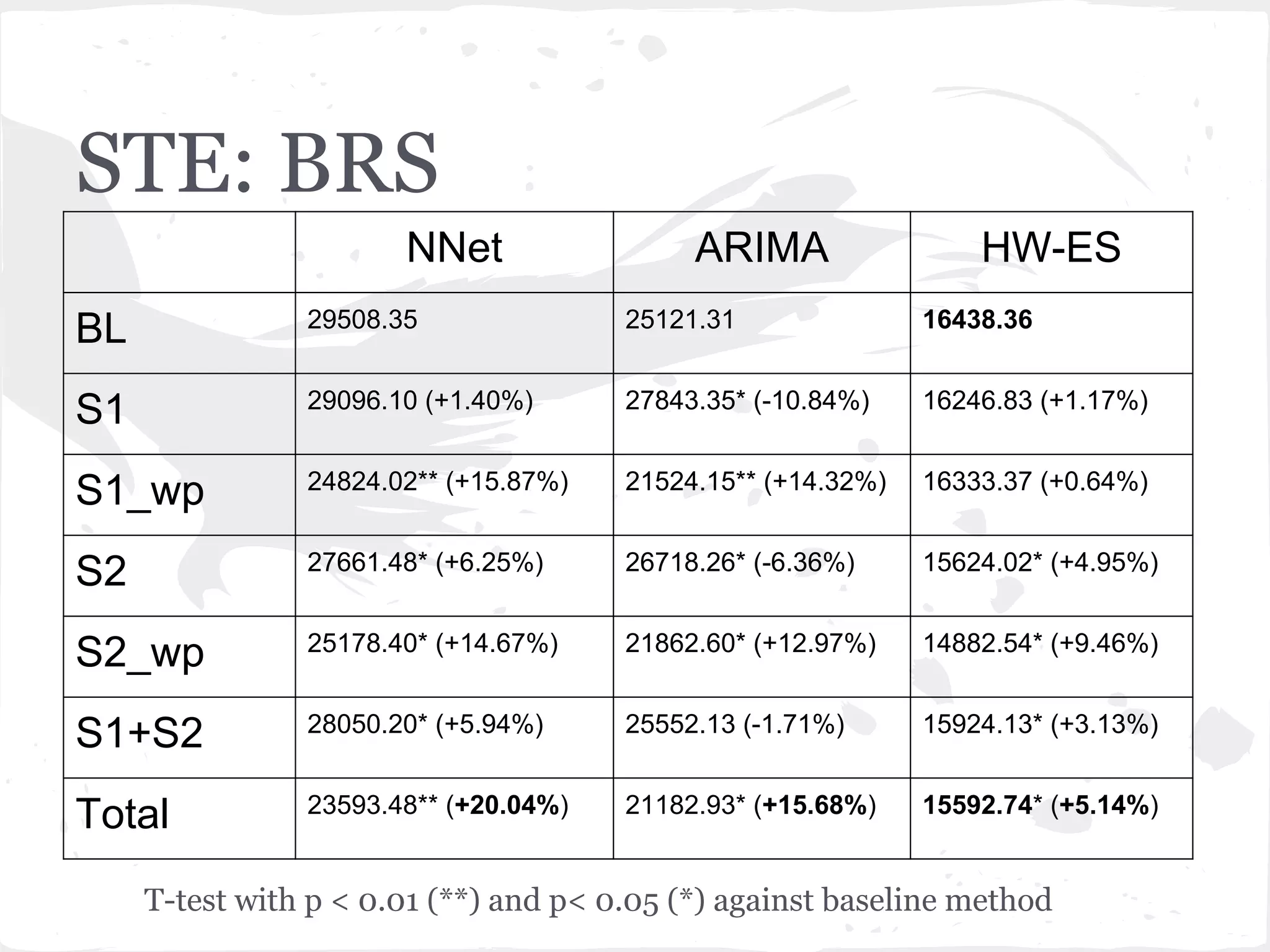
NNet ARIMA HW-ES
BL 29508.35 25121.31 16438.36
S1 29096.10 (+1.40%) 27843.35* (-10.84%) 16246.83 (+1.17%)
S1_wp 24824.02** (+15.87%) 21524.15** (+14.32%) 16333.37 (+0.64%)
S2 27661.48* (+6.25%) 26718.26* (-6.36%) 15624.02* (+4.95%)
S2_wp 25178.40* (+14.67%) 21862.60* (+12.97%) 14882.54* (+9.46%)
S1+S2 28050.20* (+5.94%) 25552.13 (-1.71%) 15924.13* (+3.13%)
Total 23593.48** (+20.04%) 21182.93* (+15.68%) 15592.74* (+5.14%)
STE: BRS
T-test with p < 0.01 (**) and p< 0.05 (*) against baseline method
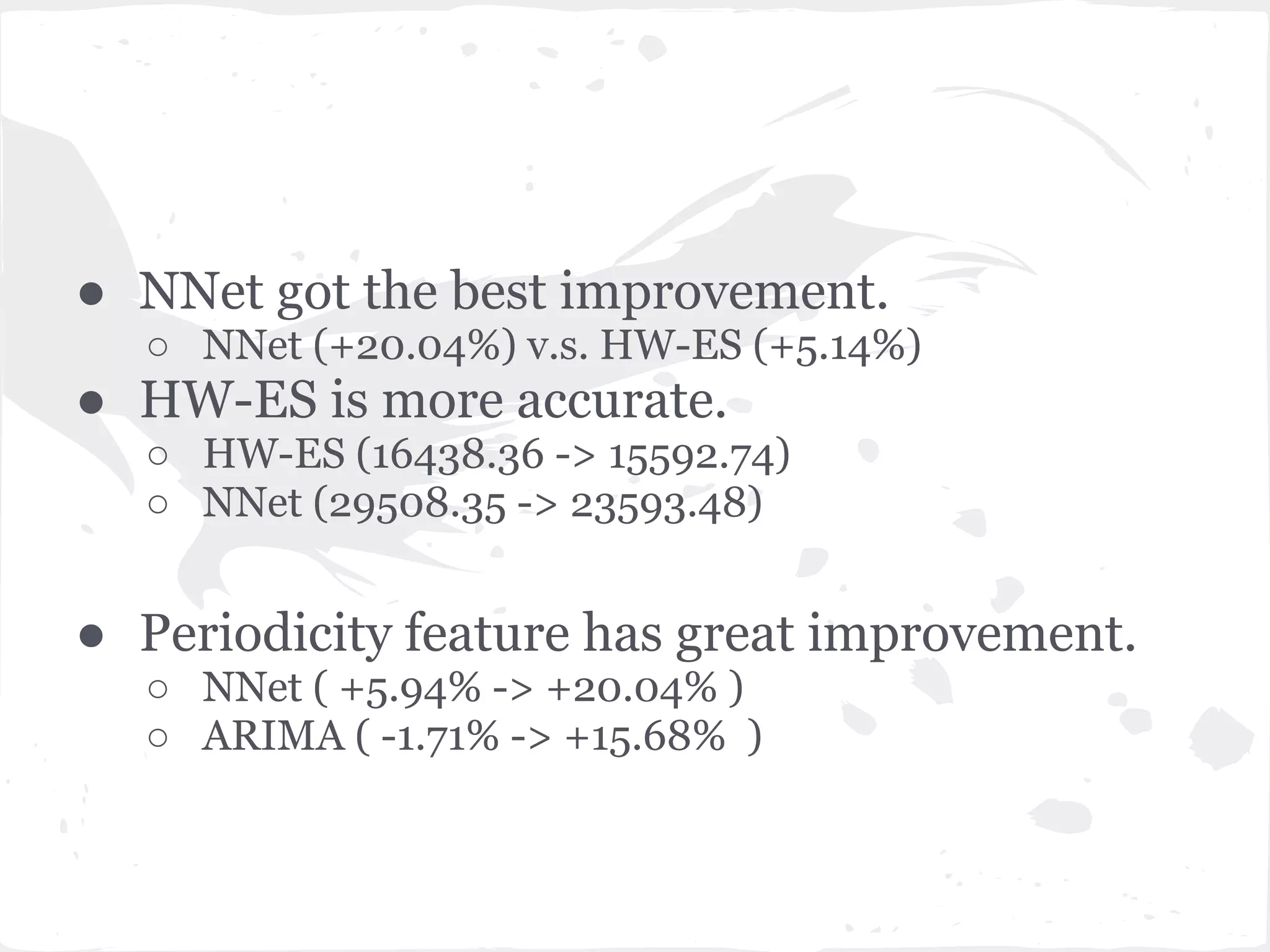
● NNet got the best improvement.
○ NNet (+20.04%) v.s. HW-ES (+5.14%)
● HW-ES is more accurate.
○ HW-ES (16438.36 -> 15592.74)
○ NNet (29508.35 -> 23593.48)
● Periodicity feature has great improvement.
○ NNet ( +5.94% -> +20.04% )
○ ARIMA ( -1.71% -> +15.68% )
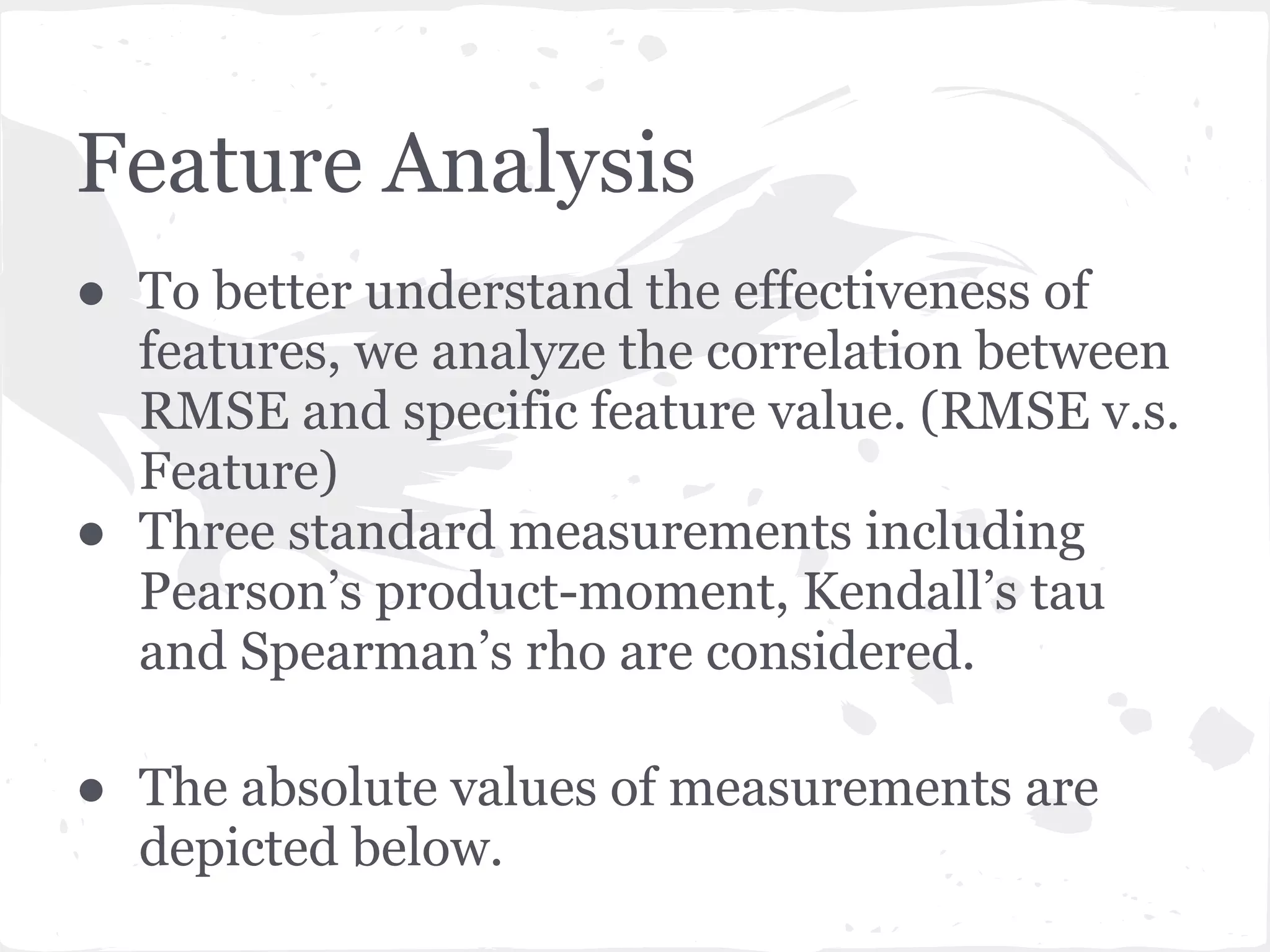
Feature Analysis
● To better understand the effectiveness of
features, we analyze the correlation between
RMSE and specific feature value. (RMSE v.s.
Feature)
● Three standard measurements including
Pearson’s product-moment, Kendall’s tau
and Spearman’s rho are considered.
● The absolute values of measurements are
depicted below.
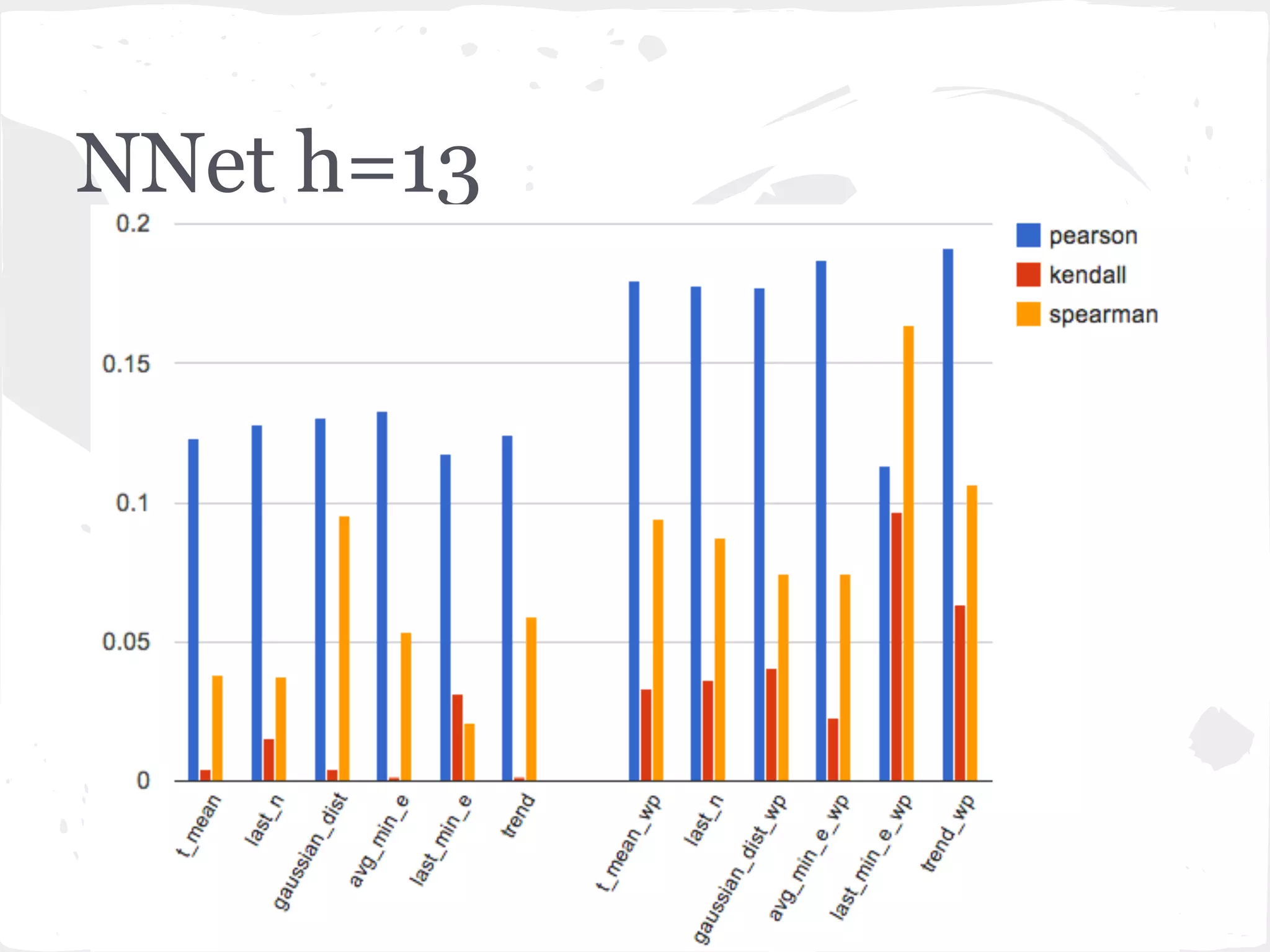
NNet h=13
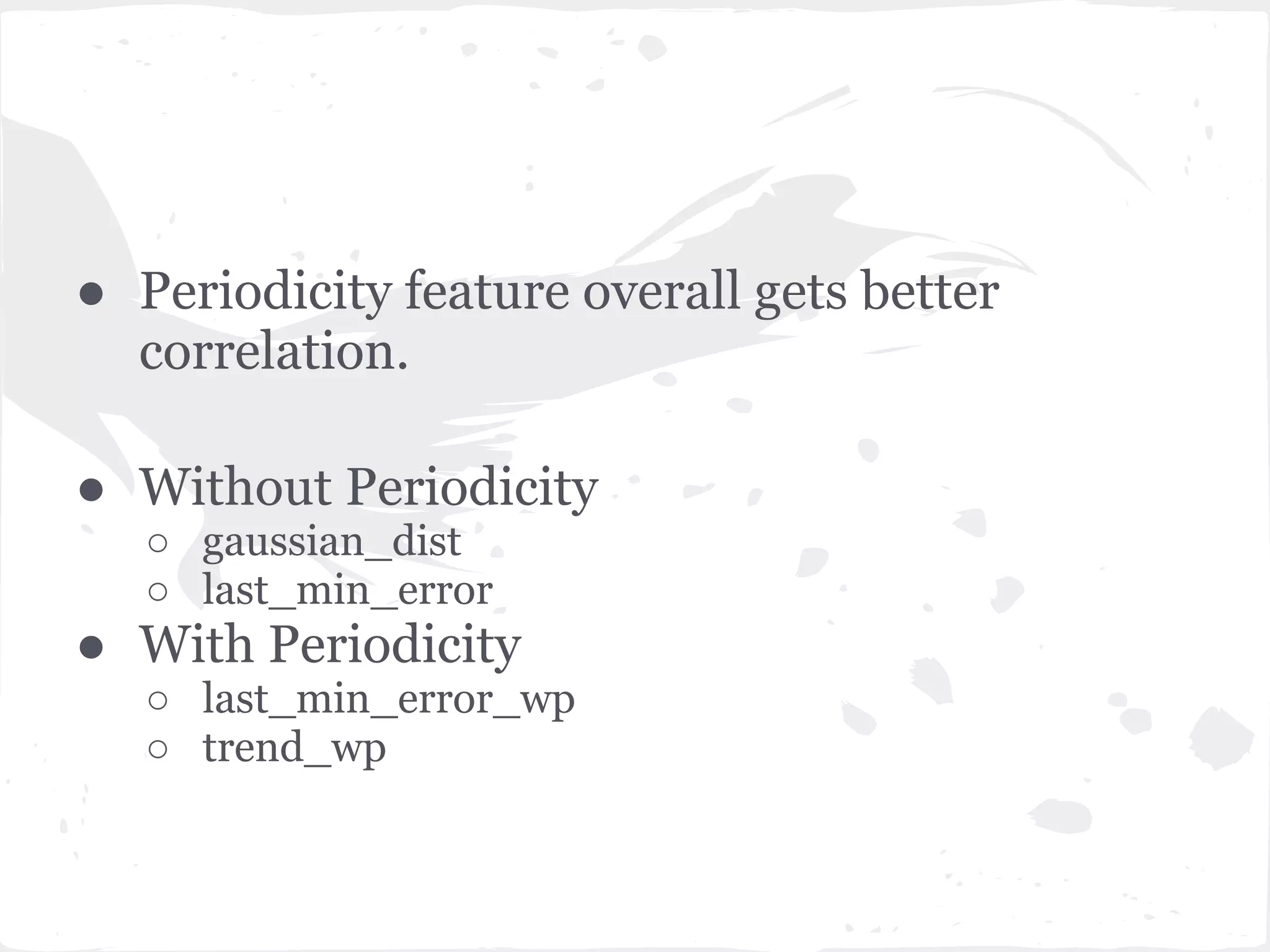
● Periodicity feature overall gets better
correlation.
● Without Periodicity
○ gaussian_dist
○ last_min_error
● With Periodicity
○ last_min_error_wp
○ trend_wp
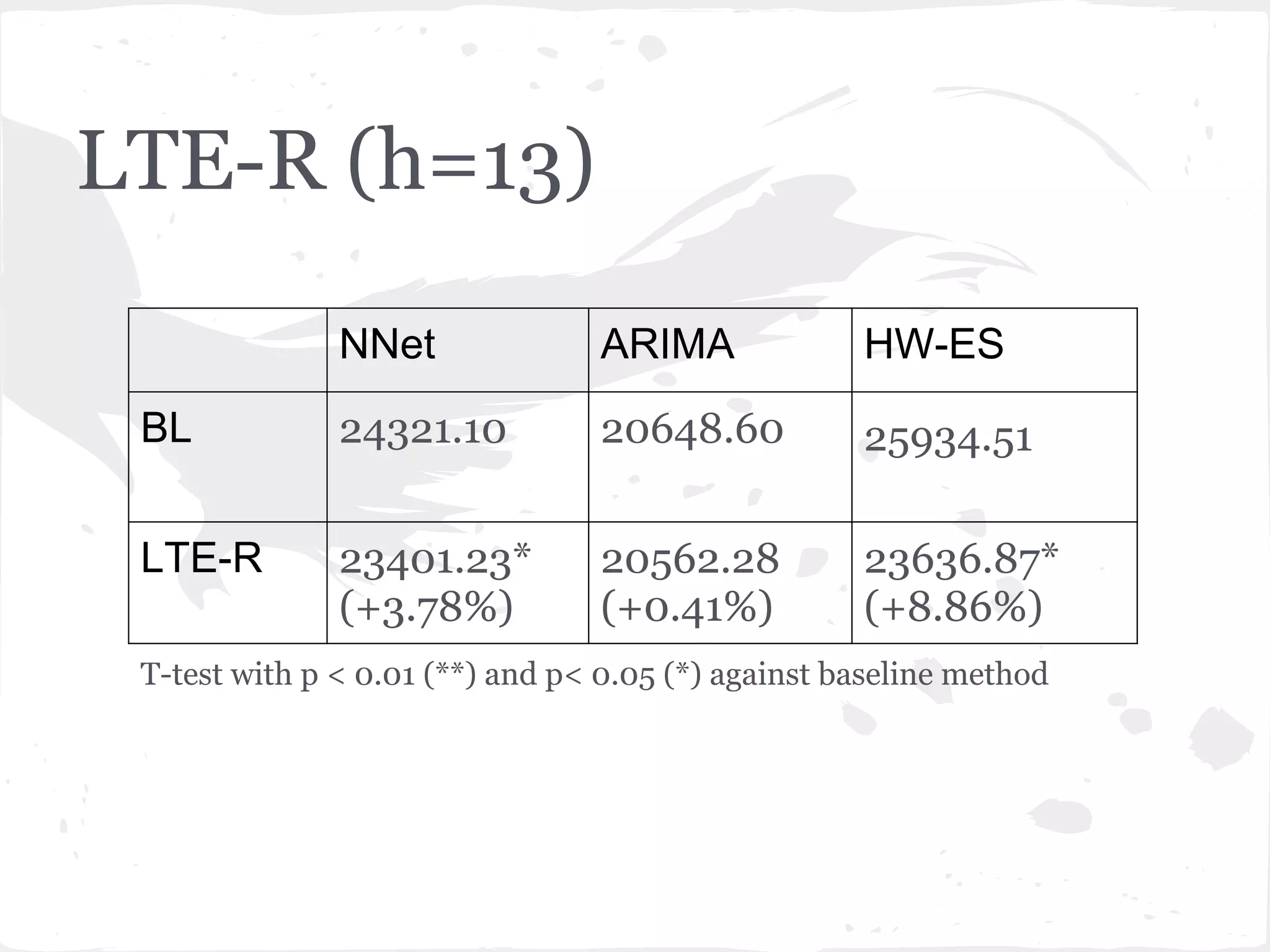
LTE-R (h=13)
NNet ARIMA HW-ES
BL 24321.10 20648.60 25934.51
LTE-R 23401.23*
(+3.78%)
20562.28
(+0.41%)
23636.87*
(+8.86%)
T-test with p < 0.01 (**) and p< 0.05 (*) against baseline method
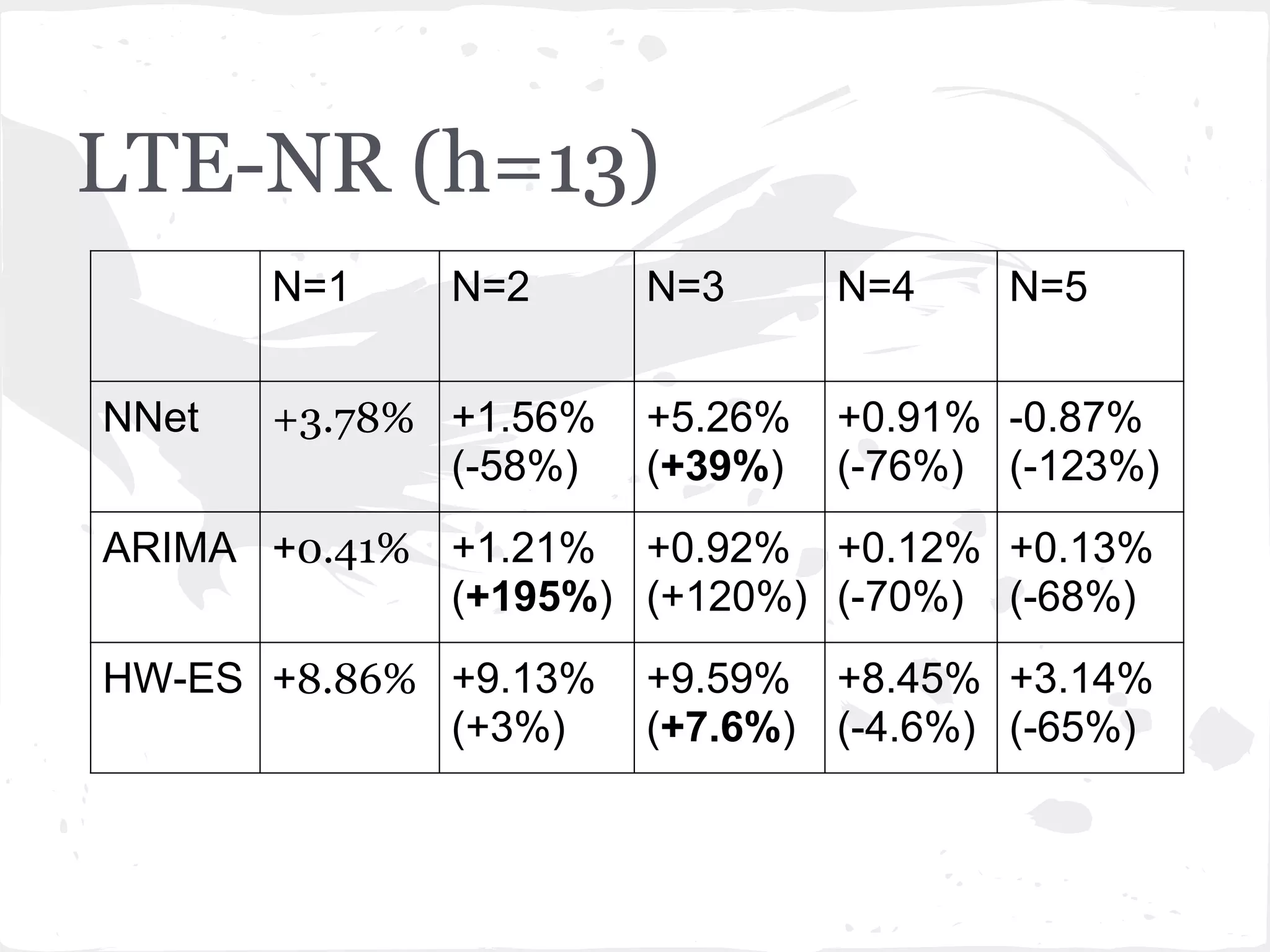
LTE-NR (h=13)
N=1 N=2 N=3 N=4 N=5
NNet +3.78% +1.56%
(-58%)
+5.26%
(+39%)
+0.91%
(-76%)
-0.87%
(-123%)
ARIMA +0.41% +1.21%
(+195%)
+0.92%
(+120%)
+0.12%
(-70%)
+0.13%
(-68%)
HW-ES +8.86% +9.13%
(+3%)
+9.59%
(+7.6%)
+8.45%
(-4.6%)
+3.14%
(-65%)
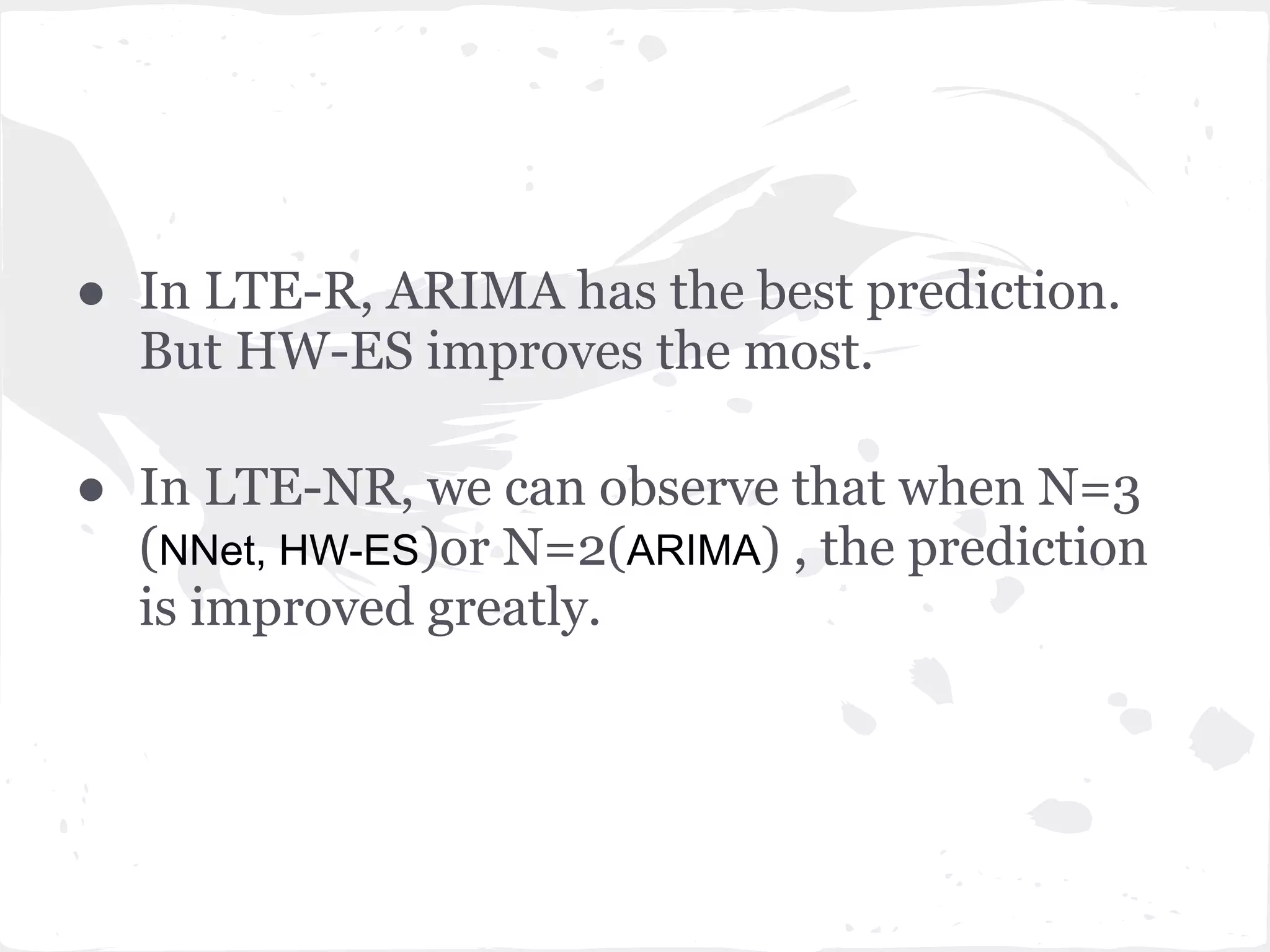
● In LTE-R, ARIMA has the best prediction.
But HW-ES improves the most.
● In LTE-NR, we can observe that when N=3
(NNet, HW-ES)or N=2(ARIMA) , the prediction
is improved greatly.
Conclusion
● We design a general framework for
enhancing prediction performance where the
predict method can capture trend or
periodicity property.
● We adopted Read-World traffic data. With
the great improvement,
○ City's competitiveness planning
○ Improves the budget and forecast estimation
○ Improve maintenance planning to optimize the
maintenance spending

A General Framework for Enhancing Prediction Performance on Time Series Data

  • 1.
    A General Frameworkfor Enhancing Prediction Performance on Time Series Data Chin-Hui Chen 陳晉暉 Prof. Pu-Jen Cheng 鄭卜壬教授 增進時序資料預測效能之一般化模型
  • 2.
    1. Motivation 2. RelatedWorks 3. Framework 4. Experiment 5. Conclusion Agenda
  • 3.
  • 4.
    ● Time seriesdata is everywhere. ● For example: ○ Query Trend Data ○ Traffic Flow Data Motivation
  • 5.
    Google Trends: "typhoon".Japan, 2004 - 2013.
  • 6.
  • 7.
    Traffic Flow: ETCbridge, 2009 - 2011
  • 8.
    Traffic Flow: ETCbridge, 2010
  • 9.
    Predict Time SeriesData ● Time series data: {Yi } where i=1,...,t (t = current timestamp) Value Yi is specific data property. E.g. Traffic Flow, Query Frequency. ● Given {Yi } and prediction horizon h, predict the value of {Yj } where j=t+1,...,t+h.
  • 10.
    Predict Time SeriesData (cont'd) ● Many researches have been studying to predict time series data. For example: Neural Network based method, Regression based method. ● These methods use past data {Yt-n ,..., Yt } to forecast future data {Yt+1 ,..., Yt+h }. Predict Method Past Data {Yt-n ,..., Yt } Future Data {Yt+1 ,..., Yt+h }
  • 11.
    Predict Time SeriesData (cont'd) ● Short-term prediction ○ h=1 ○ e.g. Predict {Yt+1 }. ● Long-term prediction ○ h>1 ○ e.g. Predict {Yt+1 ,..., Yt+13 }.
  • 12.
  • 13.
  • 14.
    Intuitively... ● The nearerthe dataset is, the more accurate we predicts. ● The longer the prediction horizon is, the more error occurs.
  • 15.
    ● The nearer... thedataset is, the more accurate we predicts. ● Predict Method: Exponential Smoothing ● We apply Exponential Smoothing on Traffic Flow Data.
  • 16.
    ● Traffic FlowPrediction
  • 17.
    The longer... the predictionhorizon is, the more error occurs. ● Prediction Horizon = 10
  • 18.
  • 19.
    ● If thepredict method captures the trend or periodicity of the time series data, then... ● Predict Method: Neural Network ○ Capture Periodicity nearer NOT ALWAYS accurate longer NOT ALWAYS error
  • 21.
    Also ● Continuous &Dependent a. Time Series Data is continuous. So the prediction can be continuous. b. The neighbor prediction results may cover each other and improve each other. If we want to predict at time t, it is possible to use result at t-1 or t-2 to cover the result.
  • 23.
  • 24.
    Multiple Prediction ● Therefore,for each data point in time series, it has been predicted h times. ● We will have "multiple prediction" in given data point in time series.
  • 25.
  • 26.
    Deep Color ->Accurate
  • 27.
  • 28.
    ● The mostaccurate result may not always happen in the latest one. ● We propose a general enhancement framework to utilize prediction results of multiple prediction to improve the accuracy.
  • 29.
  • 30.
    Related Works Time SeriesPredict Methods: 1. Machine Learning Based a. Neural Network 2. Regression Based a. ARIMA approach b. Holt-Winters ES approach
  • 31.
  • 32.
    NNet The architecture ofmultilayer perceptron is as follows: ● Notation: NNet(i, h) ● Input Layer: i neurons ● Single hidden layer: 4 neurons ● Output Layer: h neurons ○ The input neurons include {v(k), k = t−i+1, ..., t}, while the output neuron is {v(t+1)...v(t+h)}, where t represents the current time.
  • 33.
    ● Tangent sigmoidfunction and linear transfer function are used for activation function. ● This model is trained using back- propagation algorithm over the training dataset.
  • 34.
  • 35.
    ARIMA ● Stands for"Autoregressive integrated moving average" ● The model comprises 3 parts. ○ differencing ○ autoregressive (AR) ○ moving average (MA) ● Seasonal ○ NS-ARIMA: Nonseasonal ARIMA ○ S-ARIMA: Seasonal ARIMA
  • 36.
    Differencing: non-stationary ->stationary ● stationary: ○ A stationary time series is one whose statistical properties such as mean, variance, autocorrelation, etc. are all constant over time.
  • 37.
    NS-ARIMA ● Notation: ARIMA(p, d, q) ○ d = the order of differencing ○ p = the order of autoregressive ○ q = the order of moving average
  • 38.
  • 40.
  • 41.
  • 42.
    ● In thiswork, S-ARIMA is adopted.
  • 43.
  • 44.
    Holt-Winters ES 1. Standsfor "Holt-Winters Exponential Smoothing" 2. Trend ActualSmoothed Periodicity
  • 45.
  • 46.
    ● To improvetime series prediction, a general enhancement framework is proposed. ● The framework utilizes multiple prediction results and tries to learn the data dependency to improve the accuracy.
  • 47.
    Predict Method Multiple Prediction Overview Past Data {Yt-n ,..., Yt } STE(Short- Term Enhancement) LTE-NR (Long- Term Enhancement NRegression) {NNet, ARIMA or HW-ES} LTE-R (Long- Term Enhancement Regression)
  • 48.
    ● Given apredict method, the multiple prediction result can be generated. The enhancement algorithms input these information and learn from it. ● The multiple prediction result and the corresponding labels are listed in the following slide.
  • 49.
  • 50.
    STE (Short-Term Enhancement) ● SVR(Support Vector Regression) is adopted. ● Target Value: Yt+1 ● As the multiple prediction is done, it is possible to have more accurate prediction values among Z1 - Z13.
  • 51.
    Feature Set 1. S1:Statistic a. Trimmed Mean (t_mean) b. Last N Prediction (last_n) c. Gaussian Distribution Modeling (gaussian_dist) 2. S2: Reliability a. Avg Min Error (avg_min_e) b. Last Min Error (last_min_e) c. Trend (trend) 3. Periodicity Feature
  • 52.
  • 53.
    S1 Statistic 1. Trimmedmean (t_mean) It calculates the mean after discarding given parts of a probability (P%) at high and low end. Mean(Z1 ,...,Zh ) trimmed with P = 10%.
  • 54.
    2. Last NPrediction (last_n) For the elements: Zh , Zh-1 ,..., Z1 , get the lastest N predictions. N = 1 is applied. (E.g. Z13 )
  • 55.
    3. Gaussian DistributionModeling (gaussian_dist) where μ = mean(Z1 ,...,Zh ), σ = std(Z1 ,...,Zh ) Produce N values from the distribution. N = 1 is applied.
  • 56.
  • 57.
    S2 Reliability 1. AvgMin Error (avg_min_e) Ground Truth Long-Term Predict Long-Term Predict
  • 58.
    1. Avg MinError (avg_min_e) VZk : the vector of partial predicted results GTZk : the corresponding ground truth of VZk Select Zk with the min MAE1 (VZk , GTZk ) where k = 1,...,h-1 1 MAE = Mean Absolute Error
  • 59.
    2. Last MinError (last_min_e) Ground Truth Long-Term Predict Long-Term Predict
  • 60.
    2. Last MinError (last_min_e) Select Zk with the min MAE( VZk [1] , GTZk [1] ) where k = 1,...,h-1
  • 61.
    3. Trend (trend) GroundTruth Long-Term Predict Long-Term Predict
  • 62.
    3. Trend (trend) difference:d(m) (t) = d(m) (t) - d(m) (t-1) Select Zk with the max cosine_sim( d(1) (VZk ) , d(1) (GTZk ) ) where k = 1,...,h-1 and |VZk |>3
  • 63.
    Periodicity Feature ● Theprevious period data represents certain accurate confidence. Therefore, we consider periodicity into feature set property. ● Periodicity detection: FFT(Fast Fourier transform) ● Add periodicity enhancement to S1 and S2.
  • 64.
  • 65.
  • 66.
    Feature Set w/Periodicity 1. S1: Statistic w/ Periodicity a. Trimmed mean (t_mean_wp) b. Last N Prediction (last_n) c. Gaussian Distribution Modeling (gaussian_dist_wp) 2. S2: Reliability w/ Periodicity a. Avg Min Error (avg_min_e_wp) b. Last Min Error (last_min_e_wp) c. Trend (trend_wp)
  • 67.
    S1 Statistic w/Periodicity 1. Trimmed mean (t_mean_wp) It calculates the mean after discarding given parts of a probability (P%) at high and low end. Mean(Z1 ,...,Zh ,Zp ) trimmed with P = 10%.
  • 68.
    3. Gaussian DistributionModeling (gaussian_dist_wp) where μ = mean(Z1 ,...,Zh ,Zp ), σ = std(Z1 ,...,Zh ,Zp ) Produce N values from the distribution. N = 1 is applied.
  • 69.
    S2 Reliability w/Periodicity 1. Avg Min Error (avg_min_e_wp) VZk : the vector of partial predicted results GTZk : the corresponding ground truth of VZk Select Zk with the min MAE(VZk , GTZk ) where k = 1,...,h-1,p
  • 70.
    2. Last MinError (last_min_e_wp) Select Zk with the min MAE( VZk [1] , GTZk [1] ) where k = 1,...,h-1,p
  • 71.
    3. Trend (trend_wp) difference:d(m) (t) = d(m) (t) - d(m) (t-1) Select Zk with the max cosine_sim( d(1) (VZk ) , d(1) (GTZk ) ) where k = 1,...,h-1,p and |VZk |>3
  • 72.
    Feature Set w/Periodicity 1. S1: Statistic w/ Periodicity a. Trimmed mean (t_mean_wp) b. Last N Prediction (last_n) c. Gaussian Distribution Modeling (gaussian_dist_wp) 2. S2: Reliability w/ Periodicity a. Avg Min Error (avg_min_e_wp) b. Last Min Error (last_min_e_wp) c. Trend (trend_wp)
  • 73.
  • 74.
    Predict Method Multiple Prediction Overview Past Data {Yt-n ,..., Yt } STE(Short- Term Enhancement) LTE-NR (Long- Term Enhancement NRegression) {NNet, ARIMA or HW-ES} LTE-R (Long- Term Enhancement Regression)
  • 75.
    LTE (Long-Term Enhancement) ● LTE-R(Long-Term Enhancement Regression) ● LTE-NR (Long-Term Enhancement NRegression)
  • 76.
    LTE-R (Long-Term Enhancement Regression) ●After STE is done, the predicted result can be used to improve Long-Term prediction. ● Given a predict method, the method takes STE result as one of the input value and make enhanced predictions. ● ...
  • 77.
    LTE-NR (Long-Term Enhancement NRegression) ●Train multiple SVRs to make N predictions. Yt+2 Yt+3 Yt+ 1 X1X2 Yt+4X3 Vz1 Vz2 Vz3 Vz12 Vzp
  • 78.
    LTE-NR (Long-Term Enhancement NRegression) ●These N predicted results can be passed into the predict method to enhance the prediction. ● LTE-R is the special case of LTE-NR when N=1 ● The behavior is illustrated. ...
  • 79.
  • 80.
    Predict Method Multiple Prediction Overview Past Data {Yt-n ,..., Yt } STE(Short- Term Enhancement) LTE-NR (Long- Term Enhancement NRegression) {NNet, ARIMA or HW-ES} LTE-R (Long- Term Enhancement Regression)
  • 81.
  • 82.
    Dataset ● BRS: ETC Data fromBridge Roadside System in Oceania Data Range Jan, 2009 - Dec, 2011 (3 yrs) Time Interval Week (ISO Week Date) Data Weekly Traffic Flow
  • 83.
    ● Traffic-Flow Theory ○Traffic stream properties: speed(v), density(k), flow (q). ○ Flow(q)*: i. x1 : a specific detection point.(e.g., induction loop) ii. m: the number of vehicles passing through x1 . iii. T: a predefined time interval. (e.g., 1 month) * Henry Lieu (January/February 1999). "Traffic-Flow Theory". Public Roads (US Dept of Transportation) (Vol. 62· No. 4).
  • 84.
    Induction Loop Photo viahttp://auto.howstuffworks.com/car-driving-safety/safety-regulatory-devices/red-light- camera1.htm
  • 87.
    Observation 1. Periodicity observed. 2.Spring and summer: Dissimilar, shifting. 3. Fall: Regular. 4. Winter: Small disturbance.
  • 88.
    Experiment Setting ● TrainingData: 2009, 2010 (104 weeks) ● Testing Data: 2011 (52 weeks) ● Prediction horizon: ○ Short-Term: h=1 ○ Long-Term: h=13 (3 months) ● Evaluate: RMSD/RMSE (stands for Root- Mean-Square Deviation/Error )
  • 89.
    Model Parameters ● NNet: ○5-fold CV. ○ input neurons: 52 ○ output neurons: h ● ARIMA: ○ d, p, q trained by Box-Jenkins approach ○ s = 52 ● HW-ES: ○ τ = 52 ● SVR: ○ 5-fold CV. ○ grid search: gamma(γ)= 2^(-3:3), cost(C)= 2^(-1:6)
  • 90.
  • 91.
    NNet ARIMA HW-ES BL29508.35 25121.31 16438.36 S1 29096.10 (+1.40%) 27843.35* (-10.84%) 16246.83 (+1.17%) S1_wp 24824.02** (+15.87%) 21524.15** (+14.32%) 16333.37 (+0.64%) S2 27661.48* (+6.25%) 26718.26* (-6.36%) 15624.02* (+4.95%) S2_wp 25178.40* (+14.67%) 21862.60* (+12.97%) 14882.54* (+9.46%) S1+S2 28050.20* (+5.94%) 25552.13 (-1.71%) 15924.13* (+3.13%) Total 23593.48** (+20.04%) 21182.93* (+15.68%) 15592.74* (+5.14%) STE: BRS T-test with p < 0.01 (**) and p< 0.05 (*) against baseline method
  • 92.
    ● NNet gotthe best improvement. ○ NNet (+20.04%) v.s. HW-ES (+5.14%) ● HW-ES is more accurate. ○ HW-ES (16438.36 -> 15592.74) ○ NNet (29508.35 -> 23593.48) ● Periodicity feature has great improvement. ○ NNet ( +5.94% -> +20.04% ) ○ ARIMA ( -1.71% -> +15.68% )
  • 93.
    Feature Analysis ● Tobetter understand the effectiveness of features, we analyze the correlation between RMSE and specific feature value. (RMSE v.s. Feature) ● Three standard measurements including Pearson’s product-moment, Kendall’s tau and Spearman’s rho are considered. ● The absolute values of measurements are depicted below.
  • 94.
  • 95.
    ● Periodicity featureoverall gets better correlation. ● Without Periodicity ○ gaussian_dist ○ last_min_error ● With Periodicity ○ last_min_error_wp ○ trend_wp
  • 96.
    LTE-R (h=13) NNet ARIMAHW-ES BL 24321.10 20648.60 25934.51 LTE-R 23401.23* (+3.78%) 20562.28 (+0.41%) 23636.87* (+8.86%) T-test with p < 0.01 (**) and p< 0.05 (*) against baseline method
  • 97.
    LTE-NR (h=13) N=1 N=2N=3 N=4 N=5 NNet +3.78% +1.56% (-58%) +5.26% (+39%) +0.91% (-76%) -0.87% (-123%) ARIMA +0.41% +1.21% (+195%) +0.92% (+120%) +0.12% (-70%) +0.13% (-68%) HW-ES +8.86% +9.13% (+3%) +9.59% (+7.6%) +8.45% (-4.6%) +3.14% (-65%)
  • 98.
    ● In LTE-R,ARIMA has the best prediction. But HW-ES improves the most. ● In LTE-NR, we can observe that when N=3 (NNet, HW-ES)or N=2(ARIMA) , the prediction is improved greatly.
  • 99.
  • 100.
    ● We designa general framework for enhancing prediction performance where the predict method can capture trend or periodicity property. ● We adopted Read-World traffic data. With the great improvement, ○ City's competitiveness planning ○ Improves the budget and forecast estimation ○ Improve maintenance planning to optimize the maintenance spending