
Origins and inf luences
RELIGIOUS ORIGINS
       IDEOLOGICAL ORIGINS
   FEMINISM and ABOLITIONISM
The inf luence of « Uncle Tom’s Cabin »
Because religion permeated most aspect of life.
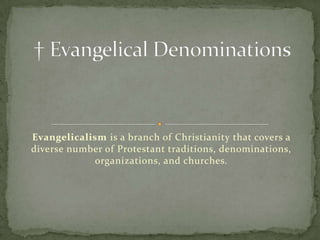
Evangelicalism is a branch of Christianity that covers a
diverse number of Protestant traditions, denominations,
            organizations, and churches.
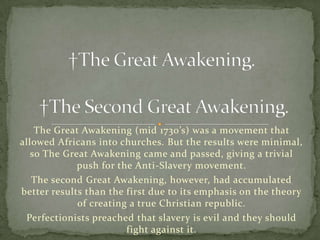
The Great Awakening (mid 1730’s) was a movement that
allowed Africans into churches. But the results were minimal,
   so The Great Awakening came and passed, giving a trivial
             push for the Anti-Slavery movement.
   The second Great Awakening, however, had accumulated
better results than the first due to its emphasis on the theory
             of creating a true Christian republic.
 Perfectionists preached that slavery is evil and they should
                        fight against it.
• Bishop William Fleetwood
 • Theodore Dwight Weld
     • Denmark Vesey
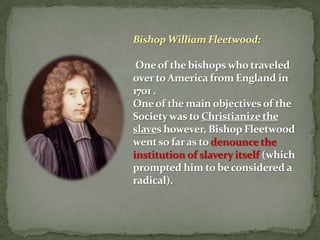
Bishop William Fleetwood:

 One of the bishops who traveled
over to America from England in
1701 .
One of the main objectives of the
Society was to Christianize the
slaves however, Bishop Fleetwood
went so far as to denounce the
institution of slavery itself (which
prompted him to be considered a
radical).
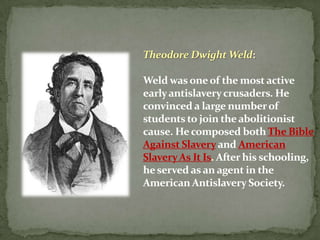
Theodore Dwight Weld:

Weld was one of the most active
early antislavery crusaders. He
convinced a large number of
students to join the abolitionist
cause. He composed both The Bible
Against Slavery and American
Slavery As It Is. After his schooling,
he served as an agent in the
American Antislavery Society.
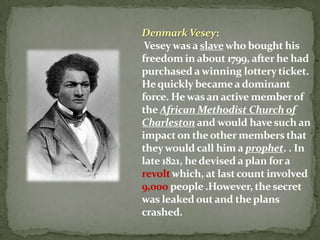
Denmark Vesey:
 Vesey was a slave who bought his
freedom in about 1799, after he had
purchased a winning lottery ticket.
He quickly became a dominant
force. He was an active member of
the African Methodist Church of
Charleston and would have such an
impact on the other members that
they would call him a prophet. . In
late 1821, he devised a plan for a
revolt which, at last count involved
9,000 people .However, the secret
was leaked out and the plans
crashed.
RELIGIOUS ORIGINS
       IDEOLOGICAL ORIGINS
   FEMINISM and ABOLITIONISM
The inf luence of « Uncle Tom’s Cabin »
• Racism
    • Immorality
  • Irony of slavery
• Nat Turner’s revolt.
Abolitionists argued that Negroes were not
 racially inferior because of skin color. As they
saw it, Negroes were still humans and therefore
                   our brothers.
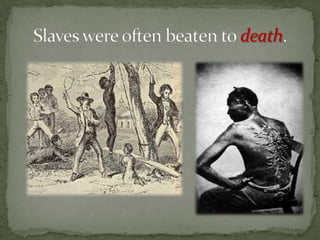
Another large cause for the cry of abolition was the cruelty
                  and injustice of slavery.
Slaves were reduced to property, a concept that didn't sit well
                   with most abolitionist.
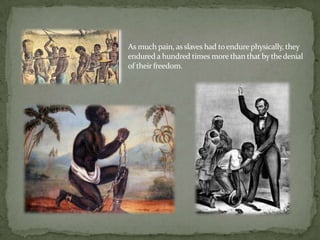
As much pain, as slaves had to endure physically, they
endured a hundred times more than that by the denial
of their freedom.
“How is it that we hear the loudest yelps for liberty among
the drivers of Negroes.”
                                                   -Dr. Johnson
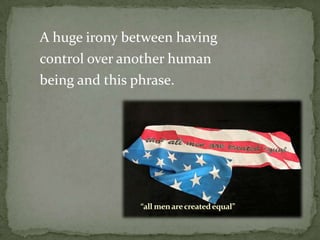
A huge irony between having
control over another human
being and this phrase.


               “all men are created equal”
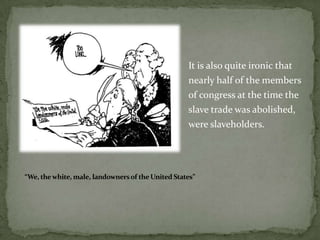
It is also quite ironic that
                                                   nearly half of the members
                                                   of congress at the time the
                                                   slave trade was abolished,
                                                   were slaveholders.


“We, the white, male, landowners of the United States”
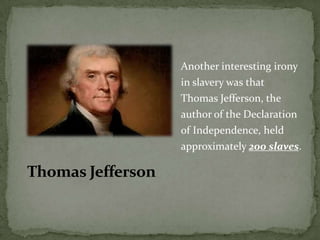
Another interesting irony
                   in slavery was that
                   Thomas Jefferson, the
                   author of the Declaration
                   of Independence, held
                   approximately 200 slaves.

Thomas Jefferson
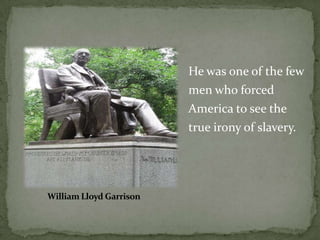
He was one of the few
                         men who forced
                         America to see the
                         true irony of slavery.


William Lloyd Garrison
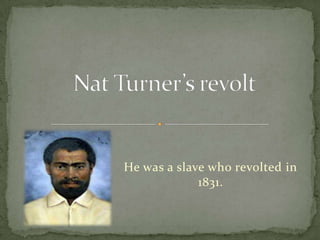
He was a slave who revolted in
             1831.
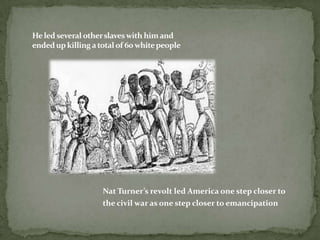
He led several other slaves with him and
ended up killing a total of 60 white people


                    Nat Turner’s revolt led America one step closer to
                    the civil war as one step closer to emancipation
RELIGIOUS ORIGINS
       IDEOLOGICAL ORIGINS
   FEMINISM and ABOLITIONISM
The inf luence of « Uncle Tom’s Cabin »
Relationship between Feminism and Abolitionism
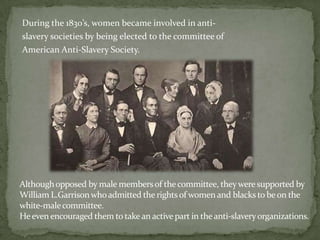
During the 1830’s, women became involved in anti-
slavery societies by being elected to the committee of
American Anti-Slavery Society.


Although opposed by male members of the committee, they were supported by
William L.Garrison who admitted the rights of women and blacks to be on the
white-male committee.
He even encouraged them to take an active part in the anti-slavery organizations.
• Maria Miller W. Stewart
   • Sojourner Truth
   • Harriet Tubman
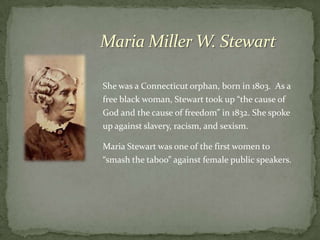
Maria Miller W. Stewart

She was a Connecticut orphan, born in 1803. As a
free black woman, Stewart took up “the cause of
God and the cause of freedom” in 1832. She spoke
up against slavery, racism, and sexism.

Maria Stewart was one of the first women to
“smash the taboo” against female public speakers.
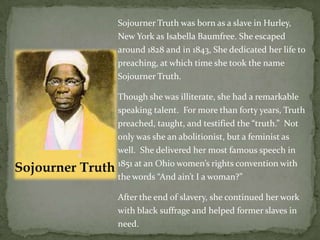
Sojourner Truth was born as a slave in Hurley,
New York as Isabella Baumfree. She escaped
around 1828 and in 1843, She dedicated her life to
preaching, at which time she took the name
Sojourner Truth.

Though she was illiterate, she had a remarkable
speaking talent. For more than forty years, Truth
preached, taught, and testified the “truth.” Not
only was she an abolitionist, but a feminist as
well. She delivered her most famous speech in
1851 at an Ohio women’s rights convention with
the words “And ain’t I a woman?”

After the end of slavery, she continued her work
with black suffrage and helped former slaves in
need.
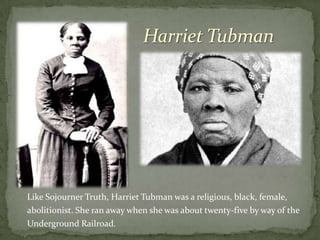
Harriet Tubman


Like Sojourner Truth, Harriet Tubman was a religious, black, female,
abolitionist. She ran away when she was about twenty-five by way of the
Underground Railroad.
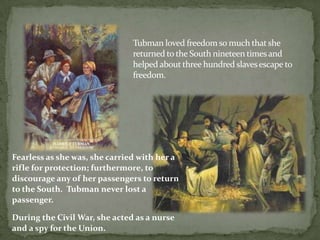
Tubman loved freedom so much that she
                               returned to the South nineteen times and
                               helped about three hundred slaves escape to
                               freedom.


Fearless as she was, she carried with her a
rifle for protection; furthermore, to
discourage any of her passengers to return
to the South. Tubman never lost a
passenger.

During the Civil War, she acted as a nurse
and a spy for the Union.
RELIGIOUS ORIGINS
       IDEOLOGICAL ORIGINS
   FEMINISM and ABOLITIONISM
The inf luence of « Uncle Tom’s Cabin »
The Story that Launched the Civil War
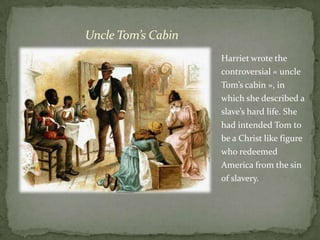
Uncle Tom’s Cabin
                    Harriet wrote the
                    controversial « uncle
                    Tom’s cabin », in
                    which she described a
                    slave’s hard life. She
                    had intended Tom to
                    be a Christ like figure
                    who redeemed
                    America from the sin
                    of slavery.
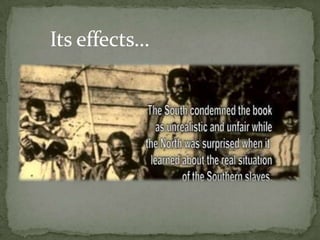
Its effects…
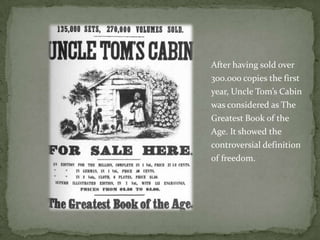
After having sold over
300.000 copies the first
year, Uncle Tom’s Cabin
was considered as The
Greatest Book of the
Age. It showed the
controversial definition
of freedom.
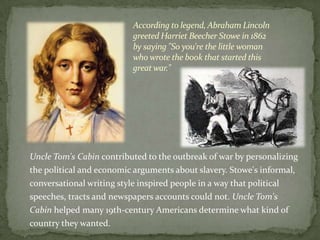
According to legend, Abraham Lincoln
                          greeted Harriet Beecher Stowe in 1862
                          by saying "So you're the little woman
                          who wrote the book that started this
                          great war."


Uncle Tom's Cabin contributed to the outbreak of war by personalizing
the political and economic arguments about slavery. Stowe's informal,
conversational writing style inspired people in a way that political
speeches, tracts and newspapers accounts could not. Uncle Tom's
Cabin helped many 19th-century Americans determine what kind of
country they wanted.
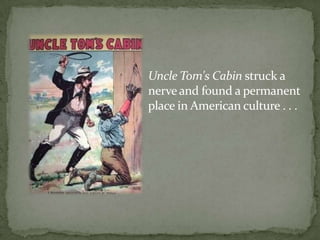
Uncle Tom's Cabin struck a
nerve and found a permanent
place in American culture . . .
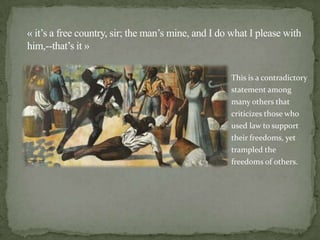
« it’s a free country, sir; the man’s mine, and I do what I please with
him,--that’s it »

                                                    This is a contradictory
                                                    statement among
                                                    many others that
                                                    criticizes those who
                                                    used law to support
                                                    their freedoms, yet
                                                    trampled the
                                                    freedoms of others.
RELIGIOUS ORIGINS
       IDEOLOGICAL ORIGINS
   FEMINISM and ABOLITIONISM
The inf luence of « Uncle Tom’s Cabin »
Origins and inf luences

Civ, anti salvery movement

  • 1.
  • 2.
    RELIGIOUS ORIGINS IDEOLOGICAL ORIGINS FEMINISM and ABOLITIONISM The inf luence of « Uncle Tom’s Cabin »
  • 3.
    Because religion permeatedmost aspect of life.
  • 5.
    Evangelicalism is abranch of Christianity that covers a diverse number of Protestant traditions, denominations, organizations, and churches.
  • 7.
    The Great Awakening(mid 1730’s) was a movement that allowed Africans into churches. But the results were minimal, so The Great Awakening came and passed, giving a trivial push for the Anti-Slavery movement. The second Great Awakening, however, had accumulated better results than the first due to its emphasis on the theory of creating a true Christian republic. Perfectionists preached that slavery is evil and they should fight against it.
  • 8.
    • Bishop WilliamFleetwood • Theodore Dwight Weld • Denmark Vesey
  • 9.
    Bishop William Fleetwood: One of the bishops who traveled over to America from England in 1701 . One of the main objectives of the Society was to Christianize the slaves however, Bishop Fleetwood went so far as to denounce the institution of slavery itself (which prompted him to be considered a radical).
  • 10.
    Theodore Dwight Weld: Weldwas one of the most active early antislavery crusaders. He convinced a large number of students to join the abolitionist cause. He composed both The Bible Against Slavery and American Slavery As It Is. After his schooling, he served as an agent in the American Antislavery Society.
  • 11.
    Denmark Vesey: Veseywas a slave who bought his freedom in about 1799, after he had purchased a winning lottery ticket. He quickly became a dominant force. He was an active member of the African Methodist Church of Charleston and would have such an impact on the other members that they would call him a prophet. . In late 1821, he devised a plan for a revolt which, at last count involved 9,000 people .However, the secret was leaked out and the plans crashed.
  • 12.
    RELIGIOUS ORIGINS IDEOLOGICAL ORIGINS FEMINISM and ABOLITIONISM The inf luence of « Uncle Tom’s Cabin »
  • 13.
    • Racism • Immorality • Irony of slavery • Nat Turner’s revolt.
  • 14.
    Abolitionists argued thatNegroes were not racially inferior because of skin color. As they saw it, Negroes were still humans and therefore our brothers.
  • 15.
    Another large causefor the cry of abolition was the cruelty and injustice of slavery. Slaves were reduced to property, a concept that didn't sit well with most abolitionist.
  • 17.
    As much pain,as slaves had to endure physically, they endured a hundred times more than that by the denial of their freedom.
  • 18.
    “How is itthat we hear the loudest yelps for liberty among the drivers of Negroes.” -Dr. Johnson
  • 19.
    A huge ironybetween having control over another human being and this phrase. “all men are created equal”
  • 20.
    It is alsoquite ironic that nearly half of the members of congress at the time the slave trade was abolished, were slaveholders. “We, the white, male, landowners of the United States”
  • 21.
    Another interesting irony in slavery was that Thomas Jefferson, the author of the Declaration of Independence, held approximately 200 slaves. Thomas Jefferson
  • 22.
    He was oneof the few men who forced America to see the true irony of slavery. William Lloyd Garrison
  • 24.
    He was aslave who revolted in 1831.
  • 25.
    He led severalother slaves with him and ended up killing a total of 60 white people Nat Turner’s revolt led America one step closer to the civil war as one step closer to emancipation
  • 27.
    RELIGIOUS ORIGINS IDEOLOGICAL ORIGINS FEMINISM and ABOLITIONISM The inf luence of « Uncle Tom’s Cabin »
  • 28.
  • 31.
    During the 1830’s,women became involved in anti- slavery societies by being elected to the committee of American Anti-Slavery Society. Although opposed by male members of the committee, they were supported by William L.Garrison who admitted the rights of women and blacks to be on the white-male committee. He even encouraged them to take an active part in the anti-slavery organizations.
  • 32.
    • Maria MillerW. Stewart • Sojourner Truth • Harriet Tubman
  • 33.
    Maria Miller W.Stewart She was a Connecticut orphan, born in 1803. As a free black woman, Stewart took up “the cause of God and the cause of freedom” in 1832. She spoke up against slavery, racism, and sexism. Maria Stewart was one of the first women to “smash the taboo” against female public speakers.
  • 34.
    Sojourner Truth wasborn as a slave in Hurley, New York as Isabella Baumfree. She escaped around 1828 and in 1843, She dedicated her life to preaching, at which time she took the name Sojourner Truth. Though she was illiterate, she had a remarkable speaking talent. For more than forty years, Truth preached, taught, and testified the “truth.” Not only was she an abolitionist, but a feminist as well. She delivered her most famous speech in 1851 at an Ohio women’s rights convention with the words “And ain’t I a woman?” After the end of slavery, she continued her work with black suffrage and helped former slaves in need.
  • 35.
    Harriet Tubman Like SojournerTruth, Harriet Tubman was a religious, black, female, abolitionist. She ran away when she was about twenty-five by way of the Underground Railroad.
  • 36.
    Tubman loved freedomso much that she returned to the South nineteen times and helped about three hundred slaves escape to freedom. Fearless as she was, she carried with her a rifle for protection; furthermore, to discourage any of her passengers to return to the South. Tubman never lost a passenger. During the Civil War, she acted as a nurse and a spy for the Union.
  • 37.
    RELIGIOUS ORIGINS IDEOLOGICAL ORIGINS FEMINISM and ABOLITIONISM The inf luence of « Uncle Tom’s Cabin »
  • 38.
    The Story thatLaunched the Civil War
  • 39.
    Uncle Tom’s Cabin Harriet wrote the controversial « uncle Tom’s cabin », in which she described a slave’s hard life. She had intended Tom to be a Christ like figure who redeemed America from the sin of slavery.
  • 40.
  • 41.
    After having soldover 300.000 copies the first year, Uncle Tom’s Cabin was considered as The Greatest Book of the Age. It showed the controversial definition of freedom.
  • 42.
    According to legend,Abraham Lincoln greeted Harriet Beecher Stowe in 1862 by saying "So you're the little woman who wrote the book that started this great war." Uncle Tom's Cabin contributed to the outbreak of war by personalizing the political and economic arguments about slavery. Stowe's informal, conversational writing style inspired people in a way that political speeches, tracts and newspapers accounts could not. Uncle Tom's Cabin helped many 19th-century Americans determine what kind of country they wanted.
  • 43.
    Uncle Tom's Cabinstruck a nerve and found a permanent place in American culture . . .
  • 44.
    « it’s afree country, sir; the man’s mine, and I do what I please with him,--that’s it » This is a contradictory statement among many others that criticizes those who used law to support their freedoms, yet trampled the freedoms of others.
  • 46.
    RELIGIOUS ORIGINS IDEOLOGICAL ORIGINS FEMINISM and ABOLITIONISM The inf luence of « Uncle Tom’s Cabin »
  • 47.