
Latin America 
More Than You Think
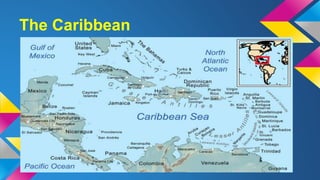
The Caribbean
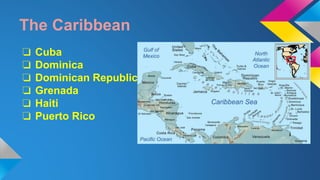
The Caribbean 
❏ Cuba 
❏ Dominica 
❏ Dominican Republic 
❏ Grenada 
❏ Haiti 
❏ Puerto Rico
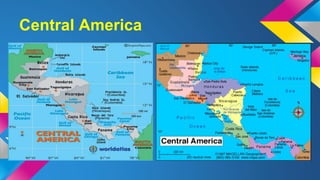
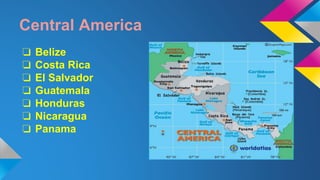
Central America
Central America 
❏ Belize 
❏ Costa Rica 
❏ El Salvador 
❏ Guatemala 
❏ Honduras 
❏ Nicaragua 
❏ Panama
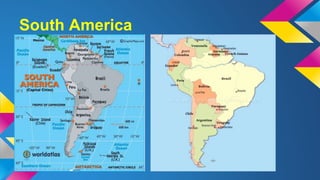
South America
South America 
❏ Argentina 
❏ Bolivia 
❏ Brazil 
❏ Chile 
❏ Colombia 
❏ Ecuador 
❏ Falkland Islands 
❏ French Guiana 
❏ Guyana 
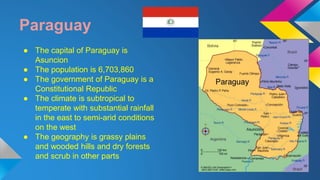
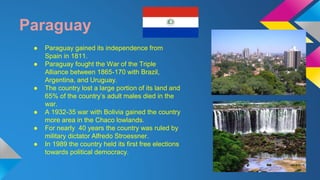
❏ Paraguay 
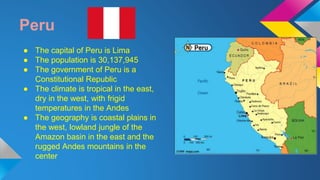
❏ Peru 
❏ Suriname 
❏ Uruguay 
❏ Venezuela
The Caribbean 
The Part People Don’t know 
About
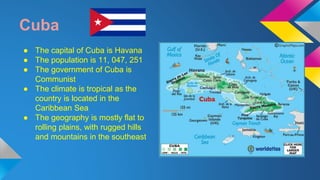
Cuba 
● The capital of Cuba is Havana 
● The population is 11, 047, 251 
● The government of Cuba is 
Communist 
● The climate is tropical as the 
country is located in the 
Caribbean Sea 
● The geography is mostly flat to 
rolling plains, with rugged hills 
and mountains in the southeast
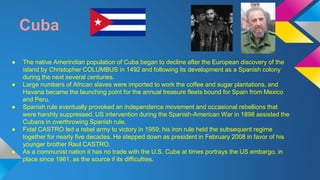
Cuba 
● The native Amerindian population of Cuba began to decline after the European discovery of the 
island by Christopher COLUMBUS in 1492 and following its development as a Spanish colony 
during the next several centuries. 
● Large numbers of African slaves were imported to work the coffee and sugar plantations, and 
Havana became the launching point for the annual treasure fleets bound for Spain from Mexico 
and Peru. 
● Spanish rule eventually provoked an independence movement and occasional rebellions that 
were harshly suppressed. US intervention during the Spanish-American War in 1898 assisted the 
Cubans in overthrowing Spanish rule. 
● Fidel CASTRO led a rebel army to victory in 1959; his iron rule held the subsequent regime 
together for nearly five decades. He stepped down as president in February 2008 in favor of his 
younger brother Raul CASTRO. 
● As a communist nation it has no trade with the U.S. Cuba at times portrays the US embargo, in 
place since 1961, as the source if its difficulties.
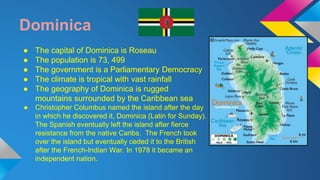
Dominica 
● The capital of Dominica is Roseau 
● The population is 73, 499 
● The government is a Parliamentary Democracy 
● The climate is tropical with vast rainfall 
● The geography of Dominica is rugged 
mountains surrounded by the Caribbean sea 
● Christopher Columbus named the island after the day 
in which he discovered it, Dominica (Latin for Sunday). 
The Spanish eventually left the island after fierce 
resistance from the native Caribs. The French took 
over the island but eventually ceded it to the British 
after the French-Indian War. In 1978 it became an 
independent nation.
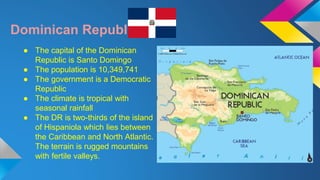
Dominican Republic 
● The capital of the Dominican 
Republic is Santo Domingo 
● The population is 10,349,741 
● The government is a Democratic 
Republic 
● The climate is tropical with 
seasonal rainfall 
● The DR is two-thirds of the island 
of Hispaniola which lies between 
the Caribbean and North Atlantic. 
The terrain is rugged mountains 
with fertile valleys.
Dominican Republic 
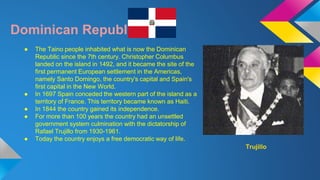
● The Taino people inhabited what is now the Dominican 
Republic since the 7th century. Christopher Columbus 
landed on the island in 1492, and it became the site of the 
first permanent European settlement in the Americas, 
namely Santo Domingo, the country's capital and Spain's 
first capital in the New World. 
● In 1697 Spain conceded the western part of the island as a 
territory of France. This territory became known as Haiti. 
● In 1844 the country gained its independence. 
● For more than 100 years the country had an unsettled 
government system culmination with the dictatorship of 
Rafael Trujillo from 1930-1961. 
● Today the country enjoys a free democratic way of life. 
Trujillo
Haiti 
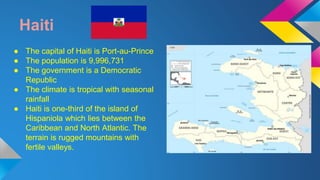
● The capital of Haiti is Port-au-Prince 
● The population is 9,996,731 
● The government is a Democratic 
Republic 
● The climate is tropical with seasonal 
rainfall 
● Haiti is one-third of the island of 
Hispaniola which lies between the 
Caribbean and North Atlantic. The 
terrain is rugged mountains with 
fertile valleys.
Haiti 
● The Taino people that inhabited the island when Columbus discovered 
the island were all but slaughtered from the island within three decades 
by the Spanish. 
● In 1697 France gained control of the island from Spain. 
● It became one of the wealthiest islands in the Caribbean but only 
because of the continued import of African slaves. 
● This heavy import of slaves backfired on the wealthy when in the late 
1700s the nearly 500,000 slaves revolted. 
● Haiti is now the poorest country in the Caribbean and has been infected 
with government instability for a century. 
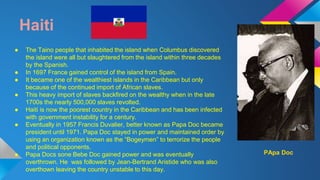
● Eventually in 1957 Francis Duvalier, better known as Papa Doc became 
president until 1971. Papa Doc stayed in power and maintained order by 
using an organization known as the “Bogeymen” to terrorize the people 
and political opponents. 
● Papa Docs sone Bebe Doc gained power and was eventually 
overthrown. He was followed by Jean-Bertrand Aristide who was also 
overthown leaving the country unstable to this day. 
PApa Doc
Grenada 
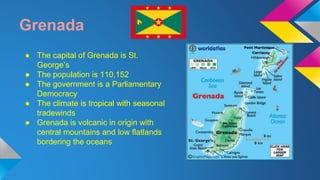
● The capital of Grenada is St. 
George’s 
● The population is 110,152 
● The government is a Parliamentary 
Democracy 
● The climate is tropical with seasonal 
tradewinds 
● Grenada is volcanic in origin with 
central mountains and low flatlands 
bordering the oceans
Grenada 
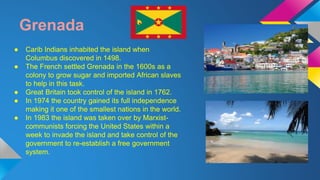
● Carib Indians inhabited the island when 
Columbus discovered in 1498. 
● The French settled Grenada in the 1600s as a 
colony to grow sugar and imported African slaves 
to help in this task. 
● Great Britain took control of the island in 1762. 
● In 1974 the country gained its full independence 
making it one of the smallest nations in the world. 
● In 1983 the island was taken over by Marxist-communists 
forcing the United States within a 
week to invade the island and take control of the 
government to re-establish a free government 
system.
Puerto Rico 
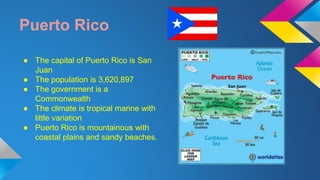
● The capital of Puerto Rico is San 
Juan 
● The population is 3,620,897 
● The government is a 
Commonwealth 
● The climate is tropical marine with 
little variation 
● Puerto Rico is mountainous with 
coastal plains and sandy beaches.
Puerto Rico 
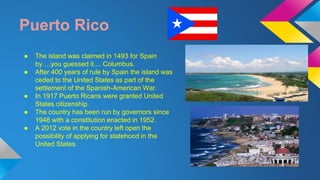
● The island was claimed in 1493 for Spain 
by….you guessed it.... Columbus. 
● After 400 years of rule by Spain the island was 
ceded to the United States as part of the 
settlement of the Spanish-American War. 
● In 1917 Puerto Ricans were granted United 
States citizenship. 
● The country has been run by governors since 
1948 with a constitution enacted in 1952. 
● A 2012 vote in the country left open the 
possibility of applying for statehood in the 
United States.
Central America 
Where Mexico Is Not
Belize 
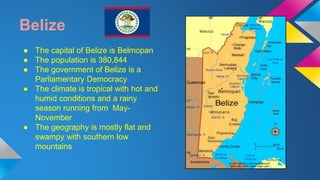
● The capital of Belize is Belmopan 
● The population is 380,844 
● The government of Belize is a 
Parliamentary Democracy 
● The climate is tropical with hot and 
humid conditions and a rainy 
season running from May- 
November 
● The geography is mostly flat and 
swampy with southern low 
mountains
Belize 
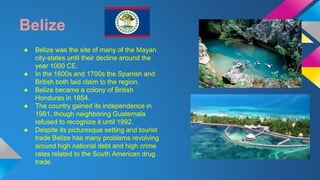
● Belize was the site of many of the Mayan 
city-states until their decline around the 
year 1000 CE. 
● In the 1600s and 1700s the Spanish and 
British both laid claim to the region. 
● Belize became a colony of British 
Honduras in 1854. 
● The country gained its independence in 
1981, though neighboring Guatemala 
refused to recognize it until 1992. 
● Despite its picturesque setting and tourist 
trade Belize has many problems revolving 
around high national debt and high crime 
rates related to the South American drug 
trade.
Costa Rica 
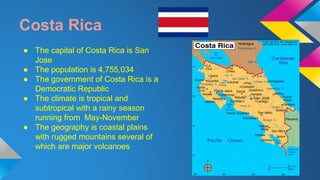
● The capital of Costa Rica is San 
Jose 
● The population is 4,755,034 
● The government of Costa Rica is a 
Democratic Republic 
● The climate is tropical and 
subtropical with a rainy season 
running from May-November 
● The geography is coastal plains 
with rugged mountains several of 
which are major volcanoes
Costa Rica 
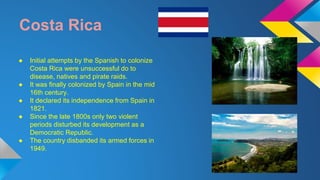
● Initial attempts by the Spanish to colonize 
Costa Rica were unsuccessful do to 
disease, natives and pirate raids. 
● It was finally colonized by Spain in the mid 
16th century. 
● It declared its independence from Spain in 
1821. 
● Since the late 1800s only two violent 
periods disturbed its development as a 
Democratic Republic. 
● The country disbanded its armed forces in 
1949.
El Salvador 
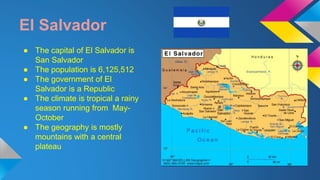
● The capital of El Salvador is 
San Salvador 
● The population is 6,125,512 
● The government of El 
Salvador is a Republic 
● The climate is tropical a rainy 
season running from May- 
October 
● The geography is mostly 
mountains with a central 
plateau
El Salvador 
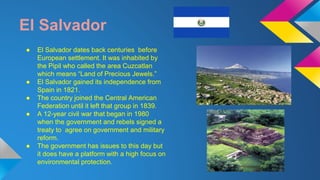
● El Salvador dates back centuries before 
European settlement. It was inhabited by 
the Pipil who called the area Cuzcatlan 
which means “Land of Precious Jewels.” 
● El Salvador gained its independence from 
Spain in 1821. 
● The country joined the Central American 
Federation until it left that group in 1839. 
● A 12-year civil war that began in 1980 
when the government and rebels signed a 
treaty to agree on government and military 
reform. 
● The government has issues to this day but 
it does have a platform with a high focus on 
environmental protection.
Guatemala 
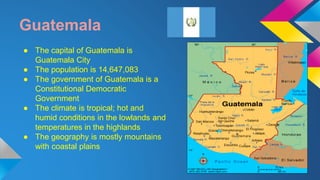
● The capital of Guatemala is 
Guatemala City 
● The population is 14,647,083 
● The government of Guatemala is a 
Constitutional Democratic 
Government 
● The climate is tropical; hot and 
humid conditions in the lowlands and 
temperatures in the highlands 
● The geography is mostly mountains 
with coastal plains
Guatemala 
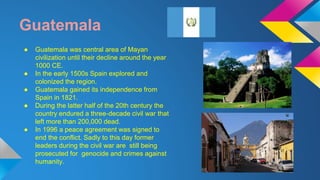
● Guatemala was central area of Mayan 
civilization until their decline around the year 
1000 CE. 
● In the early 1500s Spain explored and 
colonized the region. 
● Guatemala gained its independence from 
Spain in 1821. 
● During the latter half of the 20th century the 
country endured a three-decade civil war that 
left more than 200,000 dead. 
● In 1996 a peace agreement was signed to 
end the conflict. Sadly to this day former 
leaders during the civil war are still being 
prosecuted for genocide and crimes against 
humanity.
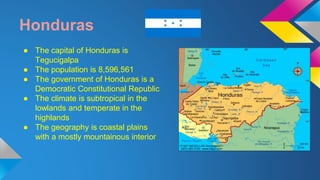
Honduras 
● The capital of Honduras is 
Tegucigalpa 
● The population is 8,596,561 
● The government of Honduras is a 
Democratic Constitutional Republic 
● The climate is subtropical in the 
lowlands and temperate in the 
highlands 
● The geography is coastal plains 
with a mostly mountainous interior
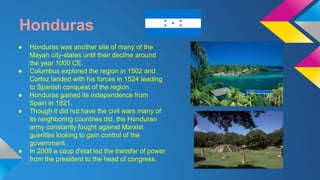
Honduras 
● Honduras was another site of many of the 
Mayan city-states until their decline around 
the year 1000 CE. 
● Columbus explored the region in 1502 and 
Cortez landed with his forces in 1524 leading 
to Spanish conquest of the region. 
● Honduras gained its independence from 
Spain in 1821. 
● Though it did not have the civil wars many of 
its neighboring countries did, the Honduran 
army constantly fought against Marxist 
guerillas looking to gain control of the 
government. 
● In 2009 a coup d'etat led the transfer of power 
from the president to the head of congress.
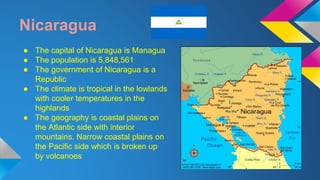
Nicaragua 
● The capital of Nicaragua is Managua 
● The population is 5,848,561 
● The government of Nicaragua is a 
Republic 
● The climate is tropical in the lowlands 
with cooler temperatures in the 
highlands 
● The geography is coastal plains on 
the Atlantic side with interior 
mountains. Narrow coastal plains on 
the Pacific side which is broken up 
by volcanoes
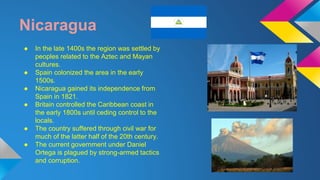
Nicaragua 
● In the late 1400s the region was settled by 
peoples related to the Aztec and Mayan 
cultures. 
● Spain colonized the area in the early 
1500s. 
● Nicaragua gained its independence from 
Spain in 1821. 
● Britain controlled the Caribbean coast in 
the early 1800s until ceding control to the 
locals. 
● The country suffered through civil war for 
much of the latter half of the 20th century. 
● The current government under Daniel 
Ortega is plagued by strong-armed tactics 
and corruption.
Panama 
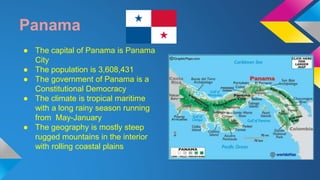
● The capital of Panama is Panama 
City 
● The population is 3,608,431 
● The government of Panama is a 
Constitutional Democracy 
● The climate is tropical maritime 
with a long rainy season running 
from May-January 
● The geography is mostly steep 
rugged mountains in the interior 
with rolling coastal plains
Panama 
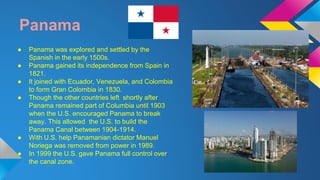
● Panama was explored and settled by the 
Spanish in the early 1500s. 
● Panama gained its independence from Spain in 
1821. 
● It joined with Ecuador, Venezuela, and Colombia 
to form Gran Colombia in 1830. 
● Though the other countries left shortly after 
Panama remained part of Columbia until 1903 
when the U.S. encouraged Panama to break 
away. This allowed the U.S. to build the 
Panama Canal between 1904-1914. 
● With U.S. help Panamanian dictator Manuel 
Noriega was removed from power in 1989. 
● In 1999 the U.S. gave Panama full control over 
the canal zone.
South America 
The Big Dog on the Block
Argentina 
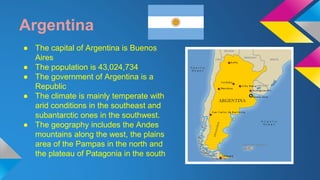
● The capital of Argentina is Buenos 
Aires 
● The population is 43,024,734 
● The government of Argentina is a 
Republic 
● The climate is mainly temperate with 
arid conditions in the southeast and 
subantarctic ones in the southwest. 
● The geography includes the Andes 
mountains along the west, the plains 
area of the Pampas in the north and 
the plateau of Patagonia in the south
Argentina 
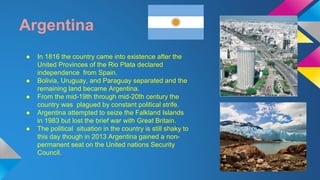
● In 1816 the country came into existence after the 
United Provinces of the Rio Plata declared 
independence from Spain. 
● Bolivia, Uruguay, and Paraguay separated and the 
remaining land became Argentina. 
● From the mid-19th through mid-20th century the 
country was plagued by constant political strife. 
● Argentina attempted to seize the Falkland Islands 
in 1983 but lost the brief war with Great Britain. 
● The political situation in the country is still shaky to 
this day though in 2013 Argentina gained a non-permanent 
seat on the United nations Security 
Council.
Bolivia 
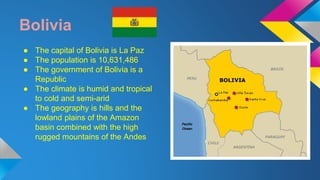
● The capital of Bolivia is La Paz 
● The population is 10,631,486 
● The government of Bolivia is a 
Republic 
● The climate is humid and tropical 
to cold and semi-arid 
● The geography is hills and the 
lowland plains of the Amazon 
basin combined with the high 
rugged mountains of the Andes
Bolivia 
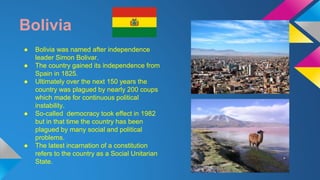
● Bolivia was named after independence 
leader Simon Bolivar. 
● The country gained its independence from 
Spain in 1825. 
● Ultimately over the next 150 years the 
country was plagued by nearly 200 coups 
which made for continuous political 
instability. 
● So-called democracy took effect in 1982 
but in that time the country has been 
plagued by many social and political 
problems. 
● The latest incarnation of a constitution 
refers to the country as a Social Unitarian 
State.
Brazil 
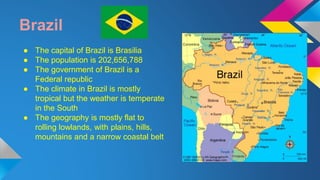
● The capital of Brazil is Brasilia 
● The population is 202,656,788 
● The government of Brazil is a 
Federal republic 
● The climate in Brazil is mostly 
tropical but the weather is temperate 
in the South 
● The geography is mostly flat to 
rolling lowlands, with plains, hills, 
mountains and a narrow coastal belt
Brazil 
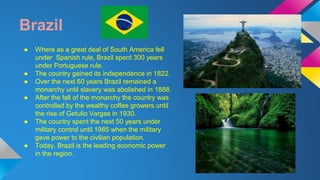
● Where as a great deal of South America fell 
under Spanish rule, Brazil spent 300 years 
under Portuguese rule. 
● The country gained its independence in 1822. 
● Over the next 60 years Brazil remained a 
monarchy until slavery was abolished in 1888. 
● After the fall of the monarchy the country was 
controlled by the wealthy coffee growers until 
the rise of Getulio Vargas in 1930. 
● The country spent the next 50 years under 
military control until 1985 when the military 
gave power to the civilian population. 
● Today, Brazil is the leading economic power 
in the region.
Chile 
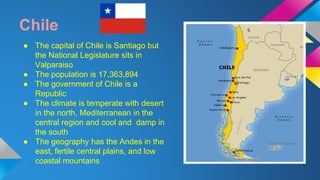
● The capital of Chile is Santiago but 
the National Legislature sits in 
Valparaiso 
● The population is 17,363,894 
● The government of Chile is a 
Republic 
● The climate is temperate with desert 
in the north, Mediterranean in the 
central region and cool and damp in 
the south 
● The geography has the Andes in the 
east, fertile central plains, and low 
coastal mountains
Chile 
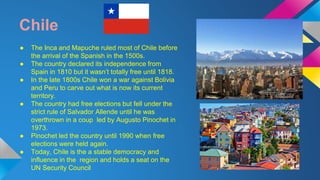
● The Inca and Mapuche ruled most of Chile before 
the arrival of the Spanish in the 1500s. 
● The country declared its independence from 
Spain in 1810 but it wasn’t totally free until 1818. 
● In the late 1800s Chile won a war against Bolivia 
and Peru to carve out what is now its current 
territory. 
● The country had free elections but fell under the 
strict rule of Salvador Allende until he was 
overthrown in a coup led by Augusto Pinochet in 
1973. 
● Pinochet led the country until 1990 when free 
elections were held again. 
● Today, Chile is the a stable democracy and 
influence in the region and holds a seat on the 
UN Security Council
Colombia 
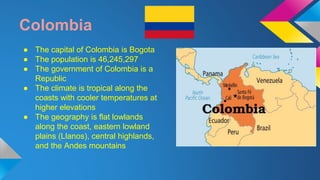
● The capital of Colombia is Bogota 
● The population is 46,245,297 
● The government of Colombia is a 
Republic 
● The climate is tropical along the 
coasts with cooler temperatures at 
higher elevations 
● The geography is flat lowlands 
along the coast, eastern lowland 
plains (Llanos), central highlands, 
and the Andes mountains
Colombia 
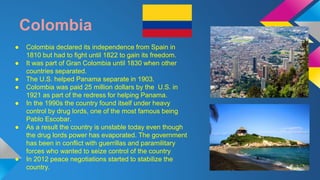
● Colombia declared its independence from Spain in 
1810 but had to fight until 1822 to gain its freedom. 
● It was part of Gran Colombia until 1830 when other 
countries separated. 
● The U.S. helped Panama separate in 1903. 
● Colombia was paid 25 million dollars by the U.S. in 
1921 as part of the redress for helping Panama. 
● In the 1990s the country found itself under heavy 
control by drug lords, one of the most famous being 
Pablo Escobar. 
● As a result the country is unstable today even though 
the drug lords power has evaporated. The government 
has been in conflict with guerrillas and paramilitary 
forces who wanted to seize control of the country 
● In 2012 peace negotiations started to stabilize the 
country.
Ecuador 
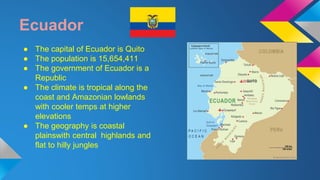
● The capital of Ecuador is Quito 
● The population is 15,654,411 
● The government of Ecuador is a 
Republic 
● The climate is tropical along the 
coast and Amazonian lowlands 
with cooler temps at higher 
elevations 
● The geography is coastal 
plainswith central highlands and 
flat to hilly jungles
Ecuador 
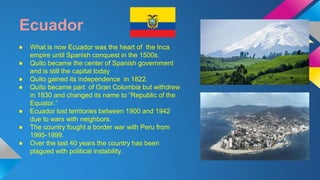
● What is now Ecuador was the heart of the Inca 
empire until Spanish conquest in the 1500s. 
● Quito became the center of Spanish government 
and is still the capital today 
● Quito gained its independence in 1822. 
● Quito became part of Gran Colombia but withdrew 
in 1830 and changed its name to “Republic of the 
Equator.” 
● Ecuador lost territories between 1900 and 1942 
due to wars with neighbors. 
● The country fought a border war with Peru from 
1995-1999. 
● Over the last 40 years the country has been 
plagued with political instability.
Falkland Islands 
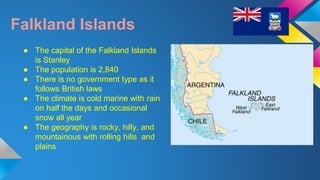
● The capital of the Falkland Islands 
is Stanley 
● The population is 2,840 
● There is no government type as it 
follows British laws 
● The climate is cold marine with rain 
on half the days and occasional 
snow all year 
● The geography is rocky, hilly, and 
mountainous with rolling hills and 
plains
Falkland Islands 
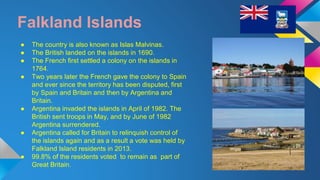
● The country is also known as Islas Malvinas. 
● The British landed on the islands in 1690. 
● The French first settled a colony on the islands in 
1764. 
● Two years later the French gave the colony to Spain 
and ever since the territory has been disputed, first 
by Spain and Britain and then by Argentina and 
Britain. 
● Argentina invaded the islands in April of 1982. The 
British sent troops in May, and by June of 1982 
Argentina surrendered. 
● Argentina called for Britain to relinquish control of 
the islands again and as a result a vote was held by 
Falkland Island residents in 2013. 
● 99.8% of the residents voted to remain as part of 
Great Britain.
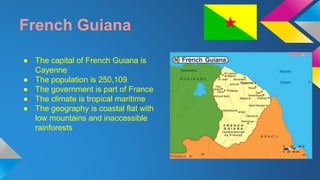
French Guiana 
● The capital of French Guiana is 
Cayenne 
● The population is 250,109 
● The government is part of France 
● The climate is tropical maritime 
● The geography is coastal flat with 
low mountains and inaccessible 
rainforests
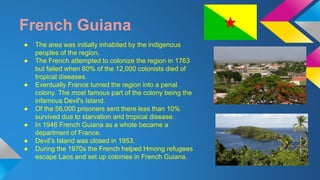
French Guiana 
● The area was initially inhabited by the indigenous 
peoples of the region. 
● The French attempted to colonize the region in 1763 
but failed when 80% of the 12,000 colonists died of 
tropical diseases. 
● Eventually France turned the region into a penal 
colony. The most famous part of the colony being the 
infamous Devil's Island. 
● Of the 56,000 prisoners sent there less than 10% 
survived due to starvation and tropical disease. 
● In 1946 French Guiana as a whole became a 
department of France. 
● Devil’s Island was closed in 1953. 
● During the 1970s the French helped Hmong refugees 
escape Laos and set up colonies in French Guiana.
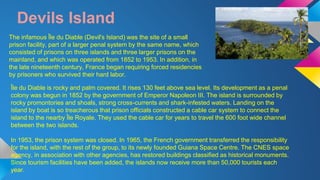
Devils Island 
The infamous Île du Diable (Devil's Island) was the site of a small 
prison facility, part of a larger penal system by the same name, which 
consisted of prisons on three islands and three larger prisons on the 
mainland, and which was operated from 1852 to 1953. In addition, in 
the late nineteenth century, France began requiring forced residencies 
by prisoners who survived their hard labor. 
Île du Diable is rocky and palm covered. It rises 130 feet above sea level. Its development as a penal 
colony was begun in 1852 by the government of Emperor Napoleon III. The island is surrounded by 
rocky promontories and shoals, strong cross-currents and shark-infested waters. Landing on the 
island by boat is so treacherous that prison officials constructed a cable car system to connect the 
island to the nearby Île Royale. They used the cable car for years to travel the 600 foot wide channel 
between the two islands. 
In 1953, the prison system was closed. In 1965, the French government transferred the responsibility 
for the island, with the rest of the group, to its newly founded Guiana Space Centre. The CNES space 
agency, in association with other agencies, has restored buildings classified as historical monuments. 
Since tourism facilities have been added, the islands now receive more than 50,000 tourists each 
year.
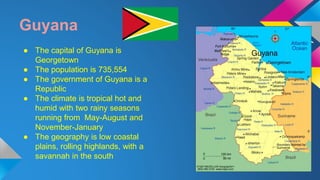
Guyana 
● The capital of Guyana is 
Georgetown 
● The population is 735,554 
● The government of Guyana is a 
Republic 
● The climate is tropical hot and 
humid with two rainy seasons 
running from May-August and 
November-January 
● The geography is low coastal 
plains, rolling highlands, with a 
savannah in the south
Guyana 
● Guyana was originally a Dutch colony. 
● By 1815 the territory fell under British rule. 
● Eventually as slavery was abolished former 
slaves and indentured servants from India 
relocated to urban areas to work the sugar 
plantations. 
● Ethnic divides fomented during this time leading 
to discontent and class and racial hostilities 
which would cause political problems. 
● In 1966 Guyana gained its independence from 
Britain. 
● Socialist governments were the norm until 1992 
when the country held what is thought of as its 
first free elections.
Paraguay 
● The capital of Paraguay is 
Asuncion 
● The population is 6,703,860 
● The government of Paraguay is a 
Constitutional Republic 
● The climate is subtropical to 
temperate with substantial rainfall 
in the east to semi-arid conditions 
on the west 
● The geography is grassy plains 
and wooded hills and dry forests 
and scrub in other parts
Paraguay 
● Paraguay gained its independence from 
Spain in 1811. 
● Paraguay fought the War of the Triple 
Alliance between 1865-170 with Brazil, 
Argentina, and Uruguay. 
● The country lost a large portion of its land and 
65% of the country’s adult males died in the 
war. 
● A 1932-35 war with Bolivia gained the country 
more area in the Chaco lowlands. 
● For nearly 40 years the country was ruled by 
military dictator Alfredo Stroessner. 
● In 1989 the country held its first free elections 
towards political democracy.
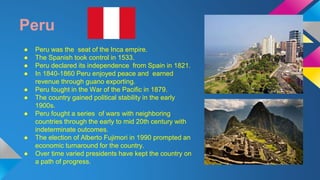
Peru 
● The capital of Peru is Lima 
● The population is 30,137,945 
● The government of Peru is a 
Constitutional Republic 
● The climate is tropical in the east, 
dry in the west, with frigid 
temperatures in the Andes 
● The geography is coastal plains in 
the west, lowland jungle of the 
Amazon basin in the east and the 
rugged Andes mountains in the 
center
Peru 
● Peru was the seat of the Inca empire. 
● The Spanish took control in 1533. 
● Peru declared its independence from Spain in 1821. 
● In 1840-1860 Peru enjoyed peace and earned 
revenue through guano exporting. 
● Peru fought in the War of the Pacific in 1879. 
● The country gained political stability in the early 
1900s. 
● Peru fought a series of wars with neighboring 
countries through the early to mid 20th century with 
indeterminate outcomes. 
● The election of Alberto Fujimori in 1990 prompted an 
economic turnaround for the country. 
● Over time varied presidents have kept the country on 
a path of progress.
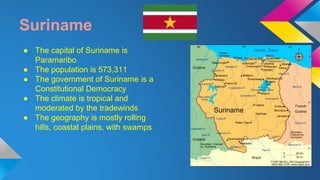
Suriname 
● The capital of Suriname is 
Paramaribo 
● The population is 573,311 
● The government of Suriname is a 
Constitutional Democracy 
● The climate is tropical and 
moderated by the tradewinds 
● The geography is mostly rolling 
hills, coastal plains, with swamps
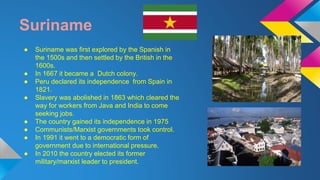
Suriname 
● Suriname was first explored by the Spanish in 
the 1500s and then settled by the British in the 
1600s. 
● In 1667 it became a Dutch colony. 
● Peru declared its independence from Spain in 
1821. 
● Slavery was abolished in 1863 which cleared the 
way for workers from Java and India to come 
seeking jobs. 
● The country gained its independence in 1975 
● Communists/Marxist governments took control. 
● In 1991 it went to a democratic form of 
government due to international pressure. 
● In 2010 the country elected its former 
military/marxist leader to president.
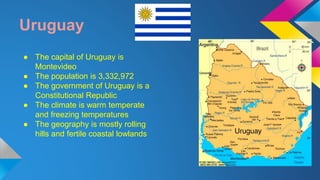
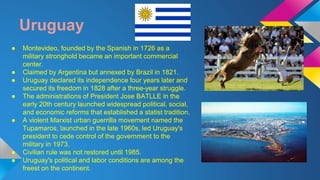
Uruguay 
● The capital of Uruguay is 
Montevideo 
● The population is 3,332,972 
● The government of Uruguay is a 
Constitutional Republic 
● The climate is warm temperate 
and freezing temperatures 
● The geography is mostly rolling 
hills and fertile coastal lowlands
Uruguay 
● Montevideo, founded by the Spanish in 1726 as a 
military stronghold became an important commercial 
center. 
● Claimed by Argentina but annexed by Brazil in 1821. 
● Uruguay declared its independence four years later and 
secured its freedom in 1828 after a three-year struggle. 
● The administrations of President Jose BATLLE in the 
early 20th century launched widespread political, social, 
and economic reforms that established a statist tradition. 
● A violent Marxist urban guerrilla movement named the 
Tupamaros, launched in the late 1960s, led Uruguay's 
president to cede control of the government to the 
military in 1973. 
● Civilian rule was not restored until 1985. 
● Uruguay's political and labor conditions are among the 
freest on the continent.
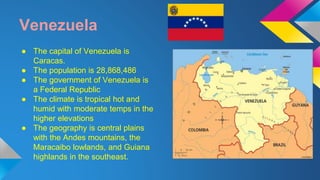
Venezuela 
● The capital of Venezuela is 
Caracas. 
● The population is 28,868,486 
● The government of Venezuela is 
a Federal Republic 
● The climate is tropical hot and 
humid with moderate temps in the 
higher elevations 
● The geography is central plains 
with the Andes mountains, the 
Maracaibo lowlands, and Guiana 
highlands in the southeast.
Venezuela 
● Venezuela was one of three countries that emerged from the 
collapse of Gran Colombia in 1830. 
● For most of the first half of the 20th century, Venezuela was 
ruled by generally benevolent military strongmen, who 
promoted the oil industry and allowed for some social 
reforms. 
● Democratically elected governments have held sway since 
1959. 
● Hugo CHAVEZ, president from 1999 to 2013, sought to 
implement his "21st Century Socialism," which purported to 
alleviate social ills while at the same time attacking capitalist 
globalization and existing democratic institutions. 
● His hand-picked successor, President Nicolas MADURO, 
continues CHAVEZ's socialist programs. 
● Current concerns include: a politicized military, rampant 
violent crime, over dependence on the petroleum industry 
with its price fluctuations, a decline in the quality of 
fundamental human rights.
Mexico 
The North American One
Mexico 
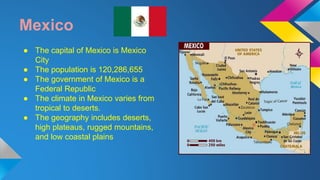
● The capital of Mexico is Mexico 
City 
● The population is 120,286,655 
● The government of Mexico is a 
Federal Republic 
● The climate in Mexico varies from 
tropical to deserts. 
● The geography includes deserts, 
high plateaus, rugged mountains, 
and low coastal plains
Mexico 
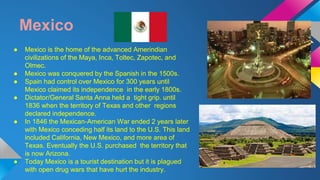
● Mexico is the home of the advanced Amerindian 
civilizations of the Maya, Inca, Toltec, Zapotec, and 
Olmec. 
● Mexico was conquered by the Spanish in the 1500s. 
● Spain had control over Mexico for 300 years until 
Mexico claimed its independence in the early 1800s. 
● Dictator/General Santa Anna held a tight grip. until 
1836 when the territory of Texas and other regions 
declared independence. 
● In 1846 the Mexican-American War ended 2 years later 
with Mexico conceding half its land to the U.S. This land 
included California, New Mexico, and more area of 
Texas. Eventually the U.S. purchased the territory that 
is now Arizona. 
● Today Mexico is a tourist destination but it is plagued 
with open drug wars that have hurt the industry.

Latin america

  • 1.
    Latin America MoreThan You Think
  • 2.
  • 3.
    The Caribbean ❏Cuba ❏ Dominica ❏ Dominican Republic ❏ Grenada ❏ Haiti ❏ Puerto Rico
  • 4.
  • 5.
    Central America ❏Belize ❏ Costa Rica ❏ El Salvador ❏ Guatemala ❏ Honduras ❏ Nicaragua ❏ Panama
  • 6.
  • 7.
    South America ❏Argentina ❏ Bolivia ❏ Brazil ❏ Chile ❏ Colombia ❏ Ecuador ❏ Falkland Islands ❏ French Guiana ❏ Guyana ❏ Paraguay ❏ Peru ❏ Suriname ❏ Uruguay ❏ Venezuela
  • 8.
    The Caribbean ThePart People Don’t know About
  • 9.
    Cuba ● Thecapital of Cuba is Havana ● The population is 11, 047, 251 ● The government of Cuba is Communist ● The climate is tropical as the country is located in the Caribbean Sea ● The geography is mostly flat to rolling plains, with rugged hills and mountains in the southeast
  • 10.
    Cuba ● Thenative Amerindian population of Cuba began to decline after the European discovery of the island by Christopher COLUMBUS in 1492 and following its development as a Spanish colony during the next several centuries. ● Large numbers of African slaves were imported to work the coffee and sugar plantations, and Havana became the launching point for the annual treasure fleets bound for Spain from Mexico and Peru. ● Spanish rule eventually provoked an independence movement and occasional rebellions that were harshly suppressed. US intervention during the Spanish-American War in 1898 assisted the Cubans in overthrowing Spanish rule. ● Fidel CASTRO led a rebel army to victory in 1959; his iron rule held the subsequent regime together for nearly five decades. He stepped down as president in February 2008 in favor of his younger brother Raul CASTRO. ● As a communist nation it has no trade with the U.S. Cuba at times portrays the US embargo, in place since 1961, as the source if its difficulties.
  • 11.
    Dominica ● Thecapital of Dominica is Roseau ● The population is 73, 499 ● The government is a Parliamentary Democracy ● The climate is tropical with vast rainfall ● The geography of Dominica is rugged mountains surrounded by the Caribbean sea ● Christopher Columbus named the island after the day in which he discovered it, Dominica (Latin for Sunday). The Spanish eventually left the island after fierce resistance from the native Caribs. The French took over the island but eventually ceded it to the British after the French-Indian War. In 1978 it became an independent nation.
  • 12.
    Dominican Republic ●The capital of the Dominican Republic is Santo Domingo ● The population is 10,349,741 ● The government is a Democratic Republic ● The climate is tropical with seasonal rainfall ● The DR is two-thirds of the island of Hispaniola which lies between the Caribbean and North Atlantic. The terrain is rugged mountains with fertile valleys.
  • 13.
    Dominican Republic ●The Taino people inhabited what is now the Dominican Republic since the 7th century. Christopher Columbus landed on the island in 1492, and it became the site of the first permanent European settlement in the Americas, namely Santo Domingo, the country's capital and Spain's first capital in the New World. ● In 1697 Spain conceded the western part of the island as a territory of France. This territory became known as Haiti. ● In 1844 the country gained its independence. ● For more than 100 years the country had an unsettled government system culmination with the dictatorship of Rafael Trujillo from 1930-1961. ● Today the country enjoys a free democratic way of life. Trujillo
  • 14.
    Haiti ● Thecapital of Haiti is Port-au-Prince ● The population is 9,996,731 ● The government is a Democratic Republic ● The climate is tropical with seasonal rainfall ● Haiti is one-third of the island of Hispaniola which lies between the Caribbean and North Atlantic. The terrain is rugged mountains with fertile valleys.
  • 15.
    Haiti ● TheTaino people that inhabited the island when Columbus discovered the island were all but slaughtered from the island within three decades by the Spanish. ● In 1697 France gained control of the island from Spain. ● It became one of the wealthiest islands in the Caribbean but only because of the continued import of African slaves. ● This heavy import of slaves backfired on the wealthy when in the late 1700s the nearly 500,000 slaves revolted. ● Haiti is now the poorest country in the Caribbean and has been infected with government instability for a century. ● Eventually in 1957 Francis Duvalier, better known as Papa Doc became president until 1971. Papa Doc stayed in power and maintained order by using an organization known as the “Bogeymen” to terrorize the people and political opponents. ● Papa Docs sone Bebe Doc gained power and was eventually overthrown. He was followed by Jean-Bertrand Aristide who was also overthown leaving the country unstable to this day. PApa Doc
  • 16.
    Grenada ● Thecapital of Grenada is St. George’s ● The population is 110,152 ● The government is a Parliamentary Democracy ● The climate is tropical with seasonal tradewinds ● Grenada is volcanic in origin with central mountains and low flatlands bordering the oceans
  • 17.
    Grenada ● CaribIndians inhabited the island when Columbus discovered in 1498. ● The French settled Grenada in the 1600s as a colony to grow sugar and imported African slaves to help in this task. ● Great Britain took control of the island in 1762. ● In 1974 the country gained its full independence making it one of the smallest nations in the world. ● In 1983 the island was taken over by Marxist-communists forcing the United States within a week to invade the island and take control of the government to re-establish a free government system.
  • 18.
    Puerto Rico ●The capital of Puerto Rico is San Juan ● The population is 3,620,897 ● The government is a Commonwealth ● The climate is tropical marine with little variation ● Puerto Rico is mountainous with coastal plains and sandy beaches.
  • 19.
    Puerto Rico ●The island was claimed in 1493 for Spain by….you guessed it.... Columbus. ● After 400 years of rule by Spain the island was ceded to the United States as part of the settlement of the Spanish-American War. ● In 1917 Puerto Ricans were granted United States citizenship. ● The country has been run by governors since 1948 with a constitution enacted in 1952. ● A 2012 vote in the country left open the possibility of applying for statehood in the United States.
  • 20.
    Central America WhereMexico Is Not
  • 21.
    Belize ● Thecapital of Belize is Belmopan ● The population is 380,844 ● The government of Belize is a Parliamentary Democracy ● The climate is tropical with hot and humid conditions and a rainy season running from May- November ● The geography is mostly flat and swampy with southern low mountains
  • 22.
    Belize ● Belizewas the site of many of the Mayan city-states until their decline around the year 1000 CE. ● In the 1600s and 1700s the Spanish and British both laid claim to the region. ● Belize became a colony of British Honduras in 1854. ● The country gained its independence in 1981, though neighboring Guatemala refused to recognize it until 1992. ● Despite its picturesque setting and tourist trade Belize has many problems revolving around high national debt and high crime rates related to the South American drug trade.
  • 23.
    Costa Rica ●The capital of Costa Rica is San Jose ● The population is 4,755,034 ● The government of Costa Rica is a Democratic Republic ● The climate is tropical and subtropical with a rainy season running from May-November ● The geography is coastal plains with rugged mountains several of which are major volcanoes
  • 24.
    Costa Rica ●Initial attempts by the Spanish to colonize Costa Rica were unsuccessful do to disease, natives and pirate raids. ● It was finally colonized by Spain in the mid 16th century. ● It declared its independence from Spain in 1821. ● Since the late 1800s only two violent periods disturbed its development as a Democratic Republic. ● The country disbanded its armed forces in 1949.
  • 25.
    El Salvador ●The capital of El Salvador is San Salvador ● The population is 6,125,512 ● The government of El Salvador is a Republic ● The climate is tropical a rainy season running from May- October ● The geography is mostly mountains with a central plateau
  • 26.
    El Salvador ●El Salvador dates back centuries before European settlement. It was inhabited by the Pipil who called the area Cuzcatlan which means “Land of Precious Jewels.” ● El Salvador gained its independence from Spain in 1821. ● The country joined the Central American Federation until it left that group in 1839. ● A 12-year civil war that began in 1980 when the government and rebels signed a treaty to agree on government and military reform. ● The government has issues to this day but it does have a platform with a high focus on environmental protection.
  • 27.
    Guatemala ● Thecapital of Guatemala is Guatemala City ● The population is 14,647,083 ● The government of Guatemala is a Constitutional Democratic Government ● The climate is tropical; hot and humid conditions in the lowlands and temperatures in the highlands ● The geography is mostly mountains with coastal plains
  • 28.
    Guatemala ● Guatemalawas central area of Mayan civilization until their decline around the year 1000 CE. ● In the early 1500s Spain explored and colonized the region. ● Guatemala gained its independence from Spain in 1821. ● During the latter half of the 20th century the country endured a three-decade civil war that left more than 200,000 dead. ● In 1996 a peace agreement was signed to end the conflict. Sadly to this day former leaders during the civil war are still being prosecuted for genocide and crimes against humanity.
  • 29.
    Honduras ● Thecapital of Honduras is Tegucigalpa ● The population is 8,596,561 ● The government of Honduras is a Democratic Constitutional Republic ● The climate is subtropical in the lowlands and temperate in the highlands ● The geography is coastal plains with a mostly mountainous interior
  • 30.
    Honduras ● Honduraswas another site of many of the Mayan city-states until their decline around the year 1000 CE. ● Columbus explored the region in 1502 and Cortez landed with his forces in 1524 leading to Spanish conquest of the region. ● Honduras gained its independence from Spain in 1821. ● Though it did not have the civil wars many of its neighboring countries did, the Honduran army constantly fought against Marxist guerillas looking to gain control of the government. ● In 2009 a coup d'etat led the transfer of power from the president to the head of congress.
  • 31.
    Nicaragua ● Thecapital of Nicaragua is Managua ● The population is 5,848,561 ● The government of Nicaragua is a Republic ● The climate is tropical in the lowlands with cooler temperatures in the highlands ● The geography is coastal plains on the Atlantic side with interior mountains. Narrow coastal plains on the Pacific side which is broken up by volcanoes
  • 32.
    Nicaragua ● Inthe late 1400s the region was settled by peoples related to the Aztec and Mayan cultures. ● Spain colonized the area in the early 1500s. ● Nicaragua gained its independence from Spain in 1821. ● Britain controlled the Caribbean coast in the early 1800s until ceding control to the locals. ● The country suffered through civil war for much of the latter half of the 20th century. ● The current government under Daniel Ortega is plagued by strong-armed tactics and corruption.
  • 33.
    Panama ● Thecapital of Panama is Panama City ● The population is 3,608,431 ● The government of Panama is a Constitutional Democracy ● The climate is tropical maritime with a long rainy season running from May-January ● The geography is mostly steep rugged mountains in the interior with rolling coastal plains
  • 34.
    Panama ● Panamawas explored and settled by the Spanish in the early 1500s. ● Panama gained its independence from Spain in 1821. ● It joined with Ecuador, Venezuela, and Colombia to form Gran Colombia in 1830. ● Though the other countries left shortly after Panama remained part of Columbia until 1903 when the U.S. encouraged Panama to break away. This allowed the U.S. to build the Panama Canal between 1904-1914. ● With U.S. help Panamanian dictator Manuel Noriega was removed from power in 1989. ● In 1999 the U.S. gave Panama full control over the canal zone.
  • 35.
    South America TheBig Dog on the Block
  • 36.
    Argentina ● Thecapital of Argentina is Buenos Aires ● The population is 43,024,734 ● The government of Argentina is a Republic ● The climate is mainly temperate with arid conditions in the southeast and subantarctic ones in the southwest. ● The geography includes the Andes mountains along the west, the plains area of the Pampas in the north and the plateau of Patagonia in the south
  • 37.
    Argentina ● In1816 the country came into existence after the United Provinces of the Rio Plata declared independence from Spain. ● Bolivia, Uruguay, and Paraguay separated and the remaining land became Argentina. ● From the mid-19th through mid-20th century the country was plagued by constant political strife. ● Argentina attempted to seize the Falkland Islands in 1983 but lost the brief war with Great Britain. ● The political situation in the country is still shaky to this day though in 2013 Argentina gained a non-permanent seat on the United nations Security Council.
  • 38.
    Bolivia ● Thecapital of Bolivia is La Paz ● The population is 10,631,486 ● The government of Bolivia is a Republic ● The climate is humid and tropical to cold and semi-arid ● The geography is hills and the lowland plains of the Amazon basin combined with the high rugged mountains of the Andes
  • 39.
    Bolivia ● Boliviawas named after independence leader Simon Bolivar. ● The country gained its independence from Spain in 1825. ● Ultimately over the next 150 years the country was plagued by nearly 200 coups which made for continuous political instability. ● So-called democracy took effect in 1982 but in that time the country has been plagued by many social and political problems. ● The latest incarnation of a constitution refers to the country as a Social Unitarian State.
  • 40.
    Brazil ● Thecapital of Brazil is Brasilia ● The population is 202,656,788 ● The government of Brazil is a Federal republic ● The climate in Brazil is mostly tropical but the weather is temperate in the South ● The geography is mostly flat to rolling lowlands, with plains, hills, mountains and a narrow coastal belt
  • 41.
    Brazil ● Whereas a great deal of South America fell under Spanish rule, Brazil spent 300 years under Portuguese rule. ● The country gained its independence in 1822. ● Over the next 60 years Brazil remained a monarchy until slavery was abolished in 1888. ● After the fall of the monarchy the country was controlled by the wealthy coffee growers until the rise of Getulio Vargas in 1930. ● The country spent the next 50 years under military control until 1985 when the military gave power to the civilian population. ● Today, Brazil is the leading economic power in the region.
  • 42.
    Chile ● Thecapital of Chile is Santiago but the National Legislature sits in Valparaiso ● The population is 17,363,894 ● The government of Chile is a Republic ● The climate is temperate with desert in the north, Mediterranean in the central region and cool and damp in the south ● The geography has the Andes in the east, fertile central plains, and low coastal mountains
  • 43.
    Chile ● TheInca and Mapuche ruled most of Chile before the arrival of the Spanish in the 1500s. ● The country declared its independence from Spain in 1810 but it wasn’t totally free until 1818. ● In the late 1800s Chile won a war against Bolivia and Peru to carve out what is now its current territory. ● The country had free elections but fell under the strict rule of Salvador Allende until he was overthrown in a coup led by Augusto Pinochet in 1973. ● Pinochet led the country until 1990 when free elections were held again. ● Today, Chile is the a stable democracy and influence in the region and holds a seat on the UN Security Council
  • 44.
    Colombia ● Thecapital of Colombia is Bogota ● The population is 46,245,297 ● The government of Colombia is a Republic ● The climate is tropical along the coasts with cooler temperatures at higher elevations ● The geography is flat lowlands along the coast, eastern lowland plains (Llanos), central highlands, and the Andes mountains
  • 45.
    Colombia ● Colombiadeclared its independence from Spain in 1810 but had to fight until 1822 to gain its freedom. ● It was part of Gran Colombia until 1830 when other countries separated. ● The U.S. helped Panama separate in 1903. ● Colombia was paid 25 million dollars by the U.S. in 1921 as part of the redress for helping Panama. ● In the 1990s the country found itself under heavy control by drug lords, one of the most famous being Pablo Escobar. ● As a result the country is unstable today even though the drug lords power has evaporated. The government has been in conflict with guerrillas and paramilitary forces who wanted to seize control of the country ● In 2012 peace negotiations started to stabilize the country.
  • 46.
    Ecuador ● Thecapital of Ecuador is Quito ● The population is 15,654,411 ● The government of Ecuador is a Republic ● The climate is tropical along the coast and Amazonian lowlands with cooler temps at higher elevations ● The geography is coastal plainswith central highlands and flat to hilly jungles
  • 47.
    Ecuador ● Whatis now Ecuador was the heart of the Inca empire until Spanish conquest in the 1500s. ● Quito became the center of Spanish government and is still the capital today ● Quito gained its independence in 1822. ● Quito became part of Gran Colombia but withdrew in 1830 and changed its name to “Republic of the Equator.” ● Ecuador lost territories between 1900 and 1942 due to wars with neighbors. ● The country fought a border war with Peru from 1995-1999. ● Over the last 40 years the country has been plagued with political instability.
  • 48.
    Falkland Islands ●The capital of the Falkland Islands is Stanley ● The population is 2,840 ● There is no government type as it follows British laws ● The climate is cold marine with rain on half the days and occasional snow all year ● The geography is rocky, hilly, and mountainous with rolling hills and plains
  • 49.
    Falkland Islands ●The country is also known as Islas Malvinas. ● The British landed on the islands in 1690. ● The French first settled a colony on the islands in 1764. ● Two years later the French gave the colony to Spain and ever since the territory has been disputed, first by Spain and Britain and then by Argentina and Britain. ● Argentina invaded the islands in April of 1982. The British sent troops in May, and by June of 1982 Argentina surrendered. ● Argentina called for Britain to relinquish control of the islands again and as a result a vote was held by Falkland Island residents in 2013. ● 99.8% of the residents voted to remain as part of Great Britain.
  • 50.
    French Guiana ●The capital of French Guiana is Cayenne ● The population is 250,109 ● The government is part of France ● The climate is tropical maritime ● The geography is coastal flat with low mountains and inaccessible rainforests
  • 51.
    French Guiana ●The area was initially inhabited by the indigenous peoples of the region. ● The French attempted to colonize the region in 1763 but failed when 80% of the 12,000 colonists died of tropical diseases. ● Eventually France turned the region into a penal colony. The most famous part of the colony being the infamous Devil's Island. ● Of the 56,000 prisoners sent there less than 10% survived due to starvation and tropical disease. ● In 1946 French Guiana as a whole became a department of France. ● Devil’s Island was closed in 1953. ● During the 1970s the French helped Hmong refugees escape Laos and set up colonies in French Guiana.
  • 52.
    Devils Island Theinfamous Île du Diable (Devil's Island) was the site of a small prison facility, part of a larger penal system by the same name, which consisted of prisons on three islands and three larger prisons on the mainland, and which was operated from 1852 to 1953. In addition, in the late nineteenth century, France began requiring forced residencies by prisoners who survived their hard labor. Île du Diable is rocky and palm covered. It rises 130 feet above sea level. Its development as a penal colony was begun in 1852 by the government of Emperor Napoleon III. The island is surrounded by rocky promontories and shoals, strong cross-currents and shark-infested waters. Landing on the island by boat is so treacherous that prison officials constructed a cable car system to connect the island to the nearby Île Royale. They used the cable car for years to travel the 600 foot wide channel between the two islands. In 1953, the prison system was closed. In 1965, the French government transferred the responsibility for the island, with the rest of the group, to its newly founded Guiana Space Centre. The CNES space agency, in association with other agencies, has restored buildings classified as historical monuments. Since tourism facilities have been added, the islands now receive more than 50,000 tourists each year.
  • 53.
    Guyana ● Thecapital of Guyana is Georgetown ● The population is 735,554 ● The government of Guyana is a Republic ● The climate is tropical hot and humid with two rainy seasons running from May-August and November-January ● The geography is low coastal plains, rolling highlands, with a savannah in the south
  • 54.
    Guyana ● Guyanawas originally a Dutch colony. ● By 1815 the territory fell under British rule. ● Eventually as slavery was abolished former slaves and indentured servants from India relocated to urban areas to work the sugar plantations. ● Ethnic divides fomented during this time leading to discontent and class and racial hostilities which would cause political problems. ● In 1966 Guyana gained its independence from Britain. ● Socialist governments were the norm until 1992 when the country held what is thought of as its first free elections.
  • 55.
    Paraguay ● Thecapital of Paraguay is Asuncion ● The population is 6,703,860 ● The government of Paraguay is a Constitutional Republic ● The climate is subtropical to temperate with substantial rainfall in the east to semi-arid conditions on the west ● The geography is grassy plains and wooded hills and dry forests and scrub in other parts
  • 56.
    Paraguay ● Paraguaygained its independence from Spain in 1811. ● Paraguay fought the War of the Triple Alliance between 1865-170 with Brazil, Argentina, and Uruguay. ● The country lost a large portion of its land and 65% of the country’s adult males died in the war. ● A 1932-35 war with Bolivia gained the country more area in the Chaco lowlands. ● For nearly 40 years the country was ruled by military dictator Alfredo Stroessner. ● In 1989 the country held its first free elections towards political democracy.
  • 57.
    Peru ● Thecapital of Peru is Lima ● The population is 30,137,945 ● The government of Peru is a Constitutional Republic ● The climate is tropical in the east, dry in the west, with frigid temperatures in the Andes ● The geography is coastal plains in the west, lowland jungle of the Amazon basin in the east and the rugged Andes mountains in the center
  • 58.
    Peru ● Peruwas the seat of the Inca empire. ● The Spanish took control in 1533. ● Peru declared its independence from Spain in 1821. ● In 1840-1860 Peru enjoyed peace and earned revenue through guano exporting. ● Peru fought in the War of the Pacific in 1879. ● The country gained political stability in the early 1900s. ● Peru fought a series of wars with neighboring countries through the early to mid 20th century with indeterminate outcomes. ● The election of Alberto Fujimori in 1990 prompted an economic turnaround for the country. ● Over time varied presidents have kept the country on a path of progress.
  • 59.
    Suriname ● Thecapital of Suriname is Paramaribo ● The population is 573,311 ● The government of Suriname is a Constitutional Democracy ● The climate is tropical and moderated by the tradewinds ● The geography is mostly rolling hills, coastal plains, with swamps
  • 60.
    Suriname ● Surinamewas first explored by the Spanish in the 1500s and then settled by the British in the 1600s. ● In 1667 it became a Dutch colony. ● Peru declared its independence from Spain in 1821. ● Slavery was abolished in 1863 which cleared the way for workers from Java and India to come seeking jobs. ● The country gained its independence in 1975 ● Communists/Marxist governments took control. ● In 1991 it went to a democratic form of government due to international pressure. ● In 2010 the country elected its former military/marxist leader to president.
  • 61.
    Uruguay ● Thecapital of Uruguay is Montevideo ● The population is 3,332,972 ● The government of Uruguay is a Constitutional Republic ● The climate is warm temperate and freezing temperatures ● The geography is mostly rolling hills and fertile coastal lowlands
  • 62.
    Uruguay ● Montevideo,founded by the Spanish in 1726 as a military stronghold became an important commercial center. ● Claimed by Argentina but annexed by Brazil in 1821. ● Uruguay declared its independence four years later and secured its freedom in 1828 after a three-year struggle. ● The administrations of President Jose BATLLE in the early 20th century launched widespread political, social, and economic reforms that established a statist tradition. ● A violent Marxist urban guerrilla movement named the Tupamaros, launched in the late 1960s, led Uruguay's president to cede control of the government to the military in 1973. ● Civilian rule was not restored until 1985. ● Uruguay's political and labor conditions are among the freest on the continent.
  • 63.
    Venezuela ● Thecapital of Venezuela is Caracas. ● The population is 28,868,486 ● The government of Venezuela is a Federal Republic ● The climate is tropical hot and humid with moderate temps in the higher elevations ● The geography is central plains with the Andes mountains, the Maracaibo lowlands, and Guiana highlands in the southeast.
  • 64.
    Venezuela ● Venezuelawas one of three countries that emerged from the collapse of Gran Colombia in 1830. ● For most of the first half of the 20th century, Venezuela was ruled by generally benevolent military strongmen, who promoted the oil industry and allowed for some social reforms. ● Democratically elected governments have held sway since 1959. ● Hugo CHAVEZ, president from 1999 to 2013, sought to implement his "21st Century Socialism," which purported to alleviate social ills while at the same time attacking capitalist globalization and existing democratic institutions. ● His hand-picked successor, President Nicolas MADURO, continues CHAVEZ's socialist programs. ● Current concerns include: a politicized military, rampant violent crime, over dependence on the petroleum industry with its price fluctuations, a decline in the quality of fundamental human rights.
  • 65.
    Mexico The NorthAmerican One
  • 66.
    Mexico ● Thecapital of Mexico is Mexico City ● The population is 120,286,655 ● The government of Mexico is a Federal Republic ● The climate in Mexico varies from tropical to deserts. ● The geography includes deserts, high plateaus, rugged mountains, and low coastal plains
  • 67.
    Mexico ● Mexicois the home of the advanced Amerindian civilizations of the Maya, Inca, Toltec, Zapotec, and Olmec. ● Mexico was conquered by the Spanish in the 1500s. ● Spain had control over Mexico for 300 years until Mexico claimed its independence in the early 1800s. ● Dictator/General Santa Anna held a tight grip. until 1836 when the territory of Texas and other regions declared independence. ● In 1846 the Mexican-American War ended 2 years later with Mexico conceding half its land to the U.S. This land included California, New Mexico, and more area of Texas. Eventually the U.S. purchased the territory that is now Arizona. ● Today Mexico is a tourist destination but it is plagued with open drug wars that have hurt the industry.