Soft tissue infections
Done by :
Abdulhadi T. Gelaidan
Supervised by ;
Dr.Majed Mansouri
Content of lecture:
• Antibiotics use
Content of lecture:
• Antibiotics use
• Relation between infection and
body.
Content of lecture:
• Antibiotics use
• Relation between infection and
body.
• Important bacteria in General
surgery.
Content of lecture:
• Antibiotics use
• Relation between infection and
body.
• Important bacteria in General
surgery.
• Important antibiotics in G.S.
Content of lecture:
• Antibiotics use
• Relation between infection and
body.
• Important bacteria in General
surgery.
• Important antibiotics in G.S.
• Types of soft tissue infections
Antibiotics use
• Prophylaxis :
indications
- Increase in risk of infect.
-Wound classes.
-Infection = Disaster
e.g : infected heart valve
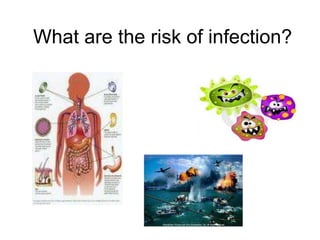
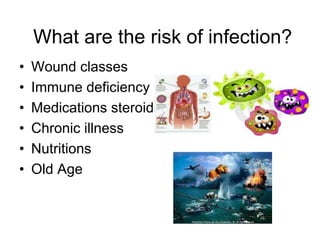
What are the risk of infection?
• Wound classes
• Immune deficiency
• Medications steroids
• Chronic illness
• Nutritions
• Old Age
What are the risk of infection?
Wound classifications
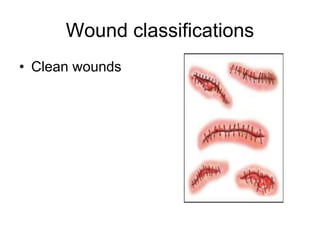
• Clean wounds
Wound classifications
• Clean wounds
• Clean-contaminated
Wound classifications
• Clean wounds
• Clean-contaminated
• Contaminated
Wound classifications
• Clean wounds
• Clean-contaminated
• Contaminated
• Dirty
Risk of infection
• Wound classes
• Immune deficiency
• Medications steroids
• Chronic illness
• Nutritions
• Old Age
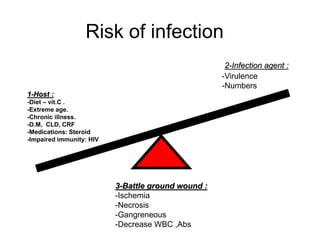
Risk of infection
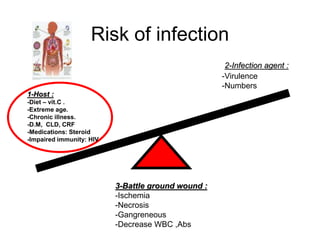
1-Host :
-Diet – vit.C .
-Extreme age.
-Chronic illness.
-D.M, CLD, CRF
-Medications: Steroid
-Impaired immunity: HIV
2-Infection agent :
3-Battle ground wound :
-Ischemia
-Necrosis
-Gangreneous
-Decrease WBC ,Abs
-Virulence
-Numbers
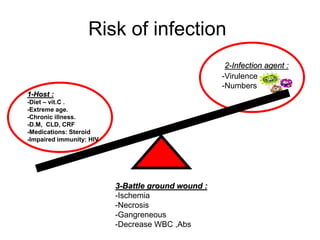
1-Host :
-Diet – vit.C .
-Extreme age.
-Chronic illness.
-D.M, CLD, CRF
-Medications: Steroid
-Impaired immunity: HIV
Risk of infection
2-Infection agent :
3-Battle ground wound :
-Ischemia
-Necrosis
-Gangreneous
-Decrease WBC ,Abs
-Virulence
-Numbers
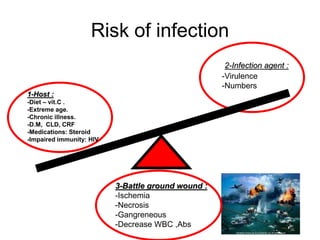
Risk of infection
1-Host :
-Diet – vit.C .
-Extreme age.
-Chronic illness.
-D.M, CLD, CRF
-Medications: Steroid
-Impaired immunity: HIV
2-Infection agent :
3-Battle ground wound :
-Ischemia
-Necrosis
-Gangreneous
-Decrease WBC ,Abs
-Virulence
-Numbers
Risk of infection
1-Host :
-Diet – vit.C .
-Extreme age.
-Chronic illness.
-D.M, CLD, CRF
-Medications: Steroid
-Impaired immunity: HIV
2-Infection agent :
3-Battle ground wound :
-Ischemia
-Necrosis
-Gangreneous
-Decrease WBC ,Abs
-Virulence
-Numbers
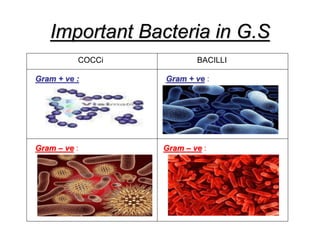
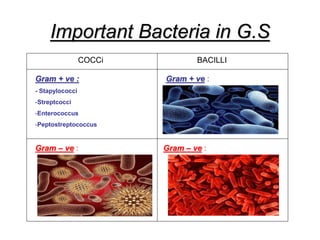
Important Bacteria in G.S
COCCi BACILLI
Gram + ve :
Gram – ve :
Gram + ve :
Gram – ve :
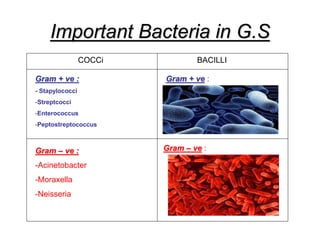
Important Bacteria in G.S
COCCi BACILLI
Gram + ve :
Gram – ve :
Gram + ve :
Gram – ve :
Gram + ve :
- Stapylococci
-Streptcocci
-Enterococcus
-Peptostreptococcus
Important Bacteria in G.S
COCCi BACILLI
Gram + ve : Gram + ve :
Gram – ve :
Gram + ve :
- Stapylococci
-Streptcocci
-Enterococcus
-Peptostreptococcus
Gram – ve :
-Acinetobacter
-Moraxella
-Neisseria
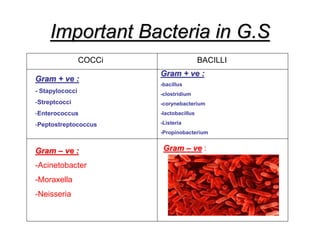
Important Bacteria in G.S
COCCi BACILLI
Gram + ve :
Gram – ve :
Gram + ve :
- Stapylococci
-Streptcocci
-Enterococcus
-Peptostreptococcus
Gram – ve :
-Acinetobacter
-Moraxella
-Neisseria
Gram + ve :
-bacillus
-clostridium
-corynebacterium
-lactobacillus
-Listeria
-Propinobacterium
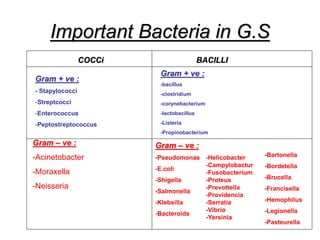
Important Bacteria in G.S
COCCi BACILLI
Gram + ve :
- Stapylococci
-Streptcocci
-Enterococcus
-Peptostreptococcus
Gram – ve :
-Acinetobacter
-Moraxella
-Neisseria
Gram – ve :
-Pseudomonas
-E.coli
-Shigella
-Salmonella
-Klebsilla
-Bacteroids
-Helicobacter
-Campylobactur
-Fusobacterium
-Proteus
-Prevottella
-Providencia
-Serratia
-Vibrio
-Yersinia
-Bartonella
-Bordetella
-Brucella
-Francisella
-Hemophilus
-Legionella
-Pasteurella
Gram + ve :
-bacillus
-clostridium
-corynebacterium
-lactobacillus
-Listeria
-Propinobacterium
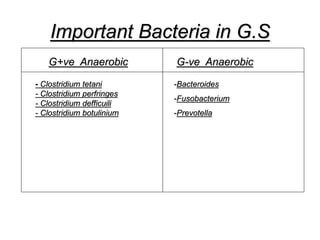
Important Bacteria in G.S
G+ve Anaerobic
- Clostridium tetani
- Clostridium perfringes
- Clostridium defficuili
- Clostridium botulinium
-Bacteroides
-Fusobacterium
-Prevotella
G-ve Anaerobic
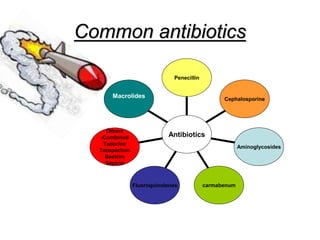
Common antibiotics
Macrolides
Others
-Combined
Tazocine
Tazopactum
Bactrim
Septrin
Fluoroquinolones carmabenum
Aminoglycosides
Cephalosporine
Penecillin
Antibiotics
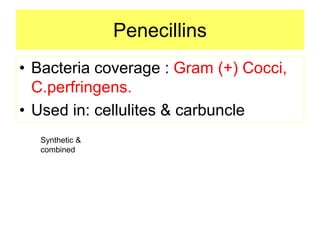
Penecillins
• Bacteria coverage : Gram (+) Cocci,
C.perfringens.
• Used in: cellulites & carbuncle
Synthetic &
combined
But what are the problem with
PENECILLINS ?
But what are the problem with
PENECILLINS ?
• Limited spectrum
But what are the problem with
PENECILLINS ?
• Limited spectrum
• Resistance
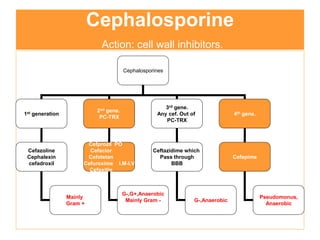
Cephalosporine
Action: cell wall inhibitors.
Cephalosporines
1st generation
2nd gene.
PC-TRX
3rd gene.
Any cef. Out of
PC-TRX
4th gene.
Cefazoline
Cephalexin
cefadroxil
Cefprozil PO
Cefaclor
Cefotetan
Cefuroxime I.M-I.V
Cefoxitin
Ceftazidime which
Pass through
BBB
Cefepime
Mainly
Gram +
G-,G+,Anaerobic
Mainly Gram - G-,Anaerobic
Pseudomonus,
Anaerobic
Aminoglycosides
• Bacteria coverage : G (+)cocci & G ( - )bacilli
• Sub group : Gentamicin, Tobramycin ,Amikacin
,Neomycin ,Streptomycin
• Execreted by: kidney
• Side effects: Renal toxicity and Ototoxicity
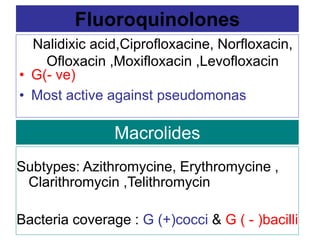
Nalidixic acid,Ciprofloxacine, Norfloxacin,
Ofloxacin ,Moxifloxacin ,Levofloxacin
• G(- ve)
• Most active against pseudomonas
Subtypes: Azithromycine, Erythromycine ,
Clarithromycin ,Telithromycin
Bacteria coverage : G (+)cocci & G ( - )bacilli
Macrolides
Fluoroquinolones
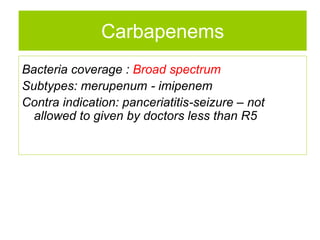
Bacteria coverage : Broad spectrum
Subtypes: merupenum - imipenem
Contra indication: panceriatitis-seizure – not
allowed to given by doctors less than R5
Carbapenems
Clindamycine
Bacteria coverage: Anaerobic & G +ve cocci
Vancomycine
• Bacteria coverage : MRSA,G + ve.
• Used in: prosthetic valve ,dialysis catheter
Augmantin
combination antibiotic containing amoxicillin trihydrate, a β-
lactam antibiotic, with potassium clavulanate, a β-
lactamase inhibitor. This combination results in an
antibiotic with an increased spectrum of action and
restored efficacy against amoxicillin-resistant bacteria
that produce β-lactamase.
Bactrim (septrin)
• combination of trimethoprim and
sulfamethoxazole
Tazocin
• Piperacillin is an extended spectrum beta-lactam
antibiotic of the ureidopenicillin class.
• It is normally used together with a beta-lactamase
inhibitor such as tazobactam. The combination drug of
piperacillin and tazobactam
• Its main uses are in intensive care medicine (pneumonia,
peritonitis), some diabetes-related foot infections and
empirical therapy in febrile neutropenia (e.g. after
chemotherapy).
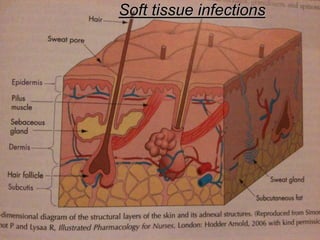
Soft tissue infections
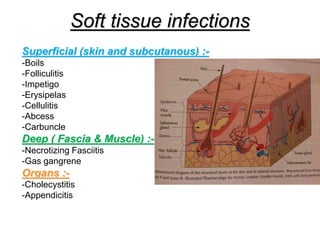
Superficial (skin and subcutanous) :-
-Boils
-Folliculitis
-Impetigo
-Erysipelas
-Cellulitis
-Abcess
-Carbuncle
Deep ( Fascia & Muscle) :-
-Necrotizing Fasciitis
-Gas gangrene
Organs :-
-Cholecystitis
-Appendicitis
Soft tissue infections
Superficial (skin and
subcutanous)
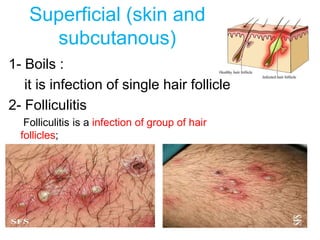
1- Boils :
it is infection of single hair follicle
2- Folliculitis
Folliculitis is a infection of group of hair
follicles;
Impetigo
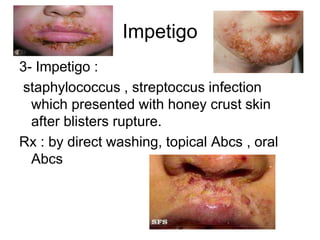
3- Impetigo :
staphylococcus , streptoccus infection
which presented with honey crust skin
after blisters rupture.
Rx : by direct washing, topical Abcs , oral
Abcs
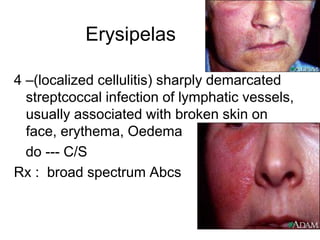
Erysipelas
4 –(localized cellulitis) sharply demarcated
streptcoccal infection of lymphatic vessels,
usually associated with broken skin on
face, erythema, Oedema
do --- C/S
Rx : broad spectrum Abcs
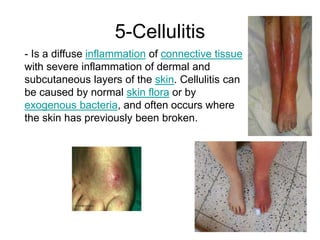
5-Cellulitis
- Is a diffuse inflammation of connective tissue
with severe inflammation of dermal and
subcutaneous layers of the skin. Cellulitis can
be caused by normal skin flora or by
exogenous bacteria, and often occurs where
the skin has previously been broken.
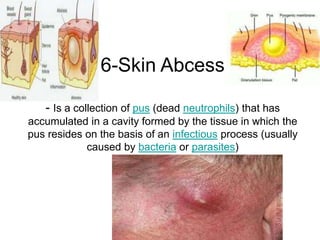
6-Skin Abcess
- Is a collection of pus (dead neutrophils) that has
accumulated in a cavity formed by the tissue in which the
pus resides on the basis of an infectious process (usually
caused by bacteria or parasites)
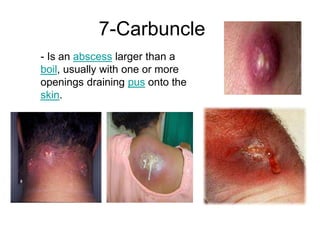
7-Carbuncle
- Is an abscess larger than a
boil, usually with one or more
openings draining pus onto the
skin.
Deep ( Muscle & Fascia)
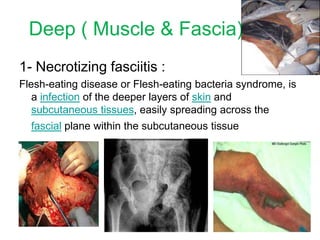
1- Necrotizing fasciitis :
Flesh-eating disease or Flesh-eating bacteria syndrome, is
a infection of the deeper layers of skin and
subcutaneous tissues, easily spreading across the
fascial plane within the subcutaneous tissue
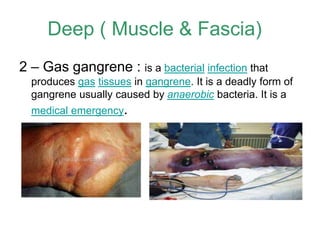
2 – Gas gangrene : is a bacterial infection that
produces gas tissues in gangrene. It is a deadly form of
gangrene usually caused by anaerobic bacteria. It is a
medical emergency.
Deep ( Muscle & Fascia)
Deep organs
- Appendicitis.
- Acute cholecystitis
Soft tissue infections (3).ppt

Soft tissue infections (3).ppt

  • 1.
    Soft tissue infections Doneby : Abdulhadi T. Gelaidan Supervised by ; Dr.Majed Mansouri
  • 2.
    Content of lecture: •Antibiotics use
  • 3.
    Content of lecture: •Antibiotics use • Relation between infection and body.
  • 4.
    Content of lecture: •Antibiotics use • Relation between infection and body. • Important bacteria in General surgery.
  • 5.
    Content of lecture: •Antibiotics use • Relation between infection and body. • Important bacteria in General surgery. • Important antibiotics in G.S.
  • 6.
    Content of lecture: •Antibiotics use • Relation between infection and body. • Important bacteria in General surgery. • Important antibiotics in G.S. • Types of soft tissue infections
  • 7.
    Antibiotics use • Prophylaxis: indications - Increase in risk of infect. -Wound classes. -Infection = Disaster e.g : infected heart valve
  • 8.
    What are therisk of infection?
  • 9.
    • Wound classes •Immune deficiency • Medications steroids • Chronic illness • Nutritions • Old Age What are the risk of infection?
  • 10.
  • 11.
  • 12.
    Wound classifications • Cleanwounds • Clean-contaminated
  • 13.
    Wound classifications • Cleanwounds • Clean-contaminated • Contaminated
  • 14.
    Wound classifications • Cleanwounds • Clean-contaminated • Contaminated • Dirty
  • 15.
    Risk of infection •Wound classes • Immune deficiency • Medications steroids • Chronic illness • Nutritions • Old Age
  • 16.
    Risk of infection 1-Host: -Diet – vit.C . -Extreme age. -Chronic illness. -D.M, CLD, CRF -Medications: Steroid -Impaired immunity: HIV 2-Infection agent : 3-Battle ground wound : -Ischemia -Necrosis -Gangreneous -Decrease WBC ,Abs -Virulence -Numbers
  • 17.
    1-Host : -Diet –vit.C . -Extreme age. -Chronic illness. -D.M, CLD, CRF -Medications: Steroid -Impaired immunity: HIV Risk of infection 2-Infection agent : 3-Battle ground wound : -Ischemia -Necrosis -Gangreneous -Decrease WBC ,Abs -Virulence -Numbers
  • 18.
    Risk of infection 1-Host: -Diet – vit.C . -Extreme age. -Chronic illness. -D.M, CLD, CRF -Medications: Steroid -Impaired immunity: HIV 2-Infection agent : 3-Battle ground wound : -Ischemia -Necrosis -Gangreneous -Decrease WBC ,Abs -Virulence -Numbers
  • 19.
    Risk of infection 1-Host: -Diet – vit.C . -Extreme age. -Chronic illness. -D.M, CLD, CRF -Medications: Steroid -Impaired immunity: HIV 2-Infection agent : 3-Battle ground wound : -Ischemia -Necrosis -Gangreneous -Decrease WBC ,Abs -Virulence -Numbers
  • 20.
    Important Bacteria inG.S COCCi BACILLI Gram + ve : Gram – ve : Gram + ve : Gram – ve :
  • 21.
    Important Bacteria inG.S COCCi BACILLI Gram + ve : Gram – ve : Gram + ve : Gram – ve : Gram + ve : - Stapylococci -Streptcocci -Enterococcus -Peptostreptococcus
  • 22.
    Important Bacteria inG.S COCCi BACILLI Gram + ve : Gram + ve : Gram – ve : Gram + ve : - Stapylococci -Streptcocci -Enterococcus -Peptostreptococcus Gram – ve : -Acinetobacter -Moraxella -Neisseria
  • 23.
    Important Bacteria inG.S COCCi BACILLI Gram + ve : Gram – ve : Gram + ve : - Stapylococci -Streptcocci -Enterococcus -Peptostreptococcus Gram – ve : -Acinetobacter -Moraxella -Neisseria Gram + ve : -bacillus -clostridium -corynebacterium -lactobacillus -Listeria -Propinobacterium
  • 24.
    Important Bacteria inG.S COCCi BACILLI Gram + ve : - Stapylococci -Streptcocci -Enterococcus -Peptostreptococcus Gram – ve : -Acinetobacter -Moraxella -Neisseria Gram – ve : -Pseudomonas -E.coli -Shigella -Salmonella -Klebsilla -Bacteroids -Helicobacter -Campylobactur -Fusobacterium -Proteus -Prevottella -Providencia -Serratia -Vibrio -Yersinia -Bartonella -Bordetella -Brucella -Francisella -Hemophilus -Legionella -Pasteurella Gram + ve : -bacillus -clostridium -corynebacterium -lactobacillus -Listeria -Propinobacterium
  • 25.
    Important Bacteria inG.S G+ve Anaerobic - Clostridium tetani - Clostridium perfringes - Clostridium defficuili - Clostridium botulinium -Bacteroides -Fusobacterium -Prevotella G-ve Anaerobic
  • 26.
  • 27.
    Penecillins • Bacteria coverage: Gram (+) Cocci, C.perfringens. • Used in: cellulites & carbuncle Synthetic & combined
  • 28.
    But what arethe problem with PENECILLINS ?
  • 29.
    But what arethe problem with PENECILLINS ? • Limited spectrum
  • 30.
    But what arethe problem with PENECILLINS ? • Limited spectrum • Resistance
  • 31.
    Cephalosporine Action: cell wallinhibitors. Cephalosporines 1st generation 2nd gene. PC-TRX 3rd gene. Any cef. Out of PC-TRX 4th gene. Cefazoline Cephalexin cefadroxil Cefprozil PO Cefaclor Cefotetan Cefuroxime I.M-I.V Cefoxitin Ceftazidime which Pass through BBB Cefepime Mainly Gram + G-,G+,Anaerobic Mainly Gram - G-,Anaerobic Pseudomonus, Anaerobic
  • 32.
    Aminoglycosides • Bacteria coverage: G (+)cocci & G ( - )bacilli • Sub group : Gentamicin, Tobramycin ,Amikacin ,Neomycin ,Streptomycin • Execreted by: kidney • Side effects: Renal toxicity and Ototoxicity
  • 33.
    Nalidixic acid,Ciprofloxacine, Norfloxacin, Ofloxacin,Moxifloxacin ,Levofloxacin • G(- ve) • Most active against pseudomonas Subtypes: Azithromycine, Erythromycine , Clarithromycin ,Telithromycin Bacteria coverage : G (+)cocci & G ( - )bacilli Macrolides Fluoroquinolones
  • 34.
    Bacteria coverage :Broad spectrum Subtypes: merupenum - imipenem Contra indication: panceriatitis-seizure – not allowed to given by doctors less than R5 Carbapenems
  • 35.
  • 36.
    Vancomycine • Bacteria coverage: MRSA,G + ve. • Used in: prosthetic valve ,dialysis catheter
  • 37.
    Augmantin combination antibiotic containingamoxicillin trihydrate, a β- lactam antibiotic, with potassium clavulanate, a β- lactamase inhibitor. This combination results in an antibiotic with an increased spectrum of action and restored efficacy against amoxicillin-resistant bacteria that produce β-lactamase.
  • 38.
    Bactrim (septrin) • combinationof trimethoprim and sulfamethoxazole
  • 39.
    Tazocin • Piperacillin isan extended spectrum beta-lactam antibiotic of the ureidopenicillin class. • It is normally used together with a beta-lactamase inhibitor such as tazobactam. The combination drug of piperacillin and tazobactam • Its main uses are in intensive care medicine (pneumonia, peritonitis), some diabetes-related foot infections and empirical therapy in febrile neutropenia (e.g. after chemotherapy).
  • 40.
    Soft tissue infections Superficial(skin and subcutanous) :- -Boils -Folliculitis -Impetigo -Erysipelas -Cellulitis -Abcess -Carbuncle Deep ( Fascia & Muscle) :- -Necrotizing Fasciitis -Gas gangrene Organs :- -Cholecystitis -Appendicitis
  • 41.
  • 42.
    Superficial (skin and subcutanous) 1-Boils : it is infection of single hair follicle 2- Folliculitis Folliculitis is a infection of group of hair follicles;
  • 43.
    Impetigo 3- Impetigo : staphylococcus, streptoccus infection which presented with honey crust skin after blisters rupture. Rx : by direct washing, topical Abcs , oral Abcs
  • 44.
    Erysipelas 4 –(localized cellulitis)sharply demarcated streptcoccal infection of lymphatic vessels, usually associated with broken skin on face, erythema, Oedema do --- C/S Rx : broad spectrum Abcs
  • 45.
    5-Cellulitis - Is adiffuse inflammation of connective tissue with severe inflammation of dermal and subcutaneous layers of the skin. Cellulitis can be caused by normal skin flora or by exogenous bacteria, and often occurs where the skin has previously been broken.
  • 46.
    6-Skin Abcess - Isa collection of pus (dead neutrophils) that has accumulated in a cavity formed by the tissue in which the pus resides on the basis of an infectious process (usually caused by bacteria or parasites)
  • 47.
    7-Carbuncle - Is anabscess larger than a boil, usually with one or more openings draining pus onto the skin.
  • 48.
    Deep ( Muscle& Fascia) 1- Necrotizing fasciitis : Flesh-eating disease or Flesh-eating bacteria syndrome, is a infection of the deeper layers of skin and subcutaneous tissues, easily spreading across the fascial plane within the subcutaneous tissue
  • 49.
    2 – Gasgangrene : is a bacterial infection that produces gas tissues in gangrene. It is a deadly form of gangrene usually caused by anaerobic bacteria. It is a medical emergency. Deep ( Muscle & Fascia)
  • 51.
    Deep organs - Appendicitis. -Acute cholecystitis