SpaceX Rockets:
Beginning of
Space-faring
civilisation
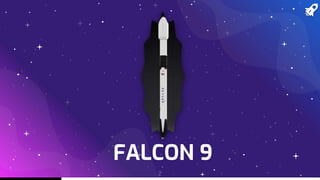
FALCON 9
2
3
● Partially reusable two-stage-to-orbit medium-lift launch vehicle.
● The rocket evolved with versions v1.0 (2010–2013), v1.1 (2013–
2016), v1.2 Full Thrust (2015–present), including the Block 5 Full
Thrust variant, flying since May 2018.
● With a success rate of 98.5%, Falcon 9 has been certified for the
National Security Space Launch program and NASA Launch
Services Program as "Category 3", which can launch the most
expensive, important, and complex NASA mission.
● As of January 2021, Falcon 9 has the most launches among all U.S.
rockets currently in operation and is the only U.S. rocket fully
certified for transporting humans to the International Space
Station, and the only commercial rocket to launch humans to orbit.
● On 24 January 2021, Falcon 9 set a new record for the most
satellites launched by a single rocket carrying 143 satellites into
orbit
● It is powered by 9 merlin engines, therefore the name Falcon ‘9’.
Description:
4
WHY FALCON 9 IS SO SPECIAL?
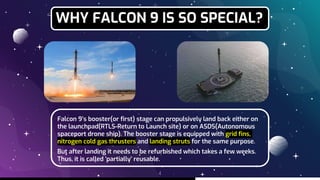
Falcon 9’s booster(or first) stage can propulsively land back either on
the launchpad(RTLS-Return to Launch site) or on ASDS(Autonomous
spaceport drone ship). The booster stage is equipped with grid fins,
nitrogen cold gas thrusters and landing struts for the same purpose.
But after landing it needs to be refurbished which takes a few weeks.
Thus, it is called ‘partially’ reusable.
5
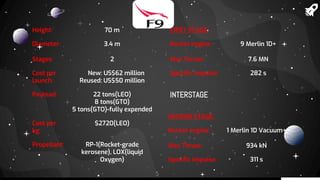
SECOND STAGE:
Rocket engine: 1 Merlin 1D Vacuum+
Max Thrust: 934 kN
Specific Impulse: 311 s
Height: 70 m
Diameter: 3.4 m
Stages: 2
Cost per
launch:
New: US$62 million
Reused: US$50 million
Payload: 22 tons(LEO)
8 tons(GTO)
5 tons(GTO)-fully expended
Cost per
kg:
$2720(LEO)
Propellant: RP-1(Rocket-grade
kerosene), LOX(liquid
Oxygen)
FIRST STAGE:
Rocket engine: 9 Merlin 1D+
Max Thrust: 7.6 MN
Specific Impulse: 282 s
INTERSTAGE
6
THANK
YOU!