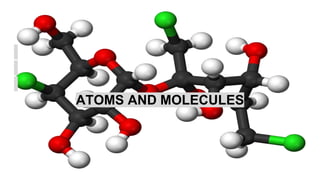
ATOMS AND MOLECULES
Atoms and molecules
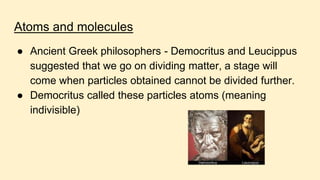
● Ancient Greek philosophers - Democritus and Leucippus
suggested that we go on dividing matter, a stage will
come when particles obtained cannot be divided further.
● Democritus called these particles atoms (meaning
indivisible)
Laws of chemical combination -
Antoine .L. Lavoisier and Joseph .L. Proust
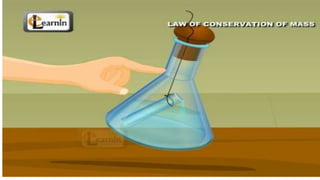
● Law of conservation of mass - Law states that mass
can neither be created nor destroyed in a chemical
reaction.
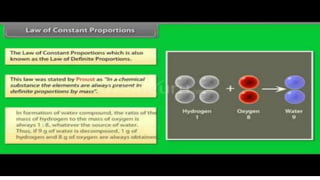
● Law of constant proportion ( Law of definite proportion)
In a chemical substance elements are always present in
definite proportion by mass
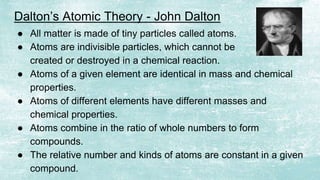
Dalton’s Atomic Theory - John Dalton
● All matter is made of tiny particles called atoms.
● Atoms are indivisible particles, which cannot be
created or destroyed in a chemical reaction.
● Atoms of a given element are identical in mass and chemical
properties.
● Atoms of different elements have different masses and
chemical properties.
● Atoms combine in the ratio of whole numbers to form
compounds.
● The relative number and kinds of atoms are constant in a given
compound.
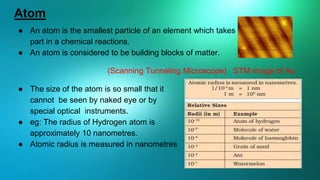
Atom
● An atom is the smallest particle of an element which takes
part in a chemical reactions.
● An atom is considered to be building blocks of matter.
(Scanning Tunneling Microscope) STM image of Au
● The size of the atom is so small that it
cannot be seen by naked eye or by
special optical instruments.
● eg: The radius of Hydrogen atom is
approximately 10 nanometres.
● Atomic radius is measured in nanometres
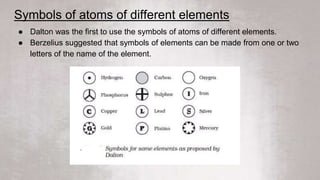
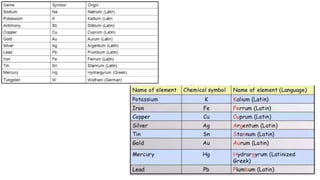
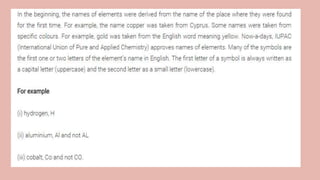
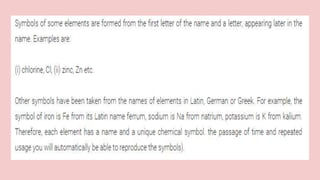
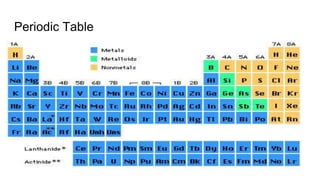
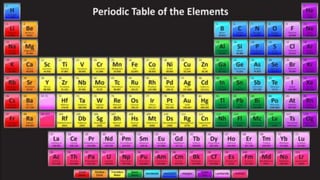
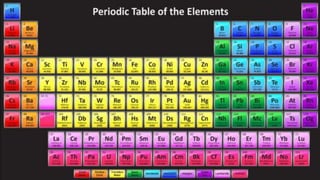
Symbols of atoms of different elements
● Dalton was the first to use the symbols of atoms of different elements.
● Berzelius suggested that symbols of elements can be made from one or two
letters of the name of the element.
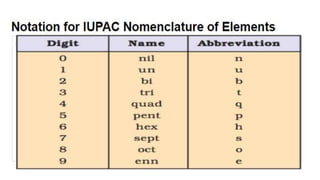
Periodic Table
Molecule
● A molecule can be defined as the smallest particle of an
element or a compound that is capable of an independent
existence and shows all the properties of that substance.
● Atoms of same element or of different elements can join
together to form molecules.
● Molecules are of two types
- Molecule of an element
- Molecule of a compound
Molecules of elements
● The molecules of an element are constituted be same type of atoms.
● eg: Molecules of some elements are made of only one type of atom
● Ar - Argon, He- Helium
● Molecules of certain elements has more than one atom.
● O2 - Oxygen (Diatomic), O3 - Ozone (triatomic)
● The number of atoms constituting a molecule is known as its atomicity
● Eg : Argon and helium are monoatomic
● Oxygen, hydrogen, nitrogen, chlorine are diatomic
● Phosphorus - Tetra-atomic
● Sulphur - Polyatomic
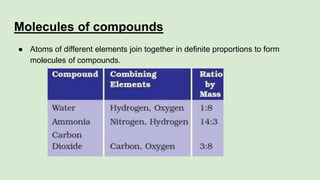
Molecules of compounds
● Atoms of different elements join together in definite proportions to form
molecules of compounds.
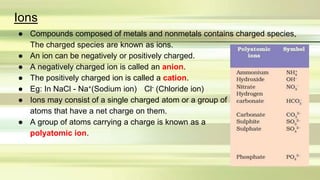
Ions
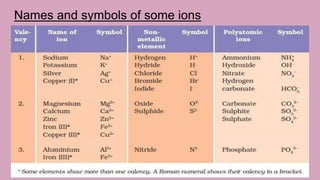
● Compounds composed of metals and nonmetals contains charged species,
The charged species are known as ions.
● An ion can be negatively or positively charged.
● A negatively charged ion is called an anion.
● The positively charged ion is called a cation.
● Eg: In NaCl - Na+(Sodium ion) Cl- (Chloride ion)
● Ions may consist of a single charged atom or a group of
atoms that have a net charge on them.
● A group of atoms carrying a charge is known as a
polyatomic ion.
Names and symbols of some ions
Chemical Formulae
● The chemical formula of a compound is the symbolic
representation of its composition.
Valency
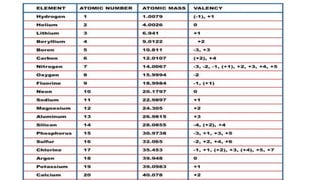
● The combining capacity of an element is known as
valency.
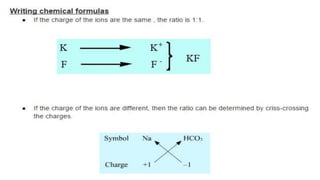
The rules that should be followed while writing chemical
formula are:
● The valencies or charges on the ion must balance.
● When a compound consists of a metal and a nonmetal, the name of the metal
is written first. For example Calcium Oxide (CaO), Sodium Chloride (NaCl),
Iron Sulphide (FeS) etc, nonmetals like oxygen, chlorine sulphur etc are
written on the right, whereas calcium, sodium, iron etc are written on the left.
● In a compound formed with polyatomic ions, the ion is enclosed in a bracket
before writing the number to indicate the ratio. In case the number of
polyatomic ion is one, the bracket is not required.
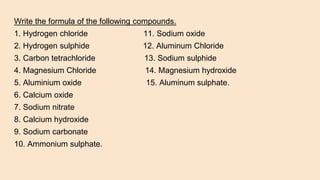
Write the formula of the following compounds.
1. Hydrogen chloride 11. Sodium oxide
2. Hydrogen sulphide 12. Aluminum Chloride
3. Carbon tetrachloride 13. Sodium sulphide
4. Magnesium Chloride 14. Magnesium hydroxide
5. Aluminium oxide 15. Aluminum sulphate.
6. Calcium oxide
7. Sodium nitrate
8. Calcium hydroxide
9. Sodium carbonate
10. Ammonium sulphate.
Atomic mass unit - ‘amu’ - u - unified mass
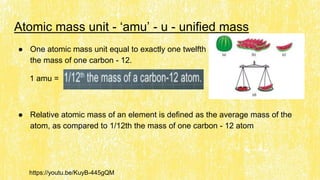
● One atomic mass unit equal to exactly one twelfth
the mass of one carbon - 12.
1 amu =
● Relative atomic mass of an element is defined as the average mass of the
atom, as compared to 1/12th the mass of one carbon - 12 atom
https://youtu.be/KuyB-445gQM
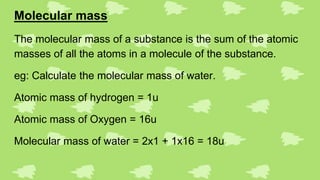
Molecular mass
The molecular mass of a substance is the sum of the atomic
masses of all the atoms in a molecule of the substance.
eg: Calculate the molecular mass of water.
Atomic mass of hydrogen = 1u
Atomic mass of Oxygen = 16u
Molecular mass of water = 2x1 + 1x16 = 18u
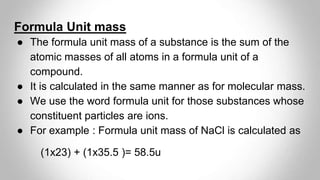
Formula Unit mass
● The formula unit mass of a substance is the sum of the
atomic masses of all atoms in a formula unit of a
compound.
● It is calculated in the same manner as for molecular mass.
● We use the word formula unit for those substances whose
constituent particles are ions.
● For example : Formula unit mass of NaCl is calculated as
(1x23) + (1x35.5 )= 58.5u
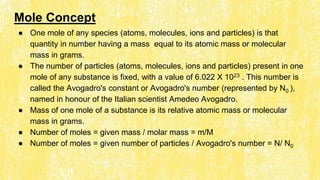
Mole Concept
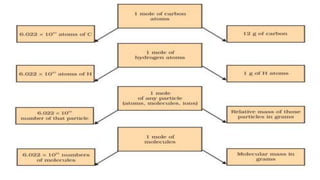
● One mole of any species (atoms, molecules, ions and particles) is that
quantity in number having a mass equal to its atomic mass or molecular
mass in grams.
● The number of particles (atoms, molecules, ions and particles) present in one
mole of any substance is fixed, with a value of 6.022 X 10²³ . This number is
called the Avogadro's constant or Avogadro's number (represented by N0 ),
named in honour of the Italian scientist Amedeo Avogadro.
● Mass of one mole of a substance is its relative atomic mass or molecular
mass in grams.
● Number of moles = given mass / molar mass = m/M
● Number of moles = given number of particles / Avogadro's number = N/ N0
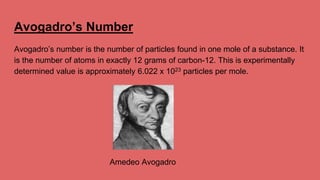
Avogadro’s Number
Avogadro’s number is the number of particles found in one mole of a substance. It
is the number of atoms in exactly 12 grams of carbon-12. This is experimentally
determined value is approximately 6.022 x 10²³ particles per mole.
Amedeo Avogadro
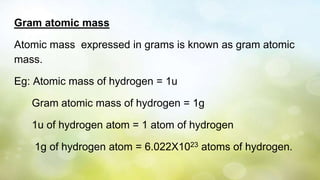
Gram atomic mass
Atomic mass expressed in grams is known as gram atomic
mass.
Eg: Atomic mass of hydrogen = 1u
Gram atomic mass of hydrogen = 1g
1u of hydrogen atom = 1 atom of hydrogen
1g of hydrogen atom = 6.022X10²³ atoms of hydrogen.
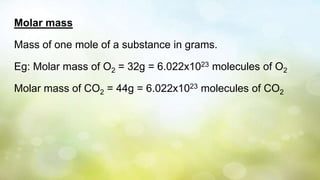
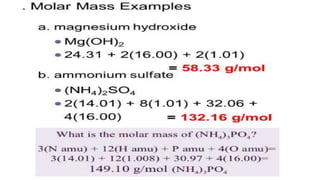
Molar mass
Mass of one mole of a substance in grams.
Eg: Molar mass of O2 = 32g = 6.022x10²³ molecules of O2
Molar mass of CO2 = 44g = 6.022x10²³ molecules of CO2
CHAP 3 ATOMS AND MOLECULES GR 9 2020-21