The Motor System BEHAVIOUR
What is the motor system? What are the functions of the skeleton? What bones form of it? THE MOTOR SYSTEM
FUNCTIONS The skeletal system has five very important jobs: 1.-  Support,  2.- protection (the bones also protect many organs, and also the brain. Our skull protects the brain and our ribs protect our internal organs),  3.- movement, 4.- storage,  5.- and production of blood cells.  Just think, if we did not have a skeletal system we would be just like a blob of Jell-O .
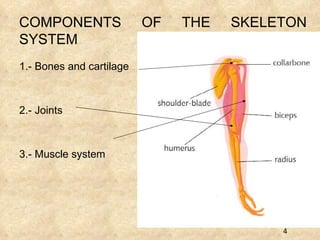
COMPONENTS OF THE SKELETON SYSTEM 1.- Bones and cartilage 2.- Joints 3.- Muscle system
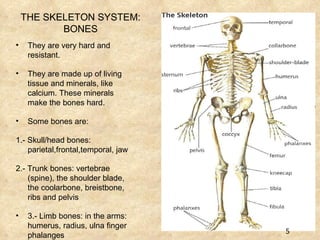
THE SKELETON SYSTEM: BONES They are very hard and resistant. They are made up of living tissue and minerals, like calcium. These minerals make the bones hard. Some bones are: 1.- Skull/head bones: parietal,frontal,temporal, jaw 2.- Trunk bones: vertebrae (spine), the shoulder blade, the coolarbone, breistbone, ribs and pelvis 3.- Limb bones: in the arms: humerus, radius, ulna finger phalanges
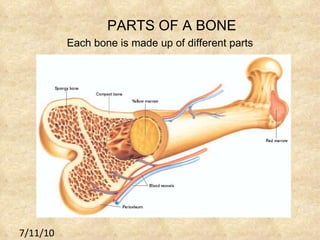
7/11/10 PARTS OF A BONE Each bone is made up of different parts
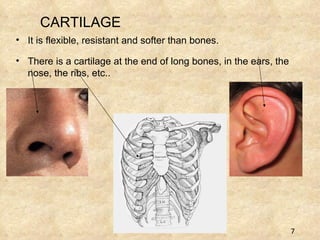
CARTILAGE It is flexible, resistant and softer than bones.  There is a cartilage at the end of long bones, in the ears, the nose, the ribs, etc..
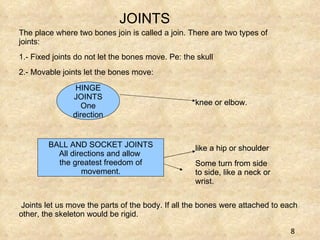
JOINTS knee or elbow.  like a hip or shoulder Some turn from side to side, like a neck or wrist.  The place where two bones join is called a join. There are two types of joints:  1.- Fixed joints do not let the bones move. Pe: the skull 2.- Movable joints let the bones move: HINGE JOINTS One direction BALL AND SOCKET JOINTS All directions  and allow  the greatest freedom of movement. knee or elbow.  like a hip or shoulder Some turn from side to side, like a neck or wrist.  Joints let us move the parts of the body. If all the bones were attached to each other, the skeleton would be rigid.
The place where bones are connected is called a joint. Joints give you the freedom to move your body. A skeleton without joints would be like a statue.  There are several different types of joints in our body: 1.- Mobile joints:  The ball and socket joint  (hip, shoulder) allows a great range of movement in all directions.  The pivot joint  (neck) moves around in a back and forth motion. A globe rotating is a good example of this . The gliding joint  (wrist, ankle) allows a great range of motion. This joint is connected by one bone sliding over another bone. 2.- Semi-mobile joints: The  hinge joint  (knee, elbow, fingers) works like a door's hinge. It only allows movement only in one plane.  3.- Fixed joints (skull, pelvis) do not move at all. All of these joints are crucial to the proper functioning of the body.  MORE ABOUT JOINTS
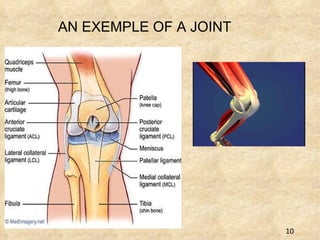
AN EXEMPLE OF A JOINT
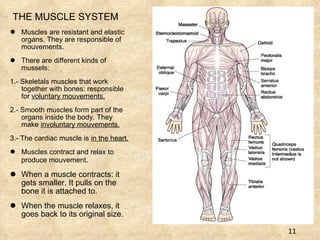
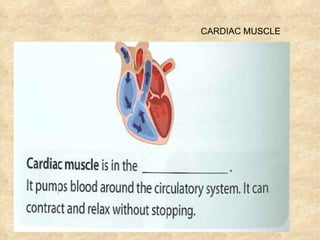
THE MUSCLE SYSTEM Muscles are resistant and elastic organs. They are responsible of mouvements. There are different kinds of mussels: 1.- Skeletals muscles that work together with bones: responsible for  voluntary mouvements. 2.- Smooth muscles form part of the organs inside the body. They make  involuntary mouvements. 3.- The cardiac muscle is  in the heart. Muscles contract and relax to produce mouvement . When a muscle contracts: it gets smaller. It pulls on the bone it is attached to. When the muscle relaxes, it goes back to its original size.
MOVEMENT Bones and muscles work together so we can move. Muscles move when the  NERVOUS SYSTEM  sends them an order to move. TYPES OF MOVEMENT: 1.- Voluntary mouvements when we want to: walking, turning the pages of the scrapbook or chewing. The  brain  send  orders  to make the voluntary movement. 2.- Involuntary mouvements without realising it. The movements internal organs make to carry out  their  functions are involuntary movements. The orders of these can come from the brain or the spinal cord. 7/11/10
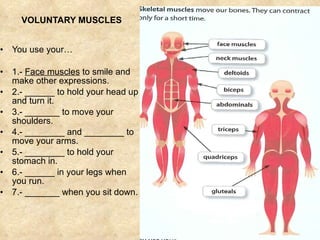
VOLUNTARY MUSCLES You use your… 1.-  Face muscles  to smile and make other expressions. 2.- ______ to hold your head up and turn it. 3.- _______ to move your shoulders. 4.- ________ and ________ to move your arms. 5.- ________ to hold your stomach in. 6.- ______ in your legs when you run. 7.- _______ when you sit down.
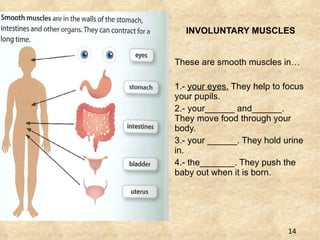
INVOLUNTARY MUSCLES These are smooth muscles in… 1.-  your eyes.  They help to focus your pupils. 2.- your______ and______. They move food through your body. 3.- your ______. They hold urine in. 4.- the_______. They push the baby out when it is born.
CARDIAC MUSCLE
REFLEXES It is a special type of movement. It is an involuntary movement They are very quick movements we make without thinking. Exemples: When you burnt your hand you avoid a more serious burn when you take your hand away quickly. 7/11/10
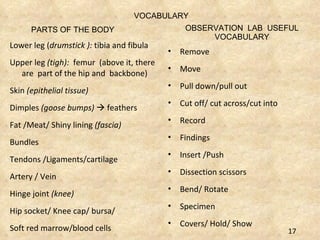
VOCABULARY PARTS OF THE BODY OBSERVATION  LAB  USEFUL VOCABULARY Lower leg ( drumstick ):  tibia and fibula Upper leg  (tigh):  femur  (above it, there are  part of the hip and  backbone) Skin  (epithelial tissue) Dimples  (goose bumps)     feathers Fat /Meat/ Shiny lining  (fascia) Bundles Tendons /Ligaments/cartilage Artery / Vein Hinge joint  (knee) Hip socket/ Knee cap/ bursa/ Soft red marrow/blood cells Remove Move Pull down/pull out Cut off/ cut across/cut into Record Findings Insert /Push  Dissection scissors Bend/ Rotate Specimen Covers/ Hold/ Show
7/11/10 ACTIVITY 3:
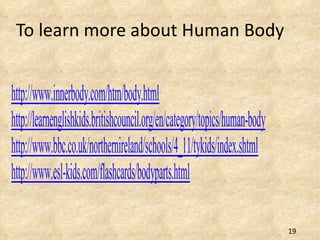
To learn more about Human Body

The motor system

  • 1.
  • 2.
    What is themotor system? What are the functions of the skeleton? What bones form of it? THE MOTOR SYSTEM
  • 3.
    FUNCTIONS The skeletalsystem has five very important jobs: 1.- Support, 2.- protection (the bones also protect many organs, and also the brain. Our skull protects the brain and our ribs protect our internal organs), 3.- movement, 4.- storage, 5.- and production of blood cells. Just think, if we did not have a skeletal system we would be just like a blob of Jell-O .
  • 4.
    COMPONENTS OF THESKELETON SYSTEM 1.- Bones and cartilage 2.- Joints 3.- Muscle system
  • 5.
    THE SKELETON SYSTEM:BONES They are very hard and resistant. They are made up of living tissue and minerals, like calcium. These minerals make the bones hard. Some bones are: 1.- Skull/head bones: parietal,frontal,temporal, jaw 2.- Trunk bones: vertebrae (spine), the shoulder blade, the coolarbone, breistbone, ribs and pelvis 3.- Limb bones: in the arms: humerus, radius, ulna finger phalanges
  • 6.
    7/11/10 PARTS OFA BONE Each bone is made up of different parts
  • 7.
    CARTILAGE It isflexible, resistant and softer than bones. There is a cartilage at the end of long bones, in the ears, the nose, the ribs, etc..
  • 8.
    JOINTS knee orelbow. like a hip or shoulder Some turn from side to side, like a neck or wrist. The place where two bones join is called a join. There are two types of joints: 1.- Fixed joints do not let the bones move. Pe: the skull 2.- Movable joints let the bones move: HINGE JOINTS One direction BALL AND SOCKET JOINTS All directions and allow the greatest freedom of movement. knee or elbow. like a hip or shoulder Some turn from side to side, like a neck or wrist. Joints let us move the parts of the body. If all the bones were attached to each other, the skeleton would be rigid.
  • 9.
    The place wherebones are connected is called a joint. Joints give you the freedom to move your body. A skeleton without joints would be like a statue. There are several different types of joints in our body: 1.- Mobile joints: The ball and socket joint (hip, shoulder) allows a great range of movement in all directions. The pivot joint (neck) moves around in a back and forth motion. A globe rotating is a good example of this . The gliding joint (wrist, ankle) allows a great range of motion. This joint is connected by one bone sliding over another bone. 2.- Semi-mobile joints: The hinge joint (knee, elbow, fingers) works like a door's hinge. It only allows movement only in one plane. 3.- Fixed joints (skull, pelvis) do not move at all. All of these joints are crucial to the proper functioning of the body. MORE ABOUT JOINTS
  • 10.
  • 11.
    THE MUSCLE SYSTEMMuscles are resistant and elastic organs. They are responsible of mouvements. There are different kinds of mussels: 1.- Skeletals muscles that work together with bones: responsible for voluntary mouvements. 2.- Smooth muscles form part of the organs inside the body. They make involuntary mouvements. 3.- The cardiac muscle is in the heart. Muscles contract and relax to produce mouvement . When a muscle contracts: it gets smaller. It pulls on the bone it is attached to. When the muscle relaxes, it goes back to its original size.
  • 12.
    MOVEMENT Bones andmuscles work together so we can move. Muscles move when the NERVOUS SYSTEM sends them an order to move. TYPES OF MOVEMENT: 1.- Voluntary mouvements when we want to: walking, turning the pages of the scrapbook or chewing. The brain send orders to make the voluntary movement. 2.- Involuntary mouvements without realising it. The movements internal organs make to carry out their functions are involuntary movements. The orders of these can come from the brain or the spinal cord. 7/11/10
  • 13.
    VOLUNTARY MUSCLES Youuse your… 1.- Face muscles to smile and make other expressions. 2.- ______ to hold your head up and turn it. 3.- _______ to move your shoulders. 4.- ________ and ________ to move your arms. 5.- ________ to hold your stomach in. 6.- ______ in your legs when you run. 7.- _______ when you sit down.
  • 14.
    INVOLUNTARY MUSCLES Theseare smooth muscles in… 1.- your eyes. They help to focus your pupils. 2.- your______ and______. They move food through your body. 3.- your ______. They hold urine in. 4.- the_______. They push the baby out when it is born.
  • 15.
  • 16.
    REFLEXES It isa special type of movement. It is an involuntary movement They are very quick movements we make without thinking. Exemples: When you burnt your hand you avoid a more serious burn when you take your hand away quickly. 7/11/10
  • 17.
    VOCABULARY PARTS OFTHE BODY OBSERVATION LAB USEFUL VOCABULARY Lower leg ( drumstick ): tibia and fibula Upper leg (tigh): femur (above it, there are part of the hip and backbone) Skin (epithelial tissue) Dimples (goose bumps)  feathers Fat /Meat/ Shiny lining (fascia) Bundles Tendons /Ligaments/cartilage Artery / Vein Hinge joint (knee) Hip socket/ Knee cap/ bursa/ Soft red marrow/blood cells Remove Move Pull down/pull out Cut off/ cut across/cut into Record Findings Insert /Push Dissection scissors Bend/ Rotate Specimen Covers/ Hold/ Show
  • 18.
  • 19.
    To learn moreabout Human Body