SSIIXX SSTTRROOKKEE EENNGGIINNEE 
PPRREEPPAARREEDD BBYY::-- 
AACCHHIINN 
MM..tteecchh ((MMaannuuffaaccttuurriinngg EEnnggiinneeeerriinngg)) 
DDeepptt.. ooff MMeecchhaanniiccaall EEnnggiinneeeerriinngg
CONTENTS 
 Introduction 
 How six stroke engine works 
 Working principles 
 Specification of six stroke engine 
 Comparison of six stroke engine with four 
stroke engine 
 Graphs 
 Gallery 
 Thermodynamic advantages 
 Conclusion
Introduction 
Malcolm beare built an innovative hybrid design of 
the I C engine , by combining a two stroke with a 
four stroke engine. 
The Beare Head is a new type of four stroke 
engine head design known as the “Beare Head” 
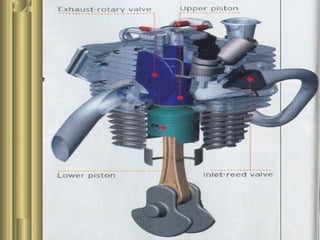
 The Beare Head uses a piston and ports very 
much like a two stroke engine to replace the over 
head valve system that is found in four stroke 
engines today. The four stroke block, pistons and 
crankshaft remain unaltered. This combination of 
two stroke and four stroke technology has given the 
engine its name – the “six stroke engine” (2 + 4 = 
6).
 Key attributes of the Beare Head 
are: 
 Increased power, 
 Increased torque, 
 Fewer, lighter reciprocating parts, 
 Simpler manufacture.
HOW SIX STROKE ENGINE 
WORKS
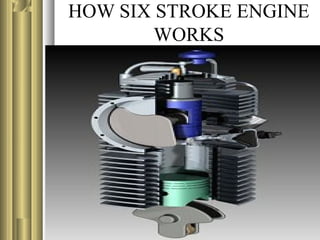
Below the cylinder head gasket, everything is 
conventional, so one advantage is that the Beare 
concept can be transplanted on to existing engines 
without any need for redesigning or retooling the 
bottom end. But the cylinder head and its poppet 
valves get thrown away. To replace the camshaft and 
valves, Beare has retained the cam drive belt and 
fitted an ultra short-stroke upper crankshaft complete 
with piston, which the belt drives at half engine speed 
just as it previously drove the cam. This piston drives 
up and down in a sleeve, past inlet exhaust ports set 
into the cylinder wall, very much like on a two-stroke: 
these are all exposed during both inlet and 
exhaust strokes.
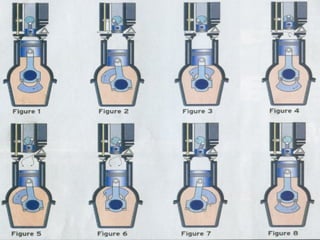
Working Principle 
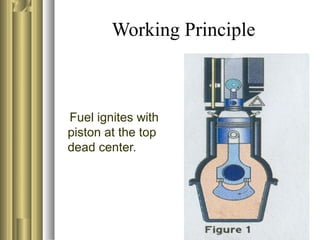
Fuel ignites with 
piston at the top 
dead center.
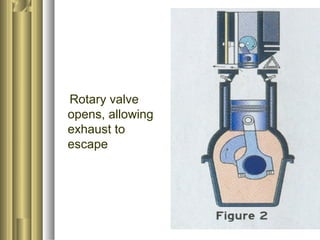
Rotary valve 
opens, allowing 
exhaust to 
escape
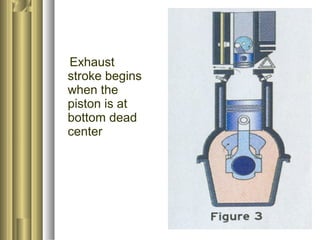
Exhaust 
stroke begins 
when the 
piston is at 
bottom dead 
center
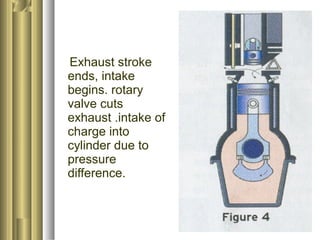
Exhaust stroke 
ends, intake 
begins. rotary 
valve cuts 
exhaust .intake of 
charge into 
cylinder due to 
pressure 
difference.
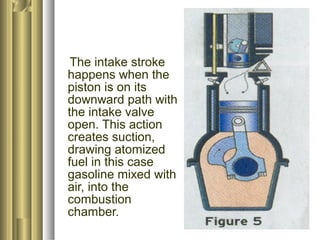
The intake stroke 
happens when the 
piston is on its 
downward path with 
the intake valve 
open. This action 
creates suction, 
drawing atomized 
fuel in this case 
gasoline mixed with 
air, into the 
combustion 
chamber.
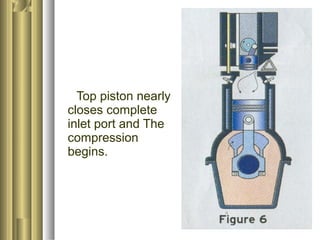
Top piston nearly 
closes complete 
inlet port and The 
compression 
begins.
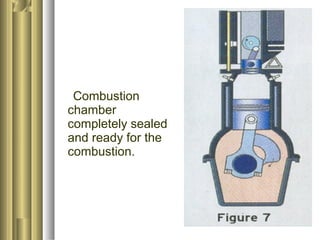
Combustion 
chamber 
completely sealed 
and ready for the 
combustion.
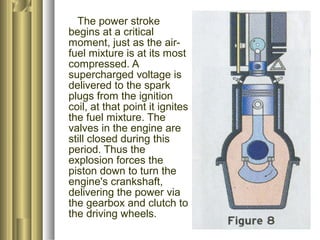
The power stroke 
begins at a critical 
moment, just as the air-fuel 
mixture is at its most 
compressed. A 
supercharged voltage is 
delivered to the spark 
plugs from the ignition 
coil, at that point it ignites 
the fuel mixture. The 
valves in the engine are 
still closed during this 
period. Thus the 
explosion forces the 
piston down to turn the 
engine's crankshaft, 
delivering the power via 
the gearbox and clutch to 
the driving wheels.
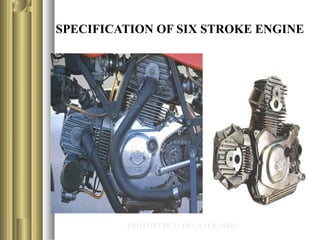
SPECIFICATION OF SIX STROKE ENGINE 
PROTOTYPE 5 - DUCATI BASED
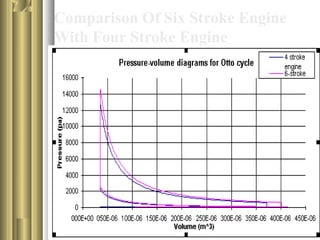
Comparison Of Six Stroke Engine 
With Four Stroke Engine
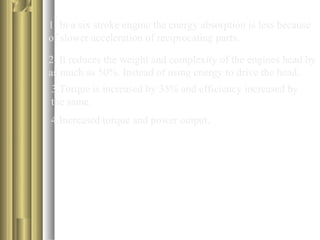
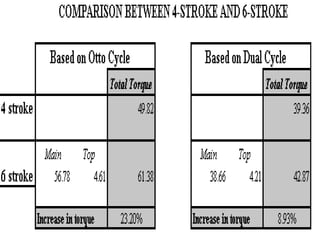
1. In a six stroke engine the energy absorption is less because 
of slower acceleration of reciprocating parts. 
2. It reduces the weight and complexity of the engines head by 
as much as 50%. Instead of using energy to drive the head. 
3.Torque is increased by 35% and efficiency increased by 
the same. 
4.Increased torque and power output.
Gallery 
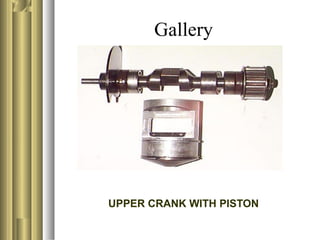
UPPER CRANK WITH PISTON
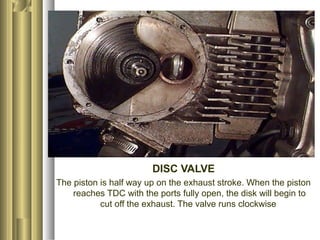
DISC VALVE 
The piston is half way up on the exhaust stroke. When the piston 
reaches TDC with the ports fully open, the disk will begin to 
cut off the exhaust. The valve runs clockwise
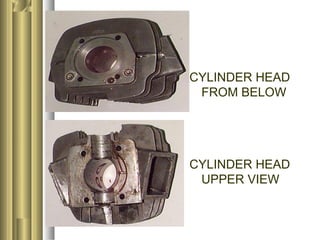
CYLINDER HEAD 
FROM BELOW 
CYLINDER HEAD 
UPPER VIEW
Thermodynamic Advantages 
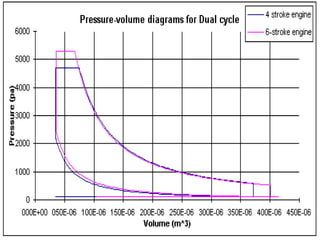
The intake begins at 0 degrees on the X-axis. 
The effect of the additional volume changes that 
the upper piston has on the volume of the engine is 
all positive from a thermodynamic point of view. If 
the engine were a normal 4 stroke the cylinder 
capacity would be 340cc. Of note - maximum 
volume at the end of the intake stroke occurs at 
173 degrees instead of 180 degrees- the change in 
volume is 308cc which is less than a 4 stroke 
(340cc)- yet the total volume at the end of the 
intake stroke is 415cc as opposed to 375cc for a 
conventional stroke.
Thermodynamic advantages 
 The change in volume during the compression 
stroke is slightly greater than a 4 stroke after the 
ports are closed. 
The expansion stroke is much greater than a 4 
stroke, both from T.D.C. to B.D.C. and from T.D.C. 
till the exhaust port is open. 
It is possible to leave the opening of the exhaust 
port later than in a 4 stroke because maximum 
volume is not reached until after B.D.C.-548 deg. 
Instead of 540 deg .
Thermodynamic advantages 
Hence the 6 stroke system is better from a 
thermodynamic point of view because more energy 
is extracted from the expansion process. 
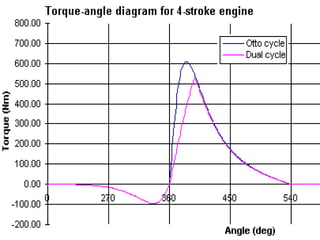
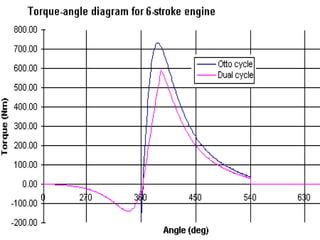
During the critical combustion period the rate of 
change in volume in the 6 stroke is less than a 4 
stroke. Minimum volume is not reached until after 
T.D.C., at 361 deg. This is because of the phasing 
of the upper piston. It is retarded in reaching its 
T.D.C. until 20 deg. after T. D.C. (380). This is 
much better from a thermodynamic view in that 
combustion occurs at a more constant volume; 
hence ignition timing is not as critical as in a 4 
stroke. There is room in the combustion chamber 
for up to 4 spark plugs and two direct injectors if 
needed.
Conclusion 
 In a six stroke engine the energy absorption is 
less because of slower acceleration of 
reciprocating parts The piston speed of the upper 
piston is about a quarter of the main piston; 
therefore its service life should be at least twice 
that of the main piston. 
 In the Beare design, per single cylinder, the 
number of parts is 15 compared to a four stroke of 
approx 40 to 50 parts. Also, to reduce 
manufacturing costs the head and block can be 
machined in o-ne piece.
The bottom piston is a standard design and the 
Beare Head bolts directly o-nto the engine block, 
replacing the overhead valves and standard head. 
It reduces the weight and complexity of the engines 
head by as much as 50%. Instead of using energy 
to drive the head, the head actually develops 
energy for conversion to power back through the 
timing chains of an engine. 
Torque is increased by 35% and efficiency 
increased by the same. This can be achieved by 
simply unbolting an existing head of a four-stroke 
engine and then bolting on a Beare Head.
Increased torque and power output, 
Better fuel economy and cleaner burning longer 
service intervals and considerably reduced tooling 
costs when compared with a conventional four-stroke 
design.
THANK YOU!!!!
QUeries ??? 
Contact me on 
achin.bajpai16@gmail.com

SIX STROKE INTERNAL COMBUSTION ENGINE

  • 1.
    SSIIXX SSTTRROOKKEE EENNGGIINNEE PPRREEPPAARREEDD BBYY::-- AACCHHIINN MM..tteecchh ((MMaannuuffaaccttuurriinngg EEnnggiinneeeerriinngg)) DDeepptt.. ooff MMeecchhaanniiccaall EEnnggiinneeeerriinngg
  • 2.
    CONTENTS  Introduction  How six stroke engine works  Working principles  Specification of six stroke engine  Comparison of six stroke engine with four stroke engine  Graphs  Gallery  Thermodynamic advantages  Conclusion
  • 3.
    Introduction Malcolm bearebuilt an innovative hybrid design of the I C engine , by combining a two stroke with a four stroke engine. The Beare Head is a new type of four stroke engine head design known as the “Beare Head”  The Beare Head uses a piston and ports very much like a two stroke engine to replace the over head valve system that is found in four stroke engines today. The four stroke block, pistons and crankshaft remain unaltered. This combination of two stroke and four stroke technology has given the engine its name – the “six stroke engine” (2 + 4 = 6).
  • 4.
     Key attributesof the Beare Head are:  Increased power,  Increased torque,  Fewer, lighter reciprocating parts,  Simpler manufacture.
  • 6.
    HOW SIX STROKEENGINE WORKS
  • 7.
    Below the cylinderhead gasket, everything is conventional, so one advantage is that the Beare concept can be transplanted on to existing engines without any need for redesigning or retooling the bottom end. But the cylinder head and its poppet valves get thrown away. To replace the camshaft and valves, Beare has retained the cam drive belt and fitted an ultra short-stroke upper crankshaft complete with piston, which the belt drives at half engine speed just as it previously drove the cam. This piston drives up and down in a sleeve, past inlet exhaust ports set into the cylinder wall, very much like on a two-stroke: these are all exposed during both inlet and exhaust strokes.
  • 10.
    Working Principle Fuelignites with piston at the top dead center.
  • 11.
    Rotary valve opens,allowing exhaust to escape
  • 12.
    Exhaust stroke begins when the piston is at bottom dead center
  • 13.
    Exhaust stroke ends,intake begins. rotary valve cuts exhaust .intake of charge into cylinder due to pressure difference.
  • 14.
    The intake stroke happens when the piston is on its downward path with the intake valve open. This action creates suction, drawing atomized fuel in this case gasoline mixed with air, into the combustion chamber.
  • 15.
    Top piston nearly closes complete inlet port and The compression begins.
  • 16.
    Combustion chamber completelysealed and ready for the combustion.
  • 17.
    The power stroke begins at a critical moment, just as the air-fuel mixture is at its most compressed. A supercharged voltage is delivered to the spark plugs from the ignition coil, at that point it ignites the fuel mixture. The valves in the engine are still closed during this period. Thus the explosion forces the piston down to turn the engine's crankshaft, delivering the power via the gearbox and clutch to the driving wheels.
  • 18.
    SPECIFICATION OF SIXSTROKE ENGINE PROTOTYPE 5 - DUCATI BASED
  • 20.
    Comparison Of SixStroke Engine With Four Stroke Engine
  • 22.
    1. In asix stroke engine the energy absorption is less because of slower acceleration of reciprocating parts. 2. It reduces the weight and complexity of the engines head by as much as 50%. Instead of using energy to drive the head. 3.Torque is increased by 35% and efficiency increased by the same. 4.Increased torque and power output.
  • 26.
  • 27.
    DISC VALVE Thepiston is half way up on the exhaust stroke. When the piston reaches TDC with the ports fully open, the disk will begin to cut off the exhaust. The valve runs clockwise
  • 28.
    CYLINDER HEAD FROMBELOW CYLINDER HEAD UPPER VIEW
  • 29.
    Thermodynamic Advantages Theintake begins at 0 degrees on the X-axis. The effect of the additional volume changes that the upper piston has on the volume of the engine is all positive from a thermodynamic point of view. If the engine were a normal 4 stroke the cylinder capacity would be 340cc. Of note - maximum volume at the end of the intake stroke occurs at 173 degrees instead of 180 degrees- the change in volume is 308cc which is less than a 4 stroke (340cc)- yet the total volume at the end of the intake stroke is 415cc as opposed to 375cc for a conventional stroke.
  • 30.
    Thermodynamic advantages The change in volume during the compression stroke is slightly greater than a 4 stroke after the ports are closed. The expansion stroke is much greater than a 4 stroke, both from T.D.C. to B.D.C. and from T.D.C. till the exhaust port is open. It is possible to leave the opening of the exhaust port later than in a 4 stroke because maximum volume is not reached until after B.D.C.-548 deg. Instead of 540 deg .
  • 31.
    Thermodynamic advantages Hencethe 6 stroke system is better from a thermodynamic point of view because more energy is extracted from the expansion process. During the critical combustion period the rate of change in volume in the 6 stroke is less than a 4 stroke. Minimum volume is not reached until after T.D.C., at 361 deg. This is because of the phasing of the upper piston. It is retarded in reaching its T.D.C. until 20 deg. after T. D.C. (380). This is much better from a thermodynamic view in that combustion occurs at a more constant volume; hence ignition timing is not as critical as in a 4 stroke. There is room in the combustion chamber for up to 4 spark plugs and two direct injectors if needed.
  • 32.
    Conclusion  Ina six stroke engine the energy absorption is less because of slower acceleration of reciprocating parts The piston speed of the upper piston is about a quarter of the main piston; therefore its service life should be at least twice that of the main piston.  In the Beare design, per single cylinder, the number of parts is 15 compared to a four stroke of approx 40 to 50 parts. Also, to reduce manufacturing costs the head and block can be machined in o-ne piece.
  • 33.
    The bottom pistonis a standard design and the Beare Head bolts directly o-nto the engine block, replacing the overhead valves and standard head. It reduces the weight and complexity of the engines head by as much as 50%. Instead of using energy to drive the head, the head actually develops energy for conversion to power back through the timing chains of an engine. Torque is increased by 35% and efficiency increased by the same. This can be achieved by simply unbolting an existing head of a four-stroke engine and then bolting on a Beare Head.
  • 34.
    Increased torque andpower output, Better fuel economy and cleaner burning longer service intervals and considerably reduced tooling costs when compared with a conventional four-stroke design.
  • 35.
  • 36.
    QUeries ??? Contactme on achin.bajpai16@gmail.com