6-STROKE ENGINE
PRESENTED BY:-
AJIT KUMAR SAHOO
REGD NO:-1421108002
INTRODUCTION
The SIX-STROKE Engine is a type 
of internal combustion engine based on 
the four-stroke engine, but with additional 
complexity intended to make it more 
efficient and reduce emissions.
There are two power strokes: one with 
fuel, the other with steam or air.
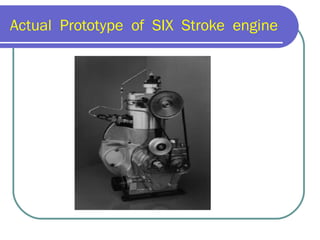
Actual Prototype of SIX Stroke engine
COMPARISON OF 4-stroke and 6-stroke
Engine
4-stroke
 One Power Stroke
 Up to 35% Efficiency
 More Emissions
 Minimal Power
 One Working Fluid
 6-stroke
 Two Power Stroke
 Up to 45% Efficiency
 Comparatively Less 
Emission
 More Power
 Two Working Fluid
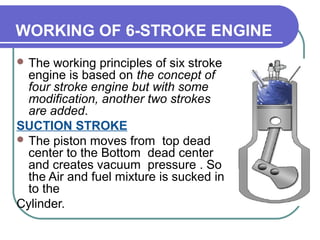
WORKING OF 6-STROKE ENGINE
 The working principles of six stroke 
engine is based on the concept of
four stroke engine but with some
modification, another two strokes
are added.
SUCTION STROKE
 The piston moves from  top dead 
center to the Bottom  dead center 
and creates vacuum  pressure . So 
the Air and fuel mixture is sucked in 
to the 
Cylinder.
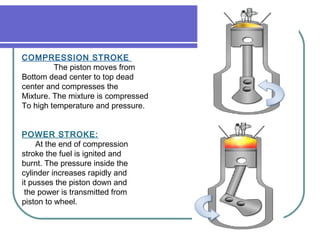
COMPRESSION STROKE
The piston moves from
Bottom dead center to top dead
center and compresses the
Mixture. The mixture is compressed
To high temperature and pressure.
POWER STROKE:
At the end of compression
stroke the fuel is ignited and
burnt. The pressure inside the
cylinder increases rapidly and
it pusses the piston down and
the power is transmitted from
piston to wheel.
EXHAUST STROKE:
The Burnt product is
pushed through the exhaust
valve by the upward movement
of the piston.
SECONDARY POWER STROKE:
At the end of the exhaust
stroke the cylinder temperature
becomes around 900-10000 C. At
this stage water is injected by an
Injector in the form of fine droplets.
The water turns in to vapour
increasing volume around 1600
times when it comes in contact
with the superheated cylinder.
The water turns into vapour
increasing volume around
1600 times when it comes in
contact with the superheated
cylinder.
SECONDARY EXHAUST STROKE:
In this stroke the water vapour
is exhausted by the upward
motion of the piston.
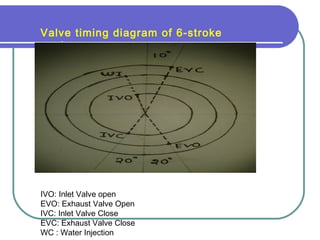
Valve timing diagram of 6-stroke
engine
IVO: Inlet Valve open
EVO: Exhaust Valve Open
IVC: Inlet Valve Close
EVC: Exhaust Valve Close
WC : Water Injection
Cycle analysis and Comparison
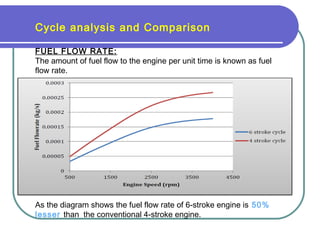
FUEL FLOW RATE:
The amount of fuel flow to the engine per unit time is known as fuel
flow rate.
As the diagram shows the fuel flow rate of 6-stroke engine is 50%
lesser than the conventional 4-stroke engine.
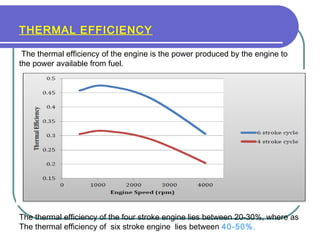
THERMAL EFFICIENCY
The thermal efficiency of the engine is the power produced by the engine to
the power available from fuel.
The thermal efficiency of the four stroke engine lies between 20-30%, where as
The thermal efficiency of six stroke engine lies between 40-50%.
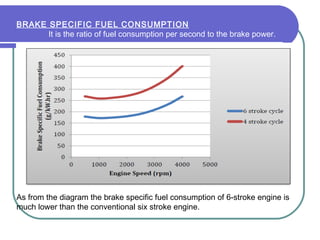
BRAKE SPECIFIC FUEL CONSUMPTION
It is the ratio of fuel consumption per second to the brake power.
As from the diagram the brake specific fuel consumption of 6-stroke engine is
much lower than the conventional six stroke engine.
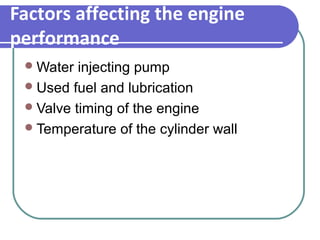
Factors affecting the engine
performance
Water injecting pump
Used fuel and lubrication
Valve timing of the engine
Temperature of the cylinder wall
MODIFICATIONS REQUIRED
FUEL TANK:
 The fuel tank should divided into two parts, as one part will contain fuel and the
other part will contain water. The water used should be neutral and distilled.
ENGINE COMPONENTS MATERIAL
The engine components like piston, cylinder , cam, crank, valves etc. are
subjected to severe thermal stress. The thermal stress developed due to the
injection of water into the very hot cylinder. The rapid temperature changes
may cause micro crack and fractures in the engine components as the
periodical compression and expansion takes place.
So the engine components should be designed with high thermal resistive
metal alloys to withstand the stress and prevent failure of engine.
The materials that can be used are…
 Silicon Nitride(Si3N4)
 Silicon Carbide(SiC)
 Zirconia(ZrO2)
 Alumina-Tungsten alloy etc.
CAM-SHAFT DESIGN
In four stroke original angular speed of camshaft is one
half of the crankshaft. The crankshaft rotates once for
every two revolution of the crank shaft.
4-
stroke
The camshaft of 6-stroke engine contains three cams.
Intake cam
Exhaust cam
Water injector cam
6-stroke
Water Injection:
The water injection is done by the help of water injector which is
operated by the cam. This thing can be done more effectively by the use of
Water metering pump or by the progressive cavity pump.
Water metering Pump:
A positive displacement pump capable of driving a fixed quantity of
water into the cylinder at regular intervals, independent of the back
pressure applied
ADVANTAGES
 There is 40% reduction in fuel consumption.
 Extracts work from heat that is ordinarily lost
through the cooling system of a conventional
engine.
 Reduces exhaust emissions per a given
power range.
 Steam stroke cools the engine internally
hence the use of much higher compression
ratios.
 The weight and power loss of conventional
cooling system parts can be eliminated.
Limitations and Obstacles
 Injecting relatively cold water onto a hot
metal piston can damage it over time from
thermal expansion and contraction.
 Separate water tank would have significant
weight and space penalties
 A steam-free cool down reduces the
temperature inside the combustion
chamber.
 Cold climate anti-freezing measures would
be needed in the water reservoir.
6 strokeengine-BY AJIT

6 strokeengine-BY AJIT

  • 1.
    6-STROKE ENGINE PRESENTED BY:- AJITKUMAR SAHOO REGD NO:-1421108002
  • 2.
  • 3.
    Actual Prototype ofSIX Stroke engine
  • 4.
    COMPARISON OF 4-strokeand 6-stroke Engine 4-stroke  One Power Stroke  Up to 35% Efficiency  More Emissions  Minimal Power  One Working Fluid  6-stroke  Two Power Stroke  Up to 45% Efficiency  Comparatively Less  Emission  More Power  Two Working Fluid
  • 5.
    WORKING OF 6-STROKEENGINE  The working principles of six stroke  engine is based on the concept of four stroke engine but with some modification, another two strokes are added. SUCTION STROKE  The piston moves from  top dead  center to the Bottom  dead center  and creates vacuum  pressure . So  the Air and fuel mixture is sucked in  to the  Cylinder.
  • 6.
    COMPRESSION STROKE The pistonmoves from Bottom dead center to top dead center and compresses the Mixture. The mixture is compressed To high temperature and pressure. POWER STROKE: At the end of compression stroke the fuel is ignited and burnt. The pressure inside the cylinder increases rapidly and it pusses the piston down and the power is transmitted from piston to wheel.
  • 7.
    EXHAUST STROKE: The Burntproduct is pushed through the exhaust valve by the upward movement of the piston. SECONDARY POWER STROKE: At the end of the exhaust stroke the cylinder temperature becomes around 900-10000 C. At this stage water is injected by an Injector in the form of fine droplets. The water turns in to vapour increasing volume around 1600 times when it comes in contact with the superheated cylinder.
  • 8.
    The water turnsinto vapour increasing volume around 1600 times when it comes in contact with the superheated cylinder. SECONDARY EXHAUST STROKE: In this stroke the water vapour is exhausted by the upward motion of the piston.
  • 9.
    Valve timing diagramof 6-stroke engine IVO: Inlet Valve open EVO: Exhaust Valve Open IVC: Inlet Valve Close EVC: Exhaust Valve Close WC : Water Injection
  • 10.
    Cycle analysis andComparison FUEL FLOW RATE: The amount of fuel flow to the engine per unit time is known as fuel flow rate. As the diagram shows the fuel flow rate of 6-stroke engine is 50% lesser than the conventional 4-stroke engine.
  • 11.
    THERMAL EFFICIENCY The thermalefficiency of the engine is the power produced by the engine to the power available from fuel. The thermal efficiency of the four stroke engine lies between 20-30%, where as The thermal efficiency of six stroke engine lies between 40-50%.
  • 12.
    BRAKE SPECIFIC FUELCONSUMPTION It is the ratio of fuel consumption per second to the brake power. As from the diagram the brake specific fuel consumption of 6-stroke engine is much lower than the conventional six stroke engine.
  • 13.
    Factors affecting theengine performance Water injecting pump Used fuel and lubrication Valve timing of the engine Temperature of the cylinder wall
  • 14.
    MODIFICATIONS REQUIRED FUEL TANK: The fuel tank should divided into two parts, as one part will contain fuel and the other part will contain water. The water used should be neutral and distilled. ENGINE COMPONENTS MATERIAL The engine components like piston, cylinder , cam, crank, valves etc. are subjected to severe thermal stress. The thermal stress developed due to the injection of water into the very hot cylinder. The rapid temperature changes may cause micro crack and fractures in the engine components as the periodical compression and expansion takes place. So the engine components should be designed with high thermal resistive metal alloys to withstand the stress and prevent failure of engine. The materials that can be used are…  Silicon Nitride(Si3N4)  Silicon Carbide(SiC)  Zirconia(ZrO2)  Alumina-Tungsten alloy etc.
  • 15.
    CAM-SHAFT DESIGN In fourstroke original angular speed of camshaft is one half of the crankshaft. The crankshaft rotates once for every two revolution of the crank shaft. 4- stroke
  • 16.
    The camshaft of6-stroke engine contains three cams. Intake cam Exhaust cam Water injector cam 6-stroke
  • 17.
    Water Injection: The waterinjection is done by the help of water injector which is operated by the cam. This thing can be done more effectively by the use of Water metering pump or by the progressive cavity pump. Water metering Pump: A positive displacement pump capable of driving a fixed quantity of water into the cylinder at regular intervals, independent of the back pressure applied
  • 18.
    ADVANTAGES  There is40% reduction in fuel consumption.  Extracts work from heat that is ordinarily lost through the cooling system of a conventional engine.  Reduces exhaust emissions per a given power range.  Steam stroke cools the engine internally hence the use of much higher compression ratios.  The weight and power loss of conventional cooling system parts can be eliminated.
  • 19.
    Limitations and Obstacles Injecting relatively cold water onto a hot metal piston can damage it over time from thermal expansion and contraction.  Separate water tank would have significant weight and space penalties  A steam-free cool down reduces the temperature inside the combustion chamber.  Cold climate anti-freezing measures would be needed in the water reservoir.