Download to read offline
![IOSR Journal of Mechanical and Civil Engineering (IOSR-JMCE)
e-ISSN: 2278-1684,p-ISSN: 2320-334X, Volume 12, Issue 4 Ver. III (Jul. - Aug. 2015), PP 07-11
www.iosrjournals.org
DOI: 10.9790/1684-12430711 www.iosrjournals.org 7 | Page
A Review: Six Stroke Internal Combustion Engine
Dheeraj Makheeja
(Department of Mechanical Engineering, S S College of Engineering, India)
Abstract: A Six Stroke Engine is that in which the power is obtained twice in a cycle of six strokes. This engine
generates more power with higher fuel efficiency than the existing engines. As a result a new engine concept is
formed, which is a six stroke engine. Lot of research work has been conducted on this topic nowadays. In a
typical four stroke diesel engine, Piston moves up and down twice in the cylinder during one rotation of crank.
The power stroke is obtained once during the two cycles that generates the torque to move vehicle. In Six stroke
engine the power stroke is obtained two times out of six strokes. The automobile industry is now seeking for the
best six-stroke design which adds one more power stroke which results more efficiency and better utilization of
the fuel. The main advantages of six stroke engine are two power strokes in the six stroke cycle, reduction in fuel
consumption by 30-40 percent, dramatic reduction in pollution, adaptability to different fuel operation.
Development of Six stroke engines by the automobile industry would have a tremendous impact on the
environment and economy. The developed six stroke engines, Beare head, Bruce crowers and Velozeta’s are
undergoing tremendous research works.
In this paper the concept, features and the comparative discussion on six-stroke diesel engine is done.
I. Introduction
The six-stroke engine is a type of internal combustion engine with an advance feature of more power
generation some complexity intended to make it more efficient and utilize the fuel. These engines almost consist
of similar components as that of the four stroke engine with addition of two more valves. The working concept
is similar to the actual internal reciprocating combustion engine as a reciprocal movement which is converted
into a rotating movement by means of a connecting rod and of a crankshaft.
The brief explanation of working of the four stroke engine is it consists of two cycles. In first stroke is
suction as the piston moves down air-fuel is intake after the 180 degree rotation of the crank the piston moves up
and compresses the fuel mixture this is the compression stroke. When the piston comes to close to the dead
centre the fuel an ignition plug ignites the mixture by means of a spark which provokes a sudden rise of
temperature and of pressure. This is known as the power stroke and as the fuel burn the piston permits the
combustion gases to expand the piston moves down with high torque. The piston moves down fast and again
comes up meanwhile the exhaust valve opens and all the burned gases are exhausted. The diesel engine uses a
comparable principle where the difference resides in the way of introducing the fuel, which, in this case, is
directly injected into the compressed, and therefore hot air, and flames up then spontaneously. [1]
The six-stroke engine is a radical hybridization of two and four stroke engine that the top portion of
two stroke engines and the bottom rather the middle section of a four stroke engine. In six-stroke cycle, two
parallel functions occur in two chambers which result in eight event cycle: four events internal combustion cycle
and four event external Combustion cycles. [2]
The first cycle of four events is of external combustion.
Pure air intake in the cylinder.
Pure air compression in the heating chamber.
Keeping pure air pressure in closed chamber where a maximum heat exchange occurs with the combustion
chambers walls, without direct action on the crankshaft.
Expansion of the super heated air in the cylinder, work.
During this four event's cycle, the pure air never comes in direct contact with the heating source.
The second cycle of four events is of internal combustion.
Re-compressions of pure heated air in the combustion chamber.
Fuel injection and combustion in closed combustion chamber, without direct action on the crankshaft.
Combustion gases expanding in the cylinder, work.
Combustion gases exhaust.
During these four events, the air comes in direct contact with the heating source.](https://image.slidesharecdn.com/b012430711-160711060059/85/B012430711-1-320.jpg)
![IOSR Journal of Mechanical and Civil Engineering (IOSR-JMCE)
e-ISSN: 2278-1684,p-ISSN: 2320-334X, Volume 12, Issue 4 Ver. III (Jul. - Aug. 2015), PP 07-11
www.iosrjournals.org
DOI: 10.9790/1684-12430711 www.iosrjournals.org 7 | Page
A Review: Six Stroke Internal Combustion Engine
Dheeraj Makheeja
(Department of Mechanical Engineering, S S College of Engineering, India)
Abstract: A Six Stroke Engine is that in which the power is obtained twice in a cycle of six strokes. This engine
generates more power with higher fuel efficiency than the existing engines. As a result a new engine concept is
formed, which is a six stroke engine. Lot of research work has been conducted on this topic nowadays. In a
typical four stroke diesel engine, Piston moves up and down twice in the cylinder during one rotation of crank.
The power stroke is obtained once during the two cycles that generates the torque to move vehicle. In Six stroke
engine the power stroke is obtained two times out of six strokes. The automobile industry is now seeking for the
best six-stroke design which adds one more power stroke which results more efficiency and better utilization of
the fuel. The main advantages of six stroke engine are two power strokes in the six stroke cycle, reduction in fuel
consumption by 30-40 percent, dramatic reduction in pollution, adaptability to different fuel operation.
Development of Six stroke engines by the automobile industry would have a tremendous impact on the
environment and economy. The developed six stroke engines, Beare head, Bruce crowers and Velozeta’s are
undergoing tremendous research works.
In this paper the concept, features and the comparative discussion on six-stroke diesel engine is done.
I. Introduction
The six-stroke engine is a type of internal combustion engine with an advance feature of more power
generation some complexity intended to make it more efficient and utilize the fuel. These engines almost consist
of similar components as that of the four stroke engine with addition of two more valves. The working concept
is similar to the actual internal reciprocating combustion engine as a reciprocal movement which is converted
into a rotating movement by means of a connecting rod and of a crankshaft.
The brief explanation of working of the four stroke engine is it consists of two cycles. In first stroke is
suction as the piston moves down air-fuel is intake after the 180 degree rotation of the crank the piston moves up
and compresses the fuel mixture this is the compression stroke. When the piston comes to close to the dead
centre the fuel an ignition plug ignites the mixture by means of a spark which provokes a sudden rise of
temperature and of pressure. This is known as the power stroke and as the fuel burn the piston permits the
combustion gases to expand the piston moves down with high torque. The piston moves down fast and again
comes up meanwhile the exhaust valve opens and all the burned gases are exhausted. The diesel engine uses a
comparable principle where the difference resides in the way of introducing the fuel, which, in this case, is
directly injected into the compressed, and therefore hot air, and flames up then spontaneously. [1]
The six-stroke engine is a radical hybridization of two and four stroke engine that the top portion of
two stroke engines and the bottom rather the middle section of a four stroke engine. In six-stroke cycle, two
parallel functions occur in two chambers which result in eight event cycle: four events internal combustion cycle
and four event external Combustion cycles. [2]
The first cycle of four events is of external combustion.
Pure air intake in the cylinder.
Pure air compression in the heating chamber.
Keeping pure air pressure in closed chamber where a maximum heat exchange occurs with the combustion
chambers walls, without direct action on the crankshaft.
Expansion of the super heated air in the cylinder, work.
During this four event's cycle, the pure air never comes in direct contact with the heating source.
The second cycle of four events is of internal combustion.
Re-compressions of pure heated air in the combustion chamber.
Fuel injection and combustion in closed combustion chamber, without direct action on the crankshaft.
Combustion gases expanding in the cylinder, work.
Combustion gases exhaust.
During these four events, the air comes in direct contact with the heating source.](https://image.slidesharecdn.com/b012430711-160711060059/75/B012430711-1-2048.jpg)
![A Review: Six Stroke Internal Combustion Engine
DOI: 10.9790/1684-12430711 www.iosrjournals.org 8 | Page
II. Principle Of Six-Stroke Engine
The six-stroke engine describes a number of approaches in IC engine to utilize the waste heat from the
4-stroke diesel cycle or Otto cycle and use it to generate more power. Generally the one compression and one
power strokes are added to cycle which higher the thermal efficiency and reduces the fuel consumption. The
piston in six-stroke engine moves up and down six times for each injection of fuel. The first four strokes are
same as that of the 4-stroke engine after the exhaust the fuel-air mixture is again compressed and burned gases
are removed during the sixth stroke. The glowing combustion chamber allows the optimal burning of any fuel
and calcinate the residues.
The first stroke of the six-stroke cycle, i.e. the admission of the air or of the air-fuel mixture, involves
only low pressure admission cylinders. The third and fourth strokes of this same cycle, i.e. the second
compression and the first expansion of the combustion gases respectively, involve only high pressure
combustion cylinders. The final discharge of the combustion gases under low pressure, which represents the
sixth stroke of the cycle, involves only low pressure admission cylinders and low pressure discharge cylinders
The engine shows 30-40 percent reduction in fuel consumption and also economical. The engine can
also use variety of fuel. As the engine has two powers stroke that gives the efficient burning of the fuel and
lower the pollution. [3]
III. Analysis Of Six Stroke Engine
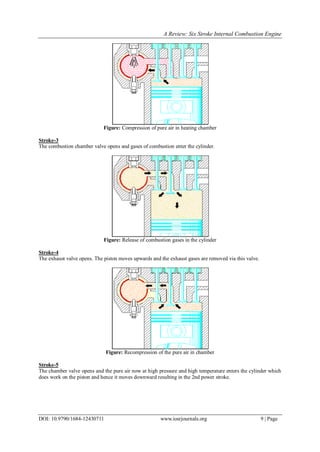
The six-stroke engine consists of six stroke and these are shown in figure the each figure shows the movement
of the air-fuel mixture, valves and piston. The name of the components are-
1. Intake valve
2. Heating chamber valve
3. Combustion chamber valve
4. Exhaust valve
5. Cylinder
6. Combustion chamber
7. Air heating chamber
8. Wall of combustion chamber
9. Fuel injector
10. Heater plug
Stroke-1
The inlet valve is kept open. Due to cranking, Piston moves downward which results in the formation of a
pressure difference due to which pure air enters the cylinder.
Fig: Intake of pure air in cylinder
Stroke-2
The inlet valve closes and the heating chamber valve opens. The piston moves upward due to cranking forcing
air into heating chamber. The air at this stage is converted to high pressure.](https://image.slidesharecdn.com/b012430711-160711060059/85/B012430711-2-320.jpg)
![A Review: Six Stroke Internal Combustion Engine
DOI: 10.9790/1684-12430711 www.iosrjournals.org 10 | Page
Figure: Release of pure air into cylinder
Stroke-6
Finally the combustion chamber valve opens. The piston moves upwards forces the pure air into the combustion
chamber. [4]
Figure: Exhaust of combustion gases
IV. Major Inventors Of Six-Stroke Engine
Beare Head
The term "Six Stroke" was coined by the inventor of the Beare Head, Malcolm Beare of Australia. The
technology combines a four stroke engine bottom end with an opposed piston in the cylinder head working at
half the cyclical rate of the bottom piston. Functionally, the second piston replaces the valve mechanism of a
conventional engine.[5]
Bruce Crowers
In a six-stroke engine prototyped in the United States by Bruce Crower, water is injected into the
cylinder after the exhaust stroke and is instantly turned to steam, which expands and forces the piston down for
an additional power stroke. Thus, waste heat that requires an air or water cooling system to discharge in most
engines is captured and put to use driving the piston.[6]
Crower estimated that his design would reduce fuel
consumption by 40% by generating the same power output at a lower RPM. The weight associated with a
cooling system could be eliminated, but that would be balanced by a need for a water tank in addition to the
normal fuel tank. Leonard Dyer invented the first six-stroke internal combustion water injection engine in 1915,
very similar to Crower's design. A dozen more similar patents have been issued since.
Dyer's six-stroke engine features:
No cooling system required
Improves a typical engine’s fuel consumption
Requires a supply of pure water to act as the medium for the second power stroke.
Extracts the additional power from the expansion of steam.](https://image.slidesharecdn.com/b012430711-160711060059/85/B012430711-4-320.jpg)
![A Review: Six Stroke Internal Combustion Engine
DOI: 10.9790/1684-12430711 www.iosrjournals.org 11 | Page
Velozeta’s
In a Velozeta engine, fresh air is injected into the cylinder during the exhaust stroke, which expands by
heat and therefore forces the piston down for an additional stroke. The valve overlaps have been removed and
the two additional strokes using air injection provide for better gas scavenging. [5]
V. Advantages And Disadvantages
An operating efficiency is of approximately 50%, hence the large reduction in specific consumption.
The specific power of the six-stroke engine will not be less than that of a four-stroke petrol engine, the increase
in thermal efficiency compensating for the issue due to the two additional strokes. Chemical, noise and thermal
pollution are reduced. There occurs no problem in combustion due inflammability difference in six stroke
engine. Better combustion and expansion of gases that take place over 540°
of crankshaft rotation, 360° of which
is in closed combustion chamber, and 180° for expansion. It has less inertia due to the lightness of the moving
parts. [6]
It has also some disadvantages as brake power & indicated power per cycle per cylinder is
comparatively lesser. The Engine size increases due to number of cylinders & additional components. These
engines are complex in design and hence higher manufacturing cost. [7]
VI. Conclusion
From the above data the concept and working of the six-stroke engine can be understood. Six stroke
engines with all the desired qualities as better from four stroke engines will be hitting the market soon. Reducing
fuel consumption and pollution without any effect on performance will reassessed the concept of automobile.
Only improvements of the current technology can help it progress within reasonable time and financial limits.
The six-stroke engine fits perfectly into this view. Its adoption by the automobile industry would have a good
impact on the environment and world economy.
Reference
[1]. Patents-US4917054
[2]. http://en.wikipedia.org/wiki/Six-stroke_engine
[3]. "Six-stroke engine." No. 2409339. 6 Dec. 2000
[4]. http://mechsters.blogspot.in/2010/10/technical-paper-on-six-stroke-engines.html
[5]. http://www.sixstroke.com/images/history/border_november_1994.pdf First use of "sixstroke" 1994
[6]. Lyons, Pete (2006-02-27). "Inside Bruce Crower’s Six-Stroke Engine". www.autoweek.com. Retrieved 2012-07-28.
[7]. "A brilliant six-stroke from techies" 14 February 2007. Archived from the original on 22 February 2013. Retrieved 8 May 2012.](https://image.slidesharecdn.com/b012430711-160711060059/85/B012430711-5-320.jpg)

The document discusses the concept and working of a six-stroke internal combustion engine. A six-stroke engine generates power twice per cycle by adding two additional strokes to the traditional four-stroke cycle. This results in higher efficiency and lower fuel consumption compared to four-stroke engines. The six-stroke cycle includes intake, compression, power, exhaust, and two additional strokes where heated air is used to generate a second power stroke. Major inventors who developed six-stroke engines include Malcolm Beare, Bruce Crower, and Velozeta. The advantages are increased efficiency and reduced emissions, but disadvantages include increased complexity and cost.


