Department of Mechanical Engineering
A Seminar Presentation On
Introduction
Types of Six stroke engines
Bajulaz Six stroke Diesel engine
Dual fuel Six stroke engine
Comparison
Specifications
Features
Performance and economy
Conclusion
The six-stroke engine is a type of internal
combustion engine based on the four-stroke
engine.
First developed in early 1990’s
Advancement is the Duel fuel six stroke
diesel engine
More efficient & reduce emissions.
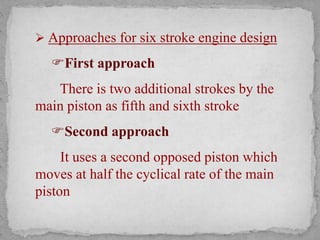
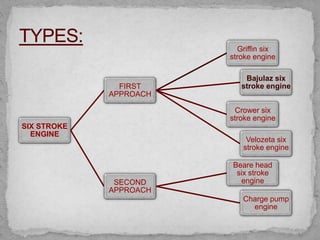
 Approaches for six stroke engine design
First approach
There is two additional strokes by the
main piston as fifth and sixth stroke
Second approach
It uses a second opposed piston which
moves at half the cyclical rate of the main
piston
SIX STROKE
ENGINE
FIRST
APPROACH
Griffin six
stroke engine
Bajulaz six
stroke engine
Crower six
stroke engine
Velozeta six
stroke engine
SECOND
APPROACH
Beare head
six stroke
engine
Charge pump
engine
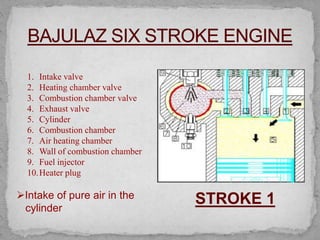
1. Intake valve
2. Heating chamber valve
3. Combustion chamber valve
4. Exhaust valve
5. Cylinder
6. Combustion chamber
7. Air heating chamber
8. Wall of combustion chamber
9. Fuel injector
10.Heater plug
STROKE 1Intake of pure air in the
cylinder
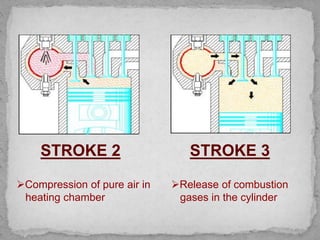
STROKE 2 STROKE 3
Compression of pure air in
heating chamber
Release of combustion
gases in the cylinder
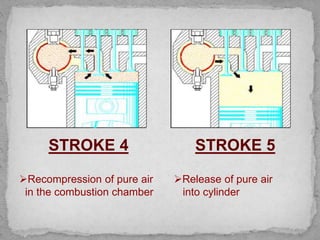
STROKE 4 STROKE 5
Release of pure air
into cylinder
Recompression of pure air
in the combustion chamber
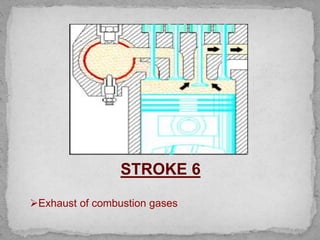
STROKE 6
Exhaust of combustion gases
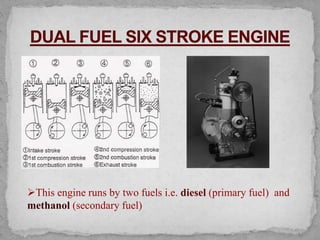
This engine runs by two fuels i.e. diesel (primary fuel) and
methanol (secondary fuel)
Table 1. Specifications of the test engine:
Four stoke Six stroke
Diesel Engine Diesel Engine
Engine type DI, Single cylinder, Air cooled, OHV
Bore x Stroke [mm] 82 x 78
Displacement [cc] 412
Top Clearance [mm] 0.9
Cavity Volume [cc] 16
Compression ratio 21
Intake Valve Open 100
BTDC 70
BTDC
Intake valve Close 1400
BTDC 1450
BTDC
Exhaust Valve Open 1350
ATDC 1400
ATDC
Exhaust Valve Close 120
ATDC 30
ATDC
Valve Overlap 220
100
Rated power 5.9 kW /3000rpm
Base Engine ----------------
Comparison between four stroke & six stroke diesel engines
Engine Parameters
Four Stroke
Diesel Engine
Six Stroke
Diesel Engine
Engine Speed Ne [rpm] 2007 2016
Supplied combustion heat per cycle
Qt [KJ/cycle] 0.50 0.68
Supplied combustion heat per unit time Ht [KJ/s]
8.36 7.62
Intake air flow per cycle
Ma [mg/cycle] 358.7 371.4
Injection quantity per cycle
Mf [mg/cycle] 11.8 16
Excess air ratio λ 2.40 1.83
Intake air flow per unit time
Ma [g/cycle] 6.00 4.16
Injection quantity per unit time
Mf [g/sec] 0.197 0.179
Brake torque Tb [N-m] 15.52 15.28
Brake power Lb [KW] 3.26 3.24
BSFC. b [ g / KW-h] 217.9 520.3
IMEP Pi [Kgf / cm2] 5.94 4.37
Indicated torque Ti [N-m] 19.10 18.71
Indicated power Li [KW] 4.01 3.75
ISFC bi [g / KW-h ] 177.2 163.3
Comparison between six stroke diesel & dual fuel six stroke engines
Diesel Fuel Six Stroke
Diesel Engine
Dual Fuel Six Stroke
Diesel Engine
Engine Speed Ne [rpm] 2016 2006
Supplied combustion heat per cycle
Qt [kJ/cycle] 0.68
Injection quantity per cycle
(First Combustion Stroke)
Mf1 [mg/cycle]
8.0
(Diesel Fuel)
Injection quantity per cycle
(Second Combustion Stroke)
Mf2 [mg/cycle]
8.0
(Diesel Fuel)
17.2
(Methanol)
Excess air ratio λ 1.86 1.93
Brake torque Tb [N-m] 6.18 6.08
Brake power Lb [kW] 1.52 1.5
B.S.F.C. b [ g / kW.h] 504.0 777.7
I.M.E.P. Pi [kgf / cm2] 4.56 4.75
Indicated torque Ti [N-m] 21.68 20.38
Indicated power Li [kW] 3.45 2.98
I.S.F.C. bi [g / kW.h ] 155.5 236.2
Indicated specific heat consumption
bi’ [MJ /kW.h] 6.61 6.37
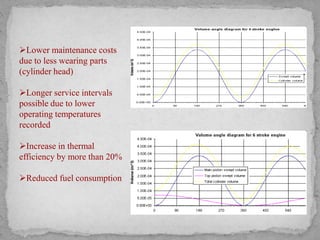
Lower maintenance costs
due to less wearing parts
(cylinder head)
Longer service intervals
possible due to lower
operating temperatures
recorded
Increase in thermal
efficiency by more than 20%
Reduced fuel consumption
Four Stroke
Diesel Engine
Six Stroke Diesel
Engine
Dual Fuel Six
Stroke Engine
Nitrous Oxide [ppm]
( % improvement) 768
113
(85.3%)
90.5
(88.2%)
Soot [%]
(%improvement) 6.8
28.8
(- 323.5%)
0
(100%)
Indicated specific heat consumption
bi’ [MJ/KW-h]
(% improvement)
7.51 6.61
(12.0%)
6.37
(15.2%)
Reduction in fuel consumption by at least 40%
Two expansions(work/Power stroke) in six strokes
Dramatic reduction in pollution ( up to 65%)
Higher overall efficiency
Lower engine temperature & noise level
Due to more air intake, the cooling system is improved
Better scavenging and more extraction of work per cycle
Less inertia due to lightness of moving parts
Brake power & indicated power per cycle per
cylinder is comparatively lesser
Engine size increases due to many number of
cylinders & additional components
Higher manufacturing cost of six stroke engine
Automobiles, heavy goods, construction-site and
farm vehicles.
motor-pumps, generator sets, stationary engines,
etc....intended for agriculture and industry.
Motorboats
Drastically reducing fuel consumption (by 40%) and
pollution (by 60-90%) without radically affecting
performances
For the dual fuel six-stroke engine, soot & nitrous oxide was
practically eliminated by a small amount of methanol in the
second combustion process.
It enables lower engine temperature and therefore increases
in the overall efficiency.
ROBIN CHAUHAN

ROBIN CHAUHAN

  • 1.
    Department of MechanicalEngineering A Seminar Presentation On
  • 2.
    Introduction Types of Sixstroke engines Bajulaz Six stroke Diesel engine Dual fuel Six stroke engine Comparison Specifications Features Performance and economy Conclusion
  • 3.
    The six-stroke engineis a type of internal combustion engine based on the four-stroke engine. First developed in early 1990’s Advancement is the Duel fuel six stroke diesel engine More efficient & reduce emissions.
  • 4.
     Approaches forsix stroke engine design First approach There is two additional strokes by the main piston as fifth and sixth stroke Second approach It uses a second opposed piston which moves at half the cyclical rate of the main piston
  • 5.
    SIX STROKE ENGINE FIRST APPROACH Griffin six strokeengine Bajulaz six stroke engine Crower six stroke engine Velozeta six stroke engine SECOND APPROACH Beare head six stroke engine Charge pump engine
  • 6.
    1. Intake valve 2.Heating chamber valve 3. Combustion chamber valve 4. Exhaust valve 5. Cylinder 6. Combustion chamber 7. Air heating chamber 8. Wall of combustion chamber 9. Fuel injector 10.Heater plug STROKE 1Intake of pure air in the cylinder
  • 7.
    STROKE 2 STROKE3 Compression of pure air in heating chamber Release of combustion gases in the cylinder
  • 8.
    STROKE 4 STROKE5 Release of pure air into cylinder Recompression of pure air in the combustion chamber
  • 9.
    STROKE 6 Exhaust ofcombustion gases
  • 10.
    This engine runsby two fuels i.e. diesel (primary fuel) and methanol (secondary fuel)
  • 12.
    Table 1. Specificationsof the test engine: Four stoke Six stroke Diesel Engine Diesel Engine Engine type DI, Single cylinder, Air cooled, OHV Bore x Stroke [mm] 82 x 78 Displacement [cc] 412 Top Clearance [mm] 0.9 Cavity Volume [cc] 16 Compression ratio 21 Intake Valve Open 100 BTDC 70 BTDC Intake valve Close 1400 BTDC 1450 BTDC Exhaust Valve Open 1350 ATDC 1400 ATDC Exhaust Valve Close 120 ATDC 30 ATDC Valve Overlap 220 100 Rated power 5.9 kW /3000rpm Base Engine ----------------
  • 13.
    Comparison between fourstroke & six stroke diesel engines Engine Parameters Four Stroke Diesel Engine Six Stroke Diesel Engine Engine Speed Ne [rpm] 2007 2016 Supplied combustion heat per cycle Qt [KJ/cycle] 0.50 0.68 Supplied combustion heat per unit time Ht [KJ/s] 8.36 7.62 Intake air flow per cycle Ma [mg/cycle] 358.7 371.4 Injection quantity per cycle Mf [mg/cycle] 11.8 16 Excess air ratio λ 2.40 1.83 Intake air flow per unit time Ma [g/cycle] 6.00 4.16 Injection quantity per unit time Mf [g/sec] 0.197 0.179 Brake torque Tb [N-m] 15.52 15.28 Brake power Lb [KW] 3.26 3.24 BSFC. b [ g / KW-h] 217.9 520.3 IMEP Pi [Kgf / cm2] 5.94 4.37 Indicated torque Ti [N-m] 19.10 18.71 Indicated power Li [KW] 4.01 3.75 ISFC bi [g / KW-h ] 177.2 163.3
  • 14.
    Comparison between sixstroke diesel & dual fuel six stroke engines Diesel Fuel Six Stroke Diesel Engine Dual Fuel Six Stroke Diesel Engine Engine Speed Ne [rpm] 2016 2006 Supplied combustion heat per cycle Qt [kJ/cycle] 0.68 Injection quantity per cycle (First Combustion Stroke) Mf1 [mg/cycle] 8.0 (Diesel Fuel) Injection quantity per cycle (Second Combustion Stroke) Mf2 [mg/cycle] 8.0 (Diesel Fuel) 17.2 (Methanol) Excess air ratio λ 1.86 1.93 Brake torque Tb [N-m] 6.18 6.08 Brake power Lb [kW] 1.52 1.5 B.S.F.C. b [ g / kW.h] 504.0 777.7 I.M.E.P. Pi [kgf / cm2] 4.56 4.75 Indicated torque Ti [N-m] 21.68 20.38 Indicated power Li [kW] 3.45 2.98 I.S.F.C. bi [g / kW.h ] 155.5 236.2 Indicated specific heat consumption bi’ [MJ /kW.h] 6.61 6.37
  • 15.
    Lower maintenance costs dueto less wearing parts (cylinder head) Longer service intervals possible due to lower operating temperatures recorded Increase in thermal efficiency by more than 20% Reduced fuel consumption
  • 16.
    Four Stroke Diesel Engine SixStroke Diesel Engine Dual Fuel Six Stroke Engine Nitrous Oxide [ppm] ( % improvement) 768 113 (85.3%) 90.5 (88.2%) Soot [%] (%improvement) 6.8 28.8 (- 323.5%) 0 (100%) Indicated specific heat consumption bi’ [MJ/KW-h] (% improvement) 7.51 6.61 (12.0%) 6.37 (15.2%)
  • 17.
    Reduction in fuelconsumption by at least 40% Two expansions(work/Power stroke) in six strokes Dramatic reduction in pollution ( up to 65%) Higher overall efficiency Lower engine temperature & noise level Due to more air intake, the cooling system is improved Better scavenging and more extraction of work per cycle Less inertia due to lightness of moving parts
  • 18.
    Brake power &indicated power per cycle per cylinder is comparatively lesser Engine size increases due to many number of cylinders & additional components Higher manufacturing cost of six stroke engine
  • 19.
    Automobiles, heavy goods,construction-site and farm vehicles. motor-pumps, generator sets, stationary engines, etc....intended for agriculture and industry. Motorboats
  • 20.
    Drastically reducing fuelconsumption (by 40%) and pollution (by 60-90%) without radically affecting performances For the dual fuel six-stroke engine, soot & nitrous oxide was practically eliminated by a small amount of methanol in the second combustion process. It enables lower engine temperature and therefore increases in the overall efficiency.