Presented By Ayesha Khaliq
 What is Situational Awareness
 Why situational awareness for computer network security
 Traditional SA
 Cyber SA
 Simple scenario of cyber Attack
 Factors
 Instance based learning theory model(IBLT)
 conclusion
 Situation awareness (SA) involves being aware of
what is happening in the vicinity
 It is also a field of study concerned with
perception of the environment critical for decision-
makers in complex areas from aviation, air traffic
control, power plant
operations, military command and control, and IT
services.
 For security purpose many organizations have their
own Computer Security Incident Response Teams
which are responsible for ensuring, availability and
integrity and confidentiality of network services. Their
main key responsibility is to maintain situational
awareness over thousands of network objects and
events .
 In short situational awareness is the prevention from
threats and future crimes in the field of computer
network security
Normally situational awareness involves predictions
related to time, space references and object. For
describing Traditional situational awareness we can
take the example of aircraft pilot, from his point of
view, he should take care of aircraft status, speed,
direction ,position(long, lat),the location of other
aircraft, friends, enemies, surrounding landing sites
and the mission
when we talk about cyber situational awareness
so one should aware from status and the
topology of IT infrastructure which is complex to
handle. Network component are usually located
using reference in logical architecture.
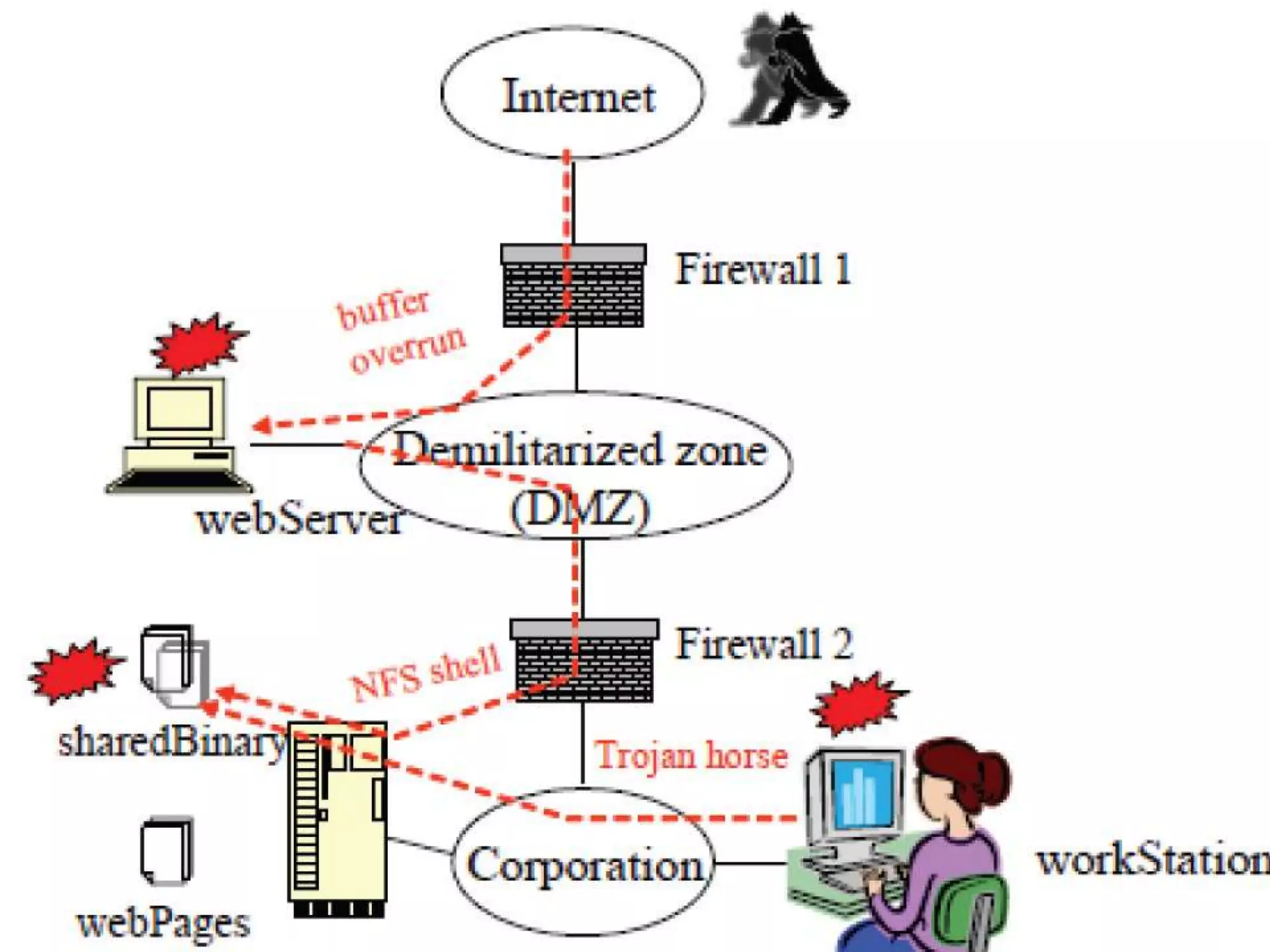
The cyber infrastructure typically consists of web server and
fileserver that are protected by two firewall in demilitarized
zone (DMZ), where DMZ separates the external network
(internet) and company’s internal network(LAN). The web
server involves with customer interactions on a company’s
website while the fileserver is a repository for many
workstations that are internal to the company and that allow
company employees to do their daily operations . The
firewall 1 controls the traffic between DMZ and the internet
Firewall 2 allows a Network File System (NFS) protocol access
between the fileserver and web server
 In this cyber infrastructure mostly attackers follows a sequence of “Island Hopping
Attack” where the web server is compromised first, and then the web server is
used to originate attacks on the fileserver (through venerability in the NFS
protocol) and other company workstations
 In this simple scenario, a security analyst is exposed to a sequence of 25 network
events (consisting of both threat and non-threat events), whose nature is not
precisely defined to a security analyst
 He is also able to observe alerts that correspond to some network events using an
intrusion detection system (IDS) (Jajodia et al., 2010). The IDS raises an alert for
suspicious file executions or suspicious packet transmission events that is
generated on the corporate network
The knowledge level of the analyst in terms of the mix of
threat and non-threat experiences stored in analyst’s
memory.
 The analyst’s risk-tolerance level, i.e., the willingness of an
analyst to classify a sequence of events as a cyber-attack.
 The analyst’s similarity model, i.e., the process that the
analyst uses to compare network events with prior
experiences that are stored in his memory
IBLT is a theory of how people make decisions from
experience in complex environments
IBLT proposes that people represent every decision
making situation as instances that are stored in
memory
IBLT composed of three part
:Situation(S),Decision(D),and Utility(U)
The IBL model of the security analyst
can be implemented by using Matlab
software
Due to the growing threat to our cyber infrastructure
and the heightened need to implement cyber security,
it becomes important to evaluate the cyber situation
awareness (cyber-SA) of security analysts in different
cyber-attack scenarios. In this research, I suggest a
memory-based account, based upon instance-based
learning theory, of the decisions of a security analyst
who is put in a popular cyber-attack scenario of an
island-hopping attack
 http://www.hss.cmu.edu/departments/sds/
ddmlab/papers/Dutt.Gonzalez.2012
 ftp://ftp.rta.nato.int/Pubfulltext/RTO/MP/RT
O-MP-IST-043/MP-IST-043-20
Situational awareness for computer network security

Situational awareness for computer network security

  • 1.
  • 2.
     What isSituational Awareness  Why situational awareness for computer network security  Traditional SA  Cyber SA  Simple scenario of cyber Attack  Factors  Instance based learning theory model(IBLT)  conclusion
  • 3.
     Situation awareness(SA) involves being aware of what is happening in the vicinity  It is also a field of study concerned with perception of the environment critical for decision- makers in complex areas from aviation, air traffic control, power plant operations, military command and control, and IT services.
  • 4.
     For securitypurpose many organizations have their own Computer Security Incident Response Teams which are responsible for ensuring, availability and integrity and confidentiality of network services. Their main key responsibility is to maintain situational awareness over thousands of network objects and events .  In short situational awareness is the prevention from threats and future crimes in the field of computer network security
  • 5.
    Normally situational awarenessinvolves predictions related to time, space references and object. For describing Traditional situational awareness we can take the example of aircraft pilot, from his point of view, he should take care of aircraft status, speed, direction ,position(long, lat),the location of other aircraft, friends, enemies, surrounding landing sites and the mission
  • 6.
    when we talkabout cyber situational awareness so one should aware from status and the topology of IT infrastructure which is complex to handle. Network component are usually located using reference in logical architecture.
  • 7.
    The cyber infrastructuretypically consists of web server and fileserver that are protected by two firewall in demilitarized zone (DMZ), where DMZ separates the external network (internet) and company’s internal network(LAN). The web server involves with customer interactions on a company’s website while the fileserver is a repository for many workstations that are internal to the company and that allow company employees to do their daily operations . The firewall 1 controls the traffic between DMZ and the internet Firewall 2 allows a Network File System (NFS) protocol access between the fileserver and web server
  • 9.
     In thiscyber infrastructure mostly attackers follows a sequence of “Island Hopping Attack” where the web server is compromised first, and then the web server is used to originate attacks on the fileserver (through venerability in the NFS protocol) and other company workstations  In this simple scenario, a security analyst is exposed to a sequence of 25 network events (consisting of both threat and non-threat events), whose nature is not precisely defined to a security analyst  He is also able to observe alerts that correspond to some network events using an intrusion detection system (IDS) (Jajodia et al., 2010). The IDS raises an alert for suspicious file executions or suspicious packet transmission events that is generated on the corporate network
  • 10.
    The knowledge levelof the analyst in terms of the mix of threat and non-threat experiences stored in analyst’s memory.  The analyst’s risk-tolerance level, i.e., the willingness of an analyst to classify a sequence of events as a cyber-attack.  The analyst’s similarity model, i.e., the process that the analyst uses to compare network events with prior experiences that are stored in his memory
  • 11.
    IBLT is atheory of how people make decisions from experience in complex environments IBLT proposes that people represent every decision making situation as instances that are stored in memory IBLT composed of three part :Situation(S),Decision(D),and Utility(U)
  • 12.
    The IBL modelof the security analyst can be implemented by using Matlab software
  • 13.
    Due to thegrowing threat to our cyber infrastructure and the heightened need to implement cyber security, it becomes important to evaluate the cyber situation awareness (cyber-SA) of security analysts in different cyber-attack scenarios. In this research, I suggest a memory-based account, based upon instance-based learning theory, of the decisions of a security analyst who is put in a popular cyber-attack scenario of an island-hopping attack
  • 14.