Network Intrusion Detection and
Countermeasure Selection in
Virtual Network Systems
Under The Guidance of:
SWATHI S WALI
Assistant Professor
Dept. of ISE, NIT & MS
Presented By:
PRAMOD M
8th Sem B.E
Dept. of ISE, NIT & MS
Overview
 Abstract
 Introduction to NICE
 NICE models
 NICE system design
 NICE attack analyzer
 Counter measures
 Conclusion
 References
Abstract
 In Cloud System attackers can explore
vulnerabilities of a cloud system and compromise
virtual machines.
 To prevent vulnerable virtual machines from being
compromised in the cloud, we propose a multi-
phase distributed vulnerability detection and
countermeasure selection mechanism called NICE.
 NICE is built on attack graph based analytical
models and reconfigurable virtual network-based
countermeasures.
Introduction
User can use the cloud system
resources to have his own virtual
machine to run the desired
application.
 Attackers can exploit vulnerabilities in
clouds and utilize cloud system
resources to deploy attacks.
 Cloud users can install vulnerable
software on their VMs, which
essentially contributes to loopholes in
Introduction(continued…)
The challenge is to establish an
effective attack detection and
response system for accurately
identifying attacks and minimizing the
impact of security breach to cloud
users.
 For better attack detection, NICE
incorporates attack graph analytical
procedures into the intrusion detection
processes.
Introduction(continued…)
 NICE includes two main phases
(1)Deploy network intrusion detection agent
(NICE-A) on each cloud server to capture
and analyze cloud traffic.
NICE-A periodically scans the virtual system
vulnerabilities within a cloud server to
establish Scenario Attack Graph (SAGs), and
then based on the severity of identified
vulnerability towards the collaborative attack
goals, NICE will decide whether or not to put
a VM in network inspection state.
Introduction(continued…)
 (2) Once a VM enters inspection state,
Deep Packet Inspection(DPI) is
applied, or virtual network
reconfigurations can be deployed to
the inspecting VM to make the
potential attack behaviors prominent.
Nice Models
 Nice Model is to describe how to
utilize attack graphs to model security
threats and vulnerabilities in a virtual
networked system.
(1)Threat Model
 The attacker’s primary goal is to
exploit vulnerable VMs and
compromise them as zombies.
Nice Models(continued…)
Protection model focuses on virtual-
network based attack detection and
reconfiguration solutions.
Nice Models(continued…)
(2)Attack Graph Model
 An attack graph is a modeling tool to
illustrate all possible multi-stage, multi-
host attack paths that are crucial to
understand threats and then to decide
appropriate countermeasures.
 In an attack graph, each node
represents either precondition or
consequence of an exploit.
Nice Models(continued…)
 Attack graph is helpful in identifying
potential threats, possible attacks and
known vulnerabilities in a cloud
system.
Attack graph provides whole picture of
current security situation of the system
where we can predict the possible
threats and attacks by correlating
detected events or activities.
Nice Models(continued…)
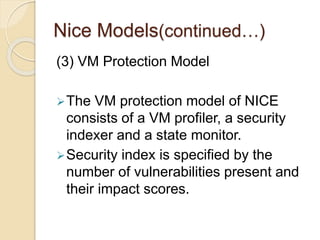
(3) VM Protection Model
The VM protection model of NICE
consists of a VM profiler, a security
indexer and a state monitor.
Security index is specified by the
number of vulnerabilities present and
their impact scores.
Nice System Design
Nice System Design
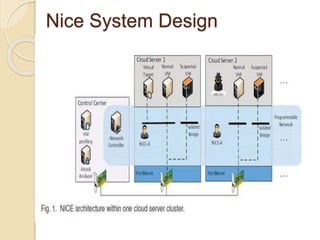
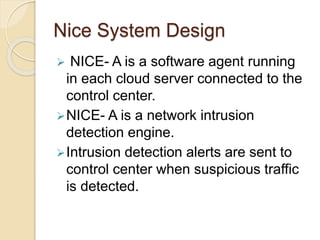
 NICE- A is a software agent running
in each cloud server connected to the
control center.
NICE- A is a network intrusion
detection engine.
Intrusion detection alerts are sent to
control center when suspicious traffic
is detected.
After receiving an alert, attack analyzer
decides what countermeasure strategies to
take, and then initiates it through the
network controller.
The network controller is responsible for
deploying attack counter measures based on
decisions made by the attack analyzer.
 VM profiles are maintained in a database
and contain comprehensive information
about vulnerabilities and alert.
Every detected vulnerability is added to its
corresponding VM entry in the database.
Alert involving theVM will be recorded in
the VM profile database.
Attack Analyzer
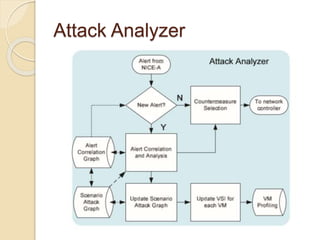
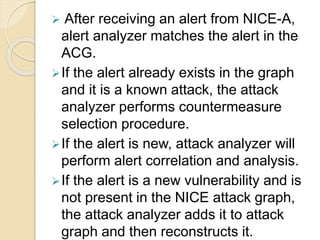
 After receiving an alert from NICE-A,
alert analyzer matches the alert in the
ACG.
If the alert already exists in the graph
and it is a known attack, the attack
analyzer performs countermeasure
selection procedure.
If the alert is new, attack analyzer will
perform alert correlation and analysis.
If the alert is a new vulnerability and is
not present in the NICE attack graph,
the attack analyzer adds it to attack
graph and then reconstructs it.
Counter Measures
By changing the MAC address of the
virtual machine, one can prevent the
vulnerabilities on the virtual machine.
Creating filtering rules, will also help in
preventing the attacks on the virtual
machines.
By changing the IP address.
Conclusion
NICE is used to identify attacks in the
cloud virtual networking environment.
NICE utilizes the attack graph model
to conduct attack detection and
prediction.
NICE shows that the proposed
solution can significantly reduce the
risk of the cloud system.
REFERENCES
[1] Coud Sercurity Alliance, “Top threats to cloud computing
v1.0,”
https://cloudsecurityalliance.org/topthreats/csathreats.v1.0.pdf
, March 2010.
[2] M. Armbrust, A. Fox, R. Griffith, A. D. Joseph, R. Katz, A.
Kon- winski, G. Lee, D. Patterson, A. Rabkin, I. Stoica, and M.
Zaharia, “A view of cloud computing,” ACM Commun., vol. 53,
no. 4, pp. 50–58, Apr. 2010.
[3] B. Joshi, A. Vijayan, and B. Joshi, “Securing cloud computing
environment against DDoS attacks,” IEEE Int’l Conf.
Computer Communication and Informatics (ICCCI ’12), Jan.
2012.
[4] H. Takabi, J. B. Joshi, and G. Ahn, “Security and privacy chal-
lenges in cloud computing environments,” IEEE Security &
Pri- vacy, vol. 8, no. 6, pp. 24–31, Dec. 2010.
[5] “Open vSwitch project,” http://openvswitch.org, May 2012.
[6] Z. Duan, P. Chen, F. Sanchez, Y. Dong, M. Stephenson, and
J. Barker, “Detecting spam zombies by monitoring outgoing
mes- sages,” IEEE Trans. Dependable and Secure
Computing, vol. 9, no. 2, pp. 198–210, Apr. 2012.
Network Intrusion Detection and Countermeasure Selection

Network Intrusion Detection and Countermeasure Selection

  • 1.
    Network Intrusion Detectionand Countermeasure Selection in Virtual Network Systems Under The Guidance of: SWATHI S WALI Assistant Professor Dept. of ISE, NIT & MS Presented By: PRAMOD M 8th Sem B.E Dept. of ISE, NIT & MS
  • 2.
    Overview  Abstract  Introductionto NICE  NICE models  NICE system design  NICE attack analyzer  Counter measures  Conclusion  References
  • 3.
    Abstract  In CloudSystem attackers can explore vulnerabilities of a cloud system and compromise virtual machines.  To prevent vulnerable virtual machines from being compromised in the cloud, we propose a multi- phase distributed vulnerability detection and countermeasure selection mechanism called NICE.  NICE is built on attack graph based analytical models and reconfigurable virtual network-based countermeasures.
  • 4.
    Introduction User can usethe cloud system resources to have his own virtual machine to run the desired application.  Attackers can exploit vulnerabilities in clouds and utilize cloud system resources to deploy attacks.  Cloud users can install vulnerable software on their VMs, which essentially contributes to loopholes in
  • 5.
    Introduction(continued…) The challenge isto establish an effective attack detection and response system for accurately identifying attacks and minimizing the impact of security breach to cloud users.  For better attack detection, NICE incorporates attack graph analytical procedures into the intrusion detection processes.
  • 6.
    Introduction(continued…)  NICE includestwo main phases (1)Deploy network intrusion detection agent (NICE-A) on each cloud server to capture and analyze cloud traffic. NICE-A periodically scans the virtual system vulnerabilities within a cloud server to establish Scenario Attack Graph (SAGs), and then based on the severity of identified vulnerability towards the collaborative attack goals, NICE will decide whether or not to put a VM in network inspection state.
  • 7.
    Introduction(continued…)  (2) Oncea VM enters inspection state, Deep Packet Inspection(DPI) is applied, or virtual network reconfigurations can be deployed to the inspecting VM to make the potential attack behaviors prominent.
  • 8.
    Nice Models  NiceModel is to describe how to utilize attack graphs to model security threats and vulnerabilities in a virtual networked system. (1)Threat Model  The attacker’s primary goal is to exploit vulnerable VMs and compromise them as zombies.
  • 9.
    Nice Models(continued…) Protection modelfocuses on virtual- network based attack detection and reconfiguration solutions.
  • 10.
    Nice Models(continued…) (2)Attack GraphModel  An attack graph is a modeling tool to illustrate all possible multi-stage, multi- host attack paths that are crucial to understand threats and then to decide appropriate countermeasures.  In an attack graph, each node represents either precondition or consequence of an exploit.
  • 11.
    Nice Models(continued…)  Attackgraph is helpful in identifying potential threats, possible attacks and known vulnerabilities in a cloud system. Attack graph provides whole picture of current security situation of the system where we can predict the possible threats and attacks by correlating detected events or activities.
  • 12.
    Nice Models(continued…) (3) VMProtection Model The VM protection model of NICE consists of a VM profiler, a security indexer and a state monitor. Security index is specified by the number of vulnerabilities present and their impact scores.
  • 13.
  • 14.
    Nice System Design NICE- A is a software agent running in each cloud server connected to the control center. NICE- A is a network intrusion detection engine. Intrusion detection alerts are sent to control center when suspicious traffic is detected.
  • 15.
    After receiving analert, attack analyzer decides what countermeasure strategies to take, and then initiates it through the network controller. The network controller is responsible for deploying attack counter measures based on decisions made by the attack analyzer.  VM profiles are maintained in a database and contain comprehensive information about vulnerabilities and alert.
  • 16.
    Every detected vulnerabilityis added to its corresponding VM entry in the database. Alert involving theVM will be recorded in the VM profile database.
  • 17.
  • 18.
     After receivingan alert from NICE-A, alert analyzer matches the alert in the ACG. If the alert already exists in the graph and it is a known attack, the attack analyzer performs countermeasure selection procedure. If the alert is new, attack analyzer will perform alert correlation and analysis. If the alert is a new vulnerability and is not present in the NICE attack graph, the attack analyzer adds it to attack graph and then reconstructs it.
  • 19.
    Counter Measures By changingthe MAC address of the virtual machine, one can prevent the vulnerabilities on the virtual machine. Creating filtering rules, will also help in preventing the attacks on the virtual machines. By changing the IP address.
  • 20.
    Conclusion NICE is usedto identify attacks in the cloud virtual networking environment. NICE utilizes the attack graph model to conduct attack detection and prediction. NICE shows that the proposed solution can significantly reduce the risk of the cloud system.
  • 21.
    REFERENCES [1] Coud SercurityAlliance, “Top threats to cloud computing v1.0,” https://cloudsecurityalliance.org/topthreats/csathreats.v1.0.pdf , March 2010. [2] M. Armbrust, A. Fox, R. Griffith, A. D. Joseph, R. Katz, A. Kon- winski, G. Lee, D. Patterson, A. Rabkin, I. Stoica, and M. Zaharia, “A view of cloud computing,” ACM Commun., vol. 53, no. 4, pp. 50–58, Apr. 2010. [3] B. Joshi, A. Vijayan, and B. Joshi, “Securing cloud computing environment against DDoS attacks,” IEEE Int’l Conf. Computer Communication and Informatics (ICCCI ’12), Jan. 2012. [4] H. Takabi, J. B. Joshi, and G. Ahn, “Security and privacy chal- lenges in cloud computing environments,” IEEE Security & Pri- vacy, vol. 8, no. 6, pp. 24–31, Dec. 2010. [5] “Open vSwitch project,” http://openvswitch.org, May 2012. [6] Z. Duan, P. Chen, F. Sanchez, Y. Dong, M. Stephenson, and J. Barker, “Detecting spam zombies by monitoring outgoing mes- sages,” IEEE Trans. Dependable and Secure Computing, vol. 9, no. 2, pp. 198–210, Apr. 2012.