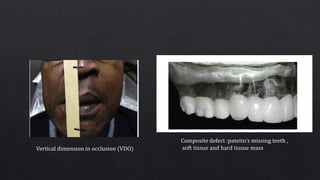
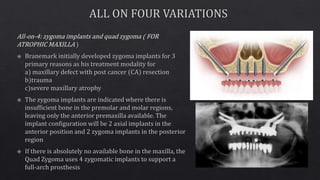
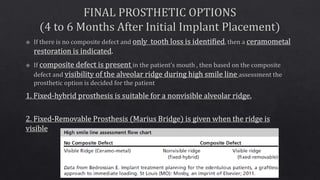
Composite defect :pateitn’s missing teeth ,
soft tissue and hard tissue mass
Vertical dimension in occlusion (VDO)
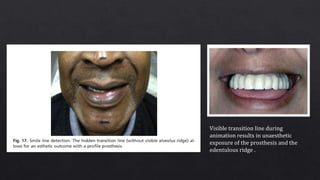
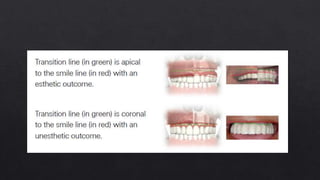
Visible transition line during
animation results in unaesthetic
exposure of the prosthesis and the
edentulous ridge .
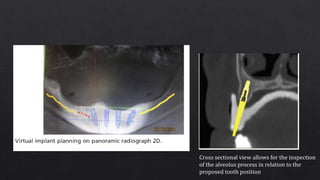
Cross sectional view allows for the inspection
of the alveolus process in relation to the
proposed tooth position
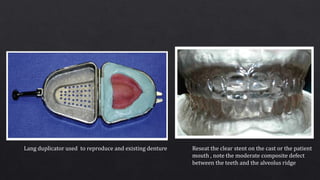
Lang duplicator used to reproduce and existing denture Reseat the clear stent on the cast or the patient
mouth , note the moderate composite defect
between the teeth and the alveolus ridge
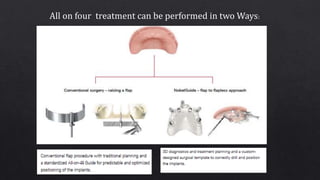
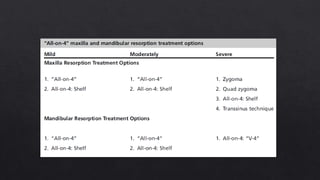
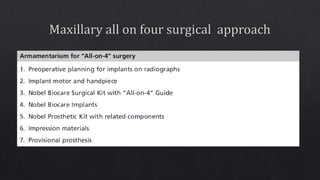
All on four treatment can be performed in two Ways:
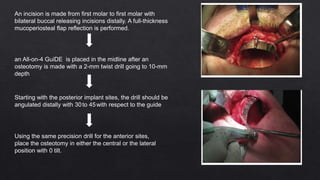
An incision is made from first molar to first molar with
bilateral buccal releasing incisions distally. A full-thickness
mucoperiosteal flap reflection is performed.
an All-on-4 GuiDE is placed in the midline after an
osteotomy is made with a 2-mm twist drill going to 10-mm
depth
Starting with the posterior implant sites, the drill should be
angulated distally with 30to 45with respect to the guide
Using the same precision drill for the anterior sites,
place the osteotomy in either the central or the lateral
position with 0 tilt.
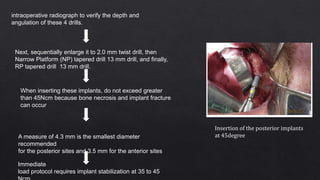
Insertion of the posterior implants
at 45degree
intraoperative radiograph to verify the depth and
angulation of these 4 drills.
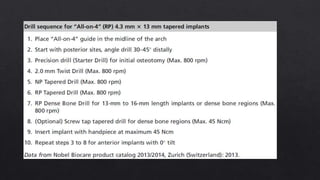
Next, sequentially enlarge it to 2.0 mm twist drill, then
Narrow Platform (NP) tapered drill 13 mm drill, and finally,
RP tapered drill 13 mm drill.
When inserting these implants, do not exceed greater
than 45Ncm because bone necrosis and implant fracture
can occur
A measure of 4.3 mm is the smallest diameter
recommended
for the posterior sites and 3.5 mm for the anterior sites
Immediate
load protocol requires implant stabilization at 35 to 45
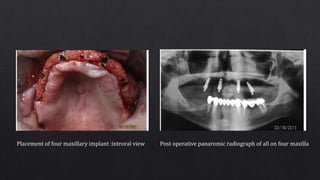
Placement of four maxillary implant :introral view Post operative panaromic radiograph of all on four maxilla
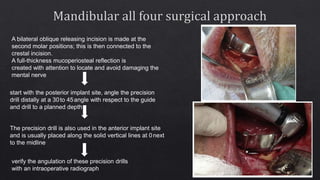
A bilateral oblique releasing incision is made at the
second molar positions; this is then connected to the
crestal incision.
A full-thickness mucoperiosteal reflection is
created with attention to locate and avoid damaging the
mental nerve
start with the posterior implant site, angle the precision
drill distally at a 30to 45angle with respect to the guide
and drill to a planned depth
The precision drill is also used in the anterior implant site
and is usually placed along the solid vertical lines at 0next
to the midline
verify the angulation of these precision drills
with an intraoperative radiograph
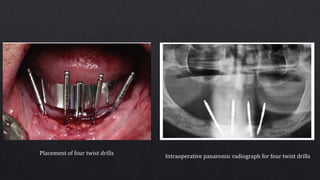
Placement of four twist drills
Intraoperative panaromic radiograph for four twist drills
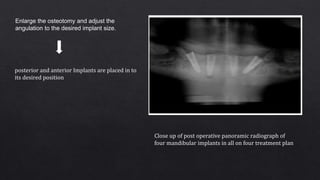
Enlarge the osteotomy and adjust the
angulation to the desired implant size.
posterior and anterior Implants are placed in to
its desired position
Close up of post operative panoramic radiograph of
four mandibular implants in all on four treatment plan
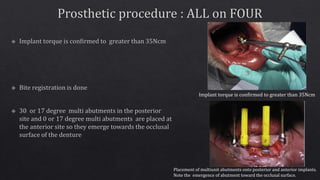
Implant torque is confirmed to greater than 35Ncm
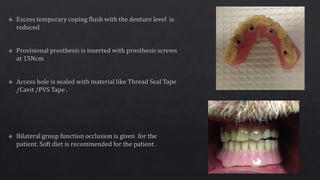
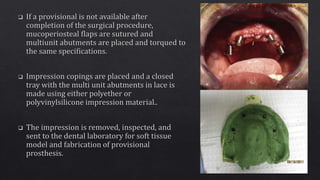
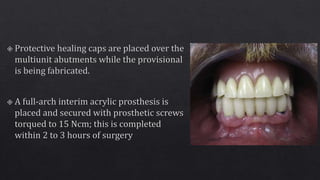
Placement of multiunit abutments onto posterior and anterior implants.
Note the emergence of abutment toward the occlusal surface.
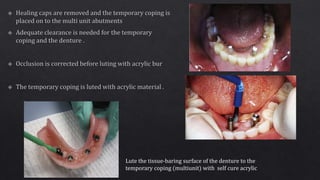
Lute the tissue-baring surface of the denture to the
temporary coping (multiunit) with self cure acrylic
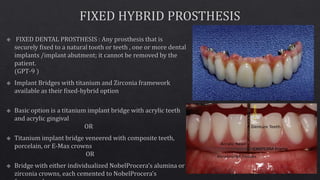
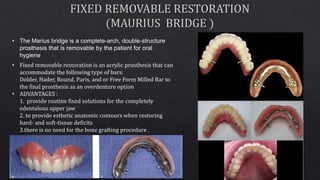
• Fixed removable restoration is an acrylic prosthesis that can
accommodate the following type of bars:
Dolder, Hader, Round, Paris, and or Free Form Milled Bar to
the final prosthesis as an overdenture option
• ADVANTAGES :
1. provide routine fixed solutions for the completely
edentulous upper jaw
2. to provide esthetic anatomic contours when restoring
hard- and soft-tissue deficits
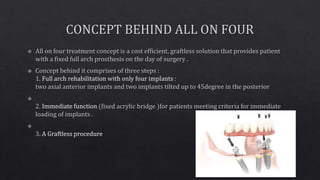
3.there is no need for the bone grafting procedure .
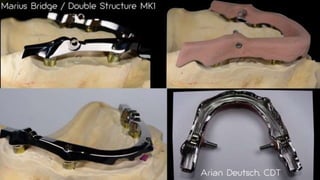
• The Marius bridge is a complete-arch, double-structure
prosthesis that is removable by the patient for oral
hygiene
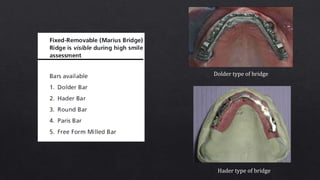
Dolder type of bridge
Hader type of bridge
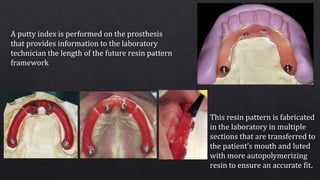
A putty index is performed on the prosthesis
that provides information to the laboratory
technician the length of the future resin pattern
framework
This resin pattern is fabricated
in the laboratory in multiple
sections that are transferred to
the patient’s mouth and luted
with more autopolymerizing
resin to ensure an accurate fit.
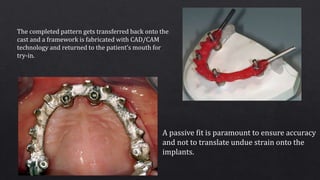
The completed pattern gets transferred back onto the
cast and a framework is fabricated with CAD/CAM
technology and returned to the patient’s mouth for
try-in.
A passive fit is paramount to ensure accuracy
and not to translate undue strain onto the
implants.
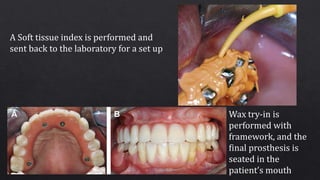
A Soft tissue index is performed and
sent back to the laboratory for a set up
Wax try-in is
performed with
framework, and the
final prosthesis is
seated in the
patient’s mouth
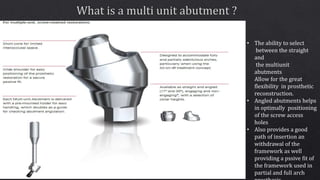
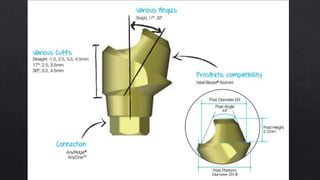
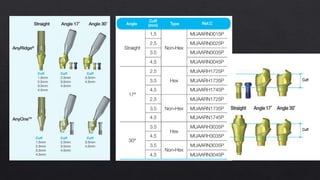
• The ability to select
between the straight
and
the multiunit
abutments
Allow for the great
flexibility in prosthetic
reconstruction.
• Angled abutments helps
in optimally positioning
of the screw access
holes
• Also provides a good
path of insertion an
withdrawal of the
framework as well
providing a pssive fit of
the framework used in
partial and full arch
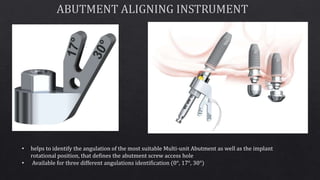
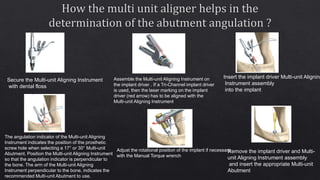
• helps to identify the angulation of the most suitable Multi-unit Abutment as well as the implant
rotational position, that defines the abutment screw access hole
• Available for three different angulations identification (0°, 17°, 30°)
Secure the Multi-unit Aligning Instrument
with dental floss
Assemble the Multi-unit Aligning Instrument on
the implant driver . If a Tri-Channel implant driver
is used, then the laser marking on the implant
driver (red arrow) has to be aligned with the
Multi-unit Aligning Instrument
Insert the implant driver Multi-unit Aligning
Instrument assembly
into the implant
The angulation indicator of the Multi-unit Aligning
Instrument indicates the position of the prosthetic
screw hole when selecting a 17° or 30° Multi-unit
Abutment. Position the Multi-unit Aligning Instrument
so that the angulation indicator is perpendicular to
the bone. The arm of the Multi-unit Aligning
Instrument perpendicular to the bone, indicates the
recommended Multi-unit Abutment to use.
Adjust the rotational position of the implant if necessary
with the Manual Torque wrench
Remove the implant driver and Multi-
unit Aligning Instrument assembly
and insert the appropriate Multi-unit
Abutment
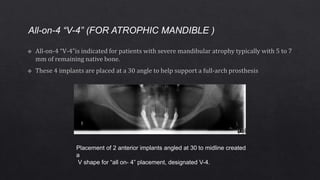
All-on-4 “V-4” (FOR ATROPHIC MANDIBLE )
Placement of 2 anterior implants angled at 30 to midline created
a
V shape for “all on- 4” placement, designated V-4.
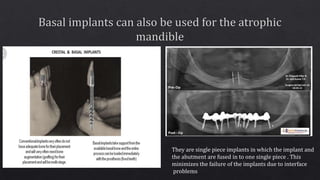
They are single piece implants in which the implant and
the abutment are fused in to one single piece . This
minimizes the failure of the implants due to interface
problems
ALL ON 4.pptx
ALL ON 4.pptx

ALL ON 4.pptx

  • 14.
    Composite defect :pateitn’smissing teeth , soft tissue and hard tissue mass Vertical dimension in occlusion (VDO)
  • 15.
    Visible transition lineduring animation results in unaesthetic exposure of the prosthesis and the edentulous ridge .
  • 17.
    Cross sectional viewallows for the inspection of the alveolus process in relation to the proposed tooth position
  • 18.
    Lang duplicator usedto reproduce and existing denture Reseat the clear stent on the cast or the patient mouth , note the moderate composite defect between the teeth and the alveolus ridge
  • 20.
    All on fourtreatment can be performed in two Ways:
  • 24.
    An incision ismade from first molar to first molar with bilateral buccal releasing incisions distally. A full-thickness mucoperiosteal flap reflection is performed. an All-on-4 GuiDE is placed in the midline after an osteotomy is made with a 2-mm twist drill going to 10-mm depth Starting with the posterior implant sites, the drill should be angulated distally with 30to 45with respect to the guide Using the same precision drill for the anterior sites, place the osteotomy in either the central or the lateral position with 0 tilt.
  • 25.
    Insertion of theposterior implants at 45degree intraoperative radiograph to verify the depth and angulation of these 4 drills. Next, sequentially enlarge it to 2.0 mm twist drill, then Narrow Platform (NP) tapered drill 13 mm drill, and finally, RP tapered drill 13 mm drill. When inserting these implants, do not exceed greater than 45Ncm because bone necrosis and implant fracture can occur A measure of 4.3 mm is the smallest diameter recommended for the posterior sites and 3.5 mm for the anterior sites Immediate load protocol requires implant stabilization at 35 to 45
  • 26.
    Placement of fourmaxillary implant :introral view Post operative panaromic radiograph of all on four maxilla
  • 28.
    A bilateral obliquereleasing incision is made at the second molar positions; this is then connected to the crestal incision. A full-thickness mucoperiosteal reflection is created with attention to locate and avoid damaging the mental nerve start with the posterior implant site, angle the precision drill distally at a 30to 45angle with respect to the guide and drill to a planned depth The precision drill is also used in the anterior implant site and is usually placed along the solid vertical lines at 0next to the midline verify the angulation of these precision drills with an intraoperative radiograph
  • 29.
    Placement of fourtwist drills Intraoperative panaromic radiograph for four twist drills
  • 30.
    Enlarge the osteotomyand adjust the angulation to the desired implant size. posterior and anterior Implants are placed in to its desired position Close up of post operative panoramic radiograph of four mandibular implants in all on four treatment plan
  • 32.
    Implant torque isconfirmed to greater than 35Ncm Placement of multiunit abutments onto posterior and anterior implants. Note the emergence of abutment toward the occlusal surface.
  • 34.
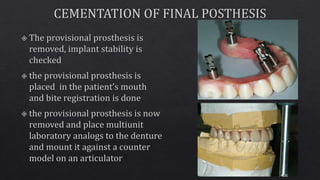
    Lute the tissue-baringsurface of the denture to the temporary coping (multiunit) with self cure acrylic
  • 42.
    • Fixed removablerestoration is an acrylic prosthesis that can accommodate the following type of bars: Dolder, Hader, Round, Paris, and or Free Form Milled Bar to the final prosthesis as an overdenture option • ADVANTAGES : 1. provide routine fixed solutions for the completely edentulous upper jaw 2. to provide esthetic anatomic contours when restoring hard- and soft-tissue deficits 3.there is no need for the bone grafting procedure . • The Marius bridge is a complete-arch, double-structure prosthesis that is removable by the patient for oral hygiene
  • 43.
    Dolder type ofbridge Hader type of bridge
  • 46.
    A putty indexis performed on the prosthesis that provides information to the laboratory technician the length of the future resin pattern framework This resin pattern is fabricated in the laboratory in multiple sections that are transferred to the patient’s mouth and luted with more autopolymerizing resin to ensure an accurate fit.
  • 47.
    The completed patterngets transferred back onto the cast and a framework is fabricated with CAD/CAM technology and returned to the patient’s mouth for try-in. A passive fit is paramount to ensure accuracy and not to translate undue strain onto the implants.
  • 48.
    A Soft tissueindex is performed and sent back to the laboratory for a set up Wax try-in is performed with framework, and the final prosthesis is seated in the patient’s mouth
  • 49.
    • The abilityto select between the straight and the multiunit abutments Allow for the great flexibility in prosthetic reconstruction. • Angled abutments helps in optimally positioning of the screw access holes • Also provides a good path of insertion an withdrawal of the framework as well providing a pssive fit of the framework used in partial and full arch
  • 52.
    • helps toidentify the angulation of the most suitable Multi-unit Abutment as well as the implant rotational position, that defines the abutment screw access hole • Available for three different angulations identification (0°, 17°, 30°)
  • 53.
    Secure the Multi-unitAligning Instrument with dental floss Assemble the Multi-unit Aligning Instrument on the implant driver . If a Tri-Channel implant driver is used, then the laser marking on the implant driver (red arrow) has to be aligned with the Multi-unit Aligning Instrument Insert the implant driver Multi-unit Aligning Instrument assembly into the implant The angulation indicator of the Multi-unit Aligning Instrument indicates the position of the prosthetic screw hole when selecting a 17° or 30° Multi-unit Abutment. Position the Multi-unit Aligning Instrument so that the angulation indicator is perpendicular to the bone. The arm of the Multi-unit Aligning Instrument perpendicular to the bone, indicates the recommended Multi-unit Abutment to use. Adjust the rotational position of the implant if necessary with the Manual Torque wrench Remove the implant driver and Multi- unit Aligning Instrument assembly and insert the appropriate Multi-unit Abutment
  • 59.
    All-on-4 “V-4” (FORATROPHIC MANDIBLE ) Placement of 2 anterior implants angled at 30 to midline created a V shape for “all on- 4” placement, designated V-4.
  • 60.
    They are singlepiece implants in which the implant and the abutment are fused in to one single piece . This minimizes the failure of the implants due to interface problems

Editor's Notes

  • #39 Composite defect represents the amount of the hard and soft tissue loss in the alveoulus proper , including teeth .
  • #61 Basal implants derive support from the basal bone which usually remains free from the infection and less prone to resorption as it utilises the strong cortical bone for support . They are of two types : basal cortical screw amd basal osseointergrated implants , 2 parts : polished surface of the implants and body of the implant , neck of the implant can be bent 15-25 degree depending upon the length of the implant .
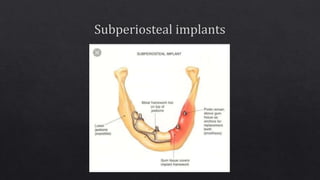
  • #62 Theses are made up of metal frameworks .the metal frame works is attached to the gum tissue above the mandibular bone , form these metal framework small posts protrude out to the oral cavity