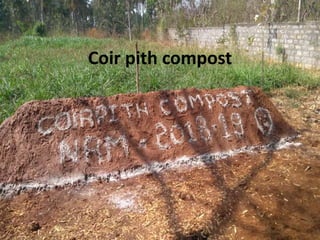
Coir pith compost
What is coir pith?
• Def: It is the waste of coir industry, which is an
excellent soil conditioner and is being
extensively used as a soil-less medium for
Agri-horticultural purposes.
• High lignin content and wider C:N ratio, so it’s
use in agriculture is limited.
Required materials
1. Organic waste materials
2. Inorganic waste materials
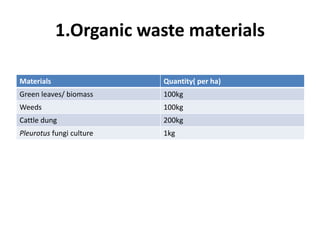
1.Organic waste materials
Materials Quantity( per ha)
Green leaves/ biomass 100kg
Weeds 100kg
Cattle dung 200kg
Pleurotus fungi culture 1kg
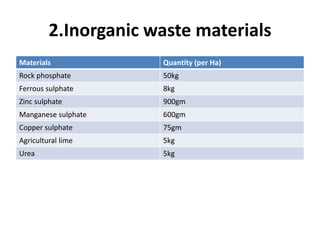
2.Inorganic waste materials
Materials Quantity (per Ha)
Rock phosphate 50kg
Ferrous sulphate 8kg
Zinc sulphate 900gm
Manganese sulphate 600gm
Copper sulphate 75gm
Agricultural lime 5kg
Urea 5kg
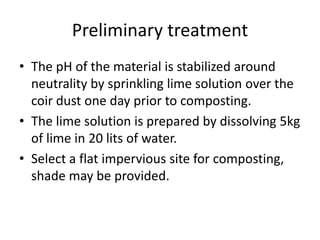
Preliminary treatment
• The pH of the material is stabilized around
neutrality by sprinkling lime solution over the
coir dust one day prior to composting.
• The lime solution is prepared by dissolving 5kg
of lime in 20 lits of water.
• Select a flat impervious site for composting,
shade may be provided.
Steps in composting
1.Construction of tank
• 6m x 3m x 1-1.5m height
tanks using bricks or stone
slabs or coconut fronds.
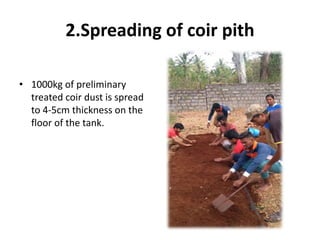
2.Spreading of coir pith
• 1000kg of preliminary
treated coir dust is spread
to 4-5cm thickness on the
floor of the tank.
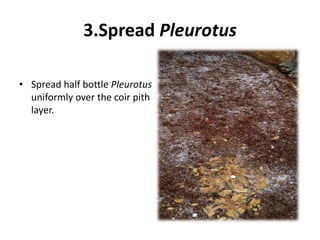
3.Spread Pleurotus
• Spread half bottle Pleurotus
uniformly over the coir pith
layer.
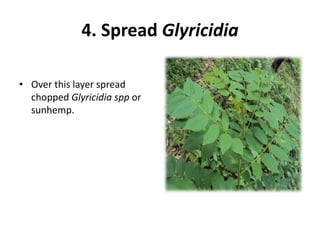
4. Spread Glyricidia
• Over this layer spread
chopped Glyricidia spp or
sunhemp.
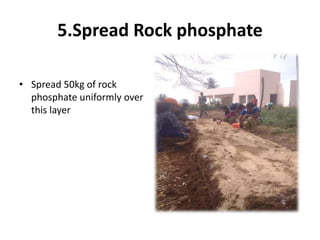
5.Spread Rock phosphate
• Spread 50kg of rock
phosphate uniformly over
this layer
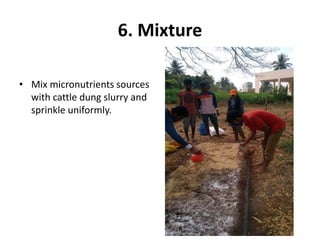
6. Mixture
• Mix micronutrients sources
with cattle dung slurry and
sprinkle uniformly.
• This forms a single set of layers.
• These layers are repeated till the heap attains 1-
1.5m ht.
• Cover the heap with slurry of wet soil.
• Turn the heap at 45th and 90th days after filling.
• Maintain 60% moisture from the beginning to till
completion of composting process.
• Compost will be ready to use at the end of 4th
month.
Compost maturity
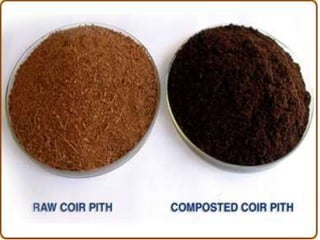
• Compost matures around 60 days.
• Turns from brown to black colour.
• Heap height will be reduced by 30%.
• Emits earthy odour.
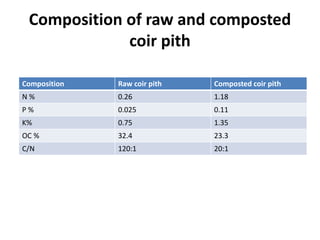
Composition of raw and composted
coir pith
Composition Raw coir pith Composted coir pith
N % 0.26 1.18
P % 0.025 0.11
K% 0.75 1.35
OC % 32.4 23.3
C/N 120:1 20:1
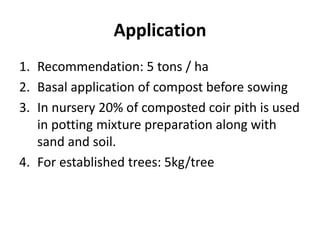
Application
1. Recommendation: 5 tons / ha
2. Basal application of compost before sowing
3. In nursery 20% of composted coir pith is used
in potting mixture preparation along with
sand and soil.
4. For established trees: 5kg/tree
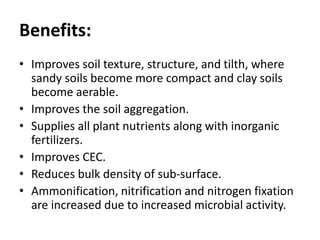
Benefits:
• Improves soil texture, structure, and tilth, where
sandy soils become more compact and clay soils
become aerable.
• Improves the soil aggregation.
• Supplies all plant nutrients along with inorganic
fertilizers.
• Improves CEC.
• Reduces bulk density of sub-surface.
• Ammonification, nitrification and nitrogen fixation
are increased due to increased microbial activity.
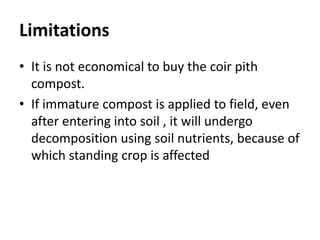
Limitations
• It is not economical to buy the coir pith
compost.
• If immature compost is applied to field, even
after entering into soil , it will undergo
decomposition using soil nutrients, because of
which standing crop is affected
Conclusion
• Efficient utilization of coir.
• Supplies all nutrients along with inorganic
fertilizers.
• Improves soil properties and microbial
activity.
Coir pith compost

Coir pith compost

  • 2.
  • 3.
    What is coirpith? • Def: It is the waste of coir industry, which is an excellent soil conditioner and is being extensively used as a soil-less medium for Agri-horticultural purposes. • High lignin content and wider C:N ratio, so it’s use in agriculture is limited.
  • 4.
    Required materials 1. Organicwaste materials 2. Inorganic waste materials
  • 5.
    1.Organic waste materials MaterialsQuantity( per ha) Green leaves/ biomass 100kg Weeds 100kg Cattle dung 200kg Pleurotus fungi culture 1kg
  • 6.
    2.Inorganic waste materials MaterialsQuantity (per Ha) Rock phosphate 50kg Ferrous sulphate 8kg Zinc sulphate 900gm Manganese sulphate 600gm Copper sulphate 75gm Agricultural lime 5kg Urea 5kg
  • 7.
    Preliminary treatment • ThepH of the material is stabilized around neutrality by sprinkling lime solution over the coir dust one day prior to composting. • The lime solution is prepared by dissolving 5kg of lime in 20 lits of water. • Select a flat impervious site for composting, shade may be provided.
  • 8.
  • 9.
    1.Construction of tank •6m x 3m x 1-1.5m height tanks using bricks or stone slabs or coconut fronds.
  • 10.
    2.Spreading of coirpith • 1000kg of preliminary treated coir dust is spread to 4-5cm thickness on the floor of the tank.
  • 11.
    3.Spread Pleurotus • Spreadhalf bottle Pleurotus uniformly over the coir pith layer.
  • 12.
    4. Spread Glyricidia •Over this layer spread chopped Glyricidia spp or sunhemp.
  • 13.
    5.Spread Rock phosphate •Spread 50kg of rock phosphate uniformly over this layer
  • 14.
    6. Mixture • Mixmicronutrients sources with cattle dung slurry and sprinkle uniformly.
  • 15.
    • This formsa single set of layers. • These layers are repeated till the heap attains 1- 1.5m ht. • Cover the heap with slurry of wet soil. • Turn the heap at 45th and 90th days after filling. • Maintain 60% moisture from the beginning to till completion of composting process. • Compost will be ready to use at the end of 4th month.
  • 16.
    Compost maturity • Compostmatures around 60 days. • Turns from brown to black colour. • Heap height will be reduced by 30%. • Emits earthy odour.
  • 18.
    Composition of rawand composted coir pith Composition Raw coir pith Composted coir pith N % 0.26 1.18 P % 0.025 0.11 K% 0.75 1.35 OC % 32.4 23.3 C/N 120:1 20:1
  • 19.
    Application 1. Recommendation: 5tons / ha 2. Basal application of compost before sowing 3. In nursery 20% of composted coir pith is used in potting mixture preparation along with sand and soil. 4. For established trees: 5kg/tree
  • 20.
    Benefits: • Improves soiltexture, structure, and tilth, where sandy soils become more compact and clay soils become aerable. • Improves the soil aggregation. • Supplies all plant nutrients along with inorganic fertilizers. • Improves CEC. • Reduces bulk density of sub-surface. • Ammonification, nitrification and nitrogen fixation are increased due to increased microbial activity.
  • 21.
    Limitations • It isnot economical to buy the coir pith compost. • If immature compost is applied to field, even after entering into soil , it will undergo decomposition using soil nutrients, because of which standing crop is affected
  • 22.
    Conclusion • Efficient utilizationof coir. • Supplies all nutrients along with inorganic fertilizers. • Improves soil properties and microbial activity.