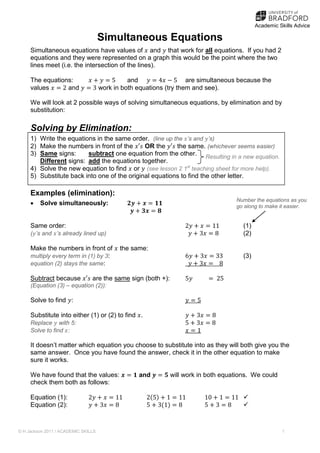
Simultaneous equations have values of x and y that satisfy all equations. There are two main methods to solve simultaneous equations - elimination and substitution.
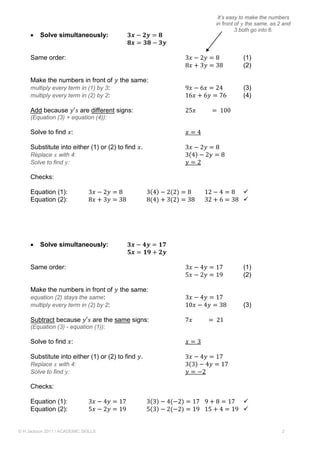
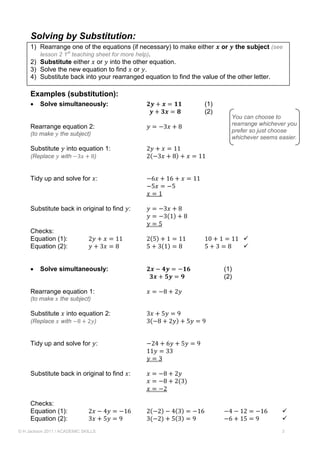
Elimination involves rewriting the equations in the same order and making coefficients of one variable the same. Terms are then eliminated to create a new equation with one variable. Substitution involves rearranging one equation to make one variable the subject, then substituting this into the other equation.
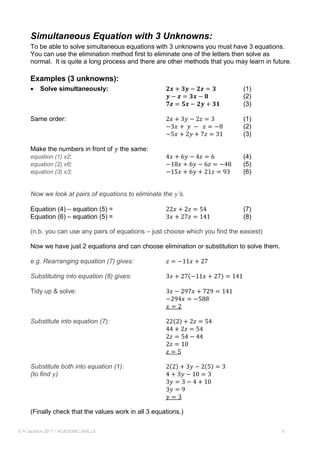
Simultaneous equations with three unknowns require three equations. One variable can be eliminated to reduce it to two equations, which are then solved using elimination or substitution to find the values of all three variables.

![Grade 8 Simplifying Expressions and Solving Equations Cambridge [PPT]](https://cdn.slidesharecdn.com/ss_thumbnails/g8unit09simplifyingexpressionsandsolvingequations-201206022011-thumbnail.jpg?width=640&height=640&fit=bounds)


