Devon Kinne
CIMT 543 – Summer 2012
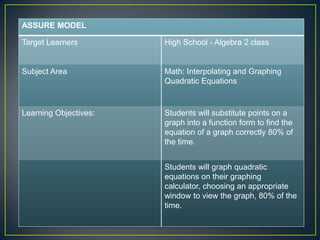
ASSURE MODEL

Target Learners        High School - Algebra 2 class


Subject Area           Math: Interpolating and Graphing
                       Quadratic Equations


Learning Objectives:   Students will substitute points on a
                       graph into a function form to find the
                       equation of a graph correctly 80% of
                       the time.


                       Students will graph quadratic
                       equations on their graphing
                       calculator, choosing an appropriate
                       window to view the graph, 80% of the
                       time.
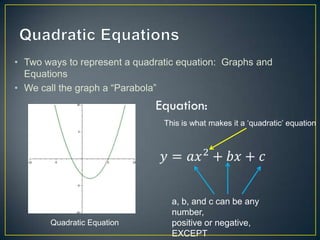
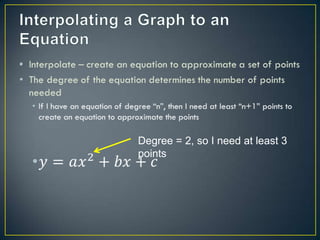
• Two ways to represent a quadratic equation: Graphs and
  Equations
• We call the graph a “Parabola”


                                This is what makes it a „quadratic‟ equation


                                  a, b, and c can be any
                                  number,
       Quadratic Equation         positive or negative,
                                  EXCEPT
•


    Degree = 2, so I need at least 3
    points
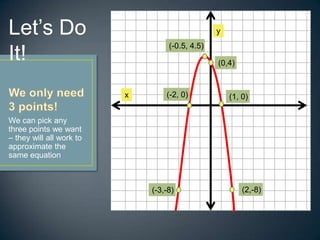
Let‟s Do                                         y
                                   (-0.5, 4.5)
It!                                              (0,4)


                          x       (-2, 0)            (1, 0)

We can pick any
three points we want
– they will all work to
approximate the
same equation


                              (-3,-8)                    (2,-8)
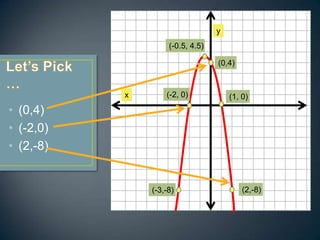
y
                    (-0.5, 4.5)

                                  (0,4)


           x       (-2, 0)            (1, 0)
• (0,4)
• (-2,0)
• (2,-8)


               (-3,-8)                    (2,-8)
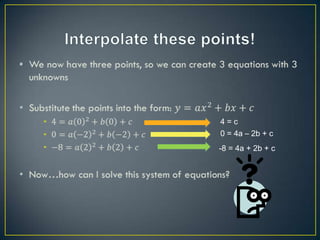
•


    4=c
    0 = 4a – 2b + c
    -8 = 4a + 2b + c
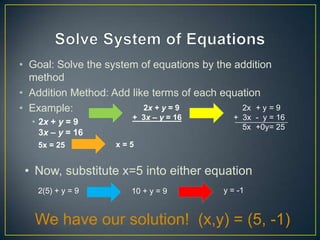
• Goal: Solve the system of equations by the addition
  method
• Addition Method: Add like terms of each equation
• Example:                2x + y = 9          2x + y = 9
                        + 3x – y = 16        + 3x - y = 16
  • 2x + y = 9
                                               5x +0y= 25
    3x – y = 16
    5x = 25         x=5


 • Now, substitute x=5 into either equation
    2(5) + y = 9        10 + y = 9         y = -1


   We have our solution! (x,y) = (5, -1)
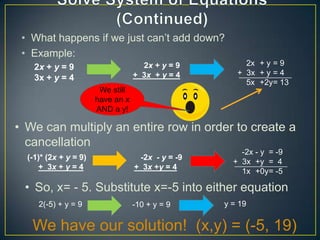
• What happens if we just can‟t add down?
 • Example:
                                     2x + y = 9         2x + y = 9
    2x + y = 9
                                   + 3x + y = 4       + 3x + y = 4
    3x + y = 4                                          5x +2y= 13
                        We still
                       have an x
                       AND a y!

• We can multiply an entire row in order to create a
  cancellation
                                                       -2x - y = -9
  (-1)* (2x + y = 9)                -2x - y = -9
                                                     + 3x +y = 4
     + 3x + y = 4                  + 3x +y = 4
                                                       1x +0y= -5

 • So, x= - 5. Substitute x=-5 into either equation
     2(-5) + y = 9                 -10 + y = 9     y = 19


   We have our solution! (x,y) = (-5, 19)
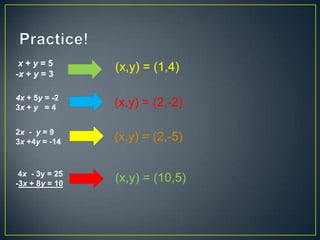
x+y=5
-x + y = 3
                (x,y) = (1,4)

4x + 5y = -2
3x + y = 4      (x,y) = (2,-2)

2x - y = 9
3x +4y = -14    (x,y) = (2,-5)

 4x - 3y = 25
-3x + 8y = 10
                (x,y) = (10,5)
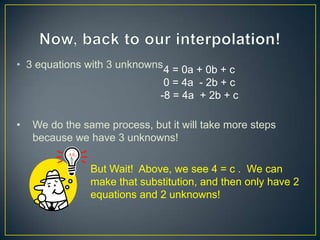
• 3 equations with 3 unknowns 4 = 0a + 0b + c
                               0 = 4a - 2b + c
                              -8 = 4a + 2b + c

•   We do the same process, but it will take more steps
    because we have 3 unknowns!

                But Wait! Above, we see 4 = c . We can
                make that substitution, and then only have 2
                equations and 2 unknowns!
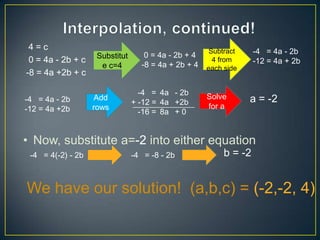
4=c                                                  Subtract     -4 = 4a - 2b
                    Substitut      0 = 4a - 2b + 4
 0 = 4a - 2b + c                                       4 from      -12 = 4a + 2b
                     e c=4        -8 = 4a + 2b + 4   each side
-8 = 4a +2b + c

                                  -4 = 4a - 2b       Solve
-4 = 4a - 2b       Add
                                + -12 = 4a +2b                   a = -2
-12 = 4a +2b       rows                              for a
                                  -16 = 8a + 0


• Now, substitute a=-2 into either equation
 -4 = 4(-2) - 2b                -4 = -8 - 2b              b = -2


We have our solution! (a,b,c) = (-2,-2, 4)
•


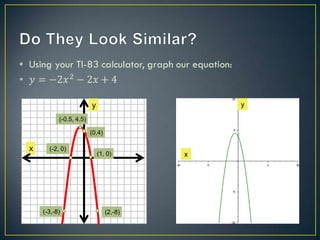
                            y                    y

              (-0.5, 4.5)

                            (0,4)

    x     (-2, 0)
                                (1, 0)       x


        (-3,-8)                     (2,-8)
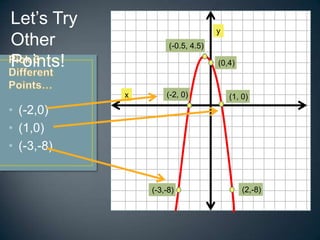
Let‟s Try
                                   y
Other                (-0.5, 4.5)

Points!                            (0,4)


            x       (-2, 0)            (1, 0)
• (-2,0)
• (1,0)
• (-3,-8)


                (-3,-8)                    (2,-8)
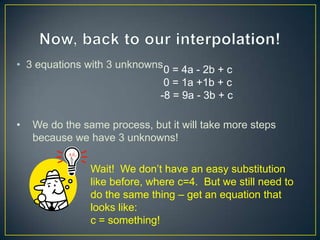
• 3 equations with 3 unknowns 0 = 4a - 2b + c
                                0 = 1a +1b + c
                               -8 = 9a - 3b + c

•   We do the same process, but it will take more steps
    because we have 3 unknowns!

                Wait! We don‟t have an easy substitution
                like before, where c=4. But we still need to
                do the same thing – get an equation that
                looks like:
                c = something!
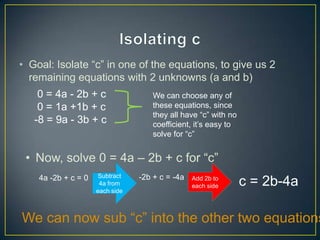
• Goal: Isolate “c” in one of the equations, to give us 2
  remaining equations with 2 unknowns (a and b)
    0 = 4a - 2b + c                 We can choose any of
    0 = 1a +1b + c                  these equations, since
                                    they all have “c” with no
   -8 = 9a - 3b + c                 coefficient, it‟s easy to
                                    solve for “c”


 • Now, solve 0 = 4a – 2b + c for “c”
    4a -2b + c = 0   Subtract    -2b + c = -4a
                      4a from
                                                 Add 2b to
                                                 each side      c = 2b-4a
                     each side


We can now sub “c” into the other two equations
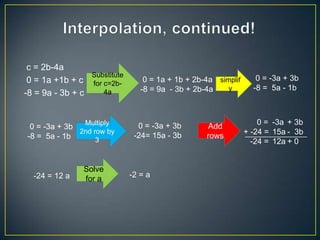
c = 2b-4a
                   Substitute                                        0 = -3a + 3b
 0 = 1a +1b + c    for c=2b-
                                    0 = 1a + 1b + 2b-4a simplif
                                   -8 = 9a - 3b + 2b-4a    y        -8 = 5a - 1b
-8 = 9a - 3b + c       4a


               Multiply           0 = -3a + 3b        Add             0 = -3a + 3b
 0 = -3a + 3b
              2nd row by
                                 -24= 15a - 3b                    + -24 = 15a - 3b
-8 = 5a - 1b                                         rows
                   3                                                -24 = 12a + 0


               Solve
  -24 = 12 a                    -2 = a
               for a
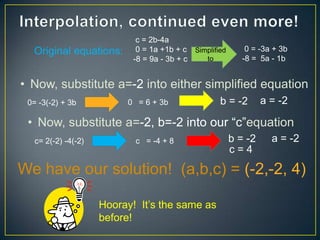
c = 2b-4a
  Original equations:        0 = 1a +1b + c Simplified       0 = -3a + 3b
                            -8 = 9a - 3b + c   to           -8 = 5a - 1b


• Now, substitute a=-2 into either simplified equation
 0= -3(-2) + 3b           0 = 6 + 3b                b = -2        a = -2

 • Now, substitute a=-2, b=-2 into our “c”equation
   c= 2(-2) -4(-2)          c = -4 + 8                   b = -2     a = -2
                                                         c=4

We have our solution! (a,b,c) = (-2,-2, 4)

                     Hooray! It‟s the same as
                     before!
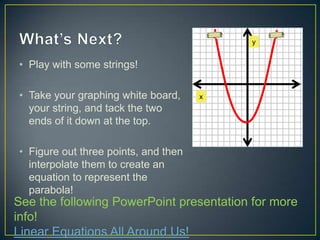
y


• Play with some strings!

• Take your graphing white board,     x
  your string, and tack the two
  ends of it down at the top.

• Figure out three points, and then
  interpolate them to create an
  equation to represent the
  parabola!
See the following PowerPoint presentation for more
info!
Linear Equations All Around Us!
• Clipart taken from Microsoft PowerPoint Clipart Library
• Images designed by Devon Kinne
Kinne, D. (2012). Linear equations all around us -
   powerpoint presentation. Retrieved June 10, 2012 from
   https://www.dropbox.com/s/ohpjydb9zwfp83n/LinearEq
   uationPresentation.wmv
Kinne, D. (2012). Parabolas all around us webquest.
   Retrieved June 10, 2012, from
   http://parabolasaroundus.weebly.com/
Smaldino, S.E., Lowther, D.L., & Russell, J.D.      (2012).
   Instructional technology and media for learning (10th
   ed.). Boston, MA:          Pearson Education, Inc.

CIMT543VisualPrinciples

  • 1.
    Devon Kinne CIMT 543– Summer 2012
  • 2.
    ASSURE MODEL Target Learners High School - Algebra 2 class Subject Area Math: Interpolating and Graphing Quadratic Equations Learning Objectives: Students will substitute points on a graph into a function form to find the equation of a graph correctly 80% of the time. Students will graph quadratic equations on their graphing calculator, choosing an appropriate window to view the graph, 80% of the time.
  • 3.
    • Two waysto represent a quadratic equation: Graphs and Equations • We call the graph a “Parabola” This is what makes it a „quadratic‟ equation a, b, and c can be any number, Quadratic Equation positive or negative, EXCEPT
  • 4.
    Degree = 2, so I need at least 3 points
  • 5.
    Let‟s Do y (-0.5, 4.5) It! (0,4) x (-2, 0) (1, 0) We can pick any three points we want – they will all work to approximate the same equation (-3,-8) (2,-8)
  • 6.
    y (-0.5, 4.5) (0,4) x (-2, 0) (1, 0) • (0,4) • (-2,0) • (2,-8) (-3,-8) (2,-8)
  • 7.
    4=c 0 = 4a – 2b + c -8 = 4a + 2b + c
  • 8.
    • Goal: Solvethe system of equations by the addition method • Addition Method: Add like terms of each equation • Example: 2x + y = 9 2x + y = 9 + 3x – y = 16 + 3x - y = 16 • 2x + y = 9 5x +0y= 25 3x – y = 16 5x = 25 x=5 • Now, substitute x=5 into either equation 2(5) + y = 9 10 + y = 9 y = -1 We have our solution! (x,y) = (5, -1)
  • 9.
    • What happensif we just can‟t add down? • Example: 2x + y = 9 2x + y = 9 2x + y = 9 + 3x + y = 4 + 3x + y = 4 3x + y = 4 5x +2y= 13 We still have an x AND a y! • We can multiply an entire row in order to create a cancellation -2x - y = -9 (-1)* (2x + y = 9) -2x - y = -9 + 3x +y = 4 + 3x + y = 4 + 3x +y = 4 1x +0y= -5 • So, x= - 5. Substitute x=-5 into either equation 2(-5) + y = 9 -10 + y = 9 y = 19 We have our solution! (x,y) = (-5, 19)
  • 10.
    x+y=5 -x + y= 3 (x,y) = (1,4) 4x + 5y = -2 3x + y = 4 (x,y) = (2,-2) 2x - y = 9 3x +4y = -14 (x,y) = (2,-5) 4x - 3y = 25 -3x + 8y = 10 (x,y) = (10,5)
  • 11.
    • 3 equationswith 3 unknowns 4 = 0a + 0b + c 0 = 4a - 2b + c -8 = 4a + 2b + c • We do the same process, but it will take more steps because we have 3 unknowns! But Wait! Above, we see 4 = c . We can make that substitution, and then only have 2 equations and 2 unknowns!
  • 12.
    4=c Subtract -4 = 4a - 2b Substitut 0 = 4a - 2b + 4 0 = 4a - 2b + c 4 from -12 = 4a + 2b e c=4 -8 = 4a + 2b + 4 each side -8 = 4a +2b + c -4 = 4a - 2b Solve -4 = 4a - 2b Add + -12 = 4a +2b a = -2 -12 = 4a +2b rows for a -16 = 8a + 0 • Now, substitute a=-2 into either equation -4 = 4(-2) - 2b -4 = -8 - 2b b = -2 We have our solution! (a,b,c) = (-2,-2, 4)
  • 13.
    y y (-0.5, 4.5) (0,4) x (-2, 0) (1, 0) x (-3,-8) (2,-8)
  • 14.
    Let‟s Try y Other (-0.5, 4.5) Points! (0,4) x (-2, 0) (1, 0) • (-2,0) • (1,0) • (-3,-8) (-3,-8) (2,-8)
  • 15.
    • 3 equationswith 3 unknowns 0 = 4a - 2b + c 0 = 1a +1b + c -8 = 9a - 3b + c • We do the same process, but it will take more steps because we have 3 unknowns! Wait! We don‟t have an easy substitution like before, where c=4. But we still need to do the same thing – get an equation that looks like: c = something!
  • 16.
    • Goal: Isolate“c” in one of the equations, to give us 2 remaining equations with 2 unknowns (a and b) 0 = 4a - 2b + c We can choose any of 0 = 1a +1b + c these equations, since they all have “c” with no -8 = 9a - 3b + c coefficient, it‟s easy to solve for “c” • Now, solve 0 = 4a – 2b + c for “c” 4a -2b + c = 0 Subtract -2b + c = -4a 4a from Add 2b to each side c = 2b-4a each side We can now sub “c” into the other two equations
  • 17.
    c = 2b-4a Substitute 0 = -3a + 3b 0 = 1a +1b + c for c=2b- 0 = 1a + 1b + 2b-4a simplif -8 = 9a - 3b + 2b-4a y -8 = 5a - 1b -8 = 9a - 3b + c 4a Multiply 0 = -3a + 3b Add 0 = -3a + 3b 0 = -3a + 3b 2nd row by -24= 15a - 3b + -24 = 15a - 3b -8 = 5a - 1b rows 3 -24 = 12a + 0 Solve -24 = 12 a -2 = a for a
  • 18.
    c = 2b-4a Original equations: 0 = 1a +1b + c Simplified 0 = -3a + 3b -8 = 9a - 3b + c to -8 = 5a - 1b • Now, substitute a=-2 into either simplified equation 0= -3(-2) + 3b 0 = 6 + 3b b = -2 a = -2 • Now, substitute a=-2, b=-2 into our “c”equation c= 2(-2) -4(-2) c = -4 + 8 b = -2 a = -2 c=4 We have our solution! (a,b,c) = (-2,-2, 4) Hooray! It‟s the same as before!
  • 19.
    y • Play withsome strings! • Take your graphing white board, x your string, and tack the two ends of it down at the top. • Figure out three points, and then interpolate them to create an equation to represent the parabola! See the following PowerPoint presentation for more info! Linear Equations All Around Us!
  • 20.
    • Clipart takenfrom Microsoft PowerPoint Clipart Library • Images designed by Devon Kinne Kinne, D. (2012). Linear equations all around us - powerpoint presentation. Retrieved June 10, 2012 from https://www.dropbox.com/s/ohpjydb9zwfp83n/LinearEq uationPresentation.wmv Kinne, D. (2012). Parabolas all around us webquest. Retrieved June 10, 2012, from http://parabolasaroundus.weebly.com/ Smaldino, S.E., Lowther, D.L., & Russell, J.D. (2012). Instructional technology and media for learning (10th ed.). Boston, MA: Pearson Education, Inc.