By: Emily Mayo
Yesenia Cardenas
Carmen Mendoza
TOPIC 12
Past Simple
Objective
Show you the written form of the past
simple, how to use them, and their
pronunciations
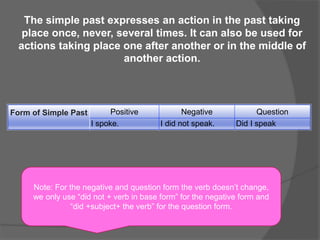
The simple past expresses an action in the past taking
place once, never, several times. It can also be used for
actions taking place one after another or in the middle of
another action.
Form of Simple Past Positive Negative Question
I spoke. I did not speak. Did I speak
Note: For the negative and question form the verb doesn’t change,
we only use “did not + verb in base form” for the negative form and
“did +subject+ the verb” for the question form.
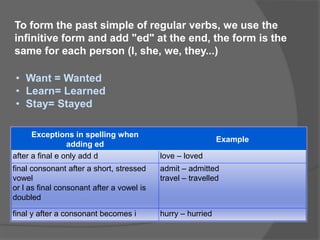
To form the past simple of regular verbs, we use the
infinitive form and add "ed" at the end, the form is the
same for each person (I, she, we, they...)
• Want = Wanted
• Learn= Learned
• Stay= Stayed
Exceptions in spelling when
adding ed
Example
after a final e only add d love – loved
final consonant after a short, stressed
vowel
or l as final consonant after a vowel is
doubled
admit – admitted
travel – travelled
final y after a consonant becomes i hurry – hurried
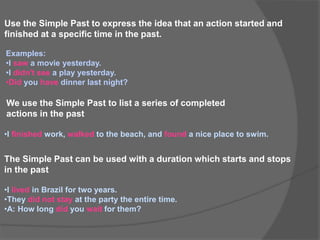
Use the Simple Past to express the idea that an action started and
finished at a specific time in the past.
Examples:
•I saw a movie yesterday.
•I didn't see a play yesterday.
•Did you have dinner last night?
We use the Simple Past to list a series of completed
actions in the past
•I finished work, walked to the beach, and found a nice place to swim.
The Simple Past can be used with a duration which starts and stops
in the past
•I lived in Brazil for two years.
•They did not stay at the party the entire time.
•A: How long did you wait for them?
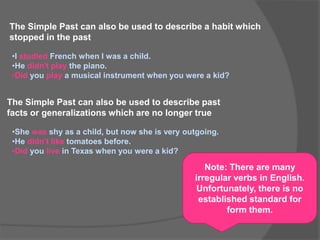
The Simple Past can also be used to describe a habit which
stopped in the past
•I studied French when I was a child.
•He didn't play the piano.
•Did you play a musical instrument when you were a kid?
The Simple Past can also be used to describe past
facts or generalizations which are no longer true
•She was shy as a child, but now she is very outgoing.
•He didn't like tomatoes before.
•Did you live in Texas when you were a kid?
Note: There are many
irregular verbs in English.
Unfortunately, there is no
established standard for
form them.
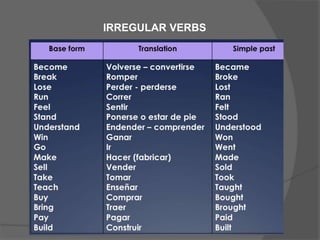
IRREGULAR VERBS
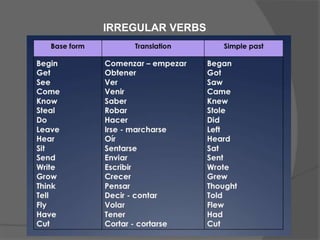
IRREGULAR VERBS
https://www.ego4u.com/en/cram-
up/grammar/simple-past
http://www.curso-
ingles.com/aprender/cursos/nivel-
intermedio/verb-tenses-past/past-simple
http://www.englishpage.com/verbpage/simplepa
st.html
Past simple presentation

Past simple presentation

  • 1.
    By: Emily Mayo YeseniaCardenas Carmen Mendoza
  • 2.
  • 3.
    Objective Show you thewritten form of the past simple, how to use them, and their pronunciations
  • 4.
    The simple pastexpresses an action in the past taking place once, never, several times. It can also be used for actions taking place one after another or in the middle of another action. Form of Simple Past Positive Negative Question I spoke. I did not speak. Did I speak Note: For the negative and question form the verb doesn’t change, we only use “did not + verb in base form” for the negative form and “did +subject+ the verb” for the question form.
  • 5.
    To form thepast simple of regular verbs, we use the infinitive form and add "ed" at the end, the form is the same for each person (I, she, we, they...) • Want = Wanted • Learn= Learned • Stay= Stayed Exceptions in spelling when adding ed Example after a final e only add d love – loved final consonant after a short, stressed vowel or l as final consonant after a vowel is doubled admit – admitted travel – travelled final y after a consonant becomes i hurry – hurried
  • 6.
    Use the SimplePast to express the idea that an action started and finished at a specific time in the past. Examples: •I saw a movie yesterday. •I didn't see a play yesterday. •Did you have dinner last night? We use the Simple Past to list a series of completed actions in the past •I finished work, walked to the beach, and found a nice place to swim. The Simple Past can be used with a duration which starts and stops in the past •I lived in Brazil for two years. •They did not stay at the party the entire time. •A: How long did you wait for them?
  • 7.
    The Simple Pastcan also be used to describe a habit which stopped in the past •I studied French when I was a child. •He didn't play the piano. •Did you play a musical instrument when you were a kid? The Simple Past can also be used to describe past facts or generalizations which are no longer true •She was shy as a child, but now she is very outgoing. •He didn't like tomatoes before. •Did you live in Texas when you were a kid? Note: There are many irregular verbs in English. Unfortunately, there is no established standard for form them.
  • 8.
  • 9.
  • 10.