Past Simple
Past Simple
DEFINITION
DEFINITION
DEFINITION
VOCABULARY
VOCABULARY
VOCABULARY
GRAMMAR
GRAMMAR
GRAMMAR
Integrantes
Bernales Luna, Fabricio
Alexander
Diaz Regalado, Elva Anni
Garcia Villy, Martin Alonso
Gaslac Mas, Jose Alexander
Reátegui Panduro, Bill
Dietrick
Rosales Gálvez, Enyanys
Ariana
Villacorta Burgos, Deyvi
Joseph
The past simple is the verb tense
used in the English language to
narrate events that occurred at a
specific time in the past.
AFFIRMATIVE SENTENCE STRUCTURE
SUBJECT + VERB IN PAST + COMPLEMENT
, "I walked to the store yesterday"
(Caminé a la tienda ayer)
"She danced all night at the party"
(Ella bailó toda la noche en la fiesta)
They cleaned the house on Saturday.
(Ellos limpiaron la casa el sábado)
"I went to the beach last weekend"
(Fui a la playa el fin de semana pasado)
"He wrote a letter to his friend yesterday"
(Él escribió una carta a su amigo ayer)
"She ate a sandwich for lunch"
(Ella comió un sándwich para el almuerzo)
WITH REGULAR VERBS
WITH IRREGULAR VERBS
ORACIONES NEGATIVAS
ORACIONES NEGATIVAS
Use the past tense form for affirmative statements. Use didn`t+ the base form for
negative statements
NEGATIVE FORM
NEGATIVE FORM
I didn`t like the concert.
You didn't buy the ingredients.
She didn't wash the car.
He didn't speak Russian.
DID + SUJETO + INFINITIVO WITHOUT "TO"
USAR DID + SUJETO + INFINITIVO SIN "TO" PARA LOS VERBOS REGULARES E
IRREGULARES, EXCEPTO EL VERBO TO BE. EJEMPLO: DID YOU STUDY YESTERDAY?
(¿ESTUDIASTE AYER?)
USAR WAS/WERE + SUJETO PARA EL VERBO TO BE. EJEMPLO: WERE YOU HAPPY?
(¿ESTABAS FELIZ?)
USAR WAS/WERE + THERE PARA PREGUNTAR POR LA EXISTENCIA DE ALGO O ALGUIEN
EN EL PASADO. EJEMPLO: WAS THERE A PARTY? (¿HUBO UNA FIESTA?)
PONER EL SIGNO DE INTERROGACIÓN AL FINAL DE LA PREGUNTA.
USAR DID + SUJETO + INFINITIVO SIN "TO" PARA LOS VERBOS REGULARES E
IRREGULARES, EXCEPTO EL VERBO TO BE. EJEMPLO: DID YOU STUDY YESTERDAY?
(¿ESTUDIASTE AYER?)
USAR WAS/WERE + SUJETO PARA EL VERBO TO BE. EJEMPLO: WERE YOU HAPPY?
(¿ESTABAS FELIZ?)
USAR WAS/WERE + THERE PARA PREGUNTAR POR LA EXISTENCIA DE ALGO O ALGUIEN
EN EL PASADO. EJEMPLO: WAS THERE A PARTY? (¿HUBO UNA FIESTA?)
PONER EL SIGNO DE INTERROGACIÓN AL FINAL DE LA PREGUNTA.
El pasado simple en forma interrogativa tiene la misma
estructura para los verbos regulares e irregulares porque
usamos did + infinitivo.
VOCABULARY
Regular Verbs
Bake ---- Hornear ----- Baked
Start----Iniciar----Started
Clean----Limpiar----Cleaned
Call----Llamar----Called
Stay----Permanecer----Stayed
Study----Estudiar-Studied
VOCABULARY
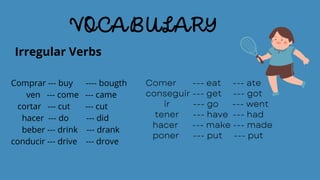
Irregular Verbs
Comprar --- buy ---- bougth
ven --- come --- came
cortar --- cut --- cut
hacer --- do --- did
beber --- drink --- drank
conducir --- drive --- drove
Comer --- eat --- ate
conseguir --- get --- got
ir --- go --- went
tener --- have --- had
hacer --- make --- made
poner --- put --- put
Example
Yesterday I went to the
playground near my house. I
had a lot of fun. I played on
the swings and the slide but
I didn’t go on the
roundabout. I saw my best
friend there. We talked
about her birthday and she
invited me to her party.
Afterwards, I didn’t want to
go home!
Example
When I was a child, I used
to visit my grandparents
every summer. We would
spend hours playing in
their garden, and my
grandmother would tell
me fascinating stories
about her own childhood.
“I was” --- to be
“I used to visit” --- visit
(modal auxiliar)
“We would spend” --- spend
(modal verb)
“She would tell” --- tell
(modal verb)
¡THANK YOU!

PAST SIMPLE

  • 1.
  • 2.
    Integrantes Bernales Luna, Fabricio Alexander DiazRegalado, Elva Anni Garcia Villy, Martin Alonso Gaslac Mas, Jose Alexander Reátegui Panduro, Bill Dietrick Rosales Gálvez, Enyanys Ariana Villacorta Burgos, Deyvi Joseph
  • 3.
    The past simpleis the verb tense used in the English language to narrate events that occurred at a specific time in the past.
  • 4.
    AFFIRMATIVE SENTENCE STRUCTURE SUBJECT+ VERB IN PAST + COMPLEMENT , "I walked to the store yesterday" (Caminé a la tienda ayer) "She danced all night at the party" (Ella bailó toda la noche en la fiesta) They cleaned the house on Saturday. (Ellos limpiaron la casa el sábado) "I went to the beach last weekend" (Fui a la playa el fin de semana pasado) "He wrote a letter to his friend yesterday" (Él escribió una carta a su amigo ayer) "She ate a sandwich for lunch" (Ella comió un sándwich para el almuerzo) WITH REGULAR VERBS WITH IRREGULAR VERBS
  • 5.
    ORACIONES NEGATIVAS ORACIONES NEGATIVAS Usethe past tense form for affirmative statements. Use didn`t+ the base form for negative statements NEGATIVE FORM NEGATIVE FORM I didn`t like the concert. You didn't buy the ingredients. She didn't wash the car. He didn't speak Russian.
  • 6.
    DID + SUJETO+ INFINITIVO WITHOUT "TO" DID + SUJETO + INFINITIVO WITHOUT "TO"
  • 7.
    USAR DID +SUJETO + INFINITIVO SIN "TO" PARA LOS VERBOS REGULARES E IRREGULARES, EXCEPTO EL VERBO TO BE. EJEMPLO: DID YOU STUDY YESTERDAY? (¿ESTUDIASTE AYER?) USAR WAS/WERE + SUJETO PARA EL VERBO TO BE. EJEMPLO: WERE YOU HAPPY? (¿ESTABAS FELIZ?) USAR WAS/WERE + THERE PARA PREGUNTAR POR LA EXISTENCIA DE ALGO O ALGUIEN EN EL PASADO. EJEMPLO: WAS THERE A PARTY? (¿HUBO UNA FIESTA?) PONER EL SIGNO DE INTERROGACIÓN AL FINAL DE LA PREGUNTA. USAR DID + SUJETO + INFINITIVO SIN "TO" PARA LOS VERBOS REGULARES E IRREGULARES, EXCEPTO EL VERBO TO BE. EJEMPLO: DID YOU STUDY YESTERDAY? (¿ESTUDIASTE AYER?) USAR WAS/WERE + SUJETO PARA EL VERBO TO BE. EJEMPLO: WERE YOU HAPPY? (¿ESTABAS FELIZ?) USAR WAS/WERE + THERE PARA PREGUNTAR POR LA EXISTENCIA DE ALGO O ALGUIEN EN EL PASADO. EJEMPLO: WAS THERE A PARTY? (¿HUBO UNA FIESTA?) PONER EL SIGNO DE INTERROGACIÓN AL FINAL DE LA PREGUNTA.
  • 8.
    El pasado simpleen forma interrogativa tiene la misma estructura para los verbos regulares e irregulares porque usamos did + infinitivo.
  • 9.
    VOCABULARY Regular Verbs Bake ----Hornear ----- Baked Start----Iniciar----Started Clean----Limpiar----Cleaned Call----Llamar----Called Stay----Permanecer----Stayed Study----Estudiar-Studied
  • 10.
    VOCABULARY Irregular Verbs Comprar ---buy ---- bougth ven --- come --- came cortar --- cut --- cut hacer --- do --- did beber --- drink --- drank conducir --- drive --- drove Comer --- eat --- ate conseguir --- get --- got ir --- go --- went tener --- have --- had hacer --- make --- made poner --- put --- put
  • 11.
    Example Yesterday I wentto the playground near my house. I had a lot of fun. I played on the swings and the slide but I didn’t go on the roundabout. I saw my best friend there. We talked about her birthday and she invited me to her party. Afterwards, I didn’t want to go home!
  • 12.
    Example When I wasa child, I used to visit my grandparents every summer. We would spend hours playing in their garden, and my grandmother would tell me fascinating stories about her own childhood.
  • 13.
    “I was” ---to be “I used to visit” --- visit (modal auxiliar) “We would spend” --- spend (modal verb) “She would tell” --- tell (modal verb)
  • 14.