SIMPLE PAST
Author:
- José R. Pérez G.
Identify Card.: 26.887.851 – Civil
Enginineering Cod.: #42
Bolivarian Republic of Venezuela.
Ministry of Univeresitary Studies.
Polytechnic Universitary Insitute “Santiago Mariño”.
Extension: Porlamar – Margarita Island – New Sparta State.
Semester II – Section “C”.
Porlamar, August 19th, 2017.
Proffesor:
César Velásquez
Subject:
English I
SIMPLE PAST
What is “Simple Past”?
The “Simple Past”
(Sometimes, known as “Past
Simple”), is a verbal time
used in the english language
to narrate sentences of facts
that happened in a
specifically moment in the
past.For example:
“I used a pencil to write a letter”
Which characteristics
do “Simple Past” have?
Unlike happens in spanish, english
verbs need its conjugation (spanish
language does not need conjugation
to the verbs), incorporating to its
grammar the regular or irregular
verbs.
a) Regular verbs change adding “ed”
at the end of the word.
b) Irregular verbs change completly
the word. For example; the past of
“swim” is “swam”, getting a different
pronuntiation and a different way to
write it.
c) Regular verbs
applies its rule to the
words that doesn’t
have a vocal at the
last word. In case that
this happens, the verb
will change just
adding the “d”, just if
the contained vocal is
“e”, if it isn’t, you’ll
have to delete the last
vocal, then, add “ed”.
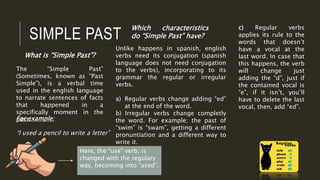
Here, the “use” verb, is
changed with the regulary
way, becoming into “used”.
SIMPLE PAST
Types of verbs in
the Simple Past:
Affirmative way:
With regular verbs:
• The affirmative sentences using
regular verbs, get constructed
adding “ed” at the end of the
word to change the verb.
With Irregular verbs:
• To make an affirmation using
irregular verbs, the the word has
to change.
Irregular verbs aren’t as
easy as regular ones,
because you can’t just add
“ed” at the end of the word.
The irregular verbs change
using its past.
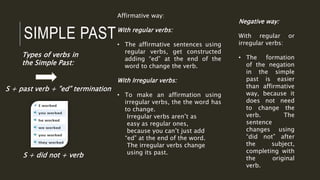
S + past verb + ”ed” termination
S + did not + verb
Negative way:
With regular or
irregular verbs:
• The formation
of the negation
in the simple
past is easier
than affirmative
way, because it
does not need
to change the
verb. The
sentence
changes using
“did not” after
the subject,
completing with
the original
verb.
SIMPLE PAST
Interrogation in simple
past:
• To make questions
using simple past, the
structure changes.
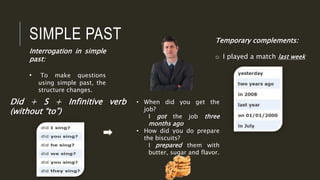
Did + S + Infinitive verb
(without “to”)
Temporary complements:
o I played a match last week
• When did you get the
job?
I got the job three
months ago
• How did you do prepare
the biscuits?
I prepared them with
butter, sugar and flavor.

Simple Past

  • 1.
    SIMPLE PAST Author: - JoséR. Pérez G. Identify Card.: 26.887.851 – Civil Enginineering Cod.: #42 Bolivarian Republic of Venezuela. Ministry of Univeresitary Studies. Polytechnic Universitary Insitute “Santiago Mariño”. Extension: Porlamar – Margarita Island – New Sparta State. Semester II – Section “C”. Porlamar, August 19th, 2017. Proffesor: César Velásquez Subject: English I
  • 2.
    SIMPLE PAST What is“Simple Past”? The “Simple Past” (Sometimes, known as “Past Simple”), is a verbal time used in the english language to narrate sentences of facts that happened in a specifically moment in the past.For example: “I used a pencil to write a letter” Which characteristics do “Simple Past” have? Unlike happens in spanish, english verbs need its conjugation (spanish language does not need conjugation to the verbs), incorporating to its grammar the regular or irregular verbs. a) Regular verbs change adding “ed” at the end of the word. b) Irregular verbs change completly the word. For example; the past of “swim” is “swam”, getting a different pronuntiation and a different way to write it. c) Regular verbs applies its rule to the words that doesn’t have a vocal at the last word. In case that this happens, the verb will change just adding the “d”, just if the contained vocal is “e”, if it isn’t, you’ll have to delete the last vocal, then, add “ed”. Here, the “use” verb, is changed with the regulary way, becoming into “used”.
  • 3.
    SIMPLE PAST Types ofverbs in the Simple Past: Affirmative way: With regular verbs: • The affirmative sentences using regular verbs, get constructed adding “ed” at the end of the word to change the verb. With Irregular verbs: • To make an affirmation using irregular verbs, the the word has to change. Irregular verbs aren’t as easy as regular ones, because you can’t just add “ed” at the end of the word. The irregular verbs change using its past. S + past verb + ”ed” termination S + did not + verb Negative way: With regular or irregular verbs: • The formation of the negation in the simple past is easier than affirmative way, because it does not need to change the verb. The sentence changes using “did not” after the subject, completing with the original verb.
  • 4.
    SIMPLE PAST Interrogation insimple past: • To make questions using simple past, the structure changes. Did + S + Infinitive verb (without “to”) Temporary complements: o I played a match last week • When did you get the job? I got the job three months ago • How did you do prepare the biscuits? I prepared them with butter, sugar and flavor.