SIMPLE &
COMPOUND
I
N
T
E
R
E
S
T
1. Introduction
2. Simple Interest
3. Compound Interest
CHAPTER 2
2.0 I
NTRODUCTION
Interest – Definition
Interest is money earned when
money is invested.
Interest is charged incurred
when a load or credit is
obtained.
2 types of interest:
❖ Simple interest
❖ Compound interest
where
:
I = Simple Interest
P = Principal /
Investment R = rate per
annum (year) T = Time
in years
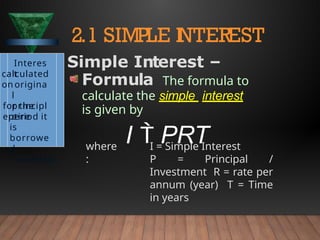
2.1 SIMPLE I
NTEREST
Interes
t
calculated
on origina
l
principl
e
for the
entire
period it
is
borrowe
d
/ invested
Simple Interest –
Formula The formula to
calculate the simple interest
is given by
I  PRT
where
:
S = Simple amount
P = Principal /
Investment R = Rate per
annum (year) T = Time in
years
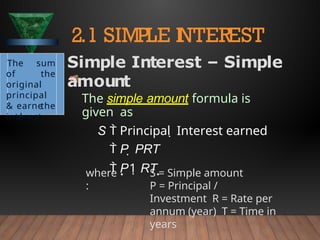
2.1 SIMPLE I
NTEREST
The sum
of the
original
principal
& the
interest
earne
d
Simple Interest – Simple
amount
The simple amount formula is
given as
S  Principal  Interest earned
 P  PRT
 P1 RT 
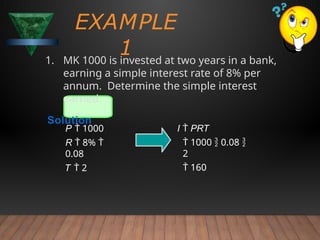
EXAMPLE
1
1. MK 1000 is invested at two years in a bank,
earning a simple interest rate of 8% per
annum. Determine the simple interest
earned.
Solution
I  PRT
 1000  0.08 
2
 160
P  1000
R  8% 
0.08
T  2
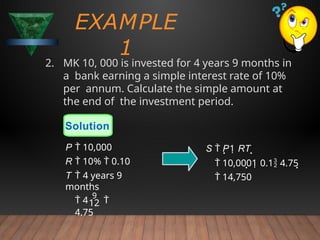
2. MK 10, 000 is invested for 4 years 9 months in
a bank earning a simple interest rate of 10%
per annum. Calculate the simple amount at
the end of the investment period.
EXAMPLE
1
S  P1 RT 
 10,0001 0.1 4.75
 14,750
12
 4
9

4.75
Solution
P  10,000
R  10%  0.10
T  4 years 9
months
EXAMPLE
1
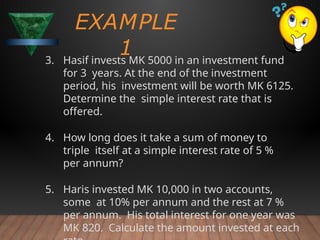
3. Hasif invests MK 5000 in an investment fund
for 3 years. At the end of the investment
period, his investment will be worth MK 6125.
Determine the simple interest rate that is
offered.
4. How long does it take a sum of money to
triple itself at a simple interest rate of 5 %
per annum?
5. Haris invested MK 10,000 in two accounts,
some at 10% per annum and the rest at 7 %
per annum. His total interest for one year was
MK 820. Calculate the amount invested at each
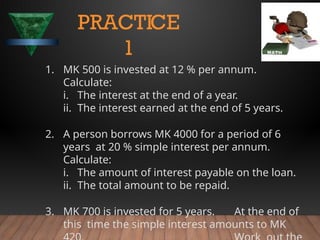
1. MK 500 is invested at 12 % per annum.
Calculate:
i. The interest at the end of a year.
ii. The interest earned at the end of 5 years.
2. A person borrows MK 4000 for a period of 6
years at 20 % simple interest per annum.
Calculate:
i. The amount of interest payable on the loan.
ii. The total amount to be repaid.
3. MK 700 is invested for 5 years. At the end of
this time the simple interest amounts to MK
PRACTICE
1
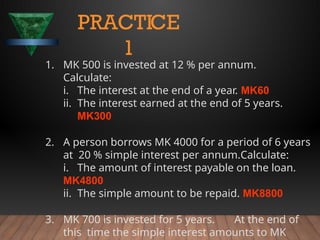
1. MK 500 is invested at 12 % per annum.
Calculate:
i. The interest at the end of a year. MK60
ii. The interest earned at the end of 5 years.
MK300
2. A person borrows MK 4000 for a period of 6 years
at 20 % simple interest per annum.Calculate:
i. The amount of interest payable on the loan.
MK4800
ii. The simple amount to be repaid. MK8800
3. MK 700 is invested for 5 years. At the end of
this time the simple interest amounts to MK
PRACTICE
1
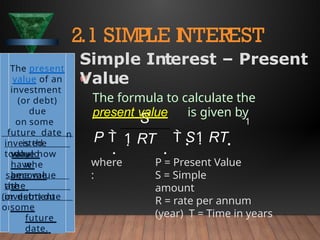
where
:
P = Present Value
S = Simple
amount
R = rate per annum
(year) T = Time in years
2.1 SIMPLE I
NTEREST
1
1 RT
S
P 
 
 S1 RT 
The present
value of an
investment
(or debt)
due
on some
future date
is the
value now
whe
n
invested
today
would
have
become
the
same value
as
the
investment
(or debt) due
on
some
future
date.
Simple Interest – Present
Value
The formula to calculate the
present value is given by
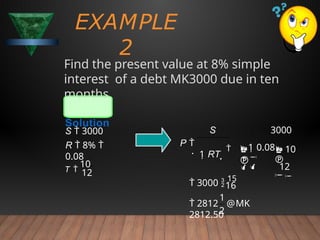
EXAMPLE
2
Find the present value at 8% simple
interest of a debt MK3000 due in ten
months.
Solution
2
1
16
 2812 @MK
2812.50
 3000 
15
 

  10

1 0.08

12
S 3000
1 RT  
P 

12
T 
10
S  3000
R  8% 
0.08
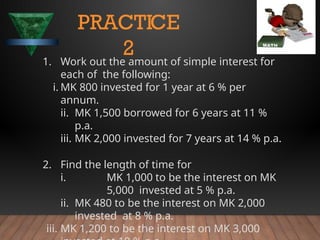
1. Work out the amount of simple interest for
each of the following:
i. MK 800 invested for 1 year at 6 % per
annum.
ii. MK 1,500 borrowed for 6 years at 11 %
p.a.
iii. MK 2,000 invested for 7 years at 14 % p.a.
2. Find the length of time for
i. MK 1,000 to be the interest on MK
5,000 invested at 5 % p.a.
ii. MK 480 to be the interest on MK 2,000
invested at 8 % p.a.
iii. MK 1,200 to be the interest on MK 3,000
PRACTICE
2
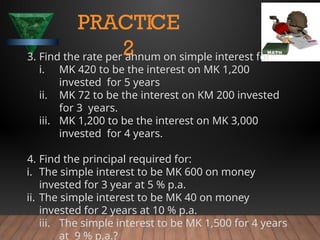
PRACTICE
2
3. Find the rate per annum on simple interest for:
i. MK 420 to be the interest on MK 1,200
invested for 5 years
ii. MK 72 to be the interest on KM 200 invested
for 3 years.
iii. MK 1,200 to be the interest on MK 3,000
invested for 4 years.
4. Find the principal required for:
i. The simple interest to be MK 600 on money
invested for 3 year at 5 % p.a.
ii. The simple interest to be MK 40 on money
invested for 2 years at 10 % p.a.
iii. The simple interest to be MK 1,500 for 4 years
at 9 % p.a.?
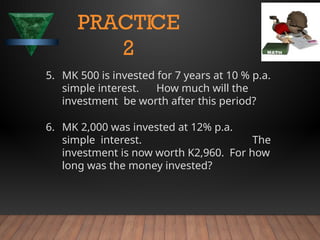
5. MK 500 is invested for 7 years at 10 % p.a.
simple interest. How much will the
investment be worth after this period?
6. MK 2,000 was invested at 12% p.a.
simple interest. The
investment is now worth K2,960. For how
long was the money invested?
PRACTICE
2
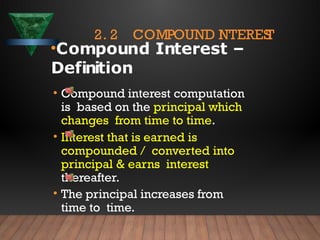
2. 2 COMPOUND I
NTERES
T
•Compound Interest –
Definition
• Compound interest computation
is based on the principal which
changes from time to time.
• Interest that is earned is
compounded / converted into
principal & earns interest
thereafter.
• The principal increases from
time to time.
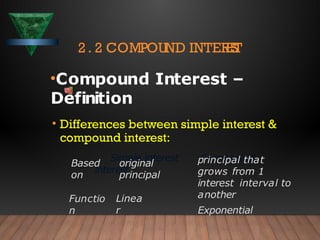
2. 2 COMPOUND INTER
E
S
T
•Compound Interest –
Definition
• Differences between simple interest &
compound interest:
Simple interest Compound
interest
Based original
on principal
Functio
n
Linea
r
principal that
grows from 1
interest interval to
another
Exponential
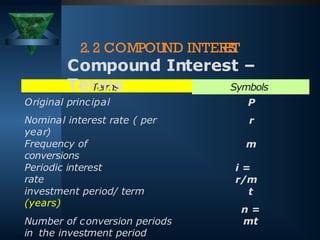
2. 2 COMPOUND INTER
E
S
T
Terms Symbols
Original principal
Nominal interest rate ( per
year)
P
r
Frequency of
conversions
m
Periodic interest
rate
i =
r/m
investment period/ term
(years)
Number of conversion periods
in the investment period
t
n =
mt
Compound Interest –
Terms
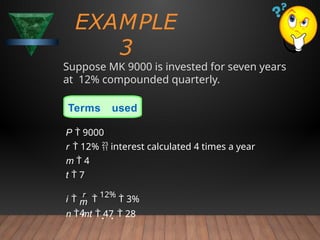
EXAMPLE
3
n  mt  47  28
m
4
i 
r

12%
 3%
Suppose MK 9000 is invested for seven years
at 12% compounded quarterly.
Terms used
P  9000
r  12%  interest calculated 4 times a year
m  4
t  7
where
:
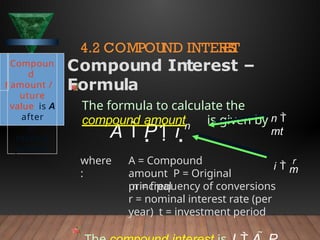
A = Compound
amount P = Original
principal
A  P1 i n
f
Compoun
d
amount /
uture
value is A
after
n
interest
periods
4.2 COMPOUND INTER
E
S
T
Compound Interest –
Formula
The formula to calculate the
compound amount is given by
m = frequency of conversions
r = nominal interest rate (per
year) t = investment period
m
i 
r
n 
mt
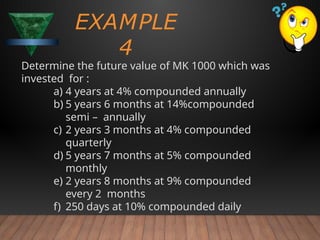
Determine the future value of MK 1000 which was
invested for :
a) 4 years at 4% compounded annually
b) 5 years 6 months at 14%compounded
semi – annually
c) 2 years 3 months at 4% compounded
quarterly
d) 5 years 7 months at 5% compounded
monthly
e) 2 years 8 months at 9% compounded
every 2 months
f) 250 days at 10% compounded daily
EXAMPLE
4
EXAMPLE
4
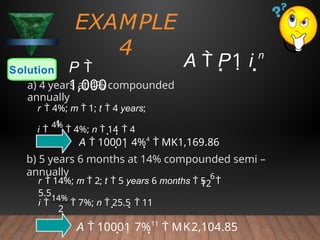
Solution P 
1,000
1
a) 4 years at 4% compounded
annually
r  4%; m  1; t  4 years;
i 
4%
 4%; n  14  4
A  10001 4%4
 MK1,169.86
b) 5 years 6 months at 14% compounded semi –
annually
A  10001 7%11
 MK2,104.85
2
12
i 
14%
 7%; n  25.5  11
r  14%; m  2; t  5 years 6 months  5
6

5.5
A  P1 i n
EXAMPLE
4
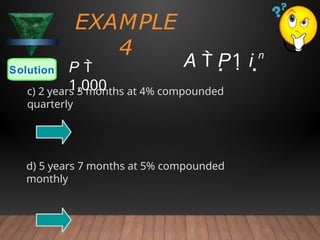
Solution P 
1,000
c) 2 years 3 months at 4% compounded
quarterly
d) 5 years 7 months at 5% compounded
monthly
A  P1 i n
EXAMPLE
4
Solution P 
1,000
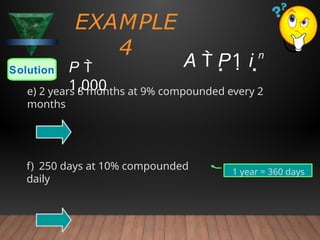
e) 2 years 8 months at 9% compounded every 2
months
f) 250 days at 10% compounded
daily
1 year = 360 days
A  P1 i n
EXAMPLE
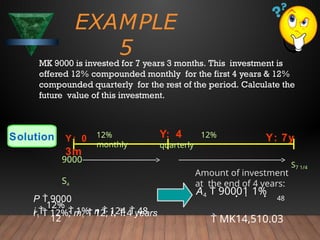
5
MK 9000 is invested for 7 years 3 months. This investment is
offered 12% compounded monthly for the first 4 years & 12%
compounded quarterly for the rest of the period. Calculate the
future value of this investment.
Solution Y: 0 Y: 7y
3m
S7 1/4
12%
monthly
Y: 4 12%
quarterly
12
12%
 1%; n  124  48
i 
9000
S4
P  9000
r1  12%; m1  12; t1  4 years
Amount of investment
at the end of 4 years:
A4  90001 1% 48
 MK14,510.03
EXAMPLE
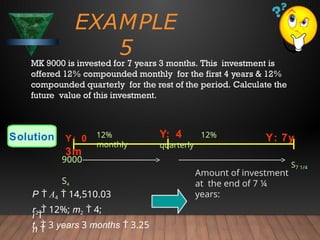
5
MK 9000 is invested for 7 years 3 months. This investment is
offered 12% compounded monthly for the first 4 years & 12%
compounded quarterly for the rest of the period. Calculate the
future value of this investment.
Solution Y: 0 Y: 7y
3m
S7 1/4
12%
monthly
Y: 4 12%
quarterly
i 
n 
9000
S4
P  A4  14,510.03
r2  12%; m2  4;
t1  3 years 3 months  3.25
Amount of investment
at the end of 7 ¼
years:
EXAMPLE
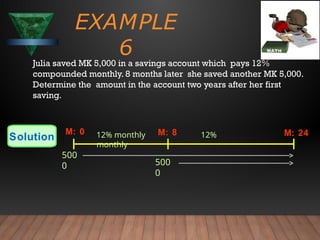
6
Julia saved MK 5,000 in a savings account which pays 12%
compounded monthly. 8 months later she saved another MK 5,000.
Determine the amount in the account two years after her first
saving.
Solution
500
0
M: 0
500
0
12% monthly 12%
monthly
M: 8 M: 24
EXAMPLE
7
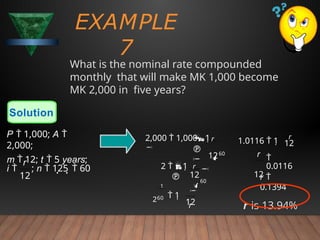
What is the nominal rate compounded
monthly that will make MK 1,000 become
MK 2,000 in five years?
Solution
12
; n  125  60
r
i 
P  1,000; A 
2,000;
m  12; t  5 years;
12
260  1

12

r
r

60

2  1

1
r

60



2,000  1,0001

12
12

0.0116
12
r
1.0116  1
r
r 
0.1394
r is 13.94%
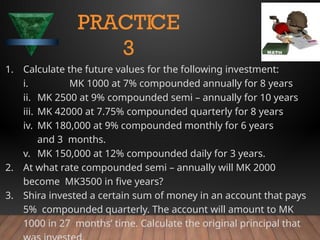
1. Calculate the future values for the following investment:
i. MK 1000 at 7% compounded annually for 8 years
ii. MK 2500 at 9% compounded semi – annually for 10 years
iii. MK 42000 at 7.75% compounded quarterly for 8 years
iv. MK 180,000 at 9% compounded monthly for 6 years
and 3 months.
v. MK 150,000 at 12% compounded daily for 3 years.
2. At what rate compounded semi – annually will MK 2000
become MK3500 in five years?
3. Shira invested a certain sum of money in an account that pays
5% compounded quarterly. The account will amount to MK
1000 in 27 months’ time. Calculate the original principal that
PRACTICE
3
4. How long will it take for MK 5000 to grow to MK 6000 if
the investment earns interest at the rate of 12%
compounded monthly?
5. How long will it take an investment of MK 2000 to double if
the investment earns interest at the rate of 9%
compounded monthly?
6. Calculate the amount to be invested now at 6%
compounded
monthly so as accumulate MK 8888 in three years.
7. Five years ago, Adam had saved MK 10,000 in an account
that pays 6% compounded monthly. Now he intends to
add another X kwacha into the account. Determine the
PRACTICE
3
Effective
rate
s useful when
an investor
wants
to compare
investments
with different
compounding
periods but
he needs
to put them
on a common
basis
2. 2 COMPOUND INTER
E
S
T
Compound
Interest –
Effective Rate
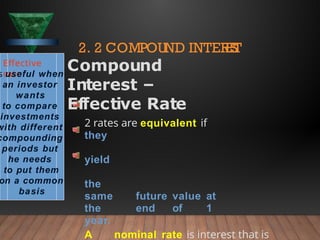
2 rates are equivalent if
they
yield
the
same future value at
the end of 1
year.
A nominal rate is interest that is
EXAMPLE
8
1
A  8001 9.04%1
 MK872.32
Solution
P  800
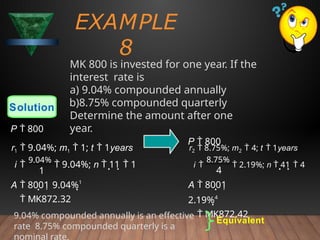
9.04% compounded annually is an effective
rate 8.75% compounded quarterly is a
nominal rate.
4
A  8001
2.19%4
 MK872.42
i 
9.04%
 9.04%; n  11  1 i 
8.75%
 2.19%; n  41  4
r1  9.04%; m1  1; t  1years r2  8.75%; m2  4; t  1years
MK 800 is invested for one year. If the
interest rate is
a) 9.04% compounded annually
b)8.75% compounded quarterly
Determine the amount after one
year.
P  800
Equivalent
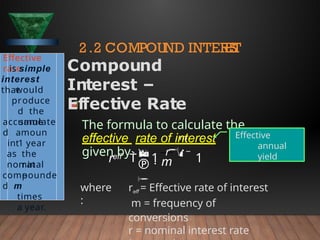
where
:
reff = Effective rate of interest
m = frequency of
conversions
r = nominal interest rate



m
eff

m
r  
1
r 
 1
Effective
rate
is simple
interest
that
would
produce
d the
same
accumulate
d amoun
t
in 1 year
as the
nominal
rat
e
compounde
d m
times
a year.
2.2 COMPOUND INTER
E
S
T
Compound
Interest –
Effective Rate
The formula to calculate the
effective rate of interest is
given by
Effective
annual
yield
EXAMPLE
9
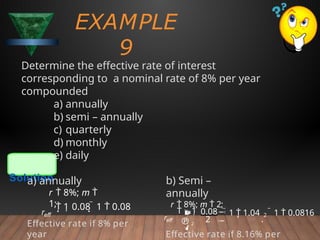
Determine the effective rate of interest
corresponding to a nominal rate of 8% per year
compounded
a) annually
b) semi – annually
c) quarterly
d) monthly
e) daily
Solution
 1 0.08  1  0.08
reff
a) annually
r  8%; m 
1;
2 2  1  0.0816
 1  1.04


 0.08

2
 1

reff
b) Semi –
annually
r  8%; m  2;
Effective rate if 8% per
year Effective rate if 8.16% per
EXAMPLE
9
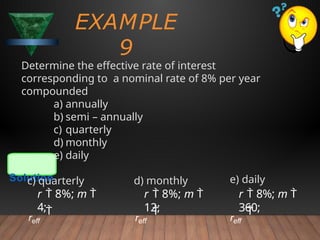
Determine the effective rate of interest
corresponding to a nominal rate of 8% per year
compounded
a) annually
b) semi – annually
c) quarterly
d) monthly
e) daily
Solution

reff
c) quarterly
r  8%; m 
4; 
reff
d) monthly
r  8%; m 
12; 
reff
e) daily
r  8%; m 
360;
EXAMPLE
10
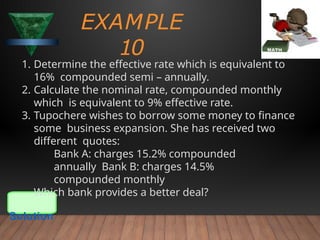
1. Determine the effective rate which is equivalent to
16% compounded semi – annually.
2. Calculate the nominal rate, compounded monthly
which is equivalent to 9% effective rate.
3. Tupochere wishes to borrow some money to finance
some business expansion. She has received two
different quotes:
Bank A: charges 15.2% compounded
annually Bank B: charges 14.5%
compounded monthly
Which bank provides a better deal?
Solution
1. Calculate the effective rate that is equivalent
to
i. 4 ½% compounded semi – annually
ii. 16% compounded quarterly
iii. 15% compounded monthly
iv. 8% compounded weekly
v. 12% compounded daily.
2. MK 1000 was invested for two years at 10% simple
interest. Calculate the effective rate that was earned?
3. What is the nominal rate compounded monthly
that is equivalent to 12% effective rate?
PRACTICE
4
4. FDH Bank offers two interest rates for fixed deposits:
Offer 1: 12% compounded quarterly
Offer 2: 13.55% simple interest
If you wish to invest for one year, which offer would
you choose?
5. Martha invested $40,000 in a boutique 5 years ago. Her
investment is worth $70,000 today. What is the effective
rate of her investment?
6. In the last 5 year, Old Mutual Fund grew at the rate of
10.4% per year compounded quarterly. Over the same
period, Public Mutual Fund grew at the rate of 10.6% per
year compounded semi – annually. Which mutual fund has
PRACTICE
4
value is given
by n
P   A1 i 
A
1 i n
The
principal,
P is
often
referre
d
the present
value (or
discounted
value) at i
%
per
interest
period
of
an amount
A.
2.2 COMPOUND INTER
E
S
T
Compound
Interest – Present
Value
The formula to calculate
the present
where
:
A = Compound
amount P = Original
principal
m = frequency of conversions
r = nominal interest rate (per
year) t = investment period
m
i 
r
n 
mt
EXAMPLE
11
How much money should be deposited in a
bank paying interest at the rate 6% per year
compounded monthly so that at the end of 3
years the accumulated amount will be MK
20,000?
Solution
12
i 
6%
 0.5%; n  123  36
A  20,000; r  6%
m  12; t  3
years;
P  200001 0.5%36
 MK16,712.90
 MK16,713
EXAMPLE
12
Determine the present value of MK 49,158.60
due in 5 years at an interest rate of 10% per
year compounded quarterly?
Solution
EXAMPLE
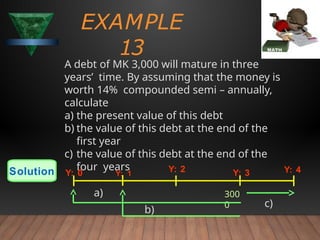
13
A debt of MK 3,000 will mature in three
years’ time. By assuming that the money is
worth 14% compounded semi – annually,
calculate
a) the present value of this debt
b) the value of this debt at the end of the
first year
c) the value of this debt at the end of the
four years
Solution
300
0
Y: 2 Y: 4
Y: 0 Y: 1 Y: 3
a)
b)
c)
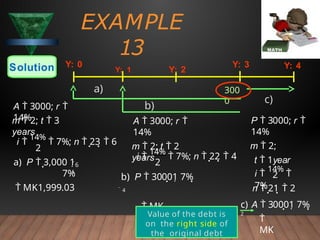

2
6
a) P  3,000 1
7%
 MK1,999.03
i 
14%
 7%; n  23  6
m  2; t  3
years
A  3000; r 
14%
EXAMPLE
13
Solution Y: 0
300
0
Y: 4
Y: 1 Y: 2
Y: 3
a)
b)
2
b) P  30001 7%
 4
 MK
i 
14%
 7%; n  22  4
A  3000; r 
14%
m  2; t  2
years

MK
2
n  21  2
c) A  30001 7%
2
i 
14%

7%
c)
P  3000; r 
14%
m  2;
t  1year
Value of the debt is
on the right side of
the original debt
2. 2 COMPOUND INTER
E
S
T
Compound Interest
– Continuous
compound
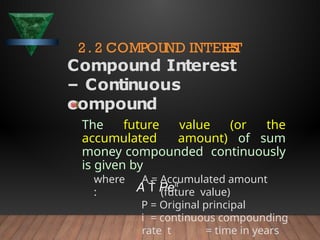
The future value (or the
accumulated amount) of sum
money compounded continuously
is given by
A  Peit
where
:
A = Accumulated amount
(future value)
P = Original principal
i = continuous compounding
rate t = time in years
EXAMPLE
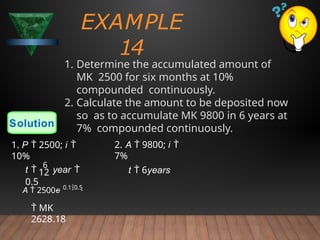
14
1. Determine the accumulated amount of
MK 2500 for six months at 10%
compounded continuously.
2. Calculate the amount to be deposited now
so as to accumulate MK 9800 in 6 years at
7% compounded continuously.
Solution
12
A  2500e 0.10.5
 MK
2628.18
t 
6
year 
0.5
1. P  2500; i 
10%
2. A  9800; i 
7%
t  6years
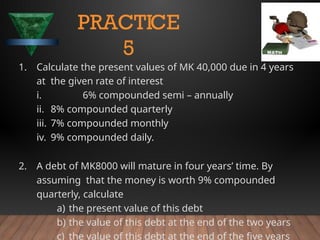
1. Calculate the present values of MK 40,000 due in 4 years
at the given rate of interest
i. 6% compounded semi – annually
ii. 8% compounded quarterly
iii. 7% compounded monthly
iv. 9% compounded daily.
2. A debt of MK8000 will mature in four years’ time. By
assuming that the money is worth 9% compounded
quarterly, calculate
a) the present value of this debt
b) the value of this debt at the end of the two years
c) the value of this debt at the end of the five years
PRACTICE
5
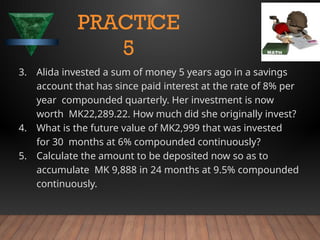
3. Alida invested a sum of money 5 years ago in a savings
account that has since paid interest at the rate of 8% per
year compounded quarterly. Her investment is now
worth MK22,289.22. How much did she originally invest?
4. What is the future value of MK2,999 that was invested
for 30 months at 6% compounded continuously?
5. Calculate the amount to be deposited now so as to
accumulate MK 9,888 in 24 months at 9.5% compounded
continuously.
PRACTICE
5
simple and compound interest [Autosaved].pptx

  • 1.
    SIMPLE & COMPOUND I N T E R E S T 1. Introduction 2.Simple Interest 3. Compound Interest CHAPTER 2
  • 2.
    2.0 I NTRODUCTION Interest –Definition Interest is money earned when money is invested. Interest is charged incurred when a load or credit is obtained. 2 types of interest: ❖ Simple interest ❖ Compound interest
  • 3.
    where : I = SimpleInterest P = Principal / Investment R = rate per annum (year) T = Time in years 2.1 SIMPLE I NTEREST Interes t calculated on origina l principl e for the entire period it is borrowe d / invested Simple Interest – Formula The formula to calculate the simple interest is given by I  PRT
  • 4.
    where : S = Simpleamount P = Principal / Investment R = Rate per annum (year) T = Time in years 2.1 SIMPLE I NTEREST The sum of the original principal & the interest earne d Simple Interest – Simple amount The simple amount formula is given as S  Principal  Interest earned  P  PRT  P1 RT 
  • 5.
    EXAMPLE 1 1. MK 1000is invested at two years in a bank, earning a simple interest rate of 8% per annum. Determine the simple interest earned. Solution I  PRT  1000  0.08  2  160 P  1000 R  8%  0.08 T  2
  • 6.
    2. MK 10,000 is invested for 4 years 9 months in a bank earning a simple interest rate of 10% per annum. Calculate the simple amount at the end of the investment period. EXAMPLE 1 S  P1 RT   10,0001 0.1 4.75  14,750 12  4 9  4.75 Solution P  10,000 R  10%  0.10 T  4 years 9 months
  • 7.
    EXAMPLE 1 3. Hasif investsMK 5000 in an investment fund for 3 years. At the end of the investment period, his investment will be worth MK 6125. Determine the simple interest rate that is offered. 4. How long does it take a sum of money to triple itself at a simple interest rate of 5 % per annum? 5. Haris invested MK 10,000 in two accounts, some at 10% per annum and the rest at 7 % per annum. His total interest for one year was MK 820. Calculate the amount invested at each
  • 8.
    1. MK 500is invested at 12 % per annum. Calculate: i. The interest at the end of a year. ii. The interest earned at the end of 5 years. 2. A person borrows MK 4000 for a period of 6 years at 20 % simple interest per annum. Calculate: i. The amount of interest payable on the loan. ii. The total amount to be repaid. 3. MK 700 is invested for 5 years. At the end of this time the simple interest amounts to MK PRACTICE 1
  • 9.
    1. MK 500is invested at 12 % per annum. Calculate: i. The interest at the end of a year. MK60 ii. The interest earned at the end of 5 years. MK300 2. A person borrows MK 4000 for a period of 6 years at 20 % simple interest per annum.Calculate: i. The amount of interest payable on the loan. MK4800 ii. The simple amount to be repaid. MK8800 3. MK 700 is invested for 5 years. At the end of this time the simple interest amounts to MK PRACTICE 1
  • 10.
    where : P = PresentValue S = Simple amount R = rate per annum (year) T = Time in years 2.1 SIMPLE I NTEREST 1 1 RT S P     S1 RT  The present value of an investment (or debt) due on some future date is the value now whe n invested today would have become the same value as the investment (or debt) due on some future date. Simple Interest – Present Value The formula to calculate the present value is given by
  • 11.
    EXAMPLE 2 Find the presentvalue at 8% simple interest of a debt MK3000 due in ten months. Solution 2 1 16  2812 @MK 2812.50  3000  15      10  1 0.08  12 S 3000 1 RT   P   12 T  10 S  3000 R  8%  0.08
  • 12.
    1. Work outthe amount of simple interest for each of the following: i. MK 800 invested for 1 year at 6 % per annum. ii. MK 1,500 borrowed for 6 years at 11 % p.a. iii. MK 2,000 invested for 7 years at 14 % p.a. 2. Find the length of time for i. MK 1,000 to be the interest on MK 5,000 invested at 5 % p.a. ii. MK 480 to be the interest on MK 2,000 invested at 8 % p.a. iii. MK 1,200 to be the interest on MK 3,000 PRACTICE 2
  • 13.
    PRACTICE 2 3. Find therate per annum on simple interest for: i. MK 420 to be the interest on MK 1,200 invested for 5 years ii. MK 72 to be the interest on KM 200 invested for 3 years. iii. MK 1,200 to be the interest on MK 3,000 invested for 4 years. 4. Find the principal required for: i. The simple interest to be MK 600 on money invested for 3 year at 5 % p.a. ii. The simple interest to be MK 40 on money invested for 2 years at 10 % p.a. iii. The simple interest to be MK 1,500 for 4 years at 9 % p.a.?
  • 14.
    5. MK 500is invested for 7 years at 10 % p.a. simple interest. How much will the investment be worth after this period? 6. MK 2,000 was invested at 12% p.a. simple interest. The investment is now worth K2,960. For how long was the money invested? PRACTICE 2
  • 15.
    2. 2 COMPOUNDI NTERES T •Compound Interest – Definition • Compound interest computation is based on the principal which changes from time to time. • Interest that is earned is compounded / converted into principal & earns interest thereafter. • The principal increases from time to time.
  • 16.
    2. 2 COMPOUNDINTER E S T •Compound Interest – Definition • Differences between simple interest & compound interest: Simple interest Compound interest Based original on principal Functio n Linea r principal that grows from 1 interest interval to another Exponential
  • 17.
    2. 2 COMPOUNDINTER E S T Terms Symbols Original principal Nominal interest rate ( per year) P r Frequency of conversions m Periodic interest rate i = r/m investment period/ term (years) Number of conversion periods in the investment period t n = mt Compound Interest – Terms
  • 18.
    EXAMPLE 3 n  mt 47  28 m 4 i  r  12%  3% Suppose MK 9000 is invested for seven years at 12% compounded quarterly. Terms used P  9000 r  12%  interest calculated 4 times a year m  4 t  7
  • 19.
    where : A = Compound amountP = Original principal A  P1 i n f Compoun d amount / uture value is A after n interest periods 4.2 COMPOUND INTER E S T Compound Interest – Formula The formula to calculate the compound amount is given by m = frequency of conversions r = nominal interest rate (per year) t = investment period m i  r n  mt
  • 20.
    Determine the futurevalue of MK 1000 which was invested for : a) 4 years at 4% compounded annually b) 5 years 6 months at 14%compounded semi – annually c) 2 years 3 months at 4% compounded quarterly d) 5 years 7 months at 5% compounded monthly e) 2 years 8 months at 9% compounded every 2 months f) 250 days at 10% compounded daily EXAMPLE 4
  • 21.
    EXAMPLE 4 Solution P  1,000 1 a)4 years at 4% compounded annually r  4%; m  1; t  4 years; i  4%  4%; n  14  4 A  10001 4%4  MK1,169.86 b) 5 years 6 months at 14% compounded semi – annually A  10001 7%11  MK2,104.85 2 12 i  14%  7%; n  25.5  11 r  14%; m  2; t  5 years 6 months  5 6  5.5 A  P1 i n
  • 22.
    EXAMPLE 4 Solution P  1,000 c)2 years 3 months at 4% compounded quarterly d) 5 years 7 months at 5% compounded monthly A  P1 i n
  • 23.
    EXAMPLE 4 Solution P  1,000 e)2 years 8 months at 9% compounded every 2 months f) 250 days at 10% compounded daily 1 year = 360 days A  P1 i n
  • 24.
    EXAMPLE 5 MK 9000 isinvested for 7 years 3 months. This investment is offered 12% compounded monthly for the first 4 years & 12% compounded quarterly for the rest of the period. Calculate the future value of this investment. Solution Y: 0 Y: 7y 3m S7 1/4 12% monthly Y: 4 12% quarterly 12 12%  1%; n  124  48 i  9000 S4 P  9000 r1  12%; m1  12; t1  4 years Amount of investment at the end of 4 years: A4  90001 1% 48  MK14,510.03
  • 25.
    EXAMPLE 5 MK 9000 isinvested for 7 years 3 months. This investment is offered 12% compounded monthly for the first 4 years & 12% compounded quarterly for the rest of the period. Calculate the future value of this investment. Solution Y: 0 Y: 7y 3m S7 1/4 12% monthly Y: 4 12% quarterly i  n  9000 S4 P  A4  14,510.03 r2  12%; m2  4; t1  3 years 3 months  3.25 Amount of investment at the end of 7 ¼ years:
  • 26.
    EXAMPLE 6 Julia saved MK5,000 in a savings account which pays 12% compounded monthly. 8 months later she saved another MK 5,000. Determine the amount in the account two years after her first saving. Solution 500 0 M: 0 500 0 12% monthly 12% monthly M: 8 M: 24
  • 27.
    EXAMPLE 7 What is thenominal rate compounded monthly that will make MK 1,000 become MK 2,000 in five years? Solution 12 ; n  125  60 r i  P  1,000; A  2,000; m  12; t  5 years; 12 260  1  12  r r  60  2  1  1 r  60    2,000  1,0001  12 12  0.0116 12 r 1.0116  1 r r  0.1394 r is 13.94%
  • 28.
    1. Calculate thefuture values for the following investment: i. MK 1000 at 7% compounded annually for 8 years ii. MK 2500 at 9% compounded semi – annually for 10 years iii. MK 42000 at 7.75% compounded quarterly for 8 years iv. MK 180,000 at 9% compounded monthly for 6 years and 3 months. v. MK 150,000 at 12% compounded daily for 3 years. 2. At what rate compounded semi – annually will MK 2000 become MK3500 in five years? 3. Shira invested a certain sum of money in an account that pays 5% compounded quarterly. The account will amount to MK 1000 in 27 months’ time. Calculate the original principal that PRACTICE 3
  • 29.
    4. How longwill it take for MK 5000 to grow to MK 6000 if the investment earns interest at the rate of 12% compounded monthly? 5. How long will it take an investment of MK 2000 to double if the investment earns interest at the rate of 9% compounded monthly? 6. Calculate the amount to be invested now at 6% compounded monthly so as accumulate MK 8888 in three years. 7. Five years ago, Adam had saved MK 10,000 in an account that pays 6% compounded monthly. Now he intends to add another X kwacha into the account. Determine the PRACTICE 3
  • 30.
    Effective rate s useful when aninvestor wants to compare investments with different compounding periods but he needs to put them on a common basis 2. 2 COMPOUND INTER E S T Compound Interest – Effective Rate 2 rates are equivalent if they yield the same future value at the end of 1 year. A nominal rate is interest that is
  • 31.
    EXAMPLE 8 1 A  80019.04%1  MK872.32 Solution P  800 9.04% compounded annually is an effective rate 8.75% compounded quarterly is a nominal rate. 4 A  8001 2.19%4  MK872.42 i  9.04%  9.04%; n  11  1 i  8.75%  2.19%; n  41  4 r1  9.04%; m1  1; t  1years r2  8.75%; m2  4; t  1years MK 800 is invested for one year. If the interest rate is a) 9.04% compounded annually b)8.75% compounded quarterly Determine the amount after one year. P  800 Equivalent
  • 32.
    where : reff = Effectiverate of interest m = frequency of conversions r = nominal interest rate    m eff  m r   1 r   1 Effective rate is simple interest that would produce d the same accumulate d amoun t in 1 year as the nominal rat e compounde d m times a year. 2.2 COMPOUND INTER E S T Compound Interest – Effective Rate The formula to calculate the effective rate of interest is given by Effective annual yield
  • 33.
    EXAMPLE 9 Determine the effectiverate of interest corresponding to a nominal rate of 8% per year compounded a) annually b) semi – annually c) quarterly d) monthly e) daily Solution  1 0.08  1  0.08 reff a) annually r  8%; m  1; 2 2  1  0.0816  1  1.04    0.08  2  1  reff b) Semi – annually r  8%; m  2; Effective rate if 8% per year Effective rate if 8.16% per
  • 34.
    EXAMPLE 9 Determine the effectiverate of interest corresponding to a nominal rate of 8% per year compounded a) annually b) semi – annually c) quarterly d) monthly e) daily Solution  reff c) quarterly r  8%; m  4;  reff d) monthly r  8%; m  12;  reff e) daily r  8%; m  360;
  • 35.
    EXAMPLE 10 1. Determine theeffective rate which is equivalent to 16% compounded semi – annually. 2. Calculate the nominal rate, compounded monthly which is equivalent to 9% effective rate. 3. Tupochere wishes to borrow some money to finance some business expansion. She has received two different quotes: Bank A: charges 15.2% compounded annually Bank B: charges 14.5% compounded monthly Which bank provides a better deal? Solution
  • 36.
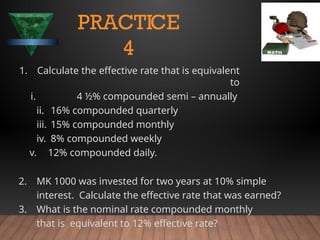
    1. Calculate theeffective rate that is equivalent to i. 4 ½% compounded semi – annually ii. 16% compounded quarterly iii. 15% compounded monthly iv. 8% compounded weekly v. 12% compounded daily. 2. MK 1000 was invested for two years at 10% simple interest. Calculate the effective rate that was earned? 3. What is the nominal rate compounded monthly that is equivalent to 12% effective rate? PRACTICE 4
  • 37.
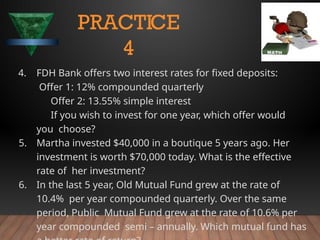
    4. FDH Bankoffers two interest rates for fixed deposits: Offer 1: 12% compounded quarterly Offer 2: 13.55% simple interest If you wish to invest for one year, which offer would you choose? 5. Martha invested $40,000 in a boutique 5 years ago. Her investment is worth $70,000 today. What is the effective rate of her investment? 6. In the last 5 year, Old Mutual Fund grew at the rate of 10.4% per year compounded quarterly. Over the same period, Public Mutual Fund grew at the rate of 10.6% per year compounded semi – annually. Which mutual fund has PRACTICE 4
  • 38.
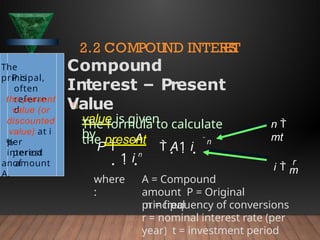
    value is given byn P   A1 i  A 1 i n The principal, P is often referre d the present value (or discounted value) at i % per interest period of an amount A. 2.2 COMPOUND INTER E S T Compound Interest – Present Value The formula to calculate the present where : A = Compound amount P = Original principal m = frequency of conversions r = nominal interest rate (per year) t = investment period m i  r n  mt
  • 39.
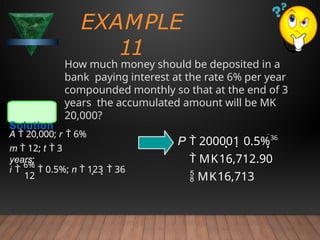
    EXAMPLE 11 How much moneyshould be deposited in a bank paying interest at the rate 6% per year compounded monthly so that at the end of 3 years the accumulated amount will be MK 20,000? Solution 12 i  6%  0.5%; n  123  36 A  20,000; r  6% m  12; t  3 years; P  200001 0.5%36  MK16,712.90  MK16,713
  • 40.
    EXAMPLE 12 Determine the presentvalue of MK 49,158.60 due in 5 years at an interest rate of 10% per year compounded quarterly? Solution
  • 41.
    EXAMPLE 13 A debt ofMK 3,000 will mature in three years’ time. By assuming that the money is worth 14% compounded semi – annually, calculate a) the present value of this debt b) the value of this debt at the end of the first year c) the value of this debt at the end of the four years Solution 300 0 Y: 2 Y: 4 Y: 0 Y: 1 Y: 3 a) b) c)
  • 42.
     2 6 a) P 3,000 1 7%  MK1,999.03 i  14%  7%; n  23  6 m  2; t  3 years A  3000; r  14% EXAMPLE 13 Solution Y: 0 300 0 Y: 4 Y: 1 Y: 2 Y: 3 a) b) 2 b) P  30001 7%  4  MK i  14%  7%; n  22  4 A  3000; r  14% m  2; t  2 years  MK 2 n  21  2 c) A  30001 7% 2 i  14%  7% c) P  3000; r  14% m  2; t  1year Value of the debt is on the right side of the original debt
  • 43.
    2. 2 COMPOUNDINTER E S T Compound Interest – Continuous compound The future value (or the accumulated amount) of sum money compounded continuously is given by A  Peit where : A = Accumulated amount (future value) P = Original principal i = continuous compounding rate t = time in years
  • 44.
    EXAMPLE 14 1. Determine theaccumulated amount of MK 2500 for six months at 10% compounded continuously. 2. Calculate the amount to be deposited now so as to accumulate MK 9800 in 6 years at 7% compounded continuously. Solution 12 A  2500e 0.10.5  MK 2628.18 t  6 year  0.5 1. P  2500; i  10% 2. A  9800; i  7% t  6years
  • 45.
    1. Calculate thepresent values of MK 40,000 due in 4 years at the given rate of interest i. 6% compounded semi – annually ii. 8% compounded quarterly iii. 7% compounded monthly iv. 9% compounded daily. 2. A debt of MK8000 will mature in four years’ time. By assuming that the money is worth 9% compounded quarterly, calculate a) the present value of this debt b) the value of this debt at the end of the two years c) the value of this debt at the end of the five years PRACTICE 5
  • 46.
    3. Alida investeda sum of money 5 years ago in a savings account that has since paid interest at the rate of 8% per year compounded quarterly. Her investment is now worth MK22,289.22. How much did she originally invest? 4. What is the future value of MK2,999 that was invested for 30 months at 6% compounded continuously? 5. Calculate the amount to be deposited now so as to accumulate MK 9,888 in 24 months at 9.5% compounded continuously. PRACTICE 5