BY Dr ANJANA.P
3RD YEAR PG
R&B DEPARTMENT
GOVT. Ayurveda College Tripunithura Kerala
SIMHANADA GUGGULU
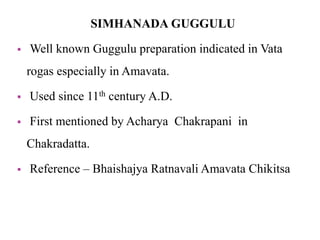
 Well known Guggulu preparation indicated in Vata
rogas especially in Amavata.
 Used since 11th century A.D.
 First mentioned by Acharya Chakrapani in
Chakradatta.
 Reference – Bhaishajya Ratnavali Amavata Chikitsa
According to B.R- Amavatadhikara,
Palatrayam kashayasya triphalaya: suchoornitam |
Sougahikam palachaikam kausikasya palam tatha ||
Kudavam chitratailasya sarvamadaya yatnata: |
Pachayet pakavit vaidya: patrae lohamayae dridae||
Hanti vatam tatha pitham slesmanam khanja pangutam|
Swasam sudurjayam hanti kasam panchavidham tatha |
Kustani vataraktani gulma soolodarani cha ||
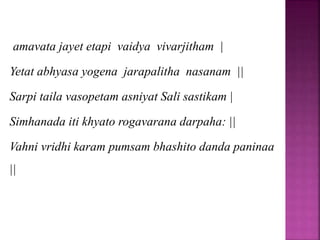
amavata jayet etapi vaidya vivarjitham |
Yetat abhyasa yogena jarapalitha nasanam ||
Sarpi taila vasopetam asniyat Sali sastikam |
Simhanada iti khyato rogavarana darpaha: ||
Vahni vridhi karam pumsam bhashito danda paninaa
||
 INGREDIENTS:
1. Triphala Kashaya – 3 Pala – 144gm each
2. Sudha Gandhaka – 1 Pala – 48g
3. Sudha Guggulu – 1 Pala – 48g
4. Eranda taila – 1 kudavam – 192g
o METHOD OF PREPARATION:
 I method:
 Coarse powder of Triphala are taken and added with
8 parts of water and reduced to one fourth to obtain
Triphala Kashaya. ( all in prescribed quantity).
 Prescribed quantity of Sudha Gandhaka and Sudha
Guggulu are added in Choorna form and mixed well.
 Eranda taila is added in the required quantity and
mixed well.
 Then the mixture is heated and simmered to get a
thick mixture to make tablets.
NOTE:
The quantity of Eranda taila ( in prescribed quantity),
may not be favourable for rolling pills, so in large scale
productions one fourth quantity of castor oil added by
Some manufactures.
 II Method:
 Take Eranda taila and Sudha Guggulu in an iron pan
and simmer the ingredients until Sudha Guggulu
gets completely mixed in castor oil. ( Softening of
Guggulu by Eranda Taila).
 Then gradually add Triphala Choorna in to the pan
and simmer the mixture until it becomes thick
Avaleha consistency.
 After the removal of the vessel from the fire, Sudha
Gandhaka is added and mixed well.
 Then prepare tablets of 3g size ( Sana pramana).
 Prepared tablets should be properly dried and stored
in air tight containers.
 Dose : Sana Pramana
 Therapeutic indications:
Kusta, Vata rakta, Gulma, Soola, Udara, Amavata,
Khanjata, Panguta, Kasa, Swasa, Jara , Palitya
 Properties:
 Doshaharatva – Tridosahara
 Action on Rasa, Rakta, Mamsa, Asthi and Majja
Dhathus.
 Main action – organs like Abdominal organs
especially intestine, nerves, muscles bones, joints and
skin.
 Main indication – Rheumatoid arthritis .
 Anupana : warm water
 Pathya : Sarpi, Taila Vasa, Sali, Shastika Saali etc.
 Side effects:
 Purgative action .
 Some may experience loose stools in high doses.
 Contraindications:
 Visceral hypersensitivity
 Irritable bowel syndrome
 Recurrent or frequent diarrhoea.
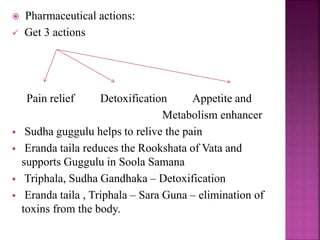
 Pharmaceutical actions:
 Get 3 actions
Pain relief Detoxification Appetite and
Metabolism enhancer
 Sudha guggulu helps to relive the pain
 Eranda taila reduces the Rookshata of Vata and
supports Guggulu in Soola Samana
 Triphala, Sudha Gandhaka – Detoxification
 Eranda taila , Triphala – Sara Guna – elimination of
toxins from the body.
 Sudha Gandhaka – reduce skin diseases by its
antibacterial, antipruritic, antimicrobial and demulcent
actions.
 Triphala in Simhanada Guggulu reduces Serum Uric
acid level and exert antioxidant, anti-inflammatory and
antihyperuricemic effects.
 Vibhitaki – antihyperuricemic action , reduces Serum
Uric acid level.
 Triphala, Eranda taila, Sudha Gandhaka , Guggulu
have synergetic effect of reducing Serum Uric acid
level, inflammation, pain and stiffness – Vata rakta
Probable mode of action in Amavata:
 Amavata – sotha pradhana and kapha being the morbid
doṣa involved in the pathogenesis of the disease
 Katu tikta rasa, rooksha guna, usnha veerya, katu vipaka,
vedana sthapaka, Deepana Pachana, rasayana Medhya
karma.
 Vatakapha samana, Ama Pachaka, Srotosodhaka
properties may help to break the pathogenesis of Amavata
 Tikta katu rasa act as antagonistic to kapha and ama
 Deepana – Agnivardhana
 Pachana – Amapacahna – Srotosodhana
 Due to Ushna Veerya it alleviates vitiated Vata
 Lekhana karma ( Laghu guna and Tikta rasa)
removes the adhered Dosa from the Dusta Srotas.
 Ushna property – does not allow the Ama to linger
at the site of pathogenesis to create Srotorodha.
 Ushna Veerya – antagonistic to Seetha and
Rooksha guna of Vata.
 Eranda taila and Haritaki – Mala Bhedana – mild
sodhana – Ama nirharana
other drugs – samana and rasayana
Both sodhana and rasayana – whole preparation
 Guggulu – kapha Medohara – chief ingredient and
sothahara.
 Triphala – mridu virechana, antioxidant, rasayana
 Guggulu – soolahara, sothahara, rasayana,
antioxidant
 Gandhaka- kustahara, rasayana
 Eranda taila – vatanulomana, vrishya, rasayana,
 Percentage of water soluble material is more than
alcohol soluble extract. It also showed the presence
of acidic nature of vati – improve Jadaragni .
 Photochemical evaluation – carbohydrates,
sulphur, brown content and tannin.
A revised pharmacognostical and physico
chemical analysis of Simhanada guggulu.
Mishra et.al pharma innovation journal)
Medicinal properties :
 Detoxifier
 Antitoxin
 Antibacterial
 Antifungal
 Antigout
 Anti inflammatory
 Antimicrobial
 Antipruritic
 Mild laxative
Manufactures :
Baidyanath
Dabur
Zandu
Patanjali
Dhootapapeswar
Unjha
THANK YOU

SIMHANADA GUGGULU - YOGA REVIEW

  • 1.
    BY Dr ANJANA.P 3RDYEAR PG R&B DEPARTMENT GOVT. Ayurveda College Tripunithura Kerala
  • 2.
    SIMHANADA GUGGULU  Wellknown Guggulu preparation indicated in Vata rogas especially in Amavata.  Used since 11th century A.D.  First mentioned by Acharya Chakrapani in Chakradatta.  Reference – Bhaishajya Ratnavali Amavata Chikitsa
  • 3.
    According to B.R-Amavatadhikara, Palatrayam kashayasya triphalaya: suchoornitam | Sougahikam palachaikam kausikasya palam tatha || Kudavam chitratailasya sarvamadaya yatnata: | Pachayet pakavit vaidya: patrae lohamayae dridae|| Hanti vatam tatha pitham slesmanam khanja pangutam| Swasam sudurjayam hanti kasam panchavidham tatha | Kustani vataraktani gulma soolodarani cha ||
  • 4.
    amavata jayet etapivaidya vivarjitham | Yetat abhyasa yogena jarapalitha nasanam || Sarpi taila vasopetam asniyat Sali sastikam | Simhanada iti khyato rogavarana darpaha: || Vahni vridhi karam pumsam bhashito danda paninaa ||
  • 5.
     INGREDIENTS: 1. TriphalaKashaya – 3 Pala – 144gm each 2. Sudha Gandhaka – 1 Pala – 48g 3. Sudha Guggulu – 1 Pala – 48g 4. Eranda taila – 1 kudavam – 192g o METHOD OF PREPARATION:  I method:  Coarse powder of Triphala are taken and added with 8 parts of water and reduced to one fourth to obtain Triphala Kashaya. ( all in prescribed quantity).
  • 6.
     Prescribed quantityof Sudha Gandhaka and Sudha Guggulu are added in Choorna form and mixed well.  Eranda taila is added in the required quantity and mixed well.  Then the mixture is heated and simmered to get a thick mixture to make tablets. NOTE: The quantity of Eranda taila ( in prescribed quantity), may not be favourable for rolling pills, so in large scale productions one fourth quantity of castor oil added by
  • 7.
    Some manufactures.  IIMethod:  Take Eranda taila and Sudha Guggulu in an iron pan and simmer the ingredients until Sudha Guggulu gets completely mixed in castor oil. ( Softening of Guggulu by Eranda Taila).  Then gradually add Triphala Choorna in to the pan and simmer the mixture until it becomes thick Avaleha consistency.  After the removal of the vessel from the fire, Sudha Gandhaka is added and mixed well.
  • 8.
     Then preparetablets of 3g size ( Sana pramana).  Prepared tablets should be properly dried and stored in air tight containers.  Dose : Sana Pramana  Therapeutic indications: Kusta, Vata rakta, Gulma, Soola, Udara, Amavata, Khanjata, Panguta, Kasa, Swasa, Jara , Palitya
  • 9.
     Properties:  Doshaharatva– Tridosahara  Action on Rasa, Rakta, Mamsa, Asthi and Majja Dhathus.  Main action – organs like Abdominal organs especially intestine, nerves, muscles bones, joints and skin.  Main indication – Rheumatoid arthritis .  Anupana : warm water  Pathya : Sarpi, Taila Vasa, Sali, Shastika Saali etc.
  • 10.
     Side effects: Purgative action .  Some may experience loose stools in high doses.  Contraindications:  Visceral hypersensitivity  Irritable bowel syndrome  Recurrent or frequent diarrhoea.
  • 11.
     Pharmaceutical actions: Get 3 actions Pain relief Detoxification Appetite and Metabolism enhancer  Sudha guggulu helps to relive the pain  Eranda taila reduces the Rookshata of Vata and supports Guggulu in Soola Samana  Triphala, Sudha Gandhaka – Detoxification  Eranda taila , Triphala – Sara Guna – elimination of toxins from the body.
  • 12.
     Sudha Gandhaka– reduce skin diseases by its antibacterial, antipruritic, antimicrobial and demulcent actions.  Triphala in Simhanada Guggulu reduces Serum Uric acid level and exert antioxidant, anti-inflammatory and antihyperuricemic effects.  Vibhitaki – antihyperuricemic action , reduces Serum Uric acid level.  Triphala, Eranda taila, Sudha Gandhaka , Guggulu have synergetic effect of reducing Serum Uric acid level, inflammation, pain and stiffness – Vata rakta
  • 13.
    Probable mode ofaction in Amavata:  Amavata – sotha pradhana and kapha being the morbid doṣa involved in the pathogenesis of the disease  Katu tikta rasa, rooksha guna, usnha veerya, katu vipaka, vedana sthapaka, Deepana Pachana, rasayana Medhya karma.  Vatakapha samana, Ama Pachaka, Srotosodhaka properties may help to break the pathogenesis of Amavata  Tikta katu rasa act as antagonistic to kapha and ama  Deepana – Agnivardhana  Pachana – Amapacahna – Srotosodhana
  • 14.
     Due toUshna Veerya it alleviates vitiated Vata  Lekhana karma ( Laghu guna and Tikta rasa) removes the adhered Dosa from the Dusta Srotas.  Ushna property – does not allow the Ama to linger at the site of pathogenesis to create Srotorodha.  Ushna Veerya – antagonistic to Seetha and Rooksha guna of Vata.  Eranda taila and Haritaki – Mala Bhedana – mild sodhana – Ama nirharana other drugs – samana and rasayana
  • 15.
    Both sodhana andrasayana – whole preparation  Guggulu – kapha Medohara – chief ingredient and sothahara.  Triphala – mridu virechana, antioxidant, rasayana  Guggulu – soolahara, sothahara, rasayana, antioxidant  Gandhaka- kustahara, rasayana  Eranda taila – vatanulomana, vrishya, rasayana,
  • 16.
     Percentage ofwater soluble material is more than alcohol soluble extract. It also showed the presence of acidic nature of vati – improve Jadaragni .  Photochemical evaluation – carbohydrates, sulphur, brown content and tannin. A revised pharmacognostical and physico chemical analysis of Simhanada guggulu. Mishra et.al pharma innovation journal)
  • 17.
    Medicinal properties : Detoxifier  Antitoxin  Antibacterial  Antifungal  Antigout  Anti inflammatory  Antimicrobial  Antipruritic  Mild laxative
  • 18.
  • 19.