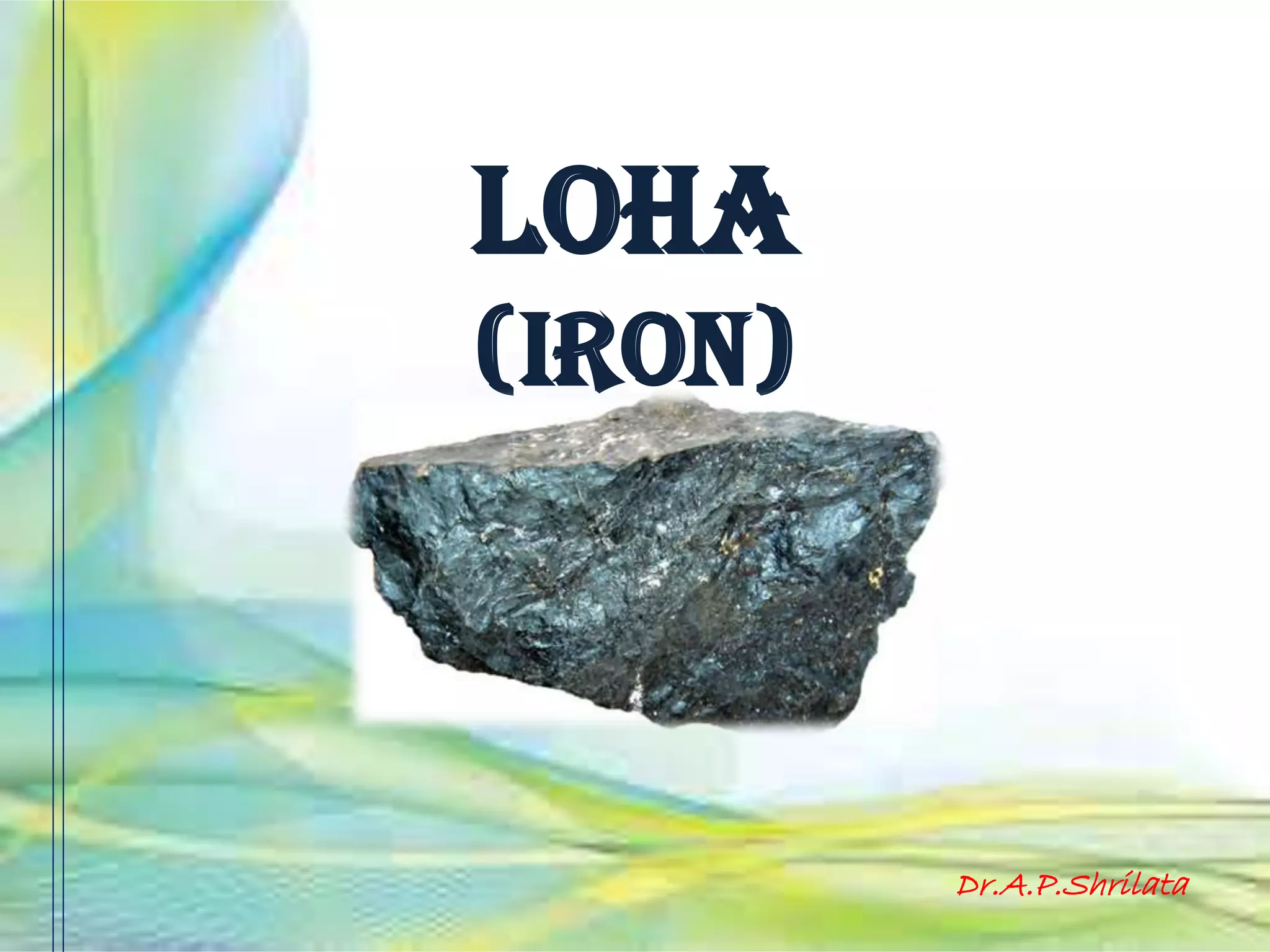
LOHA
(IRON)
Dr.A.P.Shrilata
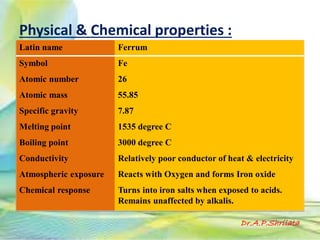
Physical & Chemical properties :
Latin name Ferrum
Symbol Fe
Atomic number 26
Atomic mass 55.85
Specific gravity 7.87
Melting point 1535 degree C
Boiling point 3000 degree C
Conductivity Relatively poor conductor of heat & electricity
Atmospheric exposure Reacts with Oxygen and forms Iron oxide
Chemical response Turns into iron salts when exposed to acids.
Remains unaffected by alkalis.
Dr.A.P.Shrilata
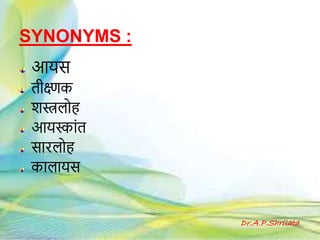
SYNONYMS :
आयस
तीक्ष्णक
शस्त्रलोह
आयस्कांत
सकरलोह
ककलकयस
Dr.A.P.Shrilata
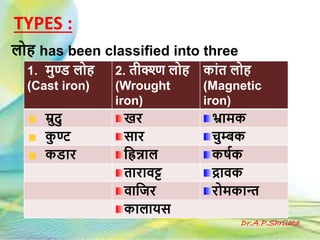
TYPES :
लोह has been classified into three
varieties
Dr.A.P.Shrilata
1. मुण्ड लोह
(Cast iron)
2. तीक्श्ण लोह
(Wrought
iron)
क ांत लोह
(Magnetic
iron)
म्रुदु खर भ्र मक
कु ण्ट स र चुम्बक
कड र ह्रिन्न ल कर्षक
त र वट्ट द्र वक
व ह्रिर रोमक न्त
क ल यस
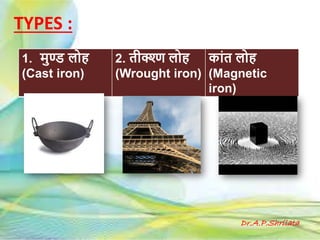
TYPES :
Dr.A.P.Shrilata
1. मुण्ड लोह
(Cast iron)
2. तीक्श्ण लोह
(Wrought iron)
क ांत लोह
(Magnetic
iron)
ORES :
Hematite -Fe2O3
Magnetite -Fe3O4
Iron pyrite -Fe2 S3,
Copper pyrite - CuFeS2
Siderite -Fe CO3
Iron is chiefly extracted from its oxide ores in
blast furnace
Dr.A.P.Shrilata
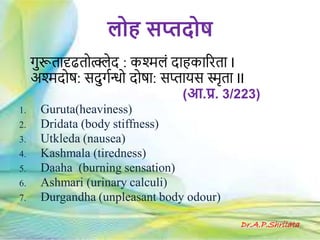
लोह सप्तदोर्
गुरूतकदृढतोत्क्लेद : कश्मलां दकहककररतक I
अश्मदोष: सदुगगन्धो दोषक: सप्तकयस स्मृतक II
(आ.प्र. 3/223)
1. Guruta(heaviness)
2. Dridata (body stiffness)
3. Utkleda (nausea)
4. Kashmala (tiredness)
5. Daaha (burning sensation)
6. Ashmari (urinary calculi)
7. Durgandha (unpleasant body odour)
Dr.A.P.ShrilataDr.A.P.Shrilata
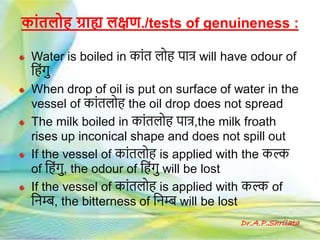
क ांतलोह ग्र ह्य लक्षण./tests of genuineness :
Water is boiled in ककांत लोह पकत्र will have odour of
हहांगु
When drop of oil is put on surface of water in the
vessel of ककांतलोह the oil drop does not spread
The milk boiled in ककांतलोह पकत्र,the milk froath
rises up inconical shape and does not spill out
If the vessel of ककांतलोह is applied with the कल्क
of हहांगु, the odour of हहांगु will be lost
If the vessel of ककांतलोह is applied with कल्क of
हिम्ब, the bitterness of हिम्ब will be lost
Dr.A.P.Shrilata
SHODHANA :
Samanya shodhana
Vishesha shodhana
Dr.A.P.Shrilata
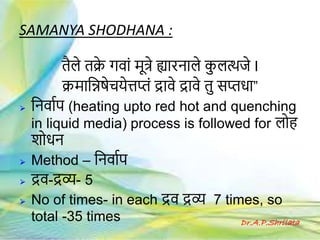
SAMANYA SHODHANA :
तैले तक्रे गवकां मूत्रे ह्यकरिकले कु लत्थजे I
क्रमकहिषेचयेत्तप्तां द्रकवे द्रकवे तु सप्तधक”
⮚ हिवकगप (heating upto red hot and quenching
in liquid media) process is followed for लोह
शोधि
⮚ Method – हिवकगप
⮚ द्रव-द्रव्य- 5
⮚ No of times- in each द्रव द्रव्य 7 times, so
total -35 times Dr.A.P.Shrilata
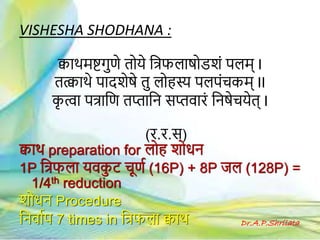
VISHESHA SHODHANA :
क्वकथमष्टगुणे तोये हत्रफलकषोडशां पलम् I
तत्क्वकथे पकदशेषे तु लोहस्य पलपांचकम् II
कृ त्वक पत्रकहण तप्तकहि सप्तवकरां हिषेचयेत् I
(र.र.स)
क्वकथ preparation for लोह शोधि
1P हत्रफलक यवकु ट चूणग (16P) + 8P जल (128P) =
1/4th reduction
शोधि Procedure
हिवकगप 7 times in हत्रफलक क्वकथ Dr.A.P.Shrilata
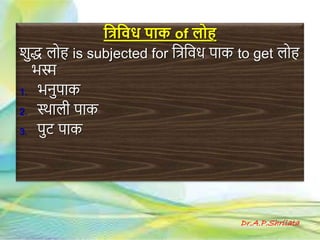
ह्रिह्रवध प क of लोह
शुद्ध लोह is subjected for हत्रहवध पकक to get लोह
भस्म
1. भिुपकक
2. स्थकली पकक
3. पुट पकक
Dr.A.P.Shrilata
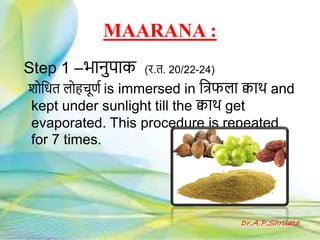
MAARANA :
Step 1 –भकिुपकक (र.त. 20/22-24)
शोहधत लोहचूणग is immersed in हत्रफलक क्वकथ and
kept under sunlight till the क्वकथ get
evaporated. This procedure is repeated
for 7 times.
Dr.A.P.Shrilata
Step 2-स्थकहल पकक (र.त. 20 / 26 – 28)
लोहचूणग which has undergone भकिुपकक is
heated intensely in हत्रफलक क्वकथ till it gets
completely evaporated
Dr.A.P.Shrilata
MAARANA :
Step 3 --पुटपकक (र.त. 20 / 31 – 39)
⮚ हत्रफलक क्वकथ is used for भकविक
⮚ Then चहक्रककs are prepared and dried
under sunlight
⮚ Then the dried चहक्रककs should be kept in
शरकव, सांहधबन्धि is done and subjected to
गजपुट
Dr.A.P.Shrilata
MAARANA :
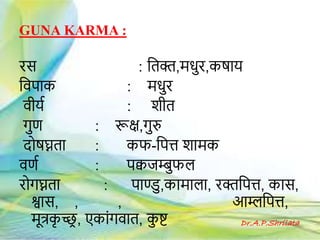
GUNA KARMA :
रस : हतक्त,मधुर,कषकय
हवपकक : मधुर
वीयग : शीत
गुण : रूक्ष,गुरु
दोषघ्नतक : कफ-हपत्त शकमक
वणग : पक्वजम्बुफल
रोगघ्नतक : पकण्डु,ककमकलक, रक्तहपत्त, ककस,
श्वकस, , , आम्लहपत्त,
मूत्रकृ च्छ्र , एककांगवकत, कु ष्ट Dr.A.P.Shrilata
म ि :
• ½ to 2 रहत्त
• अिुपकि : हत्रफल, मधु
Dr.A.P.Shrilata
अनुप न :
ह्रवक रश ांह्रत /Management :
हवडांग +अगस्थ्य स्वरस and patient should be
exposed to sunlight.
हवडांग + शूलघ्न द्रव्य +अगस्थ्य पत्र स्वरस
हवरेचि कमगshould be preformed with अरग्वध
फल मज्जक
Dr.A.P.Shrilata
योग :
लोह पपगटी
िवकयकस लौह
धकत्री लौह
सप्तकहित लौह
आरोग्यवहधगिी रस
चन्द्रप्रभक वहट
लोहकसव
Dr.A.P.Shrilata
Dr.A.P.Shrilata

Loha iron

  • 1.
  • 2.
    Physical & Chemicalproperties : Latin name Ferrum Symbol Fe Atomic number 26 Atomic mass 55.85 Specific gravity 7.87 Melting point 1535 degree C Boiling point 3000 degree C Conductivity Relatively poor conductor of heat & electricity Atmospheric exposure Reacts with Oxygen and forms Iron oxide Chemical response Turns into iron salts when exposed to acids. Remains unaffected by alkalis. Dr.A.P.Shrilata
  • 3.
  • 4.
    TYPES : लोह hasbeen classified into three varieties Dr.A.P.Shrilata 1. मुण्ड लोह (Cast iron) 2. तीक्श्ण लोह (Wrought iron) क ांत लोह (Magnetic iron) म्रुदु खर भ्र मक कु ण्ट स र चुम्बक कड र ह्रिन्न ल कर्षक त र वट्ट द्र वक व ह्रिर रोमक न्त क ल यस
  • 5.
    TYPES : Dr.A.P.Shrilata 1. मुण्डलोह (Cast iron) 2. तीक्श्ण लोह (Wrought iron) क ांत लोह (Magnetic iron)
  • 6.
    ORES : Hematite -Fe2O3 Magnetite-Fe3O4 Iron pyrite -Fe2 S3, Copper pyrite - CuFeS2 Siderite -Fe CO3 Iron is chiefly extracted from its oxide ores in blast furnace Dr.A.P.Shrilata
  • 7.
    लोह सप्तदोर् गुरूतकदृढतोत्क्लेद :कश्मलां दकहककररतक I अश्मदोष: सदुगगन्धो दोषक: सप्तकयस स्मृतक II (आ.प्र. 3/223) 1. Guruta(heaviness) 2. Dridata (body stiffness) 3. Utkleda (nausea) 4. Kashmala (tiredness) 5. Daaha (burning sensation) 6. Ashmari (urinary calculi) 7. Durgandha (unpleasant body odour) Dr.A.P.ShrilataDr.A.P.Shrilata
  • 8.
    क ांतलोह ग्रह्य लक्षण./tests of genuineness : Water is boiled in ककांत लोह पकत्र will have odour of हहांगु When drop of oil is put on surface of water in the vessel of ककांतलोह the oil drop does not spread The milk boiled in ककांतलोह पकत्र,the milk froath rises up inconical shape and does not spill out If the vessel of ककांतलोह is applied with the कल्क of हहांगु, the odour of हहांगु will be lost If the vessel of ककांतलोह is applied with कल्क of हिम्ब, the bitterness of हिम्ब will be lost Dr.A.P.Shrilata
  • 9.
    SHODHANA : Samanya shodhana Visheshashodhana Dr.A.P.Shrilata
  • 10.
    SAMANYA SHODHANA : तैलेतक्रे गवकां मूत्रे ह्यकरिकले कु लत्थजे I क्रमकहिषेचयेत्तप्तां द्रकवे द्रकवे तु सप्तधक” ⮚ हिवकगप (heating upto red hot and quenching in liquid media) process is followed for लोह शोधि ⮚ Method – हिवकगप ⮚ द्रव-द्रव्य- 5 ⮚ No of times- in each द्रव द्रव्य 7 times, so total -35 times Dr.A.P.Shrilata
  • 11.
    VISHESHA SHODHANA : क्वकथमष्टगुणेतोये हत्रफलकषोडशां पलम् I तत्क्वकथे पकदशेषे तु लोहस्य पलपांचकम् II कृ त्वक पत्रकहण तप्तकहि सप्तवकरां हिषेचयेत् I (र.र.स) क्वकथ preparation for लोह शोधि 1P हत्रफलक यवकु ट चूणग (16P) + 8P जल (128P) = 1/4th reduction शोधि Procedure हिवकगप 7 times in हत्रफलक क्वकथ Dr.A.P.Shrilata
  • 12.
    ह्रिह्रवध प कof लोह शुद्ध लोह is subjected for हत्रहवध पकक to get लोह भस्म 1. भिुपकक 2. स्थकली पकक 3. पुट पकक Dr.A.P.Shrilata
  • 13.
    MAARANA : Step 1–भकिुपकक (र.त. 20/22-24) शोहधत लोहचूणग is immersed in हत्रफलक क्वकथ and kept under sunlight till the क्वकथ get evaporated. This procedure is repeated for 7 times. Dr.A.P.Shrilata
  • 14.
    Step 2-स्थकहल पकक(र.त. 20 / 26 – 28) लोहचूणग which has undergone भकिुपकक is heated intensely in हत्रफलक क्वकथ till it gets completely evaporated Dr.A.P.Shrilata MAARANA :
  • 15.
    Step 3 --पुटपकक(र.त. 20 / 31 – 39) ⮚ हत्रफलक क्वकथ is used for भकविक ⮚ Then चहक्रककs are prepared and dried under sunlight ⮚ Then the dried चहक्रककs should be kept in शरकव, सांहधबन्धि is done and subjected to गजपुट Dr.A.P.Shrilata MAARANA :
  • 16.
    GUNA KARMA : रस: हतक्त,मधुर,कषकय हवपकक : मधुर वीयग : शीत गुण : रूक्ष,गुरु दोषघ्नतक : कफ-हपत्त शकमक वणग : पक्वजम्बुफल रोगघ्नतक : पकण्डु,ककमकलक, रक्तहपत्त, ककस, श्वकस, , , आम्लहपत्त, मूत्रकृ च्छ्र , एककांगवकत, कु ष्ट Dr.A.P.Shrilata
  • 17.
    म ि : •½ to 2 रहत्त • अिुपकि : हत्रफल, मधु Dr.A.P.Shrilata अनुप न :
  • 18.
    ह्रवक रश ांह्रत/Management : हवडांग +अगस्थ्य स्वरस and patient should be exposed to sunlight. हवडांग + शूलघ्न द्रव्य +अगस्थ्य पत्र स्वरस हवरेचि कमगshould be preformed with अरग्वध फल मज्जक Dr.A.P.Shrilata
  • 19.
    योग : लोह पपगटी िवकयकसलौह धकत्री लौह सप्तकहित लौह आरोग्यवहधगिी रस चन्द्रप्रभक वहट लोहकसव Dr.A.P.Shrilata
  • 20.