Data Structures
Chapter 1: Basic Concepts
1-1
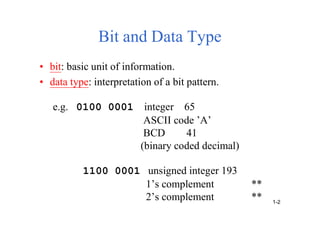
• bit: basic unit of information.
• data type: interpretation of a bit pattern.
e.g. 0100 0001 integer 65
ASCII code ’A’
BCD 41
(binary coded decimal)
1100 0001 unsigned integer 193
1’s complement **
2’s complement **
Bit and Data Type
1-2
1’s and 2’s Complements
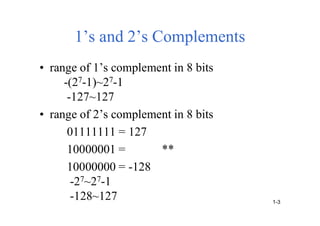
• range of 1’s complement in 8 bits
-(27-1)~27-1
-127~127
• range of 2’s complement in 8 bits
01111111 = 127
10000001 = **
10000000 = -128
-27~27-1
-128~127 1-3
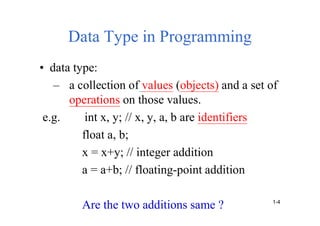
Data Type in Programming
• data type:
– a collection of values (objects) and a set of
operations on those values.
e.g. int x, y; // x, y, a, b are identifiers
float a, b;
x = x+y; // integer addition
a = a+b; // floating-point addition
Are the two additions same ? 1-4
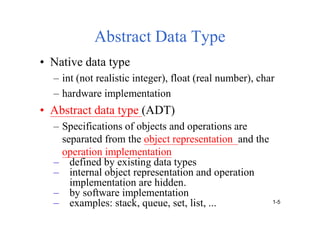
Abstract Data Type
• Native data type
– int (not realistic integer), float (real number), char
– hardware implementation
• Abstract data type (ADT)
– Specifications of objects and operations are
separated from the object representation and the
operation implementation
– defined by existing data types
– internal object representation and operation
implementation are hidden.
– by software implementation
– examples: stack, queue, set, list, ... 1-5
ADT of NaturalNumber
ADT NaturalNumber is
objects: An ordered subrange of the integers starting at zero and ending
at the maximum integer (MAXINT) on the computer
functions: for all x, yNaturalNumber, TRUE, FALSE  Boolean and
where +, , <, ==, and = are the usual integer operations
Nat_Num Zero() ::= 0
Boolean IsZero(x) ::=if (x == 0) return true
else return false
Equal(x,y) :: == if (x == y) return true
else return false
Successor :: == …
Add(x, y) :: == if (x+y <= MAXINT) Add = x + y
else Add = MAXINT
Subtract(x,y) :: == …
end NaturalNumber
1-6
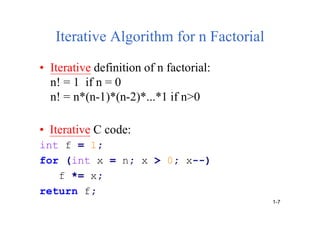
Iterative Algorithm for n Factorial
• Iterative definition of n factorial:
n! = 1 if n = 0
n! = n*(n-1)*(n-2)*...*1 if n>0
• Iterative C code:
int f = 1;
for (int x = n; x > 0; x--)
f *= x;
return f;
1-7
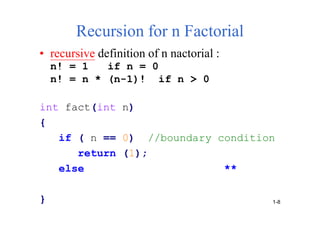
Recursion for n Factorial
• recursive definition of n nactorial :
n! = 1 if n = 0
n! = n * (n-1)! if n > 0
int fact(int n)
{
if ( n == 0) //boundary condition
return (1);
else **
} 1-8
An Example for Binary Search
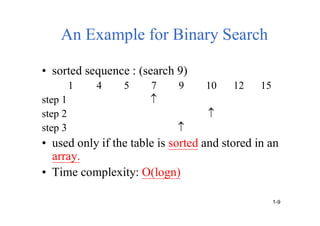
• sorted sequence : (search 9)
1 4 5 7 9 10 12 15
step 1 
step 2 
step 3 
• used only if the table is sorted and stored in an
array.
• Time complexity: O(logn)
1-9
Algorithm for Binary Search
• Algorithm (pseudo code):
while (there are more elements) {
middle = (left + right) / 2;
if (searchnum < list[middle])
right = middle – 1;
else if (searchnum > list[middle])
left = middle + 1;
else return middle;
}
Not found; 1-10
Iterative C Code for Binary Search
int BinarySearch (int *a, int x, const int n)
// Search a[0], ..., a[n-1] for x
{
int left = 0, right = n - 1;
while (left <= right;) {
int middle = (left + right)/2;
if (x < a[middle]) right = middle - 1;
else if (x > a[middle]) left = middle + 1;
else return middle;
} // end of while
return -1; // not found
} 1-11
Recursion for Binary Search
int BinarySearch (int *a, int x, const int left,
const int right)
//Search a[left], ..., a[right] for x
{
if (left <= right) {
int middle = (left + right)/2;
if (x < a[middle])
return BinarySearch(a, x, left, middle-1);
else if (x > a[middle])
return BinarySearch(a, x, middle+1, right);
else return middle;
} // end of if
return -1;// not found
}
1-12
Recursive Permutation Generator
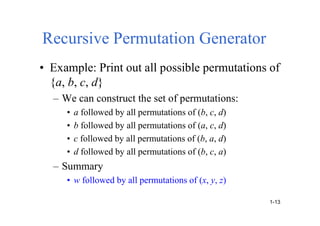
• Example: Print out all possible permutations of
{a, b, c, d}
– We can construct the set of permutations:
• a followed by all permutations of (b, c, d)
• b followed by all permutations of (a, c, d)
• c followed by all permutations of (b, a, d)
• d followed by all permutations of (b, c, a)
– Summary
• w followed by all permutations of (x, y, z)
1-13
#include <iostream>
void Permutations (char *a, const int k, const int m)
//Generate all the permutations of a[k], ..., a[m]
{
if (k == m) { //Output permutation
for (int i = 0; i <= m; i++) cout << a[i] << " ";
cout << endl;
}
else { //a[k], ..., a[m] has more than one permutation
for (int i = k; i <= m; i++)
{
swap(a[k], a[i]); // exchange
Permutations(a, k+1, m);
swap(a[k], a[i]);
}
} // end of else
} // end of Permutations
1-14
Permutation – main() of perm.cpp
int main()
{
char b[10];
b[0] = 'a'; b[1] = 'b'; b[2] = 'c'; b[3] = 'd';
b[4] = 'e'; b[5] = 'f'; b[6] = 'g';
Permutations(b,0,2);
cout << endl
}
1-15
Output: **
The Criteria to Judge a Program
• Does it do what we want it to do?
• Does it work correctly according to the original
specification of the task?
• Is there documentation that describes how to use it
and how it works?
• Do we effectively use functions to create logical units?
• Is the code readable?
• Do we effectively use primary and secondary storage?
• Is running time acceptable?
1-16
Fibonacci Sequence (1)
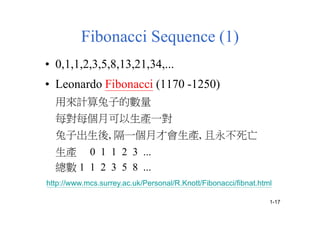
• 0,1,1,2,3,5,8,13,21,34,...
• Leonardo Fibonacci (1170 -1250)
用來計算兔子的數量
每對每個月可以生產一對
兔子出生後, 隔一個月才會生產, 且永不死亡
生產 0 1 1 2 3 ...
總數 1 1 2 3 5 8 ...
http://www.mcs.surrey.ac.uk/Personal/R.Knott/Fibonacci/fibnat.html
1-17
Fibonacci Sequence (2)
• 0,1,1,2,3,5,8,13,21,34,...
1-18
Fibonacci Sequence and Golden Number
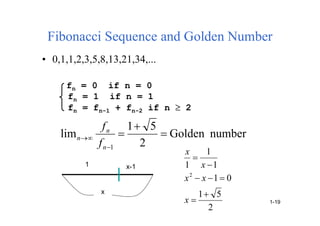
• 0,1,1,2,3,5,8,13,21,34,...
fn = 0 if n = 0
fn = 1 if n = 1
fn = fn-1 + fn-2 if n  2
number
Golden
2
5
1
lim
1






n
n
n
f
f
1 x-1
x
2
5
1
0
1
1
1
1
2







x
x
x
x
x
1-19
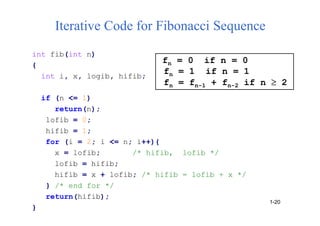
Iterative Code for Fibonacci Sequence
int fib(int n)
{
int i, x, logib, hifib;
if (n <= 1)
return(n);
lofib = 0;
hifib = 1;
for (i = 2; i <= n; i++){
x = lofib; /* hifib, lofib */
lofib = hifib;
hifib = x + lofib; /* hifib = lofib + x */
} /* end for */
return(hifib);
}
fn = 0 if n = 0
fn = 1 if n = 1
fn = fn-1 + fn-2 if n  2
1-20
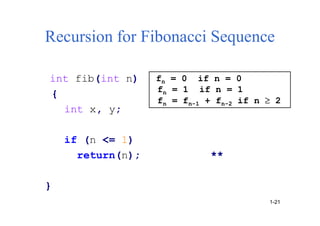
Recursion for Fibonacci Sequence
int fib(int n)
{
int x, y;
if (n <= 1)
return(n); **
}
fn = 0 if n = 0
fn = 1 if n = 1
fn = fn-1 + fn-2 if n  2
1-21
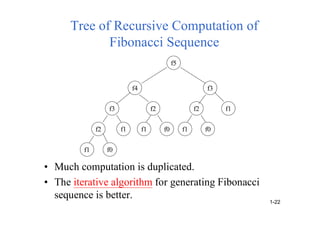
Tree of Recursive Computation of
Fibonacci Sequence
• Much computation is duplicated.
• The iterative algorithm for generating Fibonacci
sequence is better.
f5
f1
f2
f2
f3
f4 f3
f2 f1
f0
f1 f0 f1
f0
f1
1-22
The Towers of Hanoi Problem
• Disks are of different diameters
• A larger disk must be put below a smaller disk
• Object: to move the disks, one each time,
from peg A to peg C, using peg B
as auxiliary.
A B C
1
2
3
4
5
The initial setup of the Towers of Hanoi.
1-23
Strategy for Moving Disks
• how to move 3 disks?
• how to move n disks?
**
**
1-24
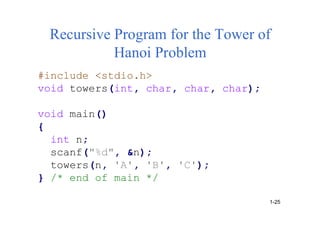
#include <stdio.h>
void towers(int, char, char, char);
void main()
{
int n;
scanf("%d", &n);
towers(n, 'A', 'B', 'C');
} /* end of main */
Recursive Program for the Tower of
Hanoi Problem
1-25
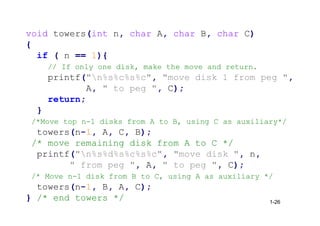
void towers(int n, char A, char B, char C)
{
if ( n == 1){
// If only one disk, make the move and return.
printf("n%s%c%s%c", "move disk 1 from peg ",
A, " to peg ", C);
return;
}
/*Move top n-1 disks from A to B, using C as auxiliary*/
towers(n-1, A, C, B);
/* move remaining disk from A to C */
printf("n%s%d%s%c%s%c", "move disk ", n,
" from peg ", A, " to peg ", C);
/* Move n-1 disk from B to C, using A as auxiliary */
towers(n-1, B, A, C);
} /* end towers */ 1-26
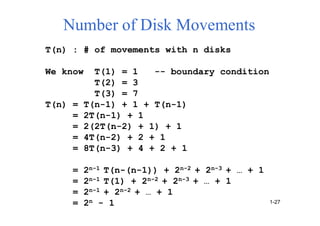
T(n) : # of movements with n disks
We know T(1) = 1 -- boundary condition
T(2) = 3
T(3) = 7
T(n) = T(n-1) + 1 + T(n-1)
= 2T(n-1) + 1
= 2(2T(n-2) + 1) + 1
= 4T(n-2) + 2 + 1
= 8T(n-3) + 4 + 2 + 1
= 2n-1 T(n-(n-1)) + 2n-2 + 2n-3 + … + 1
= 2n-1 T(1) + 2n-2 + 2n-3 + … + 1
= 2n-1 + 2n-2 + … + 1
= 2n - 1
Number of Disk Movements
1-27
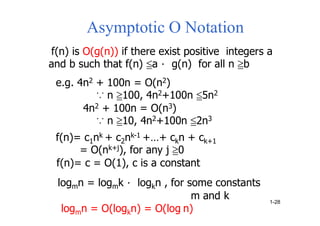
Asymptotic O Notation
f(n) is O(g(n)) if there exist positive integers a
and b such that f(n) ≦a. g(n) for all n ≧b
e.g. 4n2 + 100n = O(n2)
∵ n ≧100, 4n2+100n ≦5n2
4n2 + 100n = O(n3)
∵ n ≧10, 4n2+100n ≦2n3
f(n)= c1nk + c2nk-1 +…+ ckn + ck+1
= O(nk+j), for any j ≧0
f(n)= c = O(1), c is a constant
logmn = logmk. logkn , for some constants
m and k
logmn = O(logkn) = O(log n)
1-28
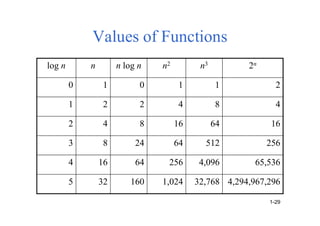
Values of Functions
log n n n log n n2 n3 2n
0 1 0 1 1 2
1 2 2 4 8 4
2 4 8 16 64 16
3 8 24 64 512 256
4 16 64 256 4,096 65,536
5 32 160 1,024 32,768 4,294,967,296
1-29
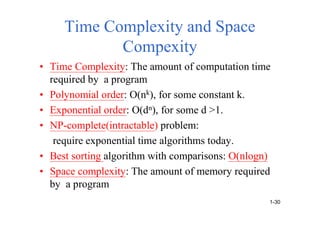
Time Complexity and Space
Compexity
• Time Complexity: The amount of computation time
required by a program
• Polynomial order: O(nk), for some constant k.
• Exponential order: O(dn), for some d >1.
• NP-complete(intractable) problem:
require exponential time algorithms today.
• Best sorting algorithm with comparisons: O(nlogn)
• Space complexity: The amount of memory required
by a program
1-30
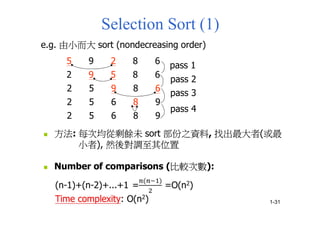
Selection Sort (1)
e.g. 由小而大 sort (nondecreasing order)
5 9 2 8 6
2 9 5 8 6
2 5 9 8 6
2 5 6 8 9
2 5 6 8 9
pass 1
pass 2
pass 4
pass 3
 方法: 每次均從剩餘未 sort 部份之資料, 找出最大者(或最
小者), 然後對調至其位置
 Number of comparisons (比較次數):
1-31
Selection Sort (2)
• Sort a collection of n integers.
– From those integers that are currently unsorted,
find the smallest and place it next in the sorted list.
• The algorithm (pseudo code):
for (int i = 0; i < n ; i++)
{
/* Examine a[i] to a[n-1] and suppose
the smallest integer is at a[j]; */
//Interchange a[i] and a[j];
} 1-32
C Code for Selection Sort
void sort (int *a, int n)
{ // sort the n integers a[0]~a[n1] into nondecreasing order
for ( int i = 0; i < n; i++)
{
int j = i; // find the smallest in a[i] to a[n1]
for (int k = i+1; k < n; k++)
if (a[k] < a[j]) j = k;
// swap(a[i], a[j]);
int temp = a[i]; a[i] = a[j]; a[j] = temp;
}
}
1-33
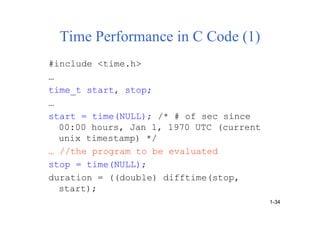
Time Performance in C Code (1)
#include <time.h>
…
time_t start, stop;
…
start = time(NULL); /* # of sec since
00:00 hours, Jan 1, 1970 UTC (current
unix timestamp) */
… //the program to be evaluated
stop = time(NULL);
duration = ((double) difftime(stop,
start);
1-34
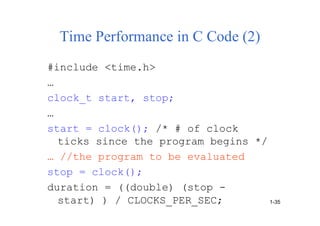
Time Performance in C Code (2)
#include <time.h>
…
clock_t start, stop;
…
start = clock(); /* # of clock
ticks since the program begins */
… //the program to be evaluated
stop = clock();
duration = ((double) (stop -
start) ) / CLOCKS_PER_SEC; 1-35

Ch01 basic concepts_nosoluiton

  • 1.
    Data Structures Chapter 1:Basic Concepts 1-1
  • 2.
    • bit: basicunit of information. • data type: interpretation of a bit pattern. e.g. 0100 0001 integer 65 ASCII code ’A’ BCD 41 (binary coded decimal) 1100 0001 unsigned integer 193 1’s complement ** 2’s complement ** Bit and Data Type 1-2
  • 3.
    1’s and 2’sComplements • range of 1’s complement in 8 bits -(27-1)~27-1 -127~127 • range of 2’s complement in 8 bits 01111111 = 127 10000001 = ** 10000000 = -128 -27~27-1 -128~127 1-3
  • 4.
    Data Type inProgramming • data type: – a collection of values (objects) and a set of operations on those values. e.g. int x, y; // x, y, a, b are identifiers float a, b; x = x+y; // integer addition a = a+b; // floating-point addition Are the two additions same ? 1-4
  • 5.
    Abstract Data Type •Native data type – int (not realistic integer), float (real number), char – hardware implementation • Abstract data type (ADT) – Specifications of objects and operations are separated from the object representation and the operation implementation – defined by existing data types – internal object representation and operation implementation are hidden. – by software implementation – examples: stack, queue, set, list, ... 1-5
  • 6.
    ADT of NaturalNumber ADTNaturalNumber is objects: An ordered subrange of the integers starting at zero and ending at the maximum integer (MAXINT) on the computer functions: for all x, yNaturalNumber, TRUE, FALSE  Boolean and where +, , <, ==, and = are the usual integer operations Nat_Num Zero() ::= 0 Boolean IsZero(x) ::=if (x == 0) return true else return false Equal(x,y) :: == if (x == y) return true else return false Successor :: == … Add(x, y) :: == if (x+y <= MAXINT) Add = x + y else Add = MAXINT Subtract(x,y) :: == … end NaturalNumber 1-6
  • 7.
    Iterative Algorithm forn Factorial • Iterative definition of n factorial: n! = 1 if n = 0 n! = n*(n-1)*(n-2)*...*1 if n>0 • Iterative C code: int f = 1; for (int x = n; x > 0; x--) f *= x; return f; 1-7
  • 8.
    Recursion for nFactorial • recursive definition of n nactorial : n! = 1 if n = 0 n! = n * (n-1)! if n > 0 int fact(int n) { if ( n == 0) //boundary condition return (1); else ** } 1-8
  • 9.
    An Example forBinary Search • sorted sequence : (search 9) 1 4 5 7 9 10 12 15 step 1  step 2  step 3  • used only if the table is sorted and stored in an array. • Time complexity: O(logn) 1-9
  • 10.
    Algorithm for BinarySearch • Algorithm (pseudo code): while (there are more elements) { middle = (left + right) / 2; if (searchnum < list[middle]) right = middle – 1; else if (searchnum > list[middle]) left = middle + 1; else return middle; } Not found; 1-10
  • 11.
    Iterative C Codefor Binary Search int BinarySearch (int *a, int x, const int n) // Search a[0], ..., a[n-1] for x { int left = 0, right = n - 1; while (left <= right;) { int middle = (left + right)/2; if (x < a[middle]) right = middle - 1; else if (x > a[middle]) left = middle + 1; else return middle; } // end of while return -1; // not found } 1-11
  • 12.
    Recursion for BinarySearch int BinarySearch (int *a, int x, const int left, const int right) //Search a[left], ..., a[right] for x { if (left <= right) { int middle = (left + right)/2; if (x < a[middle]) return BinarySearch(a, x, left, middle-1); else if (x > a[middle]) return BinarySearch(a, x, middle+1, right); else return middle; } // end of if return -1;// not found } 1-12
  • 13.
    Recursive Permutation Generator •Example: Print out all possible permutations of {a, b, c, d} – We can construct the set of permutations: • a followed by all permutations of (b, c, d) • b followed by all permutations of (a, c, d) • c followed by all permutations of (b, a, d) • d followed by all permutations of (b, c, a) – Summary • w followed by all permutations of (x, y, z) 1-13
  • 14.
    #include <iostream> void Permutations(char *a, const int k, const int m) //Generate all the permutations of a[k], ..., a[m] { if (k == m) { //Output permutation for (int i = 0; i <= m; i++) cout << a[i] << " "; cout << endl; } else { //a[k], ..., a[m] has more than one permutation for (int i = k; i <= m; i++) { swap(a[k], a[i]); // exchange Permutations(a, k+1, m); swap(a[k], a[i]); } } // end of else } // end of Permutations 1-14
  • 15.
    Permutation – main()of perm.cpp int main() { char b[10]; b[0] = 'a'; b[1] = 'b'; b[2] = 'c'; b[3] = 'd'; b[4] = 'e'; b[5] = 'f'; b[6] = 'g'; Permutations(b,0,2); cout << endl } 1-15 Output: **
  • 16.
    The Criteria toJudge a Program • Does it do what we want it to do? • Does it work correctly according to the original specification of the task? • Is there documentation that describes how to use it and how it works? • Do we effectively use functions to create logical units? • Is the code readable? • Do we effectively use primary and secondary storage? • Is running time acceptable? 1-16
  • 17.
    Fibonacci Sequence (1) •0,1,1,2,3,5,8,13,21,34,... • Leonardo Fibonacci (1170 -1250) 用來計算兔子的數量 每對每個月可以生產一對 兔子出生後, 隔一個月才會生產, 且永不死亡 生產 0 1 1 2 3 ... 總數 1 1 2 3 5 8 ... http://www.mcs.surrey.ac.uk/Personal/R.Knott/Fibonacci/fibnat.html 1-17
  • 18.
    Fibonacci Sequence (2) •0,1,1,2,3,5,8,13,21,34,... 1-18
  • 19.
    Fibonacci Sequence andGolden Number • 0,1,1,2,3,5,8,13,21,34,... fn = 0 if n = 0 fn = 1 if n = 1 fn = fn-1 + fn-2 if n  2 number Golden 2 5 1 lim 1       n n n f f 1 x-1 x 2 5 1 0 1 1 1 1 2        x x x x x 1-19
  • 20.
    Iterative Code forFibonacci Sequence int fib(int n) { int i, x, logib, hifib; if (n <= 1) return(n); lofib = 0; hifib = 1; for (i = 2; i <= n; i++){ x = lofib; /* hifib, lofib */ lofib = hifib; hifib = x + lofib; /* hifib = lofib + x */ } /* end for */ return(hifib); } fn = 0 if n = 0 fn = 1 if n = 1 fn = fn-1 + fn-2 if n  2 1-20
  • 21.
    Recursion for FibonacciSequence int fib(int n) { int x, y; if (n <= 1) return(n); ** } fn = 0 if n = 0 fn = 1 if n = 1 fn = fn-1 + fn-2 if n  2 1-21
  • 22.
    Tree of RecursiveComputation of Fibonacci Sequence • Much computation is duplicated. • The iterative algorithm for generating Fibonacci sequence is better. f5 f1 f2 f2 f3 f4 f3 f2 f1 f0 f1 f0 f1 f0 f1 1-22
  • 23.
    The Towers ofHanoi Problem • Disks are of different diameters • A larger disk must be put below a smaller disk • Object: to move the disks, one each time, from peg A to peg C, using peg B as auxiliary. A B C 1 2 3 4 5 The initial setup of the Towers of Hanoi. 1-23
  • 24.
    Strategy for MovingDisks • how to move 3 disks? • how to move n disks? ** ** 1-24
  • 25.
    #include <stdio.h> void towers(int,char, char, char); void main() { int n; scanf("%d", &n); towers(n, 'A', 'B', 'C'); } /* end of main */ Recursive Program for the Tower of Hanoi Problem 1-25
  • 26.
    void towers(int n,char A, char B, char C) { if ( n == 1){ // If only one disk, make the move and return. printf("n%s%c%s%c", "move disk 1 from peg ", A, " to peg ", C); return; } /*Move top n-1 disks from A to B, using C as auxiliary*/ towers(n-1, A, C, B); /* move remaining disk from A to C */ printf("n%s%d%s%c%s%c", "move disk ", n, " from peg ", A, " to peg ", C); /* Move n-1 disk from B to C, using A as auxiliary */ towers(n-1, B, A, C); } /* end towers */ 1-26
  • 27.
    T(n) : #of movements with n disks We know T(1) = 1 -- boundary condition T(2) = 3 T(3) = 7 T(n) = T(n-1) + 1 + T(n-1) = 2T(n-1) + 1 = 2(2T(n-2) + 1) + 1 = 4T(n-2) + 2 + 1 = 8T(n-3) + 4 + 2 + 1 = 2n-1 T(n-(n-1)) + 2n-2 + 2n-3 + … + 1 = 2n-1 T(1) + 2n-2 + 2n-3 + … + 1 = 2n-1 + 2n-2 + … + 1 = 2n - 1 Number of Disk Movements 1-27
  • 28.
    Asymptotic O Notation f(n)is O(g(n)) if there exist positive integers a and b such that f(n) ≦a. g(n) for all n ≧b e.g. 4n2 + 100n = O(n2) ∵ n ≧100, 4n2+100n ≦5n2 4n2 + 100n = O(n3) ∵ n ≧10, 4n2+100n ≦2n3 f(n)= c1nk + c2nk-1 +…+ ckn + ck+1 = O(nk+j), for any j ≧0 f(n)= c = O(1), c is a constant logmn = logmk. logkn , for some constants m and k logmn = O(logkn) = O(log n) 1-28
  • 29.
    Values of Functions logn n n log n n2 n3 2n 0 1 0 1 1 2 1 2 2 4 8 4 2 4 8 16 64 16 3 8 24 64 512 256 4 16 64 256 4,096 65,536 5 32 160 1,024 32,768 4,294,967,296 1-29
  • 30.
    Time Complexity andSpace Compexity • Time Complexity: The amount of computation time required by a program • Polynomial order: O(nk), for some constant k. • Exponential order: O(dn), for some d >1. • NP-complete(intractable) problem: require exponential time algorithms today. • Best sorting algorithm with comparisons: O(nlogn) • Space complexity: The amount of memory required by a program 1-30
  • 31.
    Selection Sort (1) e.g.由小而大 sort (nondecreasing order) 5 9 2 8 6 2 9 5 8 6 2 5 9 8 6 2 5 6 8 9 2 5 6 8 9 pass 1 pass 2 pass 4 pass 3  方法: 每次均從剩餘未 sort 部份之資料, 找出最大者(或最 小者), 然後對調至其位置  Number of comparisons (比較次數): 1-31
  • 32.
    Selection Sort (2) •Sort a collection of n integers. – From those integers that are currently unsorted, find the smallest and place it next in the sorted list. • The algorithm (pseudo code): for (int i = 0; i < n ; i++) { /* Examine a[i] to a[n-1] and suppose the smallest integer is at a[j]; */ //Interchange a[i] and a[j]; } 1-32
  • 33.
    C Code forSelection Sort void sort (int *a, int n) { // sort the n integers a[0]~a[n1] into nondecreasing order for ( int i = 0; i < n; i++) { int j = i; // find the smallest in a[i] to a[n1] for (int k = i+1; k < n; k++) if (a[k] < a[j]) j = k; // swap(a[i], a[j]); int temp = a[i]; a[i] = a[j]; a[j] = temp; } } 1-33
  • 34.
    Time Performance inC Code (1) #include <time.h> … time_t start, stop; … start = time(NULL); /* # of sec since 00:00 hours, Jan 1, 1970 UTC (current unix timestamp) */ … //the program to be evaluated stop = time(NULL); duration = ((double) difftime(stop, start); 1-34
  • 35.
    Time Performance inC Code (2) #include <time.h> … clock_t start, stop; … start = clock(); /* # of clock ticks since the program begins */ … //the program to be evaluated stop = clock(); duration = ((double) (stop - start) ) / CLOCKS_PER_SEC; 1-35