Ameer Hussein Mohammed
Reed Solomon
OUTLINES
Reed-Solomon code
Encoding of RS Codes
Decoding of RS Codes
Reed Solomon vs BCH
References
Reed-Solomon
RS codes
BCH codes
Cyclic codes
Linear block codes
Reed-Solomon (RS) codes is a special class of non-binary BCH codes
• Discovered by Irving Reed and Gustave Solomon in
1960.
• RS codes are very powerful in correcting both random
errors and bursty errors.
• In RS system, the decoder corrects a symbol, it
replaces the incorrect symbol with a correct one,
whether the error was caused by one bit being
corrupted or all symbol bits being corrupted, this
gives the RS code an advantage over binary codes.
Introduction
• today RS code are found in numerous consumer
products, such as
• mass storage devices (e.g., CDs and DVDs)
• broadband modems (e.g., cable modems)
• wireless mobile communications systems (e.g., WiMax,
cellular telephone and microwave links ).
• Digital television and DVB
Applications
Where :
Reed Solomon coding operates on a finite field called Galios Field GF(2m).
M is the number of a symbol
the total no. of code symbols (Code Length): n = 2𝑚-1
The No. of data symbols: k = 2𝑚
-1-2t
No. of parity check symbols: n-k = 2t
The number of error that need to correct: t
Description of RS Codes
Example 6
A given Reed-Solomon code with RS(204,188) of first generation
DVB standards. Find error correction capability (t).
Solution: Each code word contains 204 code word bytes, of which 188
bytes are data and 16 bytes are parity. For this code:
n = 204, k = 188
2t = n-k = 16, t = 8
The decoder can correct any 8 symbol errors in the code word: i.e.
errors in up to 8 bytes anywhere in the code word can be automatically
corrected.
Encoding of RS Codes
Code Generator Polynomial
An (n, k) Reed-Solomon code is constructed by forming
the code generator polynomial g(x), the roots of which are
consecutive elements of the Galois field.
Thus the code generator polynomial takes the form:
𝒈 𝒙 = 𝒙 + 𝜶 𝒙 + 𝜶𝟐
𝒙 + 𝜶𝟑
… … 𝒙 + 𝜶𝟐𝒕
Or: 𝒈 𝒙 = 𝒙 − 𝜶 𝒙 − 𝜶𝟐
𝒙 − 𝜶𝟑
… … 𝒙
Encoding of RS Codes
 The codeword vector for RS code can be obtained by
𝒄 𝒙 = 𝒙𝐧−𝒌
𝐦 𝒙 𝐦𝐨𝐝 𝐠(𝐱) + 𝒙𝒏−𝒌
𝒎 𝒙
Length of c(x) is n symbol
Length of m(x) is k symbol
𝑥𝑛−𝑘
𝑚 𝑥 : data shifted by n-k
Example 7
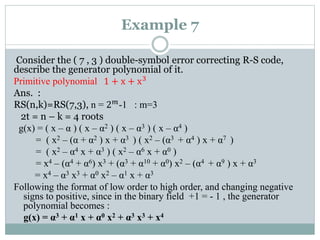
Consider the ( 7 , 3 ) double-symbol error correcting R-S code,
describe the generator polynomial of it.
Primitive polynomial 1 + x + x3
Ans. :
RS(n,k)=RS(7,3), n = 2𝑚
-1 : m=3
2t = n – k = 4 roots
g(x) = ( x – α ) ( x – α2 ) ( x – α3 ) ( x – α4 )
= ( x2 – (α + α2 ) x + α3 ) ( x2 – (α3 + α4 ) x + α7 )
= ( x2 – α4 x + α3 ) ( x2 – α6 x + α0 )
= x4 – (α4 + α6) x3 + (α3 + α10 + α0) x2 – (α4 + α9 ) x + α3
= x4 – α3 x3 + α0 x2 – α1 x + α3
Following the format of low order to high order, and changing negative
signs to positive, since in the binary field +1 = - 1 , the generator
polynomial becomes :
g(x) = α3 + α1 x + α0 x2 + α3 x3 + x4
Example 8
Consider the double error correcting RS code of block length n=15
over GF(16) describe the generator polynomial
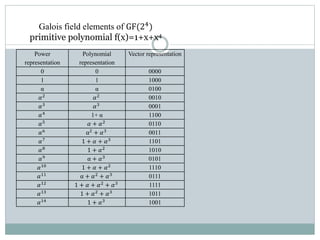
Primitive polynomial 1 + x + x4
Sol:
When GF(16) :M=4, t=2
Primitive polynomial : 𝑓 𝑥 = 𝑥4 + 𝑥 + 1
The generator polynomial can written as:
g(x) = ( x – α ) ( x – α2 ) ( x – α3 ) ( x – α4 )
g(x)= ( x2 – (α + α2 ) x + α3 ) ( x2 – (α3 + α4 ) x + α7 )
g(x)= ( x2 – (α5 ) x + α3 ) ( x2 – (α7 ) x + α7 )
.
.
g(x)= x4 + α13 x3 + α6 x2 + α3 x+ α10
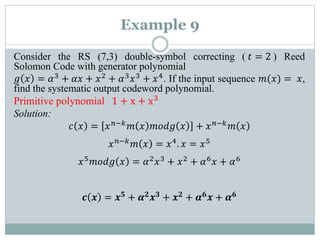
Consider the RS (7,3) double-symbol correcting ( 𝑡 = 2 ) Reed
Solomon Code with generator polynomial
𝑔 𝑥 = 𝛼3
+ 𝛼𝑥 + 𝑥2
+ 𝛼3
𝑥3
+ 𝑥4
. If the input sequence 𝑚(𝑥) = 𝑥,
find the systematic output codeword polynomial.
Primitive polynomial 1 + x + x3
Solution:
𝑐 𝑥 = 𝑥𝑛−𝑘𝑚 𝑥 𝑚𝑜𝑑𝑔 𝑥 + 𝑥𝑛−𝑘𝑚 𝑥
𝑥𝑛−𝑘𝑚 𝑥 = 𝑥4. 𝑥 = 𝑥5
𝑥5𝑚𝑜𝑑𝑔 𝑥 = 𝛼2𝑥3 + 𝑥2 + 𝛼6𝑥 + 𝛼6
𝒄 𝒙 = 𝒙𝟓 + 𝜶𝟐𝒙𝟑 + 𝒙𝟐 + 𝜶𝟔𝒙 + 𝜶𝟔
Example 9
output
D
m(x)
D
D
(n-k) shift register stages
+
+
+
α3
α1 α0 α3
+
control
D
RS Encoder circuit
Decoding block diagram of RS Codes
calculate the
syndrome
From the error
location
polynomial 𝝈 𝑿
calculate the
error values
Forney method
Chien search of
error positions
Data delay
Input r
output
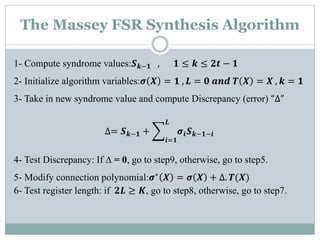
The Massey FSR Synthesis Algorithm
1- Compute syndrome values:𝑺𝒌−𝟏 , 𝟏 ≤ 𝒌 ≤ 𝟐𝒕 − 𝟏
2- Initialize algorithm variables:𝝈 𝑿 = 𝟏 , 𝑳 = 𝟎 𝒂𝒏𝒅 𝑻 𝑿 = 𝑿 , 𝒌 = 𝟏
3- Take in new syndrome value and compute Discrepancy (error) “∆”
∆= 𝑺𝒌−𝟏 +
𝒊=𝟏
𝑳
𝝈𝒊𝑺𝒌−𝟏−𝒊
4- Test Discrepancy: If ∆ = 0, go to step9, otherwise, go to step5.
5- Modify connection polynomial:𝝈∗ 𝑿 = 𝝈 𝑿 + ∆. 𝑻(𝑿)
6- Test register length: if 𝟐𝑳 ≥ 𝑲, go to step8, otherwise, go to step7.
The Massey FSR Synthesis Algorithm
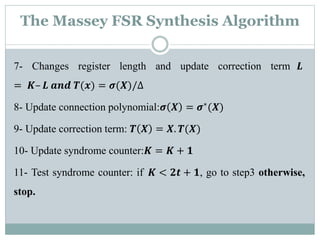
7- Changes register length and update correction term 𝑳
= 𝑲– 𝑳 𝒂𝒏𝒅 𝑻(𝒙) = 𝝈(𝑿)/∆
8- Update connection polynomial:𝝈 𝑿 = 𝝈∗(𝑿)
9- Update correction term: 𝑻 𝑿 = 𝑿. 𝑻(𝑿)
10- Update syndrome counter:𝑲 = 𝑲 + 𝟏
11- Test syndrome counter: if 𝑲 < 𝟐𝒕 + 𝟏, go to step3 otherwise,
stop.
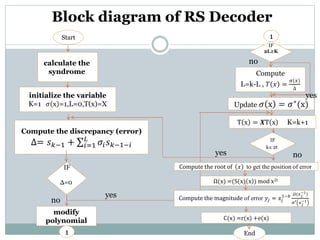
Start
calculate the
syndrome
initialize the variable
K=1 𝜎 x =1,L=0,T(x)=X
Compute the discrepancy (error)
∆= 𝑠𝑘−1 + 𝑖=1
𝐿
𝜎𝑖𝑠𝑘−1−𝑖
IF
∆=0
modify
polynomial
no
1
1
IF
2L≥K
Compute
L=k-L , 𝑇 𝑥 =
𝜎 𝑥
∆
Update 𝜎 x = 𝜎∗(x)
yes
T x = 𝑿T x K=k+1
IF
k≤ 2t
yes no
no
yes
Block diagram of RS Decoder
Compute the root of 𝑥 to get the position of error
Ω(x) =(S(x) x ) mod x2t
Compute the magnitude of error 𝑦𝑗 = 𝑥𝑗
1−𝑏 𝛺(𝑥𝑗
−1
)
σ′ 𝑥𝑗
−1
End
C(x) =r(x) +e(x)
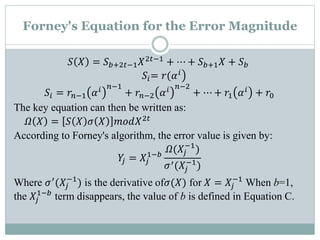
Forney's Equation for the Error Magnitude
𝑆 𝑋 = 𝑆𝑏+2𝑡−1𝑋2𝑡−1 + ⋯ + 𝑆𝑏+1𝑋 + 𝑆𝑏
𝑆𝑖= 𝑟(𝛼𝑖
𝑆𝑖 = 𝑟𝑛−1 𝛼𝑖 𝑛−1
+ 𝑟𝑛−2 𝛼𝑖 𝑛−2
+ ⋯ + 𝑟1 𝛼𝑖 + 𝑟0
The key equation can then be written as:
𝛺 𝑋 = 𝑆 𝑋 𝜎 𝑋 𝑚𝑜𝑑𝑋2𝑡
According to Forney's algorithm, the error value is given by:
𝑌
𝑗 = 𝑋𝑗
1−𝑏
𝛺(𝑋𝑗
−1
)
𝜎′(𝑋𝑗
−1
)
Where 𝜎′(𝑋𝑗
−1
) is the derivative of𝜎(𝑋) for 𝑋 = 𝑋𝑗
−1
When b=1,
the 𝑋𝑗
1−𝑏
term disappears, the value of b is defined in Equation C.
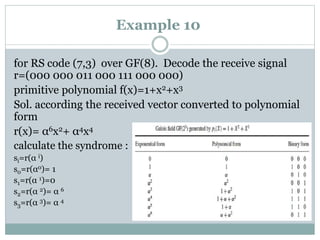
Example 10
for RS code (7,3) over GF(8). Decode the receive signal
r=(000 000 011 000 111 000 000)
primitive polynomial f(x)=1+x2+x3
Sol. according the received vector converted to polynomial
form
r(x)= α6x2+ α4x4
calculate the syndrome :
si=r(α i)
s0=r(α0)= 1
s1=r(α 1)=0
s2=r(α 2)= α 6
s3=r(α 3)= α 4
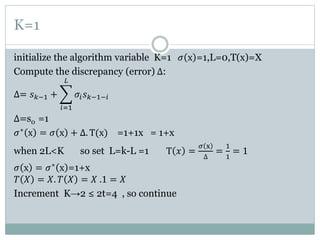
K=1
initialize the algorithm variable K=1 𝜎 x =1,L=0,T(x)=X
Compute the discrepancy (error) ∆:
∆= 𝑠𝑘−1 +
𝑖=1
𝐿
𝜎𝑖𝑠𝑘−1−𝑖
∆=s0 =1
𝜎∗
x = 𝜎 x + ∆. T(x) =1+1x = 1+x
when 2L<K so set L=k-L =1 T 𝑥 =
𝜎 x
∆
=
1
1
= 1
𝜎 x = 𝜎∗
x =1+x
𝑇 𝑋 = 𝑋. 𝑇 𝑋 = 𝑋 .1 = 𝑋
Increment K→2 ≤ 2t=4 , so continue
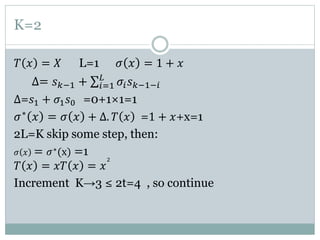
K=2
𝑇 𝑥 = 𝑋 L=1 𝜎 𝑥 = 1 + 𝑥
∆= 𝑠𝑘−1 + 𝑖=1
𝐿
𝜎𝑖𝑠𝑘−1−𝑖
∆=𝑠1 + 𝜎1𝑠0 =0+1×1=1
𝜎∗ 𝑥 = 𝜎 𝑥 + ∆. 𝑇 𝑥 =1 + 𝑥+x=1
2L=K skip some step, then:
𝜎 𝑥 = 𝜎∗ x =1
𝑇 𝑥 = 𝑥𝑇 𝑥 = 𝑥
2
Increment K→3 ≤ 2t=4 , so continue
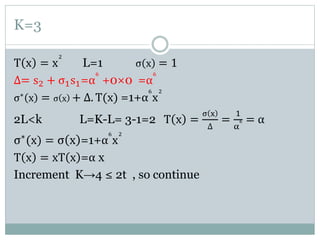
K=3
T x = x
2
L=1 σ x = 1
∆= s2 + σ1s1=α
6
+0×0 =α
6
σ∗ x = σ x + ∆. T(x) =1+α
6
x
2
2L<k L=K-L= 3-1=2 T x =
σ x
∆
=
1
α
6 = α
σ∗(x) = σ x =1+α
6
x
2
T x = xT x =α x
Increment K→4 ≤ 2t , so continue
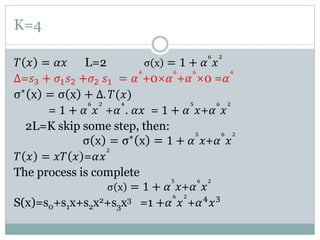
K=4
𝑇 𝑥 = 𝛼𝑥 L=2 σ x = 1 + 𝛼
6
𝑥
2
∆=𝑠3 + 𝜎1𝑠2 +𝜎2 𝑠1 = 𝛼
4
+0×𝛼
6
+𝛼
6
×0 =𝛼
4
σ∗ x = σ x + ∆. 𝑇(𝑥)
= 1 + 𝛼
6
𝑥
2
+𝛼
4
. 𝛼𝑥 = 1 + 𝛼
5
𝑥+𝛼
6
𝑥
2
2L=K skip some step, then:
σ x = σ∗
x = 1 + 𝛼
5
𝑥+𝛼
6
𝑥
2
𝑇 𝑥 = 𝑥𝑇 𝑥 =𝛼𝑥
2
The process is complete
σ x = 1 + 𝛼
5
𝑥+𝛼
6
𝑥
2
S(x)=s0+s1x+s2x2+s3x3 =1 +𝛼
6
𝑥
2
+𝛼4𝑥3
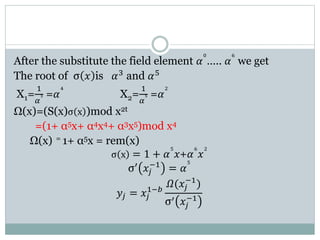
After the substitute the field element 𝛼
0
….. 𝛼
6
we get
The root of σ 𝑥 is 𝛼3 and 𝛼5
X1=
1
𝛼
3 =𝛼
4
X2=
1
𝛼
5 =𝛼
2
Ω(x)=(S(x)σ x )mod x2t
=(1+ α5x+ α4x4+ α3x5)mod x4
Ω(x) = 1+ α5x = rem(x)
σ x = 1 + 𝛼
5
𝑥+𝛼
6
𝑥
2
σ′
𝑥𝑗
−1
= 𝛼
5
𝑦𝑗 = 𝑥𝑗
1−𝑏
𝛺(𝑥𝑗
−1
)
σ′ 𝑥𝑗
−1
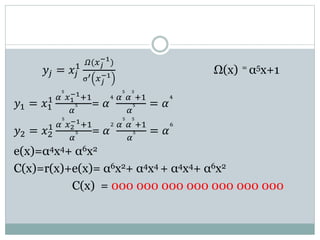
𝑦𝑗 = 𝑥𝑗
1 𝛺(𝑥𝑗
−1
)
σ′ 𝑥𝑗
−1
Ω(x) = α5x+1
𝑦1 = 𝑥1
1 𝛼
5
𝑥1
−1+1
𝛼
5 = 𝛼
4 𝛼
5
𝛼
3
+1
𝛼
5 = 𝛼
4
𝑦2 = 𝑥2
1 𝛼
5
𝑥2
−1+1
𝛼
5 = 𝛼
2 𝛼
5
𝛼
5
+1
𝛼
5 = 𝛼
6
e(x)=α4x4+ α6x2
C(x)=r(x)+e(x)= α6x2+ α4x4 + α4x4+ α6x2
C(x) = 000 000 000 000 000 000 000
Reed-Solomon with First Generation
 The standards DVB-C, DVB-T, DVB-S are used Reed-Solomon
RS (204,188, t = 8) code .
 Due to the complexity and implementation cost of Reed Solomon
codes it is preferred to use BCH codes instead of RS in the
second generation.
 The Reed-Solomon code has codewords length 204 bytes, and
data dimension 188 bytes and allows to correct up to 8 random
erroneous bytes in a received word of 204 bytes.
 Code Generator Polynomial is:
𝑔 𝑥 = 𝑥 + 𝛼 𝑥 + 𝛼2
𝑥 + 𝛼3
… … (𝑥 + 𝛼16
)
(188 BYTES) USER
FRAME
16 PARITY
SYMBOLS
n-k=16
k=188
n=204
Reed Solomon vs BCH
BCH
RS
Its binary cyclic code
Its non-binary cyclic code
Minimum error correction
capability t=1 byte and
maximum
capability up to t=12 bytes
Minimum error correction
capability t=2 byte and
maximum capability up to t=8
bytes
Use in outer coding of DVB-
S2, DVB-C2, DVB-T2
Use in outer coding of DVB-S,
DVB-C, DVB-T
Outer Coding Standard depend
on Inner coding rate
Outer Coding Standard is
RS(204,188,t=8)
Easy Decoding process
Complex Decoding process
References
1. P. Sweeney, “Error Control Coding From Theory to Practice”, Wiley, 2002.
2. Y.Jiang, “A Practical Guide to Error-Control Coding Using MATLAB”, Artech
House, 2010.
3. S. Lin, and D.J. Costello Jr. “Error Control Coding Fundamentals and
Applications”, Prentice Hall, 1983.
4. Ulrich Reimers, “DVB The Family of International Standards for Digital Video
Broadcasting”, Second Edition, Springer-Verlag Berlin Heidelberg, 2005.
5. Jorge Castiñeira Moreira and Patrick Guy Farrell,‘ 'ESSENTIALS OF ERROR-
CONTROL CODING'', John Wiley & Sons Ltd, 2006.
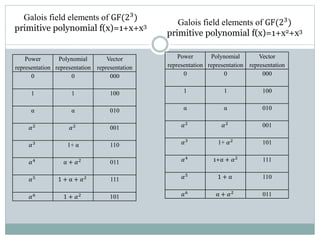
Power
representation
Polynomial
representation
Vector
representation
0 0 000
1 1 100
α α 010
𝛼2
𝛼2
001
𝛼3
1+ α 110
𝛼4
α + 𝛼2
011
𝛼5 1 + α + 𝛼2
111
𝛼6
1 + 𝛼2
101
Galois field elements of GF(23)
primitive polynomial f(x)=1+x+x3
Power
representation
Polynomial
representation
Vector
representation
0 0 000
1 1 100
α α 010
𝛼2
𝛼2
001
𝛼3
1+ 𝛼2
101
𝛼4
1+α + 𝛼2
111
𝛼5 1 + α 110
𝛼6
α + 𝛼2
011
Galois field elements of GF(23)
primitive polynomial f(x)=1+x2+x3
Power
representation
Polynomial
representation
Vector representation
0 0 0000
1 1 1000
α α 0100
𝛼2
𝛼2
0010
𝛼3
𝛼3
0001
𝛼4
1+ α 1100
𝛼5 𝛼 + 𝛼2
0110
𝛼6
α2
+ 𝛼3
0011
𝛼7
1 + 𝛼 + 𝛼3
1101
𝛼8
1 + 𝛼2
1010
𝛼9
α + 𝛼3
0101
𝛼10
1 + 𝛼 + 𝛼2
1110
𝛼11
α + 𝛼2
+ 𝛼3
0111
𝛼12
1 + 𝛼 + 𝛼2
+ 𝛼3
1111
𝛼13
1 + 𝛼2
+ 𝛼3
1011
𝛼14
1 + 𝛼3
1001
Galois field elements of GF(24)
primitive polynomial f(x)=1+x+x4
Thank you

Reed solomon Encoder and Decoder

  • 1.
  • 2.
    OUTLINES Reed-Solomon code Encoding ofRS Codes Decoding of RS Codes Reed Solomon vs BCH References
  • 3.
    Reed-Solomon RS codes BCH codes Cycliccodes Linear block codes Reed-Solomon (RS) codes is a special class of non-binary BCH codes
  • 4.
    • Discovered byIrving Reed and Gustave Solomon in 1960. • RS codes are very powerful in correcting both random errors and bursty errors. • In RS system, the decoder corrects a symbol, it replaces the incorrect symbol with a correct one, whether the error was caused by one bit being corrupted or all symbol bits being corrupted, this gives the RS code an advantage over binary codes. Introduction
  • 5.
    • today RScode are found in numerous consumer products, such as • mass storage devices (e.g., CDs and DVDs) • broadband modems (e.g., cable modems) • wireless mobile communications systems (e.g., WiMax, cellular telephone and microwave links ). • Digital television and DVB Applications
  • 6.
    Where : Reed Solomoncoding operates on a finite field called Galios Field GF(2m). M is the number of a symbol the total no. of code symbols (Code Length): n = 2𝑚-1 The No. of data symbols: k = 2𝑚 -1-2t No. of parity check symbols: n-k = 2t The number of error that need to correct: t Description of RS Codes
  • 7.
    Example 6 A givenReed-Solomon code with RS(204,188) of first generation DVB standards. Find error correction capability (t). Solution: Each code word contains 204 code word bytes, of which 188 bytes are data and 16 bytes are parity. For this code: n = 204, k = 188 2t = n-k = 16, t = 8 The decoder can correct any 8 symbol errors in the code word: i.e. errors in up to 8 bytes anywhere in the code word can be automatically corrected.
  • 8.
    Encoding of RSCodes Code Generator Polynomial An (n, k) Reed-Solomon code is constructed by forming the code generator polynomial g(x), the roots of which are consecutive elements of the Galois field. Thus the code generator polynomial takes the form: 𝒈 𝒙 = 𝒙 + 𝜶 𝒙 + 𝜶𝟐 𝒙 + 𝜶𝟑 … … 𝒙 + 𝜶𝟐𝒕 Or: 𝒈 𝒙 = 𝒙 − 𝜶 𝒙 − 𝜶𝟐 𝒙 − 𝜶𝟑 … … 𝒙
  • 9.
    Encoding of RSCodes  The codeword vector for RS code can be obtained by 𝒄 𝒙 = 𝒙𝐧−𝒌 𝐦 𝒙 𝐦𝐨𝐝 𝐠(𝐱) + 𝒙𝒏−𝒌 𝒎 𝒙 Length of c(x) is n symbol Length of m(x) is k symbol 𝑥𝑛−𝑘 𝑚 𝑥 : data shifted by n-k
  • 10.
    Example 7 Consider the( 7 , 3 ) double-symbol error correcting R-S code, describe the generator polynomial of it. Primitive polynomial 1 + x + x3 Ans. : RS(n,k)=RS(7,3), n = 2𝑚 -1 : m=3 2t = n – k = 4 roots g(x) = ( x – α ) ( x – α2 ) ( x – α3 ) ( x – α4 ) = ( x2 – (α + α2 ) x + α3 ) ( x2 – (α3 + α4 ) x + α7 ) = ( x2 – α4 x + α3 ) ( x2 – α6 x + α0 ) = x4 – (α4 + α6) x3 + (α3 + α10 + α0) x2 – (α4 + α9 ) x + α3 = x4 – α3 x3 + α0 x2 – α1 x + α3 Following the format of low order to high order, and changing negative signs to positive, since in the binary field +1 = - 1 , the generator polynomial becomes : g(x) = α3 + α1 x + α0 x2 + α3 x3 + x4
  • 11.
    Example 8 Consider thedouble error correcting RS code of block length n=15 over GF(16) describe the generator polynomial Primitive polynomial 1 + x + x4 Sol: When GF(16) :M=4, t=2 Primitive polynomial : 𝑓 𝑥 = 𝑥4 + 𝑥 + 1 The generator polynomial can written as: g(x) = ( x – α ) ( x – α2 ) ( x – α3 ) ( x – α4 ) g(x)= ( x2 – (α + α2 ) x + α3 ) ( x2 – (α3 + α4 ) x + α7 ) g(x)= ( x2 – (α5 ) x + α3 ) ( x2 – (α7 ) x + α7 ) . . g(x)= x4 + α13 x3 + α6 x2 + α3 x+ α10
  • 12.
    Consider the RS(7,3) double-symbol correcting ( 𝑡 = 2 ) Reed Solomon Code with generator polynomial 𝑔 𝑥 = 𝛼3 + 𝛼𝑥 + 𝑥2 + 𝛼3 𝑥3 + 𝑥4 . If the input sequence 𝑚(𝑥) = 𝑥, find the systematic output codeword polynomial. Primitive polynomial 1 + x + x3 Solution: 𝑐 𝑥 = 𝑥𝑛−𝑘𝑚 𝑥 𝑚𝑜𝑑𝑔 𝑥 + 𝑥𝑛−𝑘𝑚 𝑥 𝑥𝑛−𝑘𝑚 𝑥 = 𝑥4. 𝑥 = 𝑥5 𝑥5𝑚𝑜𝑑𝑔 𝑥 = 𝛼2𝑥3 + 𝑥2 + 𝛼6𝑥 + 𝛼6 𝒄 𝒙 = 𝒙𝟓 + 𝜶𝟐𝒙𝟑 + 𝒙𝟐 + 𝜶𝟔𝒙 + 𝜶𝟔 Example 9
  • 13.
    output D m(x) D D (n-k) shift registerstages + + + α3 α1 α0 α3 + control D RS Encoder circuit
  • 14.
    Decoding block diagramof RS Codes calculate the syndrome From the error location polynomial 𝝈 𝑿 calculate the error values Forney method Chien search of error positions Data delay Input r output
  • 15.
    The Massey FSRSynthesis Algorithm 1- Compute syndrome values:𝑺𝒌−𝟏 , 𝟏 ≤ 𝒌 ≤ 𝟐𝒕 − 𝟏 2- Initialize algorithm variables:𝝈 𝑿 = 𝟏 , 𝑳 = 𝟎 𝒂𝒏𝒅 𝑻 𝑿 = 𝑿 , 𝒌 = 𝟏 3- Take in new syndrome value and compute Discrepancy (error) “∆” ∆= 𝑺𝒌−𝟏 + 𝒊=𝟏 𝑳 𝝈𝒊𝑺𝒌−𝟏−𝒊 4- Test Discrepancy: If ∆ = 0, go to step9, otherwise, go to step5. 5- Modify connection polynomial:𝝈∗ 𝑿 = 𝝈 𝑿 + ∆. 𝑻(𝑿) 6- Test register length: if 𝟐𝑳 ≥ 𝑲, go to step8, otherwise, go to step7.
  • 16.
    The Massey FSRSynthesis Algorithm 7- Changes register length and update correction term 𝑳 = 𝑲– 𝑳 𝒂𝒏𝒅 𝑻(𝒙) = 𝝈(𝑿)/∆ 8- Update connection polynomial:𝝈 𝑿 = 𝝈∗(𝑿) 9- Update correction term: 𝑻 𝑿 = 𝑿. 𝑻(𝑿) 10- Update syndrome counter:𝑲 = 𝑲 + 𝟏 11- Test syndrome counter: if 𝑲 < 𝟐𝒕 + 𝟏, go to step3 otherwise, stop.
  • 17.
    Start calculate the syndrome initialize thevariable K=1 𝜎 x =1,L=0,T(x)=X Compute the discrepancy (error) ∆= 𝑠𝑘−1 + 𝑖=1 𝐿 𝜎𝑖𝑠𝑘−1−𝑖 IF ∆=0 modify polynomial no 1 1 IF 2L≥K Compute L=k-L , 𝑇 𝑥 = 𝜎 𝑥 ∆ Update 𝜎 x = 𝜎∗(x) yes T x = 𝑿T x K=k+1 IF k≤ 2t yes no no yes Block diagram of RS Decoder Compute the root of 𝑥 to get the position of error Ω(x) =(S(x) x ) mod x2t Compute the magnitude of error 𝑦𝑗 = 𝑥𝑗 1−𝑏 𝛺(𝑥𝑗 −1 ) σ′ 𝑥𝑗 −1 End C(x) =r(x) +e(x)
  • 18.
    Forney's Equation forthe Error Magnitude 𝑆 𝑋 = 𝑆𝑏+2𝑡−1𝑋2𝑡−1 + ⋯ + 𝑆𝑏+1𝑋 + 𝑆𝑏 𝑆𝑖= 𝑟(𝛼𝑖 𝑆𝑖 = 𝑟𝑛−1 𝛼𝑖 𝑛−1 + 𝑟𝑛−2 𝛼𝑖 𝑛−2 + ⋯ + 𝑟1 𝛼𝑖 + 𝑟0 The key equation can then be written as: 𝛺 𝑋 = 𝑆 𝑋 𝜎 𝑋 𝑚𝑜𝑑𝑋2𝑡 According to Forney's algorithm, the error value is given by: 𝑌 𝑗 = 𝑋𝑗 1−𝑏 𝛺(𝑋𝑗 −1 ) 𝜎′(𝑋𝑗 −1 ) Where 𝜎′(𝑋𝑗 −1 ) is the derivative of𝜎(𝑋) for 𝑋 = 𝑋𝑗 −1 When b=1, the 𝑋𝑗 1−𝑏 term disappears, the value of b is defined in Equation C.
  • 19.
    Example 10 for RScode (7,3) over GF(8). Decode the receive signal r=(000 000 011 000 111 000 000) primitive polynomial f(x)=1+x2+x3 Sol. according the received vector converted to polynomial form r(x)= α6x2+ α4x4 calculate the syndrome : si=r(α i) s0=r(α0)= 1 s1=r(α 1)=0 s2=r(α 2)= α 6 s3=r(α 3)= α 4
  • 20.
    K=1 initialize the algorithmvariable K=1 𝜎 x =1,L=0,T(x)=X Compute the discrepancy (error) ∆: ∆= 𝑠𝑘−1 + 𝑖=1 𝐿 𝜎𝑖𝑠𝑘−1−𝑖 ∆=s0 =1 𝜎∗ x = 𝜎 x + ∆. T(x) =1+1x = 1+x when 2L<K so set L=k-L =1 T 𝑥 = 𝜎 x ∆ = 1 1 = 1 𝜎 x = 𝜎∗ x =1+x 𝑇 𝑋 = 𝑋. 𝑇 𝑋 = 𝑋 .1 = 𝑋 Increment K→2 ≤ 2t=4 , so continue
  • 21.
    K=2 𝑇 𝑥 =𝑋 L=1 𝜎 𝑥 = 1 + 𝑥 ∆= 𝑠𝑘−1 + 𝑖=1 𝐿 𝜎𝑖𝑠𝑘−1−𝑖 ∆=𝑠1 + 𝜎1𝑠0 =0+1×1=1 𝜎∗ 𝑥 = 𝜎 𝑥 + ∆. 𝑇 𝑥 =1 + 𝑥+x=1 2L=K skip some step, then: 𝜎 𝑥 = 𝜎∗ x =1 𝑇 𝑥 = 𝑥𝑇 𝑥 = 𝑥 2 Increment K→3 ≤ 2t=4 , so continue
  • 22.
    K=3 T x =x 2 L=1 σ x = 1 ∆= s2 + σ1s1=α 6 +0×0 =α 6 σ∗ x = σ x + ∆. T(x) =1+α 6 x 2 2L<k L=K-L= 3-1=2 T x = σ x ∆ = 1 α 6 = α σ∗(x) = σ x =1+α 6 x 2 T x = xT x =α x Increment K→4 ≤ 2t , so continue
  • 23.
    K=4 𝑇 𝑥 =𝛼𝑥 L=2 σ x = 1 + 𝛼 6 𝑥 2 ∆=𝑠3 + 𝜎1𝑠2 +𝜎2 𝑠1 = 𝛼 4 +0×𝛼 6 +𝛼 6 ×0 =𝛼 4 σ∗ x = σ x + ∆. 𝑇(𝑥) = 1 + 𝛼 6 𝑥 2 +𝛼 4 . 𝛼𝑥 = 1 + 𝛼 5 𝑥+𝛼 6 𝑥 2 2L=K skip some step, then: σ x = σ∗ x = 1 + 𝛼 5 𝑥+𝛼 6 𝑥 2 𝑇 𝑥 = 𝑥𝑇 𝑥 =𝛼𝑥 2 The process is complete σ x = 1 + 𝛼 5 𝑥+𝛼 6 𝑥 2 S(x)=s0+s1x+s2x2+s3x3 =1 +𝛼 6 𝑥 2 +𝛼4𝑥3
  • 24.
    After the substitutethe field element 𝛼 0 ….. 𝛼 6 we get The root of σ 𝑥 is 𝛼3 and 𝛼5 X1= 1 𝛼 3 =𝛼 4 X2= 1 𝛼 5 =𝛼 2 Ω(x)=(S(x)σ x )mod x2t =(1+ α5x+ α4x4+ α3x5)mod x4 Ω(x) = 1+ α5x = rem(x) σ x = 1 + 𝛼 5 𝑥+𝛼 6 𝑥 2 σ′ 𝑥𝑗 −1 = 𝛼 5 𝑦𝑗 = 𝑥𝑗 1−𝑏 𝛺(𝑥𝑗 −1 ) σ′ 𝑥𝑗 −1
  • 25.
    𝑦𝑗 = 𝑥𝑗 1𝛺(𝑥𝑗 −1 ) σ′ 𝑥𝑗 −1 Ω(x) = α5x+1 𝑦1 = 𝑥1 1 𝛼 5 𝑥1 −1+1 𝛼 5 = 𝛼 4 𝛼 5 𝛼 3 +1 𝛼 5 = 𝛼 4 𝑦2 = 𝑥2 1 𝛼 5 𝑥2 −1+1 𝛼 5 = 𝛼 2 𝛼 5 𝛼 5 +1 𝛼 5 = 𝛼 6 e(x)=α4x4+ α6x2 C(x)=r(x)+e(x)= α6x2+ α4x4 + α4x4+ α6x2 C(x) = 000 000 000 000 000 000 000
  • 26.
    Reed-Solomon with FirstGeneration  The standards DVB-C, DVB-T, DVB-S are used Reed-Solomon RS (204,188, t = 8) code .  Due to the complexity and implementation cost of Reed Solomon codes it is preferred to use BCH codes instead of RS in the second generation.  The Reed-Solomon code has codewords length 204 bytes, and data dimension 188 bytes and allows to correct up to 8 random erroneous bytes in a received word of 204 bytes.  Code Generator Polynomial is: 𝑔 𝑥 = 𝑥 + 𝛼 𝑥 + 𝛼2 𝑥 + 𝛼3 … … (𝑥 + 𝛼16 ) (188 BYTES) USER FRAME 16 PARITY SYMBOLS n-k=16 k=188 n=204
  • 27.
    Reed Solomon vsBCH BCH RS Its binary cyclic code Its non-binary cyclic code Minimum error correction capability t=1 byte and maximum capability up to t=12 bytes Minimum error correction capability t=2 byte and maximum capability up to t=8 bytes Use in outer coding of DVB- S2, DVB-C2, DVB-T2 Use in outer coding of DVB-S, DVB-C, DVB-T Outer Coding Standard depend on Inner coding rate Outer Coding Standard is RS(204,188,t=8) Easy Decoding process Complex Decoding process
  • 28.
    References 1. P. Sweeney,“Error Control Coding From Theory to Practice”, Wiley, 2002. 2. Y.Jiang, “A Practical Guide to Error-Control Coding Using MATLAB”, Artech House, 2010. 3. S. Lin, and D.J. Costello Jr. “Error Control Coding Fundamentals and Applications”, Prentice Hall, 1983. 4. Ulrich Reimers, “DVB The Family of International Standards for Digital Video Broadcasting”, Second Edition, Springer-Verlag Berlin Heidelberg, 2005. 5. Jorge Castiñeira Moreira and Patrick Guy Farrell,‘ 'ESSENTIALS OF ERROR- CONTROL CODING'', John Wiley & Sons Ltd, 2006.
  • 29.
    Power representation Polynomial representation Vector representation 0 0 000 11 100 α α 010 𝛼2 𝛼2 001 𝛼3 1+ α 110 𝛼4 α + 𝛼2 011 𝛼5 1 + α + 𝛼2 111 𝛼6 1 + 𝛼2 101 Galois field elements of GF(23) primitive polynomial f(x)=1+x+x3 Power representation Polynomial representation Vector representation 0 0 000 1 1 100 α α 010 𝛼2 𝛼2 001 𝛼3 1+ 𝛼2 101 𝛼4 1+α + 𝛼2 111 𝛼5 1 + α 110 𝛼6 α + 𝛼2 011 Galois field elements of GF(23) primitive polynomial f(x)=1+x2+x3
  • 30.
    Power representation Polynomial representation Vector representation 0 00000 1 1 1000 α α 0100 𝛼2 𝛼2 0010 𝛼3 𝛼3 0001 𝛼4 1+ α 1100 𝛼5 𝛼 + 𝛼2 0110 𝛼6 α2 + 𝛼3 0011 𝛼7 1 + 𝛼 + 𝛼3 1101 𝛼8 1 + 𝛼2 1010 𝛼9 α + 𝛼3 0101 𝛼10 1 + 𝛼 + 𝛼2 1110 𝛼11 α + 𝛼2 + 𝛼3 0111 𝛼12 1 + 𝛼 + 𝛼2 + 𝛼3 1111 𝛼13 1 + 𝛼2 + 𝛼3 1011 𝛼14 1 + 𝛼3 1001 Galois field elements of GF(24) primitive polynomial f(x)=1+x+x4
  • 31.