Signature Verification using
Grid based feature extraction
                                       Aniket Sahasrabuddhe
                                                    Anurag
  D. Y. Patil College Of Engineering              Shashank
  Akurdi, Pune                             Sushant Saurav
Presentation Agenda

  Introduction
  Existingtechniques
  Proposed work
  Algorithms
  Mathematical model
  Advantages & disadvantages
  Conclusion
Introduction

  Computers     are largely used in almost each and
  every field.

  Thesecurity measures to be used must be
  cheap, reliable and un-intrusive to the
  authorized person.
Importance of Signature

  Transaction


  Individuals   less likely to object

  Biometric
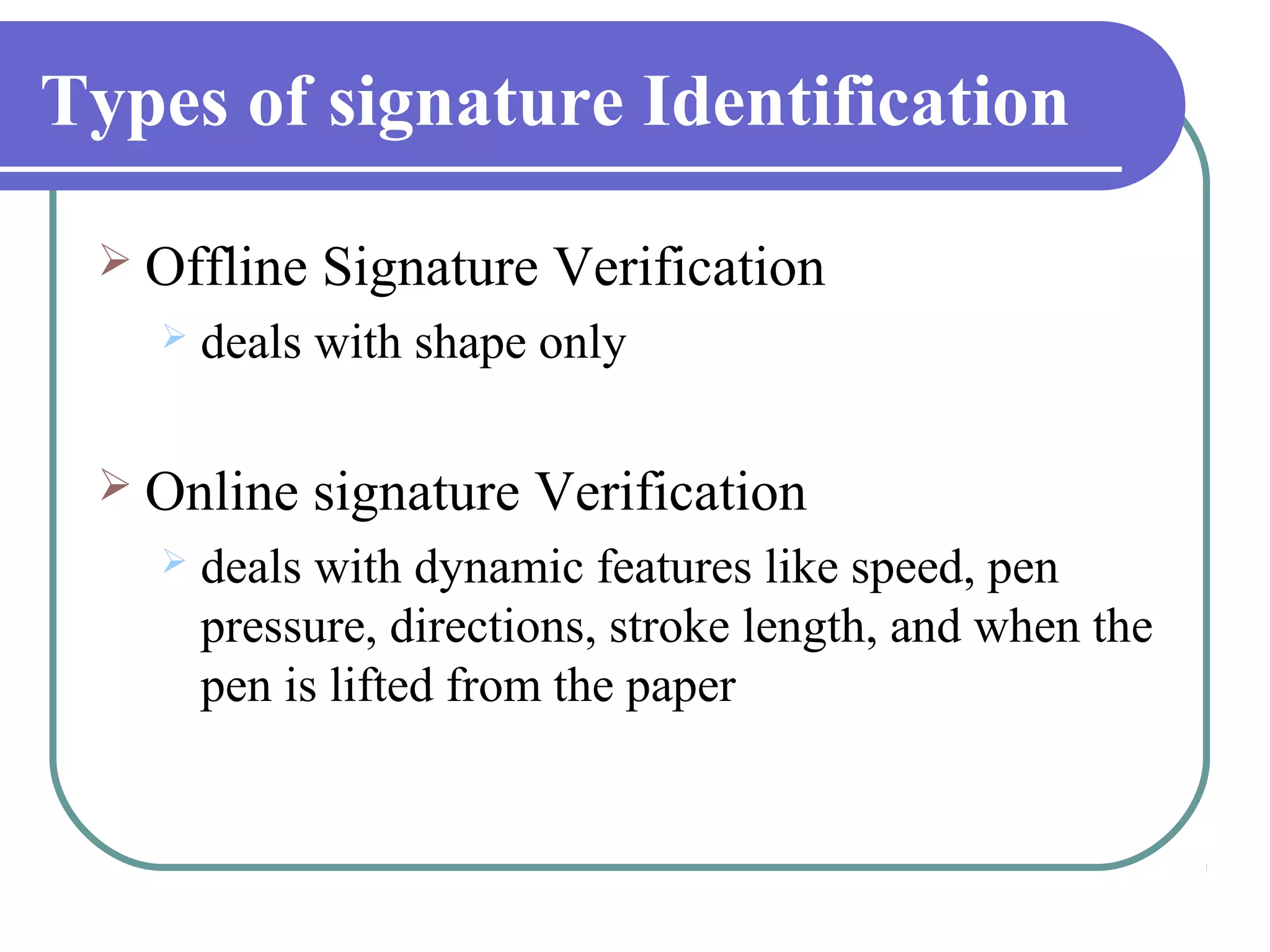
Types of signature Identification

  Offline   Signature Verification
      deals with shape only

  Online    signature Verification
      deals with dynamic features like speed, pen
       pressure, directions, stroke length, and when the
       pen is lifted from the paper
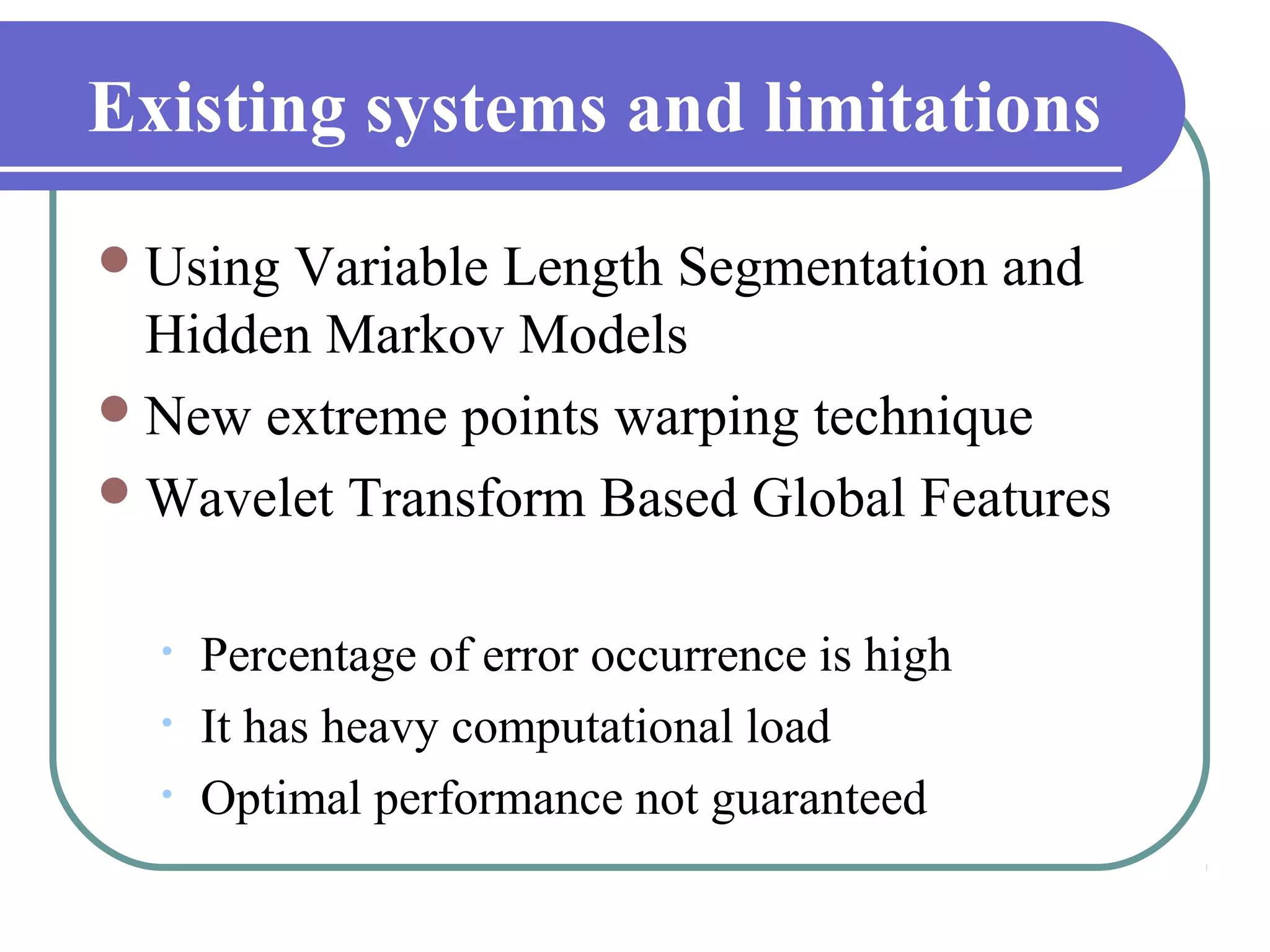
Existing systems and limitations
 UsingVariable Length Segmentation and
  Hidden Markov Models
 New extreme points warping technique
 Wavelet Transform Based Global Features


  •   Percentage of error occurrence is high
  •   It has heavy computational load
  •   Optimal performance not guaranteed
Challenging tasks
  Differentiating between the parts of the signature
   that vary with each signing.

  The signature can vary substantially over an
   individual’s lifetime.
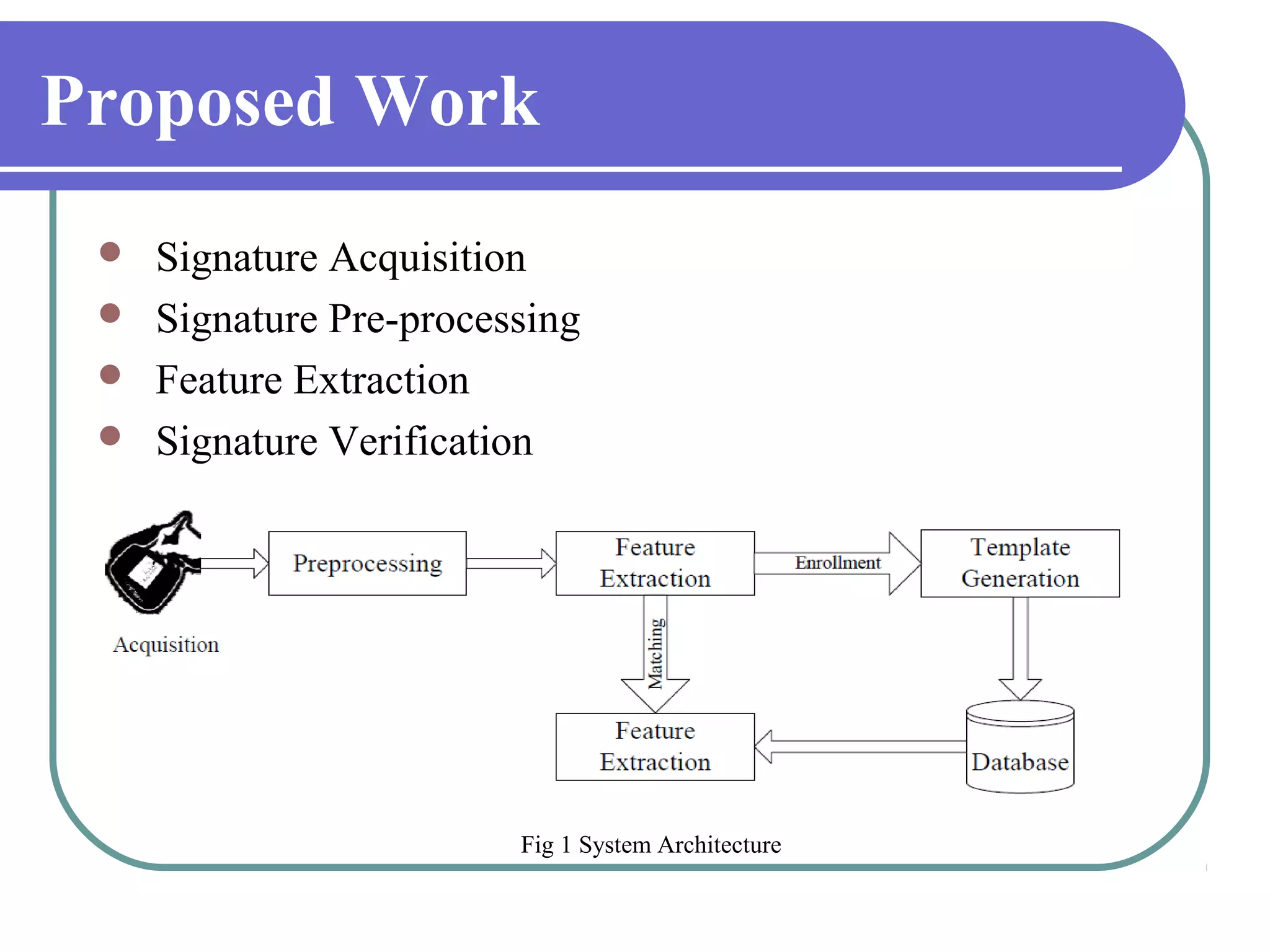
Proposed Work
    Signature Acquisition
    Signature Pre-processing
    Feature Extraction
    Signature Verification


                         Fig 1 System Architecture
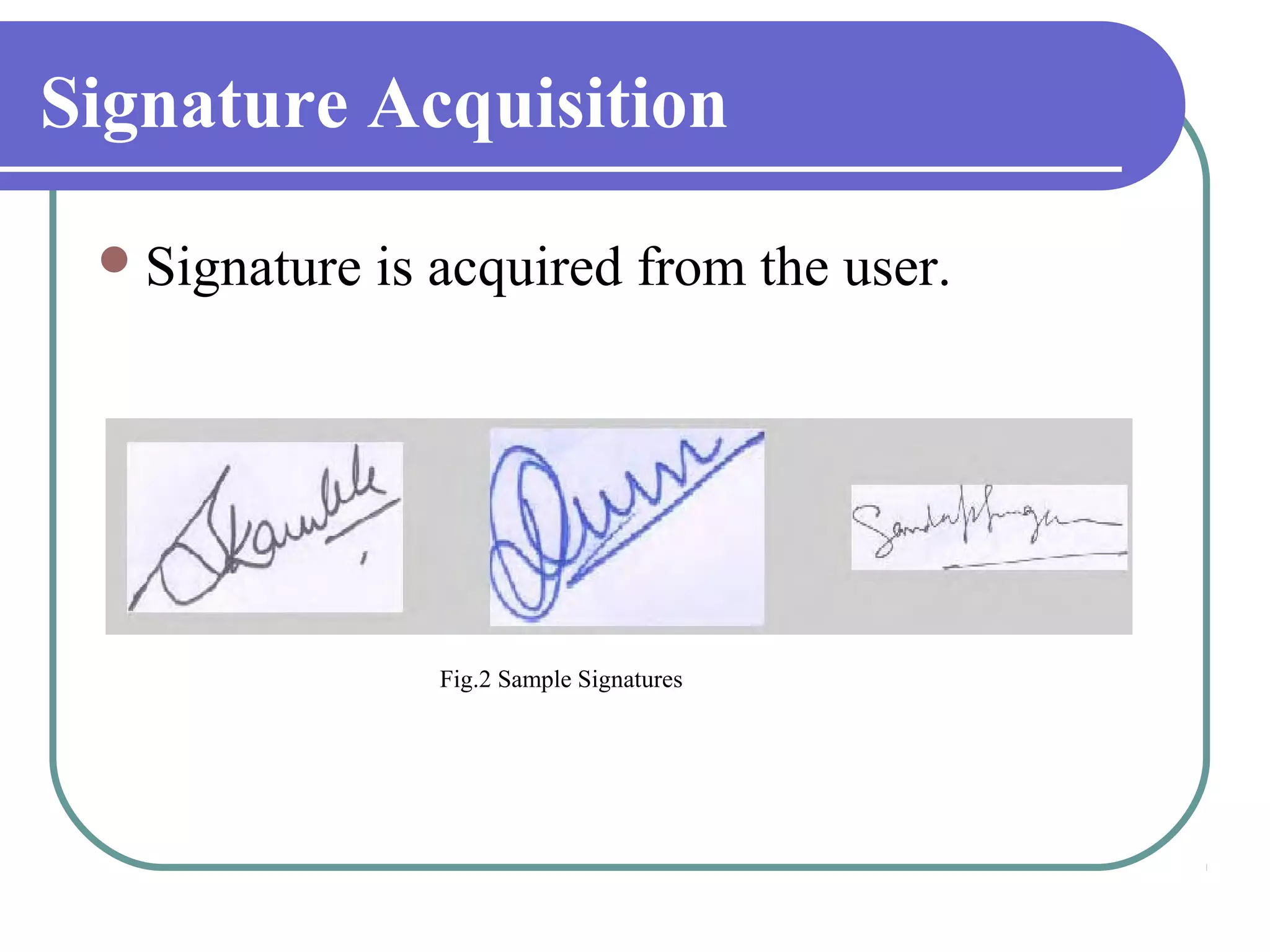
Signature Acquisition

  Signature   is acquired from the user.


                 Fig.2 Sample Signatures
Signature Pre-processing

 Function of the preprocessor
 Image resizing
 Image binarizing
 Image thinning
 Image normalizing
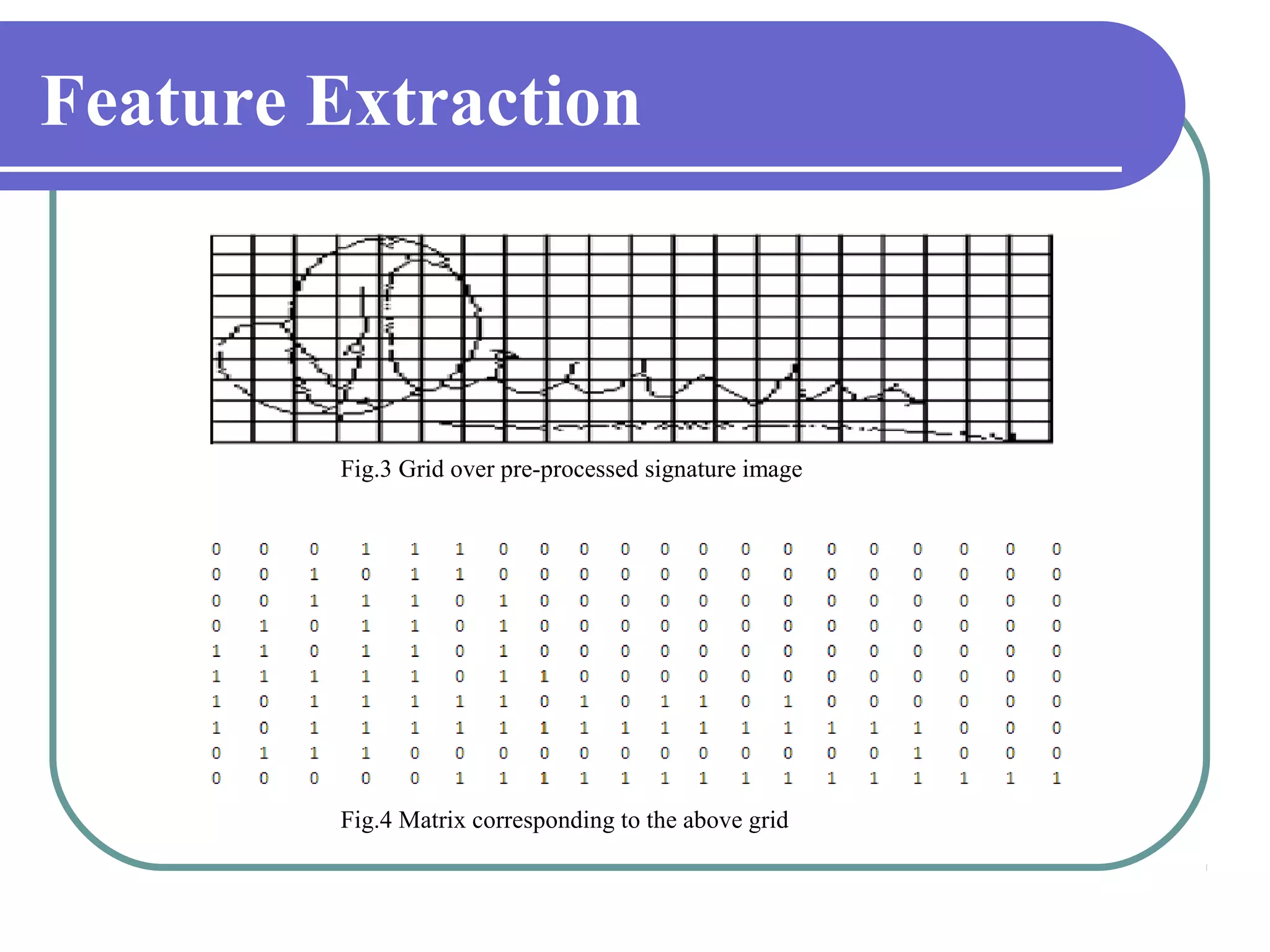
Feature Extraction


        Fig.3 Grid over pre-processed signature image


        Fig.4 Matrix corresponding to the above grid
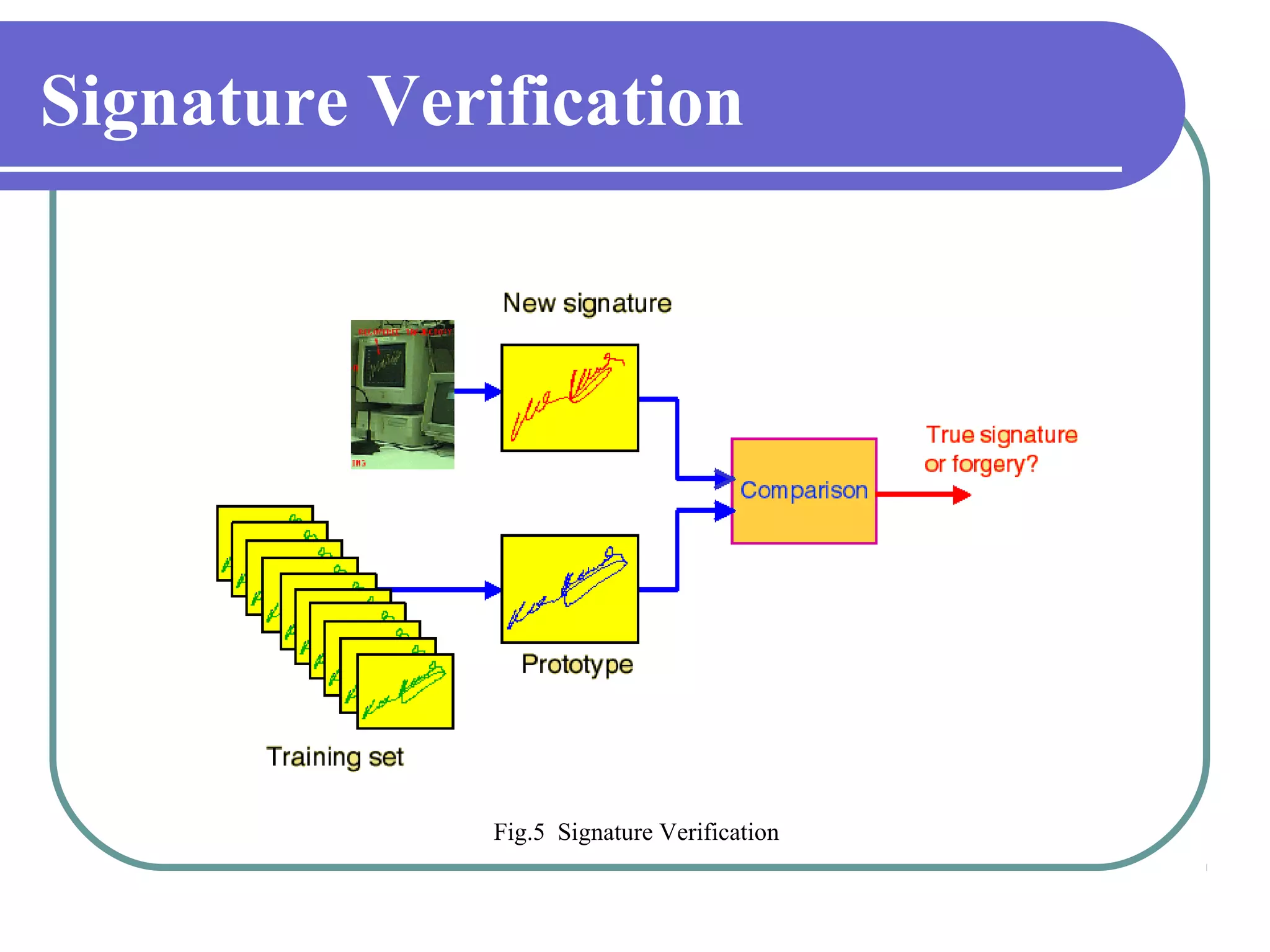
Signature Verification


              Fig.5 Signature Verification
Applications

  Banking,


  Passport   office,

  And  any other places which require
   identification !
Advantages

  Low   error rate.
  Forgery is detected even when the forger has
   managed to get a copy of the authentic
   signature.
  Fast and simple training.
  Cheap hardware.
  Little storage requirements.
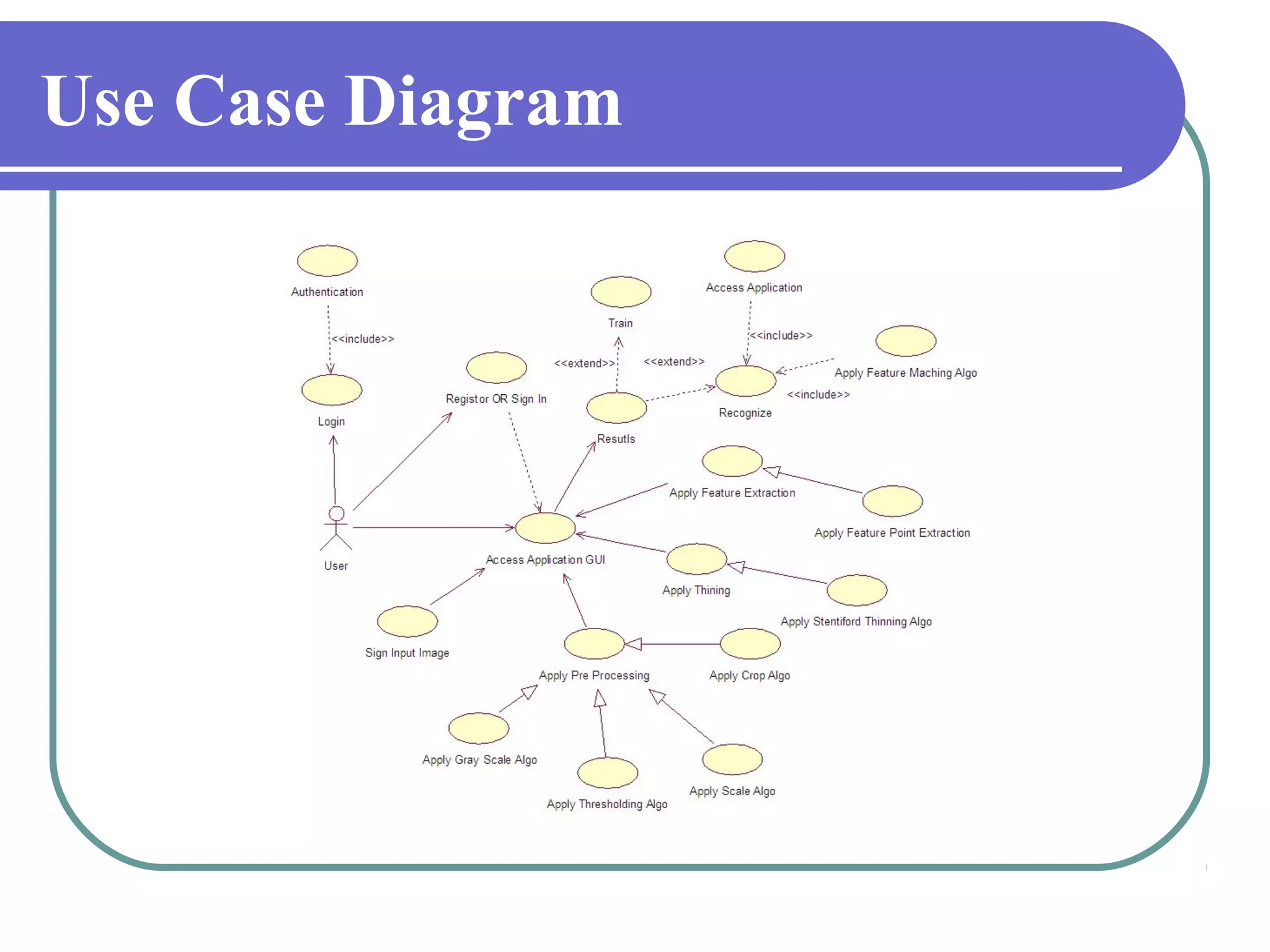
Use Case Diagram
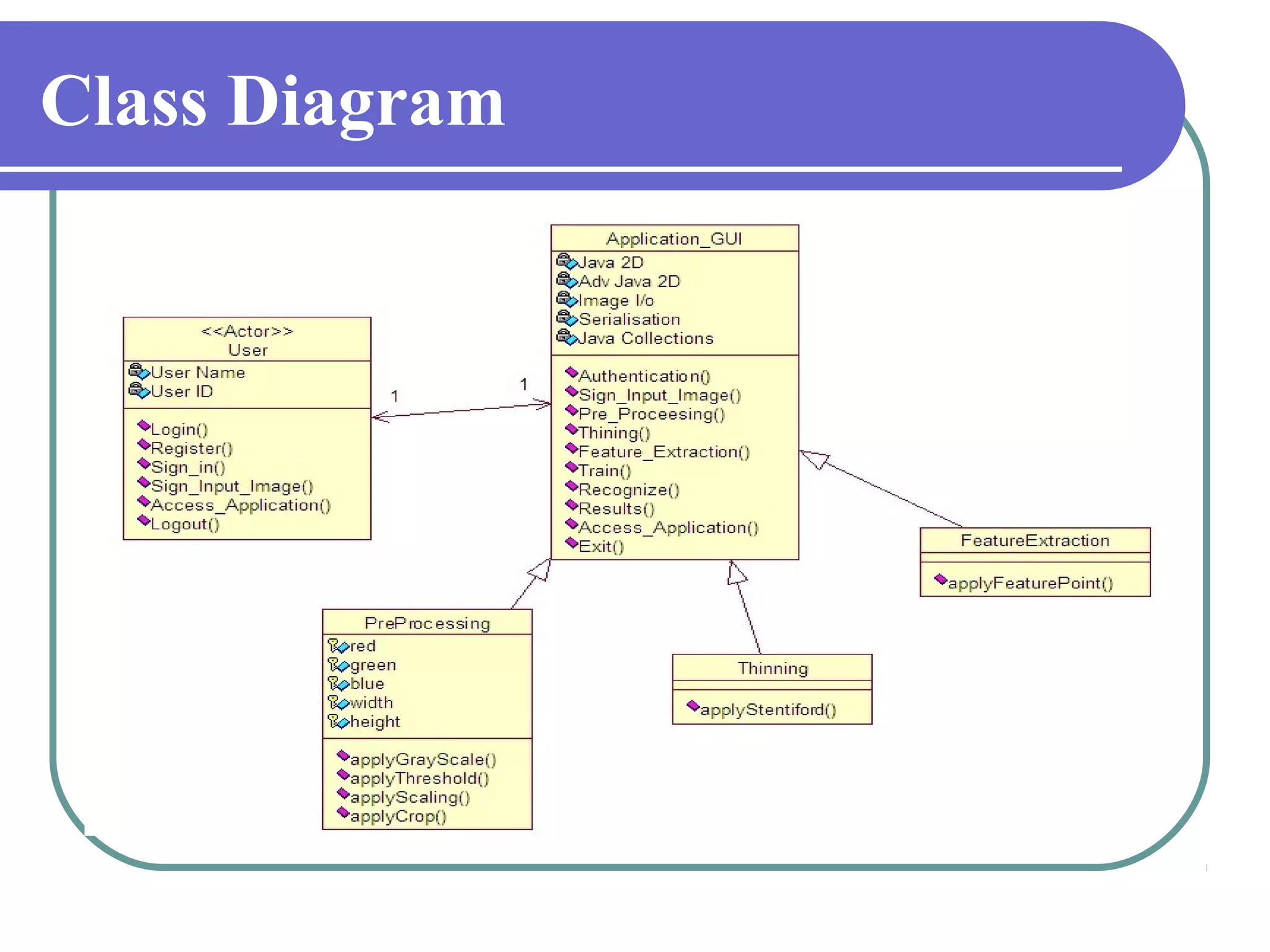
Class Diagram
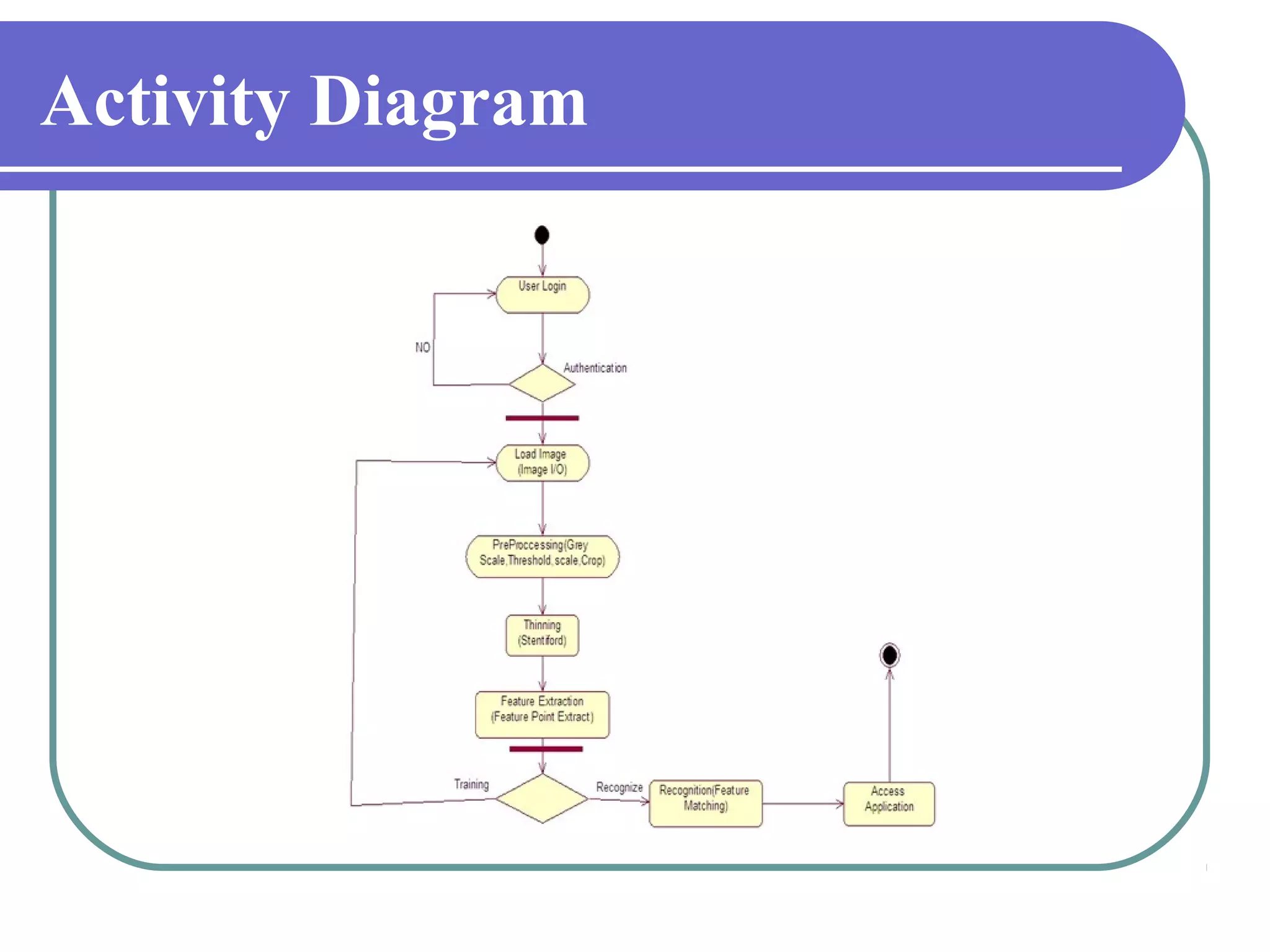
Activity Diagram
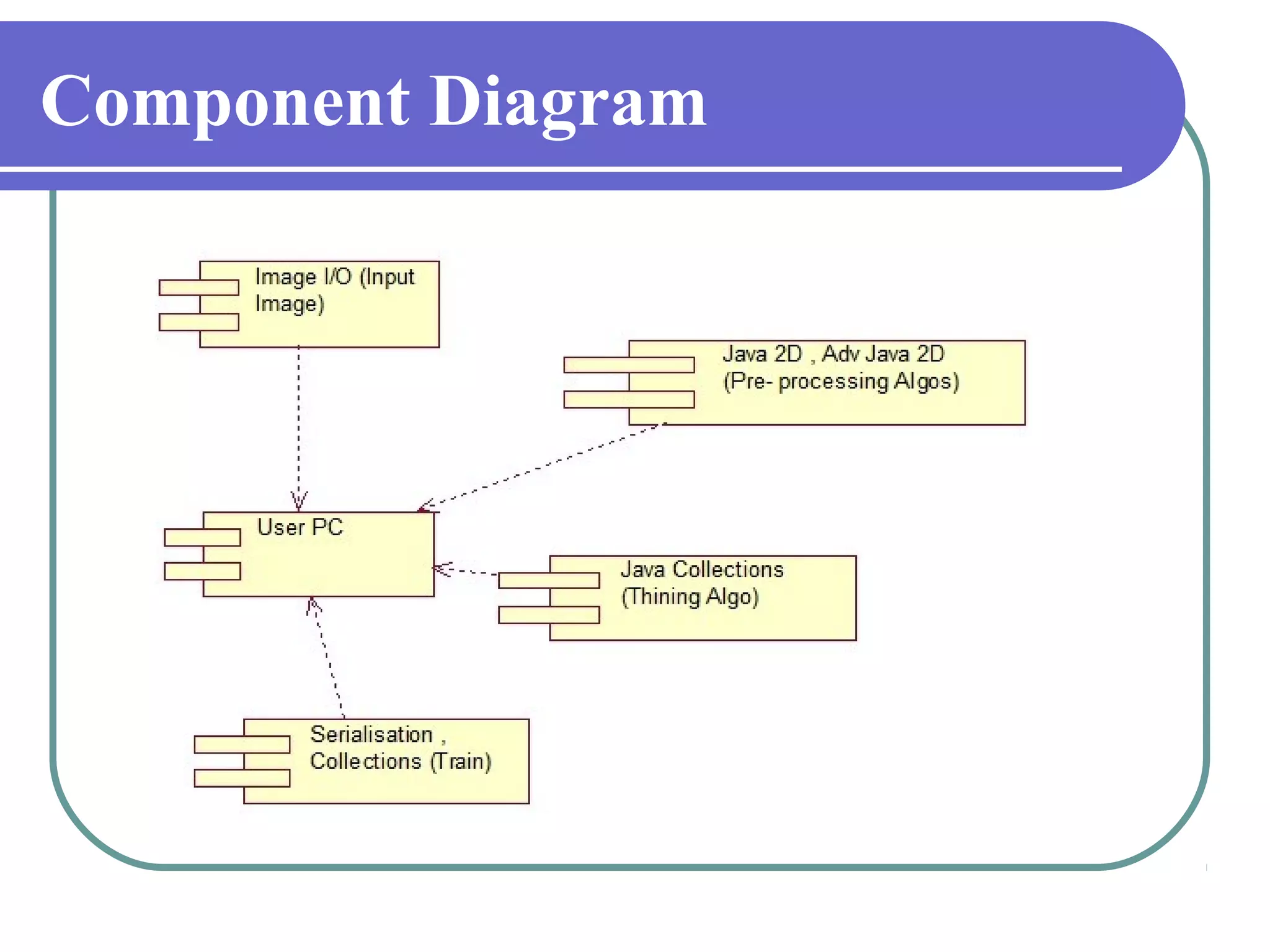
Component Diagram
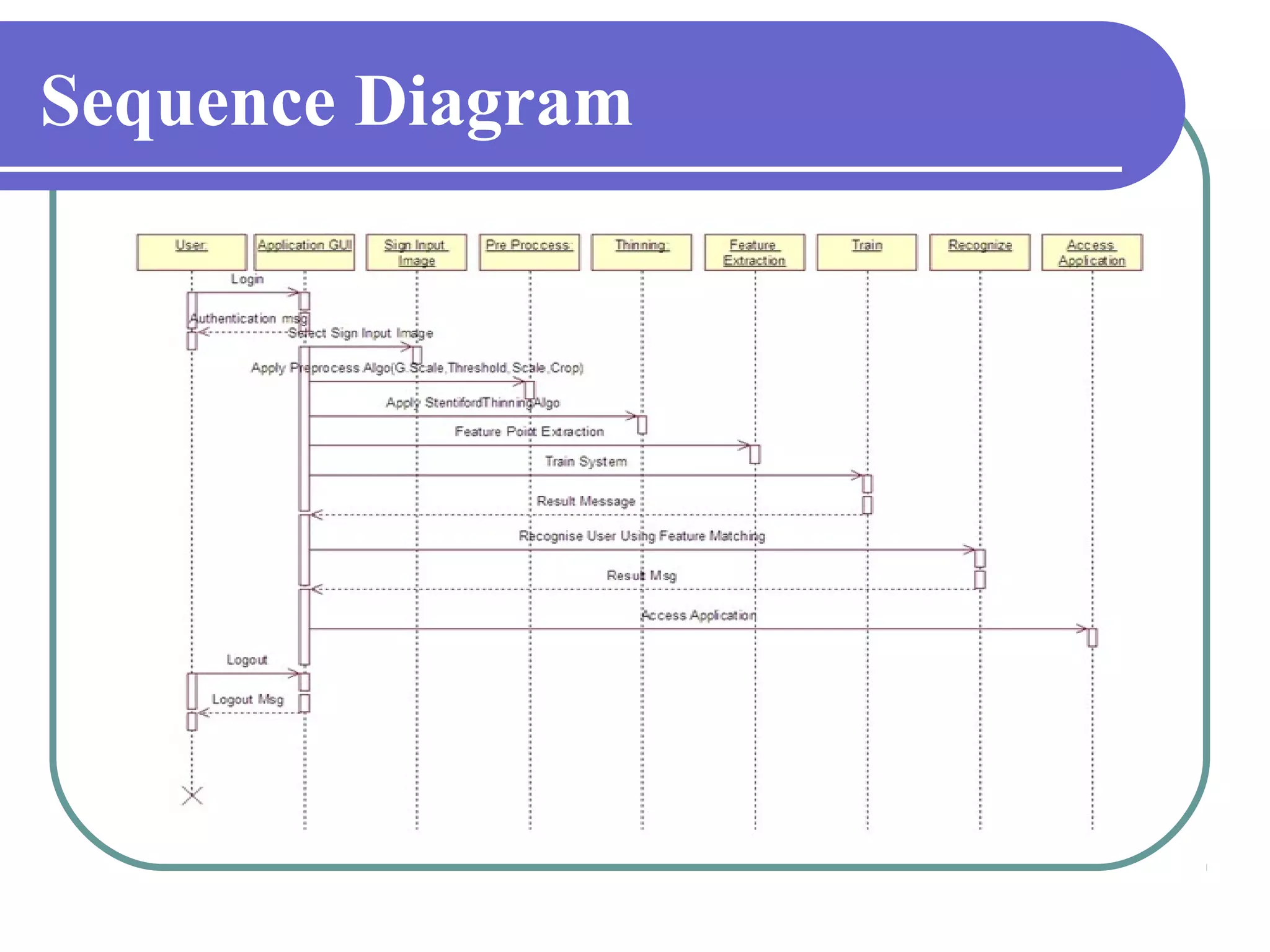
Sequence Diagram
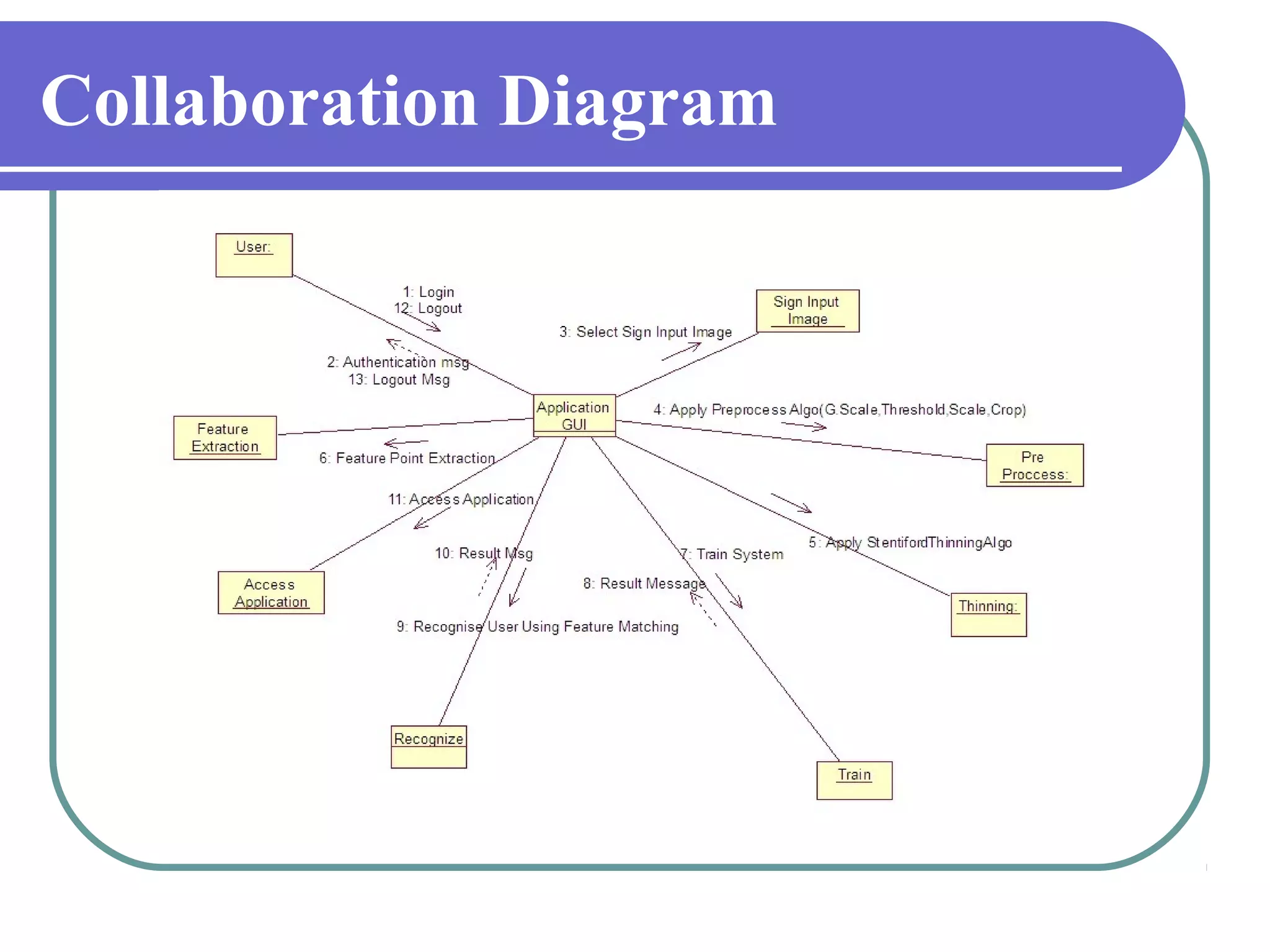
Collaboration Diagram
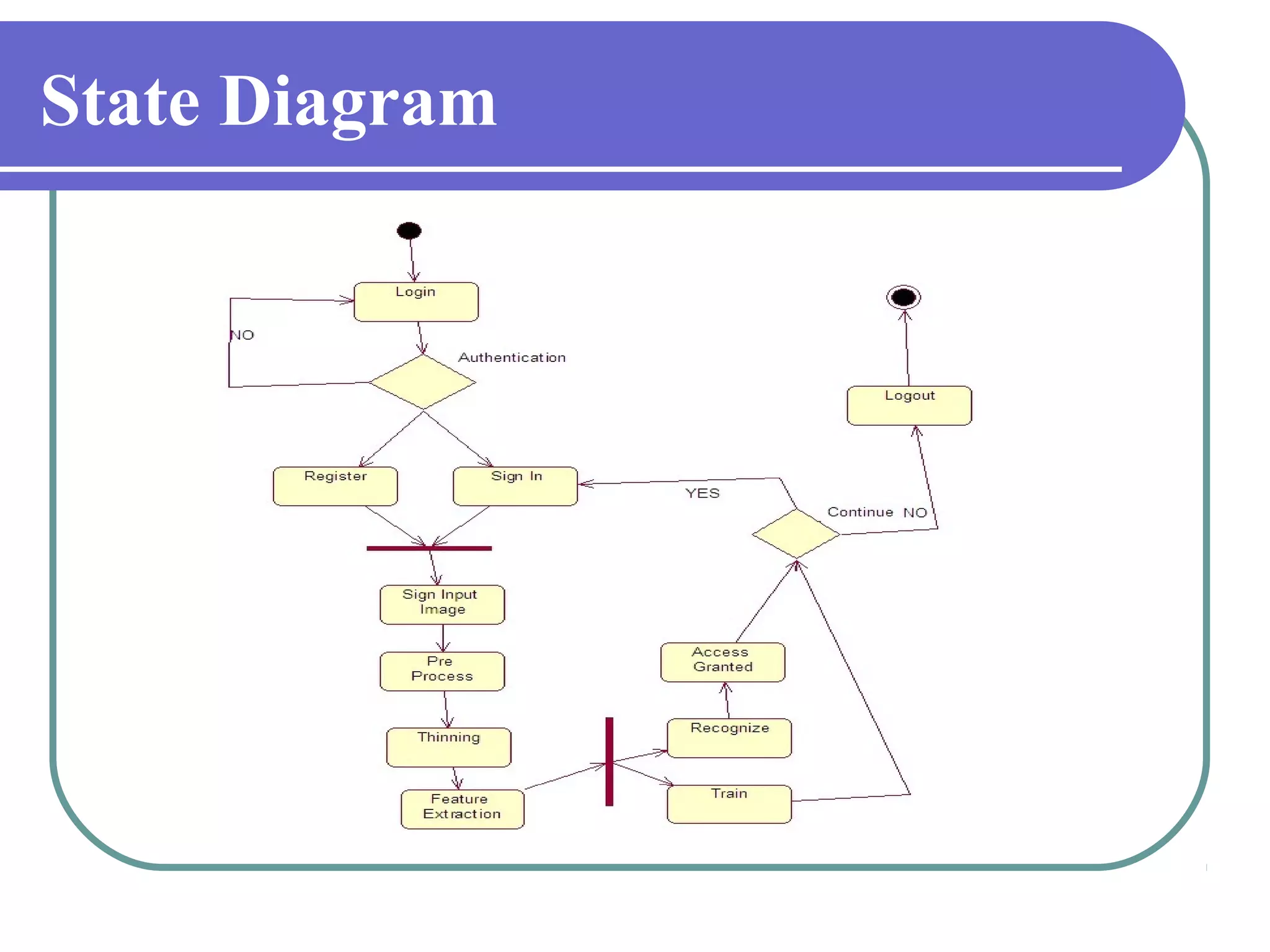
State Diagram
Requirements & Technologies

 The hardware component we are using here is a scanning
 device(WEBCAM), high RAM for better results and good
 processor.

    •   Operating System: Windows XP or Higher
    •   NetBeans IDE 7.0
    •   SDK - J2SE
    •   Intel core 2 duo processor
    •   2.1 GHZ, 1 GB RAM
Conclusion
  The  pre-processed signature i.e. resized, binarized,
   thinned and rotation normalized signature is
   segmented into grid of size 10x20 cells where each
   cell is having 100 pixels.
  The system does not need any special hardware like
   tablet, fingerprint verification or iris scanning
   systems.
  It requires only low cost webcams
  The database used for the verification will not be
   large.
References
    Muhammed Nauman Sajid “Vital Sign: Personal Signature based Biometric
     Authentication System”, Bs degree thesis, Pakistan Institute of Engineering and
     Applied sciences, sept 2009.
    K. Yasuda, D. Muramatsu, and T. Matsumoto, “Visual-based online signature
     verification by pen tip tracking”, Proc. CIMCA 2008, 2008, pp. 175–180.
    D.Muramatsu, M. Kondo, M. Sasaki, S. Tachibana, and T. Matsumoto. “A
     markov chain monte carlo algorithm for bayesian dynamic signature
     verification”. IEEE Transactionson Information Forensics and Security,
     1(1):22–34, March,2006.
    Satoshi Shirato, D. Muramatsu, and T. Matsumoto, “camera-based online
     signature verification: Effects of camera positions.” World Automation
     congress2010 TSI press.
    D. Muramatsu, K. Yasuda, S. Shirato, and T. Matsumoto. “Visual-based online
     signature verification using features extracted from video”, Journal of Network
     and Computer Applications Volume 33, Issue 3, May 2010, Pages 333-341.
Cont.
    M. E. Munich and P. Perona. “Visual identification by signature tracking.”
     IEEE Trans. Pattern Analysis and MachineIntelligence, 25(2):200–217,
     February 2003.
    F.A.Afsar, M. Arif and U. Farrukh, “Wavelet Transform Based Global Features
     for Online Signature Recognition”, Proceeding of IEEE International Multi-
     topic Conference INMIC, pp. 1-6 Dec. 2005.
    Charles E. Pippin, “Dynamic Signature Verification using Local and Global
     Features”, Georgia Institute of Technology, July 2004.
    Hao Feng and Chan Choong Wah, “Online Signature Verification Using New
     Extreme Points Warping Technique”, Pattern Recognition Letters, vol. 24, pp.
     2943-2951, Dec. 2003.
    F.A. Afsar, M. Arif and U. Farrukh, “Wavelet Transform Based Global Features
     for Online Signature Recognition”, Proceeding of IEEE International Multi-
     topic Conference INMIC, pp. 1-6 Dec. 2005.
Thank You

Sign verification

  • 1.
    Signature Verification using Gridbased feature extraction Aniket Sahasrabuddhe Anurag D. Y. Patil College Of Engineering Shashank Akurdi, Pune Sushant Saurav
  • 2.
    Presentation Agenda Introduction  Existingtechniques  Proposed work  Algorithms  Mathematical model  Advantages & disadvantages  Conclusion
  • 3.
    Introduction  Computers are largely used in almost each and every field.  Thesecurity measures to be used must be cheap, reliable and un-intrusive to the authorized person.
  • 4.
    Importance of Signature  Transaction  Individuals less likely to object  Biometric
  • 5.
    Types of signatureIdentification  Offline Signature Verification  deals with shape only  Online signature Verification  deals with dynamic features like speed, pen pressure, directions, stroke length, and when the pen is lifted from the paper
  • 6.
    Existing systems andlimitations  UsingVariable Length Segmentation and Hidden Markov Models  New extreme points warping technique  Wavelet Transform Based Global Features • Percentage of error occurrence is high • It has heavy computational load • Optimal performance not guaranteed
  • 7.
    Challenging tasks Differentiating between the parts of the signature that vary with each signing.  The signature can vary substantially over an individual’s lifetime.
  • 8.
    Proposed Work  Signature Acquisition  Signature Pre-processing  Feature Extraction  Signature Verification Fig 1 System Architecture
  • 9.
    Signature Acquisition Signature is acquired from the user. Fig.2 Sample Signatures
  • 10.
    Signature Pre-processing Functionof the preprocessor Image resizing Image binarizing Image thinning Image normalizing
  • 11.
    Feature Extraction Fig.3 Grid over pre-processed signature image Fig.4 Matrix corresponding to the above grid
  • 12.
    Signature Verification Fig.5 Signature Verification
  • 13.
    Applications  Banking,  Passport office,  And any other places which require identification !
  • 14.
    Advantages  Low error rate.  Forgery is detected even when the forger has managed to get a copy of the authentic signature.  Fast and simple training.  Cheap hardware.  Little storage requirements.
  • 15.
  • 16.
  • 17.
  • 18.
  • 19.
  • 20.
  • 21.
  • 22.
    Requirements & Technologies The hardware component we are using here is a scanning device(WEBCAM), high RAM for better results and good processor. • Operating System: Windows XP or Higher • NetBeans IDE 7.0 • SDK - J2SE • Intel core 2 duo processor • 2.1 GHZ, 1 GB RAM
  • 23.
    Conclusion  The pre-processed signature i.e. resized, binarized, thinned and rotation normalized signature is segmented into grid of size 10x20 cells where each cell is having 100 pixels.  The system does not need any special hardware like tablet, fingerprint verification or iris scanning systems.  It requires only low cost webcams  The database used for the verification will not be large.
  • 24.
    References  Muhammed Nauman Sajid “Vital Sign: Personal Signature based Biometric Authentication System”, Bs degree thesis, Pakistan Institute of Engineering and Applied sciences, sept 2009.  K. Yasuda, D. Muramatsu, and T. Matsumoto, “Visual-based online signature verification by pen tip tracking”, Proc. CIMCA 2008, 2008, pp. 175–180.  D.Muramatsu, M. Kondo, M. Sasaki, S. Tachibana, and T. Matsumoto. “A markov chain monte carlo algorithm for bayesian dynamic signature verification”. IEEE Transactionson Information Forensics and Security, 1(1):22–34, March,2006.  Satoshi Shirato, D. Muramatsu, and T. Matsumoto, “camera-based online signature verification: Effects of camera positions.” World Automation congress2010 TSI press.  D. Muramatsu, K. Yasuda, S. Shirato, and T. Matsumoto. “Visual-based online signature verification using features extracted from video”, Journal of Network and Computer Applications Volume 33, Issue 3, May 2010, Pages 333-341.
  • 25.
    Cont.  M. E. Munich and P. Perona. “Visual identification by signature tracking.” IEEE Trans. Pattern Analysis and MachineIntelligence, 25(2):200–217, February 2003.  F.A.Afsar, M. Arif and U. Farrukh, “Wavelet Transform Based Global Features for Online Signature Recognition”, Proceeding of IEEE International Multi- topic Conference INMIC, pp. 1-6 Dec. 2005.  Charles E. Pippin, “Dynamic Signature Verification using Local and Global Features”, Georgia Institute of Technology, July 2004.  Hao Feng and Chan Choong Wah, “Online Signature Verification Using New Extreme Points Warping Technique”, Pattern Recognition Letters, vol. 24, pp. 2943-2951, Dec. 2003.  F.A. Afsar, M. Arif and U. Farrukh, “Wavelet Transform Based Global Features for Online Signature Recognition”, Proceeding of IEEE International Multi- topic Conference INMIC, pp. 1-6 Dec. 2005.
  • 26.