International Research Journal of Engineering and Technology (IRJET) e-ISSN: 2395-0056
Volume: 07 Issue: 02 | Feb 2020 www.irjet.net p-ISSN: 2395-0072
© 2020, IRJET | Impact Factor value: 7.34 | ISO 9001:2008 Certified Journal | Page 3228
GRAPHICAL PASSWORD AUTHENTICATION FOR BANKING SYSTEM
Heera K1*, Anusuya M2, Kaviyaa V3, Lavanya AK4, Shanthi R5
1,2,3,4UG Students, Department of Information Technology, SRM Valliammai Engineering College, Kancheepuram,
Tamil Nadu, India
Assistant Professor 5, Department of Information Technology, SRM Valliammai Engineering College,
Kancheepuram, Tamil Nadu, India
---------------------------------------------------------------------***----------------------------------------------------------------------
Abstract - A bank plays a vital role in people's life. Security of
the customer is the major concern of the bank. The
authentication must be secured in order to protect user
accounts. The common technique which is used is textual
password. The system demonstrates the securityofthebanking
website through the graphicalpasswordtoprovideapromising
alternative to the conventional alphanumeric password
techniques. As there are a lot of security breaches that can
happen to a banking transaction, thesystemattemptstosecure
the transactions by implementing twostepverificationprocess.
The pass point based technique is used to secure the user’s
account from unauthenticated user during the login process.
And the color palette technique is used to provide security to
the customer’s transaction in the banking system. By this way
the chances of fraudulence gets reduced and the transaction
becomes more secured. In addition, the functionality of the
website is improved by its ability of identifying any
unauthenticated user intending to interrupt the transactions.
The process of Electronic filing is used to directly forward any
irregular activities happening in the system to the authorities.
Apart from filing the complaint, it automatically halts the
transaction from further process. An authenticated user must
be aware of the reasons of terminating the transactions in the
middle, in case of any misuse. This is done by generating a
message to the registered mobile number, the message statesa
justification of ending the process.
Key Words: Security, Graphical Password, Pass Point,
ColorPalette,Click-Points, Authentication,Electronic Filing
1. INTRODUCTION
Bank has an important role in providing secure transactions
to the customers and maintaining their details in a
confidential manner. Each bank has their own constraints to
secure client details and transactions that is both online and
offline. Authentication is usually thefirststepencounteredby
users for a security-focused system. Authentication plays a
vital role as it determines whether the user can be granted
access to a particular system or not. The most comon way of
authentication is alphanumerical password which have been
used for decades. In addition, conventional passwords have
significant security issues, due to the difficult combination of
keys(which includes uppercase, special characters and
numbers). Thus, human felt it so hard to remember those
passwords. When they choose a straight forward password,
this helps hackers to crack their passwords easily. The
creation of a secure graphical password is to provide best
possible usability and security.Here,thesystemfollowsa two
step verification process to validatetheauthenticateduser.In
the first step the pass-point based verification is usedand the
color palette is followed as a next step verification. The user
selects an image during the registrationprocessandcreatesa
sequence of click points. During the login process, the user
needs to click on the same sequence. To continue with a
successful transaction the user needs to enter the valid pin
with the help of the color palettes.
1.1 OBJECTIVE
While using the pass-point verification and color palette
technique, the system aims to provide Graphical Passwordas
an alternative to the Conventional Alphanumeric password
techniques and to provide an efficient way of verification to
achieve confidentiality during the transaction. The
functionality of the system is improved by the addition of
Electronic Filing technique. The process is terminatedin case
of any fraudulence occurring in the system and to send an
automatic notification to the user’sregistered mobilenumber
in case of halts.
1.2 BENEFITS
The system is user friendly by making it easier for user such
that it is not necessary to remember any sequence of items.
The proposed system is not vulnerable to traditional attacks
such as shoulder surfing, dictionary attacks, spyware attacks
and guessing attacks. Details of the customer is maintained
confidentiallybygraphical passwordtechnique.Thesystemis
less vulnerable to brute force attacks comparedtotraditional
system. The confidentiality is high where the images are
uploaded by one user is not visible to others.
1.3 CHALLENGES
Based on the survey, the systems are prone to attacks suchas
shoulder surfing, dictionary attack, guessing attack.Retrieval
of images from the database is tedious and time consuming.
Presenting more pictures on the screen, user cannot
distinguish the images from one another. The recognition
based technique requires more storage space. Crackers can
guess the image patterns easily.
2. LITRATURE SURVEY
The systems have encountered many reference papers, this
work enabled to understand the graphical password
authentication in a better way.
International Research Journal of Engineering and Technology (IRJET) e-ISSN: 2395-0056
Volume: 07 Issue: 02 | Feb 2020 www.irjet.net p-ISSN: 2395-0072
© 2020, IRJET | Impact Factor value: 7.34 | ISO 9001:2008 Certified Journal | Page 3229
[1] Mudassar Ali Khan, et al.in “gRAT A Novel Graphical
Randomized Authentication Technique” for Consumer
Smart Devices, IEEE Transactions on consumer
electronics, 2018.
The gRAT system is also a graphical watchword technique
that uses photos that unit of measurement bestowed in
Associate in Nursing passing 3x3 grid. Among the system the
place of pictures changes whenever a user wishes to be real.
[2] Muhammad Ahsan, et al.in “Graphical password
Authentication using Image Sequence”, International
Reseach Journal of Engineering and Technology(IRJET),
2017.
In this methodology, user will transfer photos and it not
visible to different users. In Recognition based technique,
multiple photos unit of measurement shown to the user in
random order.
[3] Weizhi Meng, et al.in “Enhancing the security of
FinTech Applications with Map-based Graphical
watchword Authentication”, ELSEVIER, 2019.
This scheme requires users to make a route on world map as
their credentials. The creation of a route is believed to
produce hints for users to remember their multiple
passwords in a usable way.
[4] Vijayakumari Rodda, et al.in “Multi-level Graphical
Password Authentication scheme for cloud(MGPASC)”,
International Journal of Recent Technology and
Engineering(IJRTE), 2019.
An authentication mechanism is the combination of two
techniques such as graphical passwordandtextual password.
This methodology provides the encrypted format using
Caesar cipher technique.
[5] Li and J.du, “Adaptive and attribute-based trustmodel
for service level agreement guarantee in cloud
computing”, Iet information security, 2018.
Particle Swarm Optimization (PSO) is also a computing
methodology that optimizes a tanglebyiterativelycreatingan
effort to reinforce a candidate resolution with relevancy a
given live of quality.
[6] Graphical password Authentication, 2019.
Graphical watchword schemes has been used as a numerous
to text based schemes, motivated half by the actual fact that
humans can detain mind footage more than text.
3. MODULE DESCRIPTION
(i) REGISTRATION PHASE
The user who is new to the website initially needs to register
in this phase by providing all the relevant information. Here,
the customer is free to set their own pin.
(ii) LOGIN PHASE
The users are required to provide their registered mobile
number as their user name.
(iii) PASS-POINT VERIFICATION
The image which the user selected and generated the click
points during the registration phase. The sequenceoftheclick
points must not be changed to identify them as an
authenticated user.
(iv) PLACE ORDER
This phase works as a normal e-commerce site where the
customers place their orders on required products.
(v) MONEY TRANSACTION
User select the person to whom the money is to be sent. After
selecting the user, the user is directed to the pin entry phase
for the authentication purpose.
(vi) PIN ENTRY
In this step, the user has to select the appropriate pin which
was set during the registration phase using the color palette.
In case of exceeding three chances of incorrect pin entry, the
process is terminated automatically.
(vii) VIEW TRANSACTION DETAILS
Here, the user can view all the transactions performed by
them.
4. SYSTEM DESIGN
The user interface is created using html, css, jquery,javascript
and the language php is used. The backend process is MySql.
4.1 ARCHITECTURAL DESIGN
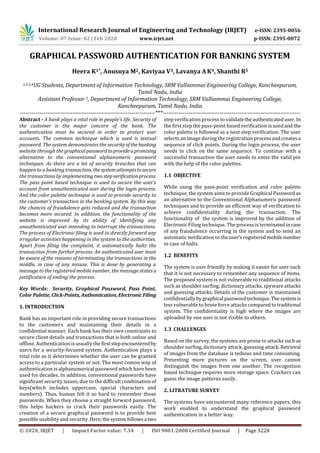
The proposed system uses the session password mechanism
for providing security to the user’s transactions, where inthe
first step is secured using the pass-point technique. In this
technique, the click points in the images generated by the
user during the registration process is used to validate the
authenticated user. The second step of the verification is
carried away with the use of color palettes. Here, instead of
the usual number pad, a pair of colors is displayed for each
number. And the authenticated user is allowed to proceed
with further transaction. When a user exceeds three chances
of entering a valid password, then he/she is identified as a
misuse and a complaint is filed against them through the
Electronic Filing mechanism. In case of any unusual amount
transaction, the user is confirmed by sending an one time
password.
International Research Journal of Engineering and Technology (IRJET) e-ISSN: 2395-0056
Volume: 07 Issue: 02 | Feb 2020 www.irjet.net p-ISSN: 2395-0072
© 2020, IRJET | Impact Factor value: 7.34 | ISO 9001:2008 Certified Journal | Page 3230
Fig -1: Architecture Diagram
4.2 PROPOSED METHOD
Pass-point Technique
Image submission: The user uploads an image from the
system and submit it during the registration phase.
Image password point mark: The user clicks on the various
points on the loaded image.
Tolerance calculation: The tolerance value is set to every
point and it is measured and verified duringtheloginprocess.
Authentication: When the points clicked on the sameimage,
during the login process is within the rangeoftolerancevalue
the user is authenticated.
Fig-2: Pass-Point Verification
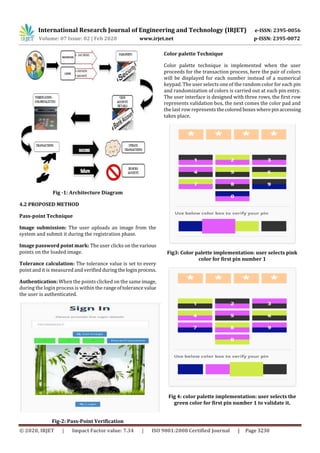
Color palette Technique
Color palette technique is implemented when the user
proceeds for the transaction process, here the pair of colors
will be displayed for each number instead of a numerical
keypad. The user selects one of the random color for each pin
and randomization of colors is carried out at each pin entry.
The user interface is designed with three rows, the first row
represents validation box, the next comes the color pad and
the last row representsthecolored boxeswherepinaccessing
takes place.
Fig3: Color palette implementation: user selects pink
color for first pin number 1
Fig 4: color palette implementation: user selects the
green color for first pin number 1 to validate it.
International Research Journal of Engineering and Technology (IRJET) e-ISSN: 2395-0056
Volume: 07 Issue: 02 | Feb 2020 www.irjet.net p-ISSN: 2395-0072
© 2020, IRJET | Impact Factor value: 7.34 | ISO 9001:2008 Certified Journal | Page 3231
1. User needs to select one random color from the pair of
colors.
2. The validation of the first pin occurs only afterrepetitionof
first step.
3. The above mentioned steps is followed by the user to
access other three PIN numbers.
4. When all the PIN entered is validated correctly the order is
placed.
Fig 5: Color palette verification: The first pin is
validated by clicking the correct color
Electronic –filing: When the user enters the invalid PIN, 3
times the account gets blocked and the IP address of the
unauthenticated user is notifiedandtheinformationissentto
the higher authority through mail.
5. CONCLUSION
In the proposed system, the traditional alphanumeric
password is replaced by the graphical password technique.
The system provides efficient way of verification to achieve
confidentiality. The proposed system provides more security
by using two step authentication. The pass-pointtechniqueis
used to authenticate the authorized user during login phase.
After successful authentication, the user may proceed to
transaction. The proposed system uses color palette
technique during the transaction phase. The Neuro fuzzy
methodology is used to generate the random colors at each
pin entry. The system has overcome the shoulder surfing
attack where the hacker cannot crack password easily. The
proposed system provides E-filing and automatically
terminates the process in case of any fraudulence detection.
5.1 FUTURE WORK
In future, for a more reliable and less complex system the
security of the system can be improved by substituting
advanced techniques. This web applications can be
implemented in various real-time scenarios like business,
telecommunication,military, banking etc.Theaccuracycanbe
further increased by adding more click points in the pass
point verification process and combinationofcolorsused can
also be improved like (10C10). In this era, security becomes
core of the arising technologiesandthecomputercrimein the
banking system will be considerably reduced.
REFERENCES
[1] Mudassar Ali Khan, Ikram ud din∗ senior member ieee,
Swayer Ullah Jadoon, Muhammad Khurram Khan∗ senior
member ieee, Mohsen Guizani fellow ieee, and Kamran
Ahmad Awan, “g-rat | A Unique Graphical Randomised
Authentication technique for client good devices” , 2018ieee.
[2] Miss.Swati Tidke,MissNagama Khan,Miss.SwatiBalpande
laptop engneering, rtm Nagpur University, M.I.E.T Bhandara,
“Password Authentication Victimisation text and colours “,
issn 2278 – 0882 volume four, issue 3, march 2015
[3] M. H. AU, J. K. Liu, W. Susilo, and T. H. Yuen, “Certificate
Based Mostly (Linkable) Ring Signature,” in proc. inf.security
follow expertise conf., 2007, pp. 79–92.
[4] M. H. AU, Y. MU, J. Chen, D. S. Wong, J. K. Liu, and G. Yang,
“Malicious Kgc Attacks In Certificateless Cryptography,” in
proc. second acm symp. inf., comput.commun.security,2007,
pp. 302–311.
[5] S. Habib, S. Hauke, S. Ries, and M. Mhlhuser, “Trust As A
Helper In Cloud Computing: A Survey,” journal of cloud
computing, vol. 1, no. 1, 2012.

IRJET - Graphical Password Authentication for Banking System

  • 1.
    International Research Journalof Engineering and Technology (IRJET) e-ISSN: 2395-0056 Volume: 07 Issue: 02 | Feb 2020 www.irjet.net p-ISSN: 2395-0072 © 2020, IRJET | Impact Factor value: 7.34 | ISO 9001:2008 Certified Journal | Page 3228 GRAPHICAL PASSWORD AUTHENTICATION FOR BANKING SYSTEM Heera K1*, Anusuya M2, Kaviyaa V3, Lavanya AK4, Shanthi R5 1,2,3,4UG Students, Department of Information Technology, SRM Valliammai Engineering College, Kancheepuram, Tamil Nadu, India Assistant Professor 5, Department of Information Technology, SRM Valliammai Engineering College, Kancheepuram, Tamil Nadu, India ---------------------------------------------------------------------***---------------------------------------------------------------------- Abstract - A bank plays a vital role in people's life. Security of the customer is the major concern of the bank. The authentication must be secured in order to protect user accounts. The common technique which is used is textual password. The system demonstrates the securityofthebanking website through the graphicalpasswordtoprovideapromising alternative to the conventional alphanumeric password techniques. As there are a lot of security breaches that can happen to a banking transaction, thesystemattemptstosecure the transactions by implementing twostepverificationprocess. The pass point based technique is used to secure the user’s account from unauthenticated user during the login process. And the color palette technique is used to provide security to the customer’s transaction in the banking system. By this way the chances of fraudulence gets reduced and the transaction becomes more secured. In addition, the functionality of the website is improved by its ability of identifying any unauthenticated user intending to interrupt the transactions. The process of Electronic filing is used to directly forward any irregular activities happening in the system to the authorities. Apart from filing the complaint, it automatically halts the transaction from further process. An authenticated user must be aware of the reasons of terminating the transactions in the middle, in case of any misuse. This is done by generating a message to the registered mobile number, the message statesa justification of ending the process. Key Words: Security, Graphical Password, Pass Point, ColorPalette,Click-Points, Authentication,Electronic Filing 1. INTRODUCTION Bank has an important role in providing secure transactions to the customers and maintaining their details in a confidential manner. Each bank has their own constraints to secure client details and transactions that is both online and offline. Authentication is usually thefirststepencounteredby users for a security-focused system. Authentication plays a vital role as it determines whether the user can be granted access to a particular system or not. The most comon way of authentication is alphanumerical password which have been used for decades. In addition, conventional passwords have significant security issues, due to the difficult combination of keys(which includes uppercase, special characters and numbers). Thus, human felt it so hard to remember those passwords. When they choose a straight forward password, this helps hackers to crack their passwords easily. The creation of a secure graphical password is to provide best possible usability and security.Here,thesystemfollowsa two step verification process to validatetheauthenticateduser.In the first step the pass-point based verification is usedand the color palette is followed as a next step verification. The user selects an image during the registrationprocessandcreatesa sequence of click points. During the login process, the user needs to click on the same sequence. To continue with a successful transaction the user needs to enter the valid pin with the help of the color palettes. 1.1 OBJECTIVE While using the pass-point verification and color palette technique, the system aims to provide Graphical Passwordas an alternative to the Conventional Alphanumeric password techniques and to provide an efficient way of verification to achieve confidentiality during the transaction. The functionality of the system is improved by the addition of Electronic Filing technique. The process is terminatedin case of any fraudulence occurring in the system and to send an automatic notification to the user’sregistered mobilenumber in case of halts. 1.2 BENEFITS The system is user friendly by making it easier for user such that it is not necessary to remember any sequence of items. The proposed system is not vulnerable to traditional attacks such as shoulder surfing, dictionary attacks, spyware attacks and guessing attacks. Details of the customer is maintained confidentiallybygraphical passwordtechnique.Thesystemis less vulnerable to brute force attacks comparedtotraditional system. The confidentiality is high where the images are uploaded by one user is not visible to others. 1.3 CHALLENGES Based on the survey, the systems are prone to attacks suchas shoulder surfing, dictionary attack, guessing attack.Retrieval of images from the database is tedious and time consuming. Presenting more pictures on the screen, user cannot distinguish the images from one another. The recognition based technique requires more storage space. Crackers can guess the image patterns easily. 2. LITRATURE SURVEY The systems have encountered many reference papers, this work enabled to understand the graphical password authentication in a better way.
  • 2.
    International Research Journalof Engineering and Technology (IRJET) e-ISSN: 2395-0056 Volume: 07 Issue: 02 | Feb 2020 www.irjet.net p-ISSN: 2395-0072 © 2020, IRJET | Impact Factor value: 7.34 | ISO 9001:2008 Certified Journal | Page 3229 [1] Mudassar Ali Khan, et al.in “gRAT A Novel Graphical Randomized Authentication Technique” for Consumer Smart Devices, IEEE Transactions on consumer electronics, 2018. The gRAT system is also a graphical watchword technique that uses photos that unit of measurement bestowed in Associate in Nursing passing 3x3 grid. Among the system the place of pictures changes whenever a user wishes to be real. [2] Muhammad Ahsan, et al.in “Graphical password Authentication using Image Sequence”, International Reseach Journal of Engineering and Technology(IRJET), 2017. In this methodology, user will transfer photos and it not visible to different users. In Recognition based technique, multiple photos unit of measurement shown to the user in random order. [3] Weizhi Meng, et al.in “Enhancing the security of FinTech Applications with Map-based Graphical watchword Authentication”, ELSEVIER, 2019. This scheme requires users to make a route on world map as their credentials. The creation of a route is believed to produce hints for users to remember their multiple passwords in a usable way. [4] Vijayakumari Rodda, et al.in “Multi-level Graphical Password Authentication scheme for cloud(MGPASC)”, International Journal of Recent Technology and Engineering(IJRTE), 2019. An authentication mechanism is the combination of two techniques such as graphical passwordandtextual password. This methodology provides the encrypted format using Caesar cipher technique. [5] Li and J.du, “Adaptive and attribute-based trustmodel for service level agreement guarantee in cloud computing”, Iet information security, 2018. Particle Swarm Optimization (PSO) is also a computing methodology that optimizes a tanglebyiterativelycreatingan effort to reinforce a candidate resolution with relevancy a given live of quality. [6] Graphical password Authentication, 2019. Graphical watchword schemes has been used as a numerous to text based schemes, motivated half by the actual fact that humans can detain mind footage more than text. 3. MODULE DESCRIPTION (i) REGISTRATION PHASE The user who is new to the website initially needs to register in this phase by providing all the relevant information. Here, the customer is free to set their own pin. (ii) LOGIN PHASE The users are required to provide their registered mobile number as their user name. (iii) PASS-POINT VERIFICATION The image which the user selected and generated the click points during the registration phase. The sequenceoftheclick points must not be changed to identify them as an authenticated user. (iv) PLACE ORDER This phase works as a normal e-commerce site where the customers place their orders on required products. (v) MONEY TRANSACTION User select the person to whom the money is to be sent. After selecting the user, the user is directed to the pin entry phase for the authentication purpose. (vi) PIN ENTRY In this step, the user has to select the appropriate pin which was set during the registration phase using the color palette. In case of exceeding three chances of incorrect pin entry, the process is terminated automatically. (vii) VIEW TRANSACTION DETAILS Here, the user can view all the transactions performed by them. 4. SYSTEM DESIGN The user interface is created using html, css, jquery,javascript and the language php is used. The backend process is MySql. 4.1 ARCHITECTURAL DESIGN The proposed system uses the session password mechanism for providing security to the user’s transactions, where inthe first step is secured using the pass-point technique. In this technique, the click points in the images generated by the user during the registration process is used to validate the authenticated user. The second step of the verification is carried away with the use of color palettes. Here, instead of the usual number pad, a pair of colors is displayed for each number. And the authenticated user is allowed to proceed with further transaction. When a user exceeds three chances of entering a valid password, then he/she is identified as a misuse and a complaint is filed against them through the Electronic Filing mechanism. In case of any unusual amount transaction, the user is confirmed by sending an one time password.
  • 3.
    International Research Journalof Engineering and Technology (IRJET) e-ISSN: 2395-0056 Volume: 07 Issue: 02 | Feb 2020 www.irjet.net p-ISSN: 2395-0072 © 2020, IRJET | Impact Factor value: 7.34 | ISO 9001:2008 Certified Journal | Page 3230 Fig -1: Architecture Diagram 4.2 PROPOSED METHOD Pass-point Technique Image submission: The user uploads an image from the system and submit it during the registration phase. Image password point mark: The user clicks on the various points on the loaded image. Tolerance calculation: The tolerance value is set to every point and it is measured and verified duringtheloginprocess. Authentication: When the points clicked on the sameimage, during the login process is within the rangeoftolerancevalue the user is authenticated. Fig-2: Pass-Point Verification Color palette Technique Color palette technique is implemented when the user proceeds for the transaction process, here the pair of colors will be displayed for each number instead of a numerical keypad. The user selects one of the random color for each pin and randomization of colors is carried out at each pin entry. The user interface is designed with three rows, the first row represents validation box, the next comes the color pad and the last row representsthecolored boxeswherepinaccessing takes place. Fig3: Color palette implementation: user selects pink color for first pin number 1 Fig 4: color palette implementation: user selects the green color for first pin number 1 to validate it.
  • 4.
    International Research Journalof Engineering and Technology (IRJET) e-ISSN: 2395-0056 Volume: 07 Issue: 02 | Feb 2020 www.irjet.net p-ISSN: 2395-0072 © 2020, IRJET | Impact Factor value: 7.34 | ISO 9001:2008 Certified Journal | Page 3231 1. User needs to select one random color from the pair of colors. 2. The validation of the first pin occurs only afterrepetitionof first step. 3. The above mentioned steps is followed by the user to access other three PIN numbers. 4. When all the PIN entered is validated correctly the order is placed. Fig 5: Color palette verification: The first pin is validated by clicking the correct color Electronic –filing: When the user enters the invalid PIN, 3 times the account gets blocked and the IP address of the unauthenticated user is notifiedandtheinformationissentto the higher authority through mail. 5. CONCLUSION In the proposed system, the traditional alphanumeric password is replaced by the graphical password technique. The system provides efficient way of verification to achieve confidentiality. The proposed system provides more security by using two step authentication. The pass-pointtechniqueis used to authenticate the authorized user during login phase. After successful authentication, the user may proceed to transaction. The proposed system uses color palette technique during the transaction phase. The Neuro fuzzy methodology is used to generate the random colors at each pin entry. The system has overcome the shoulder surfing attack where the hacker cannot crack password easily. The proposed system provides E-filing and automatically terminates the process in case of any fraudulence detection. 5.1 FUTURE WORK In future, for a more reliable and less complex system the security of the system can be improved by substituting advanced techniques. This web applications can be implemented in various real-time scenarios like business, telecommunication,military, banking etc.Theaccuracycanbe further increased by adding more click points in the pass point verification process and combinationofcolorsused can also be improved like (10C10). In this era, security becomes core of the arising technologiesandthecomputercrimein the banking system will be considerably reduced. REFERENCES [1] Mudassar Ali Khan, Ikram ud din∗ senior member ieee, Swayer Ullah Jadoon, Muhammad Khurram Khan∗ senior member ieee, Mohsen Guizani fellow ieee, and Kamran Ahmad Awan, “g-rat | A Unique Graphical Randomised Authentication technique for client good devices” , 2018ieee. [2] Miss.Swati Tidke,MissNagama Khan,Miss.SwatiBalpande laptop engneering, rtm Nagpur University, M.I.E.T Bhandara, “Password Authentication Victimisation text and colours “, issn 2278 – 0882 volume four, issue 3, march 2015 [3] M. H. AU, J. K. Liu, W. Susilo, and T. H. Yuen, “Certificate Based Mostly (Linkable) Ring Signature,” in proc. inf.security follow expertise conf., 2007, pp. 79–92. [4] M. H. AU, Y. MU, J. Chen, D. S. Wong, J. K. Liu, and G. Yang, “Malicious Kgc Attacks In Certificateless Cryptography,” in proc. second acm symp. inf., comput.commun.security,2007, pp. 302–311. [5] S. Habib, S. Hauke, S. Ries, and M. Mhlhuser, “Trust As A Helper In Cloud Computing: A Survey,” journal of cloud computing, vol. 1, no. 1, 2012.