Adaptive multi-element polynomial chaos with
discrete measure: Algorithms and application to
SPDEs
Mengdi Zheng and George Karniadakis
Content:	 
1. computing SPDE by MEPCM
2. motivations
3. numerical integration on discrete
measure
4. numerical example on KdV
equation
5. future work
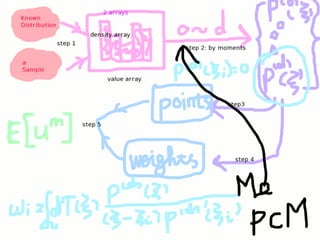
1.What computational SPDE is about? (MEPCM)
Xt(!) E[y(x, t; !)]
Xt(!)
Xt(⇠1, ⇠2, ...⇠n)
...
⇠n
⇠3
⇠2
⇠1
⌦
E[ym
(x, t; !)]
E[ym
(x, t; ⇠1, ⇠2, ..., ⇠n)]
fix x, t, integration
over a finite
dimensional
sample space
MEPCM=FEM on
sample space
⇠1
⇠2
⌦
⇡ ⇡
Gauss quadratures
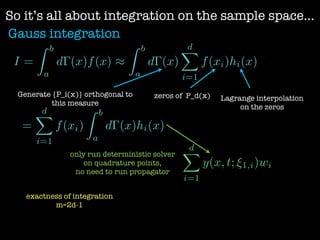
So it’s all about integration on the sample space...
Gauss integration
I =
Z b
a
d (x)f(x) ⇡
Z b
a
d (x)
dX
i=1
f(xi)hi(x)
=
dX
i=1
f(xi)
Z b
a
d (x)hi(x)
Generate {P_i(x)} orthogonal to
this measure
zeros of P_d(x) Lagrange interpolation
on the zeros
dX
i=1
y(x, t; ⇠1,i)wi
only run deterministic solver
on quadrature points,
no need to run propagator
exactness of integration
m=2d-1
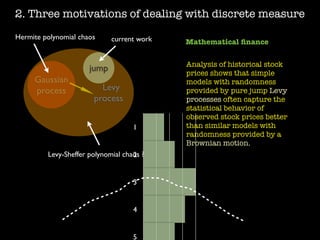
2. Three motivations of dealing with discrete measure
Gaussian 	

process Levy 	

process
Hermite polynomial chaos
Levy-Sheffer polynomial chaos ?
jump
current work
Analysis of historical stock
prices shows that simple
models with randomness
provided by pure jump Levy
processes often capture the
statistical behavior of
observed stock prices better
than similar models with
randomness provided by a
Brownian motion.
Mathematical finance
1
2
3
4
5
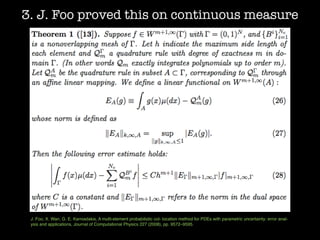
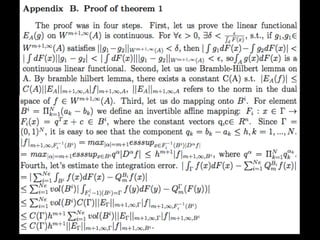
3. J. Foo proved this on continuous measure
J. Foo, X. Wan, G. E. Karniadakis, A multi-element probabilistic col- location method for PDEs with parametric uncertainty: error anal-
ysis and applications, Journal of Computational Physics 227 (2008), pp. 9572–9595.
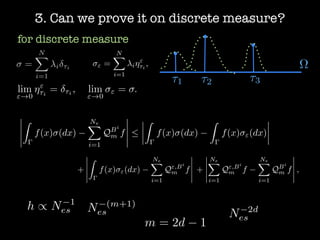
3. Can we prove it on discrete measure?
for discrete measure
" =
NX
i=1
i⌘"
⌧i
,
lim
"!0
⌘"
⌧i
= ⌧i , lim
"!0
" = .
Z
f(x) (dx)
NeX
i=1
QBi
m f 
Z
f(x) (dx)
Z
f(x) "(dx)
+
Z
f(x) "(dx)
NeX
i=1
Q",Bi
m f +
NeX
i=1
Q",Bi
m f
NeX
i=1
QBi
m f ,
h / N 1
es N (m+1)
es
m = 2d 1
N 2d
es
=
NX
i=1
i ⌧i ⌦
⌧1 ⌧2 ⌧3
Generating orthogonal polynomials for discrete measure
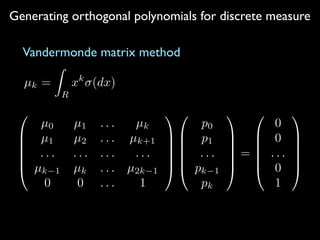
Vandermonde matrix method
µk =
Z
R
xk
(dx)
0
B
B
B
B
@
µ0 µ1 . . . µk
µ1 µ2 . . . µk+1
. . . . . . . . . . . .
µk 1 µk . . . µ2k 1
0 0 . . . 1
1
C
C
C
C
A
0
B
B
B
B
@
p0
p1
. . .
pk 1
pk
1
C
C
C
C
A
=
0
B
B
B
B
@
0
0
. . .
0
1
1
C
C
C
C
A
Generating orthogonal polynomials for discrete measure
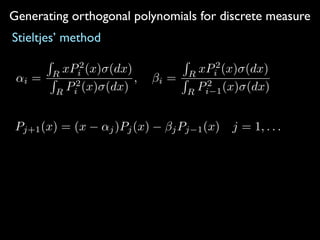
Stieltjes’ method
↵i =
R
R
xP2
i (x) (dx)
R
R
P2
i (x) (dx)
, i =
R
R
xP2
i (x) (dx)
R
R
P2
i 1(x) (dx)
Pj+1(x) = (x ↵j)Pj(x) jPj 1(x) j = 1, . . .
Generating orthogonal polynomials for discrete measure
Fischer’s method
=
NX
i=1
i ⌧i ⌫ = + ⌧
↵⌫
i = ↵i +
2
i Pi(⌧)Pi+1(⌧)
1 +
Pi
j=0
2
j P2
j (⌧)
2
i 1Pi(⌧)Pi 1(⌧)
1 +
Pi 1
j=0
2
j P2
j (⌧)
⌫
i = i
[1 +
Pi 2
j=0
2
j P2
j (⌧)][1 +
Pi
j=0
2
j P2
j (⌧)]
[1 +
Pi 1
j=0
2
j P2
j (⌧)]2
Generating orthogonal polynomials for discrete measure
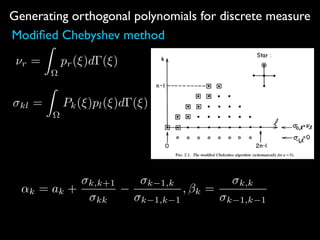
Modified Chebyshev method
⌫r =
Z
⌦
pr(⇠)d (⇠)
kl =
Z
⌦
Pk(⇠)pl(⇠)d (⇠)
↵k = ak +
k,k+1
kk
k 1,k
k 1,k 1
, k =
k,k
k 1,k 1
Generating orthogonal polynomials for discrete measure
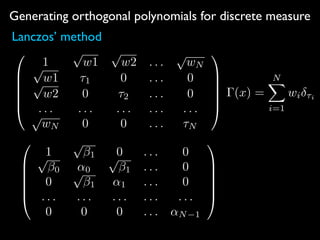
Lanczos’ method
0
B
B
B
B
@
1
p
w1
p
w2 . . .
p
wNp
w1 ⌧1 0 . . . 0p
w2 0 ⌧2 . . . 0
. . . . . . . . . . . . . . .
p
wN 0 0 . . . ⌧N
1
C
C
C
C
A
0
B
B
B
B
@
1
p
1 0 . . . 0p
0 ↵0
p
1 . . . 0
0
p
1 ↵1 . . . 0
. . . . . . . . . . . . . . .
0 0 0 . . . ↵N 1
1
C
C
C
C
A
(x) =
NX
i=1
wi ⌧i
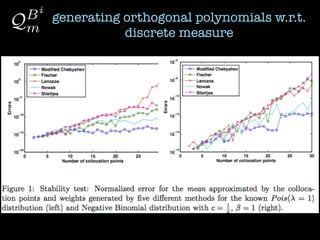
QBi
m
generating orthogonal polynomials w.r.t.
discrete measure
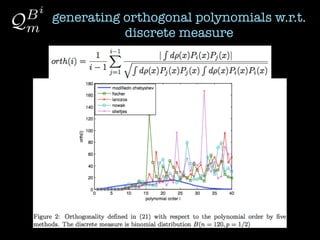
QBi
m
generating orthogonal polynomials w.r.t.
discrete measure
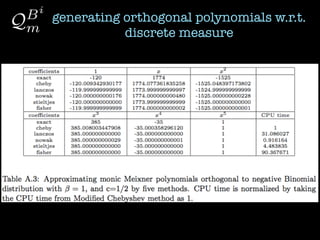
QBi
m
generating orthogonal polynomials w.r.t.
discrete measure
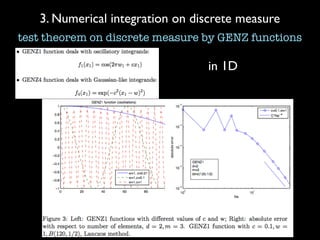
3. Numerical integration on discrete measure
test theorem on discrete measure by GENZ functions
in 1D
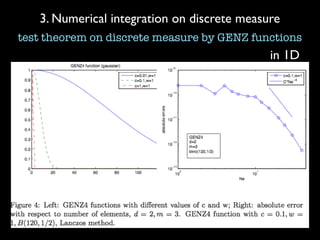
3. Numerical integration on discrete measure
in 1D
test theorem on discrete measure by GENZ functions
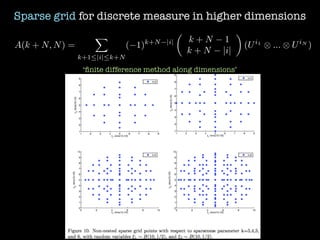
Sparse grid for discrete measure in higher dimensions
A(k + N, N) =
X
k+1|i|k+N
( 1)k+N |i|
✓
k + N 1
k + N |i|
◆
(Ui1
⌦ ... ⌦ UiN
)
‘finite difference method along dimensions’
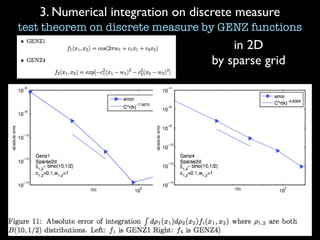
3. Numerical integration on discrete measure
in 2D 	

by sparse grid
test theorem on discrete measure by GENZ functions
Numerical example on KdV equation
ut + 6uux + uxxx = ⇠, x 2 R
u(x, 0) =
a
2
sech2
(
p
a
2
(x x0))
< um
(x, T; !) >=
Z
R
d⇢(⇠)[
a
2
sech2
(
p
a
2
(x 3 ⇠T2
x0 aT)) + ⇠T]m
L2u1 =
qR
dx(E[unum(x, T; !)] E[uex(x, T; !)])2
qR
dx(E[uex(x, T; !)])2
L2u2 =
qR
dx(E[u2
num(x, T; !)] E[u2
ex(x, T; !)])2
qR
dx(E[u2
ex(x, T; !)])2
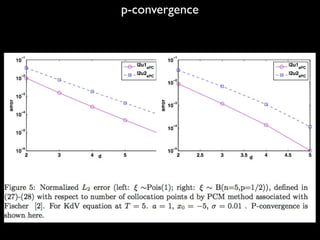
p-convergence
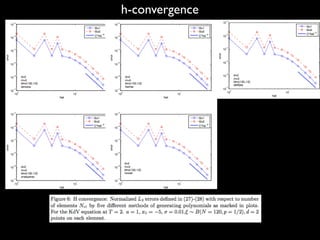
h-convergence
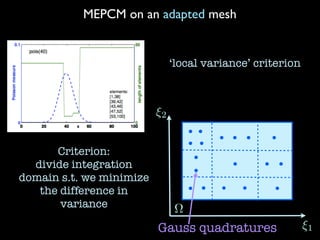
MEPCM on an adapted mesh
⇠1
⇠2
⌦
Gauss quadratures
Criterion:
divide integration
domain s.t. we minimize
the difference in
variance
‘local variance’ criterion
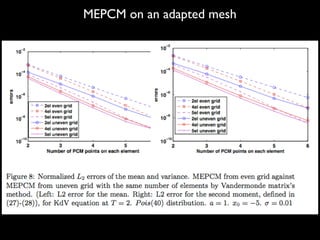
MEPCM on an adapted mesh
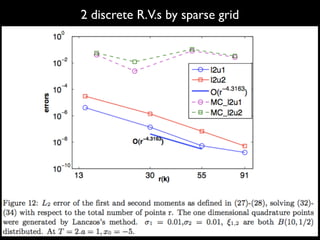
2 discrete R.V.s by sparse grid
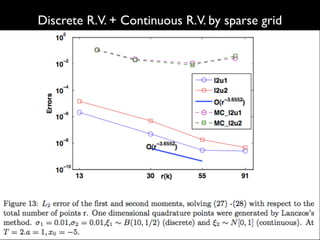
Discrete R.V. + Continuous R.V. by sparse grid
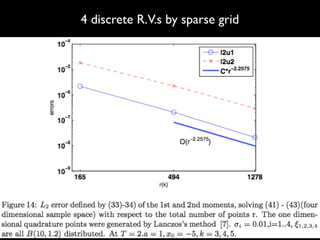
4 discrete R.V.s by sparse grid
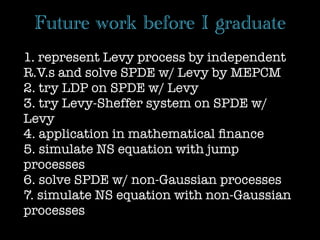
Future work before I graduate
1. represent Levy process by independent
R.V.s and solve SPDE w/ Levy by MEPCM
2. try LDP on SPDE w/ Levy
3. try Levy-Sheffer system on SPDE w/
Levy
4. application in mathematical finance
5. simulate NS equation with jump
processes
6. solve SPDE w/ non-Gaussian processes
7. simulate NS equation with non-Gaussian
processes
SPDE presentation 2012

SPDE presentation 2012

  • 1.
    Adaptive multi-element polynomialchaos with discrete measure: Algorithms and application to SPDEs Mengdi Zheng and George Karniadakis
  • 2.
    Content: 1. computingSPDE by MEPCM 2. motivations 3. numerical integration on discrete measure 4. numerical example on KdV equation 5. future work
  • 3.
    1.What computational SPDEis about? (MEPCM) Xt(!) E[y(x, t; !)] Xt(!) Xt(⇠1, ⇠2, ...⇠n) ... ⇠n ⇠3 ⇠2 ⇠1 ⌦ E[ym (x, t; !)] E[ym (x, t; ⇠1, ⇠2, ..., ⇠n)] fix x, t, integration over a finite dimensional sample space MEPCM=FEM on sample space ⇠1 ⇠2 ⌦ ⇡ ⇡ Gauss quadratures
  • 4.
    So it’s allabout integration on the sample space... Gauss integration I = Z b a d (x)f(x) ⇡ Z b a d (x) dX i=1 f(xi)hi(x) = dX i=1 f(xi) Z b a d (x)hi(x) Generate {P_i(x)} orthogonal to this measure zeros of P_d(x) Lagrange interpolation on the zeros dX i=1 y(x, t; ⇠1,i)wi only run deterministic solver on quadrature points, no need to run propagator exactness of integration m=2d-1
  • 5.
    2. Three motivationsof dealing with discrete measure Gaussian process Levy process Hermite polynomial chaos Levy-Sheffer polynomial chaos ? jump current work Analysis of historical stock prices shows that simple models with randomness provided by pure jump Levy processes often capture the statistical behavior of observed stock prices better than similar models with randomness provided by a Brownian motion. Mathematical finance 1 2 3 4 5
  • 6.
    3. J. Fooproved this on continuous measure J. Foo, X. Wan, G. E. Karniadakis, A multi-element probabilistic col- location method for PDEs with parametric uncertainty: error anal- ysis and applications, Journal of Computational Physics 227 (2008), pp. 9572–9595.
  • 7.
    3. Can weprove it on discrete measure? for discrete measure " = NX i=1 i⌘" ⌧i , lim "!0 ⌘" ⌧i = ⌧i , lim "!0 " = . Z f(x) (dx) NeX i=1 QBi m f  Z f(x) (dx) Z f(x) "(dx) + Z f(x) "(dx) NeX i=1 Q",Bi m f + NeX i=1 Q",Bi m f NeX i=1 QBi m f , h / N 1 es N (m+1) es m = 2d 1 N 2d es = NX i=1 i ⌧i ⌦ ⌧1 ⌧2 ⌧3
  • 10.
    Generating orthogonal polynomialsfor discrete measure Vandermonde matrix method µk = Z R xk (dx) 0 B B B B @ µ0 µ1 . . . µk µ1 µ2 . . . µk+1 . . . . . . . . . . . . µk 1 µk . . . µ2k 1 0 0 . . . 1 1 C C C C A 0 B B B B @ p0 p1 . . . pk 1 pk 1 C C C C A = 0 B B B B @ 0 0 . . . 0 1 1 C C C C A
  • 11.
    Generating orthogonal polynomialsfor discrete measure Stieltjes’ method ↵i = R R xP2 i (x) (dx) R R P2 i (x) (dx) , i = R R xP2 i (x) (dx) R R P2 i 1(x) (dx) Pj+1(x) = (x ↵j)Pj(x) jPj 1(x) j = 1, . . .
  • 12.
    Generating orthogonal polynomialsfor discrete measure Fischer’s method = NX i=1 i ⌧i ⌫ = + ⌧ ↵⌫ i = ↵i + 2 i Pi(⌧)Pi+1(⌧) 1 + Pi j=0 2 j P2 j (⌧) 2 i 1Pi(⌧)Pi 1(⌧) 1 + Pi 1 j=0 2 j P2 j (⌧) ⌫ i = i [1 + Pi 2 j=0 2 j P2 j (⌧)][1 + Pi j=0 2 j P2 j (⌧)] [1 + Pi 1 j=0 2 j P2 j (⌧)]2
  • 13.
    Generating orthogonal polynomialsfor discrete measure Modified Chebyshev method ⌫r = Z ⌦ pr(⇠)d (⇠) kl = Z ⌦ Pk(⇠)pl(⇠)d (⇠) ↵k = ak + k,k+1 kk k 1,k k 1,k 1 , k = k,k k 1,k 1
  • 14.
    Generating orthogonal polynomialsfor discrete measure Lanczos’ method 0 B B B B @ 1 p w1 p w2 . . . p wNp w1 ⌧1 0 . . . 0p w2 0 ⌧2 . . . 0 . . . . . . . . . . . . . . . p wN 0 0 . . . ⌧N 1 C C C C A 0 B B B B @ 1 p 1 0 . . . 0p 0 ↵0 p 1 . . . 0 0 p 1 ↵1 . . . 0 . . . . . . . . . . . . . . . 0 0 0 . . . ↵N 1 1 C C C C A (x) = NX i=1 wi ⌧i
  • 15.
  • 16.
  • 17.
  • 18.
    3. Numerical integrationon discrete measure test theorem on discrete measure by GENZ functions in 1D
  • 19.
    3. Numerical integrationon discrete measure in 1D test theorem on discrete measure by GENZ functions
  • 20.
    Sparse grid fordiscrete measure in higher dimensions A(k + N, N) = X k+1|i|k+N ( 1)k+N |i| ✓ k + N 1 k + N |i| ◆ (Ui1 ⌦ ... ⌦ UiN ) ‘finite difference method along dimensions’
  • 21.
    3. Numerical integrationon discrete measure in 2D by sparse grid test theorem on discrete measure by GENZ functions
  • 22.
    Numerical example onKdV equation ut + 6uux + uxxx = ⇠, x 2 R u(x, 0) = a 2 sech2 ( p a 2 (x x0)) < um (x, T; !) >= Z R d⇢(⇠)[ a 2 sech2 ( p a 2 (x 3 ⇠T2 x0 aT)) + ⇠T]m L2u1 = qR dx(E[unum(x, T; !)] E[uex(x, T; !)])2 qR dx(E[uex(x, T; !)])2 L2u2 = qR dx(E[u2 num(x, T; !)] E[u2 ex(x, T; !)])2 qR dx(E[u2 ex(x, T; !)])2
  • 23.
  • 24.
  • 25.
    MEPCM on anadapted mesh ⇠1 ⇠2 ⌦ Gauss quadratures Criterion: divide integration domain s.t. we minimize the difference in variance ‘local variance’ criterion
  • 26.
    MEPCM on anadapted mesh
  • 27.
    2 discrete R.V.sby sparse grid
  • 28.
    Discrete R.V. +Continuous R.V. by sparse grid
  • 29.
    4 discrete R.V.sby sparse grid
  • 30.
    Future work beforeI graduate 1. represent Levy process by independent R.V.s and solve SPDE w/ Levy by MEPCM 2. try LDP on SPDE w/ Levy 3. try Levy-Sheffer system on SPDE w/ Levy 4. application in mathematical finance 5. simulate NS equation with jump processes 6. solve SPDE w/ non-Gaussian processes 7. simulate NS equation with non-Gaussian processes