Presented by:
Shana White
March 31, 2015
INTRODUCTION TO ROC
CURVE ANALYSIS WITH
APPLICATIONS IN
FUNCTIONAL GENOMICS
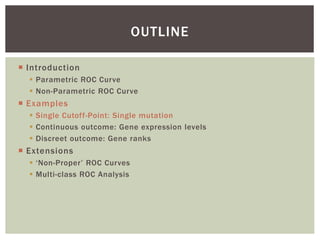
 Introduction
 Parametric ROC Curve
 Non-Parametric ROC Curve
 Examples
 Single Cutoff-Point: Single mutation
 Continuous outcome: Gene expression levels
 Discreet outcome: Gene ranks
 Extensions
 ‘Non-Proper’ ROC Curves
 Multi-class ROC Analysis
OUTLINE
ROC CURVES
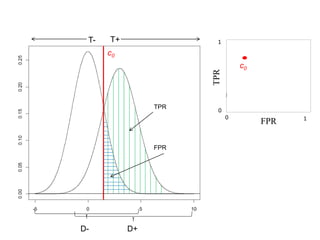
 ROC = Receiver-operator characteristic (signal detection)
 Purpose: evaluation of classification model that predicts
binary group membership
 Model can be based on supervised or unsupervised methods, but ‘true’
group membership (as determined by ‘gold standard’) is known
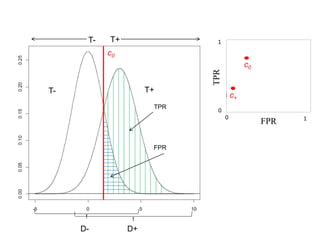
 Depict tradeoffs between sensitivity and specificity over a
range of cutoff values. In terms of disease:
 Sensitivity (True positive rate [TPR]): identification of those who
truly have the disease (D+) as having the disease (T+)
 Specificity (True negative rate [TNR]): identification of those that
do not actually have the disease (D-) as not having the disease (T-)
 The value [1-Specificity] (False positive rate [FPR]) is used in
graphs
 Ideal classification models have high TPR while maintaining low FPR
 TPR and FPR increase/decrease together
D- D+
c0
T- T+
TPR
FPR
0
FPR
0
1
1
TPR
c0
T+T-
D+D-
c+
TPR
FPR
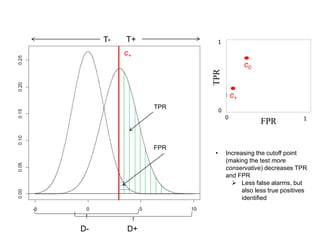
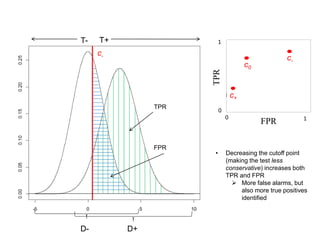
• Increasing the cutoff point
(making the test more
conservative) decreases TPR
and FPR
 Less false alarms, but
also less true positives
identified
0
FPR
0
1
1
TPR
c+
c0
T+T-
D+D-
T+T-
c0
TPR
FPR
0
FPR
0
1
1
TPR
c+
c0
D+D-
0
FPR
0
1
1
TPR
c+
c0
• Decreasing the cutoff point
(making the test less
conservative) increases both
TPR and FPR
 More false alarms, but
also more true positives
identified
T+T-
c-
c-
TPR
FPR
0
FPR0
1
1
TPR
0
FPR0
1
1
TPR
Non-Parametric Parametric
AUC AUC
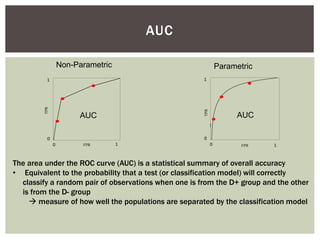
The area under the ROC curve (AUC) is a statistical summary of overall accuracy
• Equivalent to the probability that a test (or classification model) will correctly
classify a random pair of observations when one is from the D+ group and the other
is from the D- group
 measure of how well the populations are separated by the classification model
AUC
0
FPR0
1
1
TPR
TPRFPR
TPRFPR
TPRFPR
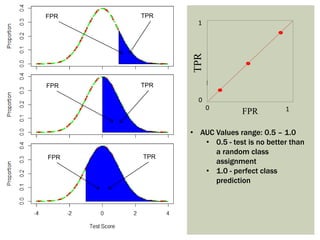
• AUC Values range: 0.5 – 1.0
• 0.5 - test is no better than
a random class
assignment
• 1.0 - perfect class
prediction
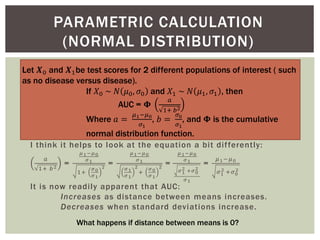
PARAMETRIC CALCULATION
(NORMAL DISTRIBUTION)
Let 𝑿0 and 𝑿1be test scores for 2 different populations of interest ( such
as no disease versus disease).
If 𝑋0 ~ 𝑁 𝜇0, 𝜎0 and 𝑋1 ~ 𝑁 𝜇1, 𝜎1 , then
AUC = 𝚽
𝑎
1+ 𝑏2
Where 𝑎 =
𝜇1−𝜇0
𝜎1
, 𝑏 =
𝜎0
𝜎1
, and 𝚽 is the cumulative
normal distribution function.
I think it helps to look at the equation a bit differently:
𝑎
1+ 𝑏2
=
𝜇1−𝜇0
𝜎1
1+
𝜎0
𝜎1
2
=
𝜇1−𝜇0
𝜎1
𝜎1
𝜎1
2
+
𝜎0
𝜎1
2
=
𝜇1−𝜇0
𝜎1
𝜎1
2 +𝜎0
2
𝜎1
=
𝜇1−𝜇0
𝜎1
2 +𝜎0
2
It is now readily apparent that AUC:
Increases as distance between means increases.
Decreases when standard deviations increase.
What happens if distance between means is 0?
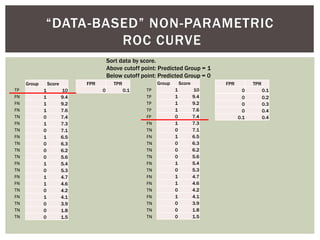
“DATA-BASED” NON-PARAMETRIC
ROC CURVE
FPR TPR
0 0.1
0 0.2
0 0.3
0 0.4
0.1 0.4
Group Score
1 10
1 9.4
1 9.2
1 7.6
0 7.4
1 7.3
0 7.1
1 6.5
0 6.3
0 6.2
0 5.6
1 5.4
0 5.3
1 4.7
1 4.6
0 4.2
1 4.1
0 3.9
0 1.8
0 1.5
Sort data by score.
Above cutoff point: Predicted Group = 1
Below cutoff point: Predicted Group = 0
TP
FN
FN
FN
TN
FN
TN
FN
TN
TN
TN
FN
TN
FN
FN
TN
FN
TN
TN
TN
FPR TPR
0 0.1
Group Score
1 10
1 9.4
1 9.2
1 7.6
0 7.4
1 7.3
0 7.1
1 6.5
0 6.3
0 6.2
0 5.6
1 5.4
0 5.3
1 4.7
1 4.6
0 4.2
1 4.1
0 3.9
0 1.8
0 1.5
TP
TP
TP
TP
FP
FN
TN
FN
TN
TN
TN
FN
TN
FN
FN
TN
FN
TN
TN
TN
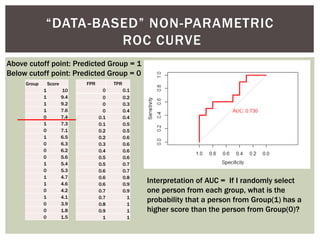
“DATA-BASED” NON-PARAMETRIC
ROC CURVE
FPR TPR
0 0.1
0 0.2
0 0.3
0 0.4
0.1 0.4
Group Score
1 10
1 9.4
1 9.2
1 7.6
0 7.4
1 7.3
0 7.1
1 6.5
0 6.3
0 6.2
0 5.6
1 5.4
0 5.3
1 4.7
1 4.6
0 4.2
1 4.1
0 3.9
0 1.8
0 1.5
0.1 0.5
0.2 0.5
0.2 0.6
0.3 0.6
0.4 0.6
0.5 0.6
0.5 0.7
0.6 0.7
0.6 0.8
0.6 0.9
0.7 0.9
0.7 1
0.8 1
0.9 1
1 1
Above cutoff point: Predicted Group = 1
Below cutoff point: Predicted Group = 0
Interpretation of AUC = If I randomly select
one person from each group, what is the
probability that a person from Group(1) has a
higher score than the person from Group(0)?
Group Score
0 1.5
0 6.2
0 5.3
0 4.2
0 3.9
0 7.1
0 5.6
0 7.4
0 1.8
0 6.3
1 9.2
1 10
1 4.1
1 6.5
1 5.4
1 9.4
1 4.6
1 7.3
1 4.7
1 7.6
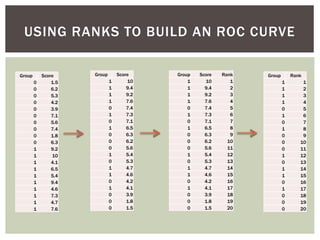
USING RANKS TO BUILD AN ROC CURVE
Group Score Rank
1 10 1
1 9.4 2
1 9.2 3
1 7.6 4
0 7.4 5
1 7.3 6
0 7.1 7
1 6.5 8
0 6.3 9
0 6.2 10
0 5.6 11
1 5.4 12
0 5.3 13
1 4.7 14
1 4.6 15
0 4.2 16
1 4.1 17
0 3.9 18
0 1.8 19
0 1.5 20
Group Score
1 10
1 9.4
1 9.2
1 7.6
0 7.4
1 7.3
0 7.1
1 6.5
0 6.3
0 6.2
0 5.6
1 5.4
0 5.3
1 4.7
1 4.6
0 4.2
1 4.1
0 3.9
0 1.8
0 1.5
Group Rank
1 1
1 2
1 3
1 4
0 5
1 6
0 7
1 8
0 9
0 10
0 11
1 12
0 13
1 14
1 15
0 16
1 17
0 18
0 19
0 20
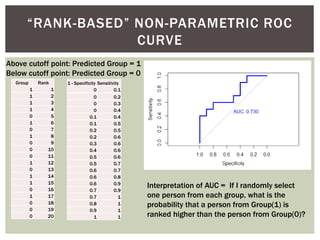
“RANK-BASED” NON-PARAMETRIC ROC
CURVE
Group Rank
1 1
1 2
1 3
1 4
0 5
1 6
0 7
1 8
0 9
0 10
0 11
1 12
0 13
1 14
1 15
0 16
1 17
0 18
0 19
0 20
1 - Specificity Sensitivity
0 0.1
0 0.2
0 0.3
0 0.4
0.1 0.4
0.1 0.5
0.2 0.5
0.2 0.6
0.3 0.6
0.4 0.6
0.5 0.6
0.5 0.7
0.6 0.7
0.6 0.8
0.6 0.9
0.7 0.9
0.7 1
0.8 1
0.9 1
1 1
Above cutoff point: Predicted Group = 1
Below cutoff point: Predicted Group = 0
Interpretation of AUC = If I randomly select
one person from each group, what is the
probability that a person from Group(1) is
ranked higher than the person from Group(0)?
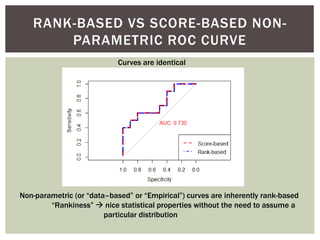
RANK-BASED VS SCORE-BASED NON-
PARAMETRIC ROC CURVE
Curves are identical
Non-parametric (or “data–based” or “Empirical”) curves are inherently rank-based
“Rankiness”  nice statistical properties without the need to assume a
particular distribution
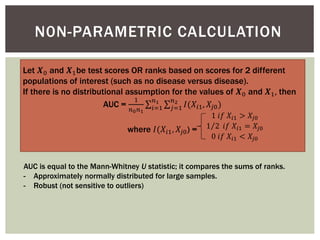
N0N-PARAMETRIC CALCULATION
Let 𝑿0 and 𝑿1be test scores OR ranks based on scores for 2 different
populations of interest (such as no disease versus disease).
If there is no distributional assumption for the values of 𝑿0 and 𝑿1, then
AUC =
1
𝑛0 𝑛1
𝑖=1
𝑛1
𝑗=1
𝑛2
𝐼(𝑋𝑖1, 𝑋𝑗0)
where 𝐼(𝑋𝑖1, 𝑋𝑗0) =
1 𝑖𝑓 𝑋𝑖1 > 𝑋𝑗0
1 2 𝑖𝑓 𝑋𝑖1 = 𝑋𝑗0
0 𝑖𝑓 𝑋𝑖1 < 𝑋𝑗0
AUC is equal to the Mann-Whitney U statistic; it compares the sums of ranks.
- Approximately normally distributed for large samples.
- Robust (not sensitive to outliers)
 Introduction
 Parametric ROC Curve
 Non-Parametric ROC Curve
 Examples
 Single Cutoff-Point: Single mutation
 Continuous outcome: Gene expression levels
 Discreet outcome: Gene ranks
 Extensions
 ‘Non-Proper’ ROC Curves
 Multi-class ROC Analysis
OUTLINE
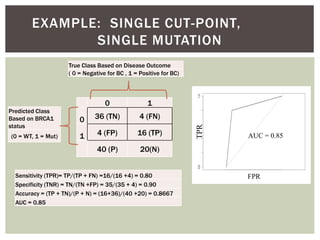
EXAMPLE: SINGLE CUT-POINT,
SINGLE MUTATION
0 1
0 36 (TN) 4 (FN)
1 4 (FP) 16 (TP)
40 (P) 20(N)
Predicted Class
Based on BRCA1
status
(0 = WT, 1 = Mut)
True Class Based on Disease Outcome
( 0 = Negative for BC , 1 = Positive for BC)
Sensitivity (TPR)= TP/(TP + FN) =16/(16 +4) = 0.80
Specificity (TNR) = TN/(TN +FP) = 35/(35 + 4) = 0.90
Accuracy = (TP + TN)/(P + N) = (16+36)/(40 +20) = 0.8667
AUC = 0.85
FPR
TPR
AUC = 0.85
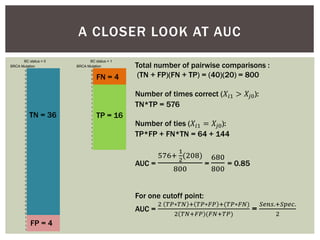
A CLOSER LOOK AT AUC
BC status = 0 BC status = 1
BRCA Mutation BRCA Mutation
0 0
0 0
0 0
0 0
0 1
0 1
0 1
0 1
0 1
0 1
0 1
0 1
0 1
0 1
0 1
0 1
0 1
0 1
0 1
0 1
0
0
0
0
0
0
0
0
0
0
0
0
0
0
0
0
1
1
1
1
TN = 36
FP = 4
TP = 16
FN = 4
Total number of pairwise comparisons :
(TN + FP)(FN + TP) = (40)(20) = 800
Number of times correct (𝑋𝑖1 > 𝑋𝑗0):
TN*TP = 576
Number of ties (𝑋𝑖1 = 𝑋𝑗0):
TP*FP + FN*TN = 64 + 144
AUC =
576+
1
2
(208)
800
=
680
800
= 0.85
For one cutoff point:
AUC =
2 𝑇𝑃∗𝑇𝑁 + 𝑇𝑃∗𝐹𝑃 +(𝑇𝑃∗𝐹𝑁)
2 𝑇𝑁+𝐹𝑃 (𝐹𝑁+𝑇𝑃)
=
𝑆𝑒𝑛𝑠.+𝑆𝑝𝑒𝑐.
2
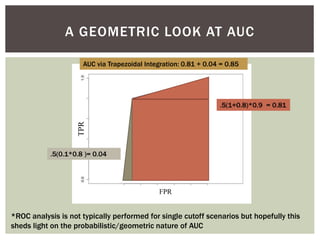
A GEOMETRIC LOOK AT AUC
FPR
TPR
.5(0.1*0.8 )= 0.04
.5(1+0.8)*0.9 = 0.81
AUC via Trapezoidal Integration: 0.81 + 0.04 = 0.85
*ROC analysis is not typically performed for single cutoff scenarios but hopefully this
sheds light on the probabilistic/geometric nature of AUC
 Introduction
 Parametric ROC Curve
 Non-Parametric ROC Curve
 Examples
 Single Cutoff-Point: Single mutation
 Continuous outcome: Gene expression levels
 Discreet outcome: Gene ranks
 Extensions
 ‘Non-Proper’ ROC Curves
 Multi-class ROC Analysis
OUTLINE
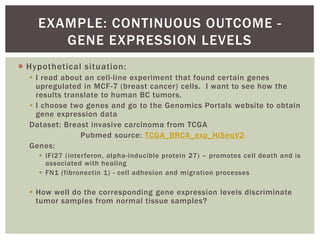
 Hypothetical situation:
 I read about an cell-line experiment that found certain genes
upregulated in MCF-7 (breast cancer) cells. I want to see how the
results translate to human BC tumors.
 I choose two genes and go to the Genomics Portals website to obtain
gene expression data
Dataset: Breast invasive carcinoma from TCGA
Pubmed source: TCGA_BRCA_exp_HiSeqV2
Genes:
 IFI27 (interferon, alpha-inducible protein 27) – promotes cell death and is
associated with healing
 FN1 (fibronectin 1) - cell adhesion and migration processes
 How well do the corresponding gene expression levels discriminate
tumor samples from normal tissue samples?
EXAMPLE: CONTINUOUS OUTCOME -
GENE EXPRESSION LEVELS
EXAMPLE: CONTINUOUS OUTCOME -
GENE EXPRESSION LEVELS
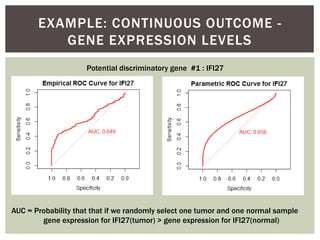
Potential discriminatory gene #1 : IFI27
AUC = Probability that that if we randomly select one tumor and one normal sample
gene expression for IFI27(tumor) > gene expression for IFI27(normal)
EXAMPLE: CONTINUOUS OUTCOME -
GENE EXPRESSION LEVELS
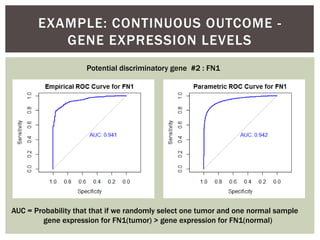
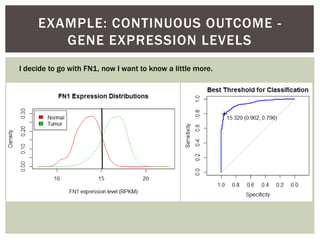
Potential discriminatory gene #2 : FN1
AUC = Probability that that if we randomly select one tumor and one normal sample
gene expression for FN1(tumor) > gene expression for FN1(normal)
EXAMPLE: CONTINUOUS OUTCOME -
GENE EXPRESSION LEVELS
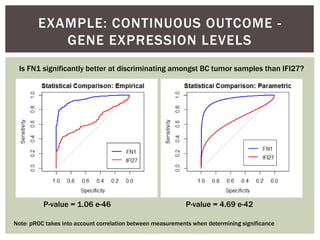
Is FN1 significantly better at discriminating amongst BC tumor samples than IFI27?
Note: pROC takes into account correlation between measurements when determining significance
P-value = 1.06 e-46 P-value = 4.69 e-42
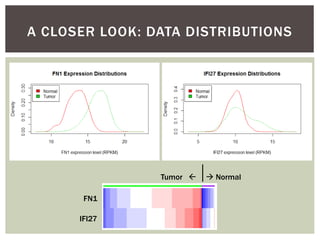
A CLOSER LOOK: DATA DISTRIBUTIONS
Tumor   Normal
FN1
IFI27
EXAMPLE: CONTINUOUS OUTCOME -
GENE EXPRESSION LEVELS
I decide to go with FN1, now I want to know a little more.
 Introduction
 Parametric ROC Curve
 Non-Parametric ROC Curve
 Examples
 Single Cutoff-Point: Single mutation
 Continuous outcome: Gene expression levels
 Discreet outcome: Gene ranks
 Extensions
 ‘Non-Proper’ ROC Curves
 Multi-class ROC Analysis
OUTLINE
Hypothetical situation:
 I have been using DEseq for differential expression analysis. I
want to start using edgeR, but I hear it is less conservative
than DEseq.
 Since edgeR is less conservative, I am concerned that it will return
more false positives than DEseq.
 On the other hand, I am concerned that DEseq will return less true
positives than edgeR.
 I construct a simulation data set to represent two groups and
expression levels for 50 genes.
 I choose at random 20 genes to be up- or down-regulated (DE) between
groups when I simulate the data
 (for more detail see Soneson & Delorenzi 2013)
 I run DE on DEseq and edgeR and then rank the genes by p-value.
EXAMPLE: DISCREET OUTCOME -
RANKING OF DE GENES
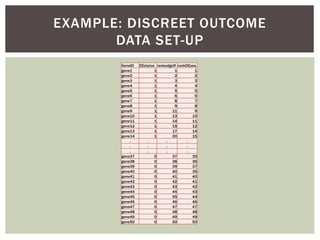
EXAMPLE: DISCREET OUTCOME
DATA SET-UP
GeneID DEstatus rankedgeR rankDEseq
gene1 1 1 1
gene2 1 2 2
gene3 1 3 3
gene4 1 4 4
gene5 1 5 5
gene6 1 6 6
gene7 1 8 7
gene8 1 9 8
gene9 1 11 9
gene10 1 13 10
gene11 1 14 11
gene12 1 15 12
gene13 1 17 14
gene14 1 20 15
. . . .
. . . .
. . . .
gene37 0 37 35
gene38 0 38 36
gene39 0 39 37
gene40 0 40 39
gene41 0 41 40
gene42 0 42 41
gene43 0 43 42
gene44 0 44 43
gene45 0 45 44
gene46 0 46 46
gene47 0 47 47
gene48 0 48 48
gene49 0 49 49
gene50 0 50 50
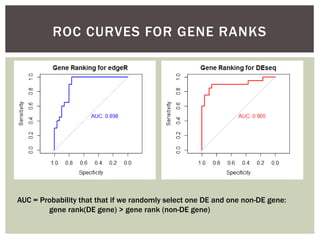
ROC CURVES FOR GENE RANKS
AUC = Probability that that if we randomly select one DE and one non-DE gene:
gene rank(DE gene) > gene rank (non-DE gene)
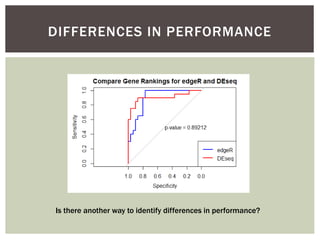
DIFFERENCES IN PERFORMANCE
Is there another way to identify differences in performance?
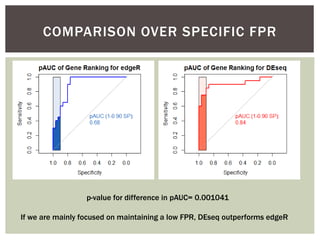
COMPARISON OVER SPECIFIC FPR
p-value for difference in pAUC= 0.001041
If we are mainly focused on maintaining a low FPR, DEseq outperforms edgeR
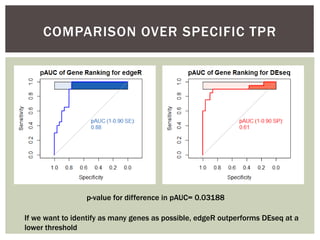
COMPARISON OVER SPECIFIC TPR
p-value for difference in pAUC= 0.03188
If we want to identify as many genes as possible, edgeR outperforms DEseq at a
lower threshold
 Introduction
 Parametric ROC Curve
 Non-Parametric ROC Curve
 Examples
 Single Cutoff-Point: Single mutation
 Continuous outcome: Gene expression levels
 Discreet outcome: Gene ranks
 Extensions
 ‘Non-Proper’ ROC Curves
 Multi-class ROC Analysis
OUTLINE
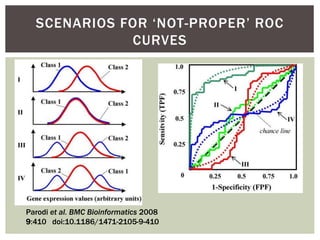
SCENARIOS FOR ‘NOT-PROPER’ ROC
CURVES
Parodi et al. BMC Bioinformatics 2008
9:410 doi:10.1186/1471-2105-9-410
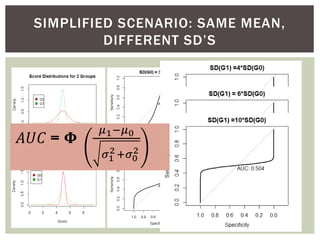
SIMPLIFIED SCENARIO: SAME MEAN,
DIFFERENT SD’S
𝐴𝑈𝐶 = 𝚽
𝜇1−𝜇0
𝜎1
2 +𝜎0
2
 Rationale: If there is no difference in mean measurement
between groups, we are ‘constrained’ to have AUC = 0.50
 Useful if difference in measurements between groups is not reflected
by an overall difference in means.
 Can account for bimodal distributions, ‘nested’ distributions
 May capture unique aspects of biological variability
 ABCR = area between the ROC curve and the rising diagonal
 TNRC = Test for Not-proper ROC Curves
ANALYSIS WITH NOT-PROPER ROCS
 Introduction
 Parametric ROC Curve
 Non-Parametric ROC Curve
 Examples
 Single Cutoff-Point: Single mutation
 Continuous outcome: Gene expression levels
 Discreet outcome: Gene ranks
 Extensions
 ‘Non-Proper’ ROC Curves
 Multi-class ROC Analysis
OUTLINE
 Oftentimes, category labels are made binary for ease of
interpretation and/or analysis
 Ex) [cancer, no cancer], [normal, abnormal], [positive, negative]
 Traditional ROC methods adhere to this ‘rule’
 If there is more than one class we are interested in, we have to ‘force
dichotomization’ by combining two [or more] classes
 Ex) Types of breast cancer (LA, LB, HER2, Basal) would all be classified as
cancer if compared to normal
 Multi-class ROC methods are natural extensions of traditional
methods
 Instead of area [under the curve], we are interested in volume under
the surface (VUS, 3-classes) or hypervolume under the manifold
(HUM, more than three classes)
 Baseline value for comparison:
1
𝑘!
where k = number of classes
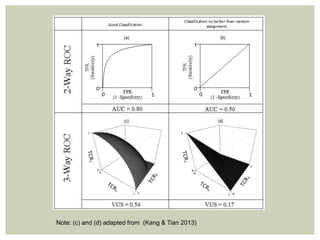
MULTI-CLASS R0C
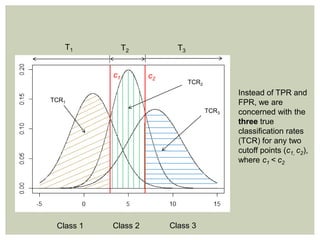
Class 1 Class 2 Class 3
c1 c2
T1 T2 T3
TCR1
Instead of TPR and
FPR, we are
concerned with the
three true
classification rates
(TCR) for any two
cutoff points (c1, c2),
where c1 < c2
TCR2
TCR3
VOLUME UNDER THE SURFACE
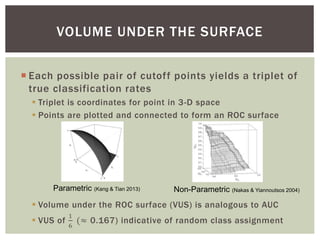
 Each possible pair of cutoff points yields a triplet of
true classification rates
 Triplet is coordinates for point in 3-D space
 Points are plotted and connected to form an ROC surface
 Volume under the ROC surface (VUS) is analogous to AUC
 VUS of
1
6
(≈ 0.167) indicative of random class assignment
Non-Parametric (Nakas & Yiannoutsos 2004)Parametric (Kang & Tian 2013)
Note: (c) and (d) adapted from (Kang & Tian 2013)
EXAMPLE: MICROSATELLITE INSTABILITY
IN COLON CANCER
 Microsatellite instability (MSI) has been associated with colon
cancer. Results from a panel of genetic markers are used to
determine MSI status on three levels:
1. MSS: microsatellite stable, no markers detected
2. MSI-L: MSI-Low; at least 1 but < 30% across panel
3. MSI-H: MSI-High; > 30% mutation rate across panel
 I read a paper (Molecular Cancer 2007, 6:54 ) that says they found a
gene that is upregulated in MSI-H vs. MSS-type tumors (they
dichotomized their data)
 I want to see if these findings also apply to tumor samples and extend to a
three-level classification system.
Gene: SECTM1
Data: Colon adenocarcinomas from TCGA
Pubmed source= TCGA_COAD_exp_HiSeqV2
EXAMPLE: MICROSATELLITE INSTABILITY
IN COLON CANCER
[Edited] Raw Data Summary:
n mu sd
Level 1: MSS 98 8.21 1.17
Level 2: MSI-L 25 8.03 1.29
Level 3: MSI-H 25 10.05 1.49
VUS=0.3419, 95% CI=[0.2258, 0.457]
Best cut-points: lower(c1)=8.0439, upper(c2)=9.3773
The group correct classification probabilities are
MSS MSH-L MSH-H
0.4184 0.6429 0.8000
VUS = Probability that if we choose at random one MSS, MSI-L and MSI-H sample:
SECTM1MSS < SECTM1MSI-L < SECTM1MSI-H
EXAMPLE: MICROSATELLITE INSTABILITY
IN COLON CANCER
[Edited] Raw Data Summary:
n mu sd
Level 1: MSI-L 25 8.03 1.29
Level 2: MSS 98 8.21 1.17
Level 3: MSI-H 25 10.05 1.49
VUS(new)=0.4692, 95% CI=[0.3289, 0.6017]
VUS(old)=0.3419
Best cut-points: lower(c1)=7.4214, upper(c2)=9.3773
The group correct classification probabilities are
MSS MSH-L MSH-H
0.4184 0.4400 0.8000
VUS = Probability that if we choose at random one MSS, MSI-L and MSI-H sample:
SECTM1MSI-L < SECTM1MSS < SECTM1MSI-H
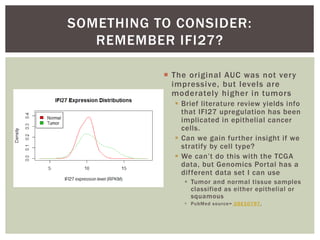
SOMETHING TO CONSIDER:
REMEMBER IFI27?
 The original AUC was not very
impressive, but levels are
moderately higher in tumors
 Brief literature review yields info
that IFI27 upregulation has been
implicated in epithelial cancer
cells.
 Can we gain further insight if we
stratify by cell type?
 We can’t do this with the TCGA
data, but Genomics Portal has a
different data set I can use
 Tumor and normal tissue samples
classified as either epithelial or
squamous
 PubMed source= GSE10797,
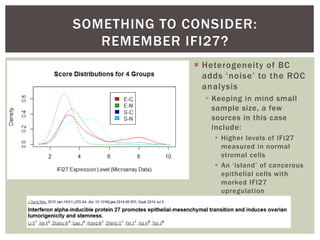
 Heterogeneity of BC
adds ‘noise’ to the ROC
analysis
 Keeping in mind small
sample size, a few
sources in this case
include:
 Higher levels of IFI27
measured in normal
stromal cells
 An ‘island’ of cancerous
epithelial cells with
marked IFI27
upregulation
SOMETHING TO CONSIDER:
REMEMBER IFI27?
 Flexible tool for evaluating classification models
 Provides statistical and graphical measures of overall accuracy
 Yields optimal cutoff values for prediction
 Some considerations for use in functional genomics:
 Heterogeneity of biological data
 We are using relatively simple methods but dealing with appreciably
complex phenomena
 Unequal sample sizes for groups
 Generally more cancer samples than normal samples
 More genes are non-DE vs DE (when considering ranking systems)
 This is only the tip of the iceberg!
 Bayesian methods, semi-parametric methods, misclassification costs,
training/validation issues, multivariable models…
SUMMARY OF ROC ANALYSIS
QUESTIONS?
http://stats.stackexchange.com/questions/423/what-is-your-favorite-data-analysis-cartoon?page=2&tab=votes#tab-top

Introduction to ROC Curve Analysis with Application in Functional Genomics

  • 1.
    Presented by: Shana White March31, 2015 INTRODUCTION TO ROC CURVE ANALYSIS WITH APPLICATIONS IN FUNCTIONAL GENOMICS
  • 2.
     Introduction  ParametricROC Curve  Non-Parametric ROC Curve  Examples  Single Cutoff-Point: Single mutation  Continuous outcome: Gene expression levels  Discreet outcome: Gene ranks  Extensions  ‘Non-Proper’ ROC Curves  Multi-class ROC Analysis OUTLINE
  • 3.
    ROC CURVES  ROC= Receiver-operator characteristic (signal detection)  Purpose: evaluation of classification model that predicts binary group membership  Model can be based on supervised or unsupervised methods, but ‘true’ group membership (as determined by ‘gold standard’) is known  Depict tradeoffs between sensitivity and specificity over a range of cutoff values. In terms of disease:  Sensitivity (True positive rate [TPR]): identification of those who truly have the disease (D+) as having the disease (T+)  Specificity (True negative rate [TNR]): identification of those that do not actually have the disease (D-) as not having the disease (T-)  The value [1-Specificity] (False positive rate [FPR]) is used in graphs  Ideal classification models have high TPR while maintaining low FPR  TPR and FPR increase/decrease together
  • 4.
  • 5.
    T+T- D+D- c+ TPR FPR • Increasing thecutoff point (making the test more conservative) decreases TPR and FPR  Less false alarms, but also less true positives identified 0 FPR 0 1 1 TPR c+ c0
  • 6.
  • 7.
    D+D- 0 FPR 0 1 1 TPR c+ c0 • Decreasing thecutoff point (making the test less conservative) increases both TPR and FPR  More false alarms, but also more true positives identified T+T- c- c- TPR FPR
  • 8.
    0 FPR0 1 1 TPR 0 FPR0 1 1 TPR Non-Parametric Parametric AUC AUC Thearea under the ROC curve (AUC) is a statistical summary of overall accuracy • Equivalent to the probability that a test (or classification model) will correctly classify a random pair of observations when one is from the D+ group and the other is from the D- group  measure of how well the populations are separated by the classification model AUC
  • 9.
    0 FPR0 1 1 TPR TPRFPR TPRFPR TPRFPR • AUC Valuesrange: 0.5 – 1.0 • 0.5 - test is no better than a random class assignment • 1.0 - perfect class prediction
  • 10.
    PARAMETRIC CALCULATION (NORMAL DISTRIBUTION) Let𝑿0 and 𝑿1be test scores for 2 different populations of interest ( such as no disease versus disease). If 𝑋0 ~ 𝑁 𝜇0, 𝜎0 and 𝑋1 ~ 𝑁 𝜇1, 𝜎1 , then AUC = 𝚽 𝑎 1+ 𝑏2 Where 𝑎 = 𝜇1−𝜇0 𝜎1 , 𝑏 = 𝜎0 𝜎1 , and 𝚽 is the cumulative normal distribution function. I think it helps to look at the equation a bit differently: 𝑎 1+ 𝑏2 = 𝜇1−𝜇0 𝜎1 1+ 𝜎0 𝜎1 2 = 𝜇1−𝜇0 𝜎1 𝜎1 𝜎1 2 + 𝜎0 𝜎1 2 = 𝜇1−𝜇0 𝜎1 𝜎1 2 +𝜎0 2 𝜎1 = 𝜇1−𝜇0 𝜎1 2 +𝜎0 2 It is now readily apparent that AUC: Increases as distance between means increases. Decreases when standard deviations increase. What happens if distance between means is 0?
  • 11.
    “DATA-BASED” NON-PARAMETRIC ROC CURVE FPRTPR 0 0.1 0 0.2 0 0.3 0 0.4 0.1 0.4 Group Score 1 10 1 9.4 1 9.2 1 7.6 0 7.4 1 7.3 0 7.1 1 6.5 0 6.3 0 6.2 0 5.6 1 5.4 0 5.3 1 4.7 1 4.6 0 4.2 1 4.1 0 3.9 0 1.8 0 1.5 Sort data by score. Above cutoff point: Predicted Group = 1 Below cutoff point: Predicted Group = 0 TP FN FN FN TN FN TN FN TN TN TN FN TN FN FN TN FN TN TN TN FPR TPR 0 0.1 Group Score 1 10 1 9.4 1 9.2 1 7.6 0 7.4 1 7.3 0 7.1 1 6.5 0 6.3 0 6.2 0 5.6 1 5.4 0 5.3 1 4.7 1 4.6 0 4.2 1 4.1 0 3.9 0 1.8 0 1.5 TP TP TP TP FP FN TN FN TN TN TN FN TN FN FN TN FN TN TN TN
  • 12.
    “DATA-BASED” NON-PARAMETRIC ROC CURVE FPRTPR 0 0.1 0 0.2 0 0.3 0 0.4 0.1 0.4 Group Score 1 10 1 9.4 1 9.2 1 7.6 0 7.4 1 7.3 0 7.1 1 6.5 0 6.3 0 6.2 0 5.6 1 5.4 0 5.3 1 4.7 1 4.6 0 4.2 1 4.1 0 3.9 0 1.8 0 1.5 0.1 0.5 0.2 0.5 0.2 0.6 0.3 0.6 0.4 0.6 0.5 0.6 0.5 0.7 0.6 0.7 0.6 0.8 0.6 0.9 0.7 0.9 0.7 1 0.8 1 0.9 1 1 1 Above cutoff point: Predicted Group = 1 Below cutoff point: Predicted Group = 0 Interpretation of AUC = If I randomly select one person from each group, what is the probability that a person from Group(1) has a higher score than the person from Group(0)?
  • 13.
    Group Score 0 1.5 06.2 0 5.3 0 4.2 0 3.9 0 7.1 0 5.6 0 7.4 0 1.8 0 6.3 1 9.2 1 10 1 4.1 1 6.5 1 5.4 1 9.4 1 4.6 1 7.3 1 4.7 1 7.6 USING RANKS TO BUILD AN ROC CURVE Group Score Rank 1 10 1 1 9.4 2 1 9.2 3 1 7.6 4 0 7.4 5 1 7.3 6 0 7.1 7 1 6.5 8 0 6.3 9 0 6.2 10 0 5.6 11 1 5.4 12 0 5.3 13 1 4.7 14 1 4.6 15 0 4.2 16 1 4.1 17 0 3.9 18 0 1.8 19 0 1.5 20 Group Score 1 10 1 9.4 1 9.2 1 7.6 0 7.4 1 7.3 0 7.1 1 6.5 0 6.3 0 6.2 0 5.6 1 5.4 0 5.3 1 4.7 1 4.6 0 4.2 1 4.1 0 3.9 0 1.8 0 1.5 Group Rank 1 1 1 2 1 3 1 4 0 5 1 6 0 7 1 8 0 9 0 10 0 11 1 12 0 13 1 14 1 15 0 16 1 17 0 18 0 19 0 20
  • 14.
    “RANK-BASED” NON-PARAMETRIC ROC CURVE GroupRank 1 1 1 2 1 3 1 4 0 5 1 6 0 7 1 8 0 9 0 10 0 11 1 12 0 13 1 14 1 15 0 16 1 17 0 18 0 19 0 20 1 - Specificity Sensitivity 0 0.1 0 0.2 0 0.3 0 0.4 0.1 0.4 0.1 0.5 0.2 0.5 0.2 0.6 0.3 0.6 0.4 0.6 0.5 0.6 0.5 0.7 0.6 0.7 0.6 0.8 0.6 0.9 0.7 0.9 0.7 1 0.8 1 0.9 1 1 1 Above cutoff point: Predicted Group = 1 Below cutoff point: Predicted Group = 0 Interpretation of AUC = If I randomly select one person from each group, what is the probability that a person from Group(1) is ranked higher than the person from Group(0)?
  • 15.
    RANK-BASED VS SCORE-BASEDNON- PARAMETRIC ROC CURVE Curves are identical Non-parametric (or “data–based” or “Empirical”) curves are inherently rank-based “Rankiness”  nice statistical properties without the need to assume a particular distribution
  • 16.
    N0N-PARAMETRIC CALCULATION Let 𝑿0and 𝑿1be test scores OR ranks based on scores for 2 different populations of interest (such as no disease versus disease). If there is no distributional assumption for the values of 𝑿0 and 𝑿1, then AUC = 1 𝑛0 𝑛1 𝑖=1 𝑛1 𝑗=1 𝑛2 𝐼(𝑋𝑖1, 𝑋𝑗0) where 𝐼(𝑋𝑖1, 𝑋𝑗0) = 1 𝑖𝑓 𝑋𝑖1 > 𝑋𝑗0 1 2 𝑖𝑓 𝑋𝑖1 = 𝑋𝑗0 0 𝑖𝑓 𝑋𝑖1 < 𝑋𝑗0 AUC is equal to the Mann-Whitney U statistic; it compares the sums of ranks. - Approximately normally distributed for large samples. - Robust (not sensitive to outliers)
  • 17.
     Introduction  ParametricROC Curve  Non-Parametric ROC Curve  Examples  Single Cutoff-Point: Single mutation  Continuous outcome: Gene expression levels  Discreet outcome: Gene ranks  Extensions  ‘Non-Proper’ ROC Curves  Multi-class ROC Analysis OUTLINE
  • 18.
    EXAMPLE: SINGLE CUT-POINT, SINGLEMUTATION 0 1 0 36 (TN) 4 (FN) 1 4 (FP) 16 (TP) 40 (P) 20(N) Predicted Class Based on BRCA1 status (0 = WT, 1 = Mut) True Class Based on Disease Outcome ( 0 = Negative for BC , 1 = Positive for BC) Sensitivity (TPR)= TP/(TP + FN) =16/(16 +4) = 0.80 Specificity (TNR) = TN/(TN +FP) = 35/(35 + 4) = 0.90 Accuracy = (TP + TN)/(P + N) = (16+36)/(40 +20) = 0.8667 AUC = 0.85 FPR TPR AUC = 0.85
  • 19.
    A CLOSER LOOKAT AUC BC status = 0 BC status = 1 BRCA Mutation BRCA Mutation 0 0 0 0 0 0 0 0 0 1 0 1 0 1 0 1 0 1 0 1 0 1 0 1 0 1 0 1 0 1 0 1 0 1 0 1 0 1 0 1 0 0 0 0 0 0 0 0 0 0 0 0 0 0 0 0 1 1 1 1 TN = 36 FP = 4 TP = 16 FN = 4 Total number of pairwise comparisons : (TN + FP)(FN + TP) = (40)(20) = 800 Number of times correct (𝑋𝑖1 > 𝑋𝑗0): TN*TP = 576 Number of ties (𝑋𝑖1 = 𝑋𝑗0): TP*FP + FN*TN = 64 + 144 AUC = 576+ 1 2 (208) 800 = 680 800 = 0.85 For one cutoff point: AUC = 2 𝑇𝑃∗𝑇𝑁 + 𝑇𝑃∗𝐹𝑃 +(𝑇𝑃∗𝐹𝑁) 2 𝑇𝑁+𝐹𝑃 (𝐹𝑁+𝑇𝑃) = 𝑆𝑒𝑛𝑠.+𝑆𝑝𝑒𝑐. 2
  • 20.
    A GEOMETRIC LOOKAT AUC FPR TPR .5(0.1*0.8 )= 0.04 .5(1+0.8)*0.9 = 0.81 AUC via Trapezoidal Integration: 0.81 + 0.04 = 0.85 *ROC analysis is not typically performed for single cutoff scenarios but hopefully this sheds light on the probabilistic/geometric nature of AUC
  • 21.
     Introduction  ParametricROC Curve  Non-Parametric ROC Curve  Examples  Single Cutoff-Point: Single mutation  Continuous outcome: Gene expression levels  Discreet outcome: Gene ranks  Extensions  ‘Non-Proper’ ROC Curves  Multi-class ROC Analysis OUTLINE
  • 22.
     Hypothetical situation: I read about an cell-line experiment that found certain genes upregulated in MCF-7 (breast cancer) cells. I want to see how the results translate to human BC tumors.  I choose two genes and go to the Genomics Portals website to obtain gene expression data Dataset: Breast invasive carcinoma from TCGA Pubmed source: TCGA_BRCA_exp_HiSeqV2 Genes:  IFI27 (interferon, alpha-inducible protein 27) – promotes cell death and is associated with healing  FN1 (fibronectin 1) - cell adhesion and migration processes  How well do the corresponding gene expression levels discriminate tumor samples from normal tissue samples? EXAMPLE: CONTINUOUS OUTCOME - GENE EXPRESSION LEVELS
  • 23.
    EXAMPLE: CONTINUOUS OUTCOME- GENE EXPRESSION LEVELS Potential discriminatory gene #1 : IFI27 AUC = Probability that that if we randomly select one tumor and one normal sample gene expression for IFI27(tumor) > gene expression for IFI27(normal)
  • 24.
    EXAMPLE: CONTINUOUS OUTCOME- GENE EXPRESSION LEVELS Potential discriminatory gene #2 : FN1 AUC = Probability that that if we randomly select one tumor and one normal sample gene expression for FN1(tumor) > gene expression for FN1(normal)
  • 25.
    EXAMPLE: CONTINUOUS OUTCOME- GENE EXPRESSION LEVELS Is FN1 significantly better at discriminating amongst BC tumor samples than IFI27? Note: pROC takes into account correlation between measurements when determining significance P-value = 1.06 e-46 P-value = 4.69 e-42
  • 26.
    A CLOSER LOOK:DATA DISTRIBUTIONS Tumor   Normal FN1 IFI27
  • 27.
    EXAMPLE: CONTINUOUS OUTCOME- GENE EXPRESSION LEVELS I decide to go with FN1, now I want to know a little more.
  • 28.
     Introduction  ParametricROC Curve  Non-Parametric ROC Curve  Examples  Single Cutoff-Point: Single mutation  Continuous outcome: Gene expression levels  Discreet outcome: Gene ranks  Extensions  ‘Non-Proper’ ROC Curves  Multi-class ROC Analysis OUTLINE
  • 29.
    Hypothetical situation:  Ihave been using DEseq for differential expression analysis. I want to start using edgeR, but I hear it is less conservative than DEseq.  Since edgeR is less conservative, I am concerned that it will return more false positives than DEseq.  On the other hand, I am concerned that DEseq will return less true positives than edgeR.  I construct a simulation data set to represent two groups and expression levels for 50 genes.  I choose at random 20 genes to be up- or down-regulated (DE) between groups when I simulate the data  (for more detail see Soneson & Delorenzi 2013)  I run DE on DEseq and edgeR and then rank the genes by p-value. EXAMPLE: DISCREET OUTCOME - RANKING OF DE GENES
  • 30.
    EXAMPLE: DISCREET OUTCOME DATASET-UP GeneID DEstatus rankedgeR rankDEseq gene1 1 1 1 gene2 1 2 2 gene3 1 3 3 gene4 1 4 4 gene5 1 5 5 gene6 1 6 6 gene7 1 8 7 gene8 1 9 8 gene9 1 11 9 gene10 1 13 10 gene11 1 14 11 gene12 1 15 12 gene13 1 17 14 gene14 1 20 15 . . . . . . . . . . . . gene37 0 37 35 gene38 0 38 36 gene39 0 39 37 gene40 0 40 39 gene41 0 41 40 gene42 0 42 41 gene43 0 43 42 gene44 0 44 43 gene45 0 45 44 gene46 0 46 46 gene47 0 47 47 gene48 0 48 48 gene49 0 49 49 gene50 0 50 50
  • 31.
    ROC CURVES FORGENE RANKS AUC = Probability that that if we randomly select one DE and one non-DE gene: gene rank(DE gene) > gene rank (non-DE gene)
  • 32.
    DIFFERENCES IN PERFORMANCE Isthere another way to identify differences in performance?
  • 33.
    COMPARISON OVER SPECIFICFPR p-value for difference in pAUC= 0.001041 If we are mainly focused on maintaining a low FPR, DEseq outperforms edgeR
  • 34.
    COMPARISON OVER SPECIFICTPR p-value for difference in pAUC= 0.03188 If we want to identify as many genes as possible, edgeR outperforms DEseq at a lower threshold
  • 35.
     Introduction  ParametricROC Curve  Non-Parametric ROC Curve  Examples  Single Cutoff-Point: Single mutation  Continuous outcome: Gene expression levels  Discreet outcome: Gene ranks  Extensions  ‘Non-Proper’ ROC Curves  Multi-class ROC Analysis OUTLINE
  • 36.
    SCENARIOS FOR ‘NOT-PROPER’ROC CURVES Parodi et al. BMC Bioinformatics 2008 9:410 doi:10.1186/1471-2105-9-410
  • 37.
    SIMPLIFIED SCENARIO: SAMEMEAN, DIFFERENT SD’S 𝐴𝑈𝐶 = 𝚽 𝜇1−𝜇0 𝜎1 2 +𝜎0 2
  • 38.
     Rationale: Ifthere is no difference in mean measurement between groups, we are ‘constrained’ to have AUC = 0.50  Useful if difference in measurements between groups is not reflected by an overall difference in means.  Can account for bimodal distributions, ‘nested’ distributions  May capture unique aspects of biological variability  ABCR = area between the ROC curve and the rising diagonal  TNRC = Test for Not-proper ROC Curves ANALYSIS WITH NOT-PROPER ROCS
  • 39.
     Introduction  ParametricROC Curve  Non-Parametric ROC Curve  Examples  Single Cutoff-Point: Single mutation  Continuous outcome: Gene expression levels  Discreet outcome: Gene ranks  Extensions  ‘Non-Proper’ ROC Curves  Multi-class ROC Analysis OUTLINE
  • 40.
     Oftentimes, categorylabels are made binary for ease of interpretation and/or analysis  Ex) [cancer, no cancer], [normal, abnormal], [positive, negative]  Traditional ROC methods adhere to this ‘rule’  If there is more than one class we are interested in, we have to ‘force dichotomization’ by combining two [or more] classes  Ex) Types of breast cancer (LA, LB, HER2, Basal) would all be classified as cancer if compared to normal  Multi-class ROC methods are natural extensions of traditional methods  Instead of area [under the curve], we are interested in volume under the surface (VUS, 3-classes) or hypervolume under the manifold (HUM, more than three classes)  Baseline value for comparison: 1 𝑘! where k = number of classes MULTI-CLASS R0C
  • 41.
    Class 1 Class2 Class 3 c1 c2 T1 T2 T3 TCR1 Instead of TPR and FPR, we are concerned with the three true classification rates (TCR) for any two cutoff points (c1, c2), where c1 < c2 TCR2 TCR3
  • 42.
    VOLUME UNDER THESURFACE  Each possible pair of cutoff points yields a triplet of true classification rates  Triplet is coordinates for point in 3-D space  Points are plotted and connected to form an ROC surface  Volume under the ROC surface (VUS) is analogous to AUC  VUS of 1 6 (≈ 0.167) indicative of random class assignment Non-Parametric (Nakas & Yiannoutsos 2004)Parametric (Kang & Tian 2013)
  • 43.
    Note: (c) and(d) adapted from (Kang & Tian 2013)
  • 44.
    EXAMPLE: MICROSATELLITE INSTABILITY INCOLON CANCER  Microsatellite instability (MSI) has been associated with colon cancer. Results from a panel of genetic markers are used to determine MSI status on three levels: 1. MSS: microsatellite stable, no markers detected 2. MSI-L: MSI-Low; at least 1 but < 30% across panel 3. MSI-H: MSI-High; > 30% mutation rate across panel  I read a paper (Molecular Cancer 2007, 6:54 ) that says they found a gene that is upregulated in MSI-H vs. MSS-type tumors (they dichotomized their data)  I want to see if these findings also apply to tumor samples and extend to a three-level classification system. Gene: SECTM1 Data: Colon adenocarcinomas from TCGA Pubmed source= TCGA_COAD_exp_HiSeqV2
  • 45.
    EXAMPLE: MICROSATELLITE INSTABILITY INCOLON CANCER [Edited] Raw Data Summary: n mu sd Level 1: MSS 98 8.21 1.17 Level 2: MSI-L 25 8.03 1.29 Level 3: MSI-H 25 10.05 1.49 VUS=0.3419, 95% CI=[0.2258, 0.457] Best cut-points: lower(c1)=8.0439, upper(c2)=9.3773 The group correct classification probabilities are MSS MSH-L MSH-H 0.4184 0.6429 0.8000 VUS = Probability that if we choose at random one MSS, MSI-L and MSI-H sample: SECTM1MSS < SECTM1MSI-L < SECTM1MSI-H
  • 46.
    EXAMPLE: MICROSATELLITE INSTABILITY INCOLON CANCER [Edited] Raw Data Summary: n mu sd Level 1: MSI-L 25 8.03 1.29 Level 2: MSS 98 8.21 1.17 Level 3: MSI-H 25 10.05 1.49 VUS(new)=0.4692, 95% CI=[0.3289, 0.6017] VUS(old)=0.3419 Best cut-points: lower(c1)=7.4214, upper(c2)=9.3773 The group correct classification probabilities are MSS MSH-L MSH-H 0.4184 0.4400 0.8000 VUS = Probability that if we choose at random one MSS, MSI-L and MSI-H sample: SECTM1MSI-L < SECTM1MSS < SECTM1MSI-H
  • 47.
    SOMETHING TO CONSIDER: REMEMBERIFI27?  The original AUC was not very impressive, but levels are moderately higher in tumors  Brief literature review yields info that IFI27 upregulation has been implicated in epithelial cancer cells.  Can we gain further insight if we stratify by cell type?  We can’t do this with the TCGA data, but Genomics Portal has a different data set I can use  Tumor and normal tissue samples classified as either epithelial or squamous  PubMed source= GSE10797,
  • 48.
     Heterogeneity ofBC adds ‘noise’ to the ROC analysis  Keeping in mind small sample size, a few sources in this case include:  Higher levels of IFI27 measured in normal stromal cells  An ‘island’ of cancerous epithelial cells with marked IFI27 upregulation SOMETHING TO CONSIDER: REMEMBER IFI27?
  • 49.
     Flexible toolfor evaluating classification models  Provides statistical and graphical measures of overall accuracy  Yields optimal cutoff values for prediction  Some considerations for use in functional genomics:  Heterogeneity of biological data  We are using relatively simple methods but dealing with appreciably complex phenomena  Unequal sample sizes for groups  Generally more cancer samples than normal samples  More genes are non-DE vs DE (when considering ranking systems)  This is only the tip of the iceberg!  Bayesian methods, semi-parametric methods, misclassification costs, training/validation issues, multivariable models… SUMMARY OF ROC ANALYSIS
  • 50.