INRODUCTION:Also Called As Betta , Siamese Fighting Fish ,Betta
Splendens,crowntail, halfmoon,Plakat Betta but Most Popularly
known as siamese Fighing Fish or Betta Splendens in India.
colorful, freshwater ray-finned fish. This fish is belonging to
member of gourami family(Osphronemidae).
There are 28 known species of betta.
The best known Betta species,however,is B.splendens, the
Siamese fighting fish.
Max. size in aquarium (min-max):6-8 cm(2.36-3.15 in)
pH of water:-6.2-7.9
Compatibility (temperament to it’s family):Peaceful to females.
Compatibility (temperament to other fish species):Peaceful in nature.
Place in the aquarium:-Top levels.
The way of breeding:-Spawning.
Fish origin:-East India.
Life Span:-2-3 years.
Some Amazing Facts about Fighting
Fish
 Males are more aggressive in Nature as studied
by many psychologists.
 Siamese fighting fish will even respond
aggressively to their own reflections in a mirror.
 Like many tropical fish,bettas might harass & kill
small, slow fancy goldfish.
 Egg & fry care is taken by male. (paternal care).
Feeding:
Siamese fighting fish have upturned mouths & are primarily
carnivorous surface feeders, although some vegetable matter
may be eaten.
In the wild, they feed on zooplanktons including crustaceans &
the larvae of mosquitoes & other insects, such as flies or
grasshoppers.
They can be feed with floating flake food, freeze dried blood
worms or frozen brine shrimp.
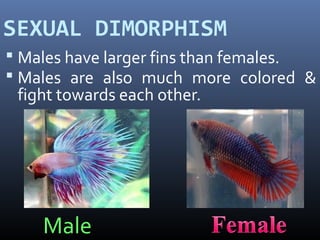
SEXUAL DIMORPHISM
 Males have larger fins than females.
 Males are also much more colored &

fight towards each other.

Male
Pre-breeding Management
 The Breeding pair:- Make sure that the male & female are relatively the

same size. Females are usually somewhat smaller than the males,but do not
try to breed a very young male/female with a much older mate. Someone
will get hurt.

 Condition the Pair:-Feed well, preferably live food (brine shrimp) & keep

their water very clean. Allow the 2 to each other for a couple of days & then
remove the female from the male’s site before placing him in the breeding
tank.

 Breeding Tank: Small tank (use 5 liter) with approxi. No more than 4-5 inches of

“conditioned” water.

 A corner sponge filter;submersile heater set at 80 F ; a plastic lid or piece of

Styrofoam cup cut for the bubblenest;& plastic or live plants so the female
can hide when needed.

 Put the male in first. Let him get used to his surroundings for about an hour

or so.
 Then introduce the female in the tank, so the male can’t get to

her right away.
 They Should show some interest in each another, & the male
should flare at female & start working on the bubble nest.
Breeding:1.
2.
3.
4.
5.
6.
7.
8.
9.

Generally male blows bubbles at the surface to form a bubble nest of
various sizes & thickness.
The male betta will flare his gills, twist his body,& spread his fins, if
interested in the female.
The female will darken in color, then curve her body back & forth.
When male & female are ready, male will “entice” the female to the nest,&
female will eventually follow.
The mating process can take 1 to 4-5 hours.
The act of spawning itself is called a “nuptial embrace", for which the male
wraps his body around the female.
Around 10-41 eggs are released during each embrace.
The male turns & releases milt into the water ,& fertilization takes place
externally.
During & after spawning, the male uses his mouth to retrieve sinking eggs
& deposit them in the bubble nest.
1. Once the female has released all of her eggs, she is

chased away from the male territory, as it is likely
that she’ll eat the eggs due to hunger & should be
taken out of the tank without disturbing the nest.
2. Henceforth, the eggs remain in the male’s care.
3. Incubation lasts for 24-36 hours, & the newlyhatched larvae remain in the nest for he next 2-3
days.
4. After absorption of yolk sac they get out of the
nest.
Fry care & Raising:
 In this first period of their lives , B. splendens fry are totally










dependent on their gills.
The labyrinth organ which allows the species to breath
atmospheric oxygen typically develops at 3-6 weeks of age.
Water should be clean during the early life stages & should be
siphoned regularly to remove debris.
While replacing the water care should be taken about the
temperature as it should be slightly equal to the previous one.
As the males get older, you will notice them becoming
aggressive with each other.
At this time males should be transferred to small jars.
Females will be okay together.
A freshwater infusoria culture can be run parallel to feed the
growing fry.
The Juveniles can reach sexual maturity at an early as 3
months.
It may take 30 weeks for them to develop any color.
Fighter Fish

Fighter Fish

  • 2.
    INRODUCTION:Also Called AsBetta , Siamese Fighting Fish ,Betta Splendens,crowntail, halfmoon,Plakat Betta but Most Popularly known as siamese Fighing Fish or Betta Splendens in India. colorful, freshwater ray-finned fish. This fish is belonging to member of gourami family(Osphronemidae). There are 28 known species of betta. The best known Betta species,however,is B.splendens, the Siamese fighting fish. Max. size in aquarium (min-max):6-8 cm(2.36-3.15 in) pH of water:-6.2-7.9 Compatibility (temperament to it’s family):Peaceful to females.
  • 3.
    Compatibility (temperament toother fish species):Peaceful in nature. Place in the aquarium:-Top levels. The way of breeding:-Spawning. Fish origin:-East India. Life Span:-2-3 years.
  • 4.
    Some Amazing Factsabout Fighting Fish  Males are more aggressive in Nature as studied by many psychologists.  Siamese fighting fish will even respond aggressively to their own reflections in a mirror.  Like many tropical fish,bettas might harass & kill small, slow fancy goldfish.  Egg & fry care is taken by male. (paternal care).
  • 5.
    Feeding: Siamese fighting fishhave upturned mouths & are primarily carnivorous surface feeders, although some vegetable matter may be eaten. In the wild, they feed on zooplanktons including crustaceans & the larvae of mosquitoes & other insects, such as flies or grasshoppers. They can be feed with floating flake food, freeze dried blood worms or frozen brine shrimp.
  • 6.
    SEXUAL DIMORPHISM  Maleshave larger fins than females.  Males are also much more colored & fight towards each other. Male
  • 7.
    Pre-breeding Management  TheBreeding pair:- Make sure that the male & female are relatively the same size. Females are usually somewhat smaller than the males,but do not try to breed a very young male/female with a much older mate. Someone will get hurt.  Condition the Pair:-Feed well, preferably live food (brine shrimp) & keep their water very clean. Allow the 2 to each other for a couple of days & then remove the female from the male’s site before placing him in the breeding tank.  Breeding Tank: Small tank (use 5 liter) with approxi. No more than 4-5 inches of “conditioned” water.  A corner sponge filter;submersile heater set at 80 F ; a plastic lid or piece of Styrofoam cup cut for the bubblenest;& plastic or live plants so the female can hide when needed.  Put the male in first. Let him get used to his surroundings for about an hour or so.
  • 8.
     Then introducethe female in the tank, so the male can’t get to her right away.  They Should show some interest in each another, & the male should flare at female & start working on the bubble nest.
  • 9.
    Breeding:1. 2. 3. 4. 5. 6. 7. 8. 9. Generally male blowsbubbles at the surface to form a bubble nest of various sizes & thickness. The male betta will flare his gills, twist his body,& spread his fins, if interested in the female. The female will darken in color, then curve her body back & forth. When male & female are ready, male will “entice” the female to the nest,& female will eventually follow. The mating process can take 1 to 4-5 hours. The act of spawning itself is called a “nuptial embrace", for which the male wraps his body around the female. Around 10-41 eggs are released during each embrace. The male turns & releases milt into the water ,& fertilization takes place externally. During & after spawning, the male uses his mouth to retrieve sinking eggs & deposit them in the bubble nest.
  • 10.
    1. Once thefemale has released all of her eggs, she is chased away from the male territory, as it is likely that she’ll eat the eggs due to hunger & should be taken out of the tank without disturbing the nest. 2. Henceforth, the eggs remain in the male’s care. 3. Incubation lasts for 24-36 hours, & the newlyhatched larvae remain in the nest for he next 2-3 days. 4. After absorption of yolk sac they get out of the nest.
  • 11.
    Fry care &Raising:  In this first period of their lives , B. splendens fry are totally          dependent on their gills. The labyrinth organ which allows the species to breath atmospheric oxygen typically develops at 3-6 weeks of age. Water should be clean during the early life stages & should be siphoned regularly to remove debris. While replacing the water care should be taken about the temperature as it should be slightly equal to the previous one. As the males get older, you will notice them becoming aggressive with each other. At this time males should be transferred to small jars. Females will be okay together. A freshwater infusoria culture can be run parallel to feed the growing fry. The Juveniles can reach sexual maturity at an early as 3 months. It may take 30 weeks for them to develop any color.

Editor's Notes