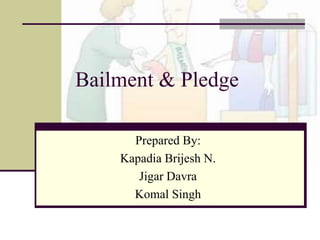
Bailment & Pledge 
Prepared By: 
Kapadia Brijesh N. 
Jigar Davra 
Komal Singh
Introduction 
 Contracts of bailment and pledge are a special 
class of contracts. These are dealt with in chapter 
ІX (Secs. 148to181) of the Indian Contract Act 
1872. 
 The contract act deals with the general principles 
underlying contracts of bailment.
Bailment 
 The word ‘bailment is derived from French word ‘ballier’ 
which means ‘to deliver’. It means any kind of ‘handing 
over.’ 
 Sec.148 defines ‘bailment’ as the delivery of goods by one 
person to another for some purpose, up on a contract, that 
they shall, when the purpose is accomplished, be returned 
or otherwise disposed of according to the direction of the 
person delivering them. 
 The person delivering the goods is called the ‘bailor’ and 
the person to whom they are delivered is called the 
‘bailee’. Eg: A delivers a piece of cloth to B ,a tailor ,to be 
stitched in to a suit. there is a contract of bailment between 
A and B.
Requisites of Bailment 
 Contract 
 A bailment is usually created by agreement 
between the bailor and the bailee 
 The agreement may be or expressed or implied. In 
some cases, bailment is implied by law as between 
a finder of goods and the owner. 
 Delivery of possession 
 A bailment necessarily involves delivery of 
possession of goods by bailor to bailee. 
 The basic features of possession are control and an 
intention to exclude others.
Requisites of Bailment 
 For some purpose 
 The delivery of goods from bailor to bailee must be 
for some purpose. 
 If goods are delivered by mistake to a person, there 
is no bailment. 
 Return of specific goods 
 It is agreed between the bailor and the bailee that as 
soon as the purpose is achieved, the goods shall be 
returned or disposed according to the directions of 
the bailor. e.g. When a piece of cloth is stitched 
into a suit.
Requisites of Bailment 
 Bailment is concerned only with goods 
 Goods as defined in Sec. 2(7) of the sale goods Act, 
1930, mean every kind of movable property other than 
money and actionable claims. 
 Other examples of bailment 
 Acceptance of goods by a transport company or railway 
for carriage [Shiv Nath v. Union of India, A.I.R (1965) 
S.C. 1666] 
 Consideration in a contract of bailment 
 In a contract of bailment, the consideration is generally 
in the form of money payment either bt the bailor or the 
bailee for example, when A gives his bicycle to B for 
repair, or when A gives his car to B on hire
Classification of Bailments 
According to the benefit derived by the parties: 
 For the exclusive benefit of the bailor 
 As delivery of some valuables to a neighbour for 
safe custody without charge 
 For the exclusive benefit of the bailee 
 As the lending of a bicycle to a friend for his use, 
without charge 
 For the mutual benefit of the bailor and the bailee 
 As the hiring of a bicycle or giving of a watch for 
repair.
Classification of Bailments 
Bailment may also be classified into: 
 Gratuitous bailment 
 It is a bailment where no consideration passes 
between the bailor and the bailee, e.g. where A 
lends a book to his friend B. 
 Non-gratuitous bailment or bailment for reward 
 It is bailment where consideration passes 
between the bailor and the bailee e.g. where 
certain goods are kept in a godown for hire,
Duties and Rights of Bailor and Bailee 
 Duties of bailor 
1. To disclose known faults 
 It is the first and foremost duty of the bailor to 
disclose known faults about the goods bailed to the 
bailee. If he does not make such disclosure, he is 
responsible for any damage caused to the bailee 
directly from such faults(Sec. 150, para 1) 
2. To bear extraordinary expenses of bailment 
 A goes out on holiday - leaves his dog with B – B 
incurred expenses on feeding the dog – A liable to 
repay B the necessary expenses incurred by him.
Duties and Rights of Bailor and Bailee 
 Duties of bailor 
3. To indemnify bailee for loss in case of premature 
termination of gratuitous bailment 
 A lends his old discarded bicycle to B gratuitously 
for 3 months – Bincurs Rs.100 on its repairs – A asks 
for return of bicycle after one month – A liable to 
compensate B for expenses incurred by him in excess 
of benefit derived by him.(Sec. 159) 
4. To receive back the goods 
 It is duty of the bailor to receive back the goods when 
the bailee returns them after the expiry of the term of 
the bailment.
Duties and Rights of Bailor and Bailee 
 Duties of bailor 
5. To indemnify the bailee 
 in case bailor has defective title to goods and not 
entitled to make bailment or receive back the goods 
or give directions in relation to them and bailee 
suffers some loss as consequence – bailor liable to 
indemnify the bailee.(Sec. 164)
Duties and Rights of Bailor and Bailee 
 Duties of bailee 
1. To take reasonable care of the goods bailed. 
 Certain goods of A were bailed with B, B 
omitted to lock u the goods, bailed, locking up 
similar goods of his own. Held he was liable 
2. Not to make any unauthorized use of goods. 
 A hires a horse in Anand from B expressly to 
march to Ahmedabad. A rides with due care, but 
marches to cuttack instead. The horse 
accidentally falls and is injured. A is liable to 
compensate B for the injury to the horse.
Duties and Rights of Bailor and Bailee 
 Duties of bailor 
3. Not to mix the goods bailed with his own goods. 
4. Not to set up an adverse title.(Sec. 117 of the 
Indian Evidence Act, 1872) 
 Bailee must hold the goods on behalf of and for 
the bailor. 
5. To return any accretion to the goods. 
 A leaves a cow in the custody of B to be taken 
care of. The cow has a calf. B is bound to deliver 
the calf as well as the cow to A. 
6. To return the goods.
Duties and Rights of Bailor and Bailee 
 Rights to bailor 
1. Enforcement of rights - Bailor can enforce by suit all the 
duties of the bailee as his rights 
2. Avoidance of contract - A lets a horse to B for his own 
riding only. B uses the horse with a carriage. A can terminate 
the bailment 
3. Return of goods lent gratuitously - Bailor can demand 
return at any time even though bailment for specified time or 
purpose – however, in case bailee suffers some loss exceeding 
the benefit derived by him, bailor has to indemnify the bailee. 
4. Compensation from a wrong-doer - If any third person 
deprives bailee use or possession of goods bailed or does 
them any injury, bailor (also the bailee) entitled to bring a suit 
against such third person for such deprivation or injury.
Duties and Rights of Bailor and Bailee 
 Rights to bailee 
1. Return of goods to one of several joint bailors - in the 
absence of any contract to the contrary. 
2. Delivery of Goods to bailor without title - if bailee acts 
in good faith, he is not responsible to the owner in 
respect of such delivery 
3. Right to apply to Court to stop delivery - if any third 
person claims the goods bailed, bailee may apply to 
Court to stop the delivery of goods and to decide the title 
to the goods. 
4. Right of action against trespassers 
5. Bailee’s lien - where lawful charges of the bailee are not 
paid, he may retain the goods (particular lien).
Law Relating to Lien 
 ‘Lien’ means the right of a person to retain possession 
of some goods belonging to another until some debt or 
claim of the person in possession is satisfied. 
 Possession is essential for exercising the right of lien, 
and in order to create a lien the possession must be 
rightful, not for a particular purpose and continuous. 
 Right of lien may arise by Statute, by express or 
implied contract, or by a general course of dealing 
between the parties in a particular trade. 
 A lien can be 1) Particular lien 2) General lien
Law Relating to Lien 
 Particular Lien : 
 A particular lien is available only against the particular 
property in respect of which the bailee has expended 
labour and skill. A bailee is entitled to a particular lien 
only e.g. A repairs B's car. B does not pay the repair 
charges. B can retain the car until payment is made. 
 General Lien : 
 A general lien is a right of one person to retain any 
property or goods which are in his possession 
belonging to another person until the promise or 
liability is discharged. General lien is available to 
bankers, factors, wharfingers, attorneys of High Court 
and policy brokers.
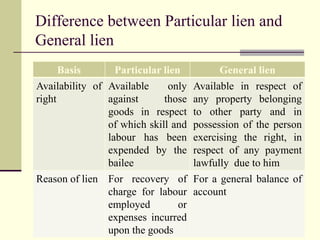
Difference between Particular lien and 
General lien 
Basis Particular lien General lien 
Availability of 
right 
Available only 
against those 
goods in respect 
of which skill and 
labour has been 
expended by the 
bailee 
Available in respect of 
any property belonging 
to other party and in 
possession of the person 
exercising the right, in 
respect of any payment 
lawfully due to him 
Reason of lien For recovery of 
charge for labour 
employed or 
expenses incurred 
upon the goods 
For a general balance of 
account
Law Relating to Lien 
 Right of bailor and bailee against wrong-doer: 
 Suit against wrong doer: when third party 
wrongfully deprives the bailee of use or possession of 
goods bailed or causes injury to the goods – bailee 
or bailor may bring a suit against the wrong-doer. 
 Apportionment of relief: whatever received by way 
of relief or compensation in any suit against wrong-doer, 
proportionate share of bailor and bailee as 
per respective interests
Finder of Goods 
 Person who comes by an article but not entitled to its 
possession - if he picks it up, he becomes a bailee 
 Rights of finder of goods : 
 Right of lien - has right of lien for expenses incurred 
on the preservation and for finding out the owner – but 
has not right to sue the owner for its recovery, as 
incurred by him voluntarily. 
 Right to sue for reward - Finder can sue for specific 
reward offered by owner for return of goods - may 
retain the goods until reward received.
Finder of Goods 
 Right of sale - finder can sell the goods 
a) If owner cannot be found with reasonable diligence, 
or 
b) If found, refuses to pay the lawful charges of finder, 
or 
c) If goods are in danger of perishing or losing the 
major part of its value, or 
d) If lawful charges of finder exceeds two-third of value 
of goods.
Finder of Goods 
 Obligations of finder of goods 
1. He Must take reasonable care of goods – if despite 
such care, if goods are destroyed, finder not 
responsible for such loss. 
2. He Must not use the goods for own purpose. 
3. He Must not mix the goods with his own. 
4. He Must try to find out the owner – if fails to do so, 
he is liable as a trespasser.
Termination of Bailment 
1. On expiry of the period - if bailment is for specific 
period. 
2. On achievement of object - if bailment is for 
specific purpose. 
3. Inconsistent use of goods - if used in manner 
inconsistent with the terms of contract. 
4. Destruction of subject matter or incapable of use 
for the purpose of bailment. 
5. Gratuitous bailment - at any time as per wishes of 
bailor.6. 
6. Death of bailor or bailee - in case of gratuitous 
bailment.
Pledge 
 Bailment of goods as security for payment of a debt or 
performance of a promise – bailor is called 
‘pledger/pawnor’ – bailee is called ‘pledgee/pawnee’ 
 Any movable property can be pledged - even a saving 
bank pass book may be pledged. 
 Delivery is necessary – may be actual or constructive 
or symbolic (likehanding over of keys of bank vault)
Difference between Bailment and Pledge 
Basis Pledge Bailment 
Purpose As security for 
performance of a 
specific promise, like 
repayment of a debt 
For any purpose 
Remedy 
on default 
After giving notice to 
pawnor, pawnee may 
sell the goods pledged. 
Bailee may either retain 
the goods or sue for his 
charges. 
Use of 
own 
purpose 
Pawnee has no right to 
use the goods pledged 
with him 
Bailee may use the 
goods bailed for own 
purpose if terms of 
bailment so provide.
Rights of pawnee 
1. Right of retainer: may retain the goods pledged 
until his dues are paid - also for interest due and 
all necessary expenses incurred by him 
for possession and preservation of goods – has 
particular lien. 
2. Right of retainer for subsequent advances: if 
pawnee lends money to same pawnor after date 
of original pledge – gets right of retainer 
over goods for subsequent advances also. 
3. Right to extraordinary expenses: can only sue 
for their recovery – no right of retainer
Rights of pawnee 
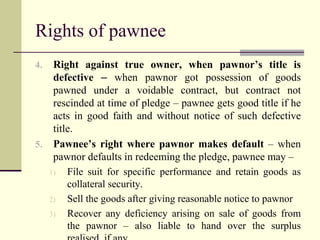
4. Right against true owner, when pawnor’s title is 
defective – when pawnor got possession of goods 
pawned under a voidable contract, but contract not 
rescinded at time of pledge – pawnee gets good title if he 
acts in good faith and without notice of such defective 
title. 
5. Pawnee’s right where pawnor makes default – when 
pawnor defaults in redeeming the pledge, pawnee may – 
1) File suit for specific performance and retain goods as 
collateral security. 
2) Sell the goods after giving reasonable notice to pawnor 
3) Recover any deficiency arising on sale of goods from 
the pawnor – also liable to hand over the surplus 
realised, if any.
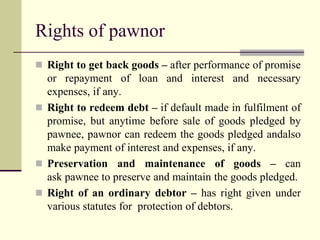
Rights of pawnor 
 Right to get back goods – after performance of promise 
or repayment of loan and interest and necessary 
expenses, if any. 
 Right to redeem debt – if default made in fulfilment of 
promise, but anytime before sale of goods pledged by 
pawnee, pawnor can redeem the goods pledged andalso 
make payment of interest and expenses, if any. 
 Preservation and maintenance of goods – can 
ask pawnee to preserve and maintain the goods pledged. 
 Right of an ordinary debtor – has right given under 
various statutes for protection of debtors.
Pledge by Non-owners 
1. Pledge by mercantile agent - in ordinary course of 
business of mercantile agent – if in possession of goods 
with consent of owner – valid onlyif pledgee acts in good 
faith and without notice of defect of agent’s title. 
2. Pledge by seller or buyer in possession after sale – 
seller left in possession after sale or buyer in possession 
before sale with consent of other party – valid only 
pledge acts in good faith and without notice of defect 
of pawnor’s title. 
3. Pledge by pawnor having limited interest - e.g. person 
having lien over the goods or a finder of goods may 
pledge them to the extent of his interest.
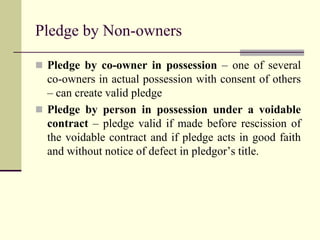
Pledge by Non-owners 
 Pledge by co-owner in possession – one of several 
co-owners in actual possession with consent of others 
– can create valid pledge 
 Pledge by person in possession under a voidable 
contract – pledge valid if made before rescission of 
the voidable contract and if pledge acts in good faith 
and without notice of defect in pledgor’s title.
Bailment & pledge

Bailment & pledge

  • 1.
    Bailment & Pledge Prepared By: Kapadia Brijesh N. Jigar Davra Komal Singh
  • 2.
    Introduction  Contractsof bailment and pledge are a special class of contracts. These are dealt with in chapter ІX (Secs. 148to181) of the Indian Contract Act 1872.  The contract act deals with the general principles underlying contracts of bailment.
  • 3.
    Bailment  Theword ‘bailment is derived from French word ‘ballier’ which means ‘to deliver’. It means any kind of ‘handing over.’  Sec.148 defines ‘bailment’ as the delivery of goods by one person to another for some purpose, up on a contract, that they shall, when the purpose is accomplished, be returned or otherwise disposed of according to the direction of the person delivering them.  The person delivering the goods is called the ‘bailor’ and the person to whom they are delivered is called the ‘bailee’. Eg: A delivers a piece of cloth to B ,a tailor ,to be stitched in to a suit. there is a contract of bailment between A and B.
  • 4.
    Requisites of Bailment  Contract  A bailment is usually created by agreement between the bailor and the bailee  The agreement may be or expressed or implied. In some cases, bailment is implied by law as between a finder of goods and the owner.  Delivery of possession  A bailment necessarily involves delivery of possession of goods by bailor to bailee.  The basic features of possession are control and an intention to exclude others.
  • 5.
    Requisites of Bailment  For some purpose  The delivery of goods from bailor to bailee must be for some purpose.  If goods are delivered by mistake to a person, there is no bailment.  Return of specific goods  It is agreed between the bailor and the bailee that as soon as the purpose is achieved, the goods shall be returned or disposed according to the directions of the bailor. e.g. When a piece of cloth is stitched into a suit.
  • 6.
    Requisites of Bailment  Bailment is concerned only with goods  Goods as defined in Sec. 2(7) of the sale goods Act, 1930, mean every kind of movable property other than money and actionable claims.  Other examples of bailment  Acceptance of goods by a transport company or railway for carriage [Shiv Nath v. Union of India, A.I.R (1965) S.C. 1666]  Consideration in a contract of bailment  In a contract of bailment, the consideration is generally in the form of money payment either bt the bailor or the bailee for example, when A gives his bicycle to B for repair, or when A gives his car to B on hire
  • 7.
    Classification of Bailments According to the benefit derived by the parties:  For the exclusive benefit of the bailor  As delivery of some valuables to a neighbour for safe custody without charge  For the exclusive benefit of the bailee  As the lending of a bicycle to a friend for his use, without charge  For the mutual benefit of the bailor and the bailee  As the hiring of a bicycle or giving of a watch for repair.
  • 8.
    Classification of Bailments Bailment may also be classified into:  Gratuitous bailment  It is a bailment where no consideration passes between the bailor and the bailee, e.g. where A lends a book to his friend B.  Non-gratuitous bailment or bailment for reward  It is bailment where consideration passes between the bailor and the bailee e.g. where certain goods are kept in a godown for hire,
  • 9.
    Duties and Rightsof Bailor and Bailee  Duties of bailor 1. To disclose known faults  It is the first and foremost duty of the bailor to disclose known faults about the goods bailed to the bailee. If he does not make such disclosure, he is responsible for any damage caused to the bailee directly from such faults(Sec. 150, para 1) 2. To bear extraordinary expenses of bailment  A goes out on holiday - leaves his dog with B – B incurred expenses on feeding the dog – A liable to repay B the necessary expenses incurred by him.
  • 10.
    Duties and Rightsof Bailor and Bailee  Duties of bailor 3. To indemnify bailee for loss in case of premature termination of gratuitous bailment  A lends his old discarded bicycle to B gratuitously for 3 months – Bincurs Rs.100 on its repairs – A asks for return of bicycle after one month – A liable to compensate B for expenses incurred by him in excess of benefit derived by him.(Sec. 159) 4. To receive back the goods  It is duty of the bailor to receive back the goods when the bailee returns them after the expiry of the term of the bailment.
  • 11.
    Duties and Rightsof Bailor and Bailee  Duties of bailor 5. To indemnify the bailee  in case bailor has defective title to goods and not entitled to make bailment or receive back the goods or give directions in relation to them and bailee suffers some loss as consequence – bailor liable to indemnify the bailee.(Sec. 164)
  • 12.
    Duties and Rightsof Bailor and Bailee  Duties of bailee 1. To take reasonable care of the goods bailed.  Certain goods of A were bailed with B, B omitted to lock u the goods, bailed, locking up similar goods of his own. Held he was liable 2. Not to make any unauthorized use of goods.  A hires a horse in Anand from B expressly to march to Ahmedabad. A rides with due care, but marches to cuttack instead. The horse accidentally falls and is injured. A is liable to compensate B for the injury to the horse.
  • 13.
    Duties and Rightsof Bailor and Bailee  Duties of bailor 3. Not to mix the goods bailed with his own goods. 4. Not to set up an adverse title.(Sec. 117 of the Indian Evidence Act, 1872)  Bailee must hold the goods on behalf of and for the bailor. 5. To return any accretion to the goods.  A leaves a cow in the custody of B to be taken care of. The cow has a calf. B is bound to deliver the calf as well as the cow to A. 6. To return the goods.
  • 14.
    Duties and Rightsof Bailor and Bailee  Rights to bailor 1. Enforcement of rights - Bailor can enforce by suit all the duties of the bailee as his rights 2. Avoidance of contract - A lets a horse to B for his own riding only. B uses the horse with a carriage. A can terminate the bailment 3. Return of goods lent gratuitously - Bailor can demand return at any time even though bailment for specified time or purpose – however, in case bailee suffers some loss exceeding the benefit derived by him, bailor has to indemnify the bailee. 4. Compensation from a wrong-doer - If any third person deprives bailee use or possession of goods bailed or does them any injury, bailor (also the bailee) entitled to bring a suit against such third person for such deprivation or injury.
  • 15.
    Duties and Rightsof Bailor and Bailee  Rights to bailee 1. Return of goods to one of several joint bailors - in the absence of any contract to the contrary. 2. Delivery of Goods to bailor without title - if bailee acts in good faith, he is not responsible to the owner in respect of such delivery 3. Right to apply to Court to stop delivery - if any third person claims the goods bailed, bailee may apply to Court to stop the delivery of goods and to decide the title to the goods. 4. Right of action against trespassers 5. Bailee’s lien - where lawful charges of the bailee are not paid, he may retain the goods (particular lien).
  • 16.
    Law Relating toLien  ‘Lien’ means the right of a person to retain possession of some goods belonging to another until some debt or claim of the person in possession is satisfied.  Possession is essential for exercising the right of lien, and in order to create a lien the possession must be rightful, not for a particular purpose and continuous.  Right of lien may arise by Statute, by express or implied contract, or by a general course of dealing between the parties in a particular trade.  A lien can be 1) Particular lien 2) General lien
  • 17.
    Law Relating toLien  Particular Lien :  A particular lien is available only against the particular property in respect of which the bailee has expended labour and skill. A bailee is entitled to a particular lien only e.g. A repairs B's car. B does not pay the repair charges. B can retain the car until payment is made.  General Lien :  A general lien is a right of one person to retain any property or goods which are in his possession belonging to another person until the promise or liability is discharged. General lien is available to bankers, factors, wharfingers, attorneys of High Court and policy brokers.
  • 18.
    Difference between Particularlien and General lien Basis Particular lien General lien Availability of right Available only against those goods in respect of which skill and labour has been expended by the bailee Available in respect of any property belonging to other party and in possession of the person exercising the right, in respect of any payment lawfully due to him Reason of lien For recovery of charge for labour employed or expenses incurred upon the goods For a general balance of account
  • 19.
    Law Relating toLien  Right of bailor and bailee against wrong-doer:  Suit against wrong doer: when third party wrongfully deprives the bailee of use or possession of goods bailed or causes injury to the goods – bailee or bailor may bring a suit against the wrong-doer.  Apportionment of relief: whatever received by way of relief or compensation in any suit against wrong-doer, proportionate share of bailor and bailee as per respective interests
  • 20.
    Finder of Goods  Person who comes by an article but not entitled to its possession - if he picks it up, he becomes a bailee  Rights of finder of goods :  Right of lien - has right of lien for expenses incurred on the preservation and for finding out the owner – but has not right to sue the owner for its recovery, as incurred by him voluntarily.  Right to sue for reward - Finder can sue for specific reward offered by owner for return of goods - may retain the goods until reward received.
  • 21.
    Finder of Goods  Right of sale - finder can sell the goods a) If owner cannot be found with reasonable diligence, or b) If found, refuses to pay the lawful charges of finder, or c) If goods are in danger of perishing or losing the major part of its value, or d) If lawful charges of finder exceeds two-third of value of goods.
  • 22.
    Finder of Goods  Obligations of finder of goods 1. He Must take reasonable care of goods – if despite such care, if goods are destroyed, finder not responsible for such loss. 2. He Must not use the goods for own purpose. 3. He Must not mix the goods with his own. 4. He Must try to find out the owner – if fails to do so, he is liable as a trespasser.
  • 23.
    Termination of Bailment 1. On expiry of the period - if bailment is for specific period. 2. On achievement of object - if bailment is for specific purpose. 3. Inconsistent use of goods - if used in manner inconsistent with the terms of contract. 4. Destruction of subject matter or incapable of use for the purpose of bailment. 5. Gratuitous bailment - at any time as per wishes of bailor.6. 6. Death of bailor or bailee - in case of gratuitous bailment.
  • 24.
    Pledge  Bailmentof goods as security for payment of a debt or performance of a promise – bailor is called ‘pledger/pawnor’ – bailee is called ‘pledgee/pawnee’  Any movable property can be pledged - even a saving bank pass book may be pledged.  Delivery is necessary – may be actual or constructive or symbolic (likehanding over of keys of bank vault)
  • 25.
    Difference between Bailmentand Pledge Basis Pledge Bailment Purpose As security for performance of a specific promise, like repayment of a debt For any purpose Remedy on default After giving notice to pawnor, pawnee may sell the goods pledged. Bailee may either retain the goods or sue for his charges. Use of own purpose Pawnee has no right to use the goods pledged with him Bailee may use the goods bailed for own purpose if terms of bailment so provide.
  • 26.
    Rights of pawnee 1. Right of retainer: may retain the goods pledged until his dues are paid - also for interest due and all necessary expenses incurred by him for possession and preservation of goods – has particular lien. 2. Right of retainer for subsequent advances: if pawnee lends money to same pawnor after date of original pledge – gets right of retainer over goods for subsequent advances also. 3. Right to extraordinary expenses: can only sue for their recovery – no right of retainer
  • 27.
    Rights of pawnee 4. Right against true owner, when pawnor’s title is defective – when pawnor got possession of goods pawned under a voidable contract, but contract not rescinded at time of pledge – pawnee gets good title if he acts in good faith and without notice of such defective title. 5. Pawnee’s right where pawnor makes default – when pawnor defaults in redeeming the pledge, pawnee may – 1) File suit for specific performance and retain goods as collateral security. 2) Sell the goods after giving reasonable notice to pawnor 3) Recover any deficiency arising on sale of goods from the pawnor – also liable to hand over the surplus realised, if any.
  • 28.
    Rights of pawnor  Right to get back goods – after performance of promise or repayment of loan and interest and necessary expenses, if any.  Right to redeem debt – if default made in fulfilment of promise, but anytime before sale of goods pledged by pawnee, pawnor can redeem the goods pledged andalso make payment of interest and expenses, if any.  Preservation and maintenance of goods – can ask pawnee to preserve and maintain the goods pledged.  Right of an ordinary debtor – has right given under various statutes for protection of debtors.
  • 29.
    Pledge by Non-owners 1. Pledge by mercantile agent - in ordinary course of business of mercantile agent – if in possession of goods with consent of owner – valid onlyif pledgee acts in good faith and without notice of defect of agent’s title. 2. Pledge by seller or buyer in possession after sale – seller left in possession after sale or buyer in possession before sale with consent of other party – valid only pledge acts in good faith and without notice of defect of pawnor’s title. 3. Pledge by pawnor having limited interest - e.g. person having lien over the goods or a finder of goods may pledge them to the extent of his interest.
  • 30.
    Pledge by Non-owners  Pledge by co-owner in possession – one of several co-owners in actual possession with consent of others – can create valid pledge  Pledge by person in possession under a voidable contract – pledge valid if made before rescission of the voidable contract and if pledge acts in good faith and without notice of defect in pledgor’s title.