SEED PRODUCTION OF SEA
BREAMAND SNAPPER
PRESENTED BY- Tandel Riya V.
Introduction
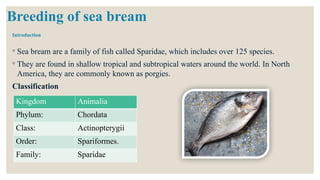
◦ Sea bream are a family of fish called Sparidae, which includes over 125 species.
◦ They are found in shallow tropical and subtropical waters around the world. In North
America, they are commonly known as porgies.
Classification
Kingdom Animalia
Phylum: Chordata
Class: Actinopterygii
Order: Spariformes.
Family: Sparidae
Breeding of sea bream
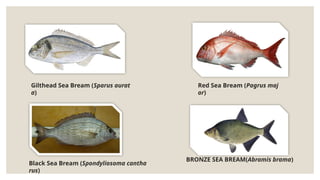
Gilthead Sea Bream (Sparus aurat
a)
Red Sea Bream (Pagrus maj
or)
Black Sea Bream (Spondyliosoma cantha
rus)
BRONZE SEA BREAM(Abramis brama)
Indian Black Sea Bream
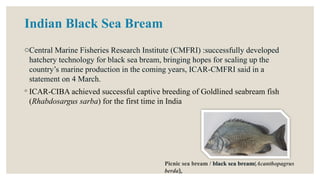
oCentral Marine Fisheries Research Institute (CMFRI) :successfully developed
hatchery technology for black sea bream, bringing hopes for scaling up the
country’s marine production in the coming years, ICAR-CMFRI said in a
statement on 4 March.
◦ ICAR-CIBA achieved successful captive breeding of Goldlined seabream fish
(Rhabdosargus sarba) for the first time in India
Picnic sea bream / black sea bream(Acanthopagrus
berda),
Habitat and biology of Sea breams
◦ Common habitats include the Mediterranean, Southern Europe, the Atlantic, rivers,
and seagrass areas.
◦ They are omnivores, eating algae, shrimp, crabs, worms, small fish, and plankton.
◦ In the wild, they can live up to 20 years, but often live 2-11 years due to fishing
pressures.
◦ Many sea breams start life as males and change to females as they age.
◦ Sea breams are medium-sized, ranging from 30-70 cm.
◦ They have a deep-bodied structure and can change color rapidly
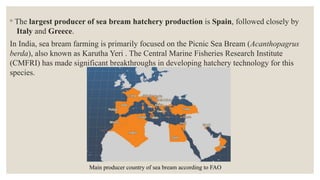
◦ The largest producer of sea bream hatchery production is Spain, followed closely by
Italy and Greece.
In India, sea bream farming is primarily focused on the Picnic Sea Bream (Acanthopagrus
berda), also known as Karutha Yeri . The Central Marine Fisheries Research Institute
(CMFRI) has made significant breakthroughs in developing hatchery technology for this
species.
Main producer country of sea bream according to FAO
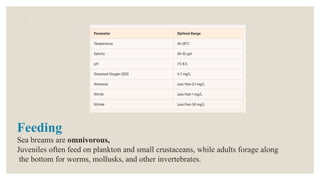
Water quality parameters
Feeding
Sea breams are omnivorous,
Juveniles often feed on plankton and small crustaceans, while adults forage along
the bottom for worms, mollusks, and other invertebrates.
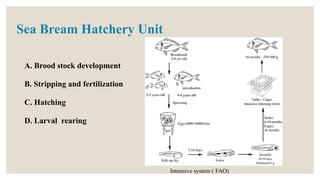
Sea Bream Hatchery Unit
A. Brood stock development
B. Stripping and fertilization
C. Hatching
D. Larval rearing
Intensive system ( FAO)
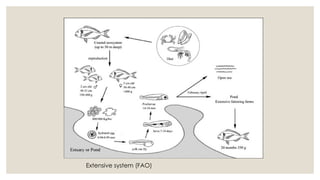
Extensive system (FAO)
• Selection Of Spawner
◦ sea bream and black sea bream, are protandrous hermaphrodites,
• Size and Age: Males are usually smaller and more slender, while females are larger a
nd rounder.
Female sea bream have a noticeable white patch on their sides above the vent.
male 2 years and turn to female after 2 year
• Sex Ratio – 1:1
• Fecundity : 2-3 million eggs in proportion to their body weight. (
Sea Bream Breeding - Prof. Dr. G. Atilla Alpbaz)
Induced spawning
Hormonal injection
oOn sea bream, HCG is used at 800-1500 IU/kg and GnRH at 1-20 mg/kg.
oIn females, a single injection of 7.5 mg/
kg GnRH induces ovulation in over 80%.
oOvulation starts 48-72 hours after hormone administration.
Stripping
• Eggs are stripped on to a clean basin and mixed with milt from more than one
male to ensure better fertilization and reduce inbreeding.
• Fertilized eggs can be transported after 20 minutes and up to 48 hours after
fertilization, but then not until the eyed-stage
Collection and incubation of egg
• fertilized eggs range in size - 0.8-1 mm.
• float in the water column (pelagic)
• transparent.
◦ The spawning tanks are supplied with continuous flow of seawater.
◦ The overflowing water carry the eggs into a small tank (2 × 0.4 × 0.3 m) containing a
plankton net (200µ mesh).
◦ Fertilized eggs are then transferred to incubation tank at the density of 100 eggs/liter.
◦ The eggs will hatch at about 17-18 hours at 26-28°C after spawning.
Larval rearing
◦ The rearing tanks are commonly fabricated from plastic, fiberglass, wood or concrete.
◦ rectangular in shape and ranges from 8-10 tons (7 x 1.2 x 1m or 10 × 1.5 x 1m).
◦ The usual stocking density for newly-hatched larvae in rearing tank is between 50-
100 larvae/liter
◦ Feed unicellular algae. And pre larva stage feed artemia or copepod.
Post larva stage ( 6 mm in total length)
◦ Transferred net cages installed at sea.
◦ Post larvae are cultured to fry stage (20-30 mm total length) in the net cages
for about 10-40days.
◦ Initial density of post larvae in the net cages is about 2000/m3
.
◦ Feeding with Braohionus plieatilisand Artemia salinais preferable at the early stage of
the net cages.But the main feed used during the net cage stage is trash shrimp and fish
Introduction
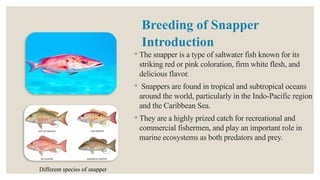
◦ The snapper is a type of saltwater fish known for its
striking red or pink coloration, firm white flesh, and
delicious flavor.
◦ Snappers are found in tropical and subtropical oceans
around the world, particularly in the Indo-Pacific region
and the Caribbean Sea.
◦ They are a highly prized catch for recreational and
commercial fishermen, and play an important role in
marine ecosystems as both predators and prey.
Different species of snapper
Breeding of Snapper
Taxonomical Classification
Kingdom: Animalia
Phylum Chordata
Class Actinopterygii
Order Perciformes
Family Lutjanidae
Genus Lutjanus
The Lutjanidae family includes around 113 species of fish, most of which are marine but
some can be found in estuaries. Snappers are predatory fish that are commonly found in
tropical and subtropical reefs and mangrove forests. The Lutjanus genus is the largest in
the family, with 67 species.
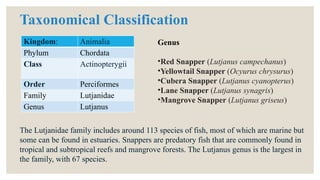
Genus
•Red Snapper (Lutjanus campechanus)
•Yellowtail Snapper (Ocyurus chrysurus)
•Cubera Snapper (Lutjanus cyanopterus)
•Lane Snapper (Lutjanus synagris)
•Mangrove Snapper (Lutjanus griseus)
In india
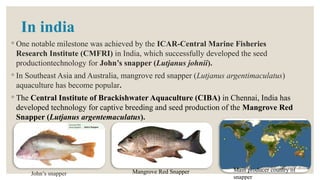
◦ One notable milestone was achieved by the ICAR-Central Marine Fisheries
Research Institute (CMFRI) in India, which successfully developed the seed
productiontechnology for John’s snapper (Lutjanus johnii).
◦ In Southeast Asia and Australia, mangrove red snapper (Lutjanus argentimaculatus)
aquaculture has become popular.
◦ The Central Institute of Brackishwater Aquaculture (CIBA) in Chennai, India has
developed technology for captive breeding and seed production of the Mangrove Red
Snapper (Lutjanus argentemaculatus).
Mangrove Red Snapper Main producer country of
snapper
John’s snapper
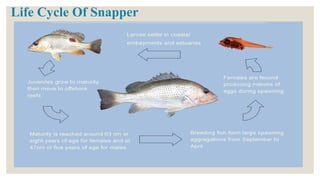
Life Cycle Of Snapper
Reproductive biology
Sexual diamorphonism
• Size: Males are often larger than females.
• Coloration: Males typically have more vibrant and distinct color patterns compared to f
emales.
• Body Shape: Males may have more pronounced body features, such as nuptial tubercle
s (small bumps) during the breeding season.
• Fin Length: Males often have longer fins than females.
Age at First sexual maturity
Male – 1.5-2 year (129.5 mm)
Female – 2 year (130.3 mm)
Induced spawning
Hormonal injection
◦ To induce spawning, inject mature red snapper with a combination of human chorionic gonadotropin
(HCG) and salmon pituitary hormone (SPH).
◦ The first injection -10 mg of SPH per kg of body weight 1,000–10,000 IU of HCG per kg of body weight.
◦ The second injection should contain the same amount of SPH, but 2,000–20,000 IU of HCG per kg of
body weight.
◦ Inject the fish a few centimeters below the dorsal fin.
◦ And striping bohth male and female
Egg Collection And Egg Hatching
• Egg collection: Strip the eggs from the fish 24 hours after the second injection. Smaller fish, weighing
0.90–1.36 kg, are easier to handle and produce 100,000–300,000 eggs each. The fecundity on an average
was 0.92 million eggs per female. (CMFRI)
• Egg hatching: About 30–50% of the eggs will hatch.
Larval Rearing
1.Day 0: Tanks filled with seawater; inoculated with Isochrysis sp. and Rhodomonas sp. (5
-10 x 105 cells/ml).
2.Day 0: Adult Acartia sp. added (30-60 nos./l).
3.Day 2: Larvae stocked (1-2 nos./l).
4.Day 3-4: Larvae feed on copepods; rotifers added to the tank.
5.Day 10: Start daily water exchange (10% initially, up to 100% by day 30).
6.Day 12-30: Artemia nauplii added (0.5 nos./l).
7.Day 25: Start weaning larvae onto artificial feed (3-7 days duration).
8.Day 35-40: Fish transferred to nursery tanks post-metamorphosis.
(CMFRI)
References
◦ https://eprints.cmfri.org.in/14966/1/Lutjanus%20johnii.pdf
◦ https://ciba.icar.gov.in/?post_type=edmento_events&p=7661
◦ Sea Bream Breeding - Prof. Dr. G. Atilla Alpbaz)
◦ https://www.slideshare.net/slideshow/seabream-culture-and-breeding/52670702
Conclusion
◦ Snapper breeding now efficiently produces highquality fry with careful
broodstock selection, controlled environments, and precise hormone and feed managem
ent, enhancing aquaculture productivity.
◦ Improved bream breeding techniques ensure efficient, high-
quality fry production through healthy broodstock, controlled environments, and precis
e hormone and feed management, boosting sustainable aquaculture.
sea bream and snapper.pptx,,,,,,,,,,,,,,

sea bream and snapper.pptx,,,,,,,,,,,,,,

  • 1.
    SEED PRODUCTION OFSEA BREAMAND SNAPPER PRESENTED BY- Tandel Riya V.
  • 2.
    Introduction ◦ Sea breamare a family of fish called Sparidae, which includes over 125 species. ◦ They are found in shallow tropical and subtropical waters around the world. In North America, they are commonly known as porgies. Classification Kingdom Animalia Phylum: Chordata Class: Actinopterygii Order: Spariformes. Family: Sparidae Breeding of sea bream
  • 3.
    Gilthead Sea Bream(Sparus aurat a) Red Sea Bream (Pagrus maj or) Black Sea Bream (Spondyliosoma cantha rus) BRONZE SEA BREAM(Abramis brama)
  • 4.
    Indian Black SeaBream oCentral Marine Fisheries Research Institute (CMFRI) :successfully developed hatchery technology for black sea bream, bringing hopes for scaling up the country’s marine production in the coming years, ICAR-CMFRI said in a statement on 4 March. ◦ ICAR-CIBA achieved successful captive breeding of Goldlined seabream fish (Rhabdosargus sarba) for the first time in India Picnic sea bream / black sea bream(Acanthopagrus berda),
  • 5.
    Habitat and biologyof Sea breams ◦ Common habitats include the Mediterranean, Southern Europe, the Atlantic, rivers, and seagrass areas. ◦ They are omnivores, eating algae, shrimp, crabs, worms, small fish, and plankton. ◦ In the wild, they can live up to 20 years, but often live 2-11 years due to fishing pressures. ◦ Many sea breams start life as males and change to females as they age. ◦ Sea breams are medium-sized, ranging from 30-70 cm. ◦ They have a deep-bodied structure and can change color rapidly
  • 6.
    ◦ The largestproducer of sea bream hatchery production is Spain, followed closely by Italy and Greece. In India, sea bream farming is primarily focused on the Picnic Sea Bream (Acanthopagrus berda), also known as Karutha Yeri . The Central Marine Fisheries Research Institute (CMFRI) has made significant breakthroughs in developing hatchery technology for this species. Main producer country of sea bream according to FAO
  • 7.
    Water quality parameters Feeding Seabreams are omnivorous, Juveniles often feed on plankton and small crustaceans, while adults forage along the bottom for worms, mollusks, and other invertebrates.
  • 8.
    Sea Bream HatcheryUnit A. Brood stock development B. Stripping and fertilization C. Hatching D. Larval rearing Intensive system ( FAO)
  • 9.
  • 10.
    • Selection OfSpawner ◦ sea bream and black sea bream, are protandrous hermaphrodites, • Size and Age: Males are usually smaller and more slender, while females are larger a nd rounder. Female sea bream have a noticeable white patch on their sides above the vent. male 2 years and turn to female after 2 year • Sex Ratio – 1:1 • Fecundity : 2-3 million eggs in proportion to their body weight. ( Sea Bream Breeding - Prof. Dr. G. Atilla Alpbaz)
  • 11.
    Induced spawning Hormonal injection oOnsea bream, HCG is used at 800-1500 IU/kg and GnRH at 1-20 mg/kg. oIn females, a single injection of 7.5 mg/ kg GnRH induces ovulation in over 80%. oOvulation starts 48-72 hours after hormone administration. Stripping • Eggs are stripped on to a clean basin and mixed with milt from more than one male to ensure better fertilization and reduce inbreeding. • Fertilized eggs can be transported after 20 minutes and up to 48 hours after fertilization, but then not until the eyed-stage
  • 12.
    Collection and incubationof egg • fertilized eggs range in size - 0.8-1 mm. • float in the water column (pelagic) • transparent. ◦ The spawning tanks are supplied with continuous flow of seawater. ◦ The overflowing water carry the eggs into a small tank (2 × 0.4 × 0.3 m) containing a plankton net (200µ mesh). ◦ Fertilized eggs are then transferred to incubation tank at the density of 100 eggs/liter. ◦ The eggs will hatch at about 17-18 hours at 26-28°C after spawning.
  • 13.
    Larval rearing ◦ Therearing tanks are commonly fabricated from plastic, fiberglass, wood or concrete. ◦ rectangular in shape and ranges from 8-10 tons (7 x 1.2 x 1m or 10 × 1.5 x 1m). ◦ The usual stocking density for newly-hatched larvae in rearing tank is between 50- 100 larvae/liter ◦ Feed unicellular algae. And pre larva stage feed artemia or copepod. Post larva stage ( 6 mm in total length) ◦ Transferred net cages installed at sea. ◦ Post larvae are cultured to fry stage (20-30 mm total length) in the net cages for about 10-40days. ◦ Initial density of post larvae in the net cages is about 2000/m3 . ◦ Feeding with Braohionus plieatilisand Artemia salinais preferable at the early stage of the net cages.But the main feed used during the net cage stage is trash shrimp and fish
  • 14.
    Introduction ◦ The snapperis a type of saltwater fish known for its striking red or pink coloration, firm white flesh, and delicious flavor. ◦ Snappers are found in tropical and subtropical oceans around the world, particularly in the Indo-Pacific region and the Caribbean Sea. ◦ They are a highly prized catch for recreational and commercial fishermen, and play an important role in marine ecosystems as both predators and prey. Different species of snapper Breeding of Snapper
  • 15.
    Taxonomical Classification Kingdom: Animalia PhylumChordata Class Actinopterygii Order Perciformes Family Lutjanidae Genus Lutjanus The Lutjanidae family includes around 113 species of fish, most of which are marine but some can be found in estuaries. Snappers are predatory fish that are commonly found in tropical and subtropical reefs and mangrove forests. The Lutjanus genus is the largest in the family, with 67 species. Genus •Red Snapper (Lutjanus campechanus) •Yellowtail Snapper (Ocyurus chrysurus) •Cubera Snapper (Lutjanus cyanopterus) •Lane Snapper (Lutjanus synagris) •Mangrove Snapper (Lutjanus griseus)
  • 16.
    In india ◦ Onenotable milestone was achieved by the ICAR-Central Marine Fisheries Research Institute (CMFRI) in India, which successfully developed the seed productiontechnology for John’s snapper (Lutjanus johnii). ◦ In Southeast Asia and Australia, mangrove red snapper (Lutjanus argentimaculatus) aquaculture has become popular. ◦ The Central Institute of Brackishwater Aquaculture (CIBA) in Chennai, India has developed technology for captive breeding and seed production of the Mangrove Red Snapper (Lutjanus argentemaculatus). Mangrove Red Snapper Main producer country of snapper John’s snapper
  • 17.
  • 18.
    Reproductive biology Sexual diamorphonism •Size: Males are often larger than females. • Coloration: Males typically have more vibrant and distinct color patterns compared to f emales. • Body Shape: Males may have more pronounced body features, such as nuptial tubercle s (small bumps) during the breeding season. • Fin Length: Males often have longer fins than females. Age at First sexual maturity Male – 1.5-2 year (129.5 mm) Female – 2 year (130.3 mm)
  • 19.
    Induced spawning Hormonal injection ◦To induce spawning, inject mature red snapper with a combination of human chorionic gonadotropin (HCG) and salmon pituitary hormone (SPH). ◦ The first injection -10 mg of SPH per kg of body weight 1,000–10,000 IU of HCG per kg of body weight. ◦ The second injection should contain the same amount of SPH, but 2,000–20,000 IU of HCG per kg of body weight. ◦ Inject the fish a few centimeters below the dorsal fin. ◦ And striping bohth male and female Egg Collection And Egg Hatching • Egg collection: Strip the eggs from the fish 24 hours after the second injection. Smaller fish, weighing 0.90–1.36 kg, are easier to handle and produce 100,000–300,000 eggs each. The fecundity on an average was 0.92 million eggs per female. (CMFRI) • Egg hatching: About 30–50% of the eggs will hatch.
  • 20.
    Larval Rearing 1.Day 0:Tanks filled with seawater; inoculated with Isochrysis sp. and Rhodomonas sp. (5 -10 x 105 cells/ml). 2.Day 0: Adult Acartia sp. added (30-60 nos./l). 3.Day 2: Larvae stocked (1-2 nos./l). 4.Day 3-4: Larvae feed on copepods; rotifers added to the tank. 5.Day 10: Start daily water exchange (10% initially, up to 100% by day 30). 6.Day 12-30: Artemia nauplii added (0.5 nos./l). 7.Day 25: Start weaning larvae onto artificial feed (3-7 days duration). 8.Day 35-40: Fish transferred to nursery tanks post-metamorphosis. (CMFRI)
  • 21.
    References ◦ https://eprints.cmfri.org.in/14966/1/Lutjanus%20johnii.pdf ◦ https://ciba.icar.gov.in/?post_type=edmento_events&p=7661 ◦Sea Bream Breeding - Prof. Dr. G. Atilla Alpbaz) ◦ https://www.slideshare.net/slideshow/seabream-culture-and-breeding/52670702
  • 22.
    Conclusion ◦ Snapper breedingnow efficiently produces highquality fry with careful broodstock selection, controlled environments, and precise hormone and feed managem ent, enhancing aquaculture productivity. ◦ Improved bream breeding techniques ensure efficient, high- quality fry production through healthy broodstock, controlled environments, and precis e hormone and feed management, boosting sustainable aquaculture.