Subacromial Impingement	Syndrome	
Subacromial Decompression	
Aaron	Venouziou
Orthopaedic Surgeon
St.	Luke’s	Hospital
Thessaloniki
Introduction
ü Ill-defined	term	for	a	variety	shoulder	disorders	that	
manifest	as	antero-lateral	shoulder	pain
ü Nonspecific	diagnosis
ü Numerous	types	of	shoulder	impingement	
ü Only	a	small	proportion	of	these	necessitate	
decompression
Etiology	
üExtrinsic
– Primary	Impingement	
• Oulet stenosis
– Secondary	Impingement
• Instability	
üIntrinsic
– Degeneration
• Aging
• Avascularity
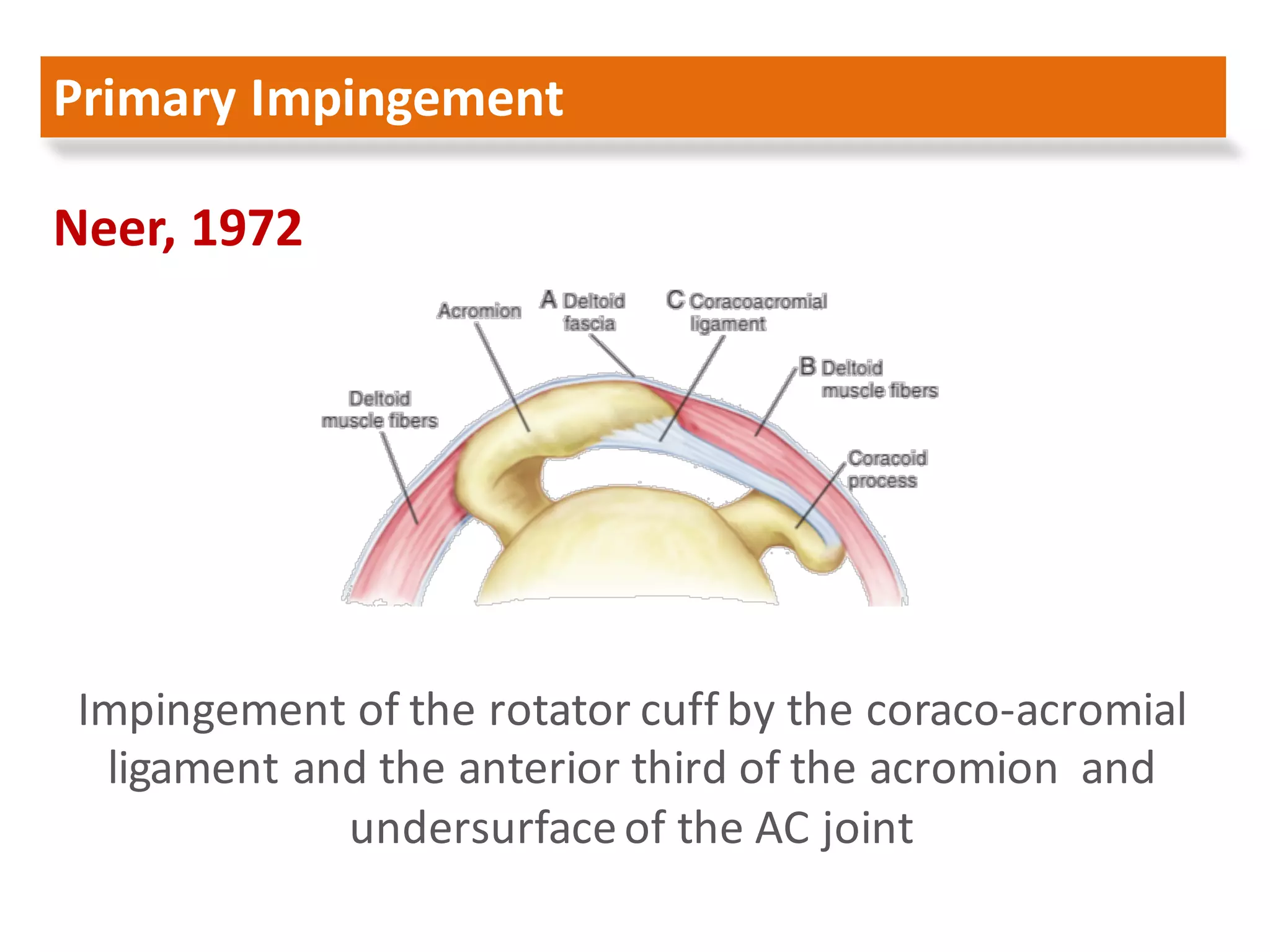
Neer,	1972
Impingement	of	the	rotator	cuff	by	the	coraco-acromial	
ligament	and	the	anterior	third	of	the	acromion		and	
undersurface	of	the	AC	joint
Primary	Impingement
ü Spurs	and	bony	changes	on	the	undersurface	of	the	
anterior	1/3	of	the	acromion	correlated	with	rotator	
cuff	tears
ü 90%	of	pts	treated	by	acromioplasty had	significant	
pain	reduction,	full	use	of	shoulder,	<20o of	overhead	
limitation,	and	at	least	75%	normal	strength
ü RC	injury	is	a	result	of	primary	impingement
Primary	Impingement
Neer,	1972
ü Popularized	the	theory	of	“extrinsic”	impingement,	
stating	that	acromial	changes	were	primary	as	
opposed	to	secondary	changes—causing	
impingement
ü 70%	of	full-thickness	RC	tears
in	type	III	acromion
ü Never	been	proven	or	peer	reviewed
Primary	Impingement
Bigliani,	1986
üGlenohumeral Instability
– Common	in	the	overhead	throwing	athlete
– Cocking	=>	strain	on	the	static	stabilizers	occur
• Early	phase	(45º	abd,	ER)	- MGHL
• Late	phase	(90º	abd,	ER)	– IGHL
ü Anterior	soft	tissue	deficiency
ü Anterior	translation	of	humeral	head
Secondary	Impingement
Jobe and	Kvitne,	1989
üInternal	Impingement
– Common	in	the	overhead	throwing	athlete
– Cocking	=>	tension	on	the	posterosuperior
articular	surface	of	the	supraspinatus	and	
compression	between	the	humeral	head	and	
adjacent	glenoid	rim
• posterior	superior	synovitis	
• partial	under-surface	tears
Secondary	Impingement
Walch,	1992
üGlenohumeral internal	rotation	deficit	(GIRD)
– Common	in	the	overhead	throwing	athlete
– Posteroinferior capsular	contracture
– Posterosuperior humeral	head	translation
– SLAP
– Internal	impingement
Secondary	Impingement
Morgan	and	Rajan,	2004
üScapulothoracic Dyskinesis
– Functional	scapular	instability
– Increased		distance	from	spinous	process	to	
medial	border	of	the	scapula
– Loss	of	acromial	elevation
Secondary	Impingement
ü Tendon	degeneration	(and	fibers	failure)		is	the	most	
important	etiologic	factor	of	symptoms	(and	cuff	
tears)	in	the	subacromial space	and	not	the	
impingement	syndrome
ü Partial	thickness	tears	are	most	often	on	the	articular	
side
ü Articular	side	of	cuff	is	hypovascularized
Intrinsic	Factors
Ozaky 1988,	Ogata	&	Uhthoff 1990
üThe	main	problem	is	tendon	degeneration	and	
weakness
Intrinsic	Factors
Burkhart,	1995
Neer impingement	test
Clinical	AssessmentLOW	SPECIFICITY
Hawkin’s impingement	test
Lidocaine	injection	test
Always	evaluate	the	AC	joint
Palpation Cross	Arm	Test Injection
Imaging	Assessment	
X-rays	
Axillary Outlet
Zanca
MRI
CT	arthrogram
Treatment
Goal	to	restore	the	health	of	Rotator	Cuff
Restoration	of	neuromuscular	balance	of	the	
shoulder	girdle	and	the	synchronous	motion	of	the	
3	joints	about	the	shoulder	to	prevent	subluxation
Treatment
üModification	of	activity	with	cessation	of	
overhead	activity
üNSAIDS	or	subacromial injection
üPhysical	therapy:	stretching/strengthening
üAcute	injury	with	profound	strength	loss:	MRI	
of	rotator	cuff
Non-operative	Treatment
üFailed	conservative	treatment	>	6	months
üAcromial	prominence/spurs/sclerosis,	+	
impingement	sign,	arc	of	pain,	relief	from	
subacromial injection
üNo	evidence	of	RCT			(+/- MRI)
üArthroscopic	subacromial decompression
Surgical	Treatment
Historical background
Ellman,	1987
ü Technically	demanding	
procedure
ü If	a	cuff	tear	is	present	you	
cannot	repair	it
Surgical	Technique	
Patient	Setup
Beach	chair	position
Bony	Landmarks
Acromion
ACJ
Coracoid
Posterior	portal
Same	skin	
incision	for	GHJ	
arthroscopy	
üRedirect	cannula
üAim	and	advance	the	scope	
beneath	the	anteriolateral
corner
Room	with	a	view
ü4	Walls,	floor,	
ceiling
üCA	ligament	is	
landmark
Clear	visualization
Lateral	portal
ü 3	cm	lateral	to	acromion
ü Spinal	needle
ü Triangulation
ü Underneath	the	anterior	
half	of	the	acromion
ü Parallel	to	it
Skin	marking	bisects	mid	AC
Introduce	a	power	shaver	through	the	lateral
portal	and	perform	a	bursectomy
Expose	undersurface	
acromion
Release	C-A	ligament
Define	anterior	&	lateral	
edges
ü From	the	undersurface	
of	the	acromion
ü From	the	distal	clavicle
ü Excise	the	C-A	ligament
Use	an	electrocautery to	remove	soft	tissues
Perform	a	“provisional”	anterior	
acromioplasty
Perform	final	acromioplasty using	the	
“Cutting	Block” technique
Flatten	acromion	from	posterior	to	anterior
Watch	the	angle	!
ΟΚ ΟΚ
Check	acromioplasty in	both	planes
Post. Ant. Med. Lat.
üCA	ligament	released?
üAcromion	flat	in	A-P	plane?
üAcromion	flat	in	M-L	plane?
üAC	joint	inspected?
üRotator	cuff	inspected?
End-point	Assessment
• Scope	posterior	/	
instruments	lateral
– Exposure
Distal	Clavicle	Resection
• Scope	lateral	/	
instruments	anterior
– Best	access	to	distal	
clavicle
– 70° arthroscope
– 8-10	mm	excision	of	
the	distal	clavicle
Distal	Clavicle	Resection
What	about	efficacy	of	the	technique?
What	about	efficacy	of	the	technique?	
Odenbring et	al	Arthroscopy	2008
Long-term	Outcomes	of	Arthroscopic	Acromioplasty for	
Chronic	Shoulder	Impingement	Syndrome:	A	Prospective	
Cohort	Study	With	a	Minimum	of	12	Years'	Follow-up
31	patients	
12-14	years	follow-up
29	patients	(open	acromioplasty)	as	a	control	group
No	full	thickness	cuff	tears
Arth group:	Revision	acromioplasty in	6	patients
Open	group:	Revision	acromioplasty in	3	patients
Good	excellent	results	in	77%
Better	results	with	arthroscopic	acromioplasty
Odenbring	et	al	Arthroscopy	2008
Arthroscopic	acromioplasty:	a	6- to	10-year	follow-up
83	patients,	mean	follow-up	8.3	years
Stephens	et	al.	Arthroscopy	1998
“Overall,	81%	of	patients	in	our	series	had	good	to	
excellent	results	after	6	to	10	years”.	
“To	optimize	the	indications	for	the	procedure,	other	
causes	of	impingement,	such	as	occult	instability	and	
degenerative	joint	disease,	should	be	ruled	out”.
Long-term	Clinical	and	Ultrasound	Evaluation	After	
Arthroscopic	Acromioplasty in	Patients	With	Partial	
Rotator	Cuff	Tears
Minimum	5	year	follow-up
26	patients
10	out	of	26	patients	developed	full	thickness	tear
“Arthroscopic	acromioplasty and	rotator	cuff	
debridement	in	patients	with	partial	tears	does	not	
protect	the	rotator	cuff	from	undergoing	further	
degeneration.”
Kartus et	al.	Arthroscopy	2007
The	Role	of	Subacromial Decompression	in	Patients	
Undergoing	Arthroscopic	Repair	of	Full-Thickness	Tears	of	
the	Rotator	Cuff:	A	Systematic	Review	and	Meta-analysis
Chahal et	al.	Arthroscopy	2012	
“On	the	basis	of	the	currently	available	literature,	
there	is	no	statistically	significant	difference	in	
subjective	outcome	after	arthroscopic	rotator	cuff	
repair	with	or	without	acromioplasty at	intermediate	
follow-up.”
Is	acromioplasty necessary	in	the	setting	of	full-thickness	
rotator	cuff	tears?	A	systematic	review.
• 354	patients:	SAD	and	Scope	Cuff	Repair
• 4	Studies:	2	Level	I	and	2	Level	II
• Conlusions:
– “does	not	support	the	routine	use	of	partial	
acromioplasty or	CA	ligament	release	in	the	
surgical	treatment	of	rotator	cuff	disease”
– “in	some	instances,	partial	acromioplasty and	
release	of	the	CA	ligament	can	result	in	anterior	
escape	and	worsening	symptoms”
Familiari et	al.	J	Orthop Traumatol 2012
“Functional	outcome	of	patients	with	calcific	
tendonitis	after	arthroscopic	bursectomy and	
debridement	of	the	calcific	deposit	is	not	influenced	if	
performed	in	combination	with	or	without	a	
subacromial decompression.”
Clement	et	al.	Arthroscopy	2015	(September)	
Short-Term	Outcome	After	Arthroscopic	Bursectomy
Debridement	of	Rotator	Cuff	Calcific	Tendonopathy With	
and	Without	Subacromial Decompression:	A Prospective	
Randomized	Controlled	Trial
13	MONTHS	FOLLOW-UP
“The	emphasis	of	treatment	is	shifting	from	that	of	
decompression	to	restoring	the	health	of	the	rotator	cuff”
F.	Fu,	1991
üFailed	conservative	treatment	>	6	months
üAcromial	prominence/spurs/sclerosis,	+	
impingement	sign,	arc	of	pain,	relief	from	
subacromial injection
üNo	evidence	of	RCT			(+/- MRI)
üArthroscopic	subacromial decompression
Surgical	Treatment

Shoulder impingement syndrome larissa 2016