
Prof. Gilder Dávila República Bolivariana de  Venezuela Ministerio del Poder Popular para la Educación L.B. “Gustavo H. Machado” Caracas-Catia. Telefax: (0212) 8 73 03 21
Have you ever heard about passive causative?
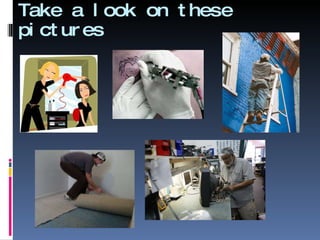
Take a look on these pictures
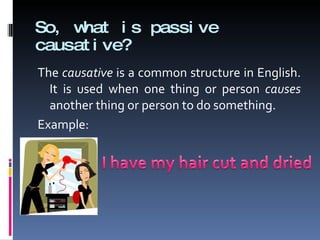
So, what is passive causative? The  causative  is a common structure in English. It is used when one thing or person  causes  another thing or person to do something.  Example:
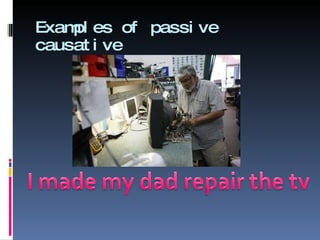
Examples of passive causative
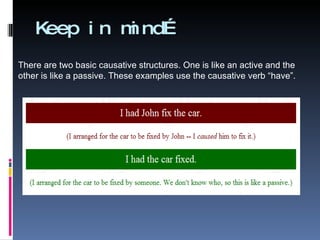
Keep in mind… There are two basic causative structures. One is like an active and the other is like a passive. These examples use the causative verb “have”.
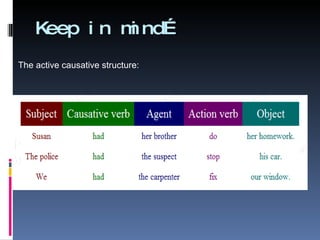
Keep in mind… The active causative structure:
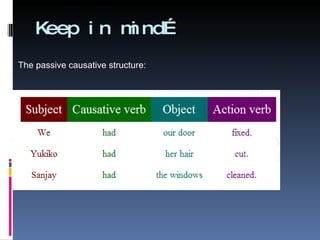
Keep in mind… The passive causative structure:
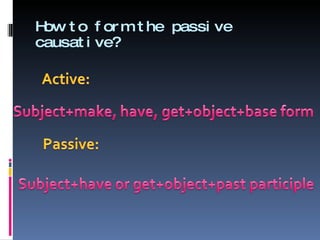
How to form the passive causative?
References Web site: BBC World Service and 410grammar respectively. http://www.bbc.co.uk/worldservice/learningenglish/radio/specials/1535_gramchallenge20/ http://web2.uvcs.uvic.ca/elc/studyzone/410/grammar/caus.htm

Passive Causative

  • 1.
    Prof. Gilder DávilaRepública Bolivariana de Venezuela Ministerio del Poder Popular para la Educación L.B. “Gustavo H. Machado” Caracas-Catia. Telefax: (0212) 8 73 03 21
  • 2.
    Have you everheard about passive causative?
  • 3.
    Take a lookon these pictures
  • 4.
    So, what ispassive causative? The causative is a common structure in English. It is used when one thing or person causes another thing or person to do something. Example:
  • 5.
  • 6.
    Keep in mind…There are two basic causative structures. One is like an active and the other is like a passive. These examples use the causative verb “have”.
  • 7.
    Keep in mind…The active causative structure:
  • 8.
    Keep in mind…The passive causative structure:
  • 9.
    How to formthe passive causative?
  • 10.
    References Web site:BBC World Service and 410grammar respectively. http://www.bbc.co.uk/worldservice/learningenglish/radio/specials/1535_gramchallenge20/ http://web2.uvcs.uvic.ca/elc/studyzone/410/grammar/caus.htm