B Y : M S . V E A - T R I S H S A N T O S
Being PROACTIVE
• Initiate change
rather than reacting to
events
• Planning ahead and
anticipating problems
• Can help eliminate
problems before they
appear
How to live a PROACTIVE
LIFE?
Using your
PERSONAL
POWER
How to live a PROACTIVE
LIFE?
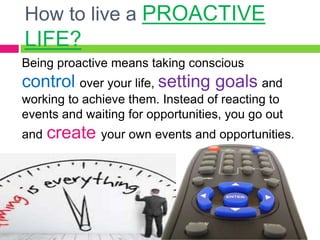
Being proactive means taking conscious
control over your life, setting goals and
working to achieve them. Instead of reacting to
events and waiting for opportunities, you go out
and create your own events and opportunities.
How to live a PROACTIVE
LIFE?
Being proactive means
that instead of merely
reacting to events as they
happen, you consciously
engineer your own
events.
IS THE
OPPOSITE OF
BEING PROACTIVE
Being REACTIVE
Being REACTIVE
IT MEANS BEING
OUT OF TOUCH
WITH THEIR CORE
VALUES
Being REACTIVE
When you are
reactive, you can
explode any
minute. Things
happen and they
“catch you off
guard”. You aren’t
ready for things that
might happen, you
deal with things
when they happen
instead of being
prepared.
SAMPLE STATEMENTS
REACTIVE PROACTIVE
Being REACTIVE. . .
BENEFITS OF A
POSITIVE
ATTITUDE
BENEFITS OF A POSITIVE
ATTITUDE
SUPERIOR
HEALTH
BENEFITS OF A POSITIVE
ATTITUDE
GREATER
ACHIEVEMENT
BENEFITS OF A POSITIVE
ATTITUDE
PERSISTEN
CE
BENEFITS OF A POSITIVE
ATTITUDE
EMOTIONAL
HEALTH
BENEFITS OF A POSITIVE
ATTITUDE
INCREASED
LONGEVITY
BENEFITS OF A POSITIVE
ATTITUDE
LESS
STRESS
CONFLICT
• Arises from differences. It occurs when
people disagree over their values, motivations,
perceptions, ideas, or desires.
• It is a common phenomenon in the
workplace.
CONFLICT MANAGEMENT
• Involves doing things to limit the negative aspects
of conflict and to increase the positive aspects of conflict.
• Aims to enhance learning and group outcomes
• Variety of ways by which people handle
grievances
HOW TO DEAL WITH CONFLICT
Avoid it
Pretend it is not there
or ignore it.
HOW TO DEAL WITH CONFLICT
Accommodate it
Give in to others,
sometimes to the extent
that you compromise
HOW TO DEAL WITH CONFLICT
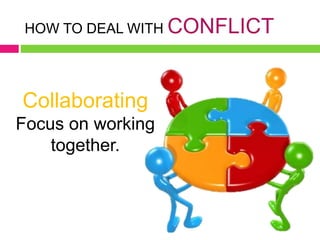
Collaborating
Focus on working
together.
HOW TO DEAL WITH CONFLICT
Know what you don't like about
yourself, early on in your career. We often
don't like in others what we don't want to see
in ourselves.
HOW TO DEAL WITH CONFLICT
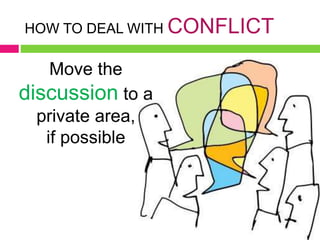
Move the
discussion to a
private area,
if possible
HOW TO DEAL WITH CONFLICT
Give the other
person time to vent
Don't interrupt them or
judge what they are
saying.
HOW TO DEAL WITH CONFLICT
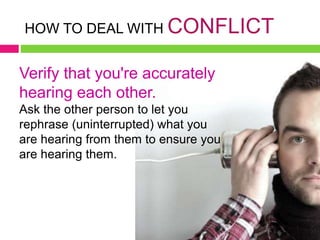
Verify that you're accurately
hearing each other.
Ask the other person to let you
rephrase (uninterrupted) what you
are hearing from them to ensure you
are hearing them.
HOW TO DEAL WITH CONFLICT
Work the issue, not the
person. When they are
convinced that you understand
them:
a. Ask "What can we do fix the
problem?" They will likely begin to
complain again.
Then ask the same question.
Focus on actions they can do, too.
FOUR KEY CONFLICT RESOLUTION
SKILLS
Since relationship conflicts is inevitable, learning
to deal with them in a healthy way is crucial.
When conflict is mismanaged, it can harm the
relationship. But when handled in a respectful and
positive way, conflict provides an opportunity for
growth.
FOUR KEY CONFLICT RESOLUTION
SKILLS
1. Quickly relieve stress
• the capacity to remain relaxed and
focused in tense situations.
• the best way to rapidly and reliably
relieve stress is through the senses:
sight, sound, touch, taste, and smell.
FOUR KEY CONFLICT RESOLUTION
SKILLS
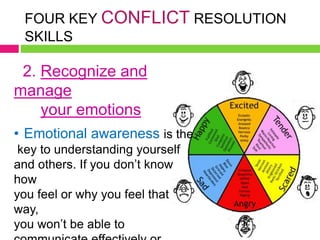
2. Recognize and
manage
your emotions
• Emotional awareness is the
key to understanding yourself
and others. If you don’t know
how
you feel or why you feel that
way,
you won’t be able to
FOUR KEY CONFLICT RESOLUTION
SKILLS
FOUR KEY CONFLICT RESOLUTION
SKILLS
3. Improve your
nonverbal
communication skills
• The most important
information exchanged during
conflicts and arguments is
often communicated
nonverbally.
• Nonverbal communication
includes eye contact, facial
expression, tone of voice,
FOUR KEY CONFLICT RESOLUTION
SKILLS
4. Use humor and play to deal with
challenges
• You can avoid many confrontations and resolve
arguments and disagreements by communicating in a
playful or humorous way.
• Humor can help you say things that might be difficult to
express
• It is important that you laugh with the
other person, not at them
Ground Rules
1. Remain calm
2. Express feelings in words, not actions
3. Be specific about what is bothering you
4. Deal with only one issue at a time
5. No “hitting below the belt”
6. Avoid accusations
7. Don’t generalize
8. Avoid “make believe”
9. Don’t stockpile
10. Avoid clamming up
Try not to overreact to difficult
situations.Tell someone directly & honestly what you
feelVague complaints are hard to work
onDon’t introduce other topics until each is fully
discussedAttacking areas of personal activity creates an
atmosphere of distrust, anger, & vulnerabilityTalk about how someone’s action made
you feelAvoid words like “never” or
“always”Don’t exaggerate or invent complaint. Stick w/ the
facts & your honest feelingsTry to deal with problems as they
arisePositive results can only be attained with two-way
Maintaining a proactive life

Maintaining a proactive life

  • 1.
    B Y :M S . V E A - T R I S H S A N T O S
  • 2.
    Being PROACTIVE • Initiatechange rather than reacting to events • Planning ahead and anticipating problems • Can help eliminate problems before they appear
  • 3.
    How to livea PROACTIVE LIFE? Using your PERSONAL POWER
  • 4.
    How to livea PROACTIVE LIFE? Being proactive means taking conscious control over your life, setting goals and working to achieve them. Instead of reacting to events and waiting for opportunities, you go out and create your own events and opportunities.
  • 5.
    How to livea PROACTIVE LIFE? Being proactive means that instead of merely reacting to events as they happen, you consciously engineer your own events.
  • 6.
    IS THE OPPOSITE OF BEINGPROACTIVE Being REACTIVE
  • 7.
    Being REACTIVE IT MEANSBEING OUT OF TOUCH WITH THEIR CORE VALUES
  • 8.
    Being REACTIVE When youare reactive, you can explode any minute. Things happen and they “catch you off guard”. You aren’t ready for things that might happen, you deal with things when they happen instead of being prepared.
  • 9.
  • 10.
  • 11.
  • 12.
    BENEFITS OF APOSITIVE ATTITUDE SUPERIOR HEALTH
  • 13.
    BENEFITS OF APOSITIVE ATTITUDE GREATER ACHIEVEMENT
  • 14.
    BENEFITS OF APOSITIVE ATTITUDE PERSISTEN CE
  • 15.
    BENEFITS OF APOSITIVE ATTITUDE EMOTIONAL HEALTH
  • 16.
    BENEFITS OF APOSITIVE ATTITUDE INCREASED LONGEVITY
  • 17.
    BENEFITS OF APOSITIVE ATTITUDE LESS STRESS
  • 19.
    CONFLICT • Arises fromdifferences. It occurs when people disagree over their values, motivations, perceptions, ideas, or desires. • It is a common phenomenon in the workplace.
  • 20.
    CONFLICT MANAGEMENT • Involvesdoing things to limit the negative aspects of conflict and to increase the positive aspects of conflict. • Aims to enhance learning and group outcomes • Variety of ways by which people handle grievances
  • 21.
    HOW TO DEALWITH CONFLICT Avoid it Pretend it is not there or ignore it.
  • 22.
    HOW TO DEALWITH CONFLICT Accommodate it Give in to others, sometimes to the extent that you compromise
  • 23.
    HOW TO DEALWITH CONFLICT Collaborating Focus on working together.
  • 24.
    HOW TO DEALWITH CONFLICT Know what you don't like about yourself, early on in your career. We often don't like in others what we don't want to see in ourselves.
  • 25.
    HOW TO DEALWITH CONFLICT Move the discussion to a private area, if possible
  • 26.
    HOW TO DEALWITH CONFLICT Give the other person time to vent Don't interrupt them or judge what they are saying.
  • 27.
    HOW TO DEALWITH CONFLICT Verify that you're accurately hearing each other. Ask the other person to let you rephrase (uninterrupted) what you are hearing from them to ensure you are hearing them.
  • 28.
    HOW TO DEALWITH CONFLICT Work the issue, not the person. When they are convinced that you understand them: a. Ask "What can we do fix the problem?" They will likely begin to complain again. Then ask the same question. Focus on actions they can do, too.
  • 29.
    FOUR KEY CONFLICTRESOLUTION SKILLS Since relationship conflicts is inevitable, learning to deal with them in a healthy way is crucial. When conflict is mismanaged, it can harm the relationship. But when handled in a respectful and positive way, conflict provides an opportunity for growth.
  • 30.
    FOUR KEY CONFLICTRESOLUTION SKILLS 1. Quickly relieve stress • the capacity to remain relaxed and focused in tense situations. • the best way to rapidly and reliably relieve stress is through the senses: sight, sound, touch, taste, and smell.
  • 31.
    FOUR KEY CONFLICTRESOLUTION SKILLS 2. Recognize and manage your emotions • Emotional awareness is the key to understanding yourself and others. If you don’t know how you feel or why you feel that way, you won’t be able to
  • 32.
    FOUR KEY CONFLICTRESOLUTION SKILLS
  • 33.
    FOUR KEY CONFLICTRESOLUTION SKILLS 3. Improve your nonverbal communication skills • The most important information exchanged during conflicts and arguments is often communicated nonverbally. • Nonverbal communication includes eye contact, facial expression, tone of voice,
  • 34.
    FOUR KEY CONFLICTRESOLUTION SKILLS 4. Use humor and play to deal with challenges • You can avoid many confrontations and resolve arguments and disagreements by communicating in a playful or humorous way. • Humor can help you say things that might be difficult to express • It is important that you laugh with the other person, not at them
  • 35.
    Ground Rules 1. Remaincalm 2. Express feelings in words, not actions 3. Be specific about what is bothering you 4. Deal with only one issue at a time 5. No “hitting below the belt” 6. Avoid accusations 7. Don’t generalize 8. Avoid “make believe” 9. Don’t stockpile 10. Avoid clamming up Try not to overreact to difficult situations.Tell someone directly & honestly what you feelVague complaints are hard to work onDon’t introduce other topics until each is fully discussedAttacking areas of personal activity creates an atmosphere of distrust, anger, & vulnerabilityTalk about how someone’s action made you feelAvoid words like “never” or “always”Don’t exaggerate or invent complaint. Stick w/ the facts & your honest feelingsTry to deal with problems as they arisePositive results can only be attained with two-way

Editor's Notes

  • #2 If you are proactive, you make things happen, instead of waiting for them to happen to you. Active means "doing something." The prefix pro- means "before." So if you are proactive, you are ready before something happens. The opposite is being reactive, or waiting for things to unfold before responding.
  • #3 To initiate means to start something ; to cause the beginning. A reaction is never a beginning. It is always a second action. We react to things because we let the ability of the situation or a person to dictate us. We let them dictate our behavior or our attitude.
  • #4 We all have Special powers and special abilities.. Timing is everything because….
  • #5 Again the KEYWORD is “TIMING IS EVERYTHING”… you create your own events and opportunities, YOU CONTROL YOUR OWN LIFE, you DO NOT LET THE SITUATION or OTHER PEOPLE to control you..
  • #6 One of my favorite qualities of leaders is how leaders choose their response. When we choose not to react the way others might normally react, we exercise a little leadership. It takes courage and reserve and planning to choose actions when we might otherwise simply react. But every time we make a conscious choice, we exercise leadership.
  • #8 Our core values is to know what is right from wrong.. SOMETIMES reactions are necessary for safety and peace (automatic defense mechanism of self). BUT being reactive often use as an excuse to abandon the work of being our best self and leading with character.
  • #15 NEVER GIVE UP!