CONTINUOUS FEEDBACK
WORKSHOP
Facilitator notes
Jorge Baldeón
Note: I don’t run
this workshop
using slides. I
suggest using
flipcharts instead.
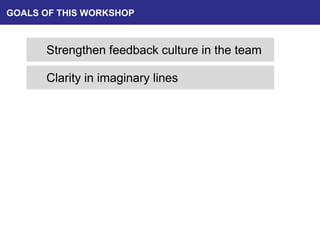
GOALS OF THIS WORKSHOP
Strengthen feedback culture in the team
Clarity in imaginary lines
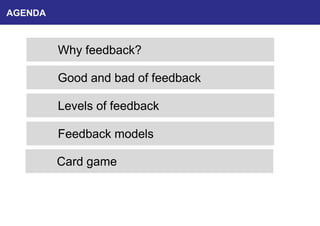
AGENDA
Why feedback?
Good and bad of feedback
Levels of feedback
Feedback models
Card game
CHECK-IN
What am I
feeling?
What could prevent
you from being fully
present?
In groups of max 6
ONE MINUTE EACH
QUESTION
When was the last time you got feedback?
QUESTION
Raise your hand if you as a person are interested
In growing professionally
QUESTION
What prevents us from giving feedback?
Discuss in pairs why and what you are interested in
3 MINUTES
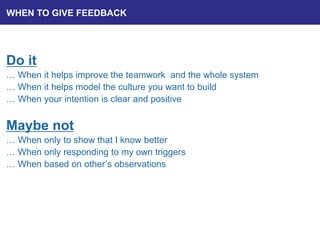
Do it
… When it helps improve the teamwork and the whole system
… When it helps model the culture you want to build
… When your intention is clear and positive
Maybe not
… When only to show that I know better
… When only responding to my own triggers
… When based on other’s observations
WHEN TO GIVE FEEDBACK
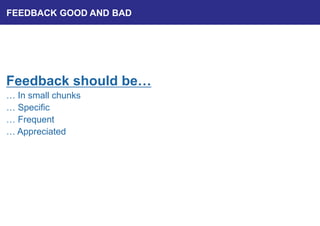
Feedback should be…
… In small chunks
… Specific
… Frequent
… Appreciated
FEEDBACK GOOD AND BAD
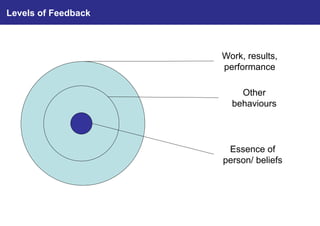
Essence of
person/ beliefs
Levels of Feedback
Work, results,
performance
Other
behaviours
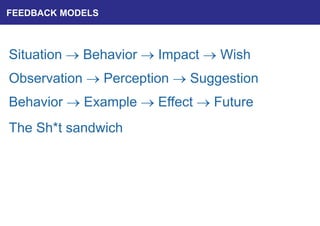
Situation  Behavior  Impact  Wish
FEEDBACK MODELS
Observation  Perception  Suggestion
Behavior  Example  Effect  Future
The Sh*t sandwich
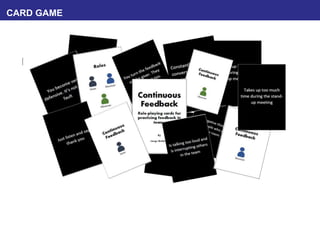
CARD GAME
CARD GAME
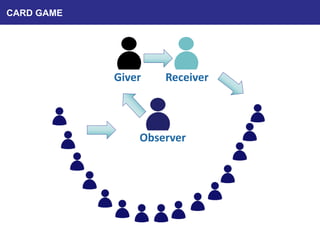
Giver Receiver
Observer
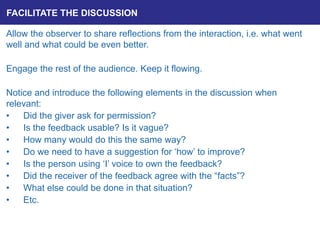
FACILITATE THE DISCUSSION
Allow the observer to share reflections from the interaction, i.e. what went
well and what could be even better.
Engage the rest of the audience. Keep it flowing.
Notice and introduce the following elements in the discussion when
relevant:
• Did the giver ask for permission?
• Is the feedback usable? Is it vague?
• How many would do this the same way?
• Do we need to have a suggestion for ‘how’ to improve?
• Is the person using ‘I’ voice to own the feedback?
• Did the receiver of the feedback agree with the “facts”?
• What else could be done in that situation?
• Etc.
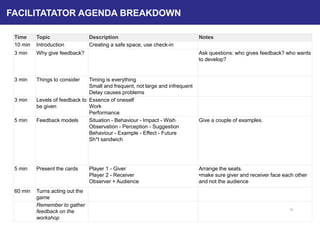
Time Topic Description Notes
10 min Introduction Creating a safe space, use check-in
3 min Why give feedback? Ask questions: who gives feedback? who wants
to develop?
3 min Things to consider Timing is everything
Small and frequent, not large and infrequent
Delay causes problems
3 min Levels of feedback to
be given
Essence of oneself
Work
Performance
5 min Feedback models Situation - Behaviour - Impact - Wish
Observation - Perception - Suggestion
Behaviour - Example - Effect - Future
Sh*t sandwich
Give a couple of examples.
5 min Present the cards Player 1 - Giver
Player 2 - Receiver
Observer + Audience
Arrange the seats.
•make sure giver and receiver face each other
and not the audience
60 min Turns acting out the
game
Remember to gather
feedback on the
workshop
15
FACILITATATOR AGENDA BREAKDOWN

Continous feedback workshop

  • 1.
    CONTINUOUS FEEDBACK WORKSHOP Facilitator notes JorgeBaldeón Note: I don’t run this workshop using slides. I suggest using flipcharts instead.
  • 2.
    GOALS OF THISWORKSHOP Strengthen feedback culture in the team Clarity in imaginary lines
  • 3.
    AGENDA Why feedback? Good andbad of feedback Levels of feedback Feedback models Card game
  • 4.
    CHECK-IN What am I feeling? Whatcould prevent you from being fully present? In groups of max 6 ONE MINUTE EACH
  • 5.
    QUESTION When was thelast time you got feedback?
  • 6.
    QUESTION Raise your handif you as a person are interested In growing professionally
  • 7.
    QUESTION What prevents usfrom giving feedback? Discuss in pairs why and what you are interested in 3 MINUTES
  • 8.
    Do it … Whenit helps improve the teamwork and the whole system … When it helps model the culture you want to build … When your intention is clear and positive Maybe not … When only to show that I know better … When only responding to my own triggers … When based on other’s observations WHEN TO GIVE FEEDBACK
  • 9.
    Feedback should be… …In small chunks … Specific … Frequent … Appreciated FEEDBACK GOOD AND BAD
  • 10.
    Essence of person/ beliefs Levelsof Feedback Work, results, performance Other behaviours
  • 11.
    Situation  Behavior Impact  Wish FEEDBACK MODELS Observation  Perception  Suggestion Behavior  Example  Effect  Future The Sh*t sandwich
  • 12.
  • 13.
  • 14.
    FACILITATE THE DISCUSSION Allowthe observer to share reflections from the interaction, i.e. what went well and what could be even better. Engage the rest of the audience. Keep it flowing. Notice and introduce the following elements in the discussion when relevant: • Did the giver ask for permission? • Is the feedback usable? Is it vague? • How many would do this the same way? • Do we need to have a suggestion for ‘how’ to improve? • Is the person using ‘I’ voice to own the feedback? • Did the receiver of the feedback agree with the “facts”? • What else could be done in that situation? • Etc.
  • 15.
    Time Topic DescriptionNotes 10 min Introduction Creating a safe space, use check-in 3 min Why give feedback? Ask questions: who gives feedback? who wants to develop? 3 min Things to consider Timing is everything Small and frequent, not large and infrequent Delay causes problems 3 min Levels of feedback to be given Essence of oneself Work Performance 5 min Feedback models Situation - Behaviour - Impact - Wish Observation - Perception - Suggestion Behaviour - Example - Effect - Future Sh*t sandwich Give a couple of examples. 5 min Present the cards Player 1 - Giver Player 2 - Receiver Observer + Audience Arrange the seats. •make sure giver and receiver face each other and not the audience 60 min Turns acting out the game Remember to gather feedback on the workshop 15 FACILITATATOR AGENDA BREAKDOWN

Editor's Notes

  • #3 We will focus on the difficult feedback. The positive reinforcing feedback is most of the time easier that telling somebody something that should be improved.
  • #5 The quality of our conversations depend on our internal state. A check-in ensures we bring our heart, attention and connection. This makes us more focused, encourages team bonding and improves outcomes.
  • #6 You can do: stand on a line. Raise your hand if you have received feedback within the last 6 months and run downwards to 2 months, 1 month, 2 weeks, 1 week. The point is that we don’t get it as often.
  • #7 If we are all interested in growing professionally and we know feedback will help us, then why is there a split?
  • #8 If we are all interested in growing professionally and we know feedback will help us, then why is there a split? Get some shares.
  • #11 Draw this and talk about it. With this idea, we try to clarify that there is a line where we don’t cross. But sometimes identifying that line can be tricky. Especially because that line is different in different groups of people.
  • #12 Don’t present too many models. Get over this first section quickly.